REVIEW 3 major objections 5 minor 1 cited by
Wavefunction-based operator optimization for two-hadron systems in lattice QCD
T0 review · 3 major / 5 minor · reviewed 2026-08-06 · deepseek-v4-flash
Pith's one-line read Two-hadron states only 5 MeV apart can be cleanly disentangled in lattice QCD by building interpolating operators from the system's spatial wavefunctions.
desk verdict A genuinely useful lattice technique with a clever Z3-noise implementation, but the proof-of-principle's 5 MeV claim is softer than it appears because the gap is below the sensitivity of the diagnostics and the comparison energies are not independent. read the letter →
The pith
A machine-rendered reading of the paper's core claim, the machinery that carries it, and where it could break.
The reading
What carries the argument
The load-bearing construction is the optimized two-hadron operator $O_n(t) = V^{-2}\sum_{\vec x,\vec r} B(\vec x+\vec r,t)B(\vec x,t)\Psi_n^*(\vec r)$, with dual functions $\Psi_n$ obtained from the inverse of the NBS-amplitude overlap matrix. In practice the paper takes $\Psi_n$ to be the finite-box eigenfunctions of the leading-order potential extracted by the time-dependent HAL QCD equation, so the wavefunction itself becomes the operator weight. At the source, the weight is implemented by a $Z_3$-noise smearing $F_n(\vec r)=\frac{1}{V_{\rm sub}^{1/3}}\sum_{\vec r_0} Z_3(\vec r_0)\Psi_n^{1/3}(\vec r_0)f(\vec r-\vec r_0)$, whose triple-product identity removes cross terms and lets the $\Psi_n$-weighted baryon pair be realized without all-to-all propagators.
What would settle it
Compute the same optimized operators for a two-hadron channel where the next-to-leading-order potential correction is known to be large, and test whether the one-pass correlation functions still have time-stable spatial profiles and whether their plateaus reproduce the finite-volume eigenvalues; a mismatch would show the leading-order-eigenfunction approximation is the point that fails.
Extended reading notes
Core claim
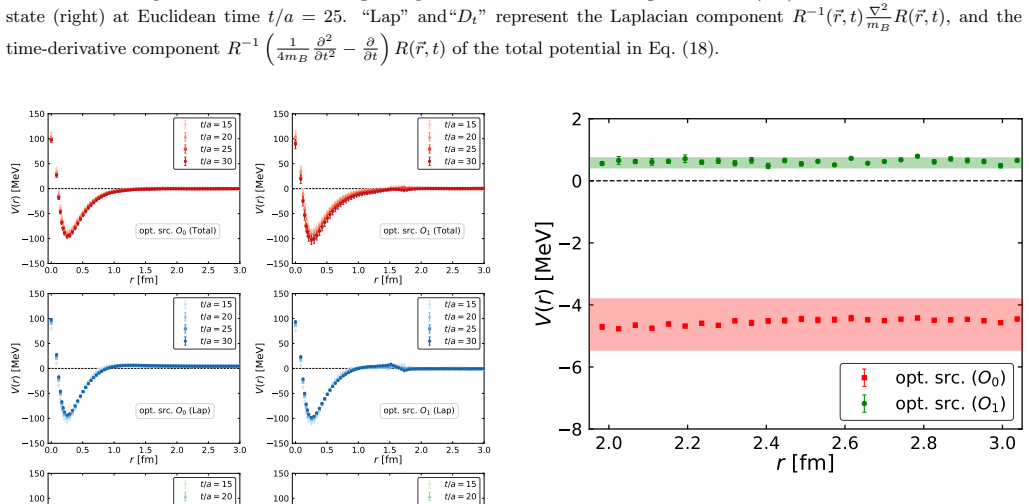
The central discovery is that the spatial profile of a two-hadron state, the Nambu-Bethe-Salpeter amplitude, can be used as the weight of an interpolating operator, and that this dramatically improves state isolation. The authors prove the concept by taking the eigenfunctions of the leading-order HAL QCD potential on a finite box as approximate NBS amplitudes, constructing dual functions $\Psi_n$ satisfying $\langle\Psi_n|\psi_m\rangle=\delta_{nm}$, and using them to define operators $O_n(t)$. With these operators, the correlation functions $R_n(\vec r,t)$ have spatial profiles that are essentially constant from $t/a=15$ to $30$, and the effective energies from $R_n(t)$ show plateaus consistent with the finite-volume eigenvalues $\varepsilon_0=-4.6(4)$ MeV and $\varepsilon_1=0.6(1)$ MeV. This disentangles the two states even though they lie within $\sim5$ MeV of each other near 9700 MeV, something the compact and wall sources fail to do.
Load-bearing premise
The method assumes that the wavefunctions obtained by diagonalizing the leading-order potential extracted from the initial wall-source measurement are close to the true two-hadron wavefunctions, so that a single construction step yields operators dominated by the target states.
Editorial extensions
If this is right
- Optimized operators produce correlation functions whose spatial profiles are stable from $t/a=15$ to $30$, so effective energies can be read from plateaus instead of from early-time fits dominated by excited-state contamination.
- The same construction resolves the ground and first excited $\Omega_{ccc}\Omega_{ccc}$ states about 5 MeV apart near 9700 MeV, with energies consistent with the finite-volume eigenvalues from the potential.
- Using an optimized operator only at the sink still extracts the correct ground and excited energies from wall or compact sources, so the method works as a state filter even when the source is unoptimized.
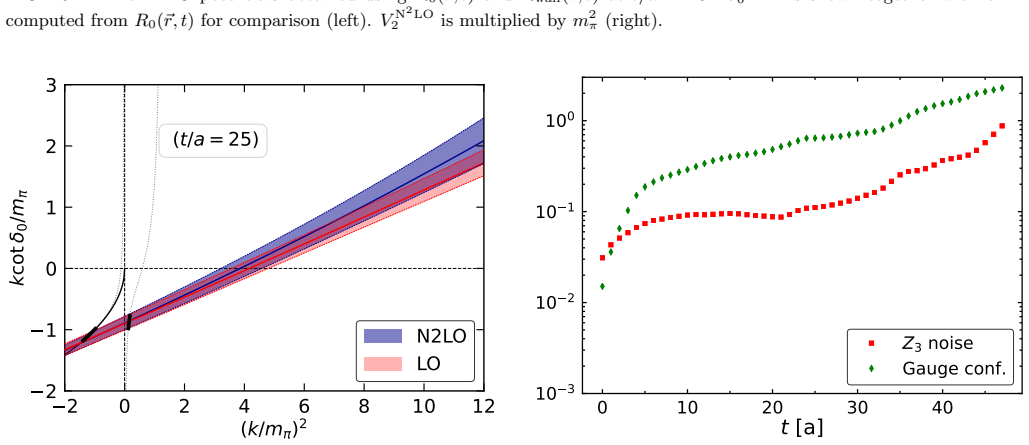
- Potentials extracted from the optimized sources are nearly time-independent, and the phase shifts they produce agree with those converted from the finite-volume spectrum.
- Because the wavefunction input can come from the HAL QCD potential or from any model or effective-field-theory wavefunction, the construction generalizes to other two-hadron systems and to higher partial waves.
Reading between the lines
- A testable extension is to compare the leading-order-potential eigenfunctions with the true NBS amplitudes obtained from a large variational analysis in the same volume; strong disagreement would identify systems that need multiple iterations before the operators are trustworthy.
- The near-orthogonality observed in this system hints that one-step construction may suffice for tightly bound heavy dibaryons, while loosely bound or resonant channels will be the stress test for the iterative loop.
- The $Z_3$-noise smearing factors the inter-hadron wavefunction into independent quark smearings, so it can likely be combined with distillation-like single-hadron operators to reach moving frames or higher partial waves without all-to-all propagators.
- The same state-filtering property should make optimized operators useful for computing matrix elements of currents between specific two-hadron states, since controlling the initial state is usually the main obstacle.
Editorial analysis
A structured set of objections, weighed in public.
Referee Report
Summary. The manuscript develops a method for constructing optimized two-hadron interpolating operators by incorporating inter-hadron spatial wavefunctions, which are obtained from eigenfunctions of the HAL QCD potential. The implementation uses a new Z3-noise-based quark smearing technique that encodes the wavefunction at the source without all-to-all propagators. The method is demonstrated on the Omega_ccc Omega_ccc system in the 1S0 channel using physical-point, 96^4 lattices with La ~ 8.1 fm. The authors report stable spatial profiles of optimized-source correlation functions and effective-energy plateaux that identify the ground and first excited states around 2m_Omega_ccc ~ 9700 MeV with an energy gap near 5 MeV, and they compare potentials and phase shifts with those obtained from wall and compact sources.
Significance. If the central claim is sustained, the paper offers a practical and possibly general strategy for two-hadron spectroscopy and matrix elements in dense-spectrum systems, and the Z3-noise smearing construction is itself a useful technical contribution. The paper contains several strong cross-checks: the LO potential is nearly independent of the source operator, the Laplacian term of the optimized correlators matches the finite-volume momentum in the asymptotic region (Fig. 16), the phase shifts from the optimized potential agree with the finite-volume conversion (Fig. 18), and the N2LO corrections are small (Fig. 20). The manuscript is also explicit about the assumption that the NBS amplitudes are nearly orthogonal, which is the condition for one-step convergence. However, the headline validation has a circular component: the optimized operators and the reference energies both come from the same HAL potential, and the stability diagnostics are not sensitive to the small-gap failure mode they are meant to rule out.
major comments (3)
- [§VI A 3, §VI B 1, Fig. 12] The validation of the central disentangling claim is partly circular. The optimized operators O0 and O1 are constructed from eigenfunctions of the LO potential V_LO obtained from the wall source (Sec. III B step (ii); Sec. VI A 3), and the reference energies epsilon_0 and epsilon_1 in Eqs. (41)-(42) are the eigenvalues of that same potential. The agreement of the plateaux in Fig. 12 with epsilon_0,1 therefore compares the operators with the input from which they were built. The Lüscher cross-check in Fig. 18 converts the same epsilon_0,1 into phase shifts, so it does not provide an independent energy determination. Please provide an energy extraction from an operator basis not derived from the HAL eigenfunctions, or give a direct quantitative bound on the excited-state contamination in R0(t) and R1(t).
- [§VI B 1, Eq. (44), Fig. 12] The stability diagnostics are insensitive to the specific failure mode they are intended to exclude. With epsilon_0 = -4.6(4) MeV and epsilon_1 = 0.6(1) MeV the gap is about 5 MeV; over the scan range t/a = 15-30 with a = 0.0844 fm one has Delta_E * t about 0.03-0.07. Under a two-state mixture the normalized profile R(r,t)/R(r,t_f) changes by only a few percent over this range, so the small residue factor L[R(r,t)] in Eq. (44) and the plateaux in Fig. 12 are consistent with a mixture of the two nearby levels rather than with isolation of either. Please provide a quantitative bound on the contamination amplitude, for example from a two-state fit to R0(t) and R1(t), or demonstrate insensitivity by extending t or by testing a system with a larger gap.
- [Abstract, §VI] The abstract states that the optimized operators outperform combinations of limited plane-wave operators in the variational analysis, but no such variational/GEVP comparison is actually presented. Section VI compares wall and compact sources with optimized sinks (Fig. 13) and optimized sources (Fig. 10), but it does not solve a GEVP in a plane-wave basis and compare the resulting energies with those from O0 and O1. Please either include that comparison or revise the claim to the form that is demonstrated in the paper.
minor comments (5)
- [§II, Fig. 12] The effective energy in Eq. (9) is defined by a ratio of Rn(t+1) and Rn(t), but the text does not explicitly state that t is in lattice units; please make the units explicit where the plateaux are discussed.
- [Abstract, §II] There are small language issues: 'enables clear identification' should be 'enable clear identification', and 'being lack of accurate Psi_n(r)' should be 'lacking accurate Psi_n(r)'.
- [Fig. 16] The vertical axis label in Fig. 16 omits units; please specify that V(r) and p^2/m_B are in MeV.
- [References] Reference [47] (Misner) has a formatting error, with 'journal =' appearing inside the citation; please correct the entry.
- [§VI B 1, Figs. 8-9] The units of the dual functions in Figs. 8 and 9 are given in fm^{-3/2}, while the normalization in Eq. (43) is a dimensionless sum over lattice points; please clarify the conversion to physical units.
Circularity Check
No significant circularity: the optimized-operator energies are extracted from lattice QCD correlation functions and are only compared with, not derived from, the HAL QCD potential eigenvalues.
full rationale
The paper's central chain is not circular by construction. The optimized operators O_n in Eq. (6) are built from dual functions obtained from eigenfunctions of the LO HAL QCD potential V_LO in Eq. (18), which itself is extracted from the wall-source correlation function. The correlation functions R_n(r,t) in Eq. (7) and R_n(t) in Eq. (8) are then computed as actual QCD four-point functions with these operators as sources and sinks. Their Euclidean time dependence is determined by the QCD Hamiltonian, not by the Schrödinger eigenvalue problem in Eq. (24). If the eigenfunctions of V_LO were poor approximations to the true NBS amplitudes, the projected correlators would retain admixtures of other states and the effective energies in Eq. (9) would not exhibit plateaus agreeing with the potential eigenvalues. The agreement in Fig. 12 between the measured effective energies and epsilon_0, epsilon_1 from Eqs. (41)-(42) is therefore a nontrivial consistency check, not an identity. Similarly, the residue-factor stability test in Eq. (44) and Fig. 11 uses only the measured R(r,t) profiles. The phase-shift comparison in Fig. 18 converts the measured finite-volume energies (not the potential eigenvalues alone) via the finite-volume formula and compares them with phase shifts from the potential; this is a self-consistency check of the HAL QCD framework rather than an external validation, but it is not a circular derivation. The self-citations to Refs. [22,35] for using HAL QCD eigenfunctions as initial NBS-amplitude approximations are methodological antecedents, and the HAL QCD potential framework itself is an established external formalism. The reader's concern that the 5 MeV gap makes the plateau and residue diagnostics insensitive to a small admixture of the nearby state is a legitimate statistical/correctness risk, not a circularity: it concerns whether the consistency check has enough resolving power, not whether the output is equal to the input by construction. No equation in the paper reduces to its own input; no fitted parameter is renamed as a prediction; and no load-bearing conclusion relies solely on a self-citation chain. Hence the circularity score is 0.
Assumptions & free parameters
free parameters (4)
- exponential smearing parameter B =
0.475 a^-1
- compact sink radius rB =
4 a
- sub-lattice spacing l =
8 a
- three-range Gaussian fit parameters a_i, b_i =
not quoted
assumptions (4)
- domain assumption Existence of an energy-independent nonlocal HAL QCD potential U(r,r') with derivative expansion to LO/N2LO.
- domain assumption Eigenfunctions of the finite-box LO potential approximate the true NBS amplitudes psi_n(r).
- standard math Z3 noise vectors satisfy the triple-product identity Eq (29) so that cross-support terms vanish on average.
- domain assumption The sublattice sum approximates the full-lattice sum at sufficiently large Euclidean time t >> m_B l^2/(4 pi^2).
Cite this review
Pith. "Pith review of Wavefunction-based operator optimization for two-hadron systems in lattice QCD." pith.science (2026). https://pith.science/paper/NKENWQHR
@misc{pith2026250709933,
  author       = {Pith},
  title        = {Pith review of: Wavefunction-based operator optimization for two-hadron systems in lattice QCD},
  year         = {2026},
  howpublished = {\url{https://pith.science/paper/NKENWQHR}},
  note         = {Machine review of arXiv:2507.09933}
}
abstract
A systematic way to constructing optimized interpolating operators for two-hadron systems is developed by incorporating inter-hadron spatial wavefunctions. The wavefunctions can be obtained from an iterative process with an appropriate initial guess. To implement these operators, a novel quark smearing technique utilizing $Z_3$ noise vectors is proposed, which allows for effectively incorporating inter-hadron spatial wavefunctions at the source without using all-to-all quark propagators. Proof-of-principle application to the $\Omega_{ccc}\Omega_{ccc}$ system using physical-point lattice configurations with a large size $La\simeq8.1$~fm demonstrates that optimized operators outperform combinations of limited plane-wave operators in the variational analysis, enabling clear identification of states around $2m_{\Omega_{ccc}}\simeq 9700$ MeV with the energy gap as narrow as $\sim 5$ MeV. A comparison on correlation functions, effective energies, and HAL QCD potentials between unoptimized operators and optimized operators is given, with a special emphasis on the effects from nearby elastic scattering states. Potential applicability of the optimized operator to various two-hadron systems and its relation to the variational method are also discussed.
Figures


Figures from the paper (16 more)







Forward citations
Cited by 1 Pith paper
-
Recent progress on charmed hadron interactions from lattice QCD
A review of lattice QCD results on charmed hadron interactions: T_cc near threshold, an attractive N-J/psi force, and an Omega_ccc-Omega_ccc state near unitarity.
Reference graph
Works this paper leans on
-
[1]
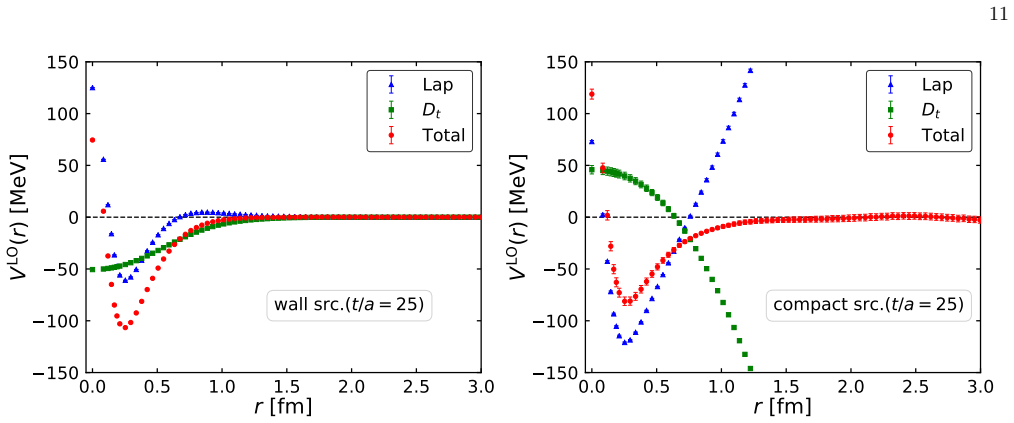
Hadronic correlation functions We first examine the spatial profile of the hadronic cor- relation functions R(⃗ r, t) defined in Eq. (16). Shown in Fig. 4 are R(⃗ r, t) with the normalization P ⃗ r∈Λ R2(⃗ r, t) = 1 at Euclidean time t/a = 15, 20, 25, and 30 calculated us- ing the wall source and the compact source, respectively. The spatial profiles exhib...
-
[2]
Lap”), and its time- derivative term R−1 1 4mB ∂2 ∂t2 − ∂ ∂t R(⃗ r, t) (denoted by “Dt
Potentials from the time-dependent HAL QCD method To overcome the issue of elastic contamination dis- cussed above, let us perform the time-dependent HAL QCD analysis in this subsection. Using the R(⃗ r, t) shown in Fig. 4, we extract the LO potentials using Eq. (18). Shown in Fig. 6 is a comparison of the LO potential calculated using the wall source and...
-
[3]
Eigen functions on a finite box Using the LO potential V LO calculated with the wall source, we solve the eigen equation in Eq. (24) on the a three dimensional discrete finite box under periodic boundary condition with a and L being same as our lat- tice setup. The obtained eigen energies defined in Eq. (25) for the ground state and the first excited stat...
-
[4]
Hadronic correlation functions Using the dual functions in Fig. 8, we construct opti- mized two-baryon operators defined in Eq. (6) and use them as source operators according to Sec. IV A to com- pute hadronic correlation functions given in Eq. (7). 5 These eigen functions are orthogonal to each other, as they are eigen modes with different eigen values o...
-
[5]
Potentials from the time-dependent HAL QCD method Let us now perform the time-dependent HAL QCD analysis using the R0,1(⃗ r, t) in Fig. 10. In Fig. 14, we show the LO potentials extracted at Euclidean time t/a = 25 by using Eq. (18). The total potentials in both cases are dominated by the Laplacian terms, with small contributions from the Dt terms, which ...
-
[6]
Results from LO potentials Shown in Fig. 17 is a comparison of the local poten- tials extracted from R0(⃗ r, t), R1(⃗ r, t) and those calcu- lated using the wall and compact sources at Euclidean time t/a = 25. These potentials show almost identical behaviors except only a slight deviation at short distances for the compact source from others. To determine...
-
[7]
Results from N 2LO potentials To see the effect of high-order terms in the derivative expansion to the potential, we derive the N 2LO poten- tials according to Sec. III A by using two hadronic cor- relation functions R0(⃗ r, t) and Rwall(⃗ r, t). This is be- cause the former is dominated by the ground state, while the latter includes scattering states mod...
-
[8]
⟨· · · ⟩F means the Wick contraction, namely permuta- tions among quarks with the same flavor
Two hadrons are located at y and w at source. ⟨· · · ⟩F means the Wick contraction, namely permuta- tions among quarks with the same flavor. Here, we have 6 Q quarks ( Q denotes for heavy quark, which is the charm quark in our current context), meaning the num- ber of permutation is 6! = 720. The coefficient tensor F is defined as, Fi′α′j′β′[ξ′ 1 · · ·ξ′ ...
Show all 58 references
-
[9]
Aoki et al
Y. Aoki et al. (Flavour Lattice Averaging Group (FLAG)), FLAG Review 2024, (2024), arXiv:2411.04268 [hep-lat]
2024 arXiv
-
[10]
Gusken, U
S. Gusken, U. Low, K. H. Mutter, R. Sommer, A. Patel, and K. Schilling, Nonsinglet Axial Vector Couplings of the Baryon Octet in Lattice QCD, Phys. Lett. B 227, 266 (1989)
1989
-
[11]
Peardon, J
M. Peardon, J. Bulava, J. Foley, C. Morningstar, J. Dudek, R. G. Edwards, B. Joo, H.-W. Lin, D. G. Richards, and K. J. Juge (Hadron Spectrum), A Novel quark-field creation operator construction for hadronic physics in lattice QCD, Phys. Rev. D 80, 054506 (2009), arXiv:0905.216...
2009 arXiv
-
[12]
Morningstar, J
C. Morningstar, J. Bulava, J. Foley, K. J. Juge, D. Lenkner, M. Peardon, and C. H. Wong, Improved stochastic estimation of quark propagation with Lapla- cian Heaviside smearing in lattice QCD, Phys. Rev. D 83, 114505 (2011), arXiv:1104.3870 [hep-lat]
2011 arXiv
-
[13]
G. S. Bali, B. Lang, B. U. Musch, and A. Sch¨ afer, Novel quark smearing for hadrons with high momenta in lattice QCD, Phys. Rev. D 93, 094515 (2016), arXiv:1602.05525 [hep-lat]
2016 arXiv
-
[14]
Morningstar, J
C. Morningstar, J. Bulava, B. Fahy, J. Foley, Y. C. Jhang, K. J. Juge, D. Lenkner, and C. H. Wong, Extended hadron and two-hadron operators of definite momentum for spectrum calculations in lattice QCD, Phys. Rev. D 88, 014511 (2013), arXiv:1303.6816 [hep-lat]
2013 arXiv
-
[15]
Aoki et al
Y. Aoki et al. (Flavour Lattice Averaging Group (FLAG)), FLAG Review 2021, Eur. Phys. J. C 82, 869 (2022), arXiv:2111.09849 [hep-lat]
2022 arXiv
-
[16]
Aoki et al
S. Aoki et al. (PACS-CS), 2+1 Flavor Lattice QCD to- ward the Physical Point, Phys. Rev. D79, 034503 (2009), arXiv:0807.1661 [hep-lat]
2009 arXiv
-
[17]
Fodor and C
Z. Fodor and C. Hoelbling, Light Hadron Masses from Lattice QCD, Rev. Mod. Phys. 84, 449 (2012), arXiv:1203.4789 [hep-lat]
2012 arXiv
-
[18]
Aoyama, T
T. Aoyama, T. M. Doi, T. Doi, E. Itou, Y. Lyu, K. Mu- rakami, and T. Sugiura (HAL QCD), Scale setting and hadronic properties in the light quark sector with (2+1)- flavor Wilson fermions at the physical point, Phys. Rev. D 110, 094502 (2024), arXiv:2406.16665 [hep-lat]
2024
-
[19]
Parisi, The Strategy for Computing the Hadronic Mass Spectrum, Phys
G. Parisi, The Strategy for Computing the Hadronic Mass Spectrum, Phys. Rept. 103, 203 (1984)
1984
-
[20]
G. P. Lepage, From actions to answers: Proceedings of the tasi 1989 (World Scientific, Singapore, 1990)
1989
-
[21]
Yamazaki, K.-i
T. Yamazaki, K.-i. Ishikawa, Y. Kuramashi, and A. Ukawa, Helium nuclei, deuteron and dineutron in 2+1 flavor lattice QCD, Phys. Rev. D 86, 074514 (2012), 20 2 1 0 1 2 (k/m )2 2.0 1.5 1.0 0.5 0.0 0.5 1.0 kcot 0/m opt. src. (O0) t/a=20 t/a=25 t/a=30 2 1 0 1 2 (k/m )2 2.0 1.5 1.0...
2012 arXiv
-
[22]
Yamazaki, K.-i
T. Yamazaki, K.-i. Ishikawa, Y. Kuramashi, and A. Ukawa, Study of quark mass dependence of binding energy for light nuclei in 2+1 flavor lattice QCD, Phys. Rev. D 92, 014501 (2015), arXiv:1502.04182 [hep-lat]
2015 arXiv
-
[23]
S. R. Beane, E. Chang, W. Detmold, H. W. Lin, T. C. Luu, K. Orginos, A. Parreno, M. J. Savage, A. Torok, and A. Walker-Loud (NPLQCD), The Deuteron and Exotic Two-Body Bound States from Lattice QCD, Phys. Rev. D 85, 054511 (2012), arXiv:1109.2889 [hep-lat]
2012 arXiv
-
[24]
S. R. Beane, E. Chang, S. D. Cohen, W. Detmold, H. W. Lin, T. C. Luu, K. Orginos, A. Parreno, M. J. Savage, and A. Walker-Loud (NPLQCD), Light Nuclei and Hyper- nuclei from Quantum Chromodynamics in the Limit of SU(3) Flavor Symmetry, Phys. Rev. D87, 034506 (2013), arXiv:1206....
2013 arXiv
-
[25]
S. R. Beane et al. (NPLQCD), Nucleon-Nucleon Scatter- ing Parameters in the Limit of SU(3) Flavor Symmetry, Phys. Rev. C 88, 024003 (2013), arXiv:1301.5790 [hep- lat]
2013 arXiv
-
[26]
Orginos, A
K. Orginos, A. Parreno, M. J. Savage, S. R. Beane, E. Chang, and W. Detmold, Two nucleon systems at mπ ∼ 450 MeV from lattice QCD, Phys. Rev. D 92, 114512 (2015), [Erratum: Phys.Rev.D 102, 039903 (2020)], arXiv:1508.07583 [hep-lat]
2015 arXiv
-
[27]
Berkowitz, T
E. Berkowitz, T. Kurth, A. Nicholson, B. Joo, E. Rinaldi, M. Strother, P. M. Vranas, and A. Walker-Loud, Two- Nucleon Higher Partial-Wave Scattering from Lattice QCD, Phys. Lett. B 765, 285 (2017), arXiv:1508.00886 [hep-lat]
2017 arXiv
-
[28]
Iritani et al
T. Iritani et al. , Mirage in Temporal Correlation func- tions for Baryon-Baryon Interactions in Lattice QCD, JHEP 10, 101, arXiv:1607.06371 [hep-lat]
-
[29]
Iritani, S
T. Iritani, S. Aoki, T. Doi, T. Hatsuda, Y. Ikeda, T. In- oue, N. Ishii, H. Nemura, and K. Sasaki, Are two nucleons bound in lattice QCD for heavy quark masses? Consis- tency check with L¨ uscher’s finite volume formula, Phys. Rev. D 96, 034521 (2017), arXiv:1703.07210 [hep-lat]
2017 arXiv
-
[30]
Iritani, S
T. Iritani, S. Aoki, T. Doi, T. Hatsuda, Y. Ikeda, T. In- oue, N. Ishii, H. Nemura, and K. Sasaki (HAL QCD Col- laboration), Consistency between L¨ uscher’s finite volume method and HAL QCD method for two-baryon systems in lattice QCD, JHEP 03, 007, arXiv:1812.08539 [hep- lat]
-
[31]
Francis, J
A. Francis, J. R. Green, P. M. Junnarkar, C. Miao, T. D. Rae, and H. Wittig, Lattice QCD study of the 21 H dibaryon using hexaquark and two-baryon interpola- tors, Phys. Rev. D 99, 074505 (2019), arXiv:1805.03966 [hep-lat]
2019 arXiv
-
[32]
H¨ orzet al
B. H¨ orzet al. , Two-nucleon S-wave interactions at the SU (3) flavor-symmetric point with mud ≃ mphys s : A first lattice QCD calculation with the stochastic Lapla- cian Heaviside method, Phys. Rev. C103, 014003 (2021), arXiv:2009.11825 [hep-lat]
2021 arXiv
-
[33]
Amarasinghe, R
S. Amarasinghe, R. Baghdadi, Z. Davoudi, W. Det- mold, M. Illa, A. Parreno, A. V. Pochinsky, P. E. Shanahan, and M. L. Wagman, Variational study of two-nucleon systems with lattice QCD, Phys. Rev. D 107, 094508 (2023), [Erratum: Phys.Rev.D 110, 119904 (2024)], arXiv:2108.10835...
2023 arXiv
-
[34]
Bulava et al
J. Bulava et al. (BaSc), Di-nucleons do not form bound states at heavy pion mass, (2025), arXiv:2505.05547 [hep-lat]
2025
-
[35]
Luscher and U
M. Luscher and U. Wolff, How to Calculate the Elastic Scattering Matrix in Two-dimensional Quantum Field Theories by Numerical Simulation, Nucl. Phys. B 339, 222 (1990)
1990
-
[36]
Blossier, M
B. Blossier, M. Della Morte, G. von Hippel, T. Mendes, and R. Sommer, On the generalized eigenvalue method for energies and matrix elements in lattice field theory, JHEP 04, 094, arXiv:0902.1265 [hep-lat]
-
[37]
Ishii, S
N. Ishii, S. Aoki, and T. Hatsuda, Nuclear Force from Lattice QCD, Phys. Rev. Lett. 99, 022001 (2007)
2007
-
[38]
Ishii, S
N. Ishii, S. Aoki, T. Doi, T. Hatsuda, Y. Ikeda, T. Inoue, K. Murano, H. Nemura, and K. Sasaki (HAL QCD Col- laboration), Hadron-hadron interactions from imaginary- time Nambu-Bethe-Salpeter wave function on the lattice, Physics Letters B 712, 437 (2012)
2012
-
[39]
S. Aoki, T. Hatsuda, and N. Ishii, Theoretical Foun- dation of the Nuclear Force in QCD and its applica- tions to Central and Tensor Forces in Quenched Lattice QCD Simulations, Prog. Theor. Phys. 123, 89 (2010), arXiv:0909.5585 [hep-lat]
2010 arXiv
-
[40]
S. Aoki, T. Doi, T. Hatsuda, Y. Ikeda, T. Inoue, N. Ishii, K. Murano, H. Nemura, and K. Sasaki (HAL QCD Col- laboration), Lattice QCD approach to Nuclear Physics, PTEP 2012, 01A105 (2012), arXiv:1206.5088 [hep-lat]
2012 arXiv
-
[41]
Aoki and T
S. Aoki and T. Doi, Lattice QCD and Baryon-Baryon Interactions: HAL QCD Method, Frontiers in Physics 8, 307 (2020)
2020
-
[42]
Iritani, S
T. Iritani, S. Aoki, T. Doi, S. Gongyo, T. Hatsuda, Y. Ikeda, T. Inoue, N. Ishii, H. Nemura, and K. Sasaki (HAL QCD Collaboration), Systematics of the HAL QCD Potential at Low Energies in Lattice QCD, Phys. Rev. D 99, 014514 (2019), arXiv:1805.02365 [hep-lat]
2019 arXiv
-
[43]
Y. Lyu, H. Tong, T. Sugiura, S. Aoki, T. Doi, T. Hatsuda, J. Meng, and T. Miyamoto, Optimized two-baryon oper- ators in lattice QCD, Phys. Rev. D 105, 074512 (2022)
2022
-
[44]
G. S. Bali, H. Neff, T. Duessel, T. Lippert, and K. Schilling (SESAM), Observation of string breaking in QCD, Phys. Rev. D 71, 114513 (2005), arXiv:hep- lat/0505012
2005
-
[45]
Li et al
A. Li et al. (xQCD), Overlap Valence on 2+1 Flavor Do- main Wall Fermion Configurations with Deflation and Low-mode Substitution, Phys. Rev. D 82, 114501 (2010), arXiv:1005.5424 [hep-lat]
2010 arXiv
-
[46]
Li, S.-C
Y. Li, S.-C. Xia, X. Feng, L.-C. Jin, and C. Liu, Field sparsening for the construction of the correlation func- tions in lattice QCD, Phys. Rev. D 103, 014514 (2021), arXiv:2009.01029 [hep-lat]
2021 arXiv
-
[47]
Detmold, D
W. Detmold, D. J. Murphy, A. V. Pochinsky, M. J. Savage, P. E. Shanahan, and M. L. Wagman, Spars- ening algorithm for multihadron lattice QCD corre- lation functions, Phys. Rev. D 104, 034502 (2021), arXiv:1908.07050 [hep-lat]
2021 arXiv
-
[48]
Doi and M
T. Doi and M. G. Endres, Unified contraction algo- rithm for multi-baryon correlators on the lattice, Com- put. Phys. Commun. 184, 117 (2013), arXiv:1205.0585 [hep-lat]
2013 arXiv
-
[49]
Nemura, Instructive discussion of an effective block algorithm for baryon–baryon correlators, Comput
H. Nemura, Instructive discussion of an effective block algorithm for baryon–baryon correlators, Comput. Phys. Commun. 207, 91 (2016), arXiv:1510.00903 [hep-lat]
2016 arXiv
-
[50]
Nemura, Lambda-Nucleon and Sigma-Nucleon poten- tials from space-time correlation function on the lat- tice, PoS LA TTICE2021, 272 (2022), arXiv:2203.07661 [hep-lat]
H. Nemura, Lambda-Nucleon and Sigma-Nucleon poten- tials from space-time correlation function on the lat- tice, PoS LA TTICE2021, 272 (2022), arXiv:2203.07661 [hep-lat]
2022 arXiv
-
[51]
S. Aoki, Y. Kuramashi, and S.-i. Tominaga, Relativistic heavy quarks on the lattice, Prog. Theor. Phys. 109, 383 (2003), arXiv:hep-lat/0107009
2003 arXiv
-
[52]
Namekawa (PACS Collaboration), Charm physics by Nf = 2+1 Iwasaki gauge and the six stout smearedO(a)- improved Wilson quark actions on a 964 lattice, Proc
Y. Namekawa (PACS Collaboration), Charm physics by Nf = 2+1 Iwasaki gauge and the six stout smearedO(a)- improved Wilson quark actions on a 964 lattice, Proc. Sci. LA TTICE2016, 125 (2017)
2017
-
[53]
P. A. Zyla et al. (Particle Data Group), Review of Par- ticle Physics, Progress of Theoretical and Experimental Physics 2020 (2020), 083C01
2020
-
[54]
K. U. Can, G. Erkol, M. Oka, and T. T. Takahashi, Look inside charmed-strange baryons from lattice QCD, Phys. Rev. D 92, 114515 (2015), arXiv:1508.03048 [hep-lat]
2015 arXiv
-
[55]
C. W. Misner, Spherical harmonic decomposition on a cubic grid, Class. Quant. Grav.21, S243 (2004), arXiv:gr- qc/9910044
2004
-
[56]
Miyamoto, Y
T. Miyamoto, Y. Akahoshi, S. Aoki, T. Aoyama, T. Doi, S. Gongyo, and K. Sasaki, Partial wave decomposition on the lattice and its applications to the HAL QCD method, journal = Phys. Rev. D, 101, 074514 (2020)
2020
-
[57]
http://bridge.kek.jp/Lattice-code/index_e.html
-
[58]
Y. Lyu, H. Tong, T. Sugiura, S. Aoki, T. Doi, T. Hat- suda, J. Meng, and T. Miyamoto, Dibaryon with Highest Charm Number near Unitarity from Lattice QCD, Phys. Rev. Lett. 127, 072003 (2021), arXiv:2102.00181 [hep- lat]
2021 arXiv
Reviewed August 6, 2026 · model on record in the stance chip above.
Discussion (0). Sign in to comment.