REVIEW 2 major objections 4 minor 54 references
Spectrum and Coherence Properties of the Current-Mirror Qubit
T0 review · 2 major / 4 minor · reviewed 2026-08-14 · deepseek-v4-flash
Pith's one-line read In its protected regime, a current-mirror circuit of about eleven rungs is predicted to keep a qubit coherent for over a millisecond against both phase noise and energy loss.
desk verdict The first full circuit treatment of Kitaev's current-mirror qubit gives a concrete design target near N=11 with millisecond coherence at the sweet spot, but the prediction leans hard on the near-zero offset-charge assumption and deserves a careful referee. read the letter →
The pith
A machine-rendered reading of the paper's core claim, the machinery that carries it, and where it could break.
The reading
What carries the argument
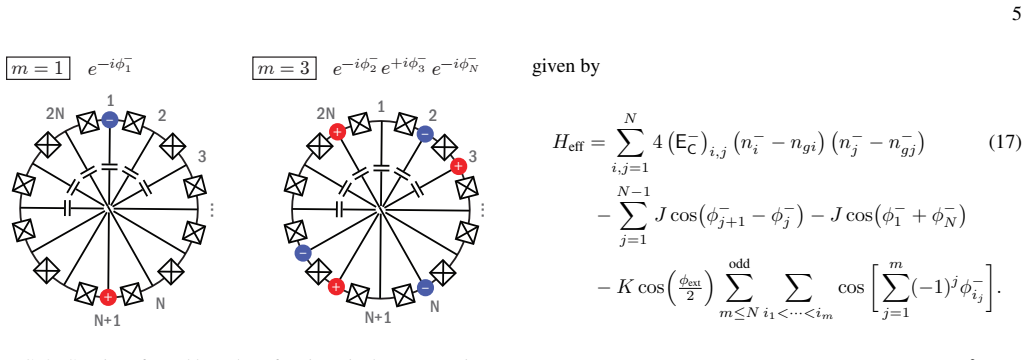
The load-bearing object is the effective exciton Hamiltonian (Eq. 17 of the paper), obtained by a Schrieffer-Wolff elimination of the high-energy agiton sector. Its degrees of freedom are Cooper-pair excitons — a Cooper pair and a Cooper-pair hole sitting on opposite plates of a big capacitor — and it contains a charging term, a nearest-neighbor hopping term $-J\cos(\varphi^-_{j+1}-\varphi^-_j)$ with amplitude $J=E_J^2/(2E_{CJ})$, a boundary hopping term of the opposite sign due to the Möbius twist, and a degeneracy-breaking term $H_K=-K\cos(\varphi_{\mathrm{ext}}/2)\sum_{\mathrm{odd}\,m\le N}\sum_{i_1<\cdots<i_m}\cos(\sum_{j=1}^m(-1)^j\varphi^-_{i_j})$. The exponential smallness of $K$ — bounded by $2^{N-1}K < E_J(2E_J/\Delta E)^{N-1}$ and computed numerically as $K\approx 175\,{\rm GHz}\,e^{-1.59N}$ — is what leaves the two potential wells at $\{\varphi^-=0\}$ and $\{\varphi^-=\pi\}$ nearly degenerate. DMRG solves this short-range model for $N$ up to 12, and the resulting spectra feed the coherence-time estimates.
What would settle it
Measure the $|0\rangle$–$|\pi\rangle$ energy splitting of an $N=11$ current-mirror device at zero flux and at the charge sweet spot: combining the paper's numerical $K(N)=175\,{\rm GHz}\,e^{-1.59N}$ with the $2^N$ factor from the degeneracy-breaking sum predicts a splitting of about $9\,{\rm MHz}$ at $N=11$, decreasing by a factor of roughly $0.41$ per added rung; a measurement orders of magnitude larger, or measured $T_\phi$ or $T_1$ below $1\,{\rm ms}$ under the assumed noise budgets, would falsify the central claim.
Extended reading notes
Core claim
The central discovery is that the current-mirror circuit, despite its many degrees of freedom, can be reduced to a one-dimensional effective model whose two lowest states are exponentially protected. Using exciton variables $\varphi^-_j = \varphi_j - \varphi_{N+j}$ and agiton variables $\varphi^+_j = \varphi_j + \varphi_{N+j}$, the authors eliminate the high-energy agiton sector by a Schrieffer-Wolff transformation, obtaining an effective Hamiltonian with nearest-neighbor exciton hopping of amplitude $J = E_J^2/(2E_{CJ})$ and an $N$-th-order degeneracy-breaking term $H_K$ with amplitude $K$ that falls off as $\exp(-1.59N)$ for the chosen parameters. The effective potential is a double well with minima at $\{\varphi^-_j=0\}$ and $\{\varphi^-_j=\pi\}$; the two lowest eigenstates localize in these wells and have matrix elements for local operators suppressed by their disjoint support. DMRG spectra confirm that this near-degeneracy develops for $N\ge 6$, and the coherence analysis predicts $T_\phi$ and $T_1$ both exceeding $1\,\mathrm{ms}$ near $N=10$–$11$, limited respectively by charge noise and dielectric loss.
Load-bearing premise
The entire protection picture rests on the assumption that every node's offset charge is effectively zero, so charge frustration can be neglected and the low-energy excitations are purely Cooper-pair excitons; at offset charges near half an electron pair the perturbative denominators vanish and the effective model, exponential suppression of $K$, and millisecond coherence predictions all break down.
Editorial extensions
If this is right
- For a device with $N\approx 10$–$11$ at the charge sweet spot, $T_\phi$ and $T_1$ are predicted to both exceed $1\,\mathrm{ms}$, with $N=11$ as the crossover where the qubit stops being dephasing-limited and becomes relaxation-limited.
- Operating at $\varphi_{\mathrm{ext}}=\pi$ would improve dephasing times by a factor of ten or more but removes the disjoint-support protection against relaxation, so it is not a useful operating point.
- Low-lying normal-mode frequencies scale as $1/N$, so increasing circuit size makes thermal excitation of harmonic modes more likely and shortens $T_1$; an optimal size balances this against the exponentially increasing $T_\phi$.
- Depolarization is dominated by escape from the qubit subspace into harmonic excitations within the same well, not by transitions between $|0\rangle$ and $|\pi\rangle$; a measurement that only reads out the well occupancy would make $T_1$ dramatically longer.
- For $N\ge 6$, the ground and first excited states become the lowest two eigenstates, so the protected regime is reachable with device sizes that are within current fabrication capabilities apart from the small junction capacitance requirement.
Reading between the lines
- If the millisecond predictions survive experimental test, the current-mirror qubit would be unusual in providing simultaneous protection against both phase noise and energy decay, potentially relaxing the overhead needed for quantum error correction.
- The exponential form $K(N)\approx 175\,{\rm GHz}\,e^{-1.59N}$ implies a direct spectroscopic test: the $|0\rangle$–$|\pi\rangle$ splitting should shrink by a factor of $e^{-1.59}\times 2 \approx 0.41$ for each added rung; measuring the splitting as a function of $N$ would verify the $N$-th-order mechanism.
- The analysis leaves open the behavior under realistic offset-charge jumps larger than $0.1e$; a natural extension would be a full-model simulation or experiment probing whether the millisecond coherence survives away from the charge sweet spot, where the effective model's energy denominators shrink.
- The same effective-model-plus-DMRG pipeline could be transferred to other protected superconducting circuits whose full Hilbert space is too large for exact diagonalization, such as the 0–$\pi$ qubit.
Signed reviews
Editorial analysis
A structured set of objections, weighed in public.
Referee Report
Summary. The paper presents a full circuit analysis of Kitaev's current-mirror qubit and derives a low-energy effective model in which Cooper-pair excitons are the relevant degrees of freedom. The effective Hamiltonian includes second-order exciton hopping and N-th-order degeneracy-breaking terms, with the latter obtained via a Schrieffer-Wolff transformation and a combinatorial assignment-problem proof. The authors validate the effective model by comparing exact diagonalization and DMRG spectra up to N = 12, finding relative deviations below 2e-6. They then compute pure-dephasing and depolarization times for charge noise, critical-current noise, flux noise, and dielectric loss, predicting both T_phi and T1 exceeding 1 ms for circuit sizes N around 10-11 at the charge sweet spot and zero external flux. The main quantitative predictions rely on the exponential suppression of the degeneracy-breaking amplitude K with N.
Significance. If the predictions hold, the current-mirror qubit would provide intrinsic protection against both pure dephasing and relaxation, with coherence times an order of magnitude beyond current transmon qubits and comparable to or better than state-of-the-art fluxonium. The paper's strengths include a detailed derivation from the full circuit Hamiltonian, a rigorous proof that the leading degeneracy-breaking processes are of N-th order and obey charge alternation, a controlled Schrieffer-Wolff treatment, and a forward calculation of coherence times using literature noise spectra. The DMRG implementation handles the Möbius topology and extends the spectrum to sizes beyond exact diagonalization. The central quantitative claim is, however, conditional on the assumption of near-zero offset charges on every node, an assumption whose experimental reach the paper does not fully address.
major comments (2)
- [Sec. III.B, Eq. (11); Sec. VI] The effective-model derivation and the exponential suppression of the degeneracy-breaking amplitude K assume vanishing offset charges on every node. As the authors note in Sec. III.B, the agiton energy denominators in Eq. (11) approach zero for n_gj^+ = 1/2, and Sec. VI defers the case of offset-charge jumps larger than 0.1e. Because real devices exhibit static offset-charge disorder and low-frequency charge drift, the headline prediction of millisecond coherence times 'within reach of experiments' is not supported unless the paper adds a quantitative analysis of robustness to small nonzero offset charges, an explicit protocol for tuning all N nodes to the charge sweet spot, or a revised claim that is explicitly conditional on such tuning. The appeal to Refs. 6 and 18 for the frustrated case is not a substitute for a derivation here, since the N-th-order computation of K in Appendix C is carried out at n_g = 0.
- [Appendix C] The numerical fit K(N) = 175 GHz × exp(−1.59N) is stated without showing the underlying data points, the fitted range of N, or the fit quality. Since the pure-dephasing predictions in Sec. V.A are governed by derivatives of K with respect to offset charge and junction critical current, the quantitative coherence times cannot be independently verified from the manuscript as written. A table or plot of the computed K(N) values and the fit residuals should be provided.
minor comments (4)
- [Eq. (17)] In Eq. (17), the first charging term is written with n_gi in one factor and n^-_gj in the other, while Eq. (12) uses n^-_gi and n^-_gj consistently; please correct the notation for uniform use of the transformed offset charges.
- [Fig. 4 caption] The caption introduces 'm' as a placeholder for the degenerate modes ω0 and ω1, but the definition is vague; please state explicitly which states the placeholder labels.
- [Abstract and conclusion] The abstract and the concluding summary should explicitly state that the millisecond coherence-time prediction is conditional on operating at the charge sweet spot with near-zero offset charges, since the body of the paper identifies this as a central assumption.
- [Eq. (1)] The primed sums in Eq. (1) are defined only in the text following the equation; consider defining the convention (modulo 2N) before or with the equation.
Circularity Check
No significant circularity: effective Hamiltonian is derived by Schrieffer-Wolff from the full circuit, and coherence times are forward outputs fed by literature noise parameters.
full rationale
I find no circular step in the derivation chain. The effective model is not assumed; it is constructed from the full circuit Hamiltonian (Eq. 8) by a Schrieffer-Wolff transformation, with the exciton-hopping amplitude J and degeneracy-breaking amplitude K computed from the capacitance-matrix energy denominators (Eqs. C6, C7, C10) rather than chosen to reproduce any target spectrum. The numerical parametrization K(N) = 175 GHz exp(-1.59N) is a fit to computed perturbative values, not to coherence data; Tphi and T1 are then obtained by inserting numerical derivatives of Heff into standard Redfield/Fermi-golden-rule formulas with literature noise amplitudes (Eqs. 26-30). Thus the ms coherence prediction is a genuine output, not a restatement of an input. Kitaev's original paper and Ref. 18 supply the circuit concept and motivation, but the paper's central spectral and coherence claims are derived and benchmarked within the paper (DMRG vs ED agreement better than 2e-6). The near-zero offset-charge assumption is explicitly flagged in Sec. III.B (energy denominators approaching zero at n_gj^+ = 1/2) and Sec. VI (offset-charge jumps >0.1e deferred); that is an admitted validity/robustness limitation, not a circular reduction. The exponential suppression used for the headline prediction is also separately corroborated by the analytical bound 2^{N-1}K < E_J(2E_J/Delta E)^{N-1}. Self-citations (e.g., Refs. 11, 13, 14, 29, 40, 49) appear only for standard decoherence formalism and background and are not load-bearing.
Assumptions & free parameters
free parameters (2)
- Circuit energy scales (ECB, ECJ, ECg, EJ) =
0.2, 100, 200, 19 GHz
- Degeneracy-breaking amplitude K(N) exponential fit =
175 GHz x exp(-1.59N)
assumptions (5)
- domain assumption Protected parameter regime: N much greater than 1, EJ < ECJ, ECB < ECJ < ECg
- domain assumption Near-zero offset charges (charge frustration neglected)
- domain assumption All junctions, rungs, and ground capacitances are identical (no disorder)
- standard math Schrieffer-Wolff perturbation theory converges and omitted higher-order terms are negligible
- domain assumption Noise models: 1/f spectra, dielectric loss with Q factors, detailed balance, independent channels
Cite this review
Pith. "Pith review of Spectrum and Coherence Properties of the Current-Mirror Qubit." pith.science (2026). https://pith.science/paper/NLYLC4CA
@misc{pith2026190804615,
  author       = {Pith},
  title        = {Pith review of: Spectrum and Coherence Properties of the Current-Mirror Qubit},
  year         = {2026},
  howpublished = {\url{https://pith.science/paper/NLYLC4CA}},
  note         = {Machine review of arXiv:1908.04615}
}
read the original abstract
The current-mirror circuit [A. Kitaev, arXiv:cond-mat/0609441 (2006)] exhibits a robust ground-state degeneracy and wave functions with disjoint support for appropriate circuit parameters. In this protected regime, Cooper-pair excitons form the relevant low-energy excitations. Based on a full circuit analysis of the current-mirror device, we introduce an effective model that systematically captures the relevant low-energy degrees of freedom, and is amenable to diagonalization using Density Matrix Renormalization Group (DMRG) methods. We find excellent agreement between DMRG and exact diagonalization, and can push DMRG simulations to much larger circuit sizes than feasible for exact diagonalization. We discuss the spectral properties of the current-mirror circuit, and predict coherence times exceeding 1 ms in parameter regimes believed to be within reach of experiments.
Figures


Figures from the paper (5 more)


Reference graph
Works this paper leans on
-
[1]
Nakamura, Y
Y . Nakamura, Y . A. Pashkin, and J. S. Tsai, Nature 398, 786 (1999)
1999
-
[2]
V . Bouchiat, D. Vion, P. Joyez, D. Esteve, and M. H. Devoret, Phys. Scr. T76, 165 (1998)
work page 1998
-
[3]
M. Kjaergaard, M. E. Schwartz, J. Braum ¨uller, P. Krantz, J. I.-J. Wang, S. Gustavsson, and W. D. Oliver, (2019), arXiv:1905.13641
arXiv 2019
-
[4]
M. H. Devoret and R. J. Schoelkopf, Science 339, 1169 (2013)
2013
- [5]
- [6]
-
[7]
Brooks, A
P. Brooks, A. Kitaev, and J. Preskill, Phys. Rev. A 87, 052306 (2013)
2013
-
[8]
L. B. Ioffe, M. V . Feigel’man, A. Ioselevich, D. Ivanov, M. Troyer, and G. Blatter, Nature 415, 503 (2002)
work page 2002
Show all 54 references
-
[9]
Gladchenko, D
S. Gladchenko, D. Olaya, E. Dupont-Ferrier, B. Douc ¸ot, L. B. Ioffe, and M. E. Gershenson, Nat. Phys. 5, 48 (2009)
2009
-
[10]
M. T. Bell, J. Paramanandam, L. B. Ioffe, and M. E. Gershen- son, Phys. Rev. Lett. 112, 167001 (2014)
2014
-
[11]
Groszkowski, A
P. Groszkowski, A. Di Paolo, A. L. Grimsmo, A. Blais, D. I. Schuster, A. A. Houck, and J. Koch, New J. Phys. 20, 043053 (2018)
2018
-
[12]
W. C. Smith, A. Kou, X. Xiao, U. V ool, and M. H. Devoret, arXiv:1905.01206
1905 arXiv
-
[13]
J. M. Dempster, B. Fu, D. G. Ferguson, D. I. Schuster, and J. Koch, Phys. Rev. B 90, 094518 (2014)
2014
-
[14]
A. D. Paolo, A. L. Grimsmo, P. Groszkowski, J. Koch, and A. Blais, New J. Phys. 21, 043002 (2019)
2019
-
[15]
M. H. Devoret, A. Wallraff, and J. M. Martinis, arXiv:cond- mat/0411174
-
[16]
Indices i, jare interpreted modulo 2N
-
[17]
A more rigorous, but essen- tially equivalent way to proceed is to base quantization on the operatoreiφj
The usual caveat applies: due to periodic boundary conditions, φj is strictly speaking ill-defined. A more rigorous, but essen- tially equivalent way to proceed is to base quantization on the operatoreiφj
-
[18]
Lee, M.-S
M. Lee, M.-S. Choi, and M. Y . Choi, Phys. Rev. B 68, 144506 (2003)
2003
-
[19]
Werman, S
M. Werman, S. Peleg, R. Melter, and T. Y . Kong, Journal of Algorithms 7, 277 (1986)
1986
-
[20]
R. M. Karp and S.-Y . R. Li, Discrete Math.13, 129 (1975)
1975
-
[21]
A truncation scheme using a global exciton-number cutoff will likely succeed in pushing exact diagonalization to slightly larger system sizes, but was not our main interest here
-
[22]
Schollw ¨ock, Rev
U. Schollw ¨ock, Rev. Mod. Phys. 77, 259 (2005)
2005
-
[23]
S. R. White, Phys. Rev. Lett. 69, 2863 (1992); Phys. Rev. B 48, 10345 (1993)
1992
-
[24]
Stoudenmire and S
M. Stoudenmire and S. R. White, http://itensor.org
-
[25]
Shnirman, Y
A. Shnirman, Y . Makhlin, and G. Sch ¨on, Phys. Scr. T102, 147 (2002)
2002
-
[26]
J. M. Martinis, S. Nam, J. Aumentado, K. M. Lang, and C. Urbina, Phys. Rev. B 67, 094510 (2003)
2003
-
[27]
R. J. Schoelkopf, A. A. Clerk, S. M. Girvin, K. W. Lehnert, and M. H. Devoret, Proc. SPIE 5115, 356 (2003)
2003
-
[28]
Ithier, E
G. Ithier, E. Collin, P. Joyez, P. J. Meeson, D. Vion, D. Es- teve, F. Chiarello, A. Shnirman, Y . Makhlin, J. Schriefl, and G. Sch¨on, Phys. Rev. B 72, 134519 (2005)
2005
-
[29]
J. Koch, T. M. Yu, J. Gambetta, A. A. Houck, D. I. Schuster, J. Majer, A. Blais, M. H. Devoret, S. M. Girvin, and R. J. Schoelkopf, Phys. Rev. A 76, 042319 (2007)
2007
-
[30]
R. K. Wangsness and F. Bloch, Phys. Rev. 89, 728 (1953)
1953
-
[31]
E. Geva, R. Kosloff, and J. L. Skinner, J. Chem. Phys. 102, 8541 (1995)
1995
-
[32]
F. C. Wellstood, C. Urbina, and J. Clarke, Appl. Phys. Lett. 50, 772 (1987)
1987
-
[33]
A. B. Zorin, F.-J. Ahlers, J. Niemeyer, T. Weimann, H. Wolf, V . A. Krupenin, and S. V . Lotkhov, Phys. Rev. B 53, 13682 (1996)
1996
-
[34]
D. J. Van Harlingen, T. L. Robertson, B. L. Plourde, P. A. Re- ichardt, T. A. Crane, and J. Clarke, Phys. Rev. B 70, 064517 (2004)
2004
-
[35]
Yoshihara, K
F. Yoshihara, K. Harrabi, A. O. Niskanen, Y . Nakamura, and J. S. Tsai, Phys. Rev. Lett. 97, 167001 (2006)
2006
-
[36]
Pourkabirian, M
A. Pourkabirian, M. V . Gustafsson, G. Johansson, J. Clarke, and P. Delsing, Phys. Rev. Lett.113, 256801 (2014)
2014
-
[37]
Kumar, S
P. Kumar, S. Sendelbach, M. A. Beck, J. W. Freeland, Z. Wang, H. Wang, C. C. Yu, R. Q. Wu, D. P. Pappas, and R. McDermott, Phys. Rev. Applied 6, 041001 (2016)
2016
-
[38]
M. D. Hutchings, J. B. Hertzberg, Y . Liu, N. T. Bronn, G. A. Keefe, M. Brink, J. M. Chow, and B. L. T. Plourde, Phys. Rev. Applied 8, 044003 (2017)
2017
-
[39]
F. Yan, S. Gustavsson, A. Kamal, J. Birenbaum, A. P. Sears, D. Hover, T. J. Gudmundsen, D. Rosenberg, G. Samach, S. We- ber, J. L. Yoder, T. P. Orlando, J. Clarke, A. J. Kerman, and W. D. Oliver, Nat. Commun.7, 12964 (2016)
2016
-
[40]
Manucharyan, J
V . Manucharyan, J. Koch, L. I. Glazman, and M. H. Devoret, Science 326, 113 (2009)
2009
-
[41]
A. A. Clerk, M. H. Devoret, S. M. Girvin, F. Marquardt, and R. J. Schoelkopf, Rev. Mod. Phys. 82, 1155 (2010)
2010
-
[42]
C. M. Quintana, Y . Chen, D. Sank, A. G. Petukhov, T. C. 18 White, D. Kafri, B. Chiaro, A. Megrant, R. Barends, B. Camp- bell, Z. Chen, A. Dunsworth, A. G. Fowler, R. Graff, E. Jef- frey, J. Kelly, E. Lucero, J. Y . Mutus, M. Neeley, C. Neill, P. J. J. O’Malley, P. Roushan, A....
2017
-
[43]
C. Wang, C. Axline, Y . Y . Gao, T. Brecht, Y . Chu, L. Frunzio, M. H. Devoret, and R. J. Schoelkopf, Appl. Phys. Lett. 107, 162601 (2015)
2015
-
[44]
I. M. Pop, K. Geerlings, G. Catelani, R. J. Schoelkopf, L. I. Glazman, and M. H. Devoret, Nature 508, 369 (2014)
2014
-
[45]
B. G. Christensen, C. D. Wilen, A. Opremcak, J. Nelson, F. Schlenker, C. H. Zimonick, L. Faoro, L. B. Ioffe, Y . J. Rosen, J. L. DuBois, B. L. T. Plourde, and R. McDermott, (2019), arXiv:1905.13712 [quant-ph]
2019 arXiv
-
[46]
Lutchyn, L
R. Lutchyn, L. Glazman, and A. Larkin, Phys. Rev. B 72, 069902 (2005)
2005
-
[47]
Serniak, M
K. Serniak, M. Hays, G. De Lange, S. Diamond, S. Shankar, L. D. Burkhart, L. Frunzio, M. Houzet, and M. H. Devoret, Phys. Rev. Lett. 121, 157701 (2018)
2018
-
[48]
Catelani, R
G. Catelani, R. J. Schoelkopf, M. H. Devoret, and L. I. Glaz- man, Phys. Rev. B 84, 064517 (2011)
2011
-
[49]
Catelani, J
G. Catelani, J. Koch, L. Frunzio, R. J. Schoelkopf, M. H. De- voret, and L. I. Glazman, Phys. Rev. Lett. 106, 077002 (2011)
2011
-
[50]
Kershaw, Math
D. Kershaw, Math. Comput. 23, 189 (1969)
1969
-
[51]
Meek, SIAM J
D. Meek, SIAM J. Numer. Anal. 17, 39 (1980)
1980
-
[52]
H. W. Kuhn, Nav. Res. Logist. 2, 83 (1955)
1955
-
[53]
Shavitt and L
I. Shavitt and L. T. Redmon, J. Chem. Phys. 73, 5711 (1980)
1980
-
[54]
I. S. Gradshteyn and I. M. Ryzhik, Table of integrals, series, and products, 7th ed. (Academic Press, 2000) p. 4
2000
Reviewed August 14, 2026 · model on record in the stance chip above.
Discussion (0). Continue with ORCID to comment.