REVIEW 3 major objections 5 minor 94 references
Localization and topological signatures under periodic twisting
T0 review · 3 major / 5 minor · reviewed 2026-08-04 · deepseek-v4-flash
Pith's one-line read Continuously rotating a superimposed lattice abolishes the static localization transition: ring-shaped extended states with non-trivial topological markers survive even at potential strengths 50 times the tunneling energy.
desk verdict The rotating-twist drive is genuinely new and the ring-localization physics is solid, but the topological signatures sit in tiny gaps with no scaling test, so treat the topological claims as provisional. read the letter →
The pith
A machine-rendered reading of the paper's core claim, the machinery that carries it, and where it could break.
The reading
What carries the argument
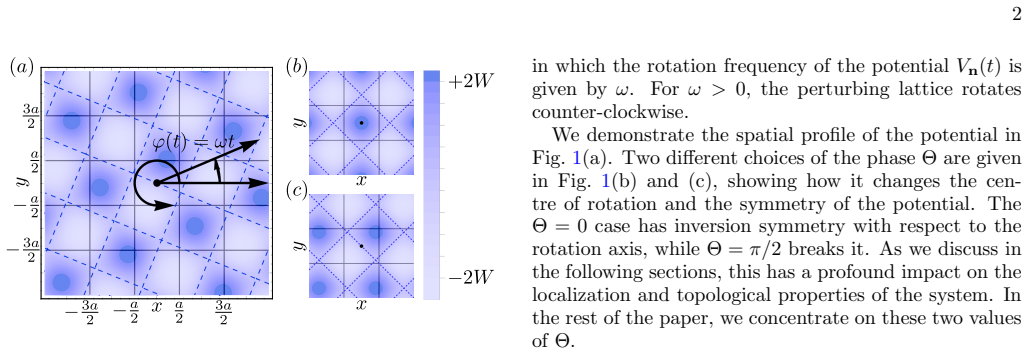
The engine is the spatially varying multi-frequency drive: at distance R from the rotation axis the rotating potential's Fourier content extends to a cutoff ν_c ≈ 2πβR with mode amplitudes ~ R^{-1/2}. A gauge transformation moves the time dependence into the hoppings as Peierls phases, and the lowest-order Magnus analysis yields J_eff ≈ J J₀(W α_nn'/ω), with α_nn' ~ (βR)^{−1/2} — the formula that produces the concentric conductive rings and the collapse of localization contours onto lines of fixed W/ω. Because the system lacks translational invariance, topology is quantified with real-space invariants built from Floquet eigenstates: the Bott index and the local Chern marker. The mechanism be
What would settle it
Scale the lattice at fixed β = 0.1β_0 (large enough that the third conductive ring fits fully inside, as in the paper's Appendix H) and track the Bott index and the ≈0.005J–0.007J degeneracy-lifting gap from N = 24 to N ≳ 100: the claim holds only if the gap remains well above the ring-sector quasienergy level spacing and the Chern-marker plateau inside the ring grows with N. A complementary wave-packet experiment: prepare a packet on the ring and measure the fraction of density still inside the annulus after 2000/J — the paper's transport claim requires the ring profile to persist.
Extended reading notes
Core claim
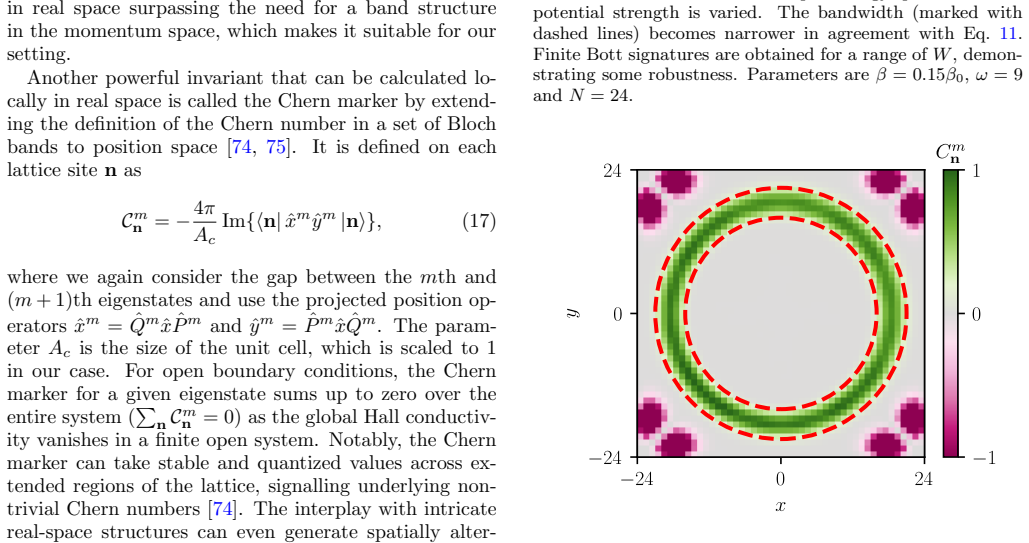
Continuous periodic twisting of the secondary lattice produces a local multi-frequency drive whose spectral cutoff grows linearly with distance from the rotation axis (ν_c ≈ 2πβR), while the induced Peierls phases decay as (W/ω)/√(βR). The incommensurate potential — the source of the static localization transition — is no longer the pivotal ingredient: the Floquet–Magnus renormalization J_eff ≈ J J₀(W α_nn'/ω), with α_nn' ~ (βR)^{−1/2}, carves concentric annuli of near-unity effective tunnelling that host ring-shaped eigenstates, which persist up to W/J = 50 and confine wave packets for thousands of hopping times. The same ring states carry non-trivial topological markers — Bott index ±1 and
Load-bearing premise
The central assumption is that the tiny gaps that lift the ring-state degeneracies — around 0.005–0.007 of the hopping energy, set by next-nearest-neighbour couplings 25 to 100 times weaker than nearest-neighbour hoppings — stay well resolved against the finite-system quasienergy level spacing, so the Bott indices and Chern markers survive in the thermodynamic limit rather than being square-geometry finite-size effects.
Editorial extensions
If this is right
- The static self-duality point W/J = 2 no longer governs localization; the drive reorganizes the phase diagram around the ratio W/ω, as visible in constant-IPR contours running along fixed W/ω.
- Wave packets seeded on a conductive ring remain confined to the annulus for thousands of hopping times, giving a clear experimental signature of sub-dimensional ring transport inside an aperiodic bulk.
- Non-trivial Chern physics (Bott index ±1, Chern marker ±1 on a ring) is realized without a uniform magnetic field, with ring radii and hybridization controlled by the lattice-constant ratio β, the rotation frequency ω, and the potential strength W.
- A discrete step-wise version of the continuous twist can be implemented holographically in quantum gas microscopes, making the localization and topological predictions testable in current cold-atom platforms; photonic waveguides offer a second route.
- The number of ring states per annulus is set by β rather than system size, so tuning β controls how many ring states and how much hybridization a given ring supports.
Reading between the lines
- The rotation axis functions as a synthetic radial coordinate that maps each annulus onto a driven quasi-1D chain; viewed this way, the conductive rings resemble a stack of coupled Floquet chains, which may connect the observed ring Chern markers to higher-dimensional pumping pictures — a connection the paper does not draw.
- The robust N-fold degenerate quasienergy states pinned at εT = 0, which survive arbitrary driving strength, point to an unexamined hidden symmetry of the Θ = π/2 rotating potential; identifying it would give an exact spectral statement the paper leaves open.
- Because the degeneracy-lifting gaps are tiny, a concrete stress test of the mechanism is to shape the twist protocol (step-wise or two-tone) to amplify the next-nearest-neighbour couplings; if the gaps widen, the ring Chern markers should become correspondingly more stable, confirming that hybridization and TRS breaking are indeed the operative ingredients.
- The same Bessel-renormalization argument should transfer to other rotating incommensurate geometries, such as eightfold-symmetric optical quasicrystals, where rings of near-unity effective hopping and their topological markers could be sought directly in the measured hopping map, e.g., in photonic lattices.
Signed reviews
Editorial analysis
A structured set of objections, weighed in public.
Referee Report
Summary. The manuscript studies a 2D Aubry-André-type model formed by two superimposed square lattices, with the secondary lattice rotating continuously at angular frequency ω. After a gauge transformation the drive appears as a spatially dependent, multi-frequency hopping phase. The authors derive Bessel-function expressions for the phase amplitudes (Eqs. 7–9, B1–B4, C4), predict W/ω scaling and a radial decay of the effective hopping, and support these predictions numerically (Figs. 4–6). For the Θ = π/2 case they report that the spectrum does not fully localize even at W/J = 50, that conductive rings host extended 'ring states', and that some ring states carry non-trivial Bott indices and Chern markers. They attribute the topological signatures to locally broken time-reversal symmetry via complex next-nearest-neighbour hopping and to hybridization between spatially separated delocalized regions. Experimental implementations are discussed in Sec. VII.
Significance. If the results hold, the paper introduces a genuinely new driving mechanism — a spatially varying multi-frequency drive generated by continuous rotation — and makes a plausible case that incommensurate geometry is subdominant to local dynamical localization in this setting. The analytic Bessel-function derivations are parameter-free and are checked against numerics; the transport simulations and the ablation tests (removing next-nearest-neighbour terms, confining geometry) are genuine causal probes. The weakest part is the topological claim: the supporting gaps are tiny and no thermodynamic-limit scaling is presented, so the Bott/Chern signatures should currently be viewed as suggestive rather than established. The model is nonetheless novel and likely to stimulate follow-up work.
major comments (3)
- [§VI C, Fig. 14] The topological claim for ring states rests on degeneracy-lifting gaps of 0.005J–0.007J caused by next-nearest-neighbour couplings that are 25–100 times smaller than nearest-neighbour terms. For the N=48 lattice the mean quasienergy spacing is approximately 8J/N² ≈ 3.5×10⁻³J, so the gap is only 1.5–2 times the mean spacing. In this regime the Bott index of a finite open system is not a stable quantized invariant without evidence that the gap remains resolved as N grows. No N-scaling test of the Bott index or Chern marker is reported; the text itself states that the protection 'remains weak due to small gaps' and calls for amplifying the couplings. Please supply N-scaling (e.g., N=48, 64, 96 with β adjusted to keep the ring fixed, plus a histogram of gap vs level spacing) and state whether the markers converge as N→∞.
- [§VI C and Appendix H] The ablation test in Fig. 14 shows that inserting a circular wall removes the corner pockets and makes the Bott index vanish; the authors argue this is not a square-geometry artifact by considering a second fully-connected ring in Appendix H. However, Appendix H reports a single N=48 realization and again gives no system-size scaling or gap/level-spacing analysis. Because the non-trivial index arises from hybridization with specific partner states (pockets or another ring), it is important to demonstrate that this mechanism survives in the thermodynamic limit rather than depending on accidental degeneracies of finite-size spectra. Please provide scaling of the Bott/Chern values for ring-ring hybridization and, ideally, a parameter sweep showing stable plateaus.
- [§IV B, Eq. (11)] Equation (11) is the first-order Magnus result strictly valid for W/ω ≪ 1, yet it is invoked at W/ω ≈ 5.6 (W=50J, ω=9J) and used to interpret the Bessel-like oscillations in Fig. 6(c). The text acknowledges the validity issue but offers no quantitative convergence check. Since the main numerical localization results do not rely solely on Eq. (11), this is not fatal, but the statement that the approximation 'appears to extend beyond' its validity should be supported by a comparison with second-order Magnus or direct Floquet spectra, or rephrased as an empirical observation.
minor comments (5)
- [Sec. VII] Typo: 'we have demonstrate' should be 'we have demonstrated'.
- [Sec. V] Typo: 'wave packages' should be 'wave packets'.
- [Eq. (8)] The notation γ_n is used before being defined; in Sec. III γ is defined for a generic radius R, but Eq. (8) applies it to sites n and n′. Please define γ_n explicitly at first use.
- [Fig. 2 caption] The caption says 'the values at which s_ν drop to zero follow a linear trend'; this appears to refer to the Bessel-function zeros rather than the spectral peaks. Please rephrase to avoid confusion with the envelope shown in Fig. 16.
- [Appendix F, Fig. 20] The gauge freedom in Φ_triangle is explained, but the figure caption should state more explicitly that the small-triangle fluxes φ are gauge-dependent while the loop fluxes Φ are not.
Circularity Check
No significant circularity: the central derivation is self-contained, and the topological claims are supported by genuine ablation tests rather than by construction.
full rationale
Walkling et al.'s core derivation is self-contained. Starting from the model Hamiltonian (1)-(3), the gauge transformation to (4)-(5) is exact, and the Fourier coefficients in Appendix B are fixed Bessel functions with no fitted parameters. The phase coefficients (7)-(8), the RMS decay (9), and the Magnus/Bessel effective hopping (11) all follow analytically from the same Hamiltonian; the W/omega scaling in Fig. 5 and the bandwidth narrowing in Fig. 4 are consistency checks of Eq. (11), not fits relabeled as predictions. The identification of ring states uses independent observables (fractal dimension, radial variance ratio, and wave-packet transport), and the topological claim is tested by ablations—removing the complex NNN terms and imposing a circular wall (Sec. VI C, Fig. 14)—and by the second-ring configuration in Appendix H. These are genuine causality tests rather than circular reductions. The self-citations present ([41], [57], [68], [84], [85]) are contextual or methodological, and no load-bearing uniqueness or ansatz is imported from them; no fitted parameter is renamed as a prediction. The paper's own caveat that the protecting gaps are small (Sec. VI C: 'protection ... remains weak due to small gaps'; 'The relatively small size of these couplings renders the associated gaps to be small as well, which is in general detrimental for topological signatures') is a finite-size/robustness limitation—relevant to whether the Bott/Chern values survive in the thermodynamic limit—but it is not an instance of a derivation reducing to its inputs. Accordingly, no circular step is identified.
Assumptions & free parameters
assumptions (4)
- domain assumption Single-band tight-binding description of the primary square lattice remains valid for W up to 50J.
- domain assumption Floquet theorem and stroboscopic evolution at T=2*pi/omega capture the physics, with no heating or dissipation.
- ad hoc to paper First-order Magnus approximation extends beyond W/omega much less than 1.
- domain assumption Random phases in the multi-harmonic sum yield the RMS phase decay in Eq. (9).
Cite this review
Pith. "Pith review of Localization and topological signatures under periodic twisting." pith.science (2026). https://pith.science/paper/NMGH5TKC
@misc{pith2026250918248,
  author       = {Pith},
  title        = {Pith review of: Localization and topological signatures under periodic twisting},
  year         = {2026},
  howpublished = {\url{https://pith.science/paper/NMGH5TKC}},
  note         = {Machine review of arXiv:2509.18248}
}
read the original abstract
We theoretically explore a dynamical generalization of the Aubry-Andr\'e model in two dimensions formed by superimposing two square-lattice potentials. Motivated by the rich physics emerging at different twist angles between the two lattices at equilibrium, we introduce periodic twisting by continuously rotating one of the lattices with respect to the other in the plane. We demonstrate that the distinct time-dependent twisting in this system gives rise to an intricate form of periodic multi-frequency driving that changes with the distance from the rotation axis. We find that the incommensurate nature of the potential no longer plays the pivotal role as it does in the static case. Rather, the tunneling can be understood in terms of a local, spatially varying dynamical localization effect, which we show to yield ring-shaped states localized within the bulk that have interesting transport signatures. Quantifying the eigenstates with the Bott index and local Chern marker, we find that there is a zoo of states with non-trivial topological signatures, the most ubiquitous of which result in relatively uniform ring-shaped regions of the Chern marker. We investigate the origin of these effects from various angles and identify that hybridization between different delocalized ring states plays a vital role. Lastly, we discuss possible experimental realizations in quantum simulation settings. Our results open a new avenue of investigation with periodic twisting inducing a spatially varying multi-frequency drive.
Figures


Figures from the paper (16 more)




Reference graph
Works this paper leans on
-
[1]
Moir´ e bands in twisted double-layer graphene,
Rafi Bistritzer and Allan H. MacDonald, “Moir´ e bands in twisted double-layer graphene,” Proceedings of the Na- tional Academy of Sciences108, 12233–12237 (2011)
2011
-
[2]
Unconventional superconductivity in magic- angle graphene superlattices,
Yuan Cao, Valla Fatemi, Shiang Fang, Kenji Watanabe, Takashi Taniguchi, Efthimios Kaxiras, and Pablo Jarillo- Herrero, “Unconventional superconductivity in magic- angle graphene superlattices,” Nature556, 43–50 (2018)
2018
-
[3]
Superconductors, orbital magnets and correlated states in magic-angle bilayer graphene,
Xiaobo Lu, Petr Stepanov, Wei Yang, Ming Xie, Mo- hammed Ali Aamir, Ipsita Das, Carles Urgell, Kenji Watanabe, Takashi Taniguchi, Guangyu Zhang, Adrian Bachtold, Allan H. MacDonald, and Dmitri K. Efetov, “Superconductors, orbital magnets and correlated states in magic-angle bilayer graphene,” Nature574, 653–657 (2019)
2019
-
[4]
Untying the insulating and superconducting or- ders in magic-angle graphene,
Petr Stepanov, Ipsita Das, Xiaobo Lu, Ali Fahimniya, Kenji Watanabe, Takashi Taniguchi, Frank H. L. Kop- pens, Johannes Lischner, Leonid Levitov, and Dmitri K. Efetov, “Untying the insulating and superconducting or- ders in magic-angle graphene,” Nature583, 375–378 (2020)
2020
-
[5]
Mott insulators in moir´ e transition metal dichalcogenides at fractional fillings: Slave-rotor mean- field theory,
Zhenhao Song, Urban F. P. Seifert, Zhu-Xi Luo, and Leon Balents, “Mott insulators in moir´ e transition metal dichalcogenides at fractional fillings: Slave-rotor mean- field theory,” Physical Review B108(2023)
2023
-
[6]
Frozen non-equilibrium dynamics of exciton mott insu- lators in moir´ e superlattices,
Shibin Deng, Heonjoon Park, Jonas Reimann, Jonas M. Peterson, Daria D. Blach, Meng-Jia Sun, Tengfei Yan, Dewei Sun, Takashi Taniguchi, Kenji Watanabe, Xi- aodong Xu, Dante M. Kennes, and Libai Huang, “Frozen non-equilibrium dynamics of exciton mott insu- lators in moir´ e superlattices,” Nature Materials (2025), 10.1038/s41563-025-02135-8
-
[7]
Correlated insulator behaviour at half-filling in magic-angle graphene superlattices,
Yuan Cao, Valla Fatemi, Ahmet Demir, Shiang Fang, Spencer L. Tomarken, Jason Y. Luo, Javier D. Sanchez-Yamagishi, Kenji Watanabe, Takashi Taniguchi, Efthimios Kaxiras, Ray C. Ashoori, and Pablo Jarillo- Herrero, “Correlated insulator behaviour at half-filling in magic-angle graphene superlattices,” Nature556, 80–84 (2018)
2018
-
[8]
Topological gaps by twisting,
Matheus I. N. Rosa, Massimo Ruzzene, and Emil Pro- 15 dan, “Topological gaps by twisting,” Communications Physics4(2021)
2021
Show all 94 references
-
[9]
Magic-angle twisted bilayer graphene as a topological heavy fermion problem,
Zhi-Da Song and B. Andrei Bernevig, “Magic-angle twisted bilayer graphene as a topological heavy fermion problem,” Phys. Rev. Lett.129, 047601 (2022)
2022
-
[10]
Stacking- engineered ferroelectricity in bilayer boron nitride,
Kenji Yasuda, Xirui Wang, Kenji Watanabe, Takashi Taniguchi, and Pablo Jarillo-Herrero, “Stacking- engineered ferroelectricity in bilayer boron nitride,” Sci- ence372, 1458–1462 (2021)
2021
-
[11]
Charge-polarized interfacial superlattices in marginally twisted hexagonal boron nitride,
CR Woods, Pablo Ares, Harriet Nevison-Andrews, MJ Holwill, Rene Fabregas, Francisco Guinea, AK Geim, KS Novoselov, NR Walet, and Laura Fumagalli, “Charge-polarized interfacial superlattices in marginally twisted hexagonal boron nitride,” Nature communica- tions12, 347 (2021)
2021
-
[12]
Electrical switching of a bistable moir´ e super- conductor,
Dahlia R. Klein, Li-Qiao Xia, David MacNeill, Kenji Watanabe, Takashi Taniguchi, and Pablo Jarillo- Herrero, “Electrical switching of a bistable moir´ e super- conductor,” Nature Nanotechnology18, 331–335 (2023)
2023
-
[13]
Matter-wave diffrac- tion from a quasicrystalline optical lattice,
Konrad Viebahn, Matteo Sbroscia, Edward Carter, Jr- Chiun Yu, and Ulrich Schneider, “Matter-wave diffrac- tion from a quasicrystalline optical lattice,” Phys. Rev. Lett.122, 110404 (2019)
2019
-
[14]
Hofstadter quasicrystals, hidden symmetries and irrational quantum oscillations,
Kirill Kozlov, Grigor Adamyan, Mariia Kryvoruchko, Yelizaveta Kulynych, and Leonid Levitov, “Hofstadter quasicrystals, hidden symmetries and irrational quantum oscillations,” arXiv preprint arXiv:2311.16967 (2023)
2023 arXiv
-
[15]
Analyticity breaking and anderson localization in incommensurate lattices,
Serge Aubry and Gilles Andr´ e, “Analyticity breaking and anderson localization in incommensurate lattices,” Ann. Israel Phys. Soc (1980)
1980
-
[16]
Metal-insulator transition for the almost Mathieu operator,
Svetlana Ya. Jitomirskaya, “Metal-insulator transition for the almost Mathieu operator,” Annals of Mathemat- ics150, 1159–1175 (1999)
1999
-
[17]
Mixed spectra and partially extended states in a two-dimensional quasiperi- odic model,
Attila Szab´ o and Ulrich Schneider, “Mixed spectra and partially extended states in a two-dimensional quasiperi- odic model,” Phys. Rev. B101, 014205 (2020)
2020
-
[18]
Ob- serving localization in a 2d quasicrystalline optical lat- tice,
Matteo Sbroscia, Konrad Viebahn, Edward Carter, Jr- Chiun Yu, Alexander Gaunt, and Ulrich Schneider, “Ob- serving localization in a 2d quasicrystalline optical lat- tice,” Phys. Rev. Lett.125, 200604 (2020)
2020
-
[19]
Coexistence of localization and transport in many-body two-dimensional aubry-andr´ e models,
Antonio ˇStrkalj, Elmer V. H. Doggen, and Claudio Castelnovo, “Coexistence of localization and transport in many-body two-dimensional aubry-andr´ e models,” Phys- ical Review B106(2022), 10.1103/physrevb.106.184209
2022 doi
-
[20]
Lo- calization Problem in One Dimension: Mapping and Es- cape,
Mahito Kohmoto, Leo P Kadanoff, and Chao Tang, “Lo- calization Problem in One Dimension: Mapping and Es- cape,” Phys. Rev. Lett.50, 1870–1872 (1983)
1983
-
[21]
One-Dimensional Schr¨ odinger Equation with an Al- most Periodic Potential,
Stellan Ostlund, Rahul Pandit, David Rand, Hans Joachim Schellnhuber, and Eric D Siggia, “One-Dimensional Schr¨ odinger Equation with an Al- most Periodic Potential,” Phys. Rev. Lett.50, 1873–1876 (1983)
1983
-
[22]
Cantor spectrum for an almost periodic Schr¨ odinger equation and a dynamical map,
M. Kohmoto and Y. Oono, “Cantor spectrum for an almost periodic Schr¨ odinger equation and a dynamical map,” Physics Letters A102, 145–148 (1984)
1984
-
[23]
The Fibonacci quasicrystal: Case study of hidden dimensions and multifractality,
Anuradha Jagannathan, “The Fibonacci quasicrystal: Case study of hidden dimensions and multifractality,” Rev. Mod. Phys.93, 045001 (2021)
2021
-
[24]
Topological photonic quasicrystals: Fractal topological spectrum and protected transport,
Miguel A. Bandres, Mikael C. Rechtsman, and Mordechai Segev, “Topological photonic quasicrystals: Fractal topological spectrum and protected transport,” Phys. Rev. X6, 011016 (2016)
2016
-
[25]
Bulk localized transport states in infinite and finite quasicrys- tals via magnetic aperiodicity,
Dean Johnstone, Matthew J. Colbrook, Anne E. B. Nielsen, Patrik ¨Ohberg, and Callum W. Duncan, “Bulk localized transport states in infinite and finite quasicrys- tals via magnetic aperiodicity,” Physical Review B106 (2022), 10.1103/physrevb.106.045149
2022 doi
-
[26]
Probing slow relaxation and many-body localization in two-dimensional quasiperiodic systems,
Pranjal Bordia, Henrik L¨ uschen, Sebastian Scherg, Sarang Gopalakrishnan, Michael Knap, Ulrich Schnei- der, and Immanuel Bloch, “Probing slow relaxation and many-body localization in two-dimensional quasiperiodic systems,” Phys. Rev. X7, 041047 (2017)
2017
-
[27]
Emer- gence of criticality through a cascade of delocalization transitions in quasiperiodic chains,
V. Goblot, A. ˇStrkalj, N. Pernet, J. L. Lado, C. Dorow, A. Lema ˆ ıtre, L. Le Gratiet, A. Harouri, I. Sagnes, S. Ravets, A. Amo, J. Bloch, and O. Zilberberg, “Emer- gence of criticality through a cascade of delocalization transitions in quasiperiodic chains,” Nature Physics16...
2020
-
[28]
Topo- logical bands for ultracold atoms,
N. R. Cooper, J. Dalibard, and I. B. Spielman, “Topo- logical bands for ultracold atoms,” Rev. Mod. Phys.91, 015005 (2019)
2019
-
[29]
Topologically quan- tized current in quasiperiodic thouless pumps,
Pasquale Marra and Muneto Nitta, “Topologically quan- tized current in quasiperiodic thouless pumps,” Phys. Rev. Res.2, 042035 (2020)
2020
-
[30]
Topological states and adiabatic pumping in quasicrystals,
Yaacov E. Kraus, Yoav Lahini, Zohar Ringel, Mor Verbin, and Oded Zilberberg, “Topological states and adiabatic pumping in quasicrystals,” Phys. Rev. Lett. 109, 106402 (2012)
2012
-
[31]
Quasiperiodicity protects quan- tized transport in disordered systems without gaps,
Emmanuel Gottlob, Dan S. Borgnia, Robert-Jan Slager, and Ulrich Schneider, “Quasiperiodicity protects quan- tized transport in disordered systems without gaps,” PRX Quantum6, 020359 (2025)
2025
-
[32]
Tunably-polarized driv- ing light controls the phase diagram of 1d quasicrys- tals and 2d quantum hall matter,
Yifei Bai and David M Weld, “Tunably-polarized driv- ing light controls the phase diagram of 1d quasicrys- tals and 2d quantum hall matter,” arXiv preprint arXiv:2406.01445 (2024)
2024 arXiv
-
[33]
Four-dimensional quantum hall effect in a two- dimensional quasicrystal,
Yaacov E. Kraus, Zohar Ringel, and Oded Zilber- berg, “Four-dimensional quantum hall effect in a two- dimensional quasicrystal,” Phys. Rev. Lett.111, 226401 (2013)
2013
-
[34]
Moir´ e localization in two-dimensional quasiperiodic systems,
Biao Huang and W. Vincent Liu, “Moir´ e localization in two-dimensional quasiperiodic systems,” Phys. Rev. B 100, 144202 (2019)
2019
-
[35]
Hubbard models for quasicrystalline potentials,
E. Gottlob and U. Schneider, “Hubbard models for quasicrystalline potentials,” Phys. Rev. B107, 144202 (2023)
2023
-
[36]
Band struc- ture engineering and non-equilibrium dynamics in flo- quet topological insulators,
Mark S Rudner and Netanel H Lindner, “Band struc- ture engineering and non-equilibrium dynamics in flo- quet topological insulators,” Nature reviews physics2, 229–244 (2020)
2020
-
[37]
Topological characterization of periodi- cally driven quantum systems,
Takuya Kitagawa, Erez Berg, Mark Rudner, and Eu- gene Demler, “Topological characterization of periodi- cally driven quantum systems,” Phys. Rev. B82, 235114 (2010)
2010
-
[38]
Anomalous edge states and the bulk-edge correspondence for periodically driven two- dimensional systems,
Mark S. Rudner, Netanel H. Lindner, Erez Berg, and Michael Levin, “Anomalous edge states and the bulk-edge correspondence for periodically driven two- dimensional systems,” Phys. Rev. X3, 031005 (2013)
2013
-
[39]
Anomalous floquet-anderson insulator as a nonadiabatic quantized charge pump,
Paraj Titum, Erez Berg, Mark S. Rudner, Gil Refael, and Netanel H. Lindner, “Anomalous floquet-anderson insulator as a nonadiabatic quantized charge pump,” Phys. Rev. X6, 021013 (2016)
2016
-
[40]
Anomalous floquet in- sulators,
Frederik Nathan, Dmitry Abanin, Erez Berg, Netanel H. Lindner, and Mark S. Rudner, “Anomalous floquet in- sulators,” Phys. Rev. B99, 195133 (2019)
2019
-
[41]
Non-abelian floquet braiding and anomalous dirac string phase in periodically driven systems,
Robert-Jan Slager, Adrien Bouhon, and F Nur ¨Unal, 16 “Non-abelian floquet braiding and anomalous dirac string phase in periodically driven systems,” Nature Communications15, 1144 (2024)
2024
-
[42]
Colloquium: Atomic quantum gases in periodically driven optical lattices,
Andr´ e Eckardt, “Colloquium: Atomic quantum gases in periodically driven optical lattices,” Reviews of Modern Physics89(2017), 10.1103/revmodphys.89.011004
2017 doi
-
[43]
Effective floquet hamiltonian in the low-frequency regime,
Michael Vogl, Martin Rodriguez-Vega, and Gregory A. Fiete, “Effective floquet hamiltonian in the low-frequency regime,” Phys. Rev. B101, 024303 (2020)
2020
-
[44]
Flo- quet perturbation theory: formalism and application to low-frequency limit,
M Rodriguez-Vega, M Lentz, and B Seradjeh, “Flo- quet perturbation theory: formalism and application to low-frequency limit,” New Journal of Physics20, 093022 (2018)
2018
-
[45]
Floquet engineering of individual band gaps in an op- tical lattice using a two-tone drive,
Kilian Sandholzer, Anne-Sophie Walter, Joaqu ´ ın Min- guzzi, Zijie Zhu, Konrad Viebahn, and Tilman Esslinger, “Floquet engineering of individual band gaps in an op- tical lattice using a two-tone drive,” Phys. Rev. Res.4, 013056 (2022)
2022
-
[46]
Pha- sonic spectroscopy of a quantum gas in a quasicrystalline lattice,
Shankari V. Rajagopal, Toshihiko Shimasaki, Peter Dotti, Mantas Raˇ ci¯ unas, Ruwan Senaratne, Egidijus Anisimovas, Andr´ e Eckardt, and David M. Weld, “Pha- sonic spectroscopy of a quantum gas in a quasicrystalline lattice,” Phys. Rev. Lett.123, 223201 (2019)
2019
-
[47]
Topological floquet engineering using two frequencies in two dimensions,
Yixiao Wang, Anne-Sophie Walter, Gregor Jotzu, and Konrad Viebahn, “Topological floquet engineering using two frequencies in two dimensions,” Phys. Rev. A107, 043309 (2023)
2023
-
[48]
Electronic states on a penrose lattice,
Mahito Kohmoto and Bill Sutherland, “Electronic states on a penrose lattice,” Phys. Rev. Lett.56, 2740–2743 (1986)
1986
-
[49]
Strictly localized states in the octago- nal ammann-beenker quasicrystal,
M. ¨O. Oktel, “Strictly localized states in the octago- nal ammann-beenker quasicrystal,” Phys. Rev. B104, 014204 (2021)
2021
-
[50]
Numerical studies of localization in disordered systems,
J T Edwards and D J Thouless, “Numerical studies of localization in disordered systems,” Journal of Physics C: Solid State Physics5, 807–820 (1972)
1972
-
[51]
Critical states and anomalous mo- bility edges in two-dimensional diagonal quasicrystals,
Callum W. Duncan, “Critical states and anomalous mo- bility edges in two-dimensional diagonal quasicrystals,” Phys. Rev. B109, 014210 (2024)
2024
-
[52]
Dynamic localization of a charged particle moving under the influence of an electric field,
D. H. Dunlap and V. M. Kenkre, “Dynamic localization of a charged particle moving under the influence of an electric field,” Physical Review B34, 3625–3633 (1986)
1986
-
[53]
Dynamical control of matter-wave tunneling in periodic poten- tials,
H. Lignier, C. Sias, D. Ciampini, Y. Singh, A. Zen- esini, O. Morsch, and E. Arimondo, “Dynamical control of matter-wave tunneling in periodic poten- tials,” Physical Review Letters99(2007), 10.1103/phys- revlett.99.220403
2007 doi
-
[54]
The magnus expansion and some of its applications,
S. Blanes, F. Casas, J.A. Oteo, and J. Ros, “The magnus expansion and some of its applications,” Physics Reports 470, 151–238 (2009)
2009
-
[55]
Anderson transitions,
Ferdinand Evers and Alexander D. Mirlin, “Anderson transitions,” Rev. Mod. Phys.80, 1355–1417 (2008)
2008
-
[56]
Fractal dimensions of wave functions and lo- cal spectral measures on the fibonacci chain,
Nicolas Mac´ e, Anuradha Jagannathan, and Fr´ ed´ eric Pi´ echon, “Fractal dimensions of wave functions and lo- cal spectral measures on the fibonacci chain,” Physical Review B93(2016), 10.1103/physrevb.93.205153
2016 doi
-
[57]
Wave-packet dy- namics and edge transport in anomalous floquet topolog- ical phases,
Miguel F. Mart ´ ınez and F. Nur¨Unal, “Wave-packet dy- namics and edge transport in anomalous floquet topolog- ical phases,” Phys. Rev. A108, 063314 (2023)
2023
-
[58]
The noncommutative geometry of the quantum hall effect,
J. Bellissard, A. van Elst, and H. Schulz-Baldes, “The noncommutative geometry of the quantum hall effect,” Journal of Mathematical Physics35, 5373–5451 (1994)
1994
-
[59]
Topological insulators and c∗-algebras: Theory and numerical prac- tice,
Matthew B. Hastings and Terry A. Loring, “Topological insulators and c∗-algebras: Theory and numerical prac- tice,” Annals of Physics326, 1699–1759 (2011)
2011
-
[60]
Entanglement spectrum of a disordered topological chern insulator,
Emil Prodan, Taylor L. Hughes, and B. Andrei Bernevig, “Entanglement spectrum of a disordered topological chern insulator,” Physical Review Letters105(2010), 10.1103/physrevlett.105.115501
2010 doi
-
[61]
Frac- tal nature of the electronic structure of a pen- rose tiling lattice in a magnetic field,
Tetsuo Hatakeyama and Hiroshi Kamimura, “Frac- tal nature of the electronic structure of a pen- rose tiling lattice in a magnetic field,” Journal of the Physical Society of Japan58, 260–268 (1989), https://doi.org/10.1143/JPSJ.58.260
1989 doi
-
[62]
Topological hofstadter insulators in a two-dimensional quasicrystal,
Duc-Thanh Tran, Alexandre Dauphin, Nathan Goldman, and Pierre Gaspard, “Topological hofstadter insulators in a two-dimensional quasicrystal,” Phys. Rev. B91, 085125 (2015)
2015
-
[63]
Lan- dau levels in quasicrystals,
Jean-No¨ el Fuchs, R´ emy Mosseri, and Julien Vidal, “Lan- dau levels in quasicrystals,” Phys. Rev. B98, 165427 (2018)
2018
-
[64]
Quantum spin hall effect and spin bott index in a quasicrystal lattice,
Huaqing Huang and Feng Liu, “Quantum spin hall effect and spin bott index in a quasicrystal lattice,” Phys. Rev. Lett.121, 126401 (2018)
2018
-
[65]
Energy levels and wave func- tions of bloch electrons in rational and irrational mag- netic fields,
Douglas R. Hofstadter, “Energy levels and wave func- tions of bloch electrons in rational and irrational mag- netic fields,” Phys. Rev. B14, 2239–2249 (1976)
1976
-
[66]
Identification and prop- erties of topological states in the bulk of quasicrystals,
Frode Balling-Ansø, Jeppe Lykke Krogh, Ella Elisabeth Lassen, and Anne EB Nielsen, “Identification and prop- erties of topological states in the bulk of quasicrystals,” arXiv preprint arXiv:2507.20722 (2025)
2025
-
[67]
Model for a quantum hall effect without landau levels: Condensed-matter realization of the
F. D. M. Haldane, “Model for a quantum hall effect without landau levels: Condensed-matter realization of the ”parity anomaly”,” Phys. Rev. Lett.61, 2015–2018 (1988)
2015
-
[68]
Individually tunable tunnelling coefficients in optical lattices using local periodic driving,
Georgia M Nixon, F Nur ¨Unal, and Ulrich Schneider, “Individually tunable tunnelling coefficients in optical lattices using local periodic driving,” Quantum Science and Technology9, 045030 (2024)
2024
-
[69]
Almost com- muting matrices, localized wannier functions, and the quantum hall effect,
Matthew B. Hastings and Terry A. Loring, “Almost com- muting matrices, localized wannier functions, and the quantum hall effect,” Journal of Mathematical Physics 51, 015214 (2010)
2010
-
[70]
thesis, Universit` a degli Studi di Trieste (2014)
Raffaello Bianco,Chern Invariant and Orbital Magneti- zation as Local Quantities, Ph.D. thesis, Universit` a degli Studi di Trieste (2014)
2014
-
[71]
A Guide to the Bott Index and Local- izer Index,
Terry A. Loring, “A Guide to the Bott Index and Local- izer Index,” (2019), arXiv:1907.11791 [math-ph]
2019 arXiv
-
[72]
On the bott index of unitary matrices on a finite torus,
Daniele Toniolo, “On the bott index of unitary matrices on a finite torus,” Letters in Mathematical Physics112 (2022), 10.1007/s11005-022-01602-6
2022 doi
-
[73]
David Vanderbilt,Berry Phases in Electronic Structure Theory(Cambridge University Press, 2018)
2018
-
[74]
Mapping topolog- ical order in coordinate space,
Raffaello Bianco and Raffaele Resta, “Mapping topolog- ical order in coordinate space,” Physical Review B84 (2011), 10.1103/physrevb.84.241106
2011 doi
-
[75]
Anyons in an exactly solved model and beyond,
Alexei Kitaev, “Anyons in an exactly solved model and beyond,” Annals of Physics321, 2–111 (2006)
2006
-
[76]
Tensor network method for real-space topology in quasicrystal chern mosaics,
Tiago VC Ant˜ ao, Yitao Sun, Adolfo O Fumega, and Jose L Lado, “Tensor network method for real-space topology in quasicrystal chern mosaics,” arXiv preprint arXiv:2506.05230 (2025)
2025 arXiv
-
[77]
Chern mosaic and berry-curvature magnetism in magic-angle graphene,
Sameer Grover, Matan Bocarsly, Aviram Uri, Petr Stepanov, Giorgio Di Battista, Indranil Roy, Jiewen Xiao, Alexander Y. Meltzer, Yuri Myasoedov, Keshav Pareek, Kenji Watanabe, Takashi Taniguchi, Binghai 17 Yan, Ady Stern, Erez Berg, Dmitri K. Efetov, and Eli Zeldov, “Chern mosa...
2022
-
[78]
We note that while there can be still a small phase as- sociated to the nearest-neighbour tunnelling amplitudes, these become negligible in strong driving regimes
-
[79]
The amplitude of the latter modulates around the ring in a way compensating the amplitude modulations in the next-nearest neighbour tunnelling strengths in the full Hamiltonian
Note that we remove all further than nearest-neighbour couplings and on-site terms in the modified Hamiltonian. The amplitude of the latter modulates around the ring in a way compensating the amplitude modulations in the next-nearest neighbour tunnelling strengths in the full ...
-
[80]
Measuring a localization phase diagram controlled by the interplay of disorder and driving,
Peter Dotti, Yifei Bai, Toshihiko Shimasaki, Anna R. Dardia, and David M. Weld, “Measuring a localization phase diagram controlled by the interplay of disorder and driving,” Phys. Rev. Res.7, L022026 (2025)
2025
-
[81]
Topological photonics,
Tomoki Ozawa, Hannah M. Price, Alberto Amo, Nathan Goldman, Mohammad Hafezi, Ling Lu, Mikael C. Rechtsman, David Schuster, Jonathan Simon, Oded Zil- berberg, and Iacopo Carusotto, “Topological photonics,” Rev. Mod. Phys.91, 015006 (2019)
2019
-
[82]
Quantum gas mi- croscopy for single atom and spin detection,
Christian Gross and Waseem S Bakr, “Quantum gas mi- croscopy for single atom and spin detection,” Nature Physics17, 1316–1323 (2021)
2021
-
[83]
Driving protocol for a floquet topological phase without static counterpart,
A Quelle, C Weitenberg, K Sengstock, and C Morais Smith, “Driving protocol for a floquet topological phase without static counterpart,” New Journal of Physics19, 113010 (2017)
2017
-
[84]
How to directly measure floquet topological invariants in op- tical lattices,
F. Nur ¨Unal, Babak Seradjeh, and Andr´ e Eckardt, “How to directly measure floquet topological invariants in op- tical lattices,” Phys. Rev. Lett.122, 253601 (2019)
2019
-
[85]
Realization of an anomalous floquet topological system with ultracold atoms,
Karen Wintersperger, Christoph Braun, F Nur ¨Unal, Andr´ e Eckardt, Marco Di Liberto, Nathan Goldman, Im- manuel Bloch, and Monika Aidelsburger, “Realization of an anomalous floquet topological system with ultracold atoms,” Nature Physics16, 1058–1063 (2020)
2020
-
[86]
Reversible pha- sonic control of a quantum phase transition in a qua- sicrystal,
Toshihiko Shimasaki, Yifei Bai, H. Esat Kondakci, Peter Dotti, Jared E. Pagett, Anna R. Dardia, Max Prichard, Andr´ e Eckardt, and David M. Weld, “Reversible pha- sonic control of a quantum phase transition in a qua- sicrystal,” Phys. Rev. Lett.133, 083405 (2024)
2024
-
[87]
Michael Stone and Paul Goldbart,Mathematics for Physics(Cambridge University Press, 2009)
2009
-
[88]
thesis, Ludwig-Maximilians-Universit¨ at M¨ unchen (2011)
Wolfgang M¨ under,Matrix product state calculations for one-dimensional quantum chains and quantum impurity models, Ph.D. thesis, Ludwig-Maximilians-Universit¨ at M¨ unchen (2011)
2011
-
[89]
Creating artificial magnetic fields for cold atoms by photon-assisted tunneling,
A. R. Kolovsky, “Creating artificial magnetic fields for cold atoms by photon-assisted tunneling,” EPL (Euro- physics Letters)93, 20003 (2011)
2011
-
[90]
High- frequency approximation for periodically driven quantum systems from a floquet-space perspective,
Andr´ e Eckardt and Egidijus Anisimovas, “High- frequency approximation for periodically driven quantum systems from a floquet-space perspective,” New Journal of Physics17, 093039 (2015). 18 Appendix A: Gauge T ransformation Starting with a generic HamiltonianH(t), we make a u...
2015
-
[91]
snake-like
Spectrum for Static Potential The static Hamiltonian of a Θ =π/2 case is given by ˆH=−J X ⟨nn′⟩ c† ncn′ + X n Vnc† ncn,(D1) where the potential is given by V(x, y) =W(sin(2πβx) + sin(2πβy)),(D2) and we takeβ= 2/(1 + √ 5). First, we explore the degeneracy of the zero-energy, E=...
-
[92]
Time Reversal Symmetry forβ→0 In the following, we show that the driving has time- reversal symmetry in the limit ofβ→0. In this limit, the potential can be written as V(x, y, t) =W[x(cos(ωt) + sin(ωt)) (D8) +y(cos(ωt)−sin(ωt))] (D9) =W[xsin(ωt+π/4) (D10) +ycos(ωt+π/4)].(D11) ...
-
[93]
17 (a) and (b)
Non-trivial T opological Signatures Complementary to the ring signatures explored in the main text, we show some examples of local topological signatures that occupy the center of the lattice in Fig. 17 (a) and (b). The small extent of these Chern marker signatures is directly...
-
[94]
angular momen- tum
Ring T ransport on24×24Lattice Complementary to the topological signatures in Fig. 13 shown for a larger system, we can proportionally reduce the scale of the system and recover the same signatures in both Chern marker and transport, even though the lo- calization structures i...
Reviewed August 4, 2026 · model on record in the stance chip above.
Discussion (0). Continue with ORCID to comment.