Kinetic freeze-out and diffusion dynamics in small-system asymmetric collisions at sqrt(sNN)=200 GeV in light of a generalized Fokker-Planck distribution
Pith reviewed 2026-06-26 01:24 UTC · model grok-4.3
The pith
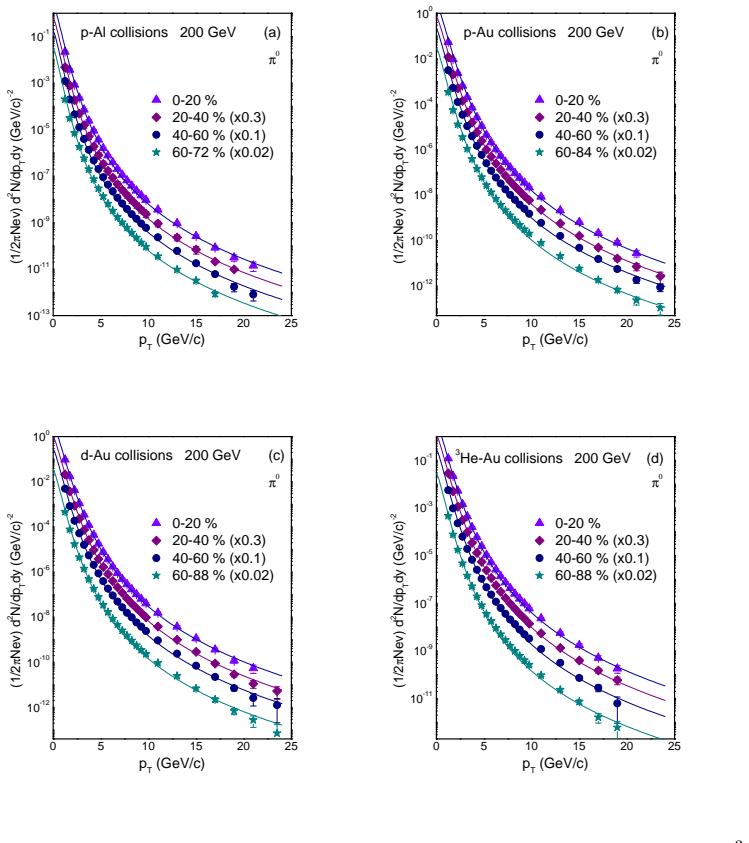
The generalized Fokker-Planck distribution describes neutral pion spectra across small asymmetric collisions at 200 GeV per nucleon pair.
A machine-rendered reading of the paper's core claim, the machinery that carries it, and where it could break.
Core claim
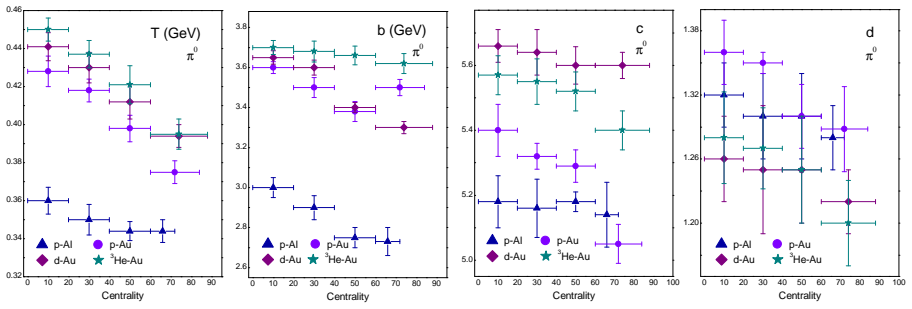
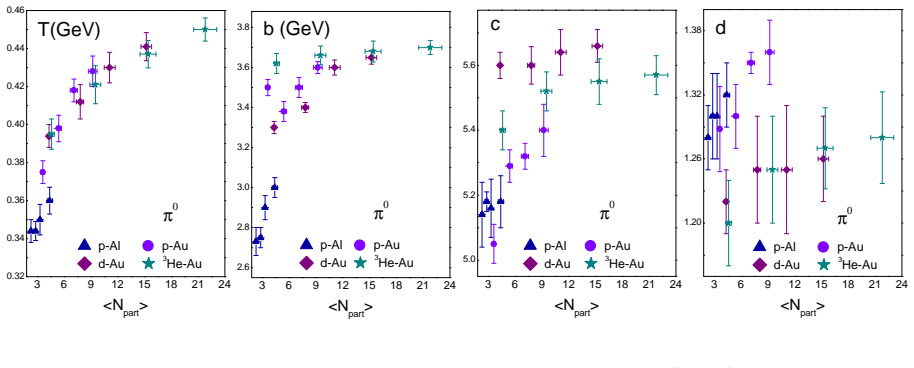
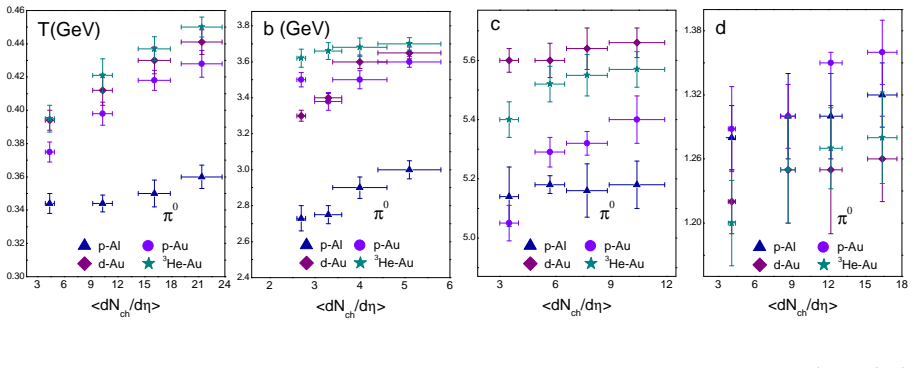
A generalized Fokker-Planck solution provides a unified description of neutral-pion pT spectra over a wide momentum range in the listed small asymmetric collisions. The extracted effective temperature increases with centrality and system size in direct correlation with <N_part> and <dN_ch/dη>, while the transition energy scale between thermal and hard regimes and the power-law exponents remain consistent except for saturation of the transition scale with centrality in 3He-Au. These trends demonstrate that the functional form encodes the relative strength of momentum-space diffusion versus drag and the sharpness of the thermal-to-hard crossover.
What carries the argument
The generalized Fokker-Planck distribution, which solves a kinetic equation containing both drag and diffusion terms together with a non-extensive parameter to produce a smooth transition from an exponential low-pT regime to a power-law tail.
If this is right
- The effective temperature extracted from the fits serves as a direct indicator of the density-dependent freeze-out conditions.
- The extracted power-law exponents quantify the balance between diffusion and drag in momentum space across different system sizes.
- Saturation of the transition scale in 3He-Au implies that diffusion reaches a geometric limit once the gold target dominates the collision volume.
- Consistent parameter trends across four distinct systems support application of the same functional form to other small-system data.
Where Pith is reading between the lines
- The same framework applied to identified hadrons at varying beam energies could expose how the transition scale depends on collision energy.
- Comparison of the extracted temperatures with hydrodynamic freeze-out surfaces would test whether kinetic and hydrodynamic pictures converge on the same late-stage conditions.
- If the non-extensive parameter remains stable across systems, it would suggest that deviations from Boltzmann statistics are intrinsic to the partonic stage rather than a volume effect.
Load-bearing premise
The generalized Fokker-Planck distribution with its fitted parameters already captures the dominant production mechanism without extra system-specific corrections.
What would settle it
A new dataset of pion spectra in the same collision systems that deviates systematically from the generalized Fokker-Planck shape or yields an effective temperature uncorrelated with <N_part>.
Figures
read the original abstract
A generalized Fokker-Planck solution is used to examine the transverse momentum ($p_{T}$) spectra of neutral pions generated in small-system asymmetric collisions, $p$-Al, $p$-Au, $d$-Au, and $^3$He-Au, at $\sqrt{s_{NN}}=200$ GeV. This framework provides a cohesive explanation of particle production over a broad range of transverse momenta. We extract the energy scale governing the transition between a thermal and a hard regime, the effective temperature ($T$), and the exponents determining the high-momentum falloff from fits to PHENIX data. $T$ increases systematically with the collision centrality and colliding system size, ranging from about 0.33 GeV in peripheral $p$-Al collisions to 0.45 GeV in central $^3$He-Au collisions. This increase is correlated with the average number of participant nucleons, $<N_{part}>$, and the charged-particle pseudorapidity density, $<dN_{ch}/d\eta >$, indicating that larger and more central collisions create a denser, more strongly interacting medium that freezes out at a higher temperature. The acquired transition scale and power-law exponents follow consistent patterns across systems and centralities, revealing details about the sharpness of the transition from thermal to hard processes, and the relative strength of momentum-space diffusion versus drag. Interestingly, when the gold target dominates the collision geometry in the largest system ($^3$He-Au), the transition scale becomes nearly independent of centrality, signifying saturation of the diffusion process. Our findings demonstrate that the generalized Fokker-Planck solution is a sensitive probe of transport properties and non-extensive dynamics in the quark-gluon plasma produced even in small-system relativistic collisions, and it consistently describes pion spectra in this set of collisions.
Editorial analysis
A structured set of objections, weighed in public.
Referee Report
Summary. The manuscript applies a generalized Fokker-Planck distribution to fit neutral-pion p_T spectra measured by PHENIX in p-Al, p-Au, d-Au and ³He-Au collisions at √s_NN=200 GeV. From the fits the authors extract an effective temperature T, a transition energy scale between thermal and hard regimes, and high-momentum power-law exponents. They report that T rises systematically from ~0.33 GeV in peripheral p-Al to ~0.45 GeV in central ³He-Au collisions, correlating with <N_part> and <dN_ch/dη>, while the transition scale and exponents show consistent patterns across systems. The central claim is that this functional form provides a cohesive description of the spectra and serves as a sensitive probe of transport properties and non-extensive dynamics in the QGP even in small asymmetric systems.
Significance. If the generalized FP form can be shown to be required by the data and the extracted parameters carry genuine dynamical information beyond fit flexibility, the work would add a useful phenomenological tool for small-system collisions. The multi-system, multi-centrality scan is a positive feature. However, the significance is currently limited by the absence of quantitative fit validation and model-comparison tests; without these the reported trends remain outputs of the chosen parametrization rather than independent evidence for diffusion-drag dynamics or non-extensivity.
major comments (3)
- [Abstract / Results] Abstract and Results section: No χ²/dof, p-values, or residual distributions are reported for the fits to the PHENIX spectra. Without these metrics it is impossible to judge whether the three-parameter generalized FP form actually describes the data better than simpler alternatives (e.g., Tsallis or blast-wave plus power-law) or whether the quoted trends in T are statistically significant.
- [Abstract] Abstract: The claim that the framework 'reveals details about the sharpness of the transition … and the relative strength of momentum-space diffusion versus drag' rests entirely on the fitted values of the transition scale and exponents. No test is presented that these parameters are constrained by the data independently of the functional form’s built-in flexibility, nor is any comparison made to hydrodynamic or transport-model predictions that would be expected to differ in asymmetric systems.
- [Abstract] Abstract: Potential cold-nuclear-matter or geometry-dependent corrections (Cronin effect, nuclear shadowing, participant asymmetry) are not discussed or subtracted. In small asymmetric collisions these contributions are expected to affect the high-p_T tail; their omission undermines the assertion that the extracted parameters directly probe QGP transport properties.
minor comments (2)
- [Formalism] Notation for the generalized FP distribution and its parameters should be defined explicitly in the text (or an appendix) rather than assumed from prior literature.
- [Figures] Figure captions should state the p_T range used in each fit and whether the same functional form was applied uniformly across all systems and centralities.
Simulated Author's Rebuttal
We thank the referee for the constructive comments. We address each major point below, agreeing where revisions are needed to strengthen the manuscript and providing clarifications on the physical motivation of the approach.
read point-by-point responses
-
Referee: [Abstract / Results] Abstract and Results section: No χ²/dof, p-values, or residual distributions are reported for the fits to the PHENIX spectra. Without these metrics it is impossible to judge whether the three-parameter generalized FP form actually describes the data better than simpler alternatives (e.g., Tsallis or blast-wave plus power-law) or whether the quoted trends in T are statistically significant.
Authors: We agree that quantitative fit-quality metrics are necessary to assess the description of the data and to enable comparisons with alternative forms. In the revised manuscript we will add χ²/dof values for every fit, together with representative residual distributions, allowing readers to evaluate both the goodness of fit and the statistical significance of the extracted trends. revision: yes
-
Referee: [Abstract] Abstract: The claim that the framework 'reveals details about the sharpness of the transition … and the relative strength of momentum-space diffusion versus drag' rests entirely on the fitted values of the transition scale and exponents. No test is presented that these parameters are constrained by the data independently of the functional form’s built-in flexibility, nor is any comparison made to hydrodynamic or transport-model predictions that would be expected to differ in asymmetric systems.
Authors: The generalized Fokker-Planck form is derived from a specific diffusion-drag transport equation, so the transition scale and power-law exponents carry direct physical interpretations tied to the underlying dynamics. The observed systematic dependence of these parameters on system size and centrality supplies supporting evidence that they are not arbitrary. We will nevertheless expand the discussion section to articulate this motivation more explicitly and to note the absence of direct hydrodynamic comparisons, which lie outside the present phenomenological scope. revision: partial
-
Referee: [Abstract] Abstract: Potential cold-nuclear-matter or geometry-dependent corrections (Cronin effect, nuclear shadowing, participant asymmetry) are not discussed or subtracted. In small asymmetric collisions these contributions are expected to affect the high-p_T tail; their omission undermines the assertion that the extracted parameters directly probe QGP transport properties.
Authors: We acknowledge that cold-nuclear-matter effects can influence the high-p_T region in asymmetric collisions. The revised manuscript will include a dedicated paragraph discussing the Cronin effect, nuclear shadowing, and geometric asymmetries, while clarifying that the present analysis applies the generalized FP parametrization directly to the published spectra to extract effective transport parameters; explicit subtraction of CNM contributions would require additional modeling beyond the scope of this work. revision: yes
Circularity Check
No significant circularity; analysis is explicit phenomenological fitting
full rationale
The paper states it fits the generalized Fokker-Planck form to PHENIX pT spectra, extracts T, transition scale and exponents, then reports trends of those fitted values versus <N_part> and <dNch/dη>. No derivation chain, first-principles prediction, or uniqueness theorem is presented that reduces by construction to the input spectra or to a self-citation. The central claim is that the chosen functional form describes the data and its parameters correlate with system size; this is a direct output of the fit procedure rather than a hidden tautology or renamed input. No load-bearing self-citation or ansatz smuggling is visible in the provided text.
Axiom & Free-Parameter Ledger
free parameters (3)
- effective temperature T =
0.33-0.45 GeV
- transition energy scale
- high-momentum power-law exponents
axioms (1)
- domain assumption The generalized Fokker-Planck distribution provides a valid description of particle production across the full pT range in these asymmetric collisions.
Reference graph
Works this paper leans on
-
[1]
Gross and F
D.J. Gross and F. Wilczek, Phys. Rev. Lett.30 (1973) 1343-1346. H.D. Politzer, Phys. Rev. Lett. 30(1973) 1346-1349
1973
-
[2]
Fritzsch, M
H. Fritzsch, M. Gell-Mann and H. Leutwyler, Phys. Lett.47B (1973) 365-368
1973
-
[3]
Grosset al., Eur
F. Grosset al., Eur. Phys. J. C83(2023) 1125
2023
-
[4]
Schmidt and S
C. Schmidt and S. Sharma, J. Phys. G44(2017) 104002
2017
-
[5]
H¨ agler, Phys
Ph. H¨ agler, Phys. Rep.490(2010) 49-175
2010
-
[6]
Navaset al.(Particle Data Group), Phys
S. Navaset al.(Particle Data Group), Phys. Rev. D110(2024) 030001
2024
-
[7]
Aokiet al.(Flavour Lattice Averaging Group (FLAG)), Phys
Y. Aokiet al.(Flavour Lattice Averaging Group (FLAG)), Phys. Rev. D113(2026) 014508
2026
-
[8]
Adamet al.(STAR Collaboration), Phys
J. Adamet al.(STAR Collaboration), Phys. Rev. C102(2020) 034909
2020
-
[9]
Adamset al.(STAR Collaboration), Phys
J. Adamset al.(STAR Collaboration), Phys. Rev. Lett.91(2003) 172302
2003
-
[10]
Acharyaet al.(ALICE Collaboration), Phys
S. Acharyaet al.(ALICE Collaboration), Phys. Lett. B805(2020) 135434
2020
-
[11]
Abelevet al.(ALICE Collaboration), Phys
B. Abelevet al.(ALICE Collaboration), Phys. Rev. Lett.109(2012) 252301
2012
-
[12]
Abbottet al.(LIGO Scientific, Virgo), Phys
B.P. Abbottet al.(LIGO Scientific, Virgo), Phys. Rev. Lett.119(2017) 161101
2017
-
[13]
B.P. Abbottet al.(LIGO Scientific, Virgo, Fermi GBM, INTEGRAL, IceCube, AstroSat Cadmium Zinc Telluride Imager Team, IPN, Insight-Hxmt, ANTARES, Swift, AGILE Team, 1M2H Team, Dark Energy Camera GW-EM, 13 DES, DLT40, GRAWITA, Fermi-LAT, ATCA, ASKAP, Las Cumbres Observatory Group, Oz- Grav, DWF (Deeper Wider Faster Program), AST3, CAASTRO, VINROUGE, MASTER,...
2017
-
[14]
Laermann and O
E. Laermann and O. Philipsen, Ann. Rev. Nucl. Part. Sci.53(2003) 163-198
2003
-
[15]
Backet al.(PHOBOS Collaboration), Nucl
B.B. Backet al.(PHOBOS Collaboration), Nucl. Phys. A757(2005) 28-101
2005
-
[16]
Adcoxet al.(PHENIX Collaboration), Nucl
K. Adcoxet al.(PHENIX Collaboration), Nucl. Phys. A757(2005) 184-283
2005
-
[17]
Adamset al.(STAR Collaboration), Nucl
J. Adamset al.(STAR Collaboration), Nucl. Phys. A757(2005) 102-183
2005
-
[18]
Arseneet al.(BRAHMS Collaboration), Nucl
I. Arseneet al.(BRAHMS Collaboration), Nucl. Phys. A757(2005) 1-27
2005
-
[19]
Adamczyket al.(STAR Collaboration), Phys
L. Adamczyket al.(STAR Collaboration), Phys. Rev. Lett.116(2016) 062301
2016
-
[20]
Adamczyket al.(STAR Collaboration), Phys
L. Adamczyket al.(STAR Collaboration), Phys. Rev. Lett.116(2016) 132301
2016
-
[21]
Adamczyket al.(STAR Collaboration), Phys
L. Adamczyket al.(STAR Collaboration), Phys. Rev. C93(2016) 064904
2016
-
[22]
Adamczyket al.(STAR Collaboration), Phys
L. Adamczyket al.(STAR Collaboration), Phys. Rev. D97(2018) 032004
2018
-
[23]
A.N. Tawfik, 16th Marcel Grossmann Meeting on Recent Developments in Theoretical and Experi- mental General Relativity, Astrophysics and Rela- tivistic Field Theories, 5-9 July 2021, MG16, 4277- 4289 (2021), doi: 10.1142/9789811269776 0359
-
[24]
Luo and N
X. Luo and N. Xu, Nucl. Sci. Tech.28(2017) 112
2017
-
[25]
Xu (STAR Collaboration), Nucl
N. Xu (STAR Collaboration), Nucl. Phys. A931 (2014) 1-12
2014
-
[26]
Badshahet al., J
M. Badshahet al., J. Phys. G: Nucl. Part. Phys. 51(2024) 065109
2024
-
[27]
Ajazet al., Chin
M. Ajazet al., Chin. J. Phys.48(2024) 053108
2024
-
[28]
Alrebdi, M
H.I. Alrebdi, M. Ajaz, M. Waqas, M.A. Ahmad, Maryam, A.M. Quraishi, J.H. Baker, S. Jagnandan and A. Jagnandan, Chin. J. Phys.89(2024) 1669- 1677
2024
-
[29]
Waqas, G.X
M. Waqas, G.X. Peng, M. Ajaz, A.A. Ismail Haj, Z. Wazir and L. L. Li, J. Phys. G49(2022) 095102
2022
-
[30]
Badshah, H.I
M. Badshah, H.I. Alrebdi, M. Waqas, M. Ajaz and M.B. Ammar, Eur. Phys. J. A60(2024) 139
2024
-
[31]
Svetitsky, Phys
B. Svetitsky, Phys. Rev. D37(1988) 2484-2491
1988
-
[33]
Zheng and L
H. Zheng and L. Zhu, Adv. in High Energy Phys. 2015(2015) 180491
2015
-
[34]
X. Yin, L. Zhu and H. Zheng, Adv. in High Energy Phys. (2017) 6708581
2017
-
[35]
Zheng, X
H. Zheng, X. Zhu, L. Zhu and A. Bonasera, Mod. Phys. Lett. A35(2020) 2050177
2020
-
[36]
Banerjee and V.M
A. Banerjee and V.M. Yakovenko, New J. Phys.12 (2010) 075032
2010
-
[37]
X. Yin, L. Zhu and H. Zheng, Adv. High Energy Phys.2017(2017) 6708581
2017
-
[38]
Acharyaet al.(PHENIX Collaboration), Phys
U.A. Acharyaet al.(PHENIX Collaboration), Phys. Rev. C105(2022) 064902
2022
-
[39]
Waqas, G.X
M. Waqas, G.X. Peng, M. Ajaz, A. Haj Ismail and E.A. Dawi, Phys. Rev. D106(2022) 075009
2022
-
[40]
Lao, F.H
H.L. Lao, F.H. Liu and B. Q. Ma, Entropy23 (2021) 803
2021
-
[41]
Waqas, G.X
M. Waqas, G.X. Peng and F.H. Liu, J. Phys. G48 (2021) 075108. 14
2021
discussion (0)
Sign in with ORCID, Apple, or X to comment. Anyone can read and Pith papers without signing in.