REVIEW 2 major objections 3 minor 58 references
Cavity-QED-controlled two-dimensional Moir\'e Excitons without twisting
T0 review · 2 major / 3 minor · reviewed 2026-08-06 · deepseek-v4-flash
Pith's one-line read Spatially structured optical cavities can emulate Moiré exciton confinement without twisting, and in dark cavities quantum vacuum fluctuations alone renormalize exciton bands and can make the excitonic mass negative.
desk verdict Novel all-optical Moiré confinement idea with careful algebra, but the dark-cavity centerpiece—long-range exciton-exciton interactions—is not evidenced by the numerics because the computed Hilbert space has at most one exciton. read the letter →
The pith
A machine-rendered reading of the paper's core claim, the machinery that carries it, and where it could break.
The reading
What carries the argument
The load-bearing object is the excitonic QED Hamiltonian (Eq. 3), built from excitonic operators $\hat{X}$, effective photon modes $\bar{q}$ with finite in-plane momentum, and coupling matrix elements $B$ (momentum-conserving exciton-photon scattering) and $I$ (ground-state exciton creation). The paper shows that when a grating gives photons a finite momentum $\bar{q}=q$, the $B$-coupling has the same operator structure as the Moiré potential $M$ with the same lattice periodicity, making the two mathematically interchangeable. In the classical regime this equivalence is analyzed with Floquet theory; in the dark regime the photon sector is eliminated by a high-frequency downfolding (Eq. 5), leaving a dressed Hamiltonian with a four-exciton interaction whose momentum structure is set by the cavity design. The effective-mode construction is what makes the coupling strength finite in the extended matter limit.
What would settle it
Compute the same spectral function with the photon Fock space extended to two photons and the matter space to two excitons; if the M-shaped central band and negative mass disappear or change character, the four-exciton interaction is not what the figures show. Alternatively, measure the exciton spectral function of an untwisted MoSe2/WSe2 bilayer inside a dark grating cavity with pitch near 16–40 nm: the claim predicts an M-shaped central band and a finite-momentum minimum, not a simple polariton splitting.
Extended reading notes
Core claim
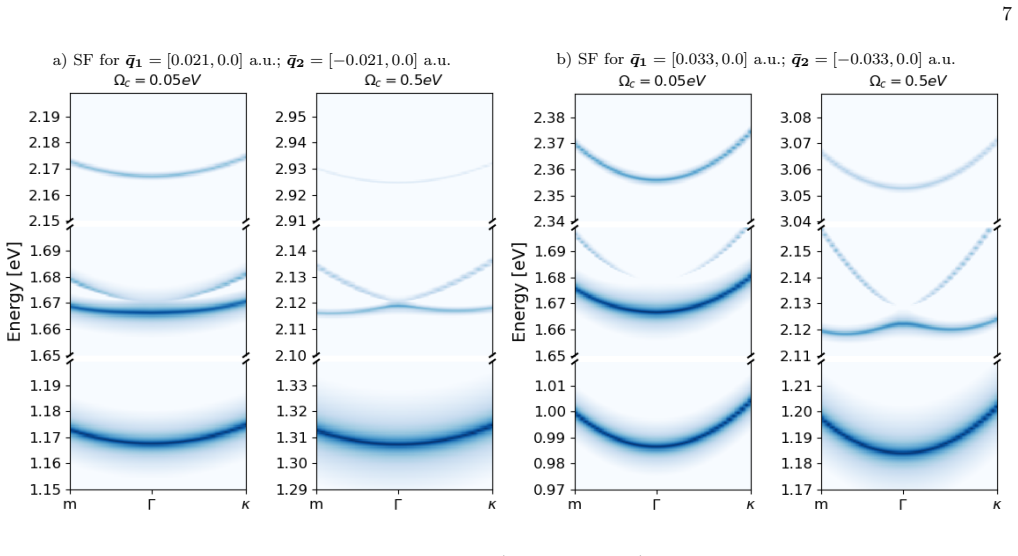
The central claim is that the bilinear light-matter coupling $B$ for finite-momentum cavity modes enters the QED Hamiltonian with exactly the same excitonic operators as the Moiré potential $M$, so a periodic photon mode acts as a synthetic superlattice. In the classical driven case the equivalence is direct: projecting onto coherent states and using Floquet theory gives band folding and avoided crossings at finite momentum, the hallmark of a particle in a periodic potential. In a dark cavity the authors downfold the photon sector in the high-frequency limit and obtain a four-exciton interaction term (Eq. 6), which they identify as a cavity-mediated exciton-exciton interaction that cannot appear in a classical treatment. This interaction is invoked to explain the calculated spectral functions: the lowest bands steepen with photon momentum, and the central band becomes M-shaped around $\Gamma$, meaning negative effective excitonic mass. The paper presents these calculations as evidence that spatially structured cavities can emulate and even go beyond twist-induced Moiré confinement.
Load-bearing premise
The load-bearing premise is that the numerical band renormalization computed in the truncated basis (Appendix E2 keeps only the vacuum and one-photon state, and at most one exciton) actually represents the four-exciton interaction derived by downfolding; if the effect is instead a single-exciton polariton self-energy, the central attribution to cavity-mediated exciton-exciton interactions is not established.
Editorial extensions
If this is right
- Structured cavities with one-dimensional gratings of pitch 10–40 nm should induce Moiré-like exciton band folding in an untwisted TMD bilayer, with splittings in the meV range.
- A dark structured cavity should renormalize the exciton dispersion, producing a negative mass around $\Gamma$; the zero-momentum exciton would become unstable toward a finite-momentum exciton-polariton state.
- Because the effective interaction is nonlocal in momentum and set by cavity geometry, cavity design becomes a tunable proxy for twist angle in engineering excitonic bands.
- The high-frequency downfolded four-exciton term implies that quantum cavities can induce exciton-exciton interactions absent for classical light, opening a route to correlated excitonic phases in equilibrium.
Reading between the lines
- Editorial extension and caveat: the numerical diagonalization is restricted to zero or one photon per mode and at most one exciton (Appendix E2), so the plotted band renormalization is a single-exciton polariton self-energy; the paper's attribution of it to the four-exciton term of Eq. 6 is derived, not directly tested by the figures, and extending the Fock space to two photons and two excitons wo
- Editorial extension: if the four-exciton interaction is real beyond the truncation, the cavity-induced mass renormalization should become density-dependent, for example a pump-induced blueshift or band flattening of the exciton dispersion at finite exciton density.
- Editorial extension: the same equivalence argument suggests that any strong exciton transition embedded in a grating cavity inherits a designer nonlocal interaction set by the grating, so the proposal extends beyond TMDs to other 2D semiconductors with bright excitons.
- Editorial extension: a side-by-side experiment on a twisted bilayer and an untwisted bilayer in a dark structured cavity with matched superlattice periodicity could separate optical Moiré effects from lattice relaxation and strain, which the paper does not address.
Editorial analysis
A structured set of objections, weighed in public.
Referee Report
Summary. The paper proposes to use spatially structured optical cavities to create Moiré-like exciton confinement in untwisted van der Waals heterostructures. The authors derive a QED Hamiltonian in an exciton basis, treat a classically driven cavity with Floquet theory, and a dark cavity by exact diagonalization with photon states {|0>,|1>}. In the driven case they report band folding due to momentum-carrying modes, analogous to a Moiré potential. In the dark-cavity case they report renormalized excitonic bands and a negative effective mass at the Γ point, which they attribute to cavity-mediated exciton-exciton interactions derived by downfolding.
Significance. If established, the proposal would offer an all-optical route to Moiré-like exciton confinement without twist, and the predicted cavity-mediated exciton-exciton interaction would connect cavity QED to correlated exciton phases. The classical-emulation result is a plausible and useful design principle: in the classical limit the momentum-carrying bilinear coupling has the same operator structure as a periodic Moiré potential. The paper also provides a detailed Hamiltonian derivation, explicit definitions of the spectral function and linear susceptibility, and concrete parameter estimates. However, the numerical evidence presented does not yet establish the central dark-cavity interaction claim, because the computed Hilbert space cannot host two excitons and therefore cannot test the four-exciton operator of Eq. (6).
major comments (2)
- [II C and Figs. 4-5 / Appendix E2] The attribution of the dark-cavity band renormalization to the four-exciton term in Eq. (6) is not supported by the numerical calculation. According to Appendix E2, the matter basis is restricted to the ground state and a single excitonic Slater determinant, and each photon mode is truncated to |0> and |1>. The implemented Hamiltonian in Eq. (E1) contains only one-exciton-conserving terms X†X and single-exciton source terms X† and X; it contains no X†X† or XX vertex. Consequently, the two-exciton operator in Eq. (6) has zero matrix elements on the computed basis, and the M-shaped central band and negative mass in Figs. 4-5 can only arise from single-exciton polariton self-energy and band folding, not from an exciton-exciton interaction. A calculation that explicitly includes the two-exciton sector, or an observable that isolates a two-exciton channel, is required before this central attribution can be accepted.
- [II C, Eqs. (5)-(6) and Appendix D] The effective four-exciton Hamiltonian is obtained by a second-order downfolding in 1/Omega_q, which is a high-frequency expansion. The dark-cavity simulations in Figs. 4-5 use cavity energies Omega_c = 0.05 eV and 0.5 eV, while the exciton transition is near 1.4 eV and the coupling A0 = 0.08 a.u. is of order 2 eV. The expansion parameter is therefore not small in the regime of the displayed spectra. Even if the two-exciton sector were included, Eq. (6) would not provide a controlled quantitative explanation of the spectra at these parameters. The authors should either use parameters where the downfolding is justified or base the interpretation on a non-perturbative calculation that resolves the two-exciton states directly.
minor comments (3)
- [Appendix C, first sentence] The text says "the full expression for the Interaction Hamiltonian (Eq. 6 of the main text)", but the coherent-state projection is performed on Eq. (4), not on Eq. (6), which is the downfolded dark-cavity Hamiltonian.
- [II A, Eq. (4)] After setting \bar q = q, the same symbol q is used for the photonic mode momentum and the Moiré lattice momentum; a distinct notation would make the argument clearer and avoid the impression that the "mutual interchangeability" is a tautological relabeling.
- [II C, Figs. 4-5] The text states that the separation between the three bands increases with Omega_c, but no dark-cavity calculation as a function of Omega_c is shown; a parametric scan or an explicit statement that this is an analytic scaling observation would make the claim verifiable.
Circularity Check
No significant circularity: the cavity-Moiré mapping is a derived operator equivalence, and the dark-cavity interaction term is obtained by a self-contained downfolding; the main caveat is evidentiary, not circular.
full rationale
The paper's central classical-cavity claim rests on the operator structure of Eq. (4), where the Moiré potential M and the bilinear coupling B share the same excitonic operators Τ†Τ once the photon momentum ¯q is set equal to the Moiré reciprocal vector q. This equivalence is not an input assumed in the definition of either term: the B coupling is derived in Appendix A from the minimal-coupling Pauli-Fierz Hamiltonian, and the Moiré potential comes from an independent electronic-structure input. Replacing photon operators by coherent-state amplitudes in the classical limit is a legitimate mathematical reduction, not a renaming of the conclusion. The dark-cavity prediction is supported by an analytic Schrieffer-Wolff-style downfolding in Appendix D, which explicitly produces the four-exciton operator of Eq. (6) from the bilinear B-term matrix elements; that derivation is self-contained and does not presuppose the claimed band renormalization. The numerical Hilbert space in Appendix E2 is restricted to at most one exciton and one photon per mode, so the figures cannot themselves exhibit the effect of the four-exciton operator; this is a real evidentiary gap between the analytic claim and the numerics, but it is a correctness/attribution issue, not a circular reduction. No fitted parameter is renamed as a prediction, and the cited self-work ([38]) is used only as a supporting remark, not as the load-bearing justification for the interaction term. The derivation chain is therefore not circular.
Assumptions & free parameters
free parameters (3)
- cavity light-matter coupling A0_bar_q =
0.02-0.16 a.u.
- photon mode momentum qx =
0.009, 0.021, 0.033 a.u.
- cavity mode energy Omega_c =
0.05-1.468 eV
assumptions (4)
- domain assumption The effective cavity mode construction of Ref. [36], originally derived within the long-wavelength approximation, remains valid for finite in-plane momentum modes.
- ad hoc to paper The photonic Fock space can be truncated to {0,1} and the matter space to at most one exciton.
- domain assumption Other excitons (inter-layer, WSe2 intra-layer) decouple from the 1s MoSe2 intra-layer exciton.
- domain assumption A 65x65 k-point grid and the Mott-Wannier parameters from Refs. [14,15] are sufficient for the excitonic wavefunctions and energies.
Cite this review
Pith. "Pith review of Cavity-QED-controlled two-dimensional Moir\'e Excitons without twisting." pith.science (2026). https://pith.science/paper/NMU5IOLI
@misc{pith2026250802388,
  author       = {Pith},
  title        = {Pith review of: Cavity-QED-controlled two-dimensional Moir\'e Excitons without twisting},
  year         = {2026},
  howpublished = {\url{https://pith.science/paper/NMU5IOLI}},
  note         = {Machine review of arXiv:2508.02388}
}
read the original abstract
We propose an all-optical Moir\'e-like exciton confinement by means of spatially periodic optical cavities. Such periodic photonic structures can control the material properties by coupling the matter excitations to the confined photons and their quantum fluctuations. We develop a low energy non-perturbative quantum electro-dynamical description of strongly coupled excitons and photons at finite momentum transfer. We find that in the classical limit of a laser driven cavity the induced optical confinement directly emulates Moir\'e physics. In a dark cavity instead, the sole presence of quantum fluctuations of light generates a sizable renormalization of the excitonic bands and effective mass. We attribute these effects to long-range cavity-mediated exciton-exciton interactions which can only be captured in a non-perturbative treatment. With these findings we propose spatially structured cavities as a promising avenue for cavity material engineering.
Figures


Figures from the paper (4 more)


Reference graph
Works this paper leans on
-
[1]
A. Geim and I. Grigorieva, Van der waals heterostruc- tures, Nature 499, 419 (2013)
work page 2013
-
[2]
K. F. Mak and J. Shan, Photonics and optoelectronics of 2D semiconductor transition metal dichalcogenides, Na- ture Photonics 10, 216 (2016)
work page 2016
-
[3]
K. S. Novoselov, A. Mishchenko, A. Carvalho, and A. H. C. Neto, 2d materials and van der waals het- erostructures, Science 353, aac9439 (2016)
work page 2016
-
[4]
V. Shanmugam, R. A. Mensah, K. Babu, S. Gawusu, A. Chanda, Y. Tu, R. E. Neisiany, M. F¨ orsth, G. Sas, and O. Das, A review of the synthesis, properties, and applications of 2d materials, Particle & Particle Systems Characterization 39, 2200031 (2022)
work page 2022
-
[5]
D. M. Kennes, M. Claassen, L. Xian, A. Georges, A. J. Millis, J. Hone, C. R. Dean, D. Basov, A. N. Pa- supathy, and A. Rubio, Moir´ e heterostructures as a condensed-matter quantum simulator, Nature Physics 17, 155 (2021)
2021
-
[6]
K. F. Mak, C. Lee, J. Hone, J. Shan, and T. F. Heinz, Atomically thin mos 2: a new direct-gap semiconductor, Physical Review letters 105, 136805 (2010)
work page 2010
- [7]
-
[8]
M. N. Gjerding, A. Taghizadeh, A. Rasmussen, S. Ali, F. Bertoldo, T. Deilmann, N. R. Knøsgaard, M. Kruse, A. H. Larsen, S. Manti,et al., Recent progress of the com- putational 2d materials database (c2db), 2D Materials 8, 044002 (2021)
work page 2021
Show all 58 references
-
[9]
G. Wang, A. Chernikov, M. M. Glazov, T. F. Heinz, X. Marie, T. Amand, and B. Urbaszek, Colloquium: Excitons in atomically thin transition metal dichalco- genides, Rev. Mod. Phys. 90, 021001 (2018)
2018
- [10]
-
[11]
Bistritzer and A
R. Bistritzer and A. H. MacDonald, Moir´ e bands in twisted double-layer graphene, Proceedings of the Na- tional Academy of Sciences 108, 12233 (2011)
2011
-
[12]
Y. Cao, V. Fatemi, S. Fang, K. Watanabe, T. Taniguchi, E. Kaxiras, and P. Jarillo-Herrero, Unconventional super- conductivity in magic-angle graphene superlattices, Na- ture 556, 43 (2018)
2018
-
[13]
Hennighausen and S
Z. Hennighausen and S. Kar, Twistronics: a turning point in 2d quantum materials, Electronic Structure 3, 014004 (2021)
2021
-
[14]
S. Brem, C. Linder¨ alv, P. Erhart, and E. Malic, Tunable phases of moir´ e excitons in van der waals heterostruc- tures, Nano Letters 20, 8534 (2020), pMID: 32970445, https://doi.org/10.1021/acs.nanolett.0c03019
2020 doi
-
[15]
Ovesen, S
S. Ovesen, S. Brem, C. Linder¨ alv, M. Kuisma, T. Korn, P. Erhart, M. Selig, and E. Malic, Interlayer exciton dy- namics in van der waals heterostructures, Communica- tions Physics 2, 23 (2019)
2019
-
[16]
Xiong, J
R. Xiong, J. H. Nie, S. L. Brantly, P. Hays, R. Sailus, K. Watanabe, T. Taniguchi, S. Tongay, and C. Jin, Cor- related insulator of excitons in wse 2/ws2 moir´ e superlat- tices, Science 380, 860 (2023)
2023
-
[17]
Y. Cao, V. Fatemi, S. Fang, et al., Unconventional super- conductivity in magic-angle graphene superlattices, Na- ture 556, 43 (2018)
2018
-
[18]
A. L. Sharpe et al., Emergent ferromagnetism near three- quarters filling in twisted bilayer graphene, Science 365, 605 (2019)
2019
-
[19]
Latini, E
S. Latini, E. Ronca, U. De Giovannini, H. H¨ ubener, and A. Rubio, Cavity control of excitons in two-dimensional materials, Nano Letters 19, 3473 (2019)
2019
-
[20]
Flatten, Z
L. Flatten, Z. He, D. Coles, et al., Room-temperature exciton-polaritons with two-dimensional ws 2, Scientific Reports 6, 33134 (2016)
2016
-
[21]
Zhang, B
H. Zhang, B. Abhiraman, Q. Zhang, et al., Hybrid exciton-plasmon-polaritons in van der waals semiconduc- tor gratings, Nature Communications 11, 3552 (2020)
2020
-
[22]
M. K. Svendsen, Y. Kurman, P. Schmidt, et al., Combin- ing density functional theory with macroscopic qed for quantum light-matter interactions in 2d materials, Na- ture Communications 12, 2778 (2021)
2021
-
[23]
Datta, M
B. Datta, M. Khatoniar, P. Deshmukh, F. Thouin, R. Bushati, S. D. Liberato, S. Kena-Cohen, and V. M. Menon, Highly nonlinear dipolar exciton-polaritons in bi- layer mos2, Nature Communications 13, 6341 (2022)
2022
-
[24]
Latini, U
S. Latini, U. De Giovannini, E. J. Sie, N. Gedik, H. Huebener, and A. Rubio, Phonoritons as hybridized exciton-photon-phonon excitations in a monolayer h-bn optical cavity, Phys. Rev. Lett. 126, 227401 (2021)
2021
-
[25]
H. Deng, G. Weihs, C. Santori, J. Bloch, and Y. Ya- mamoto, Condensation of semiconductor microcavity ex- citon polaritons, Science 298, 199 (2002)
2002
-
[26]
Kasprzak, M
J. Kasprzak, M. Richard, S. Kundermann, A. Baas, P. Jeambrun, J. M. J. Keeling, F. M. Marchetti, M. H. Szyma´ nska, R. Andr´ e, J. L. Staehli, V. Savona, P. B. Lit- tlewood, B. Deveaud, and L. S. Dang, Bose–einstein con- densation of exciton polaritons, Nature 443, 409 (2006)
2006
-
[27]
Appugliese, J
F. Appugliese, J. Enkner, G. L. Paravicini-Bagliani, M. Beck, C. Reichl, W. Wegscheider, G. Scalari, C. Ciuti, and J. Faist, Breakdown of topological protection by cav- 10 ity vacuum fields in the integer quantum hall effect, Sci- ence 375, 1030 (2022)
2022
-
[28]
M. A. Sentef et al., Cavity quantum-electrodynamical polaritonically enhanced electron-phonon coupling and its influence on superconductivity, Science Advances 4, eaau6969 (2018)
2018
-
[29]
Mazza and A
G. Mazza and A. Georges, Superradiant quantum mate- rials, Phys. Rev. Lett. 122, 017401 (2019)
2019
-
[30]
H¨ ubener, E
H. H¨ ubener, E. V. Bostr¨ om, M. Claassen, S. Latini, and A. Rubio, Quantum materials engineering by structured cavity vacuum fluctuations, Materials for Quantum Tech- nology 4, 023002 (2024)
2024
-
[31]
Latini, D
S. Latini, D. Shin, S. A. Sato, C. Schaefer, U. De Giovan- nini, H. Huebener, and A. Rubio, The ferroelectric photo ground state of srtio 3: Cavity materials engineering, Proc. Natl. Acad. Sci. U.S.A. 118, e2105618118 (2021)
2021
-
[32]
Carusotto and C
I. Carusotto and C. Ciuti, Quantum fluids of light, Rev. Mod. Phys. 85, 299 (2013)
2013
-
[33]
Vi˜ nas Bostr¨ om, A
E. Vi˜ nas Bostr¨ om, A. Sriram, M. Claassen,et al., Con- trolling the magnetic state of the proximate quantum spin liquid α-rucl3 with an optical cavity, npj Compu- tational Materials 9, 202 (2023)
2023
-
[34]
I.-T. Lu, D. Shin, M. K. Svendsen, S. Latini, H. H¨ ubener, M. Ruggenthaler, and A. Rubio, Cavity engineering of solid-state materials without external driving, Advances in Optics and Photonics 17, 441 (2025)
2025
-
[35]
Sarkar, M
S. Sarkar, M. J. Mehrabad, D. G. Su´ arez-Forero, L. Gu, C. J. Flower, L. Xu, K. Watanabe, T. Taniguchi, S. Park, H. Jang, Y. Zhou, and M. Hafezi, Sub-wavelength optical lattice in 2d materials, Science Advances 10, eadv2023 (2024)
2024
- [36]
-
[37]
Rokaj, M
V. Rokaj, M. Ruggenthaler, F. G. Eich, and A. Ru- bio, Free electron gas in cavity quantum electrodynamics, Physical Review Research 4, 013012 (2022)
2022
-
[38]
H. Liu, F. Troisi, H. Huebener, S. Latini, and A. Rubio, Cavity-mediated electron-electron inter- actions: Renormalizing dirac states in graphene https://doi.org/10.48550/arXiv.2505.10166 (2025)
2025 doi
-
[39]
Oka and S
T. Oka and S. Kitamura, Floquet engineering of quantum materials, Annual Review of Condensed Matter Physics 10, 387 (2019)
2019
-
[40]
H¨ ubener, U
H. H¨ ubener, U. De Giovannini, C. Sch¨ afer, et al., En- gineering quantum materials with chiral optical cavities, Nature Materials 20, 438 (2021)
2021
-
[41]
J. Li, L. Schamriß, and M. Eckstein, Effective theory of lattice electrons strongly coupled to quantum electromag- netic fields, Phys. Rev. B 105, 165121 (2022)
2022
-
[42]
Mikami, S
T. Mikami, S. Kitamura, K. Yasuda, N. Tsuji, T. Oka, and H. Aoki, Brillouin-wigner theory for high-frequency expansion in periodically driven systems: Application to floquet topological insulators, Phys. Rev. B 93, 144307 (2016)
2016
-
[43]
Barton III, J
D. Barton III, J. Hu, J. Dixon, E. Klopfer, S. Dagli, M. Lawrence, and J. Dionne, High-q nanophotonics: sculpting wavefronts with slow light, Nanophotonics 10, 83 (2020)
2020
-
[44]
D. R. Danielsen, N. Lassaline, S. J. Linde, M. V. Nielsen, X. Zambrana-Puyalto, A. Sarbajna, D. H. Nguyen, T. J. Booth, N. Leitherer-Stenger, and S. Raza, Fourier- tailored light–matter coupling in van der waals het- erostructures, ACS nano (2025)
2025
-
[45]
Herzig Sheinfux, L
H. Herzig Sheinfux, L. Orsini, M. Jung, I. Torre, M. Cec- canti, S. Marconi, R. A. Maniyara, D. Barcons Ruiz, A. H¨ otger, R. Bertini, S. Castilla, N. C. H. Hesp, E. Janzen, A. Holleitner, V. Pruneri, J. H. Edgar, G. Shvets, and F. H. L. Koppens, High-quality nanocav- ities th...
2024
-
[46]
Galiffi, G
E. Galiffi, G. Carini, X. Ni, G. ´Alvarez P´ erez, S. Yves, E. M. Renzi, R. Nolen, S. Wasserroth, M. Wolf, P. Alonso-Gonz´ alez, A. Paarmann, and A. Al` u, Ex- treme light confinement and control in low-symmetry phonon-polaritonic crystals, Nature Reviews Materials 9, 9 (2024)
2024
-
[47]
Y. Chen, S. Miao, T. Wang, D. Zhong, A. Saxena, C. Chow, J. Whitehead, D. Gerace, X. Xu, S. Shi, and A. Majumdar, Metasurface integrated monolayer exciton polariton, Nano Letters 20, 5292 (2020)
2020
-
[48]
Ruggenthaler, N
M. Ruggenthaler, N. Tancogne-Dejean, J. Flick, et al., From a quantum-electrodynamical light–matter descrip- tion to novel spectroscopies, Nature Reviews Chemistry 2, 0118 (2018)
2018
-
[49]
Korm´ anyos, G
A. Korm´ anyos, G. Burkard, M. Gmitra, J. Fabian, V. Z´ olyomi, N. D. Drummond, and V. Falko, k ·p the- ory for two-dimensional transition metal dichalcogenide semiconductors, 2D Materials 2, 022001 (2015). 11 Appendix A: QED Hamiltonian derivation This section contains the de...
2015
-
[50]
Refer to Fig
QED Hamiltonian with electronic creation and annihilation operators This work studies Moir´ e excitons in type-II MoSe2/WSe2 hetero-structure in optical cavities. Refer to Fig. 1 of the main text for its representation. The two layers are separated by a dielectric medium. Let ...
-
[51]
QED Hamiltonian in the electron-hole basis We prefer to use an exciton representation to study the behavior of excitons in such a system, as it allows to directly encode the effect of the Coulomb potential in the formation of such bound quasi-particles. To address this problem...
-
[52]
QED Hamiltonian in the excitonic basis The basis used in the previous section can be further optimized for the present problem. For this purpose, we introduce the bound excitons operators ˆX ll′ Q , where Q is the center of mass momentum of the exciton, such that: ˆP † l,i,k;l...
-
[53]
It is obtained from applying the linear response theory to the polaritonic states [48]
Linear response function The linear response function χ (ω, Ωc, θ) represents the optical response of the system. It is obtained from applying the linear response theory to the polaritonic states [48]. We only calculate the matter part of such a response by tracing out the pho...
-
[54]
We use the spectral function to obtain the band structure of the polaritonic system in the Moir´ e BZ
Spectral function We define the spectral function S (ω, Ωc, θ,Q) as: S (ω, Ωc, θ,Q) = X I ⟨ΨI | ˆS† Q |Ψ0⟩ ⟨Ψ0| ˆSQ |ΨI ⟩ ω − (EI (Ωc, θ) − E0 (Ωc, θ)) + iη (B2) where all quantities and indexes have the same definition as in Section B 1. We use the spectral function to obtain...
-
[55]
In the following, we consider a classically driven cavity with ˜A0 = 0.02a.u
High frequency limit In this section, we discuss the high frequency limit for the classically driven Hamiltonian. In the following, we consider a classically driven cavity with ˜A0 = 0.02a.u. and two modes with momentumq = [0.009, 0], −q = [−0.009, 0]. Since we are interested ...
-
[56]
A16: ℏ2k2 2mr ll′ ψν ll′ (k) − X q W ll′ q ψν ll′ (k + q) = ˆEν ll′ψν ll′ (k) where W ll′ q is the Coulomb potential defined in A1 and ˆEν ll′ is the bound energy
Mott-W annier model computational details Excitons in the Mott-Wannier model are formed thanks to the solution of Eq. A16: ℏ2k2 2mr ll′ ψν ll′ (k) − X q W ll′ q ψν ll′ (k + q) = ˆEν ll′ψν ll′ (k) where W ll′ q is the Coulomb potential defined in A1 and ˆEν ll′ is the bound ene...
-
[57]
3 of the main text
QED Hamiltonian approximations The QED Hamiltonian is reported in Eq. 3 of the main text. We represent this Hamiltonian on the basis |ΨEX ⟩ ⊗ |n⟩0 ⊗|n⟩1 ..., where |ΨEX ⟩ is a Slater determinant representing an excitonic excitation or the many-body ground state and |n⟩i repres...
-
[58]
As for the photonic part, it is immediate to see that the matrix element is non-zero only if |n ¯q⟩ = |m ¯q⟩ ±1
T ransition matrix elements The transition matrix elements are given by computing the quantity ⟨ΨEX,Q, n¯q| ˆHbil |ΨEX,q′ , m¯q⟩ where |n ¯q⟩ , |m ¯q⟩ represent the initial and final photonic state for the mode ¯q, and ˆHbil is: ˆHbil = X λ, ¯q ˜A0, ¯q X Q Bλ Q, ¯q ˆX † Q+ ¯q ...
Reviewed August 6, 2026 · model on record in the stance chip above.
Discussion (0). Sign in to comment.