REVIEW 3 major objections 7 minor 15 references
Distilling On-Device Intelligence at the Network Edge
T0 review · 3 major / 7 minor · reviewed 2026-08-14 · deepseek-v4-flash
Pith's one-line read The design space for wireless edge ML training is organised by what is exchanged: model parameters, model outputs, or surrogate data.
desk verdict A clean survey-like map of seven edge-FL frameworks from the authors' own prior work, organized by what is exchanged; the taxonomy is useful, but the empirical claims are all borrowed from self-cited papers. read the letter →
The pith
A machine-rendered reading of the paper's core claim, the machinery that carries it, and where it could break.
The reading
What carries the argument
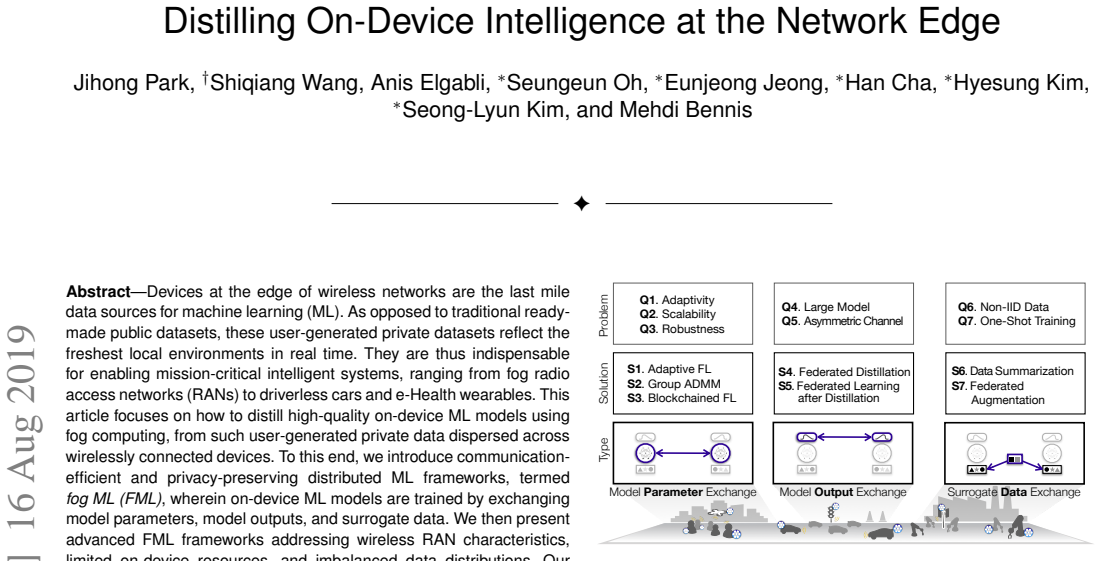
The carrying object is a three-way taxonomy of what crosses the wireless link. Parameter exchange is realised by Vanilla FL, which averages local models at a server at fixed intervals. Output exchange is realised by federated distillation, which replaces raw samples with a small set of proxy samples (class representatives or quantized states), averages the logits per proxy across devices, and uses co-distillation to pull every local model toward the global average prediction; this makes the communicated payload scale with the number of proxy labels rather than the number of model parameters. Surrogate-data exchange is realised by statistical or compressed summaries (mean, histograms, PCA, coresets) and by federated GAN training, where devices jointly train a generator network so each device can reproduce the others' data locally. Adaptive communication intervals, neighbour-only ADMM, blockchain consensus, and multi-hop seed-sample collection are the supporting mechanisms that let each exchange mode handle its assigned problem.
What would settle it
Re-run the MNIST classification and CartPole reinforcement-learning experiments from the cited works with matched datasets, device counts, and total communication and computation budgets. The central efficiency claim loses support if federated distillation does not reach accuracy close to Vanilla FL while transmitting about one tenth of the bytes, or if the hybrid FLD scheme does not beat both pure FL and pure FD when each device uploads 2% of its local data.
Extended reading notes
Core claim
The central claim is that seven investigated problems of on-device learning at the edge do not require seven unrelated algorithms. Each solution is a specialisation of one of three exchange modes: model-parameter exchange, where devices send weights or gradients to a server that averages them; model-output exchange, where devices share averaged predictions on shared proxy samples and align their local models through knowledge distillation; and surrogate-data exchange, where devices share summaries or collectively train a generator that produces realistic synthetic samples. The article maps S1–S7 onto these modes, and argues that parameter exchange alone is ill-suited to large models and uplink bottlenecks, that output exchange makes the payload independent of model size but degrades under non-IID data, and that surrogate-data exchange rectifies non-IID distributions and enables single-round training. The paper concludes that fully realising fog ML requires co-designing communication and distributed ML operations while accounting for heterogeneous hardware, data characteristics, and privacy requirements.
Load-bearing premise
The article's recommendations rest on the assumption that training by exchanging only model parameters, model outputs, or surrogate data can match the accuracy of centralized training, with the headline quantitative results carried over from the authors' earlier experiments that this preprint does not reproduce or make reproducible.
Editorial extensions
If this is right
- Communication payload can be made independent of model size by exchanging model outputs instead of parameters, which matters for deep networks with millions of weights.
- Server-less parameter exchange (GADMM, BlockFL) removes the single point of failure and lets each device communicate only with neighbours, trading a central server for consensus overhead.
- Asymmetric uplink and downlink channels can be exploited by sending outputs on the weak uplink and parameters on the strong downlink, with knowledge distillation at the server converting between the two.
- Non-IID data, which degrades both parameter and output exchange, can be counteracted by sharing data summaries or by federated augmentation that regenerates missing classes locally.
- Single-round training becomes feasible when devices exchange surrogate data, since a summary or generator substitutes for the iterative exchange of updates.
Reading between the lines
- A testable extension the paper leaves implicit is a switching policy: use output exchange when the model is large and the uplink weak, then switch to parameter exchange when channels improve, guided by the convergence bounds of the adaptive scheme.
- The taxonomy suggests a phase diagram in model size, uplink capacity, and data heterogeneity in which each exchange mode is optimal; such a diagram could be built from the accuracy-versus-bytes curves the article reports.
- The privacy guarantees of the three modes are not quantified in this article, so a formal comparison of what an adversary can infer from parameters, averaged logits, and surrogate data would be a natural next step.
- Because federated distillation's payload is independent of model size, it could support heterogeneous on-device architectures, an idea the article mentions for hardware heterogeneity but does not develop.
Signed reviews
Editorial analysis
A structured set of objections, weighed in public.
Referee Report
Summary. This paper proposes a taxonomy for fog machine learning (FML) organized by the type of information exchanged among edge devices: model parameters (solutions S1–S3), model outputs (S4–S5), and surrogate data (S6–S7). It defines seven fundamental problems Q1–Q7—adaptivity, scalability, robustness, large models, asymmetric channels, non-IID data, and one-shot training—and maps each to a framework drawn primarily from the authors' prior work: Adaptive FL, Group ADMM, Blockchained FL, Federated Distillation, Federated Learning after Distillation, Federated Data Summarization, and Federated Augmentation. Each framework is described at a high level, and the article closes with a discussion of realistic RAN characteristics, heterogeneous hardware, and privacy/fairness.
Significance. As a structural claim, the paper offers a memorable and useful 'what to exchange' axis for organizing the rapidly growing distributed edge-learning literature, complementing taxonomies based on data correlations such as [3]. The writing is clear and the intended scope (data-parallel architectures, communication efficiency) is stated explicitly. The paper is also honest in attributing each component to prior work, which makes the survey's provenance transparent. Its main weakness is that the practical-benefit claims—communication reductions, accuracy plots, privacy guarantees—rest on self-cited workshop and arXiv papers without enough detail in the present manuscript to be independently checked. This weakens the article's value as a quantitative reference, although it does not invalidate the organizational thesis.
major comments (3)
- [Sec. 3.1, Figs. 2, 5b, 6b] The quantitative performance claims, such as 'FD yields comparable accuracy with Vanilla FL, while reducing the communication overhead by tenfold' in Section 3.1, are presented as evidence that the proposed FML frameworks are communication-efficient—a central contribution stated in the abstract. However, the only support offered is the authors' own prior workshop and arXiv papers ([5], [9], [11], [15]), and the manuscript provides no experimental protocol, hyperparameters, error bars, or code. Please either include sufficient experimental detail (in the text or a supplement) to make these claims checkable, or soften the claims to qualitative summaries with explicit pointers to the original publications for the numerical evidence.
- [Sec. 2.2, after 'Dual Updates'] The claim that 'GADMM achieves the training convergence rate o(1/k) with k iterations, which is faster than o(1/√k) of the distributed gradient descent algorithm' uses small-o notation in a context where big-O is almost certainly intended. As written, the statement is not well defined (small-o requires a limiting statement), and no assumptions on the loss function or algorithm parameters are supplied. Please correct the notation, state the precise assumptions from [6], and cite the specific convergence result, because this speed advantage is a stated motivation for S2.
- [Abstract and Sec. 5.3] The manuscript repeatedly describes FML frameworks as 'privacy-preserving' without defining a threat model or a privacy metric. Section 5.3 itself acknowledges a privacy-accuracy trade-off, and earlier sections note that logits, seed samples, and SDI may leak information. Please qualify the privacy claim (for instance, by stating whether the guarantee is 'no raw data transmission' or a formal differential-privacy notion), and specify the assumed adversary; otherwise the central claim of privacy preservation is not checkable from this manuscript.
minor comments (7)
- [Sec. 2.2] The phrase 'Alternating Direct Method of Multiplier' should read 'Alternating Direction Method of Multipliers' (ADMM).
- [Sec. 2.1, Fig. 2] The legend of Fig. 2 is crowded and the labels 'data1' through 'data9' are not explained in the caption; please clarify what these curves represent or state that the details are in [5].
- [Sec. 3.1, Fig. 4] The numbered callouts in Fig. 4 ('UL: local avg. logits1', 'DL: global avg. logits2', 'CD: global avg. logits → local model3') are difficult to follow; please renumber the steps and describe them in the caption.
- [Sec. 4.2, Fig. 6b] The two-panel Fig. 6b should either be split into separate subfigures or the caption should clearly label which panel shows test accuracy and which shows label privacy, using larger or clearer labels than the current parenthetical convention.
- [Sec. 4.1] Since Q7 asks for 'one-shot training', the sentence 'by aggregating the data summary at a single location, ML models can be trained without further exchanging raw data samples' should explicitly state that this corresponds to a single communication round for S6.
- [Sec. 4.2] The sentence 'The private SDI [0,0,1] of device2 can identically become the public SDI' is ambiguous; 'identically' should be replaced with 'coincide with' or a similar expression.
- [Sec. 5.3] The sentence 'User-generated data can preserve its privacy by distorting raw samples or adding dummy information in FML' is awkwardly phrased; consider rewriting as 'The privacy of user-generated data can be preserved by distorting raw samples or adding dummy information in FML.'
Circularity Check
No significant circularity: the central taxonomy is a structural classification of the authors' prior frameworks, and the self-cited quantitative claims are not load-bearing for that classification.
full rationale
The paper is a survey-style exposition rather than a derivation, and its central claim is the classification statement: "our proposed solutions S1-S7 to these problems Q1-Q7 boil down to three types of on-device ML model training methods: by exchanging (1) model parameters, (2) model outputs, and (3) surrogate data." This is a structural claim about the algorithms described in Sections 2-4, and the descriptions in this paper are sufficient to support the categorization on their own. The quantitative accuracy and communication-overhead assertions, such as "FD yields comparable accuracy with Vanilla FL, while reducing the communication overhead by tenfold, in our experiments ... [9], [11]", are imported from prior publications by the same authors and are not reproduced here; that is a reproducibility concern, not circularity. Those numbers are not used to derive the taxonomy, and the taxonomy would remain coherent even if the experimental numbers were revised or challenged. No equation in the paper is shown to equal its own input, no fitted parameter is renamed as a prediction, and no uniqueness theorem is invoked to force a choice. The self-citations are descriptive references to the authors' own earlier work, and while they carry evidentiary weight for specific empirical claims, they do not constitute a circular derivation chain within this paper.
Assumptions & free parameters
assumptions (4)
- domain assumption Vanilla federated averaging (McMahan et al. [2]) is a valid and representative baseline for distributed on-device learning.
- domain assumption Knowledge distillation using average logits on proxy samples preserves sufficient information for model training.
- domain assumption The experimental results reported in [5], [9], and [15] are correct and reproducible.
- domain assumption GAN-based data augmentation can generate realistic surrogate data for rectifying non-IID datasets.
Cite this review
Pith. "Pith review of Distilling On-Device Intelligence at the Network Edge." pith.science (2026). https://pith.science/paper/NMXVQ5EI
@misc{pith2026190805895,
  author       = {Pith},
  title        = {Pith review of: Distilling On-Device Intelligence at the Network Edge},
  year         = {2026},
  howpublished = {\url{https://pith.science/paper/NMXVQ5EI}},
  note         = {Machine review of arXiv:1908.05895}
}
read the original abstract
Devices at the edge of wireless networks are the last mile data sources for machine learning (ML). As opposed to traditional ready-made public datasets, these user-generated private datasets reflect the freshest local environments in real time. They are thus indispensable for enabling mission-critical intelligent systems, ranging from fog radio access networks (RANs) to driverless cars and e-Health wearables. This article focuses on how to distill high-quality on-device ML models using fog computing, from such user-generated private data dispersed across wirelessly connected devices. To this end, we introduce communication-efficient and privacy-preserving distributed ML frameworks, termed fog ML (FML), wherein on-device ML models are trained by exchanging model parameters, model outputs, and surrogate data. We then present advanced FML frameworks addressing wireless RAN characteristics, limited on-device resources, and imbalanced data distributions. Our study suggests that the full potential of FML can be reached by co-designing communication and distributed ML operations while accounting for heterogeneous hardware specifications, data characteristics, and user requirements.
Figures


Figures from the paper (3 more)


Reference graph
Works this paper leans on
-
[5]
Adaptive federated learning in resource constrained edge computing systems,
S. Wang, T. Tuor, T. Salonidis, K. K. Leung, C. Makaya, T. He, and K. Chan, “Adaptive federated learning in resource constrained edge computing systems,” IEEE Journal on Selected Areas in Com- munications, vol. 37, pp. 1205–1221, June 2019
work page 2019
-
[9]
E. Jeong, S. Oh, H. Kim, J. Park, M. Bennis, and S.-L. Kim, “Communication-efficient on-device machine learning: Federated distillation and augmentation under non-IID private data,” pre- sented at Neural Information Processing Systems (NeurIPS) Wksp. Machine Learning on the Phone and other Consumer Devices (MLPCD), Dec. 2018. [online], ArXiv preprint , htt...
work page 2018
-
[15]
Multi-hop federated private data augmentation with sample compression,
E. Jeong, S. Oh, J. Park, H. Kim, B. Bennis, and S.-L. Kim, “Multi-hop federated private data augmentation with sample compression,” to be presented at 2019 International Joint Conference on Artificial Intelligence (IJCAI) Wksp. Federated Machine Learning for User Privacy and Data Confidentiality (FML)
work page 2019
-
[3]
Federated machine learn- ing: Concept and applications,
Q. Yang, Y. Liu, T. Chen, and Y. Tong, “Federated machine learn- ing: Concept and applications,” ACM Trans. Intell. Syst. Technol. , vol. 10, Feb. 2019
work page 2019
-
[11]
Federated reinforcement distillation with proxy experience memory,
H. Cha, J. Park, H. Kim, B. Bennis, and S.-L. Kim, “Federated reinforcement distillation with proxy experience memory,” to be presented at 2019 International Joint Conference on Artificial Intelli- gence (IJCAI) Wksp. Federated Machine Learning for User Privacy and Data Confidentiality (FML)
work page 2019
-
[6]
GADMM: Fast and communication efficient framework for distributed machine learning,
A. Elgabli, J. Park, A. S. Bedi, and V . Aggarwal, “GADMM: Fast and communication efficient framework for distributed machine learning,” submitted to 2019 Neural Information Processing Systems (NeurIPS)
work page 2019
-
[1]
Wireless network intelligence at the edge,
J. Park, S. Samarakoon, M. Bennis, and M. Debbah, “Wireless network intelligence at the edge,” submitted to Proceedings of the IEEE [Online]. Arxiv preprint, vol. abs/1812.02858, December 2018
arXiv 2018
-
[2]
Communication-efficient learning of deep networks from decentralized data,
H. B. McMahan, E. Moore, D. Ramage, S. Hampson, and B. A. y Arcas, “Communication-efficient learning of deep networks from decentralized data,” in Proc. of AISTATS, (Fort Lauderdale, FL, USA), Apr. 2017
work page 2017
Show all 15 references
-
[4]
No peek: A survey of private distributed deep learning,
P . Vepakomma, T. Swedish, R. Raskar, O. Gupta, and A. Dubey, “No peek: A survey of private distributed deep learning,” [On- line]. ArXiv preprint: https://arxiv.org/abs/1812.03288
-
[7]
Blockchained on-device federated learning,
H. Kim, J. Park, M. Bennis, and S.-L. Kim, “Blockchained on-device federated learning,” to appear in IEEE Communications Letters [On- line]. ArXiv preprint: abs/1808.03949
-
[8]
A linear speedup analysis of distributed deep learning with sparse and quantized communication,
P . Jiang and G. Agrawal, “A linear speedup analysis of distributed deep learning with sparse and quantized communication,” in Advances in Neural Information Processing Systems 31 (S. Bengio, H. Wallach, H. Larochelle, K. Grauman, N. Cesa-Bianchi, and R. Garnett, eds.), pp. 25...
2018
-
[10]
Large scale distributed neural network training through online distillation,
R. Anil, G. Pereyra, A. Passos, R. Ormandi, G. E. Dahl, and G. E. Hinton, “Large scale distributed neural network training through online distillation,” ArXiv preprint, vol. abs//1804.03235, Apr. 2018
2018 arXiv
-
[12]
Tractable resource management with uplink decoupled millimeter-wave overlay in ultra-dense cellular networks,
J. Park, S.-L. Kim, and J. Zander, “Tractable resource management with uplink decoupled millimeter-wave overlay in ultra-dense cellular networks,” IEEE Transactions on Wireless Communications , vol. 15, pp. 4362–4379, June 2016
2016
-
[13]
On data summa- rization for machine learning in multi-organization federations,
B. Ko, S. Wang, T. He, and D. Conway-Jones, “On data summa- rization for machine learning in multi-organization federations,” in in Proc. of Workshop on Distributed Analytics InfraStructure and Algorithms for Multi-Organization Federations (DAIS), 2019
2019
-
[14]
Robust coreset construction for distributed machine learning,
H. Lu, M.-J. Li, T. He, S. Wang, V . Narayanan, and K. S. Chan, “Robust coreset construction for distributed machine learning,” [Online]. ArXiv preprint: https://arxiv.org/abs/1904.05961
1904 arXiv
Reviewed August 14, 2026 · model on record in the stance chip above.
Discussion (0). Continue with ORCID to comment.