REVIEW 3 major objections 7 minor 41 references
Stronger structured-light depth plus a depth-first SLAM design is enough for practical, robust tracking and reconstruction.
Reviewed by Pith at T0; open to challenge. T0 means a machine referee read the full paper against a public rubric. the ladder, T0–T4 →
T0 review · grok-4.5
2026-07-31 13:12 UTC pith:NNF5I3HE
load-bearing objection Solid systems paper: better in-loop SL depth plus a deliberately simple depth-first stack; synthetic evidence is clean, real claims lean on T265 as a failure oracle. the 3 major comments →
NSL-SLAM: High-Fidelity Neural Structured-Light Depth for Practical SLAM and Reconstruction
The pith
A machine-rendered reading of the paper's core claim, the machinery that carries it, and where it could break.
Core claim
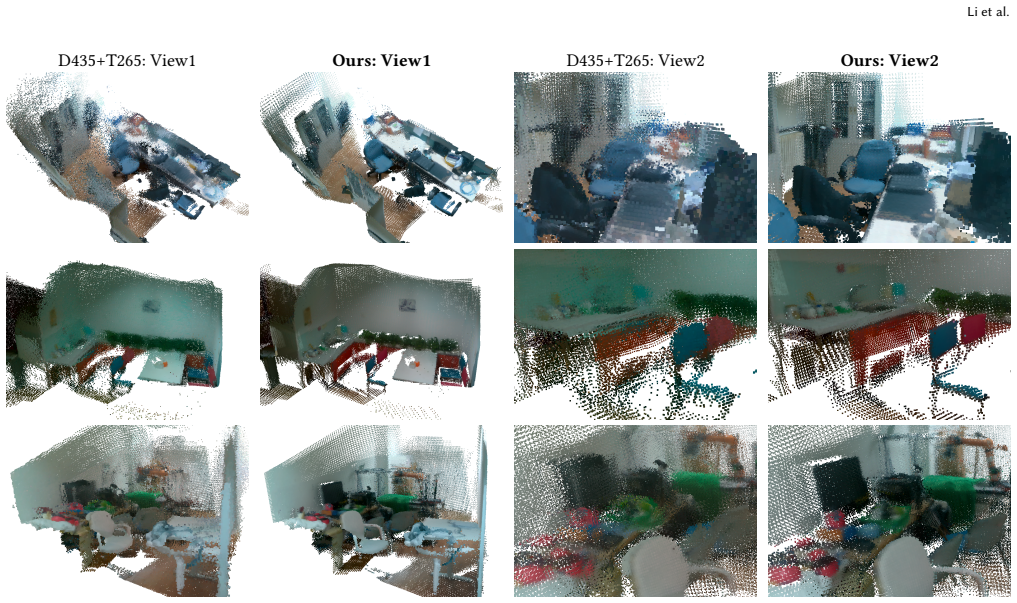
Once neural structured-light depth is made strong enough by injecting monocular priors into iterative decoding, a deliberately simple depth-centric SLAM stack—dense geometric registration as primary signal, sparse visual anchors only for degenerate cases, online Gaussians, and lightweight backend correction—delivers practical robust tracking and higher-quality reconstruction without heavy general RGB-D machinery.
What carries the argument
Visual-guided GICP with adaptive anchor weighting: dense structured-light depth drives generalized ICP against an online 3D Gaussian map (which also supplies anisotropic covariances), while sparse back-projected image matches are scaled by the relative strength of the geometric and anchor Hessians so depth stays primary and vision only rescues weak geometry.
Load-bearing premise
On real data, large drift away from a consumer reference tracker is treated as proof of catastrophic failure, and staying close to that tracker is treated as evidence of success, even though the paper says the reference is not ground truth.
What would settle it
Run the same eight real sequences (or a new set) with a metrically accurate external ground-truth trajectory; if NSL-SLAM then shows large absolute trajectory error or reconstruction error while still hugging the reference tracker—or if a baseline that diverged from the reference is actually closer to ground truth—the real-world stability claim fails.
If this is right
- Commodity structured-light devices can support online SLAM at interactive rates without treating depth as a noisy secondary cue.
- Shared-depth protocol comparisons become the fair way to isolate SLAM design once neural SL depth is fixed.
- Injecting foundation monocular features inside the stereo update loop, rather than after it, is a reusable recipe for active depth sensors.
- Final maps can be built by reprojecting dense per-frame depth along a lightly corrected trajectory instead of relying on the Gaussian map as the sole geometric output.
- When depth is dense and metric, sparse vision and light BA are residual stabilizers, not the main engine.
Where Pith is reading between the lines
- The same synthetic-only decoder transferring qualitatively to other structured-light sensors suggests a path to multi-vendor SLAM without per-device retraining.
- If monocular priors keep improving, further depth RMSE cuts may shrink the need for even the sparse-anchor branch on many indoor scenes.
- Failure modes where planes and weak texture hit geometry and vision together still imply a remaining niche for inertial or multi-view cues the paper leaves open.
- A public real SL benchmark with true trajectory and mesh GT would turn the current reference-gap metric into a calibrated absolute ranking.
Editorial analysis
A structured set of objections, weighed in public.
Referee Report
Summary. The paper presents NSL-SLAM, a SLAM system built around neural structured-light (SL) depth. The depth contribution modifies the NSL decoder (RAFT-Stereo-style iterative disparity refinement) by injecting frozen Depth Anything v2 features into the context pathway at every update step, rather than using a foundation model as post-hoc refinement; on the authors' Replica-SL benchmark this reduces depth RMSE by 35% relative to NSL. The system contribution is a depth-centric pipeline: GICP against an online 3D Gaussian map as the primary tracking signal, sparse LightGlue-derived 3D–3D visual anchors with an adaptive weight for geometrically degenerate frames, a lightweight GTSAM keyframe backend, and "soft" feedback of backend corrections through the Gaussian map. On Replica-SL under a shared-depth protocol (all baselines receive the same predicted depth), NSL-SLAM achieves the best or near-best tracking and reconstruction; on 8 real D435 sequences it is the only method with no sequence exceeding a 0.3 m deviation threshold from a T265 reference trajectory; the system runs at 20.9 FPS on an RTX 4090. Ablations attribute an order-of-magnitude ATE reduction to the depth improvement and further gains to anchors, BA, and soft feedback.
Significance. If the results hold, the paper makes a useful and well-evidenced systems point: once neural structured-light decoding is strong enough, a deliberately simple depth-centric SLAM pipeline — dense GICP as the primary signal, sparse visual anchors only as backup, online Gaussians plus lightweight BA — is competitive with much heavier learned systems. The paper ships several practices the field should reward: a shared-depth SLAM protocol that isolates downstream design from upstream depth quality; first-frame-aligned ATE instead of post-hoc best-fit alignment; a clean component ablation (Table 4) showing depth quality dominates (1.55→0.15 m ATE) and each add-on helps; a one-factor hyperparameter sensitivity sweep; and an unusually candid Limitations section. The depth-side contribution (frozen Depth Anything v2 features injected into the iterative RAFT-Stereo decoding loop rather than applied post-hoc) is a modest but sensible architectural delta over NSL and FoundationStereo, with a clear 35% RMSE reduction on the downstream-relevant benchmark. The main soft spots are the real-world evaluation anchored to a T265 reference rather than ground truth, and the fact that the in-domain depth表
major comments (3)
- [§4.4, Table 3; Abstract] The real-world headline claims — 'only method that avoids catastrophic failure on all 8 sequences' and '43.3% lower trajectory deviation' — rest entirely on the T265 trajectory as a de facto oracle, evaluated via first-frame-aligned translation gap with a 0.3 m failure threshold. The paper itself states the T265 'is not ground truth: agreement with it does not prove correctness.' This disclosure is commendable but does not close the evidential gap: if T265 drifts or biases in exactly the selected hard conditions (stairs, treadmill, repeated structure), a baseline marked 'failed' could be closer to the true trajectory, and NSL-SLAM's low gaps demonstrate consistency with a visual-inertial reference rather than absolute correctness. Two concrete remedies, either of which would suffice: (a) add at least one independent anchor on a subset of the real sequences — e.g., return-to-start drift o
- [§4.2, Table 1; §B (Eq. 10)] Contribution (1) and the abstract claim a depth estimator that reduces RMSE by 35% over NSL, but Table 1 shows this holds only on Replica-SL (0.069→0.045 m). On the in-domain NSL-Test benchmark, NSL-SLAM is actually worse on RMSE (0.079 vs 0.075) and AbsRel (0.028 vs 0.025), better only on MAE and δ1.05. The text in §4.2 acknowledges this honestly and argues Replica-SL is the relevant operating point, which is a defensible position — but then the headline claim should be scoped accordingly, and the argument would be strengthened by evidence that the gain is not specific to the authors' own Replica-SL image-formation model (Eq. 10, with author-chosen α, β, γ, η and Retinex-based reflectance). A depth-only evaluation on one external synthetic SL rendering (e.g., a different pattern/baseline/attenuation model), or at minimum a sensitivity sweep of the Eq. 10 parameters showing the NSL-vs-ou
- [§3.3, Eqs. (4)–(5); Table 4] The robustness story — dense GICP primary, sparse anchors 'for geometrically degenerate cases' — is load-bearing for the system claim, but Eq. (5) as written is a scale-normalization rule, not a degeneracy gate. α = clip(tr(H_geo)/tr(H_anc), 10⁻³, 10³) makes the anchor term's Hessian trace proportional to the geometric term's; when geometry becomes weak (small tr(H_geo), e.g., a large plane), α shrinks and the anchor term is suppressed in aggregate rather than amplified. The mechanism can still fix GICP's null directions if off-plane anchors exist, but that is a different mechanism from 'anchors take over when geometry is ambiguous,' and the 6-decade clip range [10⁻³, 10³] functions as a free hyperparameter. Please (i) state precisely what α is intended to do, with a short derivation; (ii) show per-frame or per-sequence α values on a degenerate sequence (e.g., stairs/office0) to demonstr
minor comments (7)
- [§4.1 Baselines; Table 2] Shared-depth protocol in Table 2 is a good controlled design, but please state explicitly whether all baselines were run with authors' code and default hyperparameters, and whether any per-scene tuning was permitted — several baselines (e.g., ViPE office1 ATE 0.1549) degrade sharply under the shared depth, and the fairness of the comparison depends on this detail.
- [§4.1 Metrics] The first-frame-aligned ATE is the right protocol for online operation, but it should be defined precisely (which frame's pose anchors the alignment, whether scale is fixed by metric depth) and a citation or formula given; readers will otherwise assume Sim(3) Umeyama alignment.
- [Abstract; §4.1] Typographical: repeated missing spaces around numbers in the abstract and intro ('by35%on', 'by1.6points', '43.3%lower'); also 'NSL-Test is the synthetic benchmark...' runs directly into 'Replica-SL' in the Datasets paragraph.
- [Table 2] Table 2 mixes bold, yellow, and orange highlighting for top-3 values; in grayscale print the yellow/orange distinction is illegible. Consider bold/underline/italic instead.
- [§4.5, Table 4] The 'hard feedback' row (0.0265) is worse than no feedback (0.0188), which is a nice result for the soft-feedback design, but the mechanism (temporary position-LR increase for 5 steps, §A.3) deserves one sentence of intuition in the main text — why abrupt pose writes corrupt the Gaussian registration target while gradual absorption does not.
- [§C.1, Fig. 9] Cross-sensor transfer (D415, Orbbec Gemini 335L) is shown only qualitatively for one capture each; either temper the generalization language in §3.2 or add quantitative error against sensor depth on planar/target objects.
- [§4.6] Runtime claim (20.9 FPS) should note that CPU GICP and frontend–backend synchronization dominate the non-depth latency, and whether the system remains real-time on hardware below an RTX 4090 — 'practical' in the title invites this question.
Circularity Check
Empirical systems paper with no derivation-by-construction circularity; claims are benchmarked, not defined into the premises.
full rationale
NSL-SLAM is an engineering/systems paper: a stronger SL depth decoder (frozen DAv2 features injected into RAFT-Stereo-style iterative decoding) plus a depth-centric SLAM stack (GICP primary, sparse anchors, online Gaussians, lightweight BA). There is no first-principles derivation chain in which a claimed prediction reduces to its inputs by definition or by a fitted parameter renamed as a forecast. Depth gains are measured against NSL, LibSGM, and LingBot-Depth on NSL-Test and Replica-SL with ground-truth depth; full-system tracking/reconstruction uses first-frame-aligned ATE and F-score under an explicit shared-depth protocol that gives all SLAM baselines the same depth, isolating pipeline design. Ablations (LibSGM→NSL depth→anchors→BA→soft feedback) are incremental empirical measurements, not tautologies. Self-citation to NSL is ordinary prior-work scaffolding, not a load-bearing uniqueness theorem that forbids alternatives. Dependence on authors’ Replica-SL render and on T265 as a real-world reference is an evaluation-validity concern, not circularity of derivation: the paper does not define success as matching a quantity it fitted, nor does any equation force the reported RMSE/ATE/F-score. Score 0 is the honest finding.
Axiom & Free-Parameter Ledger
free parameters (5)
- adaptive anchor weight α clip range =
[1e-3, 1e3]
- depth network training hyperparameters =
AdamW 6e-5, 200k steps, 16 iters
- GICP/keyframe/backend thresholds =
defaults in Supp. A.2–A.4
- real-sequence failure threshold =
0.3 m
- Replica-SL image-formation parameters =
β auto-calibrated per dataset; baseline 8 cm
axioms (5)
- domain assumption Metric depth from calibrated disparity z = fB/d is the correct geometric backbone for tracking and reconstruction.
- domain assumption Frozen monocular DAv2 features provide useful global context on projected-pattern IR without breaking metric stereo grounding.
- domain assumption Dense GICP against an online Gaussian map is a sufficient primary tracker when per-frame SL depth is strong.
- ad hoc to paper Large first-frame-aligned translation gap to T265 indicates catastrophic tracking failure on real sequences.
- standard math Standard SE(3) registration, factor-graph BA, and 3D Gaussian optimization mathematics hold as used (GICP covariances, GTSAM factors, etc.).
invented entities (3)
-
Replica-SL benchmark
no independent evidence
-
D435 real 8-scene benchmark with T265 reference
no independent evidence
-
NSL-SLAM depth-centric pipeline (visual-guided GICP + soft Gaussian feedback)
no independent evidence
read the original abstract
Structured-light (SL) cameras power depth sensing in millions of devices, and recent neural SL decoding methods have substantially improved their depth quality. SLAM systems can benefit greatly from such strong depth sensing, where reliable geometry enables stable tracking and faithful reconstruction. In this work, we present NSL-SLAM, a practical SLAM system tailored for high-fidelity structured-light depth. We first strengthen SL depth sensing: inspired by the neural structured-light (NSL) method, we further incorporate strong monocular depth priors into the SL stereo decoding, reducing depth RMSE by 35% on Replica-SL compared to NSL. We then build a depth-centric SLAM pipeline with this stronger depth: because structured-light geometry is dense and metrically accurate, we keep it as the primary tracking signal, and add only sparse visual correspondences for geometrically degenerate cases and lightweight bundle adjustment for long-range drift. Our depth estimator and SLAM design reinforce each other: stronger depth makes a simple SLAM pipeline effective, and the depth-centric pipeline ensures this advantage transfers to downstream reconstruction. Experimentally, on the synthetic Replica-SL benchmark, NSL-SLAM achieves the best tracking accuracy and improves reconstruction F-score by 1.6 points over the SOTA baseline under a shared-depth protocol. On a real benchmark of 8 challenging scenes, it is the only method that avoids catastrophic failure on all sequences while achieving 43.3% lower trajectory deviation than selected baselines. The SLAM system runs online at 20.9 FPS, demonstrating that stronger structured-light depth and depth-centric system design together enable practical, robust SLAM.
Figures





Reference graph
Works this paper leans on
-
[1]
Robust single-shot structured light 3D imaging via neural feature decoding
Jiaheng Li, Qiyu Dai, Lihan Li, Praneeth Chakravarthula, He Sun, Baoquan Chen, and Wenzheng Chen. Robust single-shot structured light 3D imaging via neural feature decoding. InSIGGRAPH Asia 2025 Conference Papers, 2025. arXiv:2512.14028
arXiv 2025
-
[2]
Lihe Yang, Bingyi Kang, Zilong Huang, Zhen Zhao, Xiaogang Xu, Jiashi Feng, and Hengshuang Zhao. Depth anything V2. InAdvances in Neural Information Processing Systems (NeurIPS), volume 37, 2024. arXiv:2406.09414
Pith/arXiv arXiv 2024
-
[3]
Pattern codification strategies in structured light systems.Pattern Recognition, 37(4):827–849, 2004
Joaquim Salvi, Jordi Pagès, and Joan Batlle. Pattern codification strategies in structured light systems.Pattern Recognition, 37(4):827–849, 2004
2004
-
[4]
Structured-light 3D surface imaging: A tutorial.Advances in Optics and Photonics, 3(2):128–160, 2011
Jason Geng. Structured-light 3D surface imaging: A tutorial.Advances in Optics and Photonics, 3(2):128–160, 2011
2011
-
[5]
Stereo processing by semiglobal matching and mutual information.IEEE Transactions on Pattern Analysis and Machine Intelligence, 30(2):328–341, 2008
Heiko Hirschmüller. Stereo processing by semiglobal matching and mutual information.IEEE Transactions on Pattern Analysis and Machine Intelligence, 30(2):328–341, 2008
2008
-
[6]
HyperDepth: Learning depth from structured light without matching
Sean Ryan Fanello, Christoph Rhemann, Vladimir Tankovich, Adarsh Kowdle, Sergio Orts Escolano, David Kim, and Shahram Izadi. HyperDepth: Learning depth from structured light without matching. In2016 IEEE Conference on Computer Vision and Pattern Recognition (CVPR), pages 5441–5450, 2016
2016
-
[7]
UltraStereo: Efficient learning-based matching for active stereo systems
Sean Ryan Fanello, Julien Valentin, Christoph Rhemann, Adarsh Kowdle, Vladimir Tankovich, Philip Davidson, and Shahram Izadi. UltraStereo: Efficient learning-based matching for active stereo systems. InProceedings of the IEEE Conference on Computer Vision and Pattern Recognition (CVPR), pages 2691–2700, 2017
2017
-
[8]
ActiveStereoNet: End-to-end self-supervised learning for active stereo systems
Yinda Zhang, Sameh Khamis, Christoph Rhemann, Julien Valentin, Adarsh Kowdle, Vladimir Tankovich, Michael Schoenberg, Shahram Izadi, Thomas Funkhouser, and Sean Fanello. ActiveStereoNet: End-to-end self-supervised learning for active stereo systems. InEuropean Conference on Computer Vision (ECCV), pages 802–819, 2018. arXiv:1807.06009
Pith/arXiv arXiv 2018
-
[9]
Depth estimation by combining binocular stereo and monocular structured-light
Yuhua Xu, Xiaoli Yang, Yushan Yu, Wei Jia, Zhaobi Chu, and Yulan Guo. Depth estimation by combining binocular stereo and monocular structured-light. In 2022 IEEE/CVF Conference on Computer Vision and Pattern Recognition (CVPR), pages 1736–1745, 2022
2022
-
[10]
Seung-Hwan Baek and Felix Heide. Polka Lines: Learning structured illumination and reconstruction for Active Stereo.CoRR, abs/2011.13117, 2020
Pith/arXiv arXiv 2011
-
[11]
Masked Depth Modeling for spatial perception, 2026
Bin Tan, Changjiang Sun, Xiage Qin, Hanat Adai, Zelin Fu, Tianxiang Zhou, Han Zhang, Yinghao Xu, Xing Zhu, Yujun Shen, and Nan Xue. Masked Depth Modeling for spatial perception, 2026
2026
-
[12]
Newcombe, Shahram Izadi, Otmar Hilliges, David Molyneaux, David Kim, Andrew J
Richard A. Newcombe, Shahram Izadi, Otmar Hilliges, David Molyneaux, David Kim, Andrew J. Davison, Pushmeet Kohli, Jamie Shotton, Steve Hodges, and Andrew W. Fitzgibbon. KinectFusion: Real-time dense surface mapping and tracking. InIEEE International Symposium on Mixed and Augmented Reality (ISMAR), pages 127–136, 2011
2011
-
[13]
Salas-Moreno, Ben Glocker, Andrew J
Thomas Whelan, Renato F. Salas-Moreno, Ben Glocker, Andrew J. Davison, and Stefan Leutenegger. ElasticFusion: Real-time dense SLAM and light source estimation.The International Journal of Robotics Research, 35(14):1697–1716, 2016
2016
-
[14]
BundleFusion: Real-time globally consistent 3D reconstruction using on-the-fly surface re-integration.ACM Transactions on Graphics, 36(3), 2017
Angela Dai, Matthias Nießner, Michael Zollöfer, Shahram Izadi, and Christian Theobalt. BundleFusion: Real-time globally consistent 3D reconstruction using on-the-fly surface re-integration.ACM Transactions on Graphics, 36(3), 2017
2017
-
[15]
ReFusion: 3D reconstruction in dynamic environments for RGB-D cameras exploiting residuals
Emanuele Palazzolo, Jens Behley, Philipp Lottes, Philippe Giguère, and Cyrill Stachniss. ReFusion: 3D reconstruction in dynamic environments for RGB-D cameras exploiting residuals. InIEEE/RSJ International Conference on Intelligent Robots and Systems (IROS), pages 7855–7862, 2019
2019
-
[16]
Gómez Rodríguez, José M
Carlos Campos, Richard Elvira, Juan J. Gómez Rodríguez, José M. M. Montiel, and Juan D. Tardós. ORB-SLAM3: An accurate open-source library for visual, visual- inertial, and multimap SLAM.IEEE Transactions on Robotics, 37(6):1874–1890, 2021
2021
-
[17]
BAD SLAM: Bundle adjusted direct RGB-D SLAM
Thomas Schöps, Torsten Sattler, and Marc Pollefeys. BAD SLAM: Bundle adjusted direct RGB-D SLAM. InProceedings of the IEEE/CVF Conference on Computer Vision and Pattern Recognition (CVPR), pages 134–144, 2019
2019
-
[18]
DROID-SLAM: Deep visual SLAM for monocular, stereo, and RGB-D cameras
Zachary Teed and Jia Deng. DROID-SLAM: Deep visual SLAM for monocular, stereo, and RGB-D cameras. InAdvances in Neural Information Processing Systems (NeurIPS), pages 16558–16569, 2021. arXiv:2108.10869
Pith/arXiv arXiv 2021
-
[19]
MegaSaM: Accurate, fast, and robust structure and motion from casual dynamic videos
Zhengqi Li, Richard Tucker, Forrester Cole, Qianqian Wang, Linyi Jin, Vickie Ye, Angjoo Kanazawa, Aleksander Holynski, and Noah Snavely. MegaSaM: Accurate, fast, and robust structure and motion from casual dynamic videos. InProceedings of the IEEE/CVF Conference on Computer Vision and Pattern Recognition (CVPR), pages 10486–10496, 2025. arXiv:2412.04463
Pith/arXiv arXiv 2025
-
[20]
ViPE: Video pose engine for 3d geometric perception, 2025
Jiahui Huang, Qunjie Zhou, Hesam Rabeti, Aleksandr Korovko, Huan Ling, Xuanchi Ren, Tianchang Shen, Jun Gao, Dmitry Slepichev, Chen-Hsuan Lin, Jiawei Ren, Kevin Xie, Joydeep Biswas, Laura Leal-Taixe, and Sanja Fidler. ViPE: Video pose engine for 3d geometric perception, 2025
2025
-
[21]
Edgar Sucar, Shikun Liu, Joseph Ortiz, and Andrew J. Davison. iMAP: Implicit mapping and positioning in real-time. InProceedings of the IEEE/CVF International Conference on Computer Vision (ICCV), pages 6229–6238, 2021. arXiv:2103.12352
Pith/arXiv arXiv 2021
-
[22]
Zihan Zhu, Songyou Peng, Viktor Larsson, Weiwei Xu, Hujun Bao, Zhaopeng Cui, Martin R. Oswald, and Marc Pollefeys. NICE-SLAM: Neural implicit scalable encoding for SLAM. InProceedings of the IEEE/CVF Conference on Computer Vision and Pattern Recognition (CVPR), pages 12786–12796, 2022. arXiv:2112.12130
Pith/arXiv arXiv 2022
-
[23]
Vox-Fusion: Dense tracking and mapping with voxel-based neural im- plicit representation
Xingrui Yang, Hai Li, Hongjia Zhai, Yuhang Ming, Yuqian Liu, and Guofeng Zhang. Vox-Fusion: Dense tracking and mapping with voxel-based neural im- plicit representation. InIEEE International Symposium on Mixed and Augmented Reality (ISMAR), pages 499–507, 2022. arXiv:2210.15858
Pith/arXiv arXiv 2022
-
[24]
Co-SLAM: Joint coordinate and sparse parametric encodings for neural real-time SLAM
Hengyi Wang, Jingwen Wang, and Lourdes Agapito. Co-SLAM: Joint coordinate and sparse parametric encodings for neural real-time SLAM. InProceedings of the IEEE/CVF Conference on Computer Vision and Pattern Recognition (CVPR), pages 13293–13302, 2023. arXiv:2304.14377
Pith/arXiv arXiv 2023
-
[25]
ESLAM: Effi- cient dense SLAM system based on hybrid representation of signed distance fields
Mohammad Mahdi Johari, Camilla Carta, and François Fleuret. ESLAM: Effi- cient dense SLAM system based on hybrid representation of signed distance fields. InProceedings of the IEEE/CVF Conference on Computer Vision and Pattern Recognition (CVPR), pages 17408–17419, 2023. arXiv:2211.11704
Pith/arXiv arXiv 2023
-
[26]
Erik Sandström, Yue Li, Luc Van Gool, and Martin R. Oswald. Point-SLAM: Dense neural point cloud-based SLAM. InProceedings of the IEEE/CVF International Con- ference on Computer Vision (ICCV), pages 18387–18398, 2023. arXiv:2304.04278
Pith/arXiv arXiv 2023
-
[27]
SplaTAM: Splat, track & map 3D gaussians for dense RGB-D SLAM
Nikhil Keetha, Jay Karhade, Krishna Murthy Jatavallabhula, Gengshan Yang, Sebastian Scherer, Deva Ramanan, and Jonathon Luiten. SplaTAM: Splat, track & map 3D gaussians for dense RGB-D SLAM. InProceedings of the IEEE/CVF Conference on Computer Vision and Pattern Recognition (CVPR), pages 21357– 21366, 2024. arXiv:2312.02126
Pith/arXiv arXiv 2024
-
[28]
Hidenobu Matsuki, Riku Murai, Paul H.J. Kelly, and Andrew J. Davison. Gaussian splatting SLAM. InProceedings of the IEEE/CVF Conference on Computer Vision and Pattern Recognition (CVPR), pages 18039–18048, 2024. arXiv:2312.06741
Pith/arXiv arXiv 2024
-
[29]
Photo-SLAM: Real- time simultaneous localization and photorealistic mapping for monocular, stereo, and RGB-D cameras
Huajian Huang, Longwei Li, Hui Cheng, and Sai-Kit Yeung. Photo-SLAM: Real- time simultaneous localization and photorealistic mapping for monocular, stereo, and RGB-D cameras. InProceedings of the IEEE/CVF Conference on Computer Vision and Pattern Recognition (CVPR), pages 21584–21593, 2024
2024
-
[30]
RTG-SLAM: Real-time 3D reconstruction at scale using Gaussian splatting
Zhexi Peng, Tianjia Shao, Yong Liu, Jingke Zhou, Yin Yang, Jingdong Wang, and Kun Zhou. RTG-SLAM: Real-time 3D reconstruction at scale using Gaussian splatting. InACM SIGGRAPH Conference Proceedings, 2024
2024
-
[31]
CaRtGS: Computational alignment for real-time Gaussian splatting SLAM
Dapeng Feng, Zhiqiang Chen, Yizhen Yin, Shipeng Zhong, Yuhua Qi, and Hongbo Chen. CaRtGS: Computational alignment for real-time Gaussian splatting SLAM. IEEE Robotics and Automation Letters, 2025. arXiv:2410.00486
Pith/arXiv arXiv 2025
-
[32]
GO-SLAM: Global optimization for consistent 3D instant reconstruction
Youmin Zhang, Fabio Tosi, Stefano Mattoccia, and Matteo Poggi. GO-SLAM: Global optimization for consistent 3D instant reconstruction. InProceedings of the IEEE/CVF International Conference on Computer Vision (ICCV), pages 3727–3737,
-
[33]
Erik Sandström, Keisuke Tateno, Michael Oechsle, Michael Niemeyer, Luc Van Gool, Martin R. Oswald, and Federico Tombari. Splat-SLAM: Globally optimized 9 Li et al. RGB-only SLAM with 3D gaussians.arXiv preprint arXiv:2405.16544, 2024
Pith/arXiv arXiv 2024
-
[34]
LoopSplat: Loop closure by registering 3D gaussian splats
Liyuan Zhu, Yue Li, Erik Sandström, Shengyu Huang, Konrad Schindler, and Iro Armeni. LoopSplat: Loop closure by registering 3D gaussian splats. In International Conference on 3D Vision (3DV), 2025. arXiv:2408.10154
Pith/arXiv arXiv 2025
-
[35]
Yuqing Lan, Chenyang Zhu, Shuaifeng Zhi, Jiazhao Zhang, Zhoufeng Wang, Renjiao Yi, Yijie Wang, and Kai Xu. RemixFusion: Residual-based mixed repre- sentation for large-scale online RGB-D reconstruction.ACM Transactions on Graphics, 2025. arXiv:2507.17594
arXiv 2025
-
[36]
Seongbo Ha, Jiung Yeon, and Hyeonwoo Yu. RGBD GS-ICP SLAM. InEuropean Conference on Computer Vision (ECCV), pages 180–197, 2024. arXiv:2403.12550
Pith/arXiv arXiv 2024
-
[37]
RAFT-Stereo: Multilevel recurrent field transforms for stereo matching
Lahav Lipson, Zachary Teed, and Jia Deng. RAFT-Stereo: Multilevel recurrent field transforms for stereo matching. InInternational Conference on 3D Vision (3DV), pages 218–227, 2021. arXiv:2109.07547
Pith/arXiv arXiv 2021
-
[38]
FoundationStereo: Zero-shot stereo matching
Bowen Wen, Matthew Trepte, Joseph Aribido, Jan Kautz, Orazio Gallo, and Stan Birchfield. FoundationStereo: Zero-shot stereo matching. InProceedings of the IEEE/CVF Conference on Computer Vision and Pattern Recognition (CVPR), pages 5249–5260, 2025
2025
-
[39]
Generalized-ICP
Aleksandr Segal, Dirk Haehnel, and Sebastian Thrun. Generalized-ICP. In Robotics: Science and Systems (RSS), 2009
2009
-
[40]
Factor graphs and GTSAM: A hands-on introduction
Frank Dellaert. Factor graphs and GTSAM: A hands-on introduction. Technical Report GT-RIM-CP&R-2012-002, Georgia Institute of Technology, 2012
2012
-
[41]
Engel, Raúl Mur-Artal, Carl Ren, Shobhit Verber, et al
Julian Straub, Thomas Whelan, Lingni Ma, Yufan Chen, Erik Wijmans, Simon Green, Jakob J. Engel, Raúl Mur-Artal, Carl Ren, Shobhit Verber, et al. The Replica dataset: A digital replica of indoor spaces.arXiv preprint arXiv:1906.05797, 2019. 10 NSL-SLAM: High-Fidelity Neural Structured-Light Depth for Practical SLAM and Reconstruction Supplementary Material...
Pith/arXiv arXiv 1906
discussion (0)
Sign in with ORCID, Apple, or X to comment. Anyone can read and Pith papers without signing in.