REVIEW 3 major objections 6 minor 13 references
Language Models Enable Data-Augmented Synthesis Planning for Inorganic Materials
T0 review · 3 major / 6 minor · reviewed 2026-08-07 · deepseek-v4-flash
Pith's one-line read Off-the-shelf language models recall published precursor sets and synthesis temperatures, and their generated recipes push a specialist transformer to 73 °C mean temperature error.
desk verdict Useful LM benchmark and synthetic-data pipeline, but the central augmentation claim needs a leakage-controlled test before I'd trust the 8.7% improvement. read the letter →
The pith
A machine-rendered reading of the paper's core claim, the machinery that carries it, and where it could break.
The reading
What carries the argument
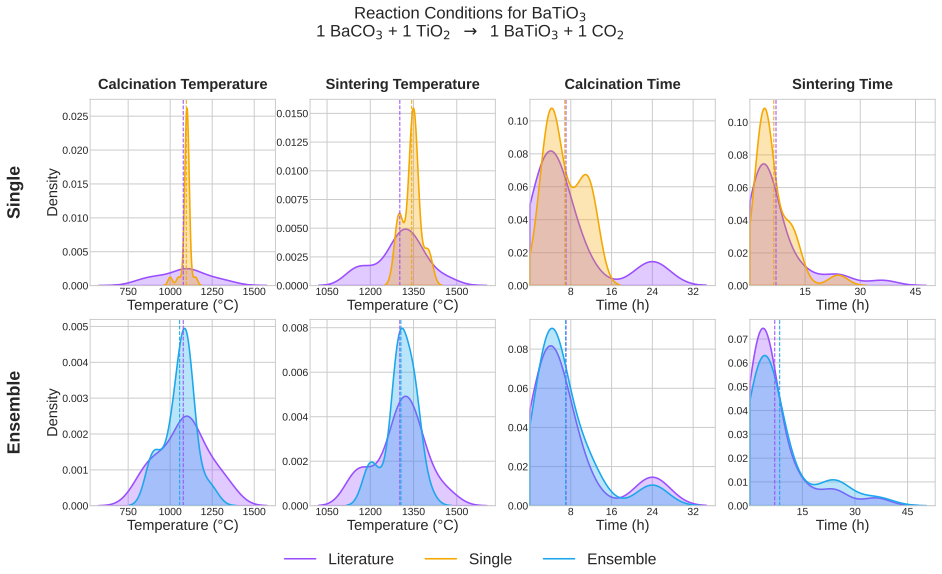
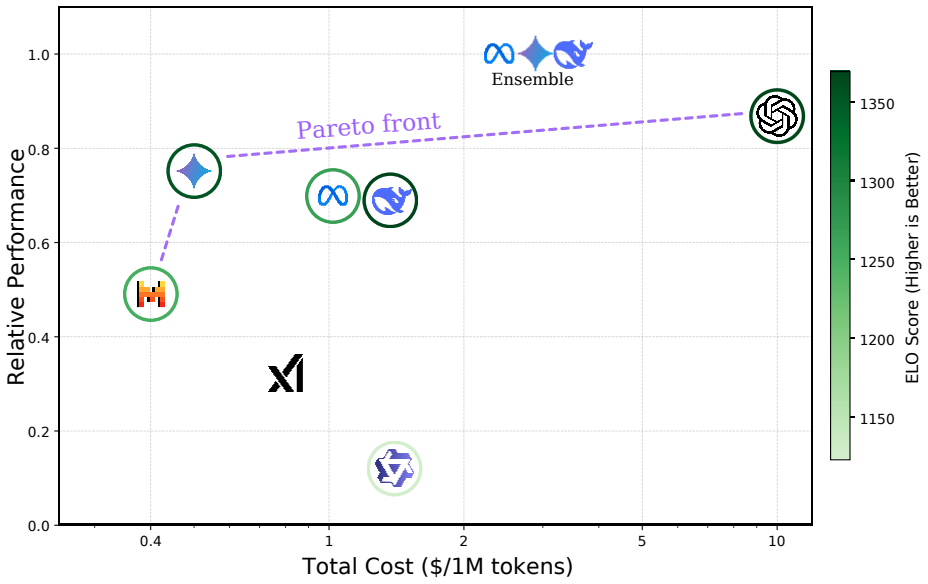
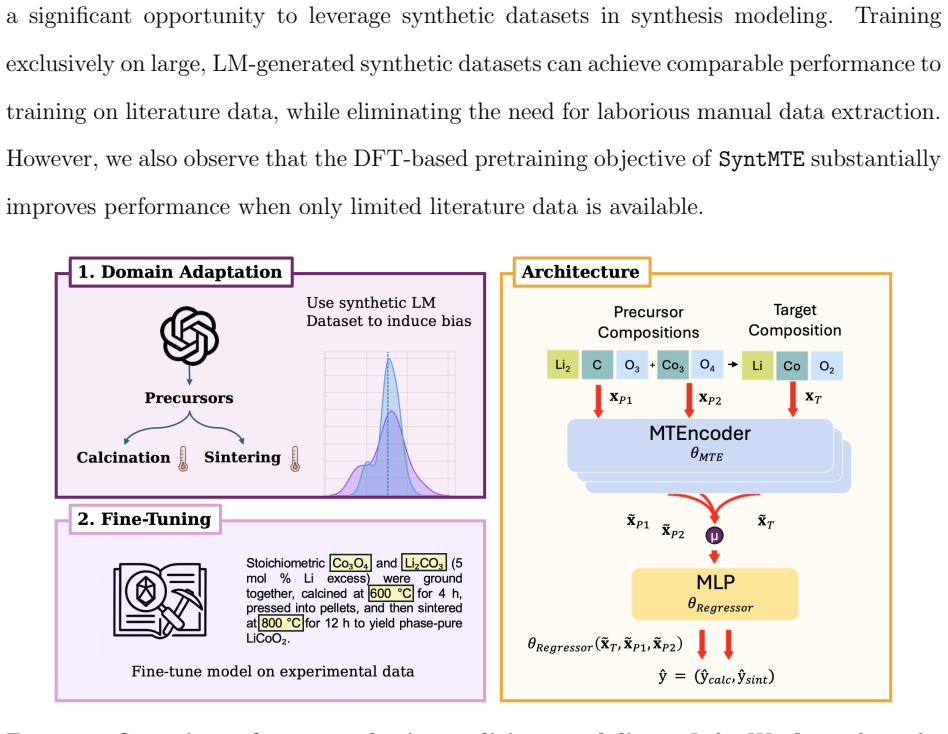
The load-bearing object is SyntMTE, a composition-transformer built on the MTEncoder architecture, which was pretrained on twelve DFT-derived property tasks from the Alexandria database: the target composition and every precursor are tokenized element-by-element, embedded, mean-pooled, concatenated, and passed to a multi-task MLP head that regresses calcination and sintering temperatures. What carries the argument is the two-stage training schedule — pretraining on the 28,548 LM-generated synthetic recipes, then fine-tuning on literature-mined experimental data — because the gains are measured by comparing this schedule with literature-only and synthetic-only training. A second mechanism is the LM ensemble: for precursor ranking, minimum-rank aggregation across Gemini 2.0 Flash, Llama 4 Maverick, and DeepSeek Chat v3 lets any candidate that one model ranks highly enter the Top-k, and for temperature regression, averaged outputs reproduce secondary modes and long tails of the literature condition distribution that single models miss. The synthetic corpus is assembled by maximum-entropy sampling of 10,000 targets from 48,927 Materials Project compounds, GPT-4.1 route generation with the top three suggestions preserved, and floor filters of 300 °C (calcination) and 500 °C (sintering) to exclude non-solid-state routes.
What would settle it
Scan the 28,548 synthetic recipes for near-duplicates of the 1,000 held-out test reactions (identical target–precursor sets or temperatures within a few degrees) and retrain SyntMTE with the duplicates removed, or regenerate the corpus with an open-weights model whose training data provably predates the test-set papers; if the 73 °C / 98 °C errors or the up-to-8.7% improvement survive neither check, the augmentation effect is memorization, not learning.
Extended reading notes
Core claim
On its own terms, the paper's central claim is that the synthesis knowledge needed to plan inorganic solid-state reactions is already latent in general-purpose language models, and that this knowledge can be distilled into a synthetic dataset that improves specialist models. The evidence chain runs: off-the-shelf LMs recall reported precursor sets (GPT-4.1 Top-1 53.8%, Top-5 66.1%) and temperatures (best sintering MAE ≈ 96 °C, calcination ≈ 123 °C); minimum-rank and averaged ensembles of diverse models recover the multi-modal, long-tailed distribution of viable conditions ('synthesis windows') that individual models flatten; and a corpus of 28,548 GPT-4.1-generated recipes, a 616% expansion over complete literature-mined recipes, extends the chemical space available for training. Pretraining SyntMTE — a transformer that embeds each precursor and the target composition and mean-pools the resulting vectors — on that corpus, then fine-tuning on literature data, yields 72.94 °C MAE for sintering and 98.39 °C for calcination, and every baseline given the combined data improves by up to 8.7% when the synthetic data is added. The LLZO case study is the extrapolation claim: with all LLZO chemistries withheld from training, the model still orders dopant families by sintering temperature and captures the sharp drop for Bi substitution.
Load-bearing premise
The augmentation result stands on the premise that GPT-4.1's 28,548 synthetic recipes carry no information about the held-out literature test reactions; the paper asserts the generated recipes do not overlap the test set but, as it concedes for its direct LM benchmark, data leakage through the model's pretraining memory remains possible and is not screened for in the synthetic corpus.
Editorial extensions
If this is right
- The two-stage schedule — synthetic pretraining followed by literature fine-tuning — yields 73 °C sintering and 98 °C calcination mean absolute errors on SyntMTE, beating every model trained on experimental data alone.
- Training exclusively on the LM-generated synthetic corpus matches or beats literature-only training for the transformer while raising $R^2$, so synthetic recipes can substitute for a substantial share of laboriously text-mined experimental data.
- Averaged and minimum-rank ensembles recover the multi-modal synthesis window that single models flatten, making model diversity, not model scale, the lever for representing one-to-many synthesis relationships.
- With all LLZO chemistries withheld, the model orders doped-LLZO sintering temperatures by dopant and captures the large drop for Bi substitution, supporting the use of such models to screen for low-temperature processing routes.
- The best-performing ensemble of three lower-priced models beats the premium single model while cutting inference cost by 70%, so the accuracy gain does not require a larger compute budget.
Reading between the lines
- A control the paper leaves unrun: nothing checks whether the 28,548 synthetic recipes echo the held-out literature test reactions through the language model's pretraining memory, so the strongest reading of the up-to-8.7% gain depends on a memorization screen that has not been published.
- The same generate-then-pretrain loop transfers directly to the conditions the paper deliberately excludes — dwell times, heating rates, atmospheres — where labels are noisier and synthetic regularization could help more.
- Because synthetic-only training raised $R^2$ while systematically underestimating the hottest and coldest temperatures, an active-learning variant that generates extra synthetic recipes in those under-predicted tails could correct the bias the paper documents in its parity plots.
- The ensemble result implies a testable scaling relationship — prediction accuracy as a function of the number of independent models at fixed total budget — which would tell practitioners whether to spend on more queries or on more model diversity.
Signed reviews
Editorial analysis
A structured set of objections, weighed in public.
Referee Report
Summary. The paper investigates whether off-the-shelf language models can perform inorganic solid-state synthesis planning tasks, and whether LM-generated synthetic recipes can augment scarce literature-mined data. The authors benchmark seven LMs on precursor recommendation and calcination/sintering temperature regression using held-out 1,000-reaction test sets derived from the Kononova dataset. They report top-1 precursor accuracies up to 53.8%, temperature MAEs near 100–126 °C, and ensemble strategies that improve recall and cut inference cost by up to 70%. They then use GPT-4.1 to generate 28,548 synthetic synthesis recipes and propose SyntMTE, a transformer-based model pretrained on synthetic and literature data. Tables 3 and 4 report that SyntMTE achieves MAEs of 72.94 °C (sintering) and 98.39 °C (calcination) and that synthetic augmentation improves relative MAE by up to 8.7% over literature-only training. A qualitative case study on doped Li7La3Zr2O12 is presented to illustrate the model's ability to recover dopant-dependent sintering trends.
Significance. If the augmentation gains hold, the paper offers a practical contribution: a sixfold larger complete-recipes dataset, a new model (SyntMTE), and a systematic benchmark of contemporary LMs on solid-state synthesis tasks. The experiments are generally careful: they use held-out test sets, several baselines, five-run statistics with standard deviations, and the code is made available. The paper is also candid that direct LM benchmark scores may be inflated by pretraining leakage. The main uncertainty is whether the synthetic-data improvements are truly independent augmentation gains or partly inherited from GPT-4.1's memorization of the same literature that defines the test set; this is a load-bearing point for the central claim and must be resolved before the quantitative improvements can be accepted.
major comments (3)
- [Synthetic data augmentation improves model performance / Additional Dataset Generation Details] The claim that synthetic-only trained models used 'recipes that do not overlap with the literature-based test set' is the only explicit control against data leakage, but this filter is not documented anywhere. The SI's 'Additional Dataset Generation Details' describes Materials Project sampling, maximum-entropy selection, GPT-4.1 route and temperature generation, and the 300/500 °C thresholds, with no mention of any deduplication or overlap-removal step. Because GPT-4.1's pretraining corpus includes the Kononova literature from which the 1,000-reaction test set is drawn, any generated recipe whose target composition coincides with a test composition could encode memorized test labels into the synthetic training set. To support the central claim, the authors must report the overlap between the 28,548 synthetic recipes (or their target compositions) and the test set, and re-run the Table 4 experiments with all test compositions explicitly excluded from the synthetic corpus. If the filter already exists, its implementation and code path must be provided.
- [Synthetic data augmentation improves model performance, Table 4] Even if 'recipes do not overlap' means no identical precursor–target strings, the temperature labels in the test set are attached to target compositions. A synthetic route that uses different precursors for the same target composition still enables GPT-4.1 to reproduce literature-reported temperatures from memory, so the no-overlap control must be applied at the target-composition level, not only at the exact-recipe level. The current wording ('recipes that do not overlap') is insufficiently precise to rule out this form of leakage, and the reported relative improvements of 3.68% (SyntMTE), 8.71% (CrabNet), and 5.74% (Composition+NN) depend on this distinction.
- [Introduction; Synthetic data augmentation improves model performance] The Introduction states that for LM predictions 'data leakage from earlier synthesis reports is likely,' and the augmentation section later discounts LM benchmark scores because of leakage. The same reasoning is not applied symmetrically to the synthetic training data, which is generated by the same GPT-4.1 model. The paper should either present a controlled experiment (e.g., a held-out set of compositions that are provably absent from GPT-4.1's likely training corpus, or a deduplication audit) or explicitly state that part of the observed augmentation gain may be attributable to memorization rather than to the statistical enrichment of the training distribution. As written, the analysis treats the leakage risk for the LM benchmark as real but for the synthetic training corpus as absent, without a concrete basis for the asymmetry.
minor comments (6)
- [Synthesis condition regression, main text] The phrase 'This is considerable respective the fact' should be reworded, e.g., 'This is notable given the fact.'
- [Baseline Models (SI)] The SI says 'we employ serveral baseline models'; the typo should be corrected to 'several'.
- [Table 2 and Table 3 captions] Some column headings appear garbled in the manuscript text (e.g., 'T op-1', 'T op-3'); please proofread the tables to ensure the final typeset version is clean.
- [Figure 3 caption] The caption reads '8 predictions each are sampled from Llama Maverick, DeepSeek Chat v3, and Gemini 2.0 Flash'; this should be reworded to '8 predictions are sampled from each of Llama Maverick, DeepSeek Chat v3, and Gemini 2.0 Flash.'
- [Figure A5 caption] The caption reports R² = 0.620 (sintering) and 0.53 (calcination) for the synthetic-only regime, while Table 4 reports 0.619 and 0.502; the discrepancy, particularly the missing standard deviation for calcination, should be reconciled.
- [Code Availability] The code repository is appreciated; please also consider releasing the 28,548-recipe synthetic dataset itself, since the central augmentation claim depends on the exact generated corpus.
Circularity Check
Reported synthetic-augmentation gains rest on an unverified non-overlap assertion; GPT-4.1's acknowledged leakage from the same literature can recirculate test labels into SyntMTE's pretraining data.
-
other
[Results, 'Synthetic data augmentation improves model performance' (Table 4) and Appendix 'Additional Dataset Generation Details'; cf. Introduction leakage caveat.]
"When trained exclusively on synthetic data, all models exhibit strong performance despite having no exposure to literature-mined data and being trained only on recipes that do not overlap with the literature-based test set. ... Since LM benchmark scores may be inflated by data leakage, we ascribe their lower performance to the inherent challenges language models face in regression tasks."
The claimed benefit of the 28,548 GPT-4.1-generated recipes over literature-only training (MAE improvements up to 8.7%, Table 4) requires the synthetic corpus to be independent of the 1,000-reaction Kononova test set. The paper's only control is the sentence asserting the synthetic recipes 'do not overlap' with the test set; the dataset-generation appendix lists Materials Project sampling, maximum-entropy selection, GPT-4.1 route/temperature generation, and temperature thresholds, but no deduplication or overlap-removal step. The paper itself warns that 'data leakage from earlier synthesis reports is likely' for LMs on this same literature.
full rationale
Most of the pipeline is not circular: the LM precursor/temperature benchmarks are explicitly framed as recall with a stated leakage caveat; SyntMTE/MTEncoder are pretrained on the external Alexandria DFT database; and the LLZO case is qualitative and withheld. The circularity is concentrated in the central data-augmentation claim. The improvement from combining GPT-4.1-generated recipes with literature data is measured on a literature test set whose labels may already be embedded in GPT-4.1's weights, and the paper supplies only an unsupported sentence to rule this out. This makes the headline 'data-augmented' gain potentially equivalent, through LM memory, to training on the test distribution, which is a partial, leakage-based circularity rather than an equation-level self-derivation. Score 6.
Assumptions & free parameters
free parameters (6)
- Minimum calcination temperature threshold =
300 °C
- Minimum sintering temperature threshold =
500 °C
- Number of precursor routes retained per material =
3
- Number of in-context examples =
40
- LM sampling temperature tau =
0.1
- Ensemble composition =
Gemini 2.0 Flash, Llama 4 Maverick, DeepSeek Chat v3 (Ensemble 1); GPT-4.1, Gemini 2.0 Flash, DeepSeek Chat v3…
assumptions (6)
- domain assumption Kononova et al. text-mined dataset provides reliable ground-truth synthesis conditions and precursor sets.
- domain assumption LM pretraining corpora encode sufficient and accurate solid-state synthesis knowledge.
- ad hoc to paper LM-generated synthetic recipes do not leak test-set information through pretraining memorization.
- domain assumption Materials Project lab-synthesized compounds are a suitable and diverse target set for synthetic recipe generation.
- domain assumption Exact-match precursor accuracy is a meaningful evaluation metric.
- ad hoc to paper Temperature thresholds of 300/500 °C produce chemically plausible solid-state recipes.
Cite this review
Pith. "Pith review of Language Models Enable Data-Augmented Synthesis Planning for Inorganic Materials." pith.science (2026). https://pith.science/paper/NO6DRJCB
@misc{pith2026250612557,
  author       = {Pith},
  title        = {Pith review of: Language Models Enable Data-Augmented Synthesis Planning for Inorganic Materials},
  year         = {2026},
  howpublished = {\url{https://pith.science/paper/NO6DRJCB}},
  note         = {Machine review of arXiv:2506.12557}
}
read the original abstract
Inorganic synthesis planning currently relies primarily on heuristic approaches or machine-learning models trained on limited datasets, which constrains its generality. We demonstrate that language models, without task-specific fine-tuning, can recall synthesis conditions. Off-the-shelf models, such as GPT-4.1, Gemini 2.0 Flash and Llama 4 Maverick, achieve a Top-1 precursor-prediction accuracy of up to 53.8 % and a Top-5 performance of 66.1 % on a held-out set of 1,000 reactions. They also predict calcination and sintering temperatures with mean absolute errors below 126 {\deg}C, matching specialized regression methods. Ensembling these language models further enhances predictive accuracy and reduces inference cost per prediction by up to 70 %. We subsequently employ language models to generate 28,548 synthetic reaction recipes, which we combine with literature-mined examples to pretrain a transformer-based model, SyntMTE. After fine-tuning on the combined dataset, SyntMTE reduces mean-absolute error in sintering temperature prediction to 73 {\deg}C and in calcination temperature to 98 {\deg}C. This strategy improves models by up to 8.7 % compared with baselines trained exclusively on experimental data. Finally, in a case study on Li7La3Zr2O12 solid-state electrolytes, we demonstrate that SyntMTE reproduces the experimentally observed dopant-dependent sintering trends. Our hybrid workflow enables scalable, data-efficient inorganic synthesis planning.
Figures


Figures from the paper (4 more)


Reference graph
Works this paper leans on
-
[1]
Generate 20 distinct c o m b i n a t i o n s of pr ec ur so r ma te ri al s
-
[2]
Use standard chemical formulas ONLY ( e . g . , ’ TiO2 ’ , ’ Na2CO3 ’)
-
[3]
Assume Oxygen and other common l a b o r a t o r y elements ( e
** C o n s t r a i n t Check :** Ensure each pr ec ur so r c o m b i n a t i o n contains ALL elements present in the target material ’ Na3Bi ( AsO4 ) 2 ’. Assume Oxygen and other common l a b o r a t o r y elements ( e . g . , C for c ar bo na te sources ) are a va il ab le
-
[4]
** P l a u s i b i l i t y Filter :** Prefer c h e m i c a l l y pl au si bl e routes using r e a s o n a b l y common and stable l a b o r a t o r y reagents . A p la us ib le route is one that uses p r e c u r s o r s commonly found in solid - state sy nt he si s and avoids highly unstable or rare c om po un ds
-
[5]
Order the 20 c o m b i n a t i o n s from the MOST pl au si bl e / common s yn th es is routes to the LEAST p la us ib le / common
-
[6]
** Common Pr ec ur so r Types :** Consider oxides ( e . g . , TiO2 , Fe2O3 ) , c a r b o n a t e s ( e . g . , Na2CO3 , CaCO3 ) , nitrates ( e . g . , KNO3 , Ca ( NO3 )
-
[7]
, h y d r o x i d e s ( e . g . , Al ( OH ) 3) , and other standard l a b o r a t o r y 50 reagents
-
[8]
** No Gases :** Do not include ’ O2 ’ in the pr ec ur so r c o m b i n a t i o n s
Show all 13 references
-
[9]
\ ce { MoF5 }
If the target material is not suitable for solid - state synthesis , respond with False as a boolean . ** Examples of Target -> P r e c u r s o r s :** - Target : " \ ce { MoF5 } " , P r e c u r s o r s : [ False ]# only s y n t h e s i z a b l e via gas - solid reaction , not...
-
[10]
Si nt er in g T e m p e r a t u r e ( in \(^{\ circ }\) C )
-
[11]
Si nt er in g Time ( in hours )
-
[12]
C a l c i n a t i o n T e m p e r a t u r e ( in \(^{\ circ }\) C )
-
[13]
- Provide s c i e n t i f i c a l l y pl au si bl e values within typical l a b o r a t o r y ranges
C a l c i n a t i o n Time ( in hours ) ** G u i d e l i n e s for P r e d i c t i o n **: - Base your p r e d i c t i o n s on e s t a b l i s h e d solid - state ch em is tr y p r i n c i p l e s . - Provide s c i e n t i f i c a l l y pl au si bl e values within typical l a...
Reviewed August 7, 2026 · model on record in the stance chip above.
Discussion (0). Continue with ORCID to comment.