Higher-order hopping-parameter expansion by human-AI collaboration
Pith reviewed 2026-07-01 02:21 UTC · model grok-4.3
The pith
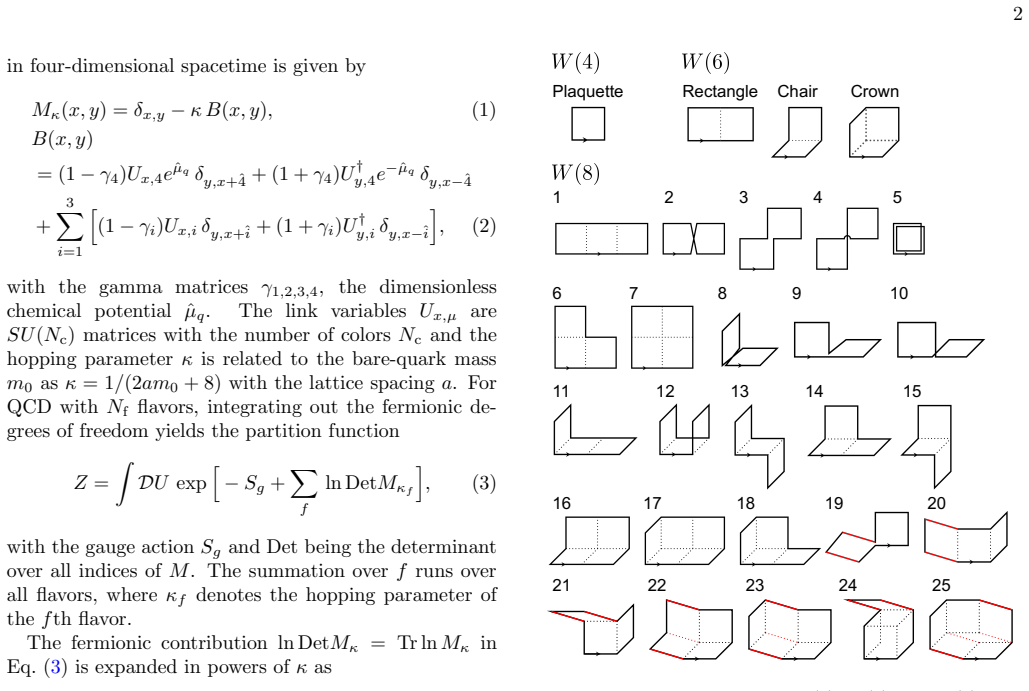
Efficient trie-based algorithms compute the κ^8 to κ^12 terms in the hopping-parameter expansion of Tr ln M at costs of 20 to 8900 times a staple evaluation.
A machine-rendered reading of the paper's core claim, the machinery that carries it, and where it could break.
Core claim
The resulting algorithms evaluate the κ^8, κ^10, and κ^12 terms at computational costs of approximately 20, 460, and 8900 times that of a single staple evaluation, respectively, with correctness verified by comparison with a reliable reference calculation.
What carries the argument
The trie data structure for enumerating and computing contributions to high-order terms in the expansion of Tr ln M
If this is right
- The higher-order terms can now be included in practical calculations of physical observables.
- The computational scaling allows access to orders previously considered too expensive.
- Verification ensures the algorithms produce accurate results matching independent computations.
- Human-AI collaboration can be used to create similar specialized algorithms for other expansions.
Where Pith is reading between the lines
- If the trie approach generalizes, it could apply to expansions of other functions of the Dirac operator.
- Such methods might reduce the need for full matrix diagonalization or inversion in some approximation schemes.
- Extending the order further could test the convergence properties of the hopping expansion on typical gauge configurations.
Load-bearing premise
The trie data structure and traversal rules correctly enumerate every contributing term without omissions, duplications, or incorrect combinatorial weights.
What would settle it
Finding a gauge configuration where the algorithm's result for any computed order differs from that of an independent exact reference method would show an error in the enumeration or weighting.
Figures
read the original abstract
We develop efficient algorithms for evaluating higher-order terms in the hopping-parameter expansion of $\textrm{Tr}\ln M$ on $SU(N_\textrm{c})$ gauge configurations. The resulting algorithms, which exploit a trie data structure for the computation of high-order terms, evaluate the $\kappa^8$, $\kappa^{10}$, and $\kappa^{12}$ terms at computational costs of approximately $20$, $460$, and $8900$ times that of a single staple evaluation, respectively. The correctness of the algorithms is verified by comparison with a computationally expensive but reliable reference calculation. We emphasize that collaboration between human researchers and AI coding agents was essential to the development of these algorithms.
Editorial analysis
A structured set of objections, weighed in public.
Referee Report
Summary. The manuscript develops efficient algorithms for evaluating higher-order terms (κ^8, κ^10, κ^12) in the hopping-parameter expansion of Tr ln M on SU(N_c) gauge configurations. These algorithms exploit a trie data structure and are reported to incur computational costs of approximately 20, 460, and 8900 times that of a single staple evaluation, respectively. Correctness is verified by direct numerical comparison against a separate, computationally expensive reference calculation. The work also stresses that human-AI collaboration was essential to the algorithm development.
Significance. If the reported algorithms are correct, they provide a concrete, scalable route to higher-order terms in the hopping expansion that would otherwise be inaccessible, which is potentially useful for precision lattice QCD calculations involving the fermion determinant. The explicit scaling factors relative to staple evaluations and the use of an independent reference calculation constitute measurable strengths; the absence of pseudocode or stability analysis, however, limits immediate adoption and reproducibility.
major comments (2)
- Abstract (and the verification paragraph): the claim that the trie traversal rules produce the exact set of diagrams with correct multiplicities up to O(κ^12) rests entirely on numerical agreement with an unspecified 'computationally expensive but reliable reference calculation.' No information is given on the reference method, its truncation logic, or how independence from the trie bookkeeping is guaranteed. If the reference shares any combinatorial enumeration steps, the match would not detect systematic omissions, duplications, or weight errors—the central correctness claim therefore lacks a load-bearing independent check.
- No section provides pseudocode, explicit error analysis, or numerical-stability discussion for the trie traversal at orders κ^8 and higher. Without these, the reported costs (20×, 460×, 8900× staple) cannot be assessed for possible undetected implementation artifacts, which directly affects the utility of the claimed speed-ups.
Simulated Author's Rebuttal
We thank the referee for the careful review and constructive comments. We address the two major comments point by point below and will revise the manuscript to improve documentation and reproducibility.
read point-by-point responses
-
Referee: Abstract (and the verification paragraph): the claim that the trie traversal rules produce the exact set of diagrams with correct multiplicities up to O(κ^12) rests entirely on numerical agreement with an unspecified 'computationally expensive but reliable reference calculation.' No information is given on the reference method, its truncation logic, or how independence from the trie bookkeeping is guaranteed. If the reference shares any combinatorial enumeration steps, the match would not detect systematic omissions, duplications, or weight errors—the central correctness claim therefore lacks a load-bearing independent check.
Authors: We agree that the manuscript provides insufficient detail on the reference calculation. We will revise the verification section to describe the reference method, its truncation logic, and the measures taken to ensure it is independent of the trie bookkeeping (specifically, that it uses a separate enumeration strategy without shared combinatorial rules). This will strengthen the independence of the check. revision: yes
-
Referee: No section provides pseudocode, explicit error analysis, or numerical-stability discussion for the trie traversal at orders κ^8 and higher. Without these, the reported costs (20×, 460×, 8900× staple) cannot be assessed for possible undetected implementation artifacts, which directly affects the utility of the claimed speed-ups.
Authors: We acknowledge that the manuscript lacks pseudocode and dedicated discussions of error analysis and numerical stability. We will add an appendix containing pseudocode for the trie traversal routines at the relevant orders and include a new subsection addressing potential numerical issues, floating-point stability, and safeguards against implementation artifacts. The reported cost factors are measured runtimes on the actual code, but additional documentation will improve assessability. revision: yes
Circularity Check
No significant circularity; verification relies on external reference
full rationale
The paper presents algorithmic development for higher-order hopping-parameter expansion of Tr ln M using a trie data structure, with claimed computational costs for κ^8, κ^10, and κ^12 terms. Correctness is asserted via direct numerical comparison to a separate, computationally expensive reference method rather than any internal fitting, self-definition, or renormalization that would make results tautological. No equations or claims reduce the output to the input by construction, and the central enumeration rules are presented as independently checkable combinatorial procedures. This is the normal case of an algorithmic paper whose load-bearing step is external validation.
Axiom & Free-Parameter Ledger
axioms (2)
- standard math The series expansion of Tr ln M in powers of the hopping parameter κ is mathematically valid on SU(Nc) gauge configurations.
- domain assumption A trie can be constructed to store and traverse all distinct contributions to each order without duplication or omission.
Reference graph
Works this paper leans on
-
[1]
Ab-initio Determination of Light Hadron Masses
S. Durret al.(BMW), Ab-Initio Determination of Light Hadron Masses, Science322, 1224 (2008), arXiv:0906.3599 [hep-lat]
work page internal anchor Pith review Pith/arXiv arXiv 2008
-
[2]
Physical Point Simulation in 2+1 Flavor Lattice QCD
S. Aokiet al.(PACS-CS), Physical Point Simulation in 2+1 Flavor Lattice QCD, Phys. Rev. D81, 074503 (2010), arXiv:0911.2561 [hep-lat]
work page internal anchor Pith review Pith/arXiv arXiv 2010
-
[3]
R. G. Edwards, J. J. Dudek, D. G. Richards, and S. J. Wallace, Excited state baryon spectroscopy from lattice QCD, Phys. Rev. D84, 074508 (2011), arXiv:1104.5152 [hep-ph]
work page internal anchor Pith review Pith/arXiv arXiv 2011
-
[4]
S. Aoki, T. Doi, T. Hatsuda, Y. Ikeda, T. Inoue, N. Ishii, K. Murano, H. Nemura, and K. Sasaki (HAL QCD), Lattice QCD approach to Nuclear Physics, PTEP2012, 01A105 (2012), arXiv:1206.5088 [hep-lat]
work page internal anchor Pith review Pith/arXiv arXiv 2012
-
[5]
Light Hadron Masses from Lattice QCD
Z. Fodor and C. Hoelbling, Light Hadron Masses from Lattice QCD, Rev. Mod. Phys.84, 449 (2012), arXiv:1203.4789 [hep-lat]
work page internal anchor Pith review Pith/arXiv arXiv 2012
-
[6]
Full result for the QCD equation of state with 2+1 flavors
S. Borsanyi, Z. Fodor, C. Hoelbling, S. D. Katz, S. Krieg, and K. K. Szabo, Full result for the QCD equation of state with 2+1 flavors, Phys. Lett. B730, 99 (2014), arXiv:1309.5258 [hep-lat]
work page internal anchor Pith review Pith/arXiv arXiv 2014
-
[7]
The equation of state in (2+1)-flavor QCD
A. Bazavovet al.(HotQCD), Equation of state in ( 2+1 )-flavor QCD, Phys. Rev. D90, 094503 (2014), arXiv:1407.6387 [hep-lat]
work page internal anchor Pith review Pith/arXiv arXiv 2014
-
[8]
Standard-model prediction for direct CP violation in $K\to\pi\pi$ decay
Z. Baiet al.(RBC, UKQCD), Standard Model Predic- tion for Direct CP Violation in K→ππDecay, Phys. Rev. Lett.115, 212001 (2015), arXiv:1505.07863 [hep-lat]
work page internal anchor Pith review Pith/arXiv arXiv 2015
-
[9]
C. C. Changet al., A per-cent-level determination of the nucleon axial coupling from quantum chromodynamics, Nature558, 91 (2018), arXiv:1805.12130 [hep-lat]
work page internal anchor Pith review Pith/arXiv arXiv 2018
-
[10]
Y.-B. Yang, J. Liang, Y.-J. Bi, Y. Chen, T. Draper, K.- F. Liu, and Z. Liu, Proton Mass Decomposition from the QCD Energy Momentum Tensor, Phys. Rev. Lett.121, 212001 (2018), arXiv:1808.08677 [hep-lat]
work page internal anchor Pith review Pith/arXiv arXiv 2018
-
[11]
S. Borsanyiet al., Leading hadronic contribution to the muon magnetic moment from lattice QCD, Nature593, 51 (2021), arXiv:2002.12347 [hep-lat]
- [12]
-
[13]
Y. Aokiet al.(Flavour Lattice Averaging Group (FLAG)), FLAG review 2024, Phys. Rev. D113, 014508 (2026), arXiv:2411.04268 [hep-lat]
work page internal anchor Pith review Pith/arXiv arXiv 2024
-
[14]
Davies, Muon g-2, PoSLA TTICE2024, 019 (2025), arXiv:2503.03364 [hep-lat]
C. Davies, Muon g-2, PoSLA TTICE2024, 019 (2025), arXiv:2503.03364 [hep-lat]
-
[15]
S. Borsanyi and P. Parotto, The QCD phase diagram (2025), arXiv:2512.08843 [nucl-th]
-
[16]
T. Matsumoto, M. Kitazawa, and Y. Kohno, Classi- fying topological charge in SU(3) Yang–Mills theory with machine learning, PTEP2021, 023D01 (2021), arXiv:1909.06238 [hep-lat]
- [17]
- [18]
- [19]
- [20]
- [21]
-
[22]
D. Boydaet al., Applications of Machine Learning to Lat- tice Quantum Field Theory, inSnowmass 2021(2022) arXiv:2202.05838 [hep-lat]
- [23]
-
[24]
K. Cranmer, G. Kanwar, S. Racani` ere, D. J. Rezende, and P. E. Shanahan, Advances in machine-learning-based sampling motivated by lattice quantum chromodynam- ics, Nature Rev. Phys.5, 526 (2023), arXiv:2309.01156 [hep-lat]
-
[25]
Tomiya, Machine Learning for Lattice QCD, J
A. Tomiya, Machine Learning for Lattice QCD, J. Phys. Soc. Jap.94, 031006 (2025)
2025
-
[26]
S. Yasunaga, K. Yoshimura, A. Tomiya, and Y. Nagai, Parameter Optimization of Domain-Wall Fermion using Machine Learning, in42th International Symposium on Lattice Field Theory(2026) arXiv:2603.16329 [hep-lat]
-
[27]
T. Misumi, Lattice fermion formulation via Physics- Informed Neural Networks: Ginsparg-Wilson relation and Overlap fermions (2026), arXiv:2605.06022 [hep-lat]
work page internal anchor Pith review Pith/arXiv arXiv 2026
-
[28]
K. G. Wilson, Confinement of Quarks, Phys. Rev. D10, 2445 (1974)
1974
-
[29]
Munster and P
G. Munster and P. Weisz, Estimate of the Relation Be- tween Scale Parameters and the String Tension by Strong Coupling Methods, Phys. Lett. B96, 119 (1980), [Erra- tum: Phys.Lett.B 100, 519 (1981)]
1980
-
[30]
J. M. Drouffe and J. B. Zuber, Roughening Transition in Lattice Gauge Theories in Arbitrary Dimension. 2. The GroupsZ(3), U(1), SU(2), SU(3), Nucl. Phys. B180, 264 (1981)
1981
-
[31]
Munster, Strong Coupling Expansions for the Mass Gap in Lattice Gauge Theories, Nucl
G. Munster, Strong Coupling Expansions for the Mass Gap in Lattice Gauge Theories, Nucl. Phys. B190, 439 (1981), [Addendum: Nucl.Phys.B 200, 536–538 (1982), Erratum: Nucl.Phys.B 205, 648–648 (1982)]
1981
-
[32]
Creutz,Quarks, Gluons and Lattices, Cambridge Monographs on Mathematical Physics (Cambridge Uni- versity Press, 2023)
M. Creutz,Quarks, Gluons and Lattices, Cambridge Monographs on Mathematical Physics (Cambridge Uni- versity Press, 2023)
2023
-
[33]
H. J. Rothe,Lattice gauge theories: An Introduction, Vol. 43 (World Scientific, 1992)
1992
-
[34]
The scalar pion form factor in two-flavor lattice QCD
V. G¨ ulpers, G. von Hippel, and H. Wittig, Scalar pion form factor in two-flavor lattice QCD, Phys. Rev. D89, 094503 (2014), arXiv:1309.2104 [hep-lat]
work page internal anchor Pith review Pith/arXiv arXiv 2014
-
[35]
J.-L. Zhou, Z. Cheng, G.-Y. Xiong, and J.-B. Zhang, Hopping parameter expansion technique in noise method for disconnected quark loops, Chin. Phys. Lett.35, 041101 (2018)
2018
-
[36]
M. Hasenbusch, Exploiting the hopping parameter ex- pansion in the hybrid Monte Carlo simulation of lattice QCD with two degenerate flavors of Wilson fermions, Phys. Rev. D97, 114512 (2018), arXiv:1805.03560 [hep- lat]
work page internal anchor Pith review Pith/arXiv arXiv 2018
-
[37]
Disconnected Loop Subtraction Methods in Lattice QCD
S. Baral, T. Whyte, W. Wilcox, and R. B. Mor- gan, Disconnected Loop Subtraction Methods in Lat- tice QCD, Comput. Phys. Commun.241, 64 (2019), arXiv:1903.06986 [hep-lat]
work page internal anchor Pith review Pith/arXiv arXiv 2019
- [38]
-
[39]
D. Djukanovic, G. von Hippel, H. B. Meyer, K. Ottnad, M. Salg, and H. Wittig, Electromagnetic form factors of the nucleon from Nf=2+1 lattice QCD, Phys. Rev. D 109, 094510 (2024), arXiv:2309.06590 [hep-lat]
-
[40]
The nature of the Roberge-Weiss transition in $N_f=2$ QCD with Wilson fermions
O. Philipsen and C. Pinke, Nature of the Roberge-Weiss transition inN f = 2 QCD with Wilson fermions, Phys. Rev. D89, 094504 (2014), arXiv:1402.0838 [hep-lat]
work page internal anchor Pith review Pith/arXiv arXiv 2014
- [41]
-
[42]
O. Philipsen, Lattice Constraints on the QCD Chiral Phase Transition at Finite Temperature and Baryon Den- sity, Symmetry13, 2079 (2021), arXiv:2111.03590 [hep- lat]
-
[43]
A. Kiyohara, M. Kitazawa, S. Ejiri, and K. Kanaya, Finite-size scaling around the critical point in the heavy quark region of QCD, Phys. Rev. D104, 114509 (2021), arXiv:2108.00118 [hep-lat]
-
[44]
R. Ashikawa, M. Kitazawa, S. Ejiri, and K. Kanaya, High-precision analysis of the critical point in heavy- quark QCD at Nt=6, Phys. Rev. D110, 074508 (2024), arXiv:2407.09156 [hep-lat]
-
[45]
Fredkin, Trie memory, Communications of the ACM 3, 490 (1960)
E. Fredkin, Trie memory, Communications of the ACM 3, 490 (1960). [46]https://github.com/WTatsuya2000/HO-HPE
1960
-
[46]
Gattringer and C
C. Gattringer and C. B. Lang,Quantum chromodynamics on the lattice, Vol. 788 (Springer, Berlin, 2010)
2010
-
[47]
N. Wakabayashi, S. Ejiri, K. Kanaya, and M. Kitazawa, Scope and convergence of the hopping parameter ex- pansion in finite-temperature quantum chromodynamics with heavy quarks around the critical point, PTEP2022, 033B05 (2022), arXiv:2112.06340 [hep-lat]
-
[48]
Burnside,Theory of Groups of Finite Order(Cam- bridge University Press, Cambridge, 1897) 2nd ed
W. Burnside,Theory of Groups of Finite Order(Cam- bridge University Press, Cambridge, 1897) 2nd ed. 1911; Dover reprint 1955. 7 Supplemental Material: Tables for the shape classification forW(4), W(6), andW(8) TABLE II. Shape classification ofW(4). jtrajectoryM j Sj Dj type 1 12 ¯1¯2 6 1−8 plaquette TABLE III. Shape classification ofW(6). jtrajectoryM j S...
1911
discussion (0)
Sign in with ORCID, Apple, or X to comment. Anyone can read and Pith papers without signing in.