REVIEW 3 major objections 4 minor 6 cited by
Dark matter minispike: a significant enhancement of eccentricity for intermediate-mass-ratio-inspirals
T0 review · 3 major / 4 minor · reviewed 2026-08-14 · deepseek-v4-flash
Pith's one-line read The paper claims that dynamical friction from a dark matter minispike can dramatically increase the eccentricity of an intermediate-mass-ratio inspiral, keeping it above 0.95 into the LISA band.
desk verdict Useful new secular equations, but the quantitative eccentricity enhancement is unsupported because the drag law is applied outside its valid regime. read the letter →
The pith
A machine-rendered reading of the paper's core claim, the machinery that carries it, and where it could break.
The reading
What carries the argument
The central object is the dark matter minispike profile $\rho_{\rm DM}(r)=\rho_{\rm sp}(r_{\rm sp}/r)^{\alpha}$ with $1.5<\alpha<7/3$, combined with the Chandrasekhar dynamical friction force $F_{\rm DF}=4\pi G^2\mu^2\rho_{\rm DM}\ln\Lambda/v^2$. The argument runs through the orbit-averaged rates of energy and angular momentum loss: because the drag is $\propto v^{-2}$, the orbital average weights it most heavily at apastron, so the friction contributes a negative term to $\dot{e}$ that counteracts the Peters--Mathews gravitational-wave circularization. The decisive comparison is in Eq. (18): the friction term scales as $p^{3/2-\alpha}$ and the gravitational-wave term as $p^{-4}$, so for large $p$ the dark matter force wins and the eccentricity grows until the binary shrinks enough for gravitational waves to take over.
What would settle it
A self-consistent calculation of the energy deposited into the minispike during the inspiral: if that deposited energy exceeds the spike's binding energy at apocenter for the large initial separations used here (hundreds to thousands of AU), the spike erodes and the predicted $e>0.95$ in the LISA band fails. Observationally, LISA detecting an IMRI entering the band at low eccentricity would rule out the strong-enhancement scenario for that source.
Extended reading notes
Core claim
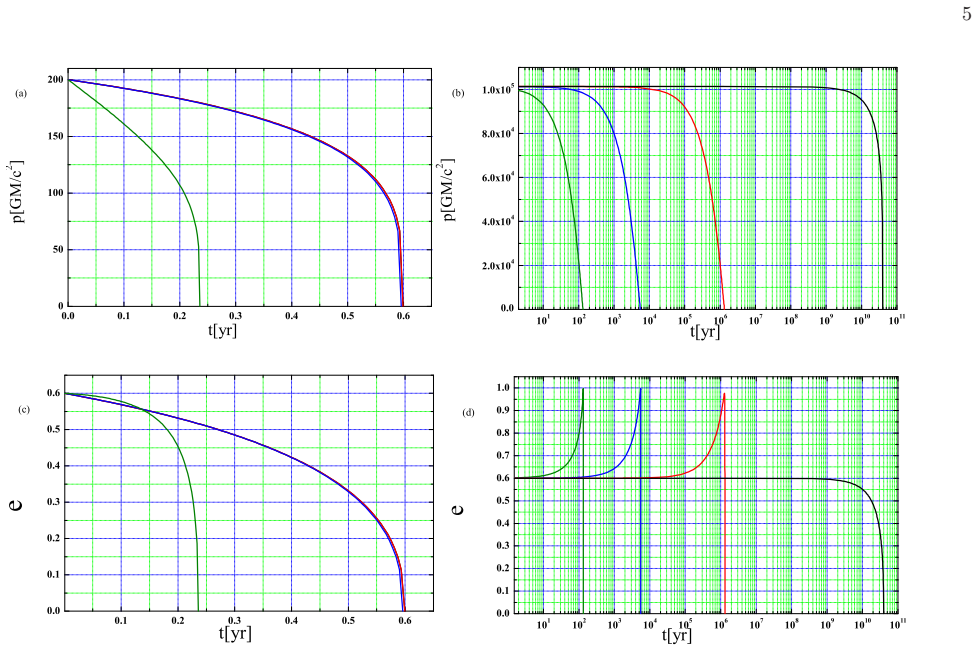
The paper derives orbit-averaged adiabatic evolution equations for the semi-latus rectum $p$ and eccentricity $e$ that include both gravitational-wave back-reaction and dynamical friction from a power-law dark matter minispike with density $\rho_{\rm DM}(r)=\rho_{\rm sp}(r_{\rm sp}/r)^{\alpha}$. Its central finding is that the friction force, $\propto \rho/v^2$, is largest near apastron, so it removes more energy at apastron than at periastron and therefore increases eccentricity. In the $p$--$e$ evolution the friction term scales as $p^{3/2-\alpha}$ while the gravitational-wave term scales as $p^{-4}$, so at large separation friction dominates and $e$ grows; gravitational-wave circularization wins only at small $p$. With $\alpha=1.5$ and initial $p=1$ AU the eccentricity grows from 0.3 to 0.85, and for denser spikes it can approach 1. In a typical globular cluster, after dynamical hardening leaves the binary at $a_0\simeq 158$--$4253$ AU with $e_0\simeq 0.98$, the eccentricity remains above 0.95 at $10^{-4}$ Hz and above 0.9 at $10^{-3}$ Hz, whereas without dark matter it drops below 0.2 and then below 0.02; the corresponding waveforms show periastron cusps and amplitude gains of two to five orders.
Load-bearing premise
That the dark matter minispike is not substantially eroded or heated by the very dynamical friction that drives the inspiral; if the spike unbinds as it gives up energy to the orbit, the eccentricity enhancement could largely disappear.
Editorial extensions
If this is right
- IMRIs with a surviving minispike can enter the LISA band on highly eccentric orbits, so the emitted signal is a train of periastron bursts rather than a quasi-circular chirp.
- Eccentricity at $10^{-4}$ Hz becomes a dark-matter diagnostic: with a spike $e>0.95$, without a spike $e<0.2$.
- The gravitational-wave amplitude at $10^{-3}$ Hz is amplified by two to five orders of magnitude in the spiky cases, improving the chance of detection.
- The minispike shifts the separation at which hardening hands over to gravitational waves from $\simeq 3.5$ AU to $\simeq 158$--$4253$ AU depending on $\alpha$, which changes the expected IMRI population and merger rate.
- Even when gravitational waves eventually dominate at small $p$, a moderate spike still substantially slows the rate of circularization.
Reading between the lines
- The same apastron-drag mechanism should operate for extreme-mass-ratio inspirals around supermassive black holes if a dark matter spike survives there; the effect should scale with $\rho_{\rm sp}$ and $\alpha$, so LISA eccentricity measurements could constrain spike density profiles.
- The feedback caveat the authors flag may be especially severe in their globular-cluster scenario: at apocenter separations of hundreds to thousands of AU the orbital velocity is only a few km/s, where the $v^{-2}$ drag is strongest and the spike's binding energy is smallest, so self-consistent spike erosion could cut the eccentricity enhancement substantially.
- If scattering processes replenish the minispike even as friction heats it, the high-eccentricity prediction could survive feedback; whether the cusp can be regenerated on the inspiral timescale is a testable question.
- The competition criterion $p^{3/2-\alpha}$ versus $p^{-4}$ implies a threshold initial separation above which eccentricity grows; mapping that threshold as a function of $\alpha$ and $\rho_{\rm sp}$ would let population studies predict which IMRIs should show cusped waveforms.
Signed reviews
Editorial analysis
A structured set of objections, weighed in public.
Referee Report
Summary. The paper derives adiabatic secular evolution equations for an eccentric intermediate-mass-ratio inspiral (IMRI) under gravitational-wave back-reaction and dynamical friction against a power-law dark-matter minispike around an intermediate-mass black hole. The central claim is that dynamical friction, being inversely proportional to velocity squared, dissipates more energy near apastron than near periastron and therefore increases the eccentricity; for a moderate minispike the eccentricity can grow from 0.3 to 0.85, and in a globular-cluster model the eccentricity can remain above 0.95 when the system enters the LISA band. The paper also presents waveforms and argues that the DM-induced eccentricity is distinguishable by LISA.
Significance. If the central claim were correct, the paper would provide a concrete way to infer the presence of DM minispikes from the eccentricity of IMRI signals, which would be of genuine interest for LISA, Taiji, and Tianqin. The derivation of Eqs. (15)-(18) is compact and the adiabatic averaging is standard, and the paper explicitly acknowledges the competing roles of GW circularization and dynamical friction. However, the quantitative predictions rest on the velocity dependence of the drag law, and that dependence is used outside its domain of validity in exactly the regime that produces the headline eccentricity enhancement. The claimed effect is therefore not established by the present analysis.
major comments (3)
- [Sec. II, Eq. (13); Sec. III, GC parameters] Equation (13) is the high-velocity (or zero-dispersion) limit of the Chandrasekhar drag formula, but the paper neither states this nor specifies the velocity dispersion sigma of the DM spike. The full formula is F = (4*pi*G^2*mu^2*rho*ln(Lambda)/v^2) * [erf(X) - (2X/sqrt(pi))*exp(-X^2)] with X = v/(sqrt(2)*sigma), and for X << 1 the force scales as F proportional to v, not v^{-2}. In the globular-cluster case of Sec. III, the alpha = 7/3 run starts at a0 = 4253 AU and e0 = 0.98, giving p ~ 168 AU and an apocenter speed of roughly 2 km/s, while the local circular speed of the spike is of order 15 km/s, so X ~ 0.1 at apocenter. In this subsonic regime the apocenter drag is suppressed by orders of magnitude relative to the v^{-2} formula, and the energy-loss rate F*v is proportional to v^2, so it is largest near periastron rather than apastron. This reverses the sign of the dynamical-friction contribution to the eccentricity evolution in Eq. (18), or at minimum eliminates the claimed enhancement. The central results in Figs. 1-3 are therefore not supported by the adopted drag law.
- [Sec. III, static-spike assumption] The calculations assume a fixed minispike profile rho(r) of Eq. (1), but the final paragraph before the Summary correctly notes that dynamical friction heats and can unbind part of the spike. For the large initial semi-major axes used in the globular-cluster model (hundreds to thousands of AU), the DM binding energy within the orbital radius is small and the secondary's apocenter speed is only a few km/s, so the back-reaction of the inspiraling body on the spike is likely to be significant. Unless the density profile is evolved self-consistently or a quantitative argument is given that the spike survives, the eccentricity curves and waveform predictions should be regarded as upper limits rather than robust predictions.
- [Sec. III, Eq. (31) and Fig. 4] The Bessel expansion of the eccentric anomaly is printed incorrectly: the standard expansion is u = Omega*t + sum_s (2/s) J_s(s e) sin(s Omega*t), but Eq. (31) has sin(Omega*t) inside the sum, which drops the harmonic index and would give an incorrect time series for r(t), phi(t), and the waveforms in Fig. 4. Relatedly, the claimed amplitude enhancement of up to five orders of magnitude is difficult to reconcile with Eq. (24): at the quoted eccentricities the pericenter radius is roughly a factor 1/(1-e) smaller than apastron, which gives amplitude ratios of order 10-100 for the eccentricities reported at 10^{-3} Hz, not 10^5. The waveform and detectability claims need to be recomputed from a correct Keplerian expansion.
minor comments (4)
- [Sec. III and Fig. 3 caption] The text gives the alpha = 7/3 initial semi-major axis as 4253 AU, while the Fig. 3 caption states a0 = 5253 AU; one of these is a typo and should be corrected.
- [Eq. (16)] The denominator contains '2e cos alpha + 1', which should read '2e cos phi + 1'.
- [Abstract and Summary] There are minor typographical errors, including 'easly' in the abstract and 'minislike' and 'DM minislike cases' in the Summary.
- [Sec. III, discussion of harmonics] The statement that for highly eccentric orbits 'the most powerful harmonic should be n = 1' is not correct in general; for high eccentricity the gravitational-wave spectrum peaks at high harmonics, n ~ (1-e^2)^{-3/2}. The text should be revised to be consistent with the standard harmonic decomposition.
Circularity Check
No circularity: the eccentricity enhancement is a derived consequence of the adopted v^-2 dynamical-friction law, not an input reused as a conclusion.
full rationale
The derivation chain is self-contained. Starting from Newtonian orbital elements, the paper computes the time-averaged energy and angular momentum losses from Peters-Mathews GW emission (Eqs. 11-12) and from Chandrasekhar dynamical friction (Eq. 13, parameterized by the independent minispike model of Eda et al. 2015 with r_sp = 0.54 pc, rho_sp = 226 Msun/pc^3 and alpha in [1.5, 7/3]). These are substituted into the identities for dp/dt and de/dt (Eqs. 7-8) to obtain Eqs. 17-18 and 19-20; the reported eccentricities (e.g. 0.3 to 0.85, e > 0.95 at 10^-4 Hz) are outputs of numerical integration of those coupled equations. No parameter entering the target result is fitted to that result; the GC initial conditions are fixed by equating the hardening and DM timescales, not by requiring the final e. The only self-citations ([10], [11], [29]) are used as routine support for the dominance of dynamical friction and for standard harmonic decomposition; they do not supply the eccentricity prediction or a uniqueness theorem that forces it. The authors' explicit caveat that minispike heating may erode the spike is a stated limitation, not a circular reduction. The physical validity of using the high-velocity v^-2 form at subsonic apocenter velocities is a legitimate correctness concern, but it concerns the input force law, not circularity.
Assumptions & free parameters
free parameters (6)
- Spike power-law index α =
1.5, 2.0, 7/3 (scanned)
- Spike density normalization ρ_sp =
226 M_sun/pc^3
- Spike radius r_sp =
0.54 pc
- Coulomb logarithm lnΛ =
10
- GC hardening parameters (H, σ, n, m*) =
H=15, σ=10 km/s, n=10^5.5/pc^3, m*=0.5 M_sun
- Initial eccentricity after hardening e0 =
0.98
assumptions (6)
- standard math Newtonian orbital mechanics and Peters-Mathews leading-order GW fluxes
- domain assumption Chandrasekhar dynamical friction with F ∝ 1/v^2 and constant lnΛ
- domain assumption Adiabatic approximation
- domain assumption The DM minispike has a single power law down to the central IMBH and is not eroded by the inspiral
- domain assumption The gravitational potential of the DM spike is neglected
- domain assumption Dynamical hardening terminates when its timescale equals the DM inspiral timescale, and the final eccentricity is 0.98
Cite this review
Pith. "Pith review of Dark matter minispike: a significant enhancement of eccentricity for intermediate-mass-ratio-inspirals." pith.science (2026). https://pith.science/paper/NP2CNEOC
@misc{pith2026190810241,
  author       = {Pith},
  title        = {Pith review of: Dark matter minispike: a significant enhancement of eccentricity for intermediate-mass-ratio-inspirals},
  year         = {2026},
  howpublished = {\url{https://pith.science/paper/NP2CNEOC}},
  note         = {Machine review of arXiv:1908.10241}
}
abstract
When a stellar massive compact object, such as a black hole (BH), inspirals into an intermediate massive black hole (IMBH), an intermediate-mass-ratio-inspiral (IMRI) system forms. Such kind of systems are important sources for space-based gravitational wave detectors including LISA, Taiji and Tianqin. Dark matter (DM) minispikes may form around IMBHs. We study the effect of dynamical friction against DM minispike on the evolution of eccentric IMRI. For such investigation we construct the dynamical equations which describes the evolution of eccentric IMRI under the effect of dynamical friction. As dynamical friction is large for small velocity, the dissipation of energy near apastron is more than that near periastron. This will greatly enhance the eccentricity. For instance, with an initial semi-latus rectum of $1\rm AU$, even a moderate DM minispike can make the eccentricity grow from $0.3$ to $0.85$. In the extremal case the eccentricity could be enhanced to near $1$. We also study a specific case which corresponds to an IMRI in the center of a globular cluster (GC) and find the eccentricity can keep its value above $0.95$ until the IMRI enters LISA band. These gravitational wave with enhanced eccentricity by DM minispikes can be easly distinguished from that without DM at $10^{-3}\rm Hz$ due to the eccentricity difference. These anticipations can be tested by future space-based GW detectors such as LISA.
Figures


Figures from the paper (1 more)

Forward citations
Cited by 6 Pith papers
-
Black hole spacetimes with dark matter spikes: Energy-momentum tensor and backreaction effects
A dark-matter spike built from the full orbital motion of its particles has ~50% more energy density near the black hole and produces metric deviations ~2.5 times larger than mass-only models.
-
Extreme mass ratio inspirals in rotating dark matter spikes
Spin of the central black hole raises the dark matter spike density and the gravitational-wave dephasing it produces, so LISA can detect the dark matter effect more easily.
-
Dynamical friction can flip the hierarchical three-body system
Dynamical friction from a dark matter spike can restore orbital flips in hierarchical triple systems that Brown's Hamiltonian would otherwise suppress.
-
Probing vector gravitational atoms with eccentric intermediate mass-ratio inspirals
Eccentric intermediate-mass-ratio inspirals around vector gravitational atoms acquire faster decay, stronger circularization, and negative periastron precession, making the cloud visible to LISA-like detectors.
-
On Equation of State of Dark Matter around Massive Black Holes
Static dark matter halos around Schwarzschild black holes are viable only if the dark matter pressure is negative, under two toy equations of state and a vanishing horizon-density boundary condition.
-
Classical Black Hole Scattering to Celestial Amplitudes in Effective Theories of Gravity
A doctoral thesis reproduces the author's published post-Newtonian and post-Minkowskian two-body observables and celestial amplitudes in scalar-tensor, Chern-Simons, Einstein-Maxwell-dilaton, and quadratic gravity.
Reference graph
Works this paper leans on
-
[1]
95 at the gravitational wave frequency 10 −4Hz, which is the lower side of LISA band. Such a large eccentricity will result in a series of cusps in GW waveforms, which can be used to distinguish the existence of DM minispike. This paper is organized as following. In the Sec. II we will derive the dynamical equations for an eccentric IMRI affected by a DM m...
-
[2]
J. F. Navarro, C. S. Frenk, and S. D. M. White, The Astrophysical Journal 490, 493 (1997)
work page 1997
-
[3]
Gondolo and J
P. Gondolo and J. Silk, Phys. Rev. Lett. 83, 1719 (1999)
1999
- [4]
-
[5]
D. Merritt, M. Milosavljevi´ c, L. Verde, and R. Jimenez, Phys. Rev. Lett. 88, 191301 (2002)
work page 2002
- [6]
- [7]
- [8]
Show all 36 references
-
[9]
K. Eda, Y. Itoh, S. Kuroyanagi, and J. Silk, Phys. Rev. Lett. 110, 221101 (2013)
2013
-
[10]
K. Eda, Y. Itoh, S. Kuroyanagi, and J. Silk, Phys. Rev. D 91, 044045 (2015)
2015
-
[11]
Yue and W.-B
X.-J. Yue and W.-B. Han, Phys. Rev. D 97, 064003 (2018)
2018
-
[12]
X. J. Yue, W. B. Han and X. Chen, Astrophysical. J 874, 34 (2019), 1802.03739
2019 arXiv
-
[13]
Kavanagh, Daniele Gaggero, and Gian- franco Bertone, Phys
Bradley J. Kavanagh, Daniele Gaggero, and Gian- franco Bertone, Phys. Rev. D 98, 023536 (2018)
2018
-
[14]
Gultekin, M
K. Gultekin, M. C. Miller, and D. P. Hamilton, The As- trophysical Journal 640, 156 (2006)
2006
-
[15]
Matsubayashi, J
T. Matsubayashi, J. Makino, and T. Ebisuzaki, The As- trophysical Journal 656, 879 (2007)
2007
-
[16]
M. A. G¨ urkan, J. M. Fregeau, and F. A. Rasio, The As- trophysical Journal 640, L39 (2006)
2006
-
[17]
G. D. Quinlan, L. Hernquist, and S. Sigurdsson, Astro- phys. J. 440, 554 (1995), astro-ph/9407005
1995 arXiv
-
[18]
Maggiore, Gravitational Waves: Volume 1: Theory and Experiments (Oxford University Press, New York, 2007)
M. Maggiore, Gravitational Waves: Volume 1: Theory and Experiments (Oxford University Press, New York, 2007)
2007
-
[19]
P. C. Peters, Phys. Rev. 136, B1224 (1964)
1964
-
[20]
P. C. Peters and J. Mathews, Phys. Rev. 131, 435 (1963)
1963
-
[21]
Chandrasekhar, Astrophys
S. Chandrasekhar, Astrophys. J. 97, 255 (1943)
1943
-
[22]
Amaro-Seoane, J
P. Amaro-Seoane, J. R. Gair, M. Freitag, M. C. Miller, I. Mandel, C. J. Cutler, and S. Babak, Classical and Quantum Gravity 24, R113 (2007)
2007
- [23]
-
[24]
S. A. Farrell, N. A. Webb, D. Barret, O. Godet, and J. M. Rodrigues, Nature (London) 460, 73 (2009), 1001.0567
2009 arXiv
-
[25]
Zhao and J
H. Zhao and J. Silk, Phys. Rev. Lett. 95, 011301 (2005)
2005
-
[26]
Bertone, A
G. Bertone, A. R. Zentner, and J. Silk, Phys. Rev. D 72, 103517 (2005)
2005
-
[27]
D. C. Heggie, Mon. Not. Roy. Astron. Soc. 173, 729 (1975)
1975
-
[28]
Mandel, D
I. Mandel, D. A. Brown, J. R. Gair, and M. C. Miller, Astrophys. J. 681, 1431 (2008), 0705.0285
2008 arXiv
-
[29]
50 of Astronomical Society of the Pacific Conference Series edited by S
Structure and dynamics of globular clusters , vol. 50 of Astronomical Society of the Pacific Conference Series edited by S. G. Djorgovski and G. Meylan, (Astronomical Society of the Pacific, San Francisco, 1993)
1993
-
[30]
W. B. Han, Z. Cao, and Y. Hu, Classical and Quantum Gravity 34 225010(2017)
2017
-
[31]
Damour, A
T. Damour, A. Gopakumar, and B. R. Iyer, Phys. Rev. D 70, 064028 (2004)
2004
-
[32]
Gopakumar and B
A. Gopakumar and B. R. Iyer, Phys. Rev. D 65, 084011 (2002)
2002
-
[33]
Preto, D
M. Preto, D. Merritt, R. Spurzem, Astrophysical. J 613, L109 (2004)
2004
-
[34]
LISA official website: https://www.lisamission.org/
-
[35]
X. Gong, S. Xu, S. Bai, Z. Cao, G. Chen, Y. Chen, X. He, G. Heinzel, Y.-K. Lau, C. Liu, et al., Classical and Quan- tum Gravity 28, 094012 (2011)
2011
-
[36]
Luo, L.-S
J. Luo, L.-S. Chen, H.-Z. Duan, Y.-G. Gong, S. Hu, J. Ji, Q. Liu, J. Mei, V. Milyukov, M. Sazhin, et al., Classical and Quantum Gravity 33, 035010 (2016)
2016
Reviewed August 14, 2026 · model on record in the stance chip above.
Discussion (0). Continue with ORCID to comment.