REVIEW 2 major objections 4 minor 300 references
Classical Black Hole Scattering to Celestial Amplitudes in Effective Theories of Gravity
T0 review · 2 major / 4 minor · reviewed 2026-08-15 · deepseek-v4-flash
Pith's one-line read This thesis computes classical black-hole scattering observables in four effective theories of gravity beyond General Relativity, using worldline and amplitude methods to produce analytic results for potentials, impulses, waveforms…
desk verdict A technically careful PhD thesis that compiles five published papers; the computations check out, but the headline dCS spin-eikonal result is blocked by an unresolved IR issue the thesis itself admits. read the letter →
The pith
A machine-rendered reading of the paper's core claim, the machinery that carries it, and where it could break.
The reading
What carries the argument
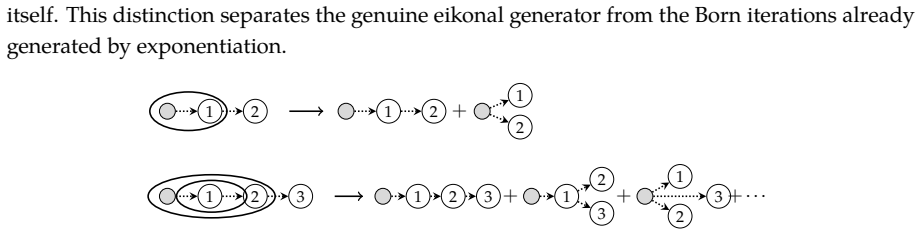
The load-bearing machinery is the worldline approach to classical scattering, in which compact objects are point particles and the gravitational and matter fields are integrated out: in the inspiral regime via non-relativistic general relativity's split into potential and radiation modes, and in the scattering regime via worldline quantum field theory, where worldline fluctuations are themselves quantized. The central generating object is the eikonal phase, understood as the classical limit of the logarithm of the S-matrix and computed with Magnus/Murua causal weights that cancel spurious infrared poles; impulse, spin kick, and scattering angle follow from Poisson-bracket expansions built on it. Multi-loop master integrals are evaluated through integration-by-parts reduction adapted to exponential Fourier kernels and through canonical dlog-form differential equations, and celestial amplitudes are obtained by Mellin transforming the eikonal-resummed amplitude.
What would settle it
Perform the 3PM dynamical Chern-Simons computation including the radiation-reaction or dissipative sector and check whether the 1/$epsilon^{2}$ infrared poles of the eikonal phase cancel. If no consistent subtraction scheme exists, the spin-dependent scattering angle quoted in Chapter 4 cannot be regarded as a well-defined classical observable.
Extended reading notes
Core claim
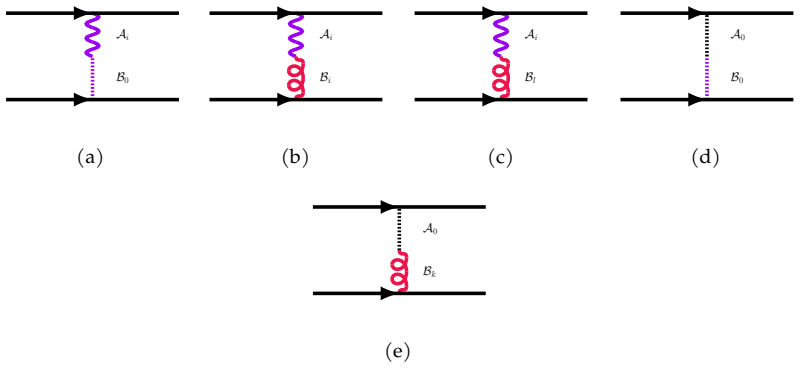
The central claim is a set of concrete classical observables computed to stated orders: the 1PN–2.5PN conservative potentials and scalar radiation up to N(4)LO for binaries in an axion and dark-photon environment; the 2PM impulse and waveforms in scalar-tensor theory with smooth massive limits; the linear-in-spin eikonal phase at 3PM in dynamical Chern-Simons gravity; the infrared-subtracted conservative potential and scattering angle in Einstein-Maxwell-dilaton theory; and the phase-dressed celestial eikonal amplitude in quadratic gravity, where, unlike in Einstein gravity, the u- and s-channel contributions do not cancel. The thesis presents these as faithful analytic results that can serve as benchmarks, and it reports a notable structural finding: the axion-photon coupling contributes to radiation only for orbits that are genuinely three-dimensional, vanishing for planar orbits in the non-spinning case.
Load-bearing premise
The 3PM dynamical Chern-Simons eikonal phase rests on an unproven assumption that its infrared divergences can be cancelled by some prescription; the thesis states that the conservative sector alone cannot remove them and leaves the systematic treatment to future work.
Editorial extensions
If this is right
- The 1PN–2.5PN potentials and scalar radiation up to N(4)LO give concrete templates for scalar and vector dark-matter effects on binary inspiral.
- The 2PM scalar-tensor impulse and waveform have smooth massless scalar limits, so they can serve as benchmark data for gravitational-wave waveform models beyond general relativity.
- The 3PM linear-in-spin eikonal phase in dynamical Chern-Simons gravity yields a spin-dependent scattering angle that, once the infrared issue is resolved, predicts parity-violating deviations in high-energy black-hole scattering.
- The Einstein-Maxwell-dilaton conservative potential and scattering angle reduce smoothly to the general-relativity and charge-free limits, providing amplitude-based benchmarks for charged compact-object dynamics.
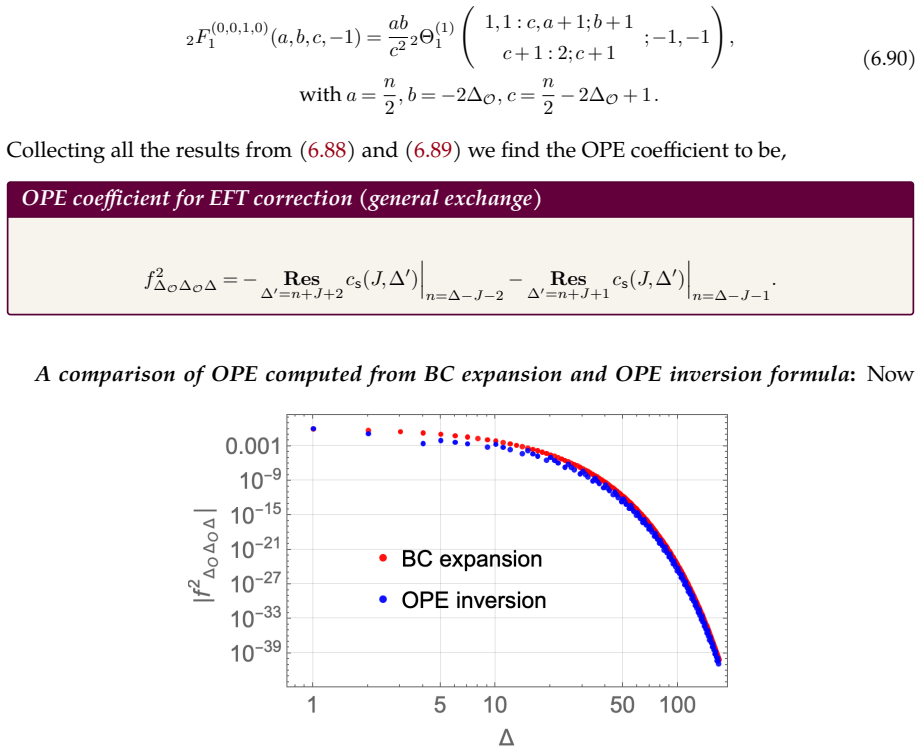
- In quadratic gravity the u- and s-channel contributions to the phase-dressed celestial eikonal do not cancel, changing the conformal data and OPE of the would-be celestial CFT relative to Einstein gravity.
Reading between the lines
- The vanishing of the axion-photon radiation for planar orbits suggests that the most promising gravitational-wave probes of axionic dark matter are eccentric or inclined binaries, or spinning binaries with spins precessing out of the orbital plane; the thesis notes the spinning case but does not frame it as a search strategy.
- If the infrared cancellation in dynamical Chern-Simons gravity requires the dissipative sector, then the conservative eikonal phase is not a standalone observable, and the 3PM spin-dependent scattering angle would need to be redefined in a way that parallels the Magnus prescription already needed in general relativity.
- The exponential-Fourier integration-by-parts method used for waveform master integrals could be applied to other observables with oscillatory factors, such as memory effects or radiation reaction, where standard rational-function IBP packages fail.
- The non-vanishing u/s-channel contributions in quadratic gravity suggest a richer celestial holographic dictionary for higher-derivative gravity; a direct test would be to compute the shadow OPE coefficients from the momentum-space Born amplitude rather than from the eikonal resummation.
Signed reviews
Editorial analysis
A structured set of objections, weighed in public.
Referee Report
Summary. This thesis develops quantum-field-theoretic tools for classical two-body gravitational dynamics beyond General Relativity and applies them to five settings: PN conservative and radiative dynamics of binaries in axion-like-particle and dark-photon environments (Chapter 2); impulse and waveforms in scalar-tensor gravity from worldline QFT (Chapter 3); a linear-in-spin eikonal phase at 3PM in dynamical Chern-Simons gravity (Chapter 4); IR-subtracted conservative potential and scattering angle in Einstein-Maxwell-dilaton theory (Chapter 5); and phase-dressed celestial eikonal amplitudes in quadratic gravity (Chapter 6). The exposition is unusually complete: Feynman rules, PN/PM power counting, master integral evaluations, and appendices are provided, and several internal consistency checks are reported, including smooth massless limits (e.g., Eqs. (2.51) and (2.170)) and the LO gravitational quadrupole formula reproducing the standard 32G/5 mu^2 r^4 Omega^6 result. The manuscript is presented as a PhD thesis and is largely based on five published co-authored papers.
Significance. If the results are correct, the thesis supplies analytic benchmarks for beyond-GR binary dynamics: the first N(4)LO scalar radiation in the axion/dark-photon model, 2PM scalar-tensor observables, a 3PM linear-in-spin dCS eikonal phase, an IR-finite EMD potential and scattering angle, and a non-vanishing s/u-channel contribution to the celestial eikonal in quadratic gravity. Credit is due for the unusually detailed derivations, the explicit master-integral technology, and the multiple internal consistency checks. The central caveat is that the dCS eikonal phase, the main result of Chapter 4, is not presented as a well-defined observable because its IR cancellation is explicitly deferred; until that is supplied or the corresponding claims are qualified, the benchmark status of the Chapter 4 observables is not established.
major comments (2)
- [Ch. 4, Secs. 4.1 and 4.5; Ch. 1, p. 11 (after Fig. 1.3)] The thesis's own statements block the central claim of Chapter 4. It states that "in our computation of the eikonal phase in dCS theory, we find that the IR divergences cannot be removed by considering only the conservative sector" and that a systematic treatment is "left as an important direction for future work." Since the eikonal phase is the generating quantity for the spin-dependent impulse and scattering angle, the 3PM linear-in-spin phase derived in Sec. 4.4 is scheme-dependent as presented; the GR cancellation of the leading 1/epsilon^2 pole via Magnus/Murua weights (Eqs. (1.33)-(1.35)) has no demonstrated analogue here. The chapter should either supply a concrete IR-cancellation prescription and show scheme independence, or explicitly present the eikonal phase and its derived observables as provisional and remove the corresponding benchmark claims.
- [Ch. 2, Secs. 2.4.6 and 2.5.2] The claimed N(4)LO precision of the scalar radiation result (Eq. (2.114)) is not yet established because the source multipoles in Eq. (2.110) are evaluated on the uncorrected Keplerian/circular orbit. Sec. 2.4.6 states that corrections to the orbit from the higher-order conservative potential are neglected, but no power-counting argument is given to show that these orbit corrections enter only beyond N(4)LO. The authors should either include the orbit corrections at the claimed orders or demonstrate by power counting that they are subleading; otherwise the N(4)LO label is unsupported.
minor comments (4)
- [Ch. 1, Sec. 1.4] The general Feynman-integral definition is numbered (2.138) inside the Introduction, and related display equations in the same section are also numbered in the 2.x series; the equation numbering should be made consistent with the chapter structure.
- [Ch. 2, Eq. (2.164)] The displayed gravitational radiation power formula is extremely long and difficult to verify as typeset; it should be split into a compact leading term plus a table of coefficient functions, with the bracketing carefully checked.
- [Ch. 2, Sec. 2.5.2] The quantity T(\dot{\bar\phi}) is introduced in Eq. (2.99) and then re-expressed in Eq. (2.101), but the relationship between the two forms is not explicitly stated; adding one line of explanation would improve readability.
- [Front matter / acknowledgments] The front matter contains non-standard material (an AI-generated image caption and an epigraph) that is unrelated to the scientific content; for archival purposes this should be removed or clearly separated from the technical presentation.
Circularity Check
No circularity: derivations are self-contained; the dCS IR caveat is a completeness limitation, not a circular reduction.
full rationale
The manuscript is a compilation of published computations, but the derivations are carried out inside the thesis rather than imported as black boxes. Each observable (potential, radiation, impulse, waveform, eikonal phase) is obtained from stated Lagrangians and WEFT/WQFT/Feynman rules with explicit integrals and master-integral reductions. There is no parameter fit to a subset of data that is later renamed a prediction. The only self-referential elements are bibliographic (the list of co-authored papers) and do not carry the derivations. The dCS eikonal IR caveat is explicitly acknowledged: 'we do not attempt such an analysis, and instead leave the systematic treatment of this issue as an important direction for future work.' That is a limitation on the well-definedness of the observable, not a circular reduction: the eikonal phase is not defined in terms of the scattering angle it is used to compute. Similarly, Chapter 2 explicitly says radiative power is evaluated on the leading-order Keplerian orbit; that is a stated approximation, not an input-output equivalence. No equation in the provided text sets a predicted quantity equal by construction to an input. Therefore there is no significant circularity.
Assumptions & free parameters
assumptions (6)
- domain assumption The two-body system is modelled by structureless point particles; finite-size (tidal) couplings C_R and C_V in the worldline action are set to zero.
- domain assumption The classical limit is extracted from tree-level worldline diagrams with soft messenger loops; purely quantum loops are dropped.
- domain assumption The WQFT partition function equals e to the i chi, and the Magnus/Murua weighting fixes the causal i-epsilon prescription so that spurious 1/epsilon squared poles cancel.
- domain assumption Radiative-sector results are evaluated on the zeroth-order Keplerian circular orbit; corrections to the orbit from the 1PN-2PN potentials are neglected.
- standard math Dimensional regularization, IBP identities (including the exponential-shift modification of Eqs. (1.45)-(1.47)), and differential-equation/canonical-basis methods are valid for the master integrals used.
- domain assumption In the celestial analysis, eikonal resummation before Mellin transformation renders the celestial amplitude well-defined or definable by analytic continuation, and the dispersion relations over the phase-dressed amplitude converge.
Cite this review
Pith. "Pith review of Classical Black Hole Scattering to Celestial Amplitudes in Effective Theories of Gravity." pith.science (2026). https://pith.science/paper/245RDZUB
@misc{pith2026260800784,
  author       = {Pith},
  title        = {Pith review of: Classical Black Hole Scattering to Celestial Amplitudes in Effective Theories of Gravity},
  year         = {2026},
  howpublished = {\url{https://pith.science/paper/245RDZUB}},
  note         = {Machine review of arXiv:2608.00784}
}
read the original abstract
This thesis investigates quantum field theoretic approaches to classical gravity beyond General Relativity. Using worldline effective field theory, worldline quantum field theory, and on shell scattering amplitudes, it investigates compact-object dynamics in dark-sector models, scalar tensor gravity, dynamical Chern Simons gravity, and Einstein Maxwell dilaton theory. The thesis derives a range of conservative and radiative observables, including impulses, waveforms, eikonal phases, two-body potentials, and scattering angles, while incorporating effects associated with spin, parity violation, infrared structure, and multi-loop integrals. It also constructs celestial eikonal amplitudes and analyzes their conformal data in gravitational theories beyond General Relativity. Collectively, these results broaden the application of modern quantum field theoretic techniques to gravitational dynamics and contribute to a more detailed understanding of gravity beyond the Einsteinian framework. (Detailed abstract in the thesis.)
Figures


Figures from the paper (27 more)




Reference graph
Works this paper leans on
-
[1]
LIGO Scientific, VirgoCollaboration, B. P. Abbottet al.,Observation of Gravitational Waves from a Binary Black Hole Merger, Phys. Rev. Lett.116(2016), no. 6, 061102 [1602.03837]. [2]LIGO Scientific, VirgoCollaboration, B. P. Abbottet al.,GW151226: Observation of Gravitational Waves from a 22-Solar-Mass Binary Black Hole Coalescence, Phys. Rev. Lett.116 (2...
arXiv 2016
-
[3]
LIGO Scientific, VirgoCollaboration, B. P. Abbottet al.,Properties of the Binary Black Hole Merger GW150914, Phys. Rev. Lett.116(2016), no. 24, 241102 [1602.03840]. [4]LIGO Scientific, VIRGOCollaboration, B. P. Abbottet al.,GW170104: Observation of a 50-Solar-Mass Binary Black Hole Coalescence at Redshift 0.2, Phys. Rev. Lett.118(2017), no. 22, 221101 [17...
arXiv 2016
-
[7]
Gourgoulhon,3+1 Formalism in General Relativity, vol
E. Gourgoulhon,3+1 Formalism in General Relativity, vol. 846 ofLecture Notes in Physics. Springer Berlin Heidelberg, Berlin, Heidelberg, 2012
2012
-
[8]
L. Lehner and F. Pretorius,Numerical Relativity and Astrophysics, Ann. Rev. Astron. Astrophys.52(2014) 661–694 [1405.4840]. [9]LIGO Scientific, VIRGO, NINJA-2Collaboration, J. Aasiet al.,The NINJA-2 project: Detecting and characterizing gravitational waveforms modelled using numerical binary black hole simulations, Class. Quant. Grav.31(2014) 115004 [1401.0939]
arXiv 2014
-
[10]
Weyl,Space, Time, Matter
H. Weyl,Space, Time, Matter. Dover, USA, 1922
1922
-
[11]
Utiyama and B
R. Utiyama and B. S. DeWitt,Renormalization of a Classical Gravitational Field Interacting with Quantized Matter Fields, Journal of Mathematical Physics3(July, 1962) 608–618. 297
1962
-
[12]
K. S. Stelle,Renormalization of higher-derivative quantum gravity, Phys. Rev. D16(Aug, 1977) 953–969
1977
-
[13]
Pais and G
A. Pais and G. E. Uhlenbeck,On Field Theories with Non-Localized Action, Phys. Rev.79(Jul,
Show all 300 references
-
[14]
Fradkin and A
E. Fradkin and A. Tseytlin,Renormalizable asymptotically free quantum theory of gravity, Nuclear Physics B201(1982), no. 3, 469–491
1982
-
[15]
S. F. Hassan and A. Sen,Twisting classical solutions in heterotic string theory, Nucl. Phys. B 375(1992) 103–118 [hep-th/9109038]
1992 arXiv
-
[16]
B. R. Holstein and J. F. Donoghue,Classical physics and quantum loops, Phys. Rev. Lett.93 (2004) 201602 [hep-th/0405239]
2004 arXiv
-
[17]
Z. Bern, C. Cheung, R. Roiban, C.-H. Shen, M. P. Solon and M. Zeng,Black Hole Binary Dynamics from the Double Copy and Effective Theory, JHEP10(2019) 206 [1908.01493]
2019 arXiv
-
[18]
Z. Bern, A. Luna, R. Roiban, C.-H. Shen and M. Zeng,Spinning black hole binary dynamics, scattering amplitudes, and effective field theory, Phys. Rev. D104(2021), no. 6, 065014 [2005.03071]
2021 arXiv
-
[19]
Z. Bern, C. Cheung, R. Roiban, C.-H. Shen, M. P. Solon and M. Zeng,Scattering Amplitudes and the Conservative Hamiltonian for Binary Systems at Third Post-Minkowskian Order, Phys. Rev. Lett.122(2019), no. 20, 201603 [1901.04424]
2019 arXiv
-
[20]
Z. Bern, H. Ita, J. Parra-Martinez and M. S. Ruf,Universality in the classical limit of massless gravitational scattering, Phys. Rev. Lett.125(2020), no. 3, 031601 [2002.02459]
2020 arXiv
-
[21]
Z. Bern, J. Parra-Martinez, R. Roiban, M. S. Ruf, C.-H. Shen, M. P. Solon and M. Zeng, Scattering Amplitudes and Conservative Binary Dynamics atO(G4), Phys. Rev. Lett.126 (2021), no. 17, 171601 [2101.07254]
2021 arXiv
-
[22]
Z. Bern, J. P. Gatica, E. Herrmann, A. Luna and M. Zeng,Scalar QED as a toy model for higher-order effects in classical gravitational scattering, JHEP08(2022) 131 [2112.12243]
2022 arXiv
-
[23]
Z. Bern, D. Kosmopoulos, A. Luna, R. Roiban and F. Teng,Binary Dynamics through the Fifth Power of Spin at O(G2), Phys. Rev. Lett.130(2023), no. 20, 201402 [2203.06202]
2023 arXiv
-
[24]
Z. Bern, E. Herrmann, R. Roiban, M. S. Ruf, A. V. Smirnov, V. A. Smirnov and M. Zeng, Second-order self-force potential-region binary dynamics atO(G5)in supergravity,2509.17412
-
[25]
N. E. J. Bjerrum-Bohr,Leading quantum gravitational corrections to scalar QED, Phys. Rev. D 66(2002) 084023 [hep-th/0206236]
2002 arXiv
-
[26]
N. E. J. Bjerrum-Bohr, L. Planté and P. Vanhove,Post-Minkowskian radial action from soft limits and velocity cuts, JHEP03(2022) 071 [2111.02976]
2022 arXiv
-
[27]
https://www.youtube.com/watch?v=484-KUavMo0, n.d
Radu Roiban, Gravitational waves from amplitudes. https://www.youtube.com/watch?v=484-KUavMo0, n.d. Accessed: 2026-03-13. 298
2026
-
[28]
D. A. Kosower, B. Maybee and D. O’Connell,Amplitudes, Observables, and Classical Scattering, JHEP02(2019) 137 [1811.10950]
2019 arXiv
-
[29]
Kälin and R
G. Kälin and R. A. Porto,Post-Minkowskian Effective Field Theory for Conservative Binary Dynamics, JHEP11(2020) 106 [2006.01184]
2020 arXiv
-
[30]
Kälin, J
G. Kälin, J. Neef and R. A. Porto,Radiation-reaction in the Effective Field Theory approach to Post-Minkowskian dynamics, JHEP01(2023) 140 [2207.00580]
2023 arXiv
-
[31]
Mogull, J
G. Mogull, J. Plefka and J. Steinhoff,Classical black hole scattering from a worldline quantum field theory, JHEP02(2021) 048 [2010.02865]
2021 arXiv
-
[32]
G. U. Jakobsen, G. Mogull, J. Plefka and B. Sauer,All things retarded: radiation-reaction in worldline quantum field theory, JHEP10(2022) 128 [2207.00569]
2022 arXiv
-
[33]
Kim, J.-W
J.-H. Kim, J.-W. Kim, S. Kim and S. Lee,Classical eikonal from Magnus expansion, 2410.22988
-
[34]
Magnus,On the exponential solution of differential equations for a linear operator, Communications on Pure and Applied Mathematics7(1954) 649–673
W. Magnus,On the exponential solution of differential equations for a linear operator, Communications on Pure and Applied Mathematics7(1954) 649–673
1954
-
[35]
Murua,The Hopf algebra of rooted trees, free Lie algebras, and Lie series, Foundations of Computational Mathematics6(2006) 387–426
A. Murua,The Hopf algebra of rooted trees, free Lie algebras, and Lie series, Foundations of Computational Mathematics6(2006) 387–426
2006
-
[36]
J. M. Maldacena,The LargeNlimit of superconformal field theories and supergravity, Adv. Theor. Math. Phys.2(1998) 231–252 [hep-th/9711200]
1998 arXiv
-
[37]
Strominger,On BMS Invariance of Gravitational Scattering, JHEP07(2014) 152 [1312.2229]
A. Strominger,On BMS Invariance of Gravitational Scattering, JHEP07(2014) 152 [1312.2229]
2014 arXiv
-
[38]
Strominger,Lectures on the Infrared Structure of Gravity and Gauge Theory
A. Strominger,Lectures on the Infrared Structure of Gravity and Gauge Theory. 3, 2017
2017
-
[39]
Pasterski, S.-H
S. Pasterski, S.-H. Shao and A. Strominger,Gluon Amplitudes as 2d Conformal Correlators, Phys. Rev. D96(2017), no. 8, 085006 [1706.03917]
2017 arXiv
-
[40]
Pasterski, M
S. Pasterski, M. Pate and A.-M. Raclariu,Celestial Holography, inSnowmass 2021. 11, 2021. 2111.11392
2021 arXiv
-
[41]
Donnay, S
L. Donnay, S. Pasterski and A. Puhm,Asymptotic Symmetries and Celestial CFT, JHEP09 (2020) 176 [2005.08990]
2020 arXiv
-
[42]
T. He, V. Lysov, P. Mitra and A. Strominger,BMS supertranslations and Weinberg’s soft graviton theorem, JHEP05(2015) 151 [1401.7026]
2015 arXiv
-
[43]
Adamo, L
T. Adamo, L. Mason and A. Sharma,Celestial amplitudes and conformal soft theorems, Class. Quant. Grav.36(2019), no. 20, 205018 [1905.09224]
2019 arXiv
-
[44]
H. A. González, A. Puhm and F. Rojas,Loop corrections to celestial amplitudes, Phys. Rev. D 102(2020), no. 12, 126027 [2009.07290]
2020 arXiv
-
[45]
Pasterski, A
S. Pasterski, A. Puhm and E. Trevisani,Celestial diamonds: conformal multiplets in celestial CFT, JHEP11(2021) 072 [2105.03516]. 299
2021 arXiv
-
[46]
Gonzo, T
R. Gonzo, T. McLoughlin and A. Puhm,Celestial holography on Kerr-Schild backgrounds, JHEP10(2022) 073 [2207.13719]
2022 arXiv
-
[47]
Strominger,w1+∞ Algebra and the Celestial Sphere: Infinite Towers of Soft Graviton, Photon, and Gluon Symmetries, Phys
A. Strominger,w1+∞ Algebra and the Celestial Sphere: Infinite Towers of Soft Graviton, Photon, and Gluon Symmetries, Phys. Rev. Lett.127(2021), no. 22, 221601 [2105.14346]
2021 arXiv
-
[48]
Arkani-Hamed, M
N. Arkani-Hamed, M. Pate, A.-M. Raclariu and A. Strominger,Celestial amplitudes from UV to IR, JHEP08(2021) 062 [2012.04208]
2021 arXiv
-
[49]
Pasterski, S.-H
S. Pasterski, S.-H. Shao and A. Strominger,Flat Space Amplitudes and Conformal Symmetry of the Celestial Sphere, Phys. Rev. D96(2017), no. 6, 065026 [1701.00049]
2017 arXiv
-
[50]
R. N. Lee,Presenting LiteRed: a tool for the Loop InTEgrals REDuction,1212.2685
-
[51]
Maierhöfer, J
P. Maierhöfer, J. Usovitsch and P. Uwer,Kira—A Feynman integral reduction program, Comput. Phys. Commun.230(2018) 99–112 [1705.05610]
2018 arXiv
-
[52]
A. V. Smirnov and F. S. Chuharev,FIRE6: Feynman Integral REduction with Modular Arithmetic, Comput. Phys. Commun.247(2020) 106877 [1901.07808]
2020 arXiv
-
[53]
Brunello and S
G. Brunello and S. De Angelis,An Improved Framework for Computing Waveforms, 2403.08009
-
[54]
J. M. Henn,Multiloop integrals in dimensional regularization made simple, Phys. Rev. Lett.110 (2013) 251601 [1304.1806]
2013 arXiv
-
[55]
R. N. Lee,Reducing differential equations for multiloop master integrals, JHEP04(2015) 108 [1411.0911]
2015 arXiv
-
[56]
R. N. Lee,Libra: A package for transformation of differential systems for multiloop integrals, Comput. Phys. Commun.267(2021) 108058 [2012.00279]
2021 arXiv
-
[57]
Meyer,Algorithmic transformation of multi-loop master integrals to a canonical basis with CANONICA, Comput
C. Meyer,Algorithmic transformation of multi-loop master integrals to a canonical basis with CANONICA, Comput. Phys. Commun.222(2018) 295–312 [1705.06252]
2018 arXiv
-
[58]
Gituliar and V
O. Gituliar and V. Magerya,Fuchsia: a tool for reducing differential equations for Feynman master integrals to epsilon form, Comput. Phys. Commun.219(2017) 329–338 [1701.04269]
2017 arXiv
-
[59]
Dlapa, J
C. Dlapa, J. Henn and K. Yan,Deriving canonical differential equations for Feynman integrals from a single uniform weight integral, JHEP05(2020) 025 [2002.02340]
2020 arXiv
-
[60]
Bhattacharyya, S
A. Bhattacharyya, S. Ghosh and S. Pal,Worldline effective field theory of inspiralling black hole binaries in presence of dark photon and axionic dark matter, JHEP08(2023) 207 [2305.15473]
2023 arXiv
-
[61]
Blanchet,Gravitational Radiation from Post-Newtonian Sources and Inspiralling Compact Binaries, Living Rev
L. Blanchet,Gravitational Radiation from Post-Newtonian Sources and Inspiralling Compact Binaries, Living Rev. Rel.17(2014) 2 [1310.1528]
2014 arXiv
-
[62]
Tagoshi, A
H. Tagoshi, A. Ohashi and B. J. Owen,Gravitational field and equations of motion of spinning compact binaries to 2.5 postNewtonian order, Phys. Rev. D63(2001) 044006 [gr-qc/0010014]
2001 arXiv
-
[63]
G. Faye, L. Blanchet and A. Buonanno,Higher-order spin effects in the dynamics of compact binaries. I. Equations of motion, Phys. Rev. D74(2006) 104033 [gr-qc/0605139]. 300
2006 arXiv
-
[64]
Blanchet, A
L. Blanchet, A. Buonanno and G. Faye,Higher-order spin effects in the dynamics of compact binaries. II. Radiation field, Phys. Rev. D74(2006) 104034 [gr-qc/0605140], [Erratum: Phys.Rev.D 75, 049903 (2007), Erratum: Phys.Rev.D 81, 089901 (2010)]
2006 arXiv
-
[65]
Blanchet, T
L. Blanchet, T. Damour, G. Esposito-Farese and B. R. Iyer,Gravitational radiation from inspiralling compact binaries completed at the third post-Newtonian order, Phys. Rev. Lett.93 (2004) 091101 [gr-qc/0406012]
2004 arXiv
-
[66]
Damour, P
T. Damour, P. Jaranowski and G. Schaefer,Equivalence between the ADM-Hamiltonian and the harmonic coordinates approaches to the third postNewtonian dynamics of compact binaries, Phys. Rev. D63(2001) 044021 [gr-qc/0010040], [Erratum: Phys.Rev.D 66, 029901 (2002)]
2001 arXiv
-
[67]
Itoh and T
Y. Itoh and T. Futamase,New derivation of a third postNewtonian equation of motion for relativistic compact binaries without ambiguity, Phys. Rev. D68(2003) 121501 [gr-qc/0310028]
2003 arXiv
-
[68]
Boetzel, C
Y. Boetzel, C. K. Mishra, G. Faye, A. Gopakumar and B. R. Iyer,Gravitational-wave amplitudes for compact binaries in eccentric orbits at the third post-Newtonian order: Tail contributions and postadiabatic corrections, Phys. Rev. D100(2019), no. 4, 044018 [1904.11814]
2019 arXiv
-
[69]
G. Faye, S. Marsat, L. Blanchet and B. R. Iyer,The third and a half post-Newtonian gravitational wave quadrupole mode for quasi-circular inspiralling compact binaries, Class. Quant. Grav.29(2012) 175004 [1204.1043]
2012 arXiv
-
[70]
C. K. Mishra, K. G. Arun and B. R. Iyer,2.5PN kick from black-hole binaries in circular orbit: Nonspinning case, Springer Proc. Phys.157(2014) 169–175 [1304.5915]
2014 arXiv
-
[71]
Fujita and B
R. Fujita and B. R. Iyer,Spherical harmonic modes of 5.5 post-Newtonian gravitational wave polarisations and associated factorised resummed waveforms for a particle in circular orbit around a Schwarzschild black hole, Phys. Rev. D82(2010) 044051 [1005.2266]
2010 arXiv
-
[72]
G. Faye, L. Blanchet and B. R. Iyer,Non-linear multipole interactions and gravitational-wave octupole modes for inspiralling compact binaries to third-and-a-half post-Newtonian order, Class. Quant. Grav.32(2015), no. 4, 045016 [1409.3546]
2015 arXiv
-
[73]
Blanchet, G
L. Blanchet, G. Faye, Q. Henry, F. Larrouturou and D. Trestini,Gravitational Wave Flux and Quadrupole Modes from Quasi-Circular Non-Spinning Compact Binaries to the Fourth Post-Newtonian Order,2304.11186
-
[74]
Blanchet, G
L. Blanchet, G. Faye, Q. Henry, F. Larrouturou and D. Trestini,Gravitational-Wave Phasing of Compact Binary Systems to the Fourth-and-a-Half post-Newtonian Order,2304.11185
-
[75]
Larrouturou, L
F. Larrouturou, L. Blanchet, Q. Henry and G. Faye,The quadrupole moment of compact binaries to the fourth post-Newtonian order: II. Dimensional regularization and renormalization, Class. Quant. Grav.39(2022), no. 11, 115008 [2110.02243]
2022 arXiv
-
[76]
Blanchet and B
L. Blanchet and B. R. Iyer,Hadamard regularization of the third post-Newtonian gravitational wave generation of two point masses, Phys. Rev. D71(2005) 024004 [gr-qc/0409094]. 301
2005 arXiv
-
[77]
Blanchet, G
L. Blanchet, G. Faye, Q. Henry, F. Larrouturou and D. Trestini,Gravitational waves from compact binaries to the fourth post-Newtonian order, in57th Rencontres de Moriond on Gravitation. 4, 2023.2304.13647
2023
-
[78]
K. G. Arun, B. R. Iyer, B. S. Sathyaprakash and P. A. Sundararajan,Parameter estimation of inspiralling compact binaries using 3.5 post-Newtonian gravitational wave phasing: The Non-spinning case, Phys. Rev. D71(2005) 084008 [gr-qc/0411146], [Erratum: Phys.Rev.D 72, 069903 (2005)]
2005 arXiv
-
[79]
B. M. Barker and R. F. O’Connell,Gravitational two-body problem with arbitrary masses, spins, and quadrupole moments, Phys. Rev. D12(Jul, 1975) 329–335
1975
-
[80]
B. M. Barker and R. F. O’Connell,Derivation of the Equations of Motion of a Gyroscope from the Quantum Theory of Gravitation, Phys. Rev. D2(Oct, 1970) 1428–1435
1970
-
[81]
L. E. Kidder, C. M. Will and A. G. Wiseman,Spin effects in the inspiral of coalescing compact binaries, Phys. Rev. D47(1993), no. 10, R4183–R4187 [gr-qc/9211025]
1993 arXiv
-
[82]
G. Cho, R. A. Porto and Z. Yang,Gravitational radiation from inspiralling compact objects: Spin effects to the fourth post-Newtonian order, Phys. Rev. D106(2022), no. 10, L101501 [2201.05138]
2022 arXiv
-
[83]
Steinhoff, S
J. Steinhoff, S. Hergt and G. Schaefer,On the next-to-leading order gravitational spin(1)-spin(2) dynamics, Phys. Rev. D77(2008) 081501 [0712.1716]
2008 arXiv
-
[84]
Steinhoff, S
J. Steinhoff, S. Hergt and G. Schaefer,Spin-squared Hamiltonian of next-to-leading order gravitational interaction, Phys. Rev. D78(2008) 101503 [0809.2200]
2008 arXiv
-
[85]
Hergt and G
S. Hergt and G. Schaefer,Higher-order-in-spin interaction Hamiltonians for binary black holes from Poincare invariance, Phys. Rev. D78(2008) 124004 [0809.2208]
2008 arXiv
-
[86]
Hergt, J
S. Hergt, J. Steinhoff and G. Schaefer,Reduced Hamiltonian for next-to-leading order Spin-Squared Dynamics of General Compact Binaries, Class. Quant. Grav.27(2010) 135007 [1002.2093]
2010 arXiv
-
[87]
R. A. Porto, A. Ross and I. Z. Rothstein,Spin induced multipole moments for the gravitational wave amplitude from binary inspirals to 2.5 Post-Newtonian order, JCAP09(2012) 028 [1203.2962]
2012 arXiv
-
[88]
Enoki and M
M. Enoki and M. Nagashima,The Effect of Orbital Eccentricity on Gravitational Wave Background Radiation from Cosmological Binaries, Prog. Theor. Phys.117(2007) 241 [astro-ph/0609377]
2007 arXiv
-
[89]
Favata,The Gravitational-wave memory from eccentric binaries, Phys
M. Favata,The Gravitational-wave memory from eccentric binaries, Phys. Rev. D84(2011) 124013 [1108.3121]
2011 arXiv
-
[90]
Munna and C
C. Munna and C. R. Evans,Eccentric-orbit extreme-mass-ratio-inspiral radiation: Analytic forms of leading-logarithm and subleading-logarithm flux terms at high PN orders, Phys. Rev. D 100(2019), no. 10, 104060 [1909.05877]. 302
2019 arXiv
-
[91]
Zhang, T
X. Zhang, T. Liu and W. Zhao,Gravitational radiation from compact binary systems in screened modified gravity, Phys. Rev. D95(2017), no. 10, 104027 [1702.08752]
2017 arXiv
-
[92]
Chowdhuri and A
A. Chowdhuri and A. Bhattacharyya,Study of eccentric binaries in Horndeski gravity, Phys. Rev. D106(2022), no. 6, 064046 [2203.09917]
2022 arXiv
-
[93]
Zhang, W
X. Zhang, W. Zhao, T. Liu, K. Lin, C. Zhang, X. Zhao, S. Zhang, T. Zhu and A. Wang, Angular momentum loss for eccentric compact binary in screened modified gravity, JCAP01 (2019) 019 [1811.00339]
2019 arXiv
-
[94]
Saffer and N
A. Saffer and N. Yunes,Angular momentum loss for a binary system in Einstein-Æther theory, Phys. Rev. D98(2018), no. 12, 124015 [1807.08049]
2018 arXiv
-
[95]
K. Lin, X. Zhao, C. Zhang, T. Liu, B. Wang, S. Zhang, X. Zhang, W. Zhao, T. Zhu and A. Wang,Gravitational waveforms, polarizations, response functions, and energy losses of triple systems in Einstein-aether theory, Phys. Rev. D99(2019), no. 2, 023010 [1810.07707]
2019 arXiv
-
[96]
Z. Li, J. Qiao, T. Liu, T. Zhu and W. Zhao,Gravitational waveform and polarization from binary black hole inspiral in dynamical Chern-Simons gravity: from generation to propagation, JCAP04(2023) 006 [2211.12188]
2023 arXiv
-
[97]
Shiralilou, T
B. Shiralilou, T. Hinderer, S. M. Nissanke, N. Ortiz and H. Witek,Post-Newtonian gravitational and scalar waves in scalar-Gauss–Bonnet gravity, Class. Quant. Grav.39(2022), no. 3, 035002 [2105.13972]
2022 arXiv
-
[98]
Julié and E
F.-L. Julié and E. Berti,Post-Newtonian dynamics and black hole thermodynamics in Einstein-scalar-Gauss-Bonnet gravity, Phys. Rev. D100(2019), no. 10, 104061 [1909.05258]
2019 arXiv
-
[99]
W. D. Goldberger and I. Z. Rothstein,An Effective field theory of gravity for extended objects, Phys. Rev. D73(2006) 104029 [hep-th/0409156]
2006 arXiv
-
[100]
R. A. Porto and I. Z. Rothstein,Apparent ambiguities in the post-Newtonian expansion for binary systems, Phys. Rev. D96(2017), no. 2, 024062 [1703.06433]
2017 arXiv
-
[101]
R. A. Porto and R. Sturani,Scalar gravity: Post-Newtonian corrections via an effective field theory approach, inLes Houches Summer School - Session 86: Particle Physics and Cosmology: The Fabric of Spacetime. 1, 2007.gr-qc/0701105
2007 arXiv
-
[102]
W. D. Goldberger, A. Ross and I. Z. Rothstein,Black hole mass dynamics and renormalization group evolution, Phys. Rev. D89(2014), no. 12, 124033 [1211.6095]
2014 arXiv
-
[103]
C. R. Galley, A. K. Leibovich, R. A. Porto and A. Ross,Tail effect in gravitational radiation reaction: Time nonlocality and renormalization group evolution, Phys. Rev. D93(2016) 124010 [1511.07379]
2016 arXiv
-
[104]
R. A. Porto, A. Ross and I. Z. Rothstein,Spin induced multipole moments for the gravitational wave flux from binary inspirals to third Post-Newtonian order, JCAP03(2011) 009 [1007.1312]
2011 arXiv
-
[105]
Levi,Binary dynamics from spin1-spin2 coupling at fourth post-Newtonian order, Phys
M. Levi,Binary dynamics from spin1-spin2 coupling at fourth post-Newtonian order, Phys. Rev. D85(2012) 064043 [1107.4322]. 303
2012 arXiv
-
[106]
Levi and J
M. Levi and J. Steinhoff,Next-to-next-to-leading order gravitational spin-orbit coupling via the effective field theory for spinning objects in the post-Newtonian scheme, JCAP01(2016) 011 [1506.05056]
2016 arXiv
-
[107]
Levi and J
M. Levi and J. Steinhoff,Next-to-next-to-leading order gravitational spin-squared potential via the effective field theory for spinning objects in the post-Newtonian scheme, JCAP01(2016) 008 [1506.05794]
2016 arXiv
-
[108]
Levi and J
M. Levi and J. Steinhoff,Equivalence of ADM Hamiltonian and Effective Field Theory approaches at next-to-next-to-leading order spin1-spin2 coupling of binary inspirals, JCAP12 (2014) 003 [1408.5762]
2014 arXiv
-
[109]
N. T. Maia, C. R. Galley, A. K. Leibovich and R. A. Porto,Radiation reaction for spinning bodies in effective field theory I: Spin-orbit effects, Phys. Rev. D96(2017), no. 8, 084064 [1705.07934]
2017 arXiv
-
[110]
N. T. Maia, C. R. Galley, A. K. Leibovich and R. A. Porto,Radiation reaction for spinning bodies in effective field theory II: Spin-spin effects, Phys. Rev. D96(2017), no. 8, 084065 [1705.07938]
2017 arXiv
-
[111]
Foffa, R
S. Foffa, R. A. Porto, I. Rothstein and R. Sturani,Conservative dynamics of binary systems to fourth Post-Newtonian order in the EFT approach II: Renormalized Lagrangian, Phys. Rev. D100 (2019), no. 2, 024048 [1903.05118]
2019 arXiv
-
[112]
R. A. Porto and I. Z. Rothstein,Next to Leading Order Spin(1)Spin(1) Effects in the Motion of Inspiralling Compact Binaries, Phys. Rev. D78(2008) 044013 [0804.0260], [Erratum: Phys.Rev.D 81, 029905 (2010)]
2008 arXiv
-
[113]
R. A. Porto and I. Z. Rothstein,Spin(1)Spin(2) Effects in the Motion of Inspiralling Compact Binaries at Third Order in the Post-Newtonian Expansion, Phys. Rev. D78(2008) 044012 [0802.0720], [Erratum: Phys.Rev.D 81, 029904 (2010)]
2008 arXiv
-
[114]
R. A. Porto,New results at 3PN via an effective field theory of gravity, in11th Marcel Grossmann Meeting on General Relativity, pp. 2493–2496. 1, 2007.gr-qc/0701106
2007 arXiv
-
[115]
M. K. Mandal, P. Mastrolia, R. Patil and J. Steinhoff,Gravitational spin-orbit Hamiltonian at NNNLO in the post-Newtonian framework, JHEP03(2023) 130 [2209.00611]
2023 arXiv
-
[116]
M. K. Mandal, P. Mastrolia, R. Patil and J. Steinhoff,Gravitational Quadratic-in-Spin Hamiltonian at NNNLO in the post-Newtonian framework,2210.09176
-
[117]
W. D. Goldberger and A. Ross,Gravitational radiative corrections from effective field theory, Phys. Rev. D81(2010) 124015 [0912.4254]
2010 arXiv
-
[118]
Ross,Multipole expansion at the level of the action, Phys
A. Ross,Multipole expansion at the level of the action, Phys. Rev. D85(2012) 125033 [1202.4750]
2012 arXiv
-
[119]
W. D. Goldberger, J. Li and I. Z. Rothstein,Non-conservative effects on spinning black holes from world-line effective field theory, JHEP06(2021) 053 [2012.14869]. 304
2021 arXiv
-
[120]
W. D. Goldberger, J. Li and S. G. Prabhu,Spinning particles, axion radiation, and the classical double copy, Phys. Rev. D97(2018), no. 10, 105018 [1712.09250]
2018 arXiv
-
[121]
W. D. Goldberger and I. Z. Rothstein,Towers of Gravitational Theories, Gen. Rel. Grav.38 (2006) 1537–1546 [hep-th/0605238]
2006 arXiv
-
[122]
W. D. Goldberger and I. Z. Rothstein,Dissipative effects in the worldline approach to black hole dynamics, Phys. Rev. D73(2006) 104030 [hep-th/0511133]
2006 arXiv
-
[123]
W. D. Goldberger,Effective Field Theory for Compact Binary Dynamics,2212.06677
-
[124]
W. D. Goldberger,Effective field theories of gravity and compact binary dynamics: A Snowmass 2021 whitepaper, inSnowmass 2021. 6, 2022.2206.14249
2021
-
[125]
Kuntz, F
A. Kuntz, F. Piazza and F. Vernizzi,Effective field theory for gravitational radiation in scalar-tensor gravity, JCAP05(2019) 052 [1902.04941]
2019 arXiv
-
[126]
Huang, M
J. Huang, M. C. Johnson, L. Sagunski, M. Sakellariadou and J. Zhang,Prospects for axion searches with Advanced LIGO through binary mergers, Phys. Rev. D99(2019), no. 6, 063013 [1807.02133]
2019 arXiv
-
[127]
Patil,EFT approach to general relativity: correction to EIH Lagrangian due to electromagnetic charge, Gen
R. Patil,EFT approach to general relativity: correction to EIH Lagrangian due to electromagnetic charge, Gen. Rel. Grav.52(2020), no. 9, 95 [2009.11107]
2020 arXiv
-
[128]
P. K. Gupta,Binary dynamics from Einstein-Maxwell theory at second post-Newtonian order using effective field theory,2205.11591
-
[129]
Grilli di Cortona, E
G. Grilli di Cortona, E. Hardy, J. Pardo Vega and G. Villadoro,The QCD axion, precisely, JHEP01(2016) 034 [1511.02867]
2016 arXiv
-
[130]
Sanchis-Gual and P
N. Sanchis-Gual and P. Izquierdo,Ultralight bosonic dark matter in white dwarfs and potential observational consequences, Phys. Rev. D105(2022), no. 8, 084023 [2202.00434]
2022 arXiv
-
[131]
I. S. Goldstein, S. M. Koushiappas and M. G. Walker,Viability of ultralight bosonic dark matter in dwarf galaxies, Phys. Rev. D106(2022), no. 6, 063010 [2206.05244]
2022 arXiv
-
[132]
Schutz,Subhalo mass function and ultralight bosonic dark matter, Phys
K. Schutz,Subhalo mass function and ultralight bosonic dark matter, Phys. Rev. D101(2020), no. 12, 123026 [2001.05503]
2020 arXiv
-
[133]
Kamionkowski, J
M. Kamionkowski, J. Pradler and D. G. E. Walker,Dark energy from the string axiverse, Phys. Rev. Lett.113(2014), no. 25, 251302 [1409.0549]
2014 arXiv
-
[134]
C. B. Adamset al.,Axion Dark Matter, inSnowmass 2021. 3, 2022.2203.14923
2021
-
[135]
Fukuda and S
H. Fukuda and S. Shirai,Detection of QCD axion dark matter by coherent scattering, Phys. Rev. D105(2022), no. 9, 095030 [2112.13536]
2022 arXiv
-
[136]
Kwonet al.,First Results from an Axion Haloscope at CAPP around 10.7µeV, Phys
CAPPCollaboration, O. Kwonet al.,First Results from an Axion Haloscope at CAPP around 10.7µeV, Phys. Rev. Lett.126(2021), no. 19, 191802 [2012.10764]
2021 arXiv
-
[137]
Sakhelashvili,Consistency of the dual formulation of axion solutions to the strong CP problem, Phys
O. Sakhelashvili,Consistency of the dual formulation of axion solutions to the strong CP problem, Phys. Rev. D105(2022), no. 8, 085020 [2110.03386]. 305
2022 arXiv
-
[138]
R. D. Peccei,The Strong CP problem and axions, Lect. Notes Phys.741(2008) 3–17 [hep-ph/0607268]
2008 arXiv
-
[139]
J. E. Kim and G. Carosi,Axions and the strongCP problem, Rev. Mod. Phys.82(Mar, 2010) 557–601
2010
-
[140]
Weinberg,A New Light Boson?, Phys
S. Weinberg,A New Light Boson?, Phys. Rev. Lett.40(Jan, 1978) 223–226
1978
-
[141]
Wilczek,Problem of StrongP andT Invariance in the Presence of Instantons, Phys
F. Wilczek,Problem of StrongP andT Invariance in the Presence of Instantons, Phys. Rev. Lett. 40(Jan, 1978) 279–282
1978
-
[142]
Preskill, M
J. Preskill, M. B. Wise and F. Wilczek,Cosmology of the Invisible Axion, Phys. Lett. B120 (1983) 127–132
1983
-
[143]
Gorghetto and G
M. Gorghetto and G. Villadoro,Topological Susceptibility and QCD Axion Mass: QED and NNLO corrections, JHEP03(2019) 033 [1812.01008]
2019
-
[144]
Di Luzio, B
L. Di Luzio, B. Gavela, P. Quilez and A. Ringwald,An even lighter QCD axion, JHEP05 (2021) 184 [2102.00012]
2021 arXiv
-
[145]
Berezhiani, L
Z. Berezhiani, L. Gianfagna and M. Giannotti,Strong CP problem and mirror world: The Weinberg-Wilczek axion revisited, Phys. Lett. B500(2001) 286–296 [hep-ph/0009290]
2001 arXiv
-
[146]
Fukuda, K
H. Fukuda, K. Harigaya, M. Ibe and T. T. Yanagida,Model of visible QCD axion, Phys. Rev. D92(2015), no. 1, 015021 [1504.06084]
2015 arXiv
-
[147]
Dimopoulos, A
S. Dimopoulos, A. Hook, J. Huang and G. Marques-Tavares,A collider observable QCD axion, JHEP11(2016) 052 [1606.03097]
2016 arXiv
-
[148]
Gherghetta, N
T. Gherghetta, N. Nagata and M. Shifman,A Visible QCD Axion from an Enlarged Color Group, Phys. Rev. D93(2016), no. 11, 115010 [1604.01127]
2016 arXiv
-
[149]
J. E. Kim,Constraints on very light axions from cavity experiments, Phys. Rev. D58(1998) 055006 [hep-ph/9802220]
1998 arXiv
-
[150]
Di Luzio, M
L. Di Luzio, M. Giannotti, E. Nardi and L. Visinelli,The landscape of QCD axion models, Phys. Rept.870(2020) 1–117 [2003.01100]
2020 arXiv
-
[151]
J. P. Conlon,The QCD axion and moduli stabilisation, JHEP05(2006) 078 [hep-th/0602233]
2006 arXiv
-
[152]
Chakraborty, T
S. Chakraborty, T. H. Jung and T. Okui,Composite neutrinos and the QCD axion: Baryogenesis, dark matter, small Dirac neutrino masses, and vanishing neutron electric dipole moment, Phys. Rev. D105(2022), no. 1, 015024 [2108.04293]
2022 arXiv
-
[153]
Harigaya and J
K. Harigaya and J. M. Leedom,QCD Axion Dark Matter from a Late Time Phase Transition, JHEP06(2020) 034 [1910.04163]
2020 arXiv
-
[154]
R. D. Peccei and H. R. Quinn,CP Conservation in the Presence of Pseudoparticles, Phys. Rev. Lett.38(Jun, 1977) 1440–1443
1977
-
[155]
R. D. Peccei and H. R. Quinn,Constraints imposed byCPconservation in the presence of pseudoparticles, Phys. Rev. D16(Sep, 1977) 1791–1797. 306
1977
-
[156]
Clowe, M
D. Clowe, M. Bradac, A. H. Gonzalez, M. Markevitch, S. W. Randall, C. Jones and D. Zaritsky,A direct empirical proof of the existence of dark matter, Astrophys. J. Lett.648 (2006) L109–L113 [astro-ph/0608407]
2006 arXiv
-
[157]
S. D. H. Hsu and F. Sannino,New solutions to the strong CP problem, Phys. Lett. B605(2005) 369–375 [hep-ph/0408319]
2005 arXiv
-
[158]
Agrawal and K
P. Agrawal and K. Howe,Factoring the Strong CP Problem, JHEP12(2018) 029 [1710.04213]
2018 arXiv
-
[159]
R. S. Gupta, V. V. Khoze and M. Spannowsky,Small instantons and the strong CP problem in composite Higgs models, Phys. Rev. D104(2021), no. 7, 075011 [2012.00017]
2021 arXiv
-
[160]
J. E. Kim,Weak-Interaction Singlet and StrongCPInvariance, Phys. Rev. Lett.43(Jul, 1979) 103–107
1979
-
[161]
C. A. Bakeret al.,An Improved experimental limit on the electric dipole moment of the neutron, Phys. Rev. Lett.97(2006) 131801 [hep-ex/0602020]
2006 arXiv
-
[162]
Zhang, Z
J. Zhang, Z. Lyu, J. Huang, M. C. Johnson, L. Sagunski, M. Sakellariadou and H. Yang, First Constraints on Nuclear Coupling of Axionlike Particles from the Binary Neutron Star Gravitational Wave Event GW170817, Phys. Rev. Lett.127(2021), no. 16, 161101 [2105.13963]
2021 arXiv
-
[163]
ADMX CollaborationCollaboration, N. Du, N. Force, R. Khatiwada, E. Lentz, R. Ottens, L. J. Rosenberg, G. Rybka, G. Carosi, N. Woollett, D. Bowring, A. S. Chou, A. Sonnenschein, W. Wester, C. Boutan, N. S. Oblath, R. Bradley, E. J. Daw, A. V. Dixit, J. Clarke, S. R. O’Kelley, N...
2018
-
[164]
Balkin, J
R. Balkin, J. Serra, K. Springmann, S. Stelzl and A. Weiler,White dwarfs as a probe of light QCD axions,2211.02661
-
[165]
Cicoli,Axion-like Particles from String Compactifications, in9th Patras Workshop on Axions, WIMPs and WISPs, pp
M. Cicoli,Axion-like Particles from String Compactifications, in9th Patras Workshop on Axions, WIMPs and WISPs, pp. 235–242. 2013.1309.6988
2013
-
[166]
Svrcek,Cosmological Constant and Axions in String Theory,hep-th/0607086
P. Svrcek,Cosmological Constant and Axions in String Theory,hep-th/0607086
-
[167]
Hiramatsu, M
T. Hiramatsu, M. Kawasaki, T. Sekiguchi, M. Yamaguchi and J. Yokoyama,Improved estimation of radiated axions from cosmological axionic strings, Phys. Rev. D83(2011) 123531 [1012.5502]
2011 arXiv
-
[168]
Arias, D
P. Arias, D. Cadamuro, M. Goodsell, J. Jaeckel, J. Redondo and A. Ringwald,WISPy Cold Dark Matter, JCAP06(2012) 013 [1201.5902]
2012 arXiv
-
[169]
Quilez Lasanta, L
P. Quilez Lasanta, L. Di Luzio, B. Gavela and A. Ringwald,An exceptionally light axion: Strong CP and Dark Matter, PoSEPS-HEP2021(2022) 177 [2111.03149]
2022 arXiv
-
[170]
Ishii, Y
T. Ishii, Y. Kaku and K. Murata,Energy extraction from AdS black holes via superradiance, JHEP10(2022) 024 [2207.03123]. 307
2022 arXiv
-
[171]
Cardoso, O
V. Cardoso, O. J. C. Dias, G. S. Hartnett, M. Middleton, P. Pani and J. E. Santos, Constraining the mass of dark photons and axion-like particles through black-hole superradiance, JCAP03(2018) 043 [1801.01420]
2018 arXiv
-
[172]
Brito, V
R. Brito, V. Cardoso and P. Pani,Superradiance: New Frontiers in Black Hole Physics, Lect. Notes Phys.906(2015) pp.1–237 [1501.06570]
2015 arXiv
-
[173]
D. K. Ghosh, A. Ghoshal and S. Jeesun,Axion-like particle (ALP) portal freeze-in dark matter confronting ALP search experiments,2305.09188
-
[174]
C. T. Hill,Axion Induced Oscillating Electric Dipole Moment of the Electron, Phys. Rev. D93 (2016), no. 2, 025007 [1508.04083]
2016 arXiv
-
[175]
V. V. Flambaum and I. B. Samsonov,Ultralight dark photon as a model for early universe dark matter, Phys. Rev. D100(2019), no. 6, 063541 [1908.09432]
2019 arXiv
-
[176]
Zhang and H
J. Zhang and H. Yang,Dynamic Signatures of Black Hole Binaries with Superradiant Clouds, Phys. Rev. D101(2020), no. 4, 043020 [1907.13582]
2020 arXiv
-
[177]
F. Dar, C. De Rham, J. T. Deskins, J. T. Giblin and A. J. Tolley,Scalar Gravitational Radiation from Binaries: Vainshtein Mechanism in Time-dependent Systems, Class. Quant. Grav.36 (2019), no. 2, 025008 [1808.02165]
2019 arXiv
-
[178]
Yoshida and J
D. Yoshida and J. Soda,Exploring the string axiverse and parity violation in gravity with gravitational waves, Int. J. Mod. Phys. D27(2018), no. 09, 1850096 [1708.09592]
2018 arXiv
-
[179]
C. S. Machado, W. Ratzinger, P. Schwaller and B. A. Stefanek,Audible Axions, JHEP01 (2019) 053 [1811.01950]
2019 arXiv
-
[180]
C. S. Machado, W. Ratzinger, P. Schwaller and B. A. Stefanek,Gravitational wave probes of axionlike particles, Phys. Rev. D102(2020), no. 7, 075033 [1912.01007]
2020 arXiv
-
[181]
Madge, W
E. Madge, W. Ratzinger, D. Schmitt and P. Schwaller,Audible axions with a booster: Stochastic gravitational waves from rotating ALPs, SciPost Phys.12(2022) 171
2022
-
[182]
Ejlli, S
A. Ejlli, S. M. Vermeulen, E. Schwartz, L. Aiello and H. Grote,Probing dark matter with polarimetry techniques, Phys. Rev. D107(2023), no. 8, 083035 [2211.09922]
2023 arXiv
-
[183]
Nagano, H
K. Nagano, H. Nakatsuka, S. Morisaki, T. Fujita, Y. Michimura and I. Obata,Axion dark matter search using arm cavity transmitted beams of gravitational wave detectors, Phys. Rev. D 104(2021), no. 6, 062008 [2106.06800]
2021 arXiv
-
[184]
C. P. Burgess,Introduction to Effective Field Theory. Cambridge University Press, 12, 2020
2020
-
[185]
R. A. Porto,The effective field theorist’s approach to gravitational dynamics, Phys. Rept.633 (2016) 1–104 [1601.04914]
2016 arXiv
-
[186]
Kol and M
B. Kol and M. Smolkin,Non-Relativistic Gravitation: From Newton to Einstein and Back, Class. Quant. Grav.25(2008) 145011 [0712.4116]
2008 arXiv
-
[187]
Levi,Effective Field Theories of Post-Newtonian Gravity: A comprehensive review, Rept
M. Levi,Effective Field Theories of Post-Newtonian Gravity: A comprehensive review, Rept. Prog. Phys.83(2020), no. 7, 075901 [1807.01699]. 308
2020 arXiv
-
[188]
P. I. Dyadina, N. A. Avdeev and S. O. Alexeyev,Horndeski gravity without screening in binary pulsars, Mon. Not. Roy. Astron. Soc.483(2019), no. 1, 947–963 [1811.05393]
2019 arXiv
-
[189]
Nastase,The Optical Theorem and the Cutting Rules, p
H. Nastase,The Optical Theorem and the Cutting Rules, p. 188–196. Cambridge University Press, 2019
2019
-
[190]
C. M. W. Eric Poisson,Gravity: Newtonian, Post-Newtonian, Relativistic. Cambridge University Press, 5, 2014
2014
-
[191]
L. Liu, Ø. Christiansen, W.-H. Ruan, Z.-K. Guo, R.-G. Cai and S. P. Kim,Gravitational and electromagnetic radiation from binary black holes with electric and magnetic charges: elliptical orbits on a cone, European Physical Journal C81(Nov., 2021) 1048 [2011.13586]
2021 arXiv
-
[192]
Z.-C. Chen, S. P. Kim and L. Liu,Gravitational and electromagnetic radiation from binary black holes with electric and magnetic charges: Hyperbolic orbits on a cone,2210.15564
-
[193]
L. Liu, O. Christiansen, Z.-K. Guo, R.-G. Cai and S. P. Kim,Gravitational and electromagnetic radiation from binary black holes with electric and magnetic charges: Circular orbits on a cone, Phys. Rev. D102(2020), no. 10, 103520 [2008.02326]
2020 arXiv
-
[194]
Cardoso, C
V. Cardoso, C. F. B. Macedo and R. Vicente,Eccentricity evolution of compact binaries and applications to gravitational-wave physics, Phys. Rev. D103(2021), no. 2, 023015 [2010.15151]
2021 arXiv
-
[195]
Husa,Michele Maggiore: Gravitational waves
S. Husa,Michele Maggiore: Gravitational waves. Volume 1: theory and experiments. Oxford University Press, 2007, 576p., GBP47.00, ISBN13: 978-0-19-857074-5, General Relativity and Gravitation41(July, 2009) 1667–1669
2007
-
[196]
Anastasiou, E
C. Anastasiou, E. W. N. Glover and C. Oleari,Scalar one loop integrals using the negative dimension approach, Nucl. Phys. B572(2000) 307–360 [hep-ph/9907494]
2000 arXiv
-
[197]
Weinzierl,Feynman Integrals, arXiv e-prints (Jan., 2022) arXiv:2201.03593 [2201.03593]
S. Weinzierl,Feynman Integrals, arXiv e-prints (Jan., 2022) arXiv:2201.03593 [2201.03593]
2022 arXiv
-
[198]
Coogan, G
A. Coogan, G. Bertone, D. Gaggero, B. J. Kavanagh and D. A. Nichols,Measuring the dark matter environments of black hole binaries with gravitational waves, Phys. Rev. D105(2022), no. 4, 043009 [2108.04154]
2022 arXiv
-
[199]
Singh, A
D. Singh, A. Gupta, E. Berti, S. Reddy and B. S. Sathyaprakash,Constraining properties of asymmetric dark matter candidates from gravitational-wave observations, Phys. Rev. D107 (2023), no. 8, 083037 [2210.15739]
2023 arXiv
-
[200]
Becker, L
N. Becker, L. Sagunski, L. Prinz and S. Rastgoo,Circularization versus eccentrification in intermediate mass ratio inspirals inside dark matter spikes, Phys. Rev. D105(2022), no. 6, 063029 [2112.09586]
2022 arXiv
-
[201]
Yue and Z
X.-J. Yue and Z. Cao,Dark matter minispike: A significant enhancement of eccentricity for intermediate-mass-ratio inspirals, Phys. Rev. D100(2019), no. 4, 043013 [1908.10241]
2019 arXiv
-
[202]
Bhattacharya, B
S. Bhattacharya, B. Dasgupta, R. Laha and A. Ray,Can LIGO Detect Asymmetric Dark Matter?,2302.07898. 309
-
[203]
Dlapa, G
C. Dlapa, G. Kälin, Z. Liu and R. A. Porto,Dynamics of binary systems to fourth Post-Minkowskian order from the effective field theory approach, Phys. Lett. B831(2022) 137203 [2106.08276]
2022 arXiv
-
[204]
Dlapa, G
C. Dlapa, G. Kälin, Z. Liu, J. Neef and R. A. Porto,Radiation Reaction and Gravitational Waves at Fourth Post-Minkowskian Order, Phys. Rev. Lett.130(2023), no. 10, 101401 [2210.05541]
2023 arXiv
-
[205]
Dlapa, G
C. Dlapa, G. Kälin, Z. Liu and R. A. Porto,Conservative Dynamics of Binary Systems at Fourth Post-Minkowskian Order in the Large-Eccentricity Expansion, Phys. Rev. Lett.128 (2022), no. 16, 161104 [2112.11296]
2022 arXiv
-
[206]
Dlapa, G
C. Dlapa, G. Kälin, Z. Liu and R. A. Porto,Bootstrapping the relativistic two-body problem, 2304.01275
-
[207]
G. U. Jakobsen and G. Mogull,Conservative and Radiative Dynamics of Spinning Bodies at Third Post-Minkowskian Order Using Worldline Quantum Field Theory, Phys. Rev. Lett.128 (2022), no. 14, 141102 [2201.07778]
2022 arXiv
-
[208]
G. U. Jakobsen, G. Mogull, J. Plefka and J. Steinhoff,SUSY in the sky with gravitons, JHEP 01(2022) 027 [2109.04465]
2022 arXiv
-
[209]
G. U. Jakobsen, G. Mogull, J. Plefka and J. Steinhoff,Gravitational Bremsstrahlung and Hidden Supersymmetry of Spinning Bodies, Phys. Rev. Lett.128(2022), no. 1, 011101 [2106.10256]
2022 arXiv
-
[210]
G. U. Jakobsen, G. Mogull, J. Plefka and J. Steinhoff,Classical Gravitational Bremsstrahlung from a Worldline Quantum Field Theory, Phys. Rev. Lett.126(2021), no. 20, 201103 [2101.12688]
2021 arXiv
-
[211]
Passarino and M
G. Passarino and M. J. G. Veltman,One Loop Corrections for e+ e- Annihilation Into mu+ mu- in the Weinberg Model, Nucl. Phys. B160(1979) 151–207
1979
-
[212]
R. N. Lee,LiteRed 1.4: a powerful tool for reduction of multiloop integrals, J. Phys. Conf. Ser. 523(2014) 012059 [1310.1145]
2014 arXiv
-
[213]
Beneke and V
M. Beneke and V. A. Smirnov,Asymptotic expansion of Feynman integrals near threshold, Nucl. Phys. B522(1998) 321–344 [hep-ph/9711391]
1998 arXiv
-
[214]
V. A. Smirnov,Feynman Integral Calculus. Springer Berlin, Heidelberg, 2006
2006
-
[215]
Bhattacharyya, D
A. Bhattacharyya, D. Ghosh, S. Ghosh and S. Pal,Observables from classical black hole scattering in Scalar-Tensor theory of gravity from worldline quantum field theory, JHEP04 (2024) 015 [2401.05492]
2024 arXiv
-
[216]
Pürrer and C.-J
M. Pürrer and C.-J. Haster,Gravitational waveform accuracy requirements for future ground-based detectors, Phys. Rev. Res.2(2020), no. 2, 023151 [1912.10055]
2020 arXiv
-
[217]
K. S. Stelle,Classical gravity with higher derivatives, General Relativity and Gravitation9 (1978), no. 4, 353–371. 310
1978
-
[218]
S. O. Alexeev and M. V. Pomazanov,Black hole solutions with dilatonic hair in higher curvature gravity, Phys. Rev. D55(1997) 2110–2118 [hep-th/9605106]
1997 arXiv
-
[219]
Lehébel,Compact astrophysical objects in modified gravity
A. Lehébel,Compact astrophysical objects in modified gravity. PhD thesis, Orsay, 2018. 1810.04434
2018 arXiv
-
[220]
M. S. Volkov,Hairy black holes in the XX-th and XXI-st centuries, in14th Marcel Grossmann Meeting on Recent Developments in Theoretical and Experimental General Relativity, Astrophysics, and Relativistic Field Theories, vol. 2, pp. 1779–1798. 2017.1601.08230
2017
-
[221]
Kunz and D
M. Kunz and D. Sapone,Dark Energy versus Modified Gravity, Phys. Rev. Lett.98(2007) 121301 [astro-ph/0612452]
2007 arXiv
-
[222]
Damour and G
T. Damour and G. Esposito-Farese,Tensor multiscalar theories of gravitation, Class. Quant. Grav.9(1992) 2093–2176
1992
-
[223]
Horbatsch, H
M. Horbatsch, H. O. Silva, D. Gerosa, P. Pani, E. Berti, L. Gualtieri and U. Sperhake, Tensor-multi-scalar theories: relativistic stars and 3 + 1 decomposition, Class. Quant. Grav.32 (2015), no. 20, 204001 [1505.07462]
2015 arXiv
-
[224]
Schön and D
O. Schön and D. D. Doneva,Tensor-multiscalar gravity: Equations of motion to 2.5 post-Newtonian order, Phys. Rev. D105(2022), no. 6, 064034 [2112.07388]
2022 arXiv
-
[225]
Rainer and A
M. Rainer and A. Zhuk,Tensor - multi - scalar theories from multidimensional cosmology, Phys. Rev. D54(1996) 6186–6192 [gr-qc/9608020]
1996 arXiv
-
[226]
De Felice and S
A. De Felice and S. Tsujikawa,Conditions for the cosmological viability of the most general scalar-tensor theories and their applications to extended Galileon dark energy models, JCAP02 (2012) 007 [1110.3878]
2012 arXiv
-
[227]
Gsponer and J
R. Gsponer and J. Noller,Tachyonic stability priors for dark energy, Phys. Rev. D105(2022), no. 6, 064002 [2107.01044]
2022 arXiv
-
[228]
Junker and G
W. Junker and G. Schäfer,Binary systems: higher order gravitational radiation damping and wave emission, Monthly Notices of the Royal Astronomical Society254(1992) 146–164
1992
-
[229]
Damour and N
T. Damour and N. Deruelle,General relativistic celestial mechanics of binary systems. II. The post-newtonian timing formula, Annales De L Institut Henri Poincare-physique Theorique 44(1986) 263–292
1986
-
[230]
De Vittori, P
L. De Vittori, P. Jetzer and A. Klein,Gravitational wave energy spectrum of hyperbolic encounters, Phys. Rev. D86(2012) 044017 [1207.5359]
2012 arXiv
-
[231]
García-Bellido and S
J. García-Bellido and S. Nesseris,Gravitational wave energy emission and detection rates of Primordial Black Hole hyperbolic encounters, Phys. Dark Univ.21(2018) 61–69 [1711.09702]
2018 arXiv
-
[232]
Gröbner, P
M. Gröbner, P. Jetzer, M. Haney, S. Tiwari and W. Ishibashi,A note on the gravitational wave energy spectrum of parabolic and hyperbolic encounters, Class. Quant. Grav.37(2020), no. 6, 067002 [2001.05187]
2020 arXiv
-
[233]
Capozziello, M
S. Capozziello, M. De Laurentis, F. De Paolis, G. Ingrosso and A. Nucita,Gravitational waves from hyperbolic encounters, Mod. Phys. Lett. A23(2008) 99–107 [0801.0122]. 311
2008 arXiv
-
[234]
Majar and M
J. Majar and M. Vasuth,Gravitational waveforms for spinning compact binaries, Phys. Rev. D 77(2008) 104005 [0806.2273]
2008 arXiv
-
[235]
Majar, P
J. Majar, P. Forgacs and M. Vasuth,Gravitational waves from binaries on unbound orbits, Phys. Rev. D82(2010) 064041 [1009.5042]
2010 arXiv
-
[236]
De Vittori, A
L. De Vittori, A. Gopakumar, A. Gupta and P. Jetzer,Gravitational waves from spinning compact binaries in hyperbolic orbits, Phys. Rev. D90(2014), no. 12, 124066 [1410.6311]
2014 arXiv
-
[237]
G. Cho, A. Gopakumar, M. Haney and H. M. Lee,Gravitational waves from compact binaries in post-Newtonian accurate hyperbolic orbits, Phys. Rev. D98(2018), no. 2, 024039 [1807.02380]
2018 arXiv
-
[238]
L. J. Rubbo, K. Holley-Bockelmann and L. S. Finn,Event rate for extreme mass ratio burst signals in the lisa band, AIP Conf. Proc.873(2006), no. 1, 284–288 [astro-ph/0602445]
2006 arXiv
-
[239]
C. P. L. Berry and J. R. Gair,Observing the Galaxy’s massive black hole with gravitational wave bursts, Mon. Not. Roy. Astron. Soc.429(2013) 589–612 [1210.2778]
2013 arXiv
-
[240]
C. P. L. Berry and J. R. Gair,Extreme-mass-ratio-bursts from extragalactic sources, Mon. Not. Roy. Astron. Soc.433(2013) 3572–3583 [1306.0774]
2013 arXiv
-
[241]
C. P. L. Berry and J. R. Gair,Expectations for extreme-mass-ratio bursts from the Galactic Centre, Mon. Not. Roy. Astron. Soc.435(2013) 3521–3540 [1307.7276]
2013 arXiv
-
[242]
Chowdhuri, R
A. Chowdhuri, R. K. Singh, K. Kangsabanik and A. Bhattacharyya,Gravitational radiation from hyperbolic encounters in the presence of dark matter,2306.11787
-
[243]
Caldarola, S
M. Caldarola, S. Kuroyanagi, S. Nesseris and J. Garcia-Bellido,The effects of orbital precession on hyperbolic encounters,2307.00915
-
[244]
Damour,Gravitational scattering, post-Minkowskian approximation and Effective One-Body theory, Phys
T. Damour,Gravitational scattering, post-Minkowskian approximation and Effective One-Body theory, Phys. Rev. D94(2016), no. 10, 104015 [1609.00354]
2016 arXiv
-
[245]
Bini and T
D. Bini and T. Damour,Gravitational scattering of two black holes at the fourth post-Newtonian approximation, Phys. Rev. D96(2017), no. 6, 064021 [1706.06877]
2017 arXiv
-
[246]
Bini and T
D. Bini and T. Damour,Gravitational spin-orbit coupling in binary systems, post-Minkowskian approximation and effective one-body theory, Phys. Rev. D96(2017), no. 10, 104038 [1709.00590]
2017 arXiv
-
[247]
Damour,High-energy gravitational scattering and the general relativistic two-body problem, Phys
T. Damour,High-energy gravitational scattering and the general relativistic two-body problem, Phys. Rev. D97(2018), no. 4, 044038 [1710.10599]
2018 arXiv
-
[248]
Damour,Classical and quantum scattering in post-Minkowskian gravity, Phys
T. Damour,Classical and quantum scattering in post-Minkowskian gravity, Phys. Rev. D102 (2020), no. 2, 024060 [1912.02139]
2020 arXiv
-
[249]
D. Bini, T. Damour and A. Geralico,Scattering of tidally interacting bodies in post-Minkowskian gravity, Phys. Rev. D101(2020), no. 4, 044039 [2001.00352]
2020 arXiv
-
[250]
D. Bini, T. Damour, A. Geralico, S. Laporta and P. Mastrolia,Gravitational dynamics at O(G6): perturbative gravitational scattering meets experimental mathematics,2008.09389. 312
2008 arXiv
-
[251]
Damour,Radiative contribution to classical gravitational scattering at the third order inG, Phys
T. Damour,Radiative contribution to classical gravitational scattering at the third order inG, Phys. Rev. D102(2020), no. 12, 124008 [2010.01641]
2020 arXiv
-
[252]
D. Bini, T. Damour, A. Geralico, S. Laporta and P. Mastrolia,Gravitational scattering at the seventh order inG: nonlocal contribution at the sixth post-Newtonian accuracy, Phys. Rev. D 103(2021), no. 4, 044038 [2012.12918]
2021 arXiv
-
[253]
D. Bini, T. Damour and A. Geralico,Radiative contributions to gravitational scattering, Phys. Rev. D104(2021), no. 8, 084031 [2107.08896]
2021 arXiv
-
[254]
D. Bini, T. Damour and A. Geralico,Radiated momentum and radiation reaction in gravitational two-body scattering including time-asymmetric effects, Phys. Rev. D107(2023), no. 2, 024012 [2210.07165]
2023 arXiv
-
[255]
Damour and P
T. Damour and P. Rettegno,Strong-field scattering of two black holes: Numerical relativity meets post-Minkowskian gravity, Phys. Rev. D107(2023), no. 6, 064051 [2211.01399]
2023 arXiv
-
[256]
Bini and T
D. Bini and T. Damour,Radiation-reaction and angular momentum loss at the second post-Minkowskian order, Phys. Rev. D106(2022), no. 12, 124049 [2211.06340]
2022 arXiv
-
[257]
Rettegno, G
P. Rettegno, G. Pratten, L. M. Thomas, P. Schmidt and T. Damour,Strong-field scattering of two spinning black holes: Numerical relativity versus post-Minkowskian gravity, Phys. Rev. D 108(2023), no. 12, 124016 [2307.06999]
2023 arXiv
-
[258]
D. Bini, T. Damour and A. Geralico,Comparing one-loop gravitational bremsstrahlung amplitudes to the multipolar-post-Minkowskian waveform, Phys. Rev. D108(2023), no. 12, 124052 [2309.14925]
2023 arXiv
-
[259]
Ceresole, T
A. Ceresole, T. Damour, A. Nagar and P. Rettegno,Double copy, Kerr-Schild gauges and the Effective-One-Body formalism,2312.01478
-
[260]
Cheung and M
C. Cheung and M. P. Solon,Tidal Effects in the Post-Minkowskian Expansion, Phys. Rev. Lett. 125(2020), no. 19, 191601 [2006.06665]
2020 arXiv
-
[261]
Kälin, Z
G. Kälin, Z. Liu and R. A. Porto,Conservative Tidal Effects in Compact Binary Systems to Next-to-Leading Post-Minkowskian Order, Phys. Rev. D102(2020) 124025 [2008.06047]
2020 arXiv
-
[262]
Haddad and A
K. Haddad and A. Helset,Tidal effects in quantum field theory, JHEP12(2020) 024 [2008.04920]
2020 arXiv
-
[263]
Kälin, Z
G. Kälin, Z. Liu and R. A. Porto,Conservative Dynamics of Binary Systems to Third Post-Minkowskian Order from the Effective Field Theory Approach, Phys. Rev. Lett.125(2020), no. 26, 261103 [2007.04977]
2020 arXiv
-
[264]
Jinno, G
R. Jinno, G. Kälin, Z. Liu and H. Rubira,Machine learning Post-Minkowskian integrals, JHEP 07(2023) 181 [2209.01091]
2023 arXiv
-
[265]
M. M. Riva and F. Vernizzi,Radiated momentum in the post-Minkowskian worldline approach via reverse unitarity, JHEP11(2021) 228 [2110.10140]
2021 arXiv
-
[266]
M. J. Duff,Quantum Tree Graphs and the Schwarzschild Solution, Phys. Rev. D7(Apr, 1973) 2317–2326. 313
1973
-
[267]
Neill and I
D. Neill and I. Z. Rothstein,Classical Space-Times from the S Matrix, Nucl. Phys. B877 (2013) 177–189 [1304.7263]
2013 arXiv
-
[268]
N. E. J. Bjerrum-Bohr, J. F. Donoghue and P. Vanhove,On-shell Techniques and Universal Results in Quantum Gravity, JHEP02(2014) 111 [1309.0804]
2014 arXiv
-
[269]
A. Luna, I. Nicholson, D. O’Connell and C. D. White,Inelastic Black Hole Scattering from Charged Scalar Amplitudes, JHEP03(2018) 044 [1711.03901]
2018 arXiv
-
[270]
N. E. J. Bjerrum-Bohr, P. H. Damgaard, G. Festuccia, L. Planté and P. Vanhove,General Relativity from Scattering Amplitudes, Phys. Rev. Lett.121(2018), no. 17, 171601 [1806.04920]
2018 arXiv
-
[271]
Cristofoli, R
A. Cristofoli, R. Gonzo, D. A. Kosower and D. O’Connell,Waveforms from amplitudes, Phys. Rev. D106(2022), no. 5, 056007 [2107.10193]
2022 arXiv
-
[272]
De Angelis, R
S. De Angelis, R. Gonzo and P. P. Novichkov,Spinning waveforms from KMOC at leading order,2309.17429
-
[273]
Brandhuber, G
A. Brandhuber, G. R. Brown, G. Chen, J. Gowdy and G. Travaglini,Resummed spinning waveforms from five-point amplitudes, JHEP02(2024) 026 [2310.04405]
2024 arXiv
-
[274]
Aoude, K
R. Aoude, K. Haddad, C. Heissenberg and A. Helset,Leading-order gravitational radiation to all spin orders, Phys. Rev. D109(2024), no. 3, 036007 [2310.05832]
2024 arXiv
-
[275]
Brandhuber, G
A. Brandhuber, G. R. Brown, G. Chen, S. De Angelis, J. Gowdy and G. Travaglini,One-loop gravitational bremsstrahlung and waveforms from a heavy-mass effective field theory, JHEP06 (2023) 048 [2303.06111]
2023 arXiv
-
[276]
Georgoudis, C
A. Georgoudis, C. Heissenberg and R. Russo,An eikonal-inspired approach to the gravitational scattering waveform, JHEP03(2024) 089 [2312.07452]
2024 arXiv
-
[277]
Herderschee, R
A. Herderschee, R. Roiban and F. Teng,The sub-leading scattering waveform from amplitudes, JHEP06(2023) 004 [2303.06112]
2023 arXiv
-
[278]
Buonanno, M
A. Buonanno, M. Khalil, D. O’Connell, R. Roiban, M. P. Solon and M. Zeng,Snowmass White Paper: Gravitational Waves and Scattering Amplitudes, inSnowmass 2021. 4, 2022. 2204.05194
2021 arXiv
-
[279]
Cheung, I
C. Cheung, I. Z. Rothstein and M. P. Solon,From Scattering Amplitudes to Classical Potentials in the Post-Minkowskian Expansion, Phys. Rev. Lett.121(2018), no. 25, 251101 [1808.02489]
2018 arXiv
-
[280]
Cristofoli, N
A. Cristofoli, N. E. J. Bjerrum-Bohr, P. H. Damgaard and P. Vanhove,Post-Minkowskian Hamiltonians in general relativity, Phys. Rev. D100(2019), no. 8, 084040 [1906.01579]
2019 arXiv
-
[281]
Cheung and M
C. Cheung and M. P. Solon,Classical gravitational scattering atO(G3) from Feynman diagrams, JHEP06(2020) 144 [2003.08351]
2020 arXiv
-
[282]
Laddha and A
A. Laddha and A. Sen,Logarithmic Terms in the Soft Expansion in Four Dimensions, JHEP10 (2018) 056 [1804.09193]. 314
2018 arXiv
-
[283]
Laddha and A
A. Laddha and A. Sen,Gravity Waves from Soft Theorem in General Dimensions, JHEP09 (2018) 105 [1801.07719]
2018 arXiv
-
[284]
Laddha and A
A. Laddha and A. Sen,Observational Signature of the Logarithmic Terms in the Soft Graviton Theorem, Phys. Rev. D100(2019), no. 2, 024009 [1806.01872]
2019 arXiv
-
[285]
Laddha and A
A. Laddha and A. Sen,Classical proof of the classical soft graviton theorem in D>4, Phys. Rev. D101(2020), no. 8, 084011 [1906.08288]
2020 arXiv
-
[286]
A. Manu, D. Ghosh, A. Laddha and P. V. Athira,Soft radiation from scattering amplitudes revisited, JHEP05(2021) 056 [2007.02077]
2021 arXiv
-
[287]
Ghosh and B
D. Ghosh and B. Sahoo,Spin-dependent gravitational tail memory inD= 4, Phys. Rev. D105 (2022), no. 2, 025024 [2106.10741]
2022 arXiv
-
[288]
M. A. and D. Ghosh,Classical spinning soft factors from gauge theory amplitudes,2210.07561
-
[289]
G. U. Jakobsen, G. Mogull, J. Plefka, B. Sauer and Y. Xu,Conservative Scattering of Spinning Black Holes at Fourth Post-Minkowskian Order, Phys. Rev. Lett.131(2023), no. 15, 151401 [2306.01714]
2023 arXiv
-
[290]
G. U. Jakobsen, G. Mogull, J. Plefka and B. Sauer,Dissipative Scattering of Spinning Black Holes at Fourth Post-Minkowskian Order, Phys. Rev. Lett.131(2023), no. 24, 241402 [2308.11514]
2023 arXiv
-
[291]
G. U. Jakobsen, G. Mogull, J. Plefka and B. Sauer,Tidal effects and renormalization at fourth post-Minkowskian order,2312.00719
-
[292]
Bastianelli, F
F. Bastianelli, F. Comberiati and L. de la Cruz,Light bending from eikonal in worldline quantum field theory, JHEP02(2022) 209 [2112.05013]
2022 arXiv
-
[293]
Shi and J
C. Shi and J. Plefka,Classical double copy of worldline quantum field theory, Phys. Rev. D105 (2022), no. 2, 026007 [2109.10345]
2022 arXiv
-
[294]
Diaz-Jaramillo, O
F. Diaz-Jaramillo, O. Hohm and J. Plefka,Double field theory as the double copy of Yang-Mills theory, Phys. Rev. D105(2022), no. 4, 045012 [2109.01153]
2022 arXiv
-
[295]
Comberiati and C
F. Comberiati and C. Shi,Classical Double Copy of Spinning Worldline Quantum Field Theory, JHEP04(2023) 008 [2212.13855]
2023 arXiv
-
[296]
Buonanno and T
A. Buonanno and T. Damour,Effective one-body approach to general relativistic two-body dynamics, Phys. Rev. D59(1999) 084006 [gr-qc/9811091]
1999 arXiv
-
[297]
M. J. Strassler,Field theory without Feynman diagrams: One loop effective actions, Nucl. Phys. B385(1992) 145–184 [hep-ph/9205205]
1992 arXiv
-
[298]
X. Feal, A. Tarasov and R. Venugopalan,QED as a many-body theory of worldlines: General formalism and infrared structure, Phys. Rev. D106(2022), no. 5, 056009 [2206.04188]
2022 arXiv
-
[299]
Ahmadiniaz, J
N. Ahmadiniaz, J. P. Edwards, C. Lopez-Arcos, M. A. Lopez-Lopez, C. M. Mata, J. Nicasio and C. Schubert,Summing Feynman diagrams in the worldline formalism, PoSLL2022(2022) 052 [2208.06585]. 315
2022 arXiv
-
[300]
D. M. Eardley,Observable effects of a scalar gravitational field in a binary pulsar, Astrophys. J. Lett.196(Mar., 1975) L59–L62
1975
-
[301]
Amati, M
D. Amati, M. Ciafaloni and G. Veneziano,Higher Order Gravitational Deflection and Soft Bremsstrahlung in Planckian Energy Superstring Collisions, Nucl. Phys. B347(1990) 550–580
1990
-
[302]
Zhou,Some algebraic and arithmetic properties of Feynman diagrams, inKMPB Conference: Elliptic Integrals, Elliptic Functions and Modular Forms in Quantum Field Theory, pp
Y. Zhou,Some algebraic and arithmetic properties of Feynman diagrams, inKMPB Conference: Elliptic Integrals, Elliptic Functions and Modular Forms in Quantum Field Theory, pp. 485–509. 2019.1801.05555
2019
-
[303]
Amati, M
D. Amati, M. Ciafaloni and G. Veneziano,Superstring Collisions at Planckian Energies, Phys. Lett. B197(1987) 81
1987
-
[304]
Maybee, D
B. Maybee, D. O’Connell and J. Vines,Observables and amplitudes for spinning particles and black holes, JHEP12(2019) 156 [1906.09260]
2019 arXiv
-
[305]
V. A. Smirnov,Analytic Tools for Feynman Integrals. Springer, Berlin, Heidelberg, 2012
2012
Reviewed August 15, 2026 · model on record in the stance chip above.
Discussion (0). Continue with ORCID to comment.