REVIEW 4 major objections 6 minor 1 cited by
From Local Cues to Global Percepts: Emergent Gestalt Organization in Self-Supervised Vision Models
T0 review · 4 major / 6 minor · reviewed 2026-08-07 · deepseek-v4-flash
Pith's one-line read The paper argues that Gestalt-like global perception in vision models is produced by the training objective, not the architecture, and presents evidence that masked-autoencoding models exceed human performance on a new spatial-oddity…
desk verdict DiSRT is a genuinely useful new probe for global spatial sensitivity, but the unvalidated 10-step texture-synthesis proxy leaves the headline SSL-vs-supervised claims weaker than they look. read the letter →
The pith
A machine-rendered reading of the paper's core claim, the machinery that carries it, and where it could break.
The reading
What carries the argument
The load-bearing machinery is DiSRT, a benchmark that generates global-relationship-distorted images by Gram-matrix texture synthesis and scores a model by whether its final-layer feature vectors single out the intact image via cosine-distance oddity detection. The paper couples this with a PCA projection of internal activations that assigns signed values to figure and ground, and with a Top-K activation sparsity operation that keeps only the most strongly activated neurons per channel to restore global sensitivity after finetuning. Together they convert a qualitative Gestalt claim into a quantitative, architecture-agnostic measurement.
What would settle it
A concrete falsifier would be to give a model only local texture statistics—for example, a readout trained on Gram matrices of local patches with no access to global layout—and show it still achieves high DiSRT accuracy; if it does, the benchmark is not isolating global spatial sensitivity. A second decisive check is to regenerate the DiSRT stimuli with the full 100-step texture-synthesis optimization and compare model rankings against the 10-step approximation the paper uses.
Extended reading notes
Core claim
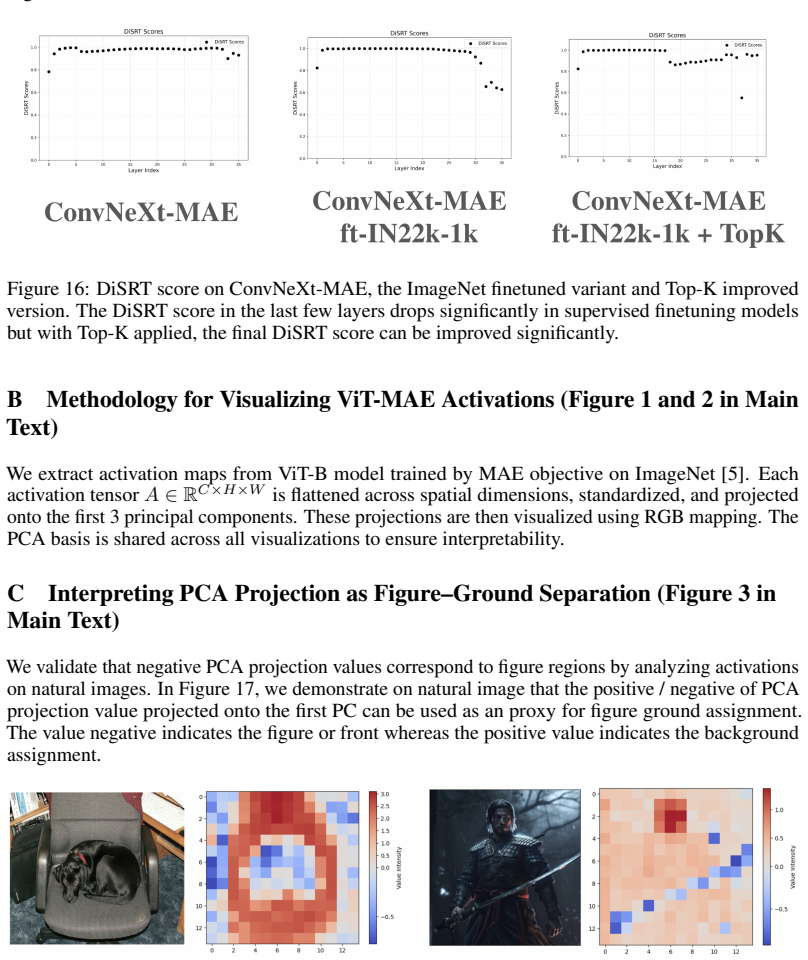
The paper's central claim is that Gestalt-like perceptual organization is an emergent property of training objectives that require global context, and not a privilege of attention architectures. Its evidence is that ViT-MAE activation patterns align with closure, continuity, proximity, convexity, and figure-ground segregation, and that both ViT and ConvNeXt models trained with MAE or CLIP achieve high DiSRT scores, whereas supervised classifiers do poorly. DiSRT asks a model to pick the odd image out of three: one original and two versions whose global layout has been randomized by Gram-matrix texture synthesis while local texture statistics are preserved. On this benchmark, MAE and CLIP models exceed the human average in some configurations. The paper also states that classification finetuning degrades DiSRT performance, and that applying Top-K sparsity to activations recovers much of the lost sensitivity.
Load-bearing premise
The DiSRT score is meaningful only if VGG Gram-matrix texture synthesis destroys global spatial relationships while preserving local texture statistics, and the paper uses a 10-step approximation of that synthesis without showing the scores have converged.
Editorial extensions
If this is right
- If training objective drives global perceptual sensitivity, DiSRT can serve as a standard diagnostic for whether a vision model is ready for tasks that require scene-level understanding rather than local texture matching.
- MAE-style pretraining should be preferred over classification pretraining when human-like global organization is the goal, since classification finetuning measurably erodes this ability.
- The Top-K sparsity result implies that even after supervised finetuning the information for global structure remains in the activations and can be unlocked without retraining.
- Because ConvNeXt-MAE matches ViT-MAE, comparisons between architectures must control for training objective before attributing global sensitivity to attention.
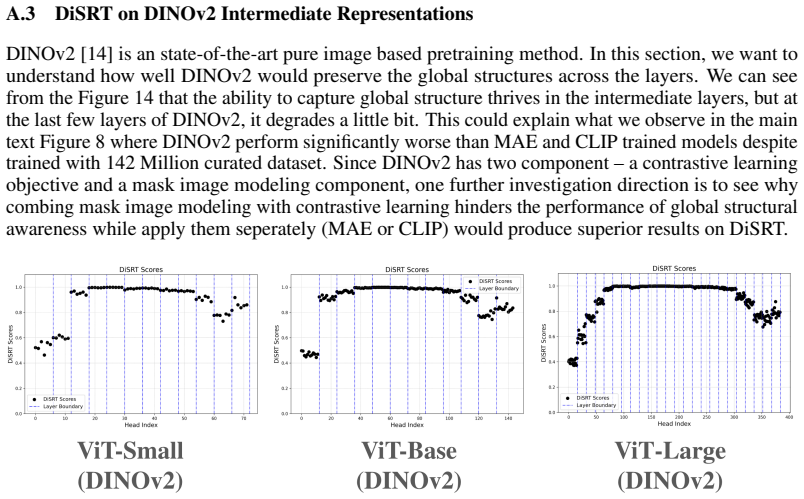
- The paper's intermediate-layer analyses suggest that supervised models discard global structure in later layers, so diagnosing sensitivity layer-by-layer may be more informative than only testing final features.
Reading between the lines
- If DiSRT truly isolates global spatial relationships, a testable extension is that models ranking high on DiSRT should also show better generalization to geometric-perturbation benchmarks and compositional scene tasks; the paper does not report such correlations.
- The Top-K restoration may indicate that sparse activations suppress texture-dominated nuisance signals rather than literally re-instating Gestalt grouping; an ablation that varies the sparsity ratio and checks activation geometry could separate these accounts.
- The 10-step approximation of texture synthesis is the most direct threat to the benchmark's validity, so recomputing DiSRT with longer synthesis runs on a subset would show whether the model rankings are stable.
- The PCA figure-ground readout trained on natural images might not transfer to synthetic illusory stimuli; a clean validation would be to compare PC1 sign assignments against human figure-ground judgments on the same Kanizsa and convexity images.
Editorial analysis
A structured set of objections, weighed in public.
Referee Report
Summary. The paper investigates whether self-supervised vision models exhibit Gestalt-like global perceptual organization. It presents qualitative evidence from attention-head/PCA visualizations that ViT-MAE internal activations follow closure, continuity, proximity, convexity, and figure-ground segregation. It then introduces DiSRT, an oddity-detection benchmark in which distractors are generated by VGG Gram-matrix texture synthesis, and reports that MAE- and CLIP-trained models outperform supervised baselines and sometimes exceed human performance, that classification fine-tuning degrades this sensitivity, and that a Top-K activation sparsity mechanism partially restores it. The paper also reports human psychophysical data on DiSRT and per-layer DiSRT curves for several model families.
Significance. If the DiSRT benchmark is valid, the central claim is significant: training objective, rather than architecture alone, would be identified as a primary driver of global structural sensitivity in vision models, and DiSRT would serve as a useful diagnostic. The paper deserves credit for including a large human study (16,800 trials), for transparently disclosing the 10-step approximation, and for analyzing intermediate layers across many model families. However, the validity of the central claims depends on three load-bearing points that are not yet established: the convergence of the texture-synthesis proxy, the statistical reliability of the reported model scores, and the independence of the Top-K improvement from benchmark-specific tuning.
major comments (4)
- [Section 4] The validity of DiSRT rests on the assumption that the texture-synthesis distractors preserve local texture while destroying global spatial relationships, so that oddity detection isolates global-structure sensitivity. The paper states (Section 4) that 'we use 10-step optimization results to approximate the 100-step optimization result' and notes that 100 steps take over 55 seconds per image. No convergence or stability analysis is reported. Starting from Gaussian noise, 10 steps of Gram-matrix matching are generally far from the converged texture-synthesis solution, so the distractors may differ from the original in low-level statistics (frequency content, edge density, sharpness, color distribution) in addition to global layout. Since the model selects the odd image using cosine distance in final-layer features (Eq. 1), such low-level artifacts would provide a shortcut: a model could achieve a high DiSRT score by detecting these artifacts without encoding long-range spatial relations. This concern propagates to all headline claims (SSL superiority, finetuning erosion, Top-K recovery) and must be addressed, for example by reporting DiSRT accuracy as a function of optimization steps on a subset, quantifying low-level statistics of the distractors, and including a control model with restricted receptive field.
- [Section 5, Figures 7-9] The DiSRT scores for models in Figures 7-9 are reported as point values without error bars or significance tests. The claims that self-supervised models 'dramatically outperform' supervised baselines and 'sometimes even exceed human performance' require an estimate of trial-to-trial or seed-to-seed variability, especially because each distractor is generated from a random initialization. At minimum, the authors should report mean and standard error over multiple texture-synthesis seeds and over multiple image subsets, and perform a paired significance test for the key MAE/CLIP-versus-supervised comparisons. The human data have an associated sample size, but no comparable uncertainty is reported for the model scores.
- [Supplementary D.2] The Top-K activation sparsity result is load-bearing for the paper's third claim, but the per-block sparsity schedule is hand-picked: for ConvNeXt-v2-MAE-finetuned the schedule is {'1': 0.2, '2': 0.25, '5': 0.25, '6': 0.25, '23': 0.3, '24': 0.25}, and the main-text improvement is reported for these specific settings. If these thresholds were chosen after observing DiSRT scores, the improvement is partly circular and likely overfits to the benchmark. The authors should state whether the configuration was selected on a separate validation set, report sensitivity to the sparsity values and block choices, and show DiSRT scores for a range of simple uniform schedules.
- [Section 2 and Supplementary C] The qualitative figure-ground conclusions rely on a PCA basis computed on natural images being a valid readout for synthetic illusory stimuli. The validation in Supplementary C demonstrates that negative/positive PC1 projection values correlate with figure/ground in natural images, but the transfer of this axis to Kanizsa-type stimuli and cue-conflict synthetic images is assumed, not tested. The authors should validate the PCA readout on synthetic stimuli with known ground truth, or use an independent linear probe trained on natural-image labels and tested on the synthetic set. Additionally, the claims in Figures 1-3 are based on selected attention heads and hand-selected stimuli; the selection criteria should be stated, and a quantitative measure (e.g., agreement with human figure-ground annotations) would strengthen the case.
minor comments (6)
- [Abstract and throughout] There are numerous typos and grammatical errors, including 'acoss' (Abstract), 'Kanisza', 'illustory countour', 'seperation', 'relationshp', 'ConNeXt', 'neccessarily', and 'squeeze-excitation'. The manuscript would benefit from thorough proofreading.
- [Eq. (2)] Equation (2) computes a softmax over the dissimilarities and then takes the argmax; since softmax is monotonically increasing, this is equivalent to simply taking argmax_i D_i. The equation should be simplified or clarified if the exponentiation is intentional for some other purpose.
- [Section 4] The statement that increasing N 'will not increase the difficulty' of the task is made without supporting data. Since N=2 is used throughout, a small experiment varying N (e.g., N=2,3,4) would make the choice principled.
- [Figure 4] The histograms in Figure 4 are described as showing 'clear separability' between figure and ground pixels, but no quantitative separation measure is reported. An AUROC or similar metric computed from the PC1 projections would substantiate the claim.
- [Supplementary D.2] The text says 'To reproduce the Figure 2 in the main manuscript' but the Top-K results appear in Figure 9 of the main text; the figure reference is incorrect.
- [Section 5] The suggestion that the squeeze-excitation module in MobileNetV3 'may introduce global structural sensitivities' is speculative and not tested by a controlled comparison (e.g., with and without the SE module in the same architecture). It should be presented as a hypothesis, or tested.
Circularity Check
Central DiSRT comparison is self-contained, but the Top-K restoration result is in-sample fitted to the benchmark it is used to support.
-
fitted input called prediction
[Section 5, 'Top-K Sparsity to the Rescue'; Supplementary D.2]
"Additionally, we also observe a significant increase in the model without pre-training (ConvNeXt-V1), from 62.1 DiSRT score to 88.1 DiSRT score when applied Top-K operation to activation. We refer to the supplementary for the implementation of Top-K and the parameter setup used to bring up the performance."
The reported Top-K gains are obtained with a per-block sparsity schedule (Supplementary D.2) that the paper explicitly identifies as 'the parameter setup used to bring up the performance.' Selecting the schedule on the DiSRT score makes the subsequent DiSRT improvement an in-sample optimized outcome rather than an independent test of the claim that Top-K activation sparsity restores global sensitivity. Absent a held-out configuration or stability check, the 'restoration' result is fitted to the metric it is used to support.
full rationale
The main DiSRT comparison (self-supervised vs. supervised models) is not circular: the distorted stimuli are generated by VGG Gram-matrix texture synthesis, which is independent of the evaluated models' training objectives, and the oddity-detection score is defined on final-layer feature distances. The figure-ground PCA analyses are also not definitionally circular, because the PCA basis is calibrated on natural images with segmentation labels and then applied to synthetic illusions; this is a probe rather than a derivation from the conclusion. The one genuine circular step is the Top-K demonstration: the per-block sparsity schedule in Supplementary D.2 is described in the main text as 'the parameter setup used to bring up the performance,' indicating that the schedule was chosen to raise the DiSRT score. The reported improvements (69.8 to 94.6 and 62.1 to 88.1) are therefore in-sample optimization results, not out-of-sample predictions that Top-K restores global sensitivity. This is a fitted-input-called-prediction pattern, but it affects a secondary claim; the central benchmark comparison retains independent content. The 10-step texture-synthesis proxy is an internal-validity concern, not a circularity, because the proxy is independent of the evaluated models. Self-citations [16] and [17] motivate Top-K but are not load-bearing, as the mechanism is evaluated directly in this paper rather than assumed from those citations.
Assumptions & free parameters
free parameters (1)
- TopK sparsity thresholds per ConvNeXt block =
{'1':0.2,'2':0.25,'5':0.25,'6':0.25,'23':0.3,'24':0.25} for fcmae_ft_in22k_in1k; uniform 0.2 for ConvNeXt-V1
assumptions (4)
- domain assumption Texture synthesis via Gram matrix matching preserves local textures and destroys global spatial relationships.
- ad hoc to paper A 10-step optimization approximates the 100-step optimization result well enough for DiSRT.
- ad hoc to paper A PCA basis computed on natural image activations remains a valid figure-ground axis for synthetic illusory stimuli.
- domain assumption Modeling global dependencies is necessary for Gestalt-like organization.
Cite this review
Pith. "Pith review of From Local Cues to Global Percepts: Emergent Gestalt Organization in Self-Supervised Vision Models." pith.science (2026). https://pith.science/paper/NP2LDBUH
@misc{pith2026250600718,
  author       = {Pith},
  title        = {Pith review of: From Local Cues to Global Percepts: Emergent Gestalt Organization in Self-Supervised Vision Models},
  year         = {2026},
  howpublished = {\url{https://pith.science/paper/NP2LDBUH}},
  note         = {Machine review of arXiv:2506.00718}
}
read the original abstract
Human vision organizes local cues into coherent global forms using Gestalt principles like closure, proximity, and figure-ground assignment -- functions reliant on global spatial structure. We investigate whether modern vision models show similar behaviors, and under what training conditions these emerge. We find that Vision Transformers (ViTs) trained with Masked Autoencoding (MAE) exhibit activation patterns consistent with Gestalt laws, including illusory contour completion, convexity preference, and dynamic figure-ground segregation. To probe the computational basis, we hypothesize that modeling global dependencies is necessary for Gestalt-like organization. We introduce the Distorted Spatial Relationship Testbench (DiSRT), which evaluates sensitivity to global spatial perturbations while preserving local textures. Using DiSRT, we show that self-supervised models (e.g., MAE, CLIP) outperform supervised baselines and sometimes even exceed human performance. ConvNeXt models trained with MAE also exhibit Gestalt-compatible representations, suggesting such sensitivity can arise without attention architectures. However, classification finetuning degrades this ability. Inspired by biological vision, we show that a Top-K activation sparsity mechanism can restore global sensitivity. Our findings identify training conditions that promote or suppress Gestalt-like perception and establish DiSRT as a diagnostic for global structure sensitivity across models.
Figures


Figures from the paper (17 more)






Forward citations
Cited by 1 Pith paper
-
Human-like Object Grouping in Self-supervised Vision Transformers
DINO self-supervised transformers best predict human same/different object RTs; object-centric patch affinity and Gram-matrix distillation explain and transfer the alignment.
Reference graph
Works this paper leans on
-
[1]
A century of gestalt psychology in visual perception: I
Johan Wagemans, James H Elder, Michael Kubovy, Stephen E Palmer, Mary A Peterson, Manish Singh, and Rüdiger von der Heydt. A century of gestalt psychology in visual perception: I. perceptual grouping and figure–ground organization.Psychological Bulletin, 138(6):1172–1217, 2012
work page 2012
-
[2]
A century of gestalt psychology in visual perception: Ii
Johan Wagemans, Jacob Feldman, Sergei Gepshtein, Ruth Kimchi, James R Pomerantz, Peter A van der Helm, and Cees van Leeuwen. A century of gestalt psychology in visual perception: Ii. conceptual and theoretical foundations.Psychological Bulletin, 138(6):1218–1252, 2012
work page 2012
-
[3]
Untersuchungen zur lehre von der gestalt, ii.Psychologische Forschung, 4:301–350, 1923
Max Wertheimer. Untersuchungen zur lehre von der gestalt, ii.Psychologische Forschung, 4:301–350, 1923
work page 1923
-
[4]
Subjective contours.Scientific American, 234(4):48–52, 1976
Gaetano Kanizsa. Subjective contours.Scientific American, 234(4):48–52, 1976
work page 1976
-
[5]
Masked autoencoders are scalable vision learners
Kaiming He, Xinlei Chen, Saining Xie, Yanghao Li, Piotr Dollár, and Ross Girshick. Masked autoencoders are scalable vision learners. InProceedings of the IEEE/CVF conference on computer vision and pattern recognition, pages 16000–16009, 2022
2022
-
[6]
Univ of California Press, 1972
Rudolf Arnheim.Art and visual perception: A psychology of the creative eye. Univ of California Press, 1972
work page 1972
-
[7]
Convexity and symmetry in figure-ground organization
Gaetano Kanizsa, Rudolf ARNHEIM, Mary HENLE, and Walter GERBINO. Convexity and symmetry in figure-ground organization. InVision and artifact, 1976
work page 1976
-
[8]
Mary A Peterson and Elizabeth Salvagio. Inhibitory competition in figure-ground perception: Context and convexity.Journal of Vision, 8(16):4–4, 2008
work page 2008
Show all 43 references
-
[9]
Who owns the contour of a visual hole?Perception, 35(7):883–894, 2006
Marco Bertamini. Who owns the contour of a visual hole?Perception, 35(7):883–894, 2006
2006
-
[10]
A convnet for the 2020s
Zhuang Liu, Hanzi Mao, Chao-Yuan Wu, Christoph Feichtenhofer, Trevor Darrell, and Saining Xie. A convnet for the 2020s. InProceedings of the IEEE/CVF conference on computer vision and pattern recognition, pages 11976–11986, 2022
2022
-
[11]
Convnext v2: Co-designing and scaling convnets with masked autoencoders
Sanghyun Woo, Shoubhik Debnath, Ronghang Hu, Xinlei Chen, Zhuang Liu, In So Kweon, and Saining Xie. Convnext v2: Co-designing and scaling convnets with masked autoencoders. InProceedings of the IEEE/CVF conference on computer vision and pattern recognition, pages 16133–16142, 2023
2023
-
[12]
Texture synthesis using convolutional neural networks.Advances in neural information processing systems, 28, 2015
Leon Gatys, Alexander S Ecker, and Matthias Bethge. Texture synthesis using convolutional neural networks.Advances in neural information processing systems, 28, 2015
2015
-
[13]
Learning transferable visual models from natural language supervision
Alec Radford, Jong Wook Kim, Chris Hallacy, Aditya Ramesh, Gabriel Goh, Sandhini Agarwal, Girish Sastry, Amanda Askell, Pamela Mishkin, Jack Clark, et al. Learning transferable visual models from natural language supervision. InInternational conference on machine learning, pag...
2021
-
[14]
Dinov2: Learning robust visual features without supervision.arXiv preprint arXiv:2304.07193, 2023
Maxime Oquab, Timothée Darcet, Théo Moutakanni, Huy V o, Marc Szafraniec, Vasil Khalidov, Pierre Fernandez, Daniel Haziza, Francisco Massa, Alaaeldin El-Nouby, et al. Dinov2: Learning robust visual features without supervision.arXiv preprint arXiv:2304.07193, 2023
2023 arXiv
-
[15]
When and why vision-language models behave like bags-of-words, and what to do about it?arXiv preprint arXiv:2210.01936, 2022
Mert Yuksekgonul, Federico Bianchi, Pratyusha Kalluri, Dan Jurafsky, and James Zou. When and why vision-language models behave like bags-of-words, and what to do about it?arXiv preprint arXiv:2210.01936, 2022
2022 arXiv
-
[16]
Emergence of shape bias in convolutional neural networks through activation sparsity.Advances in Neural Information Processing Systems, 36:71755–71766, 2023
Tianqin Li, Ziqi Wen, Yangfan Li, and Tai Sing Lee. Emergence of shape bias in convolutional neural networks through activation sparsity.Advances in Neural Information Processing Systems, 36:71755–71766, 2023
2023
-
[17]
Large-scale two-photon imaging revealed super-sparse population codes in the v1 superficial layer of awake monkeys.Elife, 7:e33370, 2018
Shiming Tang, Yimeng Zhang, Zhihao Li, Ming Li, Fang Liu, Hongfei Jiang, and Tai Sing Lee. Large-scale two-photon imaging revealed super-sparse population codes in the v1 superficial layer of awake monkeys.Elife, 7:e33370, 2018. 10
2018
-
[18]
Surfgen: Adversarial 3d shape synthesis with explicit surface discriminators
Andrew Luo, Tianqin Li, Wen-Hao Zhang, and Tai Sing Lee. Surfgen: Adversarial 3d shape synthesis with explicit surface discriminators. InProceedings of the IEEE/CVF International Conference on Computer Vision, pages 16238–16248, 2021
2021
-
[19]
Deep residual learning for image recognition
Kaiming He, Xiangyu Zhang, Shaoqing Ren, and Jian Sun. Deep residual learning for image recognition. InProceedings of the IEEE conference on computer vision and pattern recognition, pages 770–778, 2016
2016
-
[20]
Language models are few-shot learners.Advances in neural information processing systems, 33:1877–1901, 2020
Tom Brown, Benjamin Mann, Nick Ryder, Melanie Subbiah, Jared D Kaplan, Prafulla Dhariwal, Arvind Neelakantan, Pranav Shyam, Girish Sastry, Amanda Askell, et al. Language models are few-shot learners.Advances in neural information processing systems, 33:1877–1901, 2020
1901
-
[21]
Robust category-level 6d pose estimation with coarse-to-fine rendering of neural features
Wufei Ma, Angtian Wang, Alan Yuille, and Adam Kortylewski. Robust category-level 6d pose estimation with coarse-to-fine rendering of neural features. InEuropean Conference on Computer Vision, pages 492–508. Springer, 2022
2022
-
[22]
Hallucination improves the performance of unsupervised visual representation learning
Jing Wu, Jennifer Hobbs, and Naira Hovakimyan. Hallucination improves the performance of unsupervised visual representation learning. InProceedings of the IEEE/CVF International Conference on Computer Vision, pages 16132–16143, 2023
2023
-
[23]
Integrating auxiliary information in self-supervised learning.arXiv preprint arXiv:2106.02869, 2021
Yao-Hung Hubert Tsai, Tianqin Li, Weixin Liu, Peiyuan Liao, Ruslan Salakhutdinov, and Louis-Philippe Morency. Integrating auxiliary information in self-supervised learning.arXiv preprint arXiv:2106.02869, 2021
2021 arXiv
-
[24]
Hierarchical interdisciplinary topic detection model for research proposal classification.IEEE Transactions on Knowledge and Data Engineering, 35(9):9685–9699, 2023
Meng Xiao, Ziyue Qiao, Yanjie Fu, Hao Dong, Yi Du, Pengyang Wang, Hui Xiong, and Yuanchun Zhou. Hierarchical interdisciplinary topic detection model for research proposal classification.IEEE Transactions on Knowledge and Data Engineering, 35(9):9685–9699, 2023
2023
-
[25]
A deep learning framework based on dynamic channel selection for early classification of left and right hand motor imagery tasks
Jiazhen Hong, Foroogh Shamsi, and Laleh Najafizadeh. A deep learning framework based on dynamic channel selection for early classification of left and right hand motor imagery tasks. In 2022 44th Annual International Conference of the IEEE Engineering in Medicine & Biology Soc...
2022
-
[26]
Learning weakly-supervised contrastive representations.arXiv preprint arXiv:2202.06670, 2022
Yao-Hung Hubert Tsai, Tianqin Li, Weixin Liu, Peiyuan Liao, Ruslan Salakhutdinov, and Louis- Philippe Morency. Learning weakly-supervised contrastive representations.arXiv preprint arXiv:2202.06670, 2022
2022 arXiv
-
[27]
Prototype memory and attention mechanisms for few shot image generation
Tianqin Li, Zijie Li, Harold Rockwell, Amir Farimani, and Tai Sing Lee. Prototype memory and attention mechanisms for few shot image generation. InProceedings of the eleventh international conference on learning representations, volume 18, 2022
2022
-
[28]
Conditional contrastive learning with kernel.arXiv preprint arXiv:2202.05458, 2022
Yao-Hung Hubert Tsai, Tianqin Li, Martin Q Ma, Han Zhao, Kun Zhang, Louis-Philippe Morency, and Ruslan Salakhutdinov. Conditional contrastive learning with kernel.arXiv preprint arXiv:2202.05458, 2022
2022 arXiv
-
[29]
A systematic review of ro- bustness in deep learning for computer vision: Mind the gap?arXiv preprint arXiv:2112.00639, 2021
Nathan Drenkow, Numair Sani, Ilya Shpitser, and Mathias Unberath. A systematic review of ro- bustness in deep learning for computer vision: Mind the gap?arXiv preprint arXiv:2112.00639, 2021
2021 arXiv
-
[30]
Opening the black box: the promise and limitations of explainable machine learning in cardiology.Canadian Journal of Cardiology, 38(2):204–213, 2022
Jeremy Petch, Shuang Di, and Walter Nelson. Opening the black box: the promise and limitations of explainable machine learning in cardiology.Canadian Journal of Cardiology, 38(2):204–213, 2022
2022
-
[31]
Explaining explanations: An overview of interpretability of machine learning
Leilani H Gilpin, David Bau, Ben Z Yuan, Ayesha Bajwa, Michael Specter, and Lalana Kagal. Explaining explanations: An overview of interpretability of machine learning. In2018 IEEE 5th International Conference on data science and advanced analytics (DSAA), pages 80–89. IEEE, 2018
2018
-
[32]
Assessing neural network representations during training using data diffusion spectra.ICML workshop on TAG-ML, 2023
Danqi Liao, Chen Liu, Alexander Tong, Guillaume Huguet, Guy Wolf, Maximilian Nickel, Ian Adelstein, and Smita Krishnaswamy. Assessing neural network representations during training using data diffusion spectra.ICML workshop on TAG-ML, 2023. 11
2023
-
[33]
Neural networks trained on natural scenes exhibit gestalt closure.Computational Brain & Behavior, 4(3):251–263, 2021
Been Kim, Emily Reif, Martin Wattenberg, Samy Bengio, and Michael C Mozer. Neural networks trained on natural scenes exhibit gestalt closure.Computational Brain & Behavior, 4(3):251–263, 2021
2021
-
[34]
Evaluating machine learning models with nero: Non-equivariance revealed on orbits.arXiv preprint arXiv:2305.19889, 2023
Zhuokai Zhao, Takumi Matsuzawa, William Irvine, Michael Maire, and Gordon L Kindlmann. Evaluating machine learning models with nero: Non-equivariance revealed on orbits.arXiv preprint arXiv:2305.19889, 2023
2023 arXiv
-
[35]
Vision transformers with self-distilled registers.arXiv preprint arXiv:2505.21501, 2025
Yinjie Chen, Zipeng Yan, Chong Zhou, Bo Dai, and Andrew F Luo. Vision transformers with self-distilled registers.arXiv preprint arXiv:2505.21501, 2025
2025
-
[36]
Visualizing and understanding convolutional networks
Matthew D Zeiler and Rob Fergus. Visualizing and understanding convolutional networks. In Computer Vision–ECCV 2014: 13th European Conference, Zurich, Switzerland, September 6-12, 2014, Proceedings, Part I 13, pages 818–833. Springer, 2014
2014
-
[37]
Imagenet-trained cnns are biased towards texture; increasing shape bias improves accuracy and robustness.arXiv preprint arXiv:1811.12231, 2018
Robert Geirhos, Patricia Rubisch, Claudio Michaelis, Matthias Bethge, Felix A Wichmann, and Wieland Brendel. Imagenet-trained cnns are biased towards texture; increasing shape bias improves accuracy and robustness.arXiv preprint arXiv:1811.12231, 2018
2018 arXiv
-
[38]
Partial success in closing the gap between human and machine vision.Advances in Neural Information Processing Systems, 34:23885– 23899, 2021
Robert Geirhos, Kantharaju Narayanappa, Benjamin Mitzkus, Tizian Thieringer, Matthias Bethge, Felix A Wichmann, and Wieland Brendel. Partial success in closing the gap between human and machine vision.Advances in Neural Information Processing Systems, 34:23885– 23899, 2021
2021
-
[39]
An image is worth 16x16 words: Transformers for image recognition at scale.arXiv preprint arXiv:2010.11929, 2020
Alexey Dosovitskiy, Lucas Beyer, Alexander Kolesnikov, Dirk Weissenborn, Xiaohua Zhai, Thomas Unterthiner, Mostafa Dehghani, Matthias Minderer, Georg Heigold, Sylvain Gelly, et al. An image is worth 16x16 words: Transformers for image recognition at scale.arXiv preprint arXiv:...
2010 arXiv
-
[40]
Vision transformers are robust learners
Sayak Paul and Pin-Yu Chen. Vision transformers are robust learners. InProceedings of the AAAI conference on Artificial Intelligence, volume 36, pages 2071–2081, 2022
2022
-
[41]
Imagenet: A large- scale hierarchical image database
Jia Deng, Wei Dong, Richard Socher, Li-Jia Li, Kai Li, and Li Fei-Fei. Imagenet: A large- scale hierarchical image database. In2009 IEEE conference on computer vision and pattern recognition, pages 248–255. Ieee, 2009
2009
-
[42]
Deit iii: Revenge of the vit
Hugo Touvron, Matthieu Cord, and Hervé Jégou. Deit iii: Revenge of the vit. InEuropean conference on computer vision, pages 516–533. Springer, 2022
2022
-
[43]
given-up
Romain Beaumont. Clip-vit-h-14-laion2b-s32b-b79k. https://huggingface.co/laion/ CLIP-ViT-H-14-laion2B-s32B-b79K , 2022. Model trained using OpenCLIP on the LAION-2B dataset. 12 Supplementary Materials A Intermediate Representation Analysis To better understand why certain meth...
2022
Reviewed August 7, 2026 · model on record in the stance chip above.
Discussion (0). Sign in to comment.