Long-range interactions assisted shortcuts to adiabaticity and battery charging in open quantum critical systems
Pith reviewed 2026-06-27 22:00 UTC · model grok-4.3
The pith
Long-range interactions allow shortcuts to adiabaticity with algebraically decaying couplings in open critical systems.
A machine-rendered reading of the paper's core claim, the machinery that carries it, and where it could break.
Core claim
In the Kitaev chain with long-range couplings, shortcuts to adiabaticity through criticality involve interaction strengths that decay algebraically with distance, in contrast to short-range interactions that may require non-zero interactions between infinitely distant spins. For non-unitary control, long-range interactions reduce the cost of STA. A modified STA technique for charging a quantum battery in the presence of dissipation shows that long-range interactions can enhance the resultant ergotropy.
What carries the argument
The Kitaev chain with algebraically decaying long-range couplings, which carries the argument by demonstrating reduced STA costs and enhanced battery charging compared to short-range cases.
If this is right
- STA control in critical systems can use finite, decaying interactions instead of infinite-range ones.
- Non-unitary STA protocols incur lower cost with long-range interactions.
- Quantum battery ergotropy increases under dissipation when using long-range interactions in the modified STA.
- Long-range interactions act as a resource for quantum control in open many-body systems.
Where Pith is reading between the lines
- This may extend to other critical models with long-range interactions beyond the Kitaev chain.
- Platforms with natural long-range couplings could implement more efficient quantum control protocols.
- Further studies could test if the algebraic decay specifically optimizes the advantage over other decay forms.
Load-bearing premise
That the Kitaev chain with algebraically decaying long-range couplings represents the general advantage of long-range interactions for STA and battery charging in open quantum critical systems.
What would settle it
A demonstration that in the Kitaev chain or similar system, the STA cost does not decrease or the ergotropy does not increase when switching from short-range to long-range interactions.
Figures
read the original abstract
In this work we show that long-range interactions can be significantly beneficial for implementing shortcuts to adiabaticity (STA) in many-body open quantum critical systems driven out of equilibrium, as well as for charging quantum batteries in the presence of dissipation. In sharp contrast to short range interactions where passage through criticality may demand STA control with non-zero interactions between infinitely distant spins, using the example of a Kitaev chain with long-range couplings, we find that the corresponding control may involve involve interaction strength with decays algebraically with distance. In case of non-unitary control, the advantage of long-range interactions manifest through reduction in the cost of STA. We further propose a modified STA technique aimed at charging a quantum battery in the presence of dissipation, in which case long-range interactions may enhance the resultant ergotropy. Our results establish long-range interactions as a valuable resource for quantum control, with direct implications for quantum technologies.
Editorial analysis
A structured set of objections, weighed in public.
Referee Report
Summary. The manuscript claims that long-range interactions provide significant advantages for shortcuts to adiabaticity (STA) in many-body open quantum critical systems and for dissipative quantum battery charging. Using the Kitaev chain with algebraically decaying couplings as the example, it contrasts this with short-range interactions (which may require non-zero couplings at infinite distance), reports reduced STA cost under non-unitary control, and proposes a modified STA protocol in which long-range interactions enhance ergotropy. The results are presented as establishing long-range interactions as a valuable resource for quantum control.
Significance. If the reported advantages are robust and extend beyond the specific model, the work could identify long-range interactions as a practical resource for quantum technologies. However, the significance is limited by the absence of evidence that the algebraic-decay control or ergotropy enhancement are model-independent features of open quantum critical systems rather than artifacts of the Kitaev chain's pairing structure.
major comments (1)
- [Abstract] Abstract and central claim: the assertion that long-range interactions are 'significantly beneficial' for STA and battery charging 'in many-body open quantum critical systems' and 'establish long-range interactions as a valuable resource' is load-bearing but rests solely on results for the Kitaev chain with algebraically decaying couplings. No additional models, dispersion relations, or dissipation structures are examined, and no analytical argument demonstrates that the advantage survives changes to the pairing or Majorana structure.
Simulated Author's Rebuttal
We thank the referee for their careful reading of the manuscript and for highlighting the need to better scope our central claims. We address this point below and have revised the manuscript accordingly.
read point-by-point responses
-
Referee: [Abstract] Abstract and central claim: the assertion that long-range interactions are 'significantly beneficial' for STA and battery charging 'in many-body open quantum critical systems' and 'establish long-range interactions as a valuable resource' is load-bearing but rests solely on results for the Kitaev chain with algebraically decaying couplings. No additional models, dispersion relations, or dissipation structures are examined, and no analytical argument demonstrates that the advantage survives changes to the pairing or Majorana structure.
Authors: We agree that the results are demonstrated explicitly for the long-range Kitaev chain, a standard exactly solvable model for one-dimensional quantum critical systems with pairing. The algebraic decay of couplings is the feature that enables STA control with finite, distance-dependent interactions, in contrast to the short-range case. No other models or dispersion relations are studied in this work. To address the concern, we have revised the abstract and introduction to state that the advantages are shown using the Kitaev chain as a representative example, and we have added a brief discussion of possible extensions to other long-range critical systems in the conclusions. We do not claim a general analytical proof of model independence. revision: yes
Circularity Check
No circularity; derivation self-contained via explicit Kitaev-chain calculations
full rationale
The paper demonstrates benefits of long-range interactions for STA and battery charging explicitly through the Kitaev chain example with algebraically decaying couplings. No equations or claims reduce by construction to fitted inputs, self-definitions, or load-bearing self-citations; the central results follow from the model's dynamics and control protocols without tautological renaming or imported uniqueness theorems. The derivation remains independent of its inputs.
Axiom & Free-Parameter Ledger
Reference graph
Works this paper leans on
-
[1]
and continuous [9] time crystals, and for designing quantum technologies [10]. However, quantum systems driven out of equilibrium are in general associated with non-adiabatic excitations [11]. This can be detrimental, for example, for quantum annealing [12], or for modeling high-performing quantum technologies, including quan- tum computers [13] and quant...
Pith/arXiv arXiv 2026
-
[2]
Using Eqs
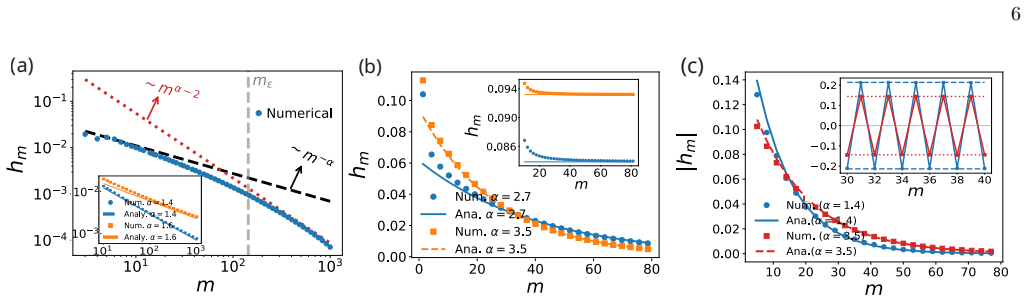
Long-range regime (1< α <2) We first analyze the behavior of the CD coupling co- efficienth m(ϵ−, α) near the critical pointµ=−1 in the long range regime (1< α <2). Using Eqs. (6) and (18), and the Taylor series expansion of the of the function fα(k) (see Appendix A), one gets hm(ϵ−, α)≈ 1 4π Z π 0 Aαkα−1 ϵ2 − +A 2αk2(α−1) sin(mk)dk.(19) (i) Away from cri...
-
[3]
Following Eq
Short-range regime (α >2) We now analyze the behavior of the CD coupling hm(ϵ−, α) in the short-range regimeα >2. Following Eq. (18), in this regime one gets hm(ϵ−, α >2)≈ 1 4π Z π 0 Bαksin(mk) ϵ2 − +B 2αk2 dk.(24) As shown in Appendix B, in the limit ofm >>1 Eq. (24) finally leads us to hm(ϵ−, α >2)≈ 1 8ζ(α−1) exp − |ϵ−| ζ(α−1) m .(25) Thus, away from th...
2025
-
[4]
Definingϵ − =µ+1 and expandingµ+cosk≃ϵ − −k 2/2, the quasiparticle spectrum reduces to (see Fig
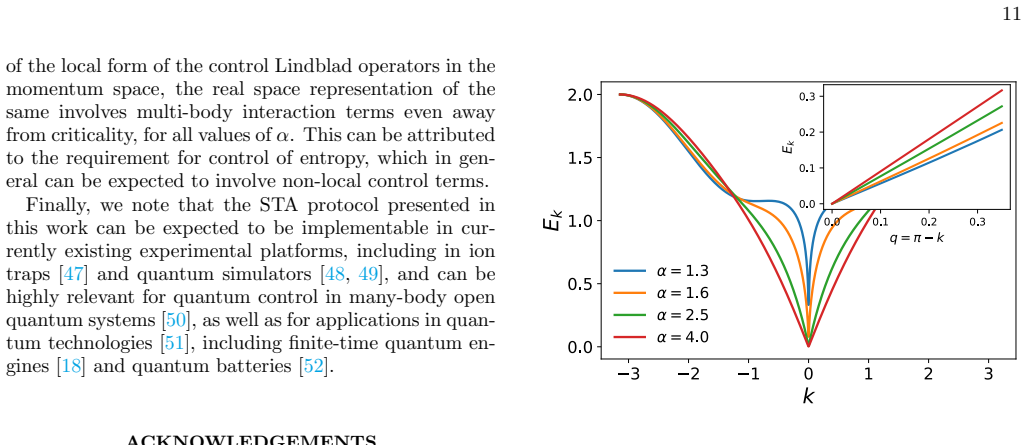
Expansion aroundµ=−1 Near the critical pointµ=−1, where the gap closes atk= 0, we have [31, 33, 53, 54] fα(k)∼ Aαkα−1,1< α <2, kln(1/k), α= 2, Bαk, α >2, (A1) where Aα = Γ(1−α) cos πα 2 , B α =ζ(α−1). Definingϵ − =µ+1 and expandingµ+cosk≃ϵ − −k 2/2, the quasiparticle spectrum reduces to (see Fig. 6) E2 k ∼ ϵ2 − +A 2 αk2(α−1) 1< α <2, ϵ...
-
[5]
Writingq=π−k, the pairing function expands as [55] fα(π−q)∼ ˜Bαq, ˜Bα =η(α−1),(A3) whereη(s) = (1−2 1−s)ζ(s) is the Dirichlet eta function
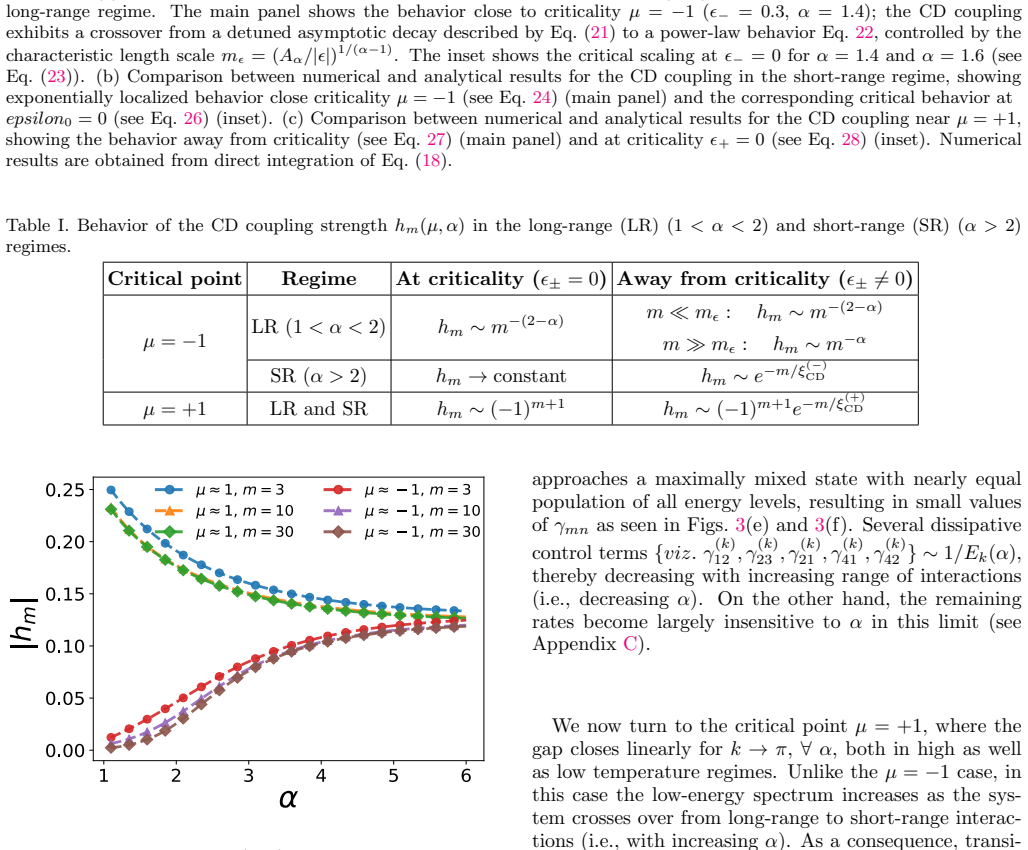
Expansion aroundµ= +1 Near the second critical pointµ= +1, the gap closes atk=π. Writingq=π−k, the pairing function expands as [55] fα(π−q)∼ ˜Bαq, ˜Bα =η(α−1),(A3) whereη(s) = (1−2 1−s)ζ(s) is the Dirichlet eta function. Definingϵ + =µ−1 and expandingµ+ cos(π−q)≃ ϵ+ +q 2/2, the spectrum becomes E2 k ∼ϵ 2 + + ˜B2 αq2.(A4) Hence, unlike the caseµ=−1, the qu...
-
[6]
Momentum-space representation The momentum-space representation of the long-range Kitaev chain (Eq.1) reads H0(t) = X k Ψ† kHk(µ)Ψk,Ψ † k = (c† k, c−k),(B1) withH k(µ) = (µ+ cosk)σ z +f α(k)σ x and the quasi- particle spectrum isE k(µ, α) = p (µ+ cosk) 2 +f 2α(k). 12 Each momentum sector therefore corresponds to an ef- fective two-level HamiltonianH k = ⃗...
-
[7]
(B5) gives HCD(t) =− ˙µ(t) 2 X k fα(k) (µ+ cosk) 2 +f 2α(k) i c−kck −c † kc† −k
Real-space representation ofH CD To obtain the real-space form of the CD Hamiltonian we first note the identity Ψ† kσyΨk =i c−kck −c † kc† −k .(B6) Substituting this into Eq. (B5) gives HCD(t) =− ˙µ(t) 2 X k fα(k) (µ+ cosk) 2 +f 2α(k) i c−kck −c † kc† −k . (B7) We now express the Fermionic operators in real space using the inverse Fourier transform ck = 1...
-
[8]
X m ˙λm|mt⟩⟨mt| X n |∂tnt⟩⟨nt| # −iTr
Derivation for the CD couplingh m Here, we derive the form of CD couplingh m(µ, α) across the criticalityµ=±1, discussed in Sec. III. (a)µ=−1,1< α <2 :Puttingϵ − = 0 in Eq. (19) one gets hm(ϵ−,1< α <2)≈ 1 4πAα Z π 0 k(1−α) sin(mk)dk Making the scaling substitutionq=mkwe get hm ≈ mα−2 4πAα Z mπ 0 q1−α sinq dq. The above integral converges for largemand usi...
-
[9]
Schaller,Lecture Notes in Physics: Open Quantum Systems Far from Equilibrium(Springer Cham, 2014)
G. Schaller,Lecture Notes in Physics: Open Quantum Systems Far from Equilibrium(Springer Cham, 2014)
2014
-
[10]
S. Bhattacharjee and A. Dutta, Quantum thermal ma- chines and batteries (2020), arXiv:2008.07889 [quant-ph]
arXiv 2020
-
[11]
Campbell, I
S. Campbell, I. D’Amico, M. A. Ciampini, J. Anders, N. Ares, S. Artini, A. Auff` eves, L. Bassman Oftelie, L. P. Bettmann, M. V. S. Bonan¸ ca, T. Busch, M. Campisi, M. F. Cavalcante, L. A. Correa, E. Cuestas, C. B. Dag, S. Dago, S. Deffner, A. Del Campo, A. Deutschmann- Olek, S. Donadi, E. Doucet, C. Elouard, K. Ensslin, P. Erker, N. Fabbri, F. Fedele, G....
2026
-
[12]
D. Jacek, Dynamics of a quantum phase transition and relaxation to a steady state, Advances in Physics59, 1063 (2010), https://doi.org/10.1080/00018732.2010.514702
-
[13]
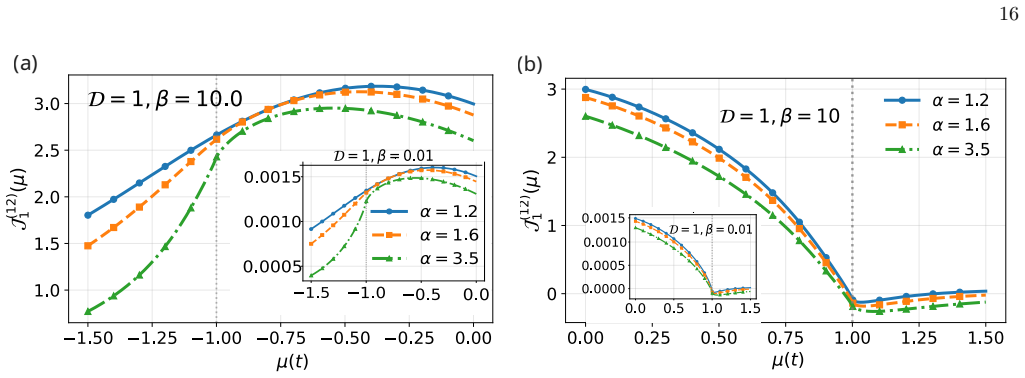
N. W¨ urkner, Y. Kuriatnikov, K. Kumaran, M. V. Ramana, J. Schmiedmayer, A. Kugi, M. Pr¨ ufer, and A. Deutschmann-Olek, Identification and optimal con- trol strategies for the transversal splitting of ultra–cold 16 (a) (b) Figure 8. (a) Shows variation of the non-unitary control strengthJ 12 as the chemical potentialµ(t) is ramped across the critical poin...
arXiv 2025
-
[14]
M. M. M¨ uller, R. S. Said, F. Jelezko, T. Calarco, and S. Montangero, One decade of quantum optimal control in the chopped random basis, Reports on Progress in Physics85, 076001 (2022)
2022
-
[15]
Z. Ou, Q. Xu, and X. Zhou, Experimental realization of remote two-qubit state preparation using single-particle operations, Phys. Rev. A112, 032625 (2025)
2025
-
[16]
Sarkar, Anurag, J
A. Sarkar, Anurag, J. A. Mondal, R. Singh, A. A. Makki, A. K. Rathi, R. J. Nicholl, S. Chakraborty, K. I. Bolotin, and S. Ghosh, Observation of tunable discrete- time-crystalline phases, Phys. Rev. Appl.25, L021001 (2026)
2026
-
[17]
and Hemmerich, Andreas and Keßler, Hans , month = aug, year =
P. Kongkhambut, J. Skulte, L. Mathey, J. G. Cosme, A. Hemmerich, and H. Keßler, Observation of a continuous time crystal, Science377, 670 (2022), https://www.science.org/doi/pdf/10.1126/science.abo3382
-
[18]
J. Koch, K. Menon, E. Cuestas, S. Barbosa, E. Lutz, T. Fogarty, T. Busch, and A. Widera, A quantum engine in the bec–bcs crossover, Nature621, 723 (2023)
2023
-
[19]
Dutta, G
A. Dutta, G. Aeppli, B. K. Chakrabarti, U. Divakaran, T. F. Rosenbaum, and D. Sen,Quantum phase tran- sitions in transverse field spin models: from statistical physics to quantum information(Cambridge University Press, Cambridge, 2015)
2015
-
[20]
A. Rajak, S. Suzuki, A. Dutta, and B. K. Chakrabarti, Quantum annealing: an overview, Philosophical Transactions of the Royal Society A: Mathematical, Physical and Engineering Sciences381, 20210417 (2022), https://royalsocietypublishing.org/rsta/article- pdf/doi/10.1098/rsta.2021.0417/1326707/rsta.2021.0417.pdf
work page doi:10.1098/rsta.2021.0417/1326707/rsta.2021.0417.pdf 2022
-
[21]
N. N. Hegade, K. Paul, Y. Ding, M. Sanz, F. Albarr´ an- Arriagada, E. Solano, and X. Chen, Shortcuts to adia- baticity in digitized adiabatic quantum computing, Phys. Rev. Appl.15, 024038 (2021)
2021
-
[22]
Hartmann, V
A. Hartmann, V. Mukherjee, W. Niedenzu, and W. Lech- ner, Many-body quantum heat engines with shortcuts to adiabaticity, Phys. Rev. Research2, 023145 (2020)
2020
-
[23]
Torrontegui, S
E. Torrontegui, S. Ib´ a˜ nez, S. Mart´ ınez-Garaot, M. Mod- ugno, A. del Campo, D. Gu´ ery-Odelin, A. Ruschhaupt, X. Chen, and J. G. Muga, Chapter 2 - shortcuts to adia- baticity, inAdvances in Atomic, Molecular, and Optical Physics, Vol. 62, edited by E. Arimondo, P. R. Berman, and C. C. Lin (Academic Press, 2013) pp. 117 – 169
2013
-
[24]
M. V. Berry, Transitionless quantum driving, Journal of Physics A: Mathematical and Theoretical42, 365303 (2009)
2009
-
[25]
Schnell, C
A. Schnell, C. Weitenberg, and A. Eckardt, Dissipative preparation of a Floquet topological insulator in an op- tical lattice via bath engineering, SciPost Phys.17, 052 (2024)
2024
-
[26]
L. M. Cangemi, C. Bhadra, and A. Levy, Quantum en- gines and refrigerators, Physics Reports1087, 1 (2024), quantum engines and refrigerators
2024
-
[27]
Vacanti, R
G. Vacanti, R. Fazio, S. Montangero, G. M. Palma, M. Paternostro, and V. Vedral, Transitionless quantum driving in open quantum systems, New Journal of Physics 16, 053017 (2014)
2014
-
[28]
Alipour, A
S. Alipour, A. Chenu, A. T. Rezakhani, and A. del Campo, Shortcuts to Adiabaticity in Driven Open Quan- tum Systems: Balanced Gain and Loss and Non- Markovian Evolution, Quantum4, 336 (2020)
2020
-
[29]
Mahunta and V
S. Mahunta and V. Mukherjee, Shortcuts to adiabatic- ity in open quantum critical systems, Physical Review B 111, 064301 (2025)
2025
-
[30]
del Campo, M
A. del Campo, M. M. Rams, and W. H. Zurek, Assisted finite-rate adiabatic passage across a quantum critical point: Exact solution for the quantum ising model, Phys. Rev. Lett.109, 115703 (2012)
2012
-
[31]
Defenu, G
N. Defenu, G. Morigi, L. Dell’Anna, and T. Enss, Uni- versal dynamical scaling of long-range topological super- conductors, Physical Review B100, 184306 (2019)
2019
-
[32]
Campbell, G
S. Campbell, G. De Chiara, M. Paternostro, G. M. Palma, and R. Fazio, Shortcut to adiabaticity in the lipkin-meshkov-glick model, Phys. Rev. Lett.114, 177206 (2015)
2015
-
[33]
Solfanelli, G
A. Solfanelli, G. Giachetti, M. Campisi, S. Ruffo, and N. Defenu, Quantum heat engine with long-range advan- tages, New Journal of Physics25, 033030 (2023). 17
2023
-
[34]
S. Puri, T. K. Konar, L. G. C. Lakkaraju, and A. S. De, Floquet driven long-range interactions induce super- extensive scaling in quantum batteries, arXiv:2412.00921 (2025)
arXiv 2025
-
[35]
Russomanno, F
A. Russomanno, F. Iemini, M. Dalmonte, and R. Fazio, Floquet time crystal in the lipkin-meshkov-glick model, Phys. Rev. B95, 214307 (2017)
2017
-
[36]
V. K. Kozin and O. Kyriienko, Quantum time crystals from hamiltonians with long-range interactions, Phys. Rev. Lett.123, 210602 (2019)
2019
-
[37]
Sachdev,Quantum Phase Transitions(Cambridge University Press, Cambridge, England, 1999)
S. Sachdev,Quantum Phase Transitions(Cambridge University Press, Cambridge, England, 1999)
1999
-
[38]
Takahashi, Transitionless quantum driving for spin systems, Phys
K. Takahashi, Transitionless quantum driving for spin systems, Phys. Rev. E87, 062117 (2013)
2013
-
[39]
Dutta and A
A. Dutta and A. Dutta, Probing the role of long-range interactions in the dynamics of a long-range kitaev chain, Physical Review B96, 125113 (2017)
2017
-
[40]
Vodola, L
D. Vodola, L. Lepori, E. Ercolessi, A. V. Gorshkov, and G. Pupillo, Kitaev chains with long-range pairing, Phys- ical Review Letters113, 156402 (2014)
2014
-
[41]
Vodola, L
D. Vodola, L. Lepori, E. Ercolessi, and G. Pupillo, Long- range ising and kitaev models: phases, correlations and edge modes, New Journal of Physics18, 015001 (2016)
2016
-
[42]
M. Keck, S. Montangero, G. E. Santoro, R. Fazio, and D. Rossini, Dissipation in adiabatic quantum computers: lessons from an exactly solvable model, New Journal of Physics19, 113029 (2017)
2017
-
[43]
Bandyopadhyay, S
S. Bandyopadhyay, S. Laha, U. Bhattacharya, and A. Dutta, Exploring the possibilities of dynamical quan- tum phase transitions in the presence of a markovian bath, Scientific Reports8, 11921 (2018)
2018
-
[44]
A. Y. Kitaev, Unpaired majorana fermions in quantum wires, Physics-Uspekhi44, 131 (2001)
2001
-
[45]
Spohn, Entropy production for quantum dynamical semigroups, Journal of Mathematical Physics19, 1227 (1978)
H. Spohn, Entropy production for quantum dynamical semigroups, Journal of Mathematical Physics19, 1227 (1978)
1978
-
[46]
Alicki, The quantum open system as a model of the heat engine, Journal of Physics A: Mathematical and General12, L103 (1979)
R. Alicki, The quantum open system as a model of the heat engine, Journal of Physics A: Mathematical and General12, L103 (1979)
1979
-
[47]
Hartmann, V
A. Hartmann, V. Mukherjee, G. B. Mbeng, W. Niedenzu, and W. Lechner, Multi-spin counter-diabatic driving in many-body quantum Otto refrigerators, Quantum4, 377 (2020)
2020
-
[48]
Rossini, G
D. Rossini, G. M. Andolina, D. Rosa, M. Carrega, and M. Polini, Quantum advantage in the charging process of sachdev-ye-kitaev batteries, Phys. Rev. Lett.125, 236402 (2020)
2020
-
[49]
Campaioli, F
F. Campaioli, F. A. Pollock, F. C. Binder, L. C´ eleri, J. Goold, S. Vinjanampathy, and K. Modi, Enhancing the charging power of quantum batteries, Phys. Rev. Lett. 118, 150601 (2017)
2017
-
[50]
Bhattacharjee and A
S. Bhattacharjee and A. Dutta, Quantum thermal ma- chines and batteries, The European Physical Journal B 94, 239 (2021)
2021
-
[51]
A. E. Allahverdyan, R. Balian, and T. M. Nieuwenhuizen, Maximal work extraction from finite quantum systems, Europhysics Letters67, 565 (2004)
2004
-
[52]
Alicki and M
R. Alicki and M. Fannes, Entanglement boost for ex- tractable work from ensembles of quantum batteries, Phys. Rev. E87, 042123 (2013)
2013
-
[53]
Pusz and S
W. Pusz and S. L. Woronowicz, Passive states and kms states for general quantum systems, Communications in Mathematical Physics58, 273 (1978)
1978
-
[54]
Lenard, Thermodynamical proof of the gibbs formula for elementary quantum systems, Journal of Statistical Physics19, 575 (1978)
A. Lenard, Thermodynamical proof of the gibbs formula for elementary quantum systems, Journal of Statistical Physics19, 575 (1978)
1978
-
[55]
Roßnagel, S
J. Roßnagel, S. T. Dawkins, K. N. Tolazzi, O. Abah, E. Lutz, F. Schmidt-Kaler, and K. Singer, A single-atom heat engine, Science352, 325 (2016)
2016
-
[56]
Bernien, S
H. Bernien, S. Schwartz, A. Keesling, H. Levine, A. Om- ran, H. Pichler, S. Choi, A. S. Zibrov, M. Endres, M. Greiner, V. Vuleti´ c, and M. D. Lukin, Probing many- body dynamics on a 51-atom quantum simulator, Nature 551, 579 (2017)
2017
-
[57]
A. D. King, S. Suzuki, J. Raymond, A. Zucca, T. Lant- ing, F. Altomare, A. J. Berkley, S. Ejtemaee, E. Hoskin- son, S. Huang, E. Ladizinsky, A. J. R. MacDonald, G. Marsden, T. Oh, G. Poulin-Lamarre, M. Reis, C. Rich, Y. Sato, J. D. Whittaker, J. Yao, R. Harris, D. A. Lidar, H. Nishimori, and M. H. Amin, Coherent quantum an- nealing in a programmable 2,000...
2022
-
[58]
P. W. Claeys, M. Pandey, D. Sels, and A. Polkovnikov, Floquet-engineering counterdiabatic protocols in quan- tum many-body systems, Phys. Rev. Lett.123, 090602 (2019)
2019
-
[59]
Mukherjee and U
V. Mukherjee and U. Divakaran, The promises and chal- lenges of many-body quantum technologies: A focus on quantum engines, Nature Communications15, 3170 (2024)
2024
-
[60]
Campaioli, F
F. Campaioli, F. A. Pollock, and S. Vinjanampathy, Quantum batteries, inThermodynamics in the Quan- tum Regime: Fundamental Aspects and New Directions (Springer, 2019) pp. 207–225
2019
-
[61]
F. W. J. Olver, D. W. Lozier, R. F. Boisvert, and C. W. Clark,NIST Handbook of Mathematical Functions(Cam- bridge University Press, Cambridge, England, 2010)
2010
-
[62]
Abramowitz and I
M. Abramowitz and I. A. Stegun,Handbook of Mathe- matical Functions with Formulas, Graphs, and Mathe- matical Tables(Dover, New York, 1964)
1964
-
[63]
Solfanelli, G
A. Solfanelli, G. Giachetti, M. Campisi, S. Ruffo, and N. Defenu, Quantum heat engine with long-range advan- tages, New Journal of Physics25, 033030 (2023)
2023
-
[64]
Kolodrubetz, D
M. Kolodrubetz, D. Sels, P. Mehta, and A. Polkovnikov, Geometry and non-adiabatic response in quantum and classical systems, Physics Reports697, 1 (2017), geom- etry and non-adiabatic response in quantum and classical systems
2017
-
[65]
I. S. Gradshteyn and I. M. Ryzhik,Table of Integrals, Series, and Products, 7th ed., edited by D. Zwillinger and V. Moll (Academic Press, Burlington, MA, 2007)
2007
discussion (0)
Sign in with ORCID, Apple, or X to comment. Anyone can read and Pith papers without signing in.