Fine-Tuning General-Purpose Large Language Models for Agricultural Applications:A Reproducible Framework and Evaluation Protocol Based on Qwen3-8B
Pith reviewed 2026-06-30 09:41 UTC · model grok-4.3
The pith
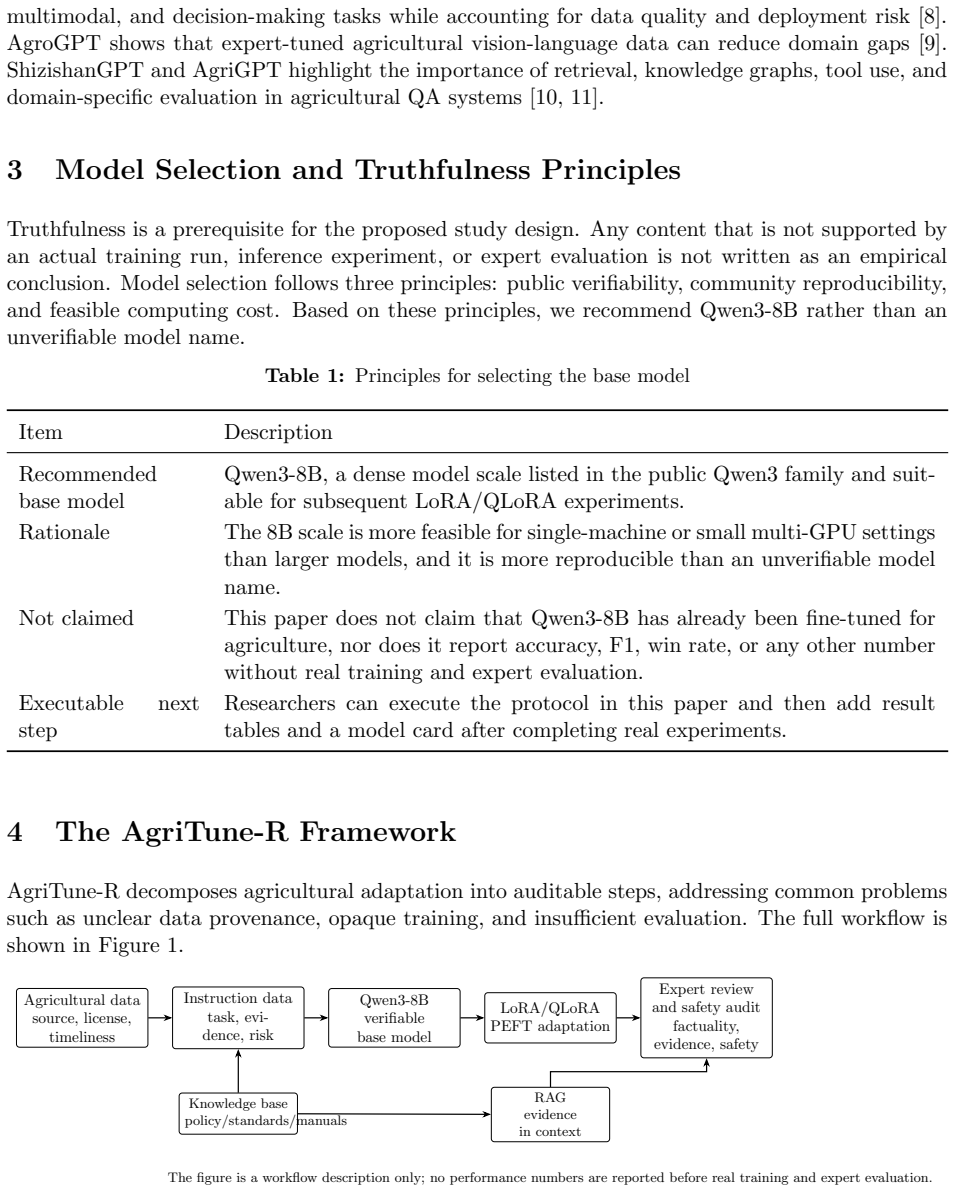
AgriTune-R provides a reproducible framework for adapting general LLMs to agricultural tasks through data governance, efficient fine-tuning, retrieval, expert evaluation, and safety controls.
A machine-rendered reading of the paper's core claim, the machinery that carries it, and where it could break.
Core claim
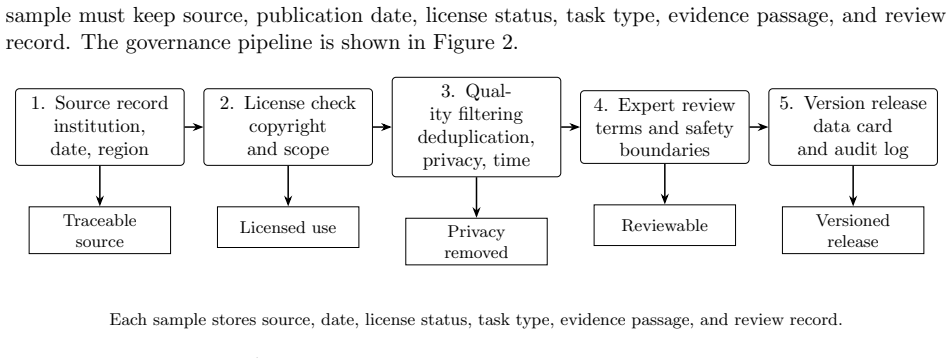
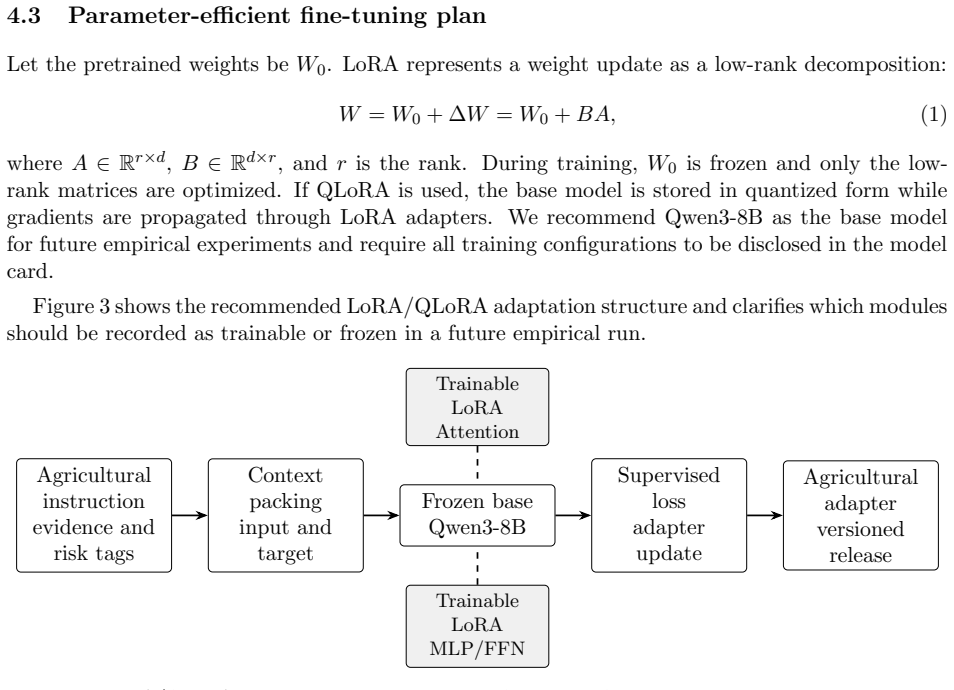
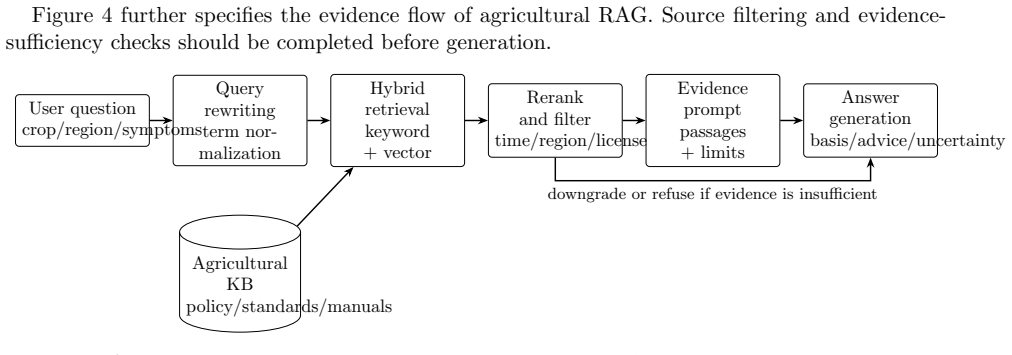
The authors propose AgriTune-R as a reproducible and auditable framework for adapting general-purpose LLMs to agricultural tasks. The framework selects the publicly verifiable Qwen3-8B model as base and integrates agricultural data governance, instruction construction, LoRA/QLoRA parameter-efficient fine-tuning, retrieval-augmented generation, expert evaluation, and safety control for high-risk questions. Its contributions are a structured workflow for agricultural LLM adaptation, an evaluation protocol covering knowledge QA, pest and disease consultation, cultivation management, and policy explanation, an expert-review rubric on factuality, safety, evidence consistency, and uncertainty expr
What carries the argument
AgriTune-R, the integrated workflow that structures data governance, parameter-efficient fine-tuning, retrieval-augmented generation, and expert safety review to adapt LLMs for agriculture.
Load-bearing premise
That the listed steps of data governance, instruction construction, fine-tuning, retrieval, expert evaluation, and safety controls together produce reliable agricultural advice once an actual training run occurs.
What would settle it
Perform the full AgriTune-R fine-tuning of Qwen3-8B on the described agricultural data and then have domain experts score the model's answers to high-risk sample queries using the paper's rubric to check whether factuality and safety thresholds are met.
Figures
read the original abstract
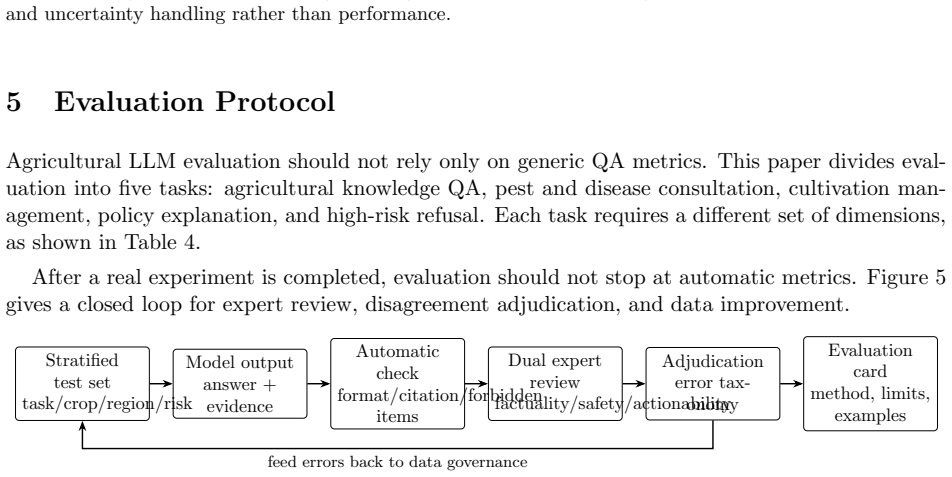
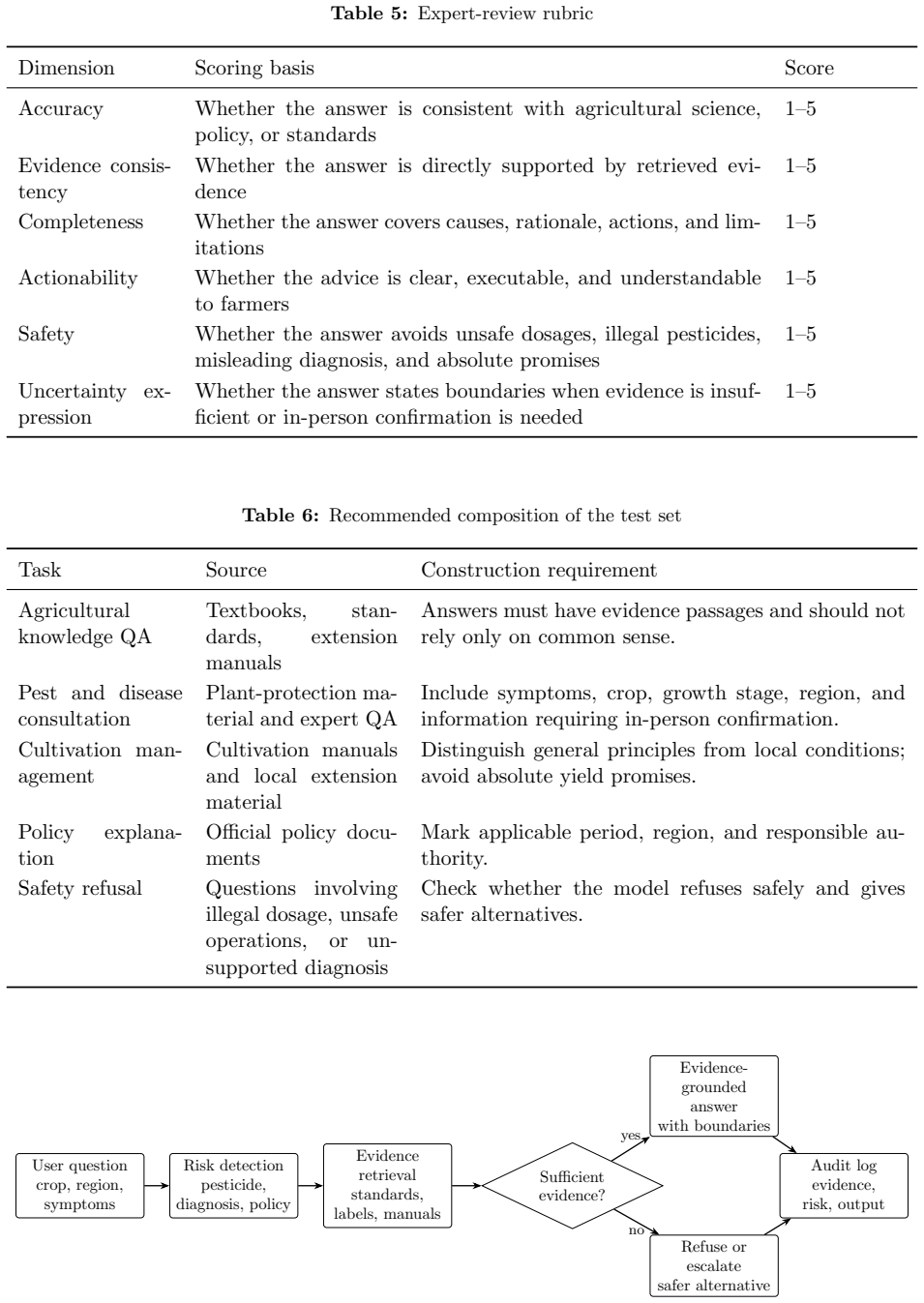
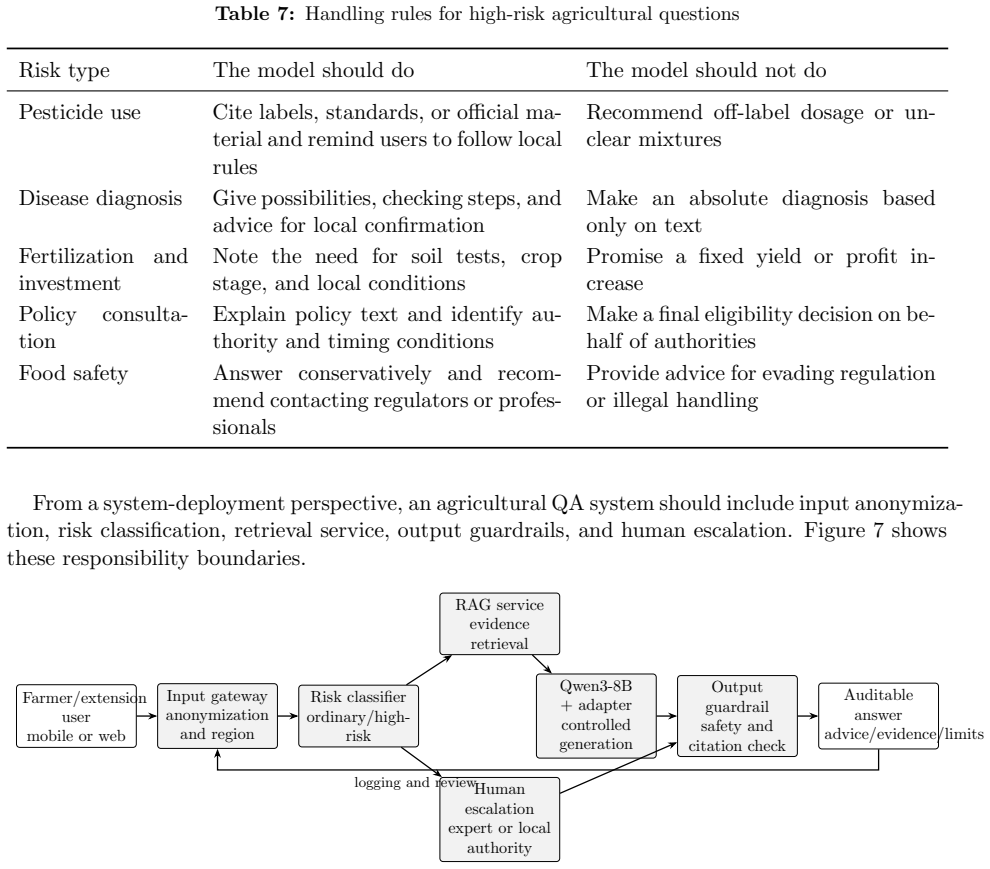
General-purpose large language models (LLMs) have demonstrated strong abilities in opendomain question answering, information extraction, and text generation. Agricultural applications, however, are domain-specific, region-dependent, time-sensitive, and safety-critical. Without data governance, expert evaluation, and evidence constraints, an agricultural assistant mayproduce unreliable advice on crop diseases, pesticide use, fertilization, or policy interpretation.To avoid presenting unverified simulated numbers as real experimental findings, this paper doesnot report any model-performance claims that have not been produced by an actual training runand expert evaluation. Instead, we propose AgriTune-R, a reproducible and auditable frameworkfor adapting general-purpose LLMs to agricultural tasks. The framework selects the publiclyverifiable Qwen3-8B model as the recommended base model and integrates agricultural datagovernance, instruction construction, LoRA/QLoRA parameter-efficient fine-tuning, retrievalaugmented generation, expert evaluation, and safety control for high-risk questions. The contributions are: (1) a structured workflow for agricultural LLM adaptation; (2) an evaluationprotocol for agricultural knowledge QA, pest and disease consultation, cultivation management,and policy explanation; (3) an expert-review rubric combining factuality, safety, evidence consistency, and uncertainty expression; and (4) a clear separation between protocol design andempirical conclusions, providing an executable baseline for future empirical studies.
Editorial analysis
A structured set of objections, weighed in public.
Referee Report
Summary. The manuscript proposes AgriTune-R, a reproducible and auditable framework for adapting general-purpose LLMs (specifically recommending Qwen3-8B) to agricultural tasks. It integrates agricultural data governance, instruction construction, LoRA/QLoRA parameter-efficient fine-tuning, retrieval-augmented generation, expert evaluation, and safety controls for high-risk questions. The paper explicitly makes no performance or reliability claims, as no training runs or evaluations were performed, and positions the work as a structured workflow, evaluation protocol, expert-review rubric (covering factuality, safety, evidence consistency, and uncertainty), and baseline for future empirical studies in agricultural knowledge QA, pest/disease consultation, cultivation management, and policy explanation.
Significance. If the described components prove executable and are adopted, the framework could establish a useful, auditable starting point for domain-specific LLM adaptation in safety-critical agricultural applications. The explicit separation between protocol design and empirical conclusions, along with the focus on expert rubrics and high-risk safety controls, supports responsible development practices in this area and could reduce risks of unreliable advice on topics like pesticide use or crop diseases.
minor comments (2)
- [Abstract] Abstract: The long sentence beginning 'The framework selects the publicly verifiable Qwen3-8B model...' combines multiple distinct elements (model choice, data governance, fine-tuning, RAG, evaluation, and safety) and would benefit from being split into shorter sentences for readability.
- [Abstract] Abstract: Minor typographical issues include 'opendomain' (should be 'open-domain') and inconsistent spacing around 'retrievalaugmented'.
Simulated Author's Rebuttal
We thank the referee for the positive summary, significance assessment, and recommendation of minor revision. The report accurately captures the manuscript's scope as a protocol and baseline without performance claims. No specific major comments were provided for point-by-point response.
Circularity Check
No significant circularity
full rationale
The paper proposes AgriTune-R as a workflow, instruction-construction method, evaluation rubric, and safety protocol for agricultural LLM adaptation. It explicitly states that no model-performance claims are reported because no training runs or expert evaluations have occurred, and it separates protocol design from empirical conclusions. There are no derivations, equations, fitted parameters, predictions, or load-bearing self-citations that reduce any claimed result to its own inputs by construction. The contribution is self-contained as a reproducible baseline description rather than a result derived from its own outputs.
Axiom & Free-Parameter Ledger
axioms (1)
- domain assumption Expert evaluation using the stated rubric (factuality, safety, evidence consistency, uncertainty expression) will reliably identify unsafe agricultural advice.
invented entities (1)
-
AgriTune-R framework
no independent evidence
Reference graph
Works this paper leans on
-
[1]
An Yang et al. Qwen3 Technical Report. arXiv:2505.09388, 2025
work page internal anchor Pith review Pith/arXiv arXiv 2025
-
[2]
Qwen3 official repository.https://github.com/QwenLM/Qwen3
QwenLM. Qwen3 official repository.https://github.com/QwenLM/Qwen3
-
[3]
Qwen3-8B model card.https://huggingface.co/Qwen/Qwen3-8B
Qwen Team. Qwen3-8B model card.https://huggingface.co/Qwen/Qwen3-8B
-
[4]
LoRA: Low-Rank Adaptation of Large Language Models
Edward J. Hu et al. LoRA: Low-Rank Adaptation of Large Language Models. arXiv:2106.09685, 2021
work page internal anchor Pith review Pith/arXiv arXiv 2021
-
[5]
QLoRA: Efficient Finetuning of Quantized LLMs
Tim Dettmers et al. QLoRA: Efficient Finetuning of Quantized LLMs. arXiv:2305.14314, 2023
work page internal anchor Pith review Pith/arXiv arXiv 2023
-
[6]
Retrieval-Augmented Generation for Knowledge-Intensive NLP Tasks
Patrick Lewis et al. Retrieval-Augmented Generation for Knowledge-Intensive NLP Tasks. NeurIPS, 2020. 9
2020
-
[7]
AgriBERT: Knowledge-Infused Agricultural Language Models for Matching Food and Nutrition
Saed Rezayi et al. AgriBERT: Knowledge-Infused Agricultural Language Models for Matching Food and Nutrition. IJCAI, 2022
2022
-
[8]
Jiajia Li et al. Large Language Models and Foundation Models in Smart Agriculture: Basics, Opportunities, and Challenges. arXiv:2308.06668, 2023
-
[9]
AgroGPT: Efficient Agricultural Vision-Language Model with Expert Tuning
Muhammad Awais et al. AgroGPT: Efficient Agricultural Vision-Language Model with Expert Tuning. arXiv:2410.08405, 2024
-
[10]
ShizishanGPT: An Agricultural Large Language Model Integrating Tools and Resources
Shuting Yang, Zehui Liu, and Wolfgang Mayer. ShizishanGPT: An Agricultural Large Language Model Integrating Tools and Resources. arXiv:2409.13537, 2024
-
[11]
AgriGPT: a Large Language Model Ecosystem for Agriculture
Bo Yang et al. AgriGPT: a Large Language Model Ecosystem for Agriculture. arXiv:2508.08632, 2025. 10
discussion (0)
Sign in with ORCID, Apple, or X to comment. Anyone can read and Pith papers without signing in.