REVIEW 4 major objections 6 minor 29 references
Historical Report Guided Bi-modal Concurrent Learning for Pathology Report Generation
T0 review · 4 major / 6 minor · reviewed 2026-08-06 · deepseek-v4-flash
Pith's one-line read The paper argues that retrieving historical pathology reports and learning visual and textual tokens concurrently over weight-shared cross-attention yields state-of-the-art report generation and Her-2 prediction on PathText-BRCA.
desk verdict Useful architecture with a real new combination, but the SOTA margins rest on a split change and an unauditable Her-2 pipeline. read the letter →
The pith
A machine-rendered reading of the paper's core claim, the machinery that carries it, and where it could break.
The reading
What carries the argument
The load-bearing object is the pair of learnable tokens, the visual token $V$ and the textual token $T$, refined by cross-attention layers whose weights are shared between branches. A complementary mechanism is the knowledge retrieval: patch embeddings from PLIP are filtered to the top-$k$ regions by first-layer visual attention scores, spatially averaged, and matched by cosine similarity against a sentence-level knowledge bank built from training reports, returning the top-$v$ sentences per region.
What would settle it
A reader could take the PathText-BRCA test set, feed each slide with genuinely retrieved knowledge versus knowledge sampled at random from the knowledge bank, and check whether the reported gains (BLEU-4 0.135, Her-2 F1 0.730) collapse; if they do not, retrieval is not the source of the improvement.
Extended reading notes
Core claim
BiGen's central claim is that pathology report generation improves when the model is given access to historical diagnostic sentences retrieved by the visual evidence itself. The authors instantiate this with a bi-modal concurrent learning strategy: a learnable visual token iteratively cross-attends to patch features to distill key visual patterns, while a learnable textual token iteratively cross-attends to retrieved knowledge; the two branches share weights to align the modalities, and a multi-modal decoder generates the report from the concatenated tokens. On PathText-BRCA, this configuration beats seven existing captioning and report-generation methods on every reported metric, with the largest gains coming from weight sharing between the visual and knowledge branches.
Load-bearing premise
The retrieval step assumes that the first-layer visual cross-attention scores flag the diagnostically relevant patches, and that PLIP patch and sentence embeddings are aligned well enough that cosine similarity returns sentences carrying the same diagnostic content as the test slide.
Editorial extensions
If this is right
- If the results are correct, BiGen outperforms the prior best pathology-report generator (HistGen) by 14.4% in BLEU-4 and improves Her-2 prediction F1 from 0.571 to 0.730 on PathText-BRCA.
- Weight sharing between the visual and textual token cross-attention layers is what aligns the two modalities; removing it drops the average metric gain from 15.26% to 13.06%.
- Knowledge retrieval without the textual token cross-attention hurts performance, showing that retrieved knowledge must be distilled to be useful.
- Attention scores from the first visual cross-attention layer localize tumor tissue, so the same scores that guide retrieval also provide interpretable heatmaps.
- The authors state that the paradigm can extend to other medical image interpretation tasks beyond pathology report generation.
Reading between the lines
- The attention-score-guided retrieval is effectively a weakly supervised selection of diagnostically relevant patches; this same signal could be reused for region-level interpretability in other whole-slide-image tasks.
- On cohorts where PLIP's image-text alignment is weak or where historical reports are systematically biased, the retrieval step could inject noise rather than semantics; a testable safeguard would be to degrade or shuffle the knowledge bank and measure the drop.
- A portion of the NLP gains may come from conditioning on text that is lexically similar to the target report rather than from better visual understanding; comparing against retrieval of random sentences would separate these effects.
- The framework suggests a broader recipe: use a foundation model for retrieval and a small set of learnable tokens for cross-modal distillation, a pattern that may carry over to radiology or dermatology report generation.
Editorial analysis
A structured set of objections, weighed in public.
Referee Report
Summary. The paper proposes BiGen, a framework for pathology report generation from whole slide images that combines a knowledge retrieval mechanism (retrieving sentence-level historical reports via PLIP embeddings of high-attention patches) with a bi-modal concurrent learning strategy using learnable visual and textual tokens and weight-shared cross-attention layers. Experiments on PathText-BRCA report state-of-the-art results in both NLP metrics (BLEU-4=0.135, ROUGE-L=0.293) and Her-2 classification metrics (F1=0.730), with a 7.4% relative improvement in NLP metrics and a 19.1% improvement in Her-2 F1 over prior methods. The authors also provide ablations over the main components and release code.
Significance. If the reported results are reproducible, BiGen is a useful contribution: it explicitly introduces historical-report retrieval into WSI report generation, proposes a relatively simple bi-modal token mechanism that improves over several strong baselines, and the public code and detailed ablations make the method easy to build on. The attention-heatmap visualization and the qualitative examples are also informative. However, the central empirical claims currently rest on a comparison protocol that is not clearly apples-to-apples and on an Her-2 evaluation pipeline that is not specified; these issues must be resolved before the significance of the reported margins can be assessed.
major comments (4)
- [§3.1, Dataset; Table 1] The paper states that it follows the PathText-BRCA splits of [3] and then 'Additionally, we remove duplicate patient samples across these sets, ensuring no patient overlap,' yielding 796/88/93 samples. It is not stated that any of the seven baselines in Table 1 were retrained or re-evaluated on this deduplicated split. If the baseline numbers come from the original splits, then the 7.4% NLP improvement and the 19.1% Her-2 F1 improvement are not measured on the same test set and the central SOTA claim is not supported. Please rerun all baselines on the exact deduplicated split with the same visual extractor, patch preprocessing, decoding strategy, and Her-2 extraction procedure, and report the resulting numbers.
- [§3.2, Table 1; Her-2 prediction metrics] The classification metrics Precision/Recall/F1 for Her-2 are computed from generated reports, but the manuscript never specifies how Her-2 status is extracted from free text (e.g., regex, keyword matching, or an external model) or whether the same extraction is applied to all baselines. Without this information, the Her-2 improvement cannot be audited. Moreover, there is a potential circularity: Fig. 2(e) shows that retrieved knowledge sentences can directly state Her-2 status (e.g., 'The tumor is ER-positive, PR-positive, and HER2-negative'), so the reported F1=0.730 may partly reflect copying biomarker labels from retrieved historical reports rather than genuinely predicting Her-2 from the WSI. Please specify the extraction pipeline, verify that it is identical for all compared methods, and provide an analysis of how much of the Her-2 gain depends on retrieved sentences that mention Her-2 status.
- [§4, Tables 1 and 2] All results in Tables 1 and 2 appear to come from a single run on a test set of 93 samples, with no error bars, standard deviations, or significance tests. Given the small test set and the moderate metric differences (e.g., BLEU-4 0.135 vs 0.118 for HistGen), the reported gains may be within run-to-run noise. Please report mean ± std over at least three random seeds and, where appropriate, bootstrap confidence intervals or a paired significance test.
- [§2.3, II; Fig. 3] The knowledge retrieval mechanism assumes that first-layer visual cross-attention scores identify diagnostically relevant patches and that PLIP patch embeddings and PLIP sentence embeddings are sufficiently aligned for cosine retrieval to return sentences with the same diagnostic content as the test WSI. This assumption is plausible but is only validated indirectly through final metric improvements on a single dataset. If the attention scores or embedding alignment degrade on a new cohort, retrieved knowledge could become noise, and the reported gains would not transfer. A more direct validation, such as an analysis of retrieval precision on held-out cases or a comparison of retrieved sentences against the ground-truth report content, would strengthen the paper.
minor comments (6)
- [§2.2 and §2.3, III] The visual token cross-attention is applied for L layers in Eq. (1), while the textual token cross-attention is applied for L−1 layers in Eq. (2), because the first-layer visual attention scores are needed for retrieval. Please clarify this asymmetry explicitly in the text, since a reader could otherwise expect both branches to use the same number of layers.
- [§2.3, II] The notation for the top-k selection is confusing: k is described as a ratio, but the set P is written as {p_i}_{i=1}^{M×k}, which suggests an integer count. Please define the number of selected patches as ⌊M·k⌋ and ensure all subsequent dimensions are consistent.
- [§3.2] There is a typo: 'genaration' should be 'generation' in the sentence introducing MI-Gen and HistGen.
- [§3.3] The phrase 'irrelative patches' should be 'irrelevant patches', and 'representatively' in the ablation discussion should likely be 'respectively'.
- [Fig. 1 and Fig. 2] Several figure labels are garbled or incomplete, for example the subscripted tokens in Fig. 1 and the caption 'Correctly prediced information' in Fig. 2. Please proofread the figures and captions.
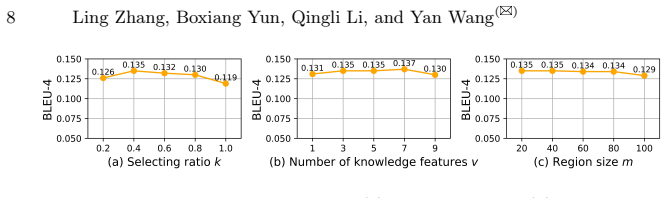
- [Fig. 3] The sensitivity plots do not specify which metric is shown; please state that the y-axis is, for example, BLEU-4, and whether other metrics show the same trend.
Circularity Check
The Her-2 'prediction' headline (F1=0.730, +19.1%) partially reduces by construction: retrieved knowledge sentences from the training-report bank directly state Her-2 status, so the classification metric reflects retrieval of known labels as much as visual diagnosis; the NLP report-generation claim is independently evaluated and not circular.
-
fitted input called prediction
[Sec. 2.3 (Knowledge Bank Construction I, Knowledge Retrieval II), Sec. 3.2 (Table 1 Her-2 metrics), Fig. 2(e)]
"...the original reports in the training set (e.g., PathText (BRCA)) are split into individual sentences and encoded using the text encoder of PLIP. The resulting sentence embeddings are stored as the knowledge bank... (Sec. 2.3-I). '...we adopt three classification metrics to evaluate Her-2 prediction in generated reports: Precision, Recall and F1 score' (Sec. 3.2). Fig. 2(e) retrieved knowledge item 5: 'The tumor is ER-positive, PR-positive, and HER2-negative.'"
The headline Her-2 F1=0.730 is reported as classification of the generated report text, but the generated text is decoded from F=Concat(VL,T^{L-1}) (Sec. 2.4), where T^{L-1} is a textual token refined over the retrieved knowledge R (Eq. 2), and R is obtained by cosine retrieval (Sec. 2.3-II) from a knowledge bank of training-set report sentences that explicitly state the evaluation label (Fig. 2(e): 'HER2-negative', 'ER-positive, PR-positive'). The Her-2 answer is thus present in the model's input before any classification happens; the decoder can transcribe the retrieved sentence into the report, making the 'prediction' a retrieval of known training-set labels rather than a visual diagnosis.
full rationale
The central NLP claim (BLEU-4=0.135, ROUGE-L=0.293, Table 1) is not circular: BiGen is trained with an NLL objective against ground-truth reports and evaluated on a held-out test set (796/88/93 after patient deduplication, Sec. 3.1) with standard captioning metrics, so the generation numbers measure held-out fidelity. The framework contains no load-bearing self-citation: all cited components (MI-Gen's splits [3], CLAM [17], UNI [4], PLIP [11], HistGen [10], the early-attention inspiration [2]) are independent external works, and none of the authors' own prior results are invoked to justify a design choice or forbid an alternative. The one genuinely circular channel is the Her-2 headline: the knowledge bank is built from training-report sentences that directly state Her-2 status, retrieval (Sec. 2.3-II) returns those label-bearing sentences to the textual token (Eq. 2), the decoder conditions on them (Eq. 3), and Table 1's Precision/Recall/F1 are described as 'Her-2 prediction in generated reports.' The 19.1% Her-2 F1 gain over retrieval-free baselines therefore reflects, in part, transcription of retrieved training labels rather than visual diagnosis, and no separate visual Her-2 estimator or text-extraction pipeline is specified, making this metric partially circular by construction. Not counted as circularity (but noted as validity risks): the deduplicated split (Sec. 3.1) may differ from the splits on which baselines were scored, and hyperparameters k, v, m are tuned on the same benchmark (Fig. 3); these affect comparability and selection bias, not the derivation chain. Weighing the vulnerable Her-2 claim (one of two headline results) against the independently evaluated NLP claim, the overall circularity score is 6.
Assumptions & free parameters
free parameters (3)
- patch selection ratio k =
0.4
- tissue region size m =
20
- number of retrieved knowledge features v =
3
assumptions (4)
- domain assumption PLIP provides a shared embedding space where pathology image patches and pathology sentences have comparable representations.
- ad hoc to paper First-layer visual cross-attention attention scores mark the diagnostically relevant patches.
- domain assumption Spatially neighboring patches on a WSI tend to share tissue type, so averaging within regions preserves diagnostic content.
- domain assumption Sentence-level splitting of reports preserves enough context for knowledge retrieval.
Cite this review
Pith. "Pith review of Historical Report Guided Bi-modal Concurrent Learning for Pathology Report Generation." pith.science (2026). https://pith.science/paper/NQPGOQAK
@misc{pith2026250618658,
  author       = {Pith},
  title        = {Pith review of: Historical Report Guided Bi-modal Concurrent Learning for Pathology Report Generation},
  year         = {2026},
  howpublished = {\url{https://pith.science/paper/NQPGOQAK}},
  note         = {Machine review of arXiv:2506.18658}
}
read the original abstract
Automated pathology report generation from Whole Slide Images (WSIs) faces two key challenges: (1) lack of semantic content in visual features and (2) inherent information redundancy in WSIs. To address these issues, we propose a novel Historical Report Guided \textbf{Bi}-modal Concurrent Learning Framework for Pathology Report \textbf{Gen}eration (BiGen) emulating pathologists' diagnostic reasoning, consisting of: (1) A knowledge retrieval mechanism to provide rich semantic content, which retrieves WSI-relevant knowledge from pre-built medical knowledge bank by matching high-attention patches and (2) A bi-modal concurrent learning strategy instantiated via a learnable visual token and a learnable textual token to dynamically extract key visual features and retrieved knowledge, where weight-shared layers enable cross-modal alignment between visual features and knowledge features. Our multi-modal decoder integrates both modals for comprehensive diagnostic reports generation. Experiments on the PathText (BRCA) dataset demonstrate our framework's superiority, achieving state-of-the-art performance with 7.4\% relative improvement in NLP metrics and 19.1\% enhancement in classification metrics for Her-2 prediction versus existing methods. Ablation studies validate the necessity of our proposed modules, highlighting our method's ability to provide WSI-relevant rich semantic content and suppress information redundancy in WSIs. Code is publicly available at https://github.com/DeepMed-Lab-ECNU/BiGen.
Figures


Reference graph
Works this paper leans on
-
[3]
Chen, P., Li, H., Zhu, C., Zheng, S., Shui, Z., Yang, L.: Wsicaption: Multiple instance generation of pathology reports for gigapixel whole-slide images. In: MIC- CAI (2024)
work page 2024
-
[1]
Banerjee, S., Lavie, A.: Meteor: An automatic metric for mt evaluation with im- proved correlation with human judgments. In: Proceedings of the acl workshop on intrinsic and extrinsic evaluation measures for machine translation and/or summa- rization (2005)
work page 2005
-
[2]
Chen, L., Zhao, H., Liu, T., Bai, S., Lin, J., Zhou, C., Chang, B.: An image is worth 1/2 tokens after layer 2: Plug-and-play inference acceleration for large vision- language models. In: ECCV (2024)
work page 2024
-
[4]
Chen, R.J., Ding, T., Lu, M.Y., Williamson, D.F., Jaume, G., Song, A.H., Chen, B., Zhang, A., Shao, D., Shaban, M., et al.: Towards a general-purpose foundation model for computational pathology. Nature Medicine30(2024)
work page 2024
-
[5]
arXiv preprint arXiv:2204.13258 (2022)
Chen, Z., Shen, Y., Song, Y., Wan, X.: Cross-modal memory networks for radiology report generation. arXiv preprint arXiv:2204.13258 (2022)
arXiv 2022
-
[6]
arXiv preprint arXiv:2010.16056 (2020)
Chen, Z., Song, Y., Chang, T.H., Wan, X.: Generating radiology reports via memory-driven transformer. arXiv preprint arXiv:2010.16056 (2020)
arXiv 2020
-
[7]
El Nahhas, O.S., van Treeck, M., Wölflein, G., Unger, M., Ligero, M., Lenz, T., Wagner, S.J., Hewitt, K.J., Khader, F., Foersch, S., et al.: From whole-slide image to biomarker prediction: end-to-end weakly supervised deep learning in computa- tional pathology. Nature Protocols20(2025)
work page 2025
-
[8]
World health organization (2000)
Fritz, A.G.: International classification of diseases for oncology: ICD-O. World health organization (2000)
work page 2000
Show all 29 references
-
[9]
In: WACV (2024)
Gu, T., Liu, D., Li, Z., Cai, W.: Complex organ mask guided radiology report generation. In: WACV (2024)
2024
-
[10]
In: MICCAI (2024)
Guo, Z., Ma, J., Xu, Y., Wang, Y., Wang, L., Chen, H.: Histgen: Histopathol- ogy report generation via local-global feature encoding and cross-modal context interaction. In: MICCAI (2024)
2024
-
[11]
Nature medicine29(2023) 10 Ling Zhang, Boxiang Yun, Qingli Li, and Yan Wang ()
Huang, Z., Bianchi, F., Yuksekgonul, M., Montine, T.J., Zou, J.: A visual–language foundation model for pathology image analysis using medical twitter. Nature medicine29(2023) 10 Ling Zhang, Boxiang Yun, Qingli Li, and Yan Wang ()
2023
-
[12]
NIPS36(2024)
Li, C., Wong, C., Zhang, S., Usuyama, N., Liu, H., Yang, J., Naumann, T., Poon, H., Gao, J.: Llava-med: Training a large language-and-vision assistant for biomedicine in one day. NIPS36(2024)
2024
-
[13]
In: CVPR (2023)
Li, H., Zhu, C., Zhang, Y., Sun, Y., Shui, Z., Kuang, W., Zheng, S., Yang, L.: Task- specific fine-tuning via variational information bottleneck for weakly-supervised pathology whole slide image classification. In: CVPR (2023)
2023
-
[14]
In: MICCAI (2021)
Liu, Q., Louis, P.C., Lu, Y., Jha, A., Zhao, M., Deng, R., Yao, T., Roland, J.T., Yang, H., Zhao, S., et al.: Simtriplet: Simple triplet representation learning with a single gpu. In: MICCAI (2021)
2021
-
[15]
In: CVPR (2017)
Lu,J.,Xiong,C.,Parikh,D.,Socher,R.:Knowingwhentolook:Adaptiveattention via a visual sentinel for image captioning. In: CVPR (2017)
2017
-
[16]
Nature634(2024)
Lu, M.Y., Chen, B., Williamson, D.F., Chen, R.J., Zhao, M., Chow, A.K., Ikemura, K., Kim, A., Pouli, D., Patel, A., et al.: A multimodal generative ai copilot for human pathology. Nature634(2024)
2024
-
[17]
Nature biomedical engineering5(2021)
Lu, M.Y., Williamson, D.F., Chen, T.Y., Chen, R.J., Barbieri, M., Mahmood, F.: Data-efficient and weakly supervised computational pathology on whole-slide images. Nature biomedical engineering5(2021)
2021
-
[18]
arXiv preprint arXiv:2010.10042 (2020)
Miura, Y., Zhang, Y., Tsai, E.B., Langlotz, C.P., Jurafsky, D.: Improving factual completeness and consistency of image-to-text radiology report generation. arXiv preprint arXiv:2010.10042 (2020)
2020 arXiv
-
[19]
In: ACL (2002)
Papineni, K., Roukos, S., Ward, T., Zhu, W.J.: Bleu: a method for automatic evaluation of machine translation. In: ACL (2002)
2002
-
[20]
In: Proceedings of Workshop on Text Summarization of ACL, Spain (2004)
Rouge, L.C.: A package for automatic evaluation of summaries. In: Proceedings of Workshop on Text Summarization of ACL, Spain (2004)
2004
-
[21]
In: MICCAI (2024)
Tan, J.W., Kim, S., Kim, E., Lee, S.H., Ahn, S., Jeong, W.K.: Clinical-grade multi- organ pathology report generation for multi-scale whole slide images via a seman- tically guided medical text foundation model. In: MICCAI (2024)
2024
-
[22]
medRxiv (2024)
Tran, M., Schmidle, P., Wagner, S.J., Koch, V., Lupperger, V., Feuchtinger, A., Boehner, A., Kaczmarczyk, R., Biedermann, T., Eyerich, K., et al.: Generating highly accurate pathology reports from gigapixel whole slide images with histogpt. medRxiv (2024)
2024
-
[23]
NEJM AI1(2024)
Tu, T., Azizi, S., Driess, D., Schaekermann, M., Amin, M., Chang, P.C., Carroll, A., Lau, C., Tanno, R., Ktena, I., et al.: Towards generalist biomedical ai. NEJM AI1(2024)
2024
-
[24]
NIPS (2017)
Vaswani, A.: Attention is all you need. NIPS (2017)
2017
-
[25]
In: CVPR (2015)
Vinyals, O., Toshev, A., Bengio, S., Erhan, D.: Show and tell: A neural image caption generator. In: CVPR (2015)
2015
-
[26]
Nature (2024)
Xu, H., Usuyama, N., Bagga, J., Zhang, S., Rao, R., Naumann, T., Wong, C., Gero, Z., González, J., Gu, Y., et al.: A whole-slide foundation model for digital pathology from real-world data. Nature (2024)
2024
-
[27]
In: ICML (2015)
Xu, K., Ba, J., Kiros, R., Cho, K., Courville, A., Salakhudinov, R., Zemel, R., Bengio, Y.: Show, attend and tell: Neural image caption generation with visual attention. In: ICML (2015)
2015
-
[28]
In: CVPR (2022)
Zhang, H., Meng, Y., Zhao, Y., Qiao, Y., Yang, X., Coupland, S.E., Zheng, Y.: Dtfd-mil: Double-tier feature distillation multiple instance learning for histopathol- ogy whole slide image classification. In: CVPR (2022)
2022
-
[29]
In: CVPR (2024)
Zhu, L., Wei, F., Lu, Y.: Beyond text: Frozen large language models in visual signal comprehension. In: CVPR (2024)
2024
Reviewed August 6, 2026 · model on record in the stance chip above.
Discussion (0). Continue with ORCID to comment.