REVIEW 3 major objections 7 minor 52 references
Five qubits hit 98% on MNIST via fixed quantum dynamics
Reviewed by Pith at T0; open to challenge. T0 means a machine referee read the full paper against a public rubric. the ladder, T0–T4 →
T0 review · glm-5.2
2026-07-10 01:13 UTC pith:NQTKIJ64
load-bearing objection Letter to colleague on arXiv:2607.08037 the 3 major comments →
Robust Quantum Learning through Hamiltonian Reservoir Computing
The pith
A machine-rendered reading of the paper's core claim, the machinery that carries it, and where it could break.
Core claim
The central discovery is that the exponential nonlinearity of quantum time evolution, applied to a fixed Hamiltonian whose parameters carry the input data, generates a feature space rich enough that a linear classifier on five-to-six qubits achieves approximately 97-98% accuracy on MNIST. This holds across both analog and digital implementations, and the feature space is robust to mixed initial states and moderate dissipation. The mechanism is reservoir computing: the quantum system acts as a fixed, untrained nonlinear dynamical map, and only the output weights are learned. A corollary is that controlled dissipation can improve performance at long evolution times by damping quantum-scrambing
What carries the argument
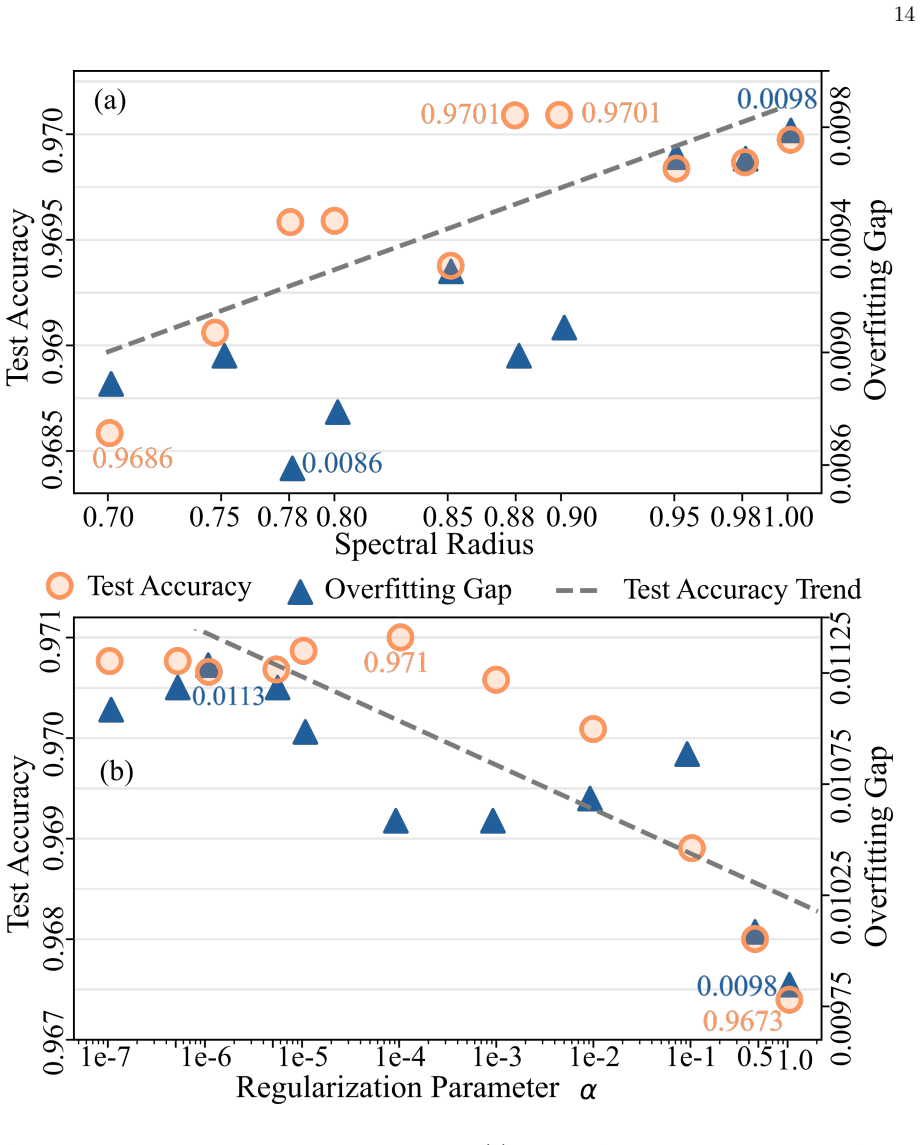
The Hamiltonian Encoding Framework (HEF): input data are linearly transformed and injected into the parameters (qubit frequencies and drive amplitudes) of a fixed many-body superconducting Hamiltonian. The system evolves unitarily under this Hamiltonian for a set of chosen timescales, and the diagonal populations (and optionally off-diagonal coherences) of the resulting density matrix are extracted as features. Multiple evolution times are concatenated (temporal multiplexing) to expand the feature space without adding qubits. A random background Hamiltonian provides structural mixing; its spectral radius is normalized to a fixed value (0.88) to ensure dynamical stability—the quantum analogue
Load-bearing premise
The framework relies on a randomly drawn fixed background Hamiltonian and a randomly drawn input encoding matrix, neither of which is optimized for the task. The paper states that reservoir computing does not depend on the specific form of the reservoir, but all reported accuracies come from specific random draws of these matrices, and no systematic study over multiple random seeds is presented to confirm that the reported performance is typical rather than a favorable
What would settle it
If the reported 97-98% MNIST accuracy varies substantially across different random draws of the background Hamiltonian and input encoding matrix—say, dropping below 90% for a significant fraction of seeds—then the claim that the framework is robust and task-agnostic would be undermined. The performance would then depend on seed selection rather than being an intrinsic property of the Hamiltonian encoding approach.
Editorial analysis
A structured set of objections, weighed in public.
Referee Report
Summary. This manuscript proposes a Hamiltonian Encoding Framework (HEF) for quantum reservoir computing in which classical input data are mapped onto a fixed Hamiltonian, evolved under quantum dynamics, and read out via a trained linear classifier. The framework is validated on two platforms: an Analog Superconducting Array Processor (ASAP) and a digital Quantum Circuit Implementation (QCI). The authors report MNIST classification accuracies of ~97-98% using only 5-6 qubits, argue that the approach avoids barren plateaus by construction, and find that finite dissipation can suppress scrambling-induced instabilities at long evolution times. The methodology is clearly described, the Hamiltonian constructions are physically motivated, and the cross-platform comparison is a genuine contribution. The central claims are internally consistent and non-circular: input data are encoded, evolved, measured, and classified by an externally trained readout. The main concern is that the headline accuracies rest on single random realizations of the fixed matrices H_base and W_in without seed-averaged error bars, leaving the robustness of the 'fixed, untrained reservoir' claim insufficiently substantiated.
Significance. The paper addresses three timely challenges in quantum machine learning—trainability, hardware efficiency, and information stability—within a single framework. The reservoir-computing approach sidestepping barren plateaus is well-motivated, and the dual analog/digital validation on a physically realistic superconducting Hamiltonian (Eq. 18) is a strength. The finding that finite dissipation constructively suppresses quantum scrambling at long evolution times (Fig. 7) is a non-trivial, falsifiable result with practical implications for near-term hardware. The demonstration that basis measurements match full density matrix measurements at K>=64 (Fig. 2a) is a useful hardware-efficiency insight. However, the significance of the headline ~98% accuracy claim is tempered by the absence of seed-averaged variance and a matched-dimensionality classical baseline, which are needed to calibrate whether the reported numbers reflect a robust property of the framework or a favorable random draw.
major comments (3)
- §II.A, Eqs. (2)-(5): All reported accuracies (Figs. 2, 4, 5) depend on specific random draws of the input encoding matrix W_in and the background Hamiltonian H_base. The manuscript asserts that 'QRP typically does not depend on the specific form of the reservoir' (§II.A), but no error bars, seed variance, or distribution over multiple random realizations is reported anywhere. This is the single most load-bearing gap: the claim that a fixed, untrained quantum reservoir reliably generates linearly separable features is empirically asserted without variance quantification. If performance fluctuates substantially across seeds, the reported ~98% could reflect a favorable draw. The authors should report mean accuracy and standard deviation over at least 5-10 independent random seeds for the main configurations (5-qubit ASAP, 5-qubit QCI) to establish that the result is typical rather than a幸运的
- §II.F, §V: The term 'competitive learning performance' is used throughout (abstract, §V, §VII) without a classical reservoir computing baseline at matched feature dimensionality. The feature dimension for a 5-qubit, 4-process configuration is dim(x_dense) = 1 + d^2 + nK^2 (Eq. 15), which can be large. Without a classical echo state network or next-generation reservoir computing model using the same feature dimension and the same linear readout, it is unclear whether the quantum dynamics provide an advantage over a classical reservoir of equivalent size. A classical baseline with matched feature count would strengthen the 'competitive' claim substantially.
- §VI, Fig. 7: The dissipation results are among the most interesting findings, but the mechanism by which dissipation suppresses scrambling is only qualitatively described. The dissipation rates used (gamma = 10^-3 for ASAP, gamma = 10^-2 for QCI) differ by an order of magnitude between platforms without explanation. Is this difference physically motivated by platform-specific coherence properties, or is it a tuned parameter? The authors should clarify the basis for this choice and, if possible, show a sweep over gamma to demonstrate that the constructive effect is robust rather than finely tuned.
minor comments (7)
- §II.A, Eq. (6): The spectral radius r_tr = 0.88 is stated without justification for this specific value. A brief comment on why 0.88 was chosen (rather than, say, 0.9 or 0.95) would help reproducibility.
- Fig. 1(b): The PCA results are reported for tau = 0.2 and tau = 50, but the optimal evolution timescale is identified as 0.1 <= tau <= 1 in Fig. 2(b). The PCA at tau = 50 seems to probe a regime outside the recommended operating range. Clarifying the motivation for analyzing tau = 50 would help.
- §II.E, Fig. 1(d): The Fisher ratio discussion notes that the untrained ratio decreases with tau, but the y-axis scale and absolute values are not clearly reported in the figure caption. Including the scale would aid interpretation.
- §IV.B, Eqs. (28)-(29): The decomposition of XX and YY interactions into CNOT/Rz/H gates is standard, but a reference to the specific gate decomposition convention would aid reproducibility.
- §VIII.A, Eqs. (43)-(44): The coupling parameter distributions (g_i ~ N(0.18, 0.04^2), Delta_ij offset of 0.4) are specific numerical choices. A brief comment on whether these are representative of current superconducting hardware or idealized would contextualize the ASAP results.
- Fig. 6 caption: 'The accuracy deviation Delta' is defined in the caption but the symbol Delta is also used for the detuning matrix in Eq. (19). Using a different symbol would avoid ambiguity.
- §VII: The discussion mentions that 'classical neural or reservoir-based models generally require significantly larger architectures' [46-48], but the cited references are from 2015-2016. More recent classical baselines for MNIST would strengthen the comparison.
Circularity Check
No significant circularity found; derivation chain is self-contained and empirically grounded.
full rationale
The paper's derivation chain is: (1) encode input data into Hamiltonian parameters via fixed random matrices (Eqs. 2-6), (2) evolve quantum system unitarily or dissipatively (Eqs. 7-9, 33-36), (3) extract features from density matrix elements (Eqs. 10-17), (4) train a linear ridge classifier on labeled MNIST data, (5) report test accuracy. No step reduces to its inputs by construction. The reported accuracies (~97-98%) are empirical simulation outcomes, not derived quantities. The spectral radius r_tr=0.88 (Eq. 6) and regularization parameter α are hyperparameters whose sensitivity is explicitly studied (Fig. 3), not presented as predictions. The barren plateau avoidance is a structural consequence of restricting training to the classical readout layer—no quantum gradients are computed—so it is not a circular claim. The dissipation finding (Section VI, Figs. 6-7) is a genuine simulation result: dissipation suppresses scrambling-induced degradation at long times, which is observed empirically, not defined into the framework. The PCA and Fisher ratio analyses (Section II.E, VIII.B) are computed from actual feature outputs, not defined to be high-dimensional or separable. One author (Ghosh) appears on reference [13], but that citation provides general background on quantum reservoir computing and is not load-bearing for any central claim. The framework's equations and numerical results are self-contained against external benchmarks (MNIST). The absence of seed-averaging or matched classical baselines is a correctness/robustness concern, not a circularity issue. Score 1 reflects the minor non-load-bearing self-citation and the otherwise clean derivation chain.
Axiom & Free-Parameter Ledger
free parameters (7)
- r_tr (spectral radius) =
0.88
- W_in (input encoding matrix) =
random
- H_base (background Hamiltonian) =
random
- Evolution times {τ_j} =
[0.2, 0.8, 1.2, 1.4]
- α (regularization) =
not specified
- Coupling parameters (g_i, Δ_ij, δJ_ij) =
N(0.18,0.04^2) etc.
- Dissipation rates (γ_1, γ_ϕ) =
10^-3 (ASAP), 10^-2 (QCI)
axioms (4)
- domain assumption Reservoir computing does not depend on the specific form of the reservoir Hamiltonian, only on global dynamical properties.
- domain assumption Linear readout is sufficient to decode the quantum features for classification.
- domain assumption MNIST classification accuracy is a meaningful benchmark for quantum learning utility.
- standard math The Markovian Lindblad master equation adequately describes environmental coupling in superconducting systems.
read the original abstract
Quantum learning provides a versatile paradigm for information processing by exploiting the intrinsic representational capacity of high-dimensional Hilbert spaces. Here, we investigate a Hamiltonian-encoding framework for quantum reservoir computing that simultaneously addresses three key challenges in quantum learning: trainability, hardware efficiency, and information stability. In this framework, input data are directly mapped onto a fixed Hamiltonian and transformed into expressive nonlinear features through quantum dynamical evolution. By employing the reservoir-computing paradigm, the approach naturally circumvents the barren plateau problem in quantum learning landscapes. We validate the framework across two complementary platforms: an analog superconducting array processor and a digital gate-based quantum circuit implementation. Despite their fundamentally different realizations, both platforms exhibit comparable representational power and achieve competitive learning performance, establishing a unified framework for cross-platform quantum learning. While both implementations achieve comparable performance, the analog processor may offer a more hardware-efficient realization by bypassing the temporal overhead of gate-based decomposition and thereby making more effective use of finite coherence times, albeit at the expense of universality. Furthermore, we find that finite dissipation suppresses quantum-scrambling-induced instabilities at long evolution times and can enhance learning performance, revealing a constructive role for environmental coupling in stabilizing quantum learning dynamics. Collectively, these results establish Hamiltonian-encoded reservoir computing as a compact, expressive, and hardware-efficient paradigm for quantum learning on current-generation quantum platforms.
Figures




Reference graph
Works this paper leans on
-
[1]
Maria Schuld and Francesco Petruccione.Machine learning with quantum computers, volume 676. Springer, 2021
work page 2021
-
[2]
Marco Cerezo, Guillaume Verdon, Hsin-Yuan Huang, Lukasz Cincio, and Patrick J Coles. Challenges and opportunities in quantum machine learning.Nature computational science, 2(9):567–576, 2022
work page 2022
-
[3]
McClean, Sergio Boixo, Vadim N
Jarrod R. McClean, Sergio Boixo, Vadim N. Smelyanskiy, Ryan Babbush, and Hartmut Neven. Barren plateaus in quantum neural network training landscapes.Nature Communications, 9:4812, 2018
work page 2018
-
[4]
Zo¨ e Holmes, Kunal Sharma, M. Cerezo, and Patrick J. Coles. Connecting ansatz expressibility to gradient magnitudes and barren plateaus.PRX Quantum, 3:010313, 2022
work page 2022
-
[5]
Quantum support vector machine for big data classification.Phys
Patrick Rebentrost, Masoud Mohseni, and Seth Lloyd. Quantum support vector machine for big data classification.Phys. Rev. Lett., 113:130503, Sep 2014
work page 2014
-
[6]
Abhinav Kandala, Antonio Mezzacapo, Kristan Temme, Maika Takita, Jerry M. Chow, and Jay M. Gambetta. Hardware-efficient variational quantum eigensolver for small molecules and quantum mag- nets.Nature, 549:242–246, 2017
work page 2017
-
[7]
C´ orcoles, Kristan Temme, Aram W
Vojtˇ ech Havl´ ıˇ cek, Antonio D. C´ orcoles, Kristan Temme, Aram W. Harrow, Abhinav Kandala, Jerry M. Chow, and Jay M. Gambetta. Supervised learning with quantum-enhanced feature spaces.Nature, 567:209–212, 2019
work page 2019
-
[8]
Herbert Jaeger and Harald Haas. Harnessing nonlinearity: Predicting chaotic systems and saving energy in wireless communication.Science, 304:78–80, 2004
work page 2004
-
[9]
Mantas Lukoˇ seviˇ cius and Herbert Jaeger. Reservoir computing approaches to recurrent neural network training.Computer science review, 3(3):127–149, 2009
work page 2009
-
[10]
Next generation reservoir computing.Nature communications, 12(1):5564, 2021
Daniel J Gauthier, Erik Bollt, Aaron Griffith, and Wendson AS Barbosa. Next generation reservoir computing.Nature communications, 12(1):5564, 2021
work page 2021
-
[11]
Scalable photonic reservoir computing for parallel machine learning tasks
A Aadhi, L Di Lauro, B Fischer, P Dmitriev, I Alamgir, C Mazoukh, N Perron, EA Viktorov, AV Ko- valev, A Eshaghi, et al. Scalable photonic reservoir computing for parallel machine learning tasks. Nature Communications, 2(9):567–576, 2025
work page 2025
-
[12]
Keisuke Fujii and Kouhei Nakajima. Harnessing disordered-ensemble quantum dynamics for machine learning.Physical Review Applied, 8:024030, 2017
work page 2017
-
[13]
Quantum reservoir processing.npj Quantum Information, 5(1):35, 2019
Sanjib Ghosh, Andrzej Opala, Micha l Matuszewski, Tomasz Paterek, and Timothy CH Liew. Quantum reservoir processing.npj Quantum Information, 5(1):35, 2019
work page 2019
-
[14]
Pere Mujal, Rodrigo Mart´ ınez-Pe˜ na, Johannes Nokkala, Jorge Garc´ ıa-Beni, Gian Luca Giorgi, Miguel C. Soriano, and Roberta Zambrini. Opportunities in quantum reservoir computing and extreme learning machines.Advanced Quantum Technologies, 4(8):2100027, 2021. 35
work page 2021
-
[15]
Quantum machine learning in feature hilbert spaces.Physical Review Letters, 122:040504, 2019
Maria Schuld and Nathan Killoran. Quantum machine learning in feature hilbert spaces.Physical Review Letters, 122:040504, 2019
work page 2019
-
[16]
Massimo Palma, Alessandro Ferraro, and Mauro Paternostro
Alessia Suprano, Danilo Zia, Luca Innocenti, Salvatore Lorenzo, Valeria Cimini, Taira Giordani, Ivan Palmisano, Emanuele Polino, Nicol` o Spagnolo, Fabio Sciarrino, G. Massimo Palma, Alessandro Ferraro, and Mauro Paternostro. Experimental property reconstruction in a photonic quantum extreme learning machine.Phys. Rev. Lett., 132:160802, Apr 2024
work page 2024
-
[17]
Andranik Senanian, Sreenath Ganjam, Daniel Gilboa, Logan Wells, Liang Wang, Caleb Weinreb, Fang Ching, Polina Anikeeva, Neil Timoney, Matthew Reagor, and Dirk Englund. Microwave signal process- ing using an analog quantum reservoir computer.Nature Communications, 15:7490, 2024
work page 2024
-
[18]
Yanjun Hou, Juncheng Hua, Ze Wu, Wei Xia, Yuquan Chen, Xiaopeng Li, Zhaokai Li, Xinhua Peng, and Jiangfeng Du. High-accuracy temporal prediction via experimental quantum reservoir computing in correlated spins.Physical Review Letters, 2026
work page 2026
-
[19]
Soriano, Roberta Zambrini, and Valentina Parigi
Iris Paparelle, Johan Henaff, Jorge Garc´ ıa-Beni, ´Emilie Gillet, Daniel Montesinos, Gian Luca Giorgi, Miguel C. Soriano, Roberta Zambrini, and Valentina Parigi. Experimental memory control in continuous-variable optical quantum reservoir computing.Nature Photonics, 20(4):413–420, 2026
work page 2026
-
[20]
Sohoni, Federico Presutti, Benjamin K
Valeria Cimini, Mandar M. Sohoni, Federico Presutti, Benjamin K. Malia, Shi-Yuan Ma, Ryotatsu Yanagimoto, Tianyu Wang, Tatsuhiro Onodera, Logan G. Wright, and Peter L. McMahon. Large-scale quantum reservoir computing using a gaussian boson sampler.npj Quantum Information, 2026
work page 2026
- [21]
-
[22]
Eric R. Anschuetz and Bobak T. Kiani. Quantum variational algorithms are swamped with traps. Nature Communications, 13:7767, 2022
work page 2022
-
[23]
Weijie Xiong, Giorgio Facelli, Mehrad Sahebi, Owen Agnel, Thiparat Chotibut, Supanut Thanasilp, and Zo¨ e Holmes. On fundamental aspects of quantum extreme learning machines.Quantum Machine Intelligence, 7(1):20, 2025
work page 2025
-
[24]
Role of scrambling and noise in temporal information processing with quantum systems
Weijie Xiong, Zo¨ e Holmes, Armando Angrisani, Yudai Suzuki, Thiparat Chotibut, and Supanut Thanasilp. Role of scrambling and noise in temporal information processing with quantum systems. arXiv preprint arXiv:2505.10080, 2025
work page internal anchor Pith review Pith/arXiv arXiv 2025
-
[25]
Edge of many-body quantum chaos in quantum reservoir computing.Phys
Kaito Kobayashi and Yukitoshi Motome. Edge of many-body quantum chaos in quantum reservoir computing.Phys. Rev. Lett., 136:040602, Jan 2026
work page 2026
-
[26]
Harrow, Avinatan Hassidim, and Seth Lloyd
Aram W. Harrow, Avinatan Hassidim, and Seth Lloyd. Quantum algorithm for linear systems of equations.Phys. Rev. Lett., 103:150502, Oct 2009
work page 2009
-
[27]
Gerard McCaul, Juan Sebastian Totero Gongora, Wendy Otieno, Sergey Savel’ev, Alexandre Zagoskin, and Alexander G. Balanov. Minimal quantum reservoirs with hamiltonian encoding.Chaos: An Interdisciplinary Journal of Nonlinear Science, 35(9):093135, 09 2025
work page 2025
-
[28]
Yann LeCun, L´ eon Bottou, Yoshua Bengio, and Patrick Haffner. Gradient-based learning applied to document recognition.Proceedings of the IEEE, 86(11):2278–2324, 1998. 36
work page 1998
-
[29]
McClean, Sergio Boixo, Vadim N
Jarrod R. McClean, Sergio Boixo, Vadim N. Smelyanskiy, Ryan Babbush, and Hartmut Neven. Barren plateaus in quantum neural network training landscapes.Nature Communications, 9(1):4812, 2018
work page 2018
-
[30]
Luca D’Alessio, Tiziano Kafatos, Anatoli Polkovnikov, and Marcos Rigol. From quantum chaos and eigenstate thermalization to statistical mechanics and thermodynamics.Advances in Physics, 65:239– 362, 2016
work page 2016
-
[31]
Vardan Papyan, Xuemei Han, and David L. Donoho. Prevalence of neural collapse during the terminal phase of deep learning training.Proceedings of the National Academy of Sciences, 117(40):24652–24663, 2020
work page 2020
-
[32]
Uri Cohen, SueYeon Chung, Daniel D. Lee, and Haim Sompolinsky. Separability and geometry of object manifolds in deep neural networks.Nature Communications, 11:746, 2020
work page 2020
-
[33]
James Bergstra and Yoshua Bengio. Random search for hyper-parameter optimization.Journal of Machine Learning Research, 13(10):281–305, 2012
work page 2012
-
[34]
Li Yang and Abdallah Shami. On hyperparameter optimization of machine learning algorithms: Theory and practice.Neurocomputing, 415:295–316, 2020
work page 2020
-
[35]
Ian Goodfellow, Yoshua Bengio, and Aaron Courville.Deep Learning. MIT Press, 2016
work page 2016
-
[36]
scikit-learn developers. Ridgeclassifier.https://scikit-learn.org/stable/modules/generated/ sklearn.linear_model.RidgeClassifier.html, 2026. Accessed: 2026-04-01
work page 2026
-
[37]
Echo state network.Scholarpedia, 2(9):2330, 2007
Herbert Jaeger. Echo state network.Scholarpedia, 2(9):2330, 2007
work page 2007
-
[38]
Mantas Lukoˇ seviˇ cius. A practical guide to applying echo state networks.Neural Networks: Tricks of the Trade, pages 659–686, 2012
work page 2012
-
[39]
Venayagamoorthy, Santosh Bashyal, Fiaz Doctor, and Ramya Venayagamoorthy
Ganesh K. Venayagamoorthy, Santosh Bashyal, Fiaz Doctor, and Ramya Venayagamoorthy. Effects of spectral radius and settling time in the design of echo state networks.Neural Networks, 22(7):861–863, 2009
work page 2009
-
[40]
Superconducting circuits for quantum information: an outlook.Science, 339(6124):1169–1174, 2013
Michel H Devoret and Robert J Schoelkopf. Superconducting circuits for quantum information: an outlook.Science, 339(6124):1169–1174, 2013
work page 2013
-
[41]
Orlando, Simon Gustavsson, and William D
Philip Krantz, Morten Kjaergaard, Fei Yan, Terry P. Orlando, Simon Gustavsson, and William D. Oliver. A quantum engineer’s guide to superconducting qubits.Applied Physics Reviews, 6(2):021318, 2019
work page 2019
-
[42]
Alexandre Blais, Arne L. Grimsmo, S. M. Girvin, and Andreas Wallraff. Circuit quantum electrody- namics.Reviews of Modern Physics, 93(2):025005, 2021
work page 2021
-
[43]
Alexandre Blais, Ren-Shou Huang, Andreas Wallraff, S. M. Girvin, and R. J. Schoelkopf. Cavity quantum electrodynamics for superconducting electrical circuits.Physical Review A, 69(6):062320, 2004
work page 2004
-
[44]
G¨ oran Lindblad. On the generators of quantum dynamical semigroups.Communications in Mathe- matical Physics, 48:119–130, 1976
work page 1976
-
[45]
Oxford Uni- versity Press, 2002
Heinz-Peter Breuer and Francesco Petruccione.The Theory of Open Quantum Systems. Oxford Uni- versity Press, 2002. 37
work page 2002
-
[46]
Constrained Extreme Learning Machines: A Study on Classification Cases
Wenhao Zhu, Jun Miao, and Long Qing. Constrained extreme learning machines: A study on classifi- cation cases.arXiv preprint arXiv:1501.06115, 2015
work page internal anchor Pith review Pith/arXiv arXiv 2015
-
[47]
Echo state networks-based reservoir computing for mnist handwritten digits recognition
Nils Schaetti, Michel Salomon, and Rapha¨ el Couturier. Echo state networks-based reservoir computing for mnist handwritten digits recognition. In2016 IEEE International Conference on Computational Science and Engineering (CSE) and IEEE International Conference on Embedded and Ubiquitous Com- puting (EUC) and 15th International Symposium on Distributed Co...
work page 2016
-
[48]
S. Pang, X. Yang, X. Zhang, and X. Lin. Deep convolutional extreme learning machine and its ap- plication in handwritten digit classification.Computational Intelligence and Neuroscience, 2016:1–12, 2016
work page 2016
-
[49]
Quantum inference on a classically trained quantum extreme learning machine, 2026
Emanuele Brusaschi, Marco Clementi, Marco Liscidini, Daniele Bajoni, Matteo Galli, and Massimo Borghi. Quantum inference on a classically trained quantum extreme learning machine, 2026
work page 2026
-
[50]
Principal component analysis.Nature Reviews Methods Primers, 2022
Michael Greenacre, Raul Primicerio, et al. Principal component analysis.Nature Reviews Methods Primers, 2022. Preprint/review version available online
work page 2022
-
[51]
Cambridge University Press, 2024
Bengt Fornberg.High-Accuracy Finite Difference Methods. Cambridge University Press, 2024
work page 2024
-
[52]
Bishop.Pattern Recognition and Machine Learning
Christopher M. Bishop.Pattern Recognition and Machine Learning. Springer, 2006
work page 2006
discussion (0)
Sign in with ORCID, Apple, or X to comment. Anyone can read and Pith papers without signing in.