REVIEW 3 major objections 4 minor 1 cited by
Conserved quantities enable the quantum Mpemba effect in weakly open systems
T0 review · 3 major / 4 minor · reviewed 2026-08-03 · deepseek-v4-flash
Pith's one-line read In weakly open systems, the quantum Mpemba effect requires the Hamiltonian to have additional conserved quantities or be integrable.
desk verdict The conserved-quantity-count criterion is an attractive contribution and the numerics are solid, but the 'only when' argument has a real gap: non-crossing of β(t) doesn't rule out crossing of distance curves. read the letter →
The pith
A machine-rendered reading of the paper's core claim, the machinery that carries it, and where it could break.
The reading
What carries the argument
The engine of the argument is the weak-dissipation decomposition ρ(t)=ρλ(t)+δρ(ε,t), where ρλ(t) is a (generalized) Gibbs ensemble with time-dependent Lagrange parameters λi(t) for each approximately conserved quantity C_i (Eq. 3), and Eq. (4) gives the slow evolution λ̇i(t) from the dissipator. With N_C=1 this reduces to a single equation for β(t); with N_C>1 it becomes a multidimensional flow. The crossing criterion is evaluated with the normalized Frobenius distance dℓ on a small subsystem (Eq. 5).
What would settle it
Compute or measure dℓ(t) for two thermal initial states at different temperatures in a chaotic Hamiltonian with no conserved quantity besides energy, scanning all Lindblad operators and subsystem sizes ℓ up to the thermodynamic limit. If the distance curves cross for N_C=1, the claimed dichotomy fails. Conversely, if the crossing time diverges with ℓ in an integrable model, the Mpemba effect may be an artifact of small-subsystem projections.
Extended reading notes
Core claim
The central claim is that the number of approximately conserved quantities N_C of the Hamiltonian governs whether the quantum Mpemba effect appears in weakly dissipative dynamics from thermal initial states. For N_C=1, the zeroth-order density matrix is a time-dependent Gibbs state, and the inverse temperature β(t) flows monotonically, so two trajectories cannot swap their distance ordering to the steady state. For N_C>1, the zeroth-order state is a time-dependent generalized Gibbs ensemble with several Lagrange parameters; its projection onto a scalar distance can cross, enabling the Mpemba effect. The paper demonstrates this for a chaotic transverse-field Ising model (no Mpemba), an integr
Load-bearing premise
The central dichotomy rests on the assumption that the weakly dissipative dynamics is faithfully captured by the zeroth-order (G)GE manifold, and that the normalized Frobenius distance on a small subsystem (ℓ=2) reveals crossings that would also appear in trace distance and in the large-ℓ limit.
Editorial extensions
If this is right
- If the criterion holds, experiments seeking the quantum Mpemba effect in weakly open systems should target integrable or nearly integrable materials, or systems with conserved charges such as magnetization, rather than generic chaotic Hamiltonians.
- The N_C=2 example shows the effect can be tuned by the bath coupling strength; the Mpemba crossing may disappear for sufficiently strong dissipation, so weak coupling is a practical requirement.
- The relation to orthogonality to the slowest decaying mode provides a microscopic handle: only when multiple conserved quantities exist can the farthest thermal state also be nearly orthogonal to the slowest mode.
- The crossing time remains O(1) in subsystem size for the integrable case, suggesting the effect is robust for experimentally relevant small subsystems, even if its thermodynamic-limit fate is unclear.
- The paper's conclusions give a concrete diagnostic: scan initial temperatures; if no distance crossing appears in a chaotic model with only energy conservation, the criterion predicts none will appear for any weak Lindblad dissipation.
Reading between the lines
- A natural extension is that the criterion may survive even for coupling to thermal baths: approximate integrability might produce sufficiently nonthermal transient dynamics to generate the Mpemba effect, a scenario the paper lists as future work.
- The no-crossing argument for N_C=1 is stated for β(t), not directly for dℓ(t); proving that no crossing of dℓ(t) occurs requires a monotonicity property of the distance functional along the Gibbs flow, which the paper asserts but does not prove.
- The large-ℓ ambiguity (crossing time may not converge) suggests the Mpemba effect could be an artifact of small-subsystem projections; a testable extension is to compute t_Mp for ℓ scaling with system size in the free-fermion GGE.
- The N_C=2 inverse Mpemba observation invites a systematic scan of the (β, μ) parameter plane to map the region of crossings, which could reveal how generic the effect is with a single additional conserved quantity.
Editorial analysis
A structured set of objections, weighed in public.
Referee Report
Summary. The paper studies weakly open many-body quantum systems initialized in thermal states and asks when the quantum Mpemba effect — the initially farther state relaxing faster to the steady state — occurs. The central claim is that, for weak bulk Lindblad dissipation, the Mpemba effect is possible only when the unitary Hamiltonian commutes with additional extensive operators (NC>1) or is integrable; when the energy is the only approximately conserved quantity (NC=1), the dynamics is confined to a one-parameter thermal manifold and the authors argue that distance curves cannot cross. The paper provides numerical support from tensor-network simulations for a chaotic Ising chain (NC=1), an integrable transverse-field Ising chain (NC~L), and a non-integrable Hamiltonian with an additional conserved S^z (NC=2), cross-checked against a generalized Gibbs ensemble (GGE) approximation.
Significance. If the central structural criterion were established, it would provide a useful necessary condition for the quantum Mpemba effect in weakly open many-body systems, tying the phenomenon to conservation laws. The paper's strengths are its large-scale tensor-network and free-fermion calculations, the explicit validation of the GGE approximation against finite-coupling TEBD, and the independent orthogonality-to-slowest-mode diagnostic in the End Matter. However, the necessity claim ('only when') is not proven; the dimensional-reduction argument addresses β(t) rather than the distance d_ℓ(t), and the numerical evidence covers a limited parameter range. The paper is significant as a candidate structural principle, but the current support is conditional.
major comments (3)
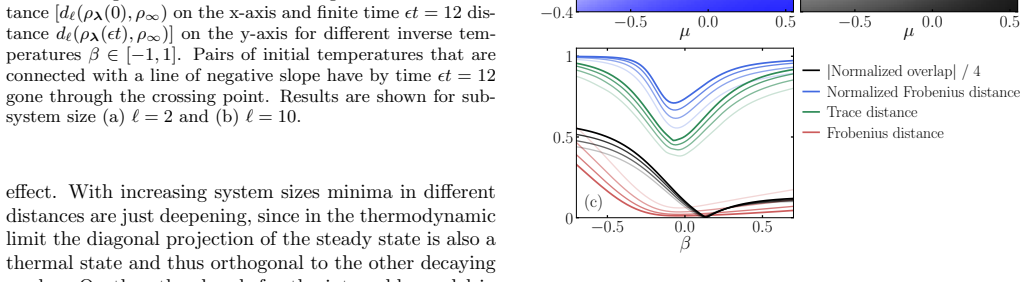
- [Results, paragraph starting 'As underlined in the equation of motion (4)' and Fig. 2(c)] The impossibility argument for NC=1 rests on non-crossing of β(t) trajectories. But the Mpemba condition is defined through d_ℓ(t)=d_ℓ(ρ_β(t),ρ_SS), Eq. (5). If β_SS lies between β_h(0) and β_c(0), then D(β)=d_ℓ(ρ_β,ρ_SS) has a minimum at β_SS; two trajectories approaching from opposite sides can have crossing D(t) curves whenever the relaxation rates on the two sides differ. A general 1D autonomous flow β̇=f(β) allows such asymmetry. The scan in Fig. 2(c) covers only β∈[0,0.2] for one chaotic model and does not test pairs straddling β_SS, nor does it establish monotonicity of D(β). Thus the universal 'only when' claim is not supported by the presented argument.
- [End Matter, Fig. 5(a)] The orthogonality analysis shows for one chaotic model (L≤16) that the thermal state orthogonal to the slowest mode is also the state closest to the steady state, ruling out Mpemba for that model. This coincidence may be model-dependent; it does not establish a general structural criterion. Since the main text claims 'possible only when NC>1 or integrable', a general argument or a systematic test across multiple chaotic NC=1 models is needed.
- [Equation (5) and End Matter distance comparisons] The central claim is established only for the normalized Frobenius distance on a small subsystem (ℓ=2). The End Matter compares trace, Frobenius, and normalized Frobenius distances only for the initial-state distance to the steady state (Fig. 5), not for the time-dependent curves. It therefore does not demonstrate that the presence/absence of a crossing is robust under the trace distance or for larger ℓ. Given the acknowledged debate on distance definitions, the claimed dichotomy may depend on the chosen measure.
minor comments (4)
- [Fig. 2(c) caption] The caption says 'different initial temperatures β∈[0,0.2]' but does not state the number of curves or their spacing. Please specify the scan resolution.
- [Text near Eq. (6)] The notation 'N_C ∼ 2^L' for the integrable case is imprecise; either 'N_C = 2^L' or a clarification of the order-of-magnitude meaning would help.
- [End Matter normalized overlap definition] The expression for the normalized overlap, '||ρ^{(r)}_{slow}||_1 * Tr[(ρ^{(l)}_{slow})^† ρ_β]', is hard to parse; a brief verbal description would improve readability.
- [Results, NC=2 model (Fig. 3)] The statement 'a finer tuning of the Lindblad operators appears to be required' is vague. Please quantify how the effect depends on the dissipator choice or the coupling strength.
Circularity Check
No definitional circularity — NC>1 predictions are computed and cross-checked by TEBD and ED orthogonality diagnostics; but the NC=1 impossibility argument equates non-crossing of β(t) with non-crossing of the Mpemba distance d_ℓ(t), leaving the load-bearing 'only when NC>1' step asserted rather than proved.
-
other
[Results, paragraph after Fig. 2 (Mpemba detection via Eq. (5)); Conclusions]
"If the dynamics starting from two different thermal states were to intersect at a Gibbs ensemble with the same temperature, both would then follow the same temperature trajectory, β(t). This, however, does not occur: the evolution from different initial states is smooth and monotonic and the trajectories do not cross while relaxing toward the steady-state temperature (Fig. 2c). ... Calculating the distance between the time-dependent GGE and the steady state projects the evolution from a multi-dimensional space to a single dimension, possibly allowing for crossing between trajectories correspon"
Mpemba is defined, Eq. (5), by crossing of scalar distances d_ℓ(ρ_β(t),ρ_SS)=D(β(t)); the quoted reasoning rules out crossing of β(t) itself. Non-crossing of β(t) does not imply non-crossing of D(β(t)): with initial β's on opposite sides of the steady-state temperature (as in Fig. 2(a), β=0 vs 0.15), both D(β_h(t)) and D(β_c(t)) decay to zero and can cross when relaxation from the two sides is asymmetric — the single-variable Markovian-Mpemba mechanism of Refs. [12,14]. No monotonicity condition is stated or proved, so the impossibility half ('possible only when...') is restated as the premise that crossings 'cannot appear' in a 1D thermal manifold, not derived. Weight limited: Fig. 2(c) numerically scans β∈[0,0.2] and the End-Matter orthogonality analysis is an independent diagnostic.
full rationale
Verdict: the paper is not circular in the definitional or data-fitting sense; its central positive content is genuinely computed. (i) The integrable-case Mpemba crossing is obtained from the free-fermion scattering equation, which the Supplementary Material derives in situ (Eqs. S5–S9), so the self-citation to Ref. [87] is not load-bearing; the weak-dissipation decomposition (Eq. 2, Ref. [78]) is a standard framework with independent support from other groups (Refs. [88–96]). (ii) Nothing is fitted and then called a prediction: crossing times and distances are direct evaluations of Eqs. (4)/(5); β_c=0.12 is motivated by the small-system slowest-mode orthogonality dip (End Matter, Fig. 7), but the integrable case exhibits crossings over a whole interval [0,0.15] (Fig. 6), not at a tuned point. (iii) Finite-ϵ TEBD results converge to the (G)GE prediction, and the orthogonality-to-slowest-mode analysis (projected Liouvillian ED, L≤16) corroborates the dichotomy independently. The flagged step is a logical gap, not a definitional equivalence: the NC=1 impossibility argument treats non-crossing of β(t) as excluding crossing of the distance curves d_ℓ(t)=D(β(t)), which single-variable Markovian Mpemba systems (Refs. [12,14]) show is generally false. The paper itself concedes scope limits — 'our dimensional-reduction argument applies at the level of the zeroth-order approximation'; 'it is difficult to conclude whether they converge to a finite value for a thermodynamically large ℓ'; 'there is some debate regarding which definition of distance should be used'; finer Lindblad tuning needed for NC=2 — and these belong to correctness/robustness risk, not circularity. Hence score 2.
Assumptions & free parameters
free parameters (4)
- Initial cold inverse temperature β_c for NC=2 model =
0.12
- Lindblad operators L_j for each model =
L_j = S+_j S-_j+1 + S^z_j + 1/2 1_j (NC=1, NC~L); L_j = 1/2 S+_j (1-σ^z_{j+1}) + σ^x_j (NC=2)
- Dissipation strength ϵ for NC=2 effect =
ϵ ≲ 0.2 (effect absent at ϵ=0.5)
- Subsystem size ℓ =
ℓ=2 in main-text figures
assumptions (5)
- domain assumption Weak-dissipation decomposition ρ(t)=ρ_λ(t)+δρ(ϵ,t) with ρ_λ of Gibbs/GGE form, Eq. (3).
- domain assumption The slow dynamics of the dissipator is captured by the projected Liouvillian onto the diagonal (Hamiltonian-eigenstate) subspace, D_mn=<m|(D|n><n|)|m>.
- domain assumption Orthogonality of the initial state to the slowest decaying Liouvillian mode is the criterion for faster relaxation (Mpemba).
- standard math Scalar autonomous ODE for β(t) has non-crossing trajectories for NC=1 (smooth monotonic relaxation).
- domain assumption The normalized Frobenius distance d_ℓ on a small subsystem is an appropriate proxy for the Mpemba effect.
Cite this review
Pith. "Pith review of Conserved quantities enable the quantum Mpemba effect in weakly open systems." pith.science (2026). https://pith.science/paper/NRHPEMTV
@misc{pith2026251116739,
  author       = {Pith},
  title        = {Pith review of: Conserved quantities enable the quantum Mpemba effect in weakly open systems},
  year         = {2026},
  howpublished = {\url{https://pith.science/paper/NRHPEMTV}},
  note         = {Machine review of arXiv:2511.16739}
}
read the original abstract
Observation of the quantum Mpemba effect has spurred much interest in its enabling conditions and its relation to the classical counterpart. Here, we consider weakly open many-body quantum systems initialized in different thermal states and examine when the initially farther state relaxes to the (non-equilibrium) steady state faster. We claim that the number of conserved quantities in the unitary part plays a crucial role: the Mpemba effect is possible only when the Hamiltonian commutes with other extensive operators or is integrable. The reason lies in the dynamical evolution happening in spaces of different dimensions. When energy is the only approximately conserved quantity, dissipation pushes the dynamics within a single-parameter manifold of different thermal states. In contrast, for Hamiltonians with several conserved quantities, the dynamics drift in the multi-dimensional space of generalized Gibbs ensembles, whose distance to the steady state is less trivial. We provide numerical results for large system sizes using tensor networks and free-fermion techniques, thereby supporting our claim.
Figures


Figures from the paper (3 more)


Forward citations
Cited by 1 Pith paper
-
Strong Quantum Mpemba Effect from Exact Slow-Mode Selection in Constrained Rydberg Chains
Translation-invariant states with Tr(Hρ0)=0 remove the exact H slow mode of the dephased Liouvillian and thus relax asymptotically faster than thermal states, yielding a strong quantum Mpemba effect in constrained Ryd...
Reference graph
Works this paper leans on
-
[1]
E. B. Mpemba and D. G. Osborne, Cool?, Phys. Educ. 4, 172 (1969)
1969
-
[2]
Greaney, G
A. Greaney, G. Lani, G. Cicero, and J. C. Grossman, Mpemba-like behavior in carbon nanotube resonators, Metall Mater Trans A42, 3907 (2011)
2011
-
[3]
Y. H. Ahn, H. Kang, D. Y. Koh, and H. Lee, Experimen- tal verifications of mpemba-like behaviors of clathrate hydrates, Korean J. Chem. Eng.33, 1903 (2016)
1903
-
[4]
Lasanta, F
A. Lasanta, F. V. Reyes, A. Prados, and A. Santos, When the hotter cools more quickly: Mpemba effect in granular fluids, Phys. Rev. Lett.119, 148001 (2017)
2017
-
[5]
Keller, V
T. Keller, V. Torggler, S. B. J¨ ager, S. Schutz, H. Ritsch, and G. Morigi, Quenches across the self-organization transition in multimode cavities, New J. Phys20, 025004 (2018)
2018
-
[6]
C. Hu, J. Li, S. Huang, H. Li, C. Luo, J. Chen, S. Jiang, and L. An, Conformation directed mpemba effect on polylactide crystallization, Cryst. Growth Des.18, 5757 (2018)
2018
-
[7]
Baity-Jesi, E
M. Baity-Jesi, E. Calore, A. Cruz, L. A. Fer- nandez, J. M. Gil-Narvi´ on, A. Gordillo-Guerrero, D. I˜ niguez, A. Lasanta, A. Maiorano, E. Marinari, V. Martin-Mayor, J. Moreno-Gordo, A. Mu˜ noz-Sudupe, D. Navarro, G. Parisi, S. Perez-Gaviro, F. Ricci- Tersenghi, J. J. Ruiz-Lorenzo, S. F. Schifano, B. Seoane, A. Taranc´ on, R. Tripiccione, and D. Yllanes, ...
2019
-
[8]
F. J. Schwarzendahl and H. L¨ owen, Anomalous cooling and overcooling of active colloids, Phys. Rev. Lett.129, 138002 (2022)
2022
Show all 103 references
-
[9]
Holtzman and O
R. Holtzman and O. Raz, Landau theory for the mpemba effect through phase transitions, Commun Phys5, 280 (2022)
2022
-
[10]
G. Teza, R. Yaacoby, and O. Raz, Relaxation short- cuts through boundary coupling, Phys. Rev. Lett.131, 017101 (2023)
2023
-
[11]
I. G.-A. Pemart ´ ın, E. Momp´ o, A. Lasanta, V. Mart ´ ın- Mayor, and J. Salas, Shortcuts of freely relaxing systems using equilibrium physical observables, Phys. Rev. Lett. 132, 117102 (2024)
2024
-
[12]
Lu and O
Z. Lu and O. Raz, Nonequilibrium thermodynamics of the markovian mpemba effect and its inverse, PNAS 114, 5083 (2017)
2017
-
[13]
Klich, O
I. Klich, O. Raz, O. Hirschberg, and M. Vucelja, Mpemba index and anomalous relaxation, Phys. Rev. X9, 021060 (2019)
2019
-
[14]
Kumar and J
A. Kumar and J. Bechhoefer, Exponentially faster cool- ing in a colloidal system, Nature584, 64 (2020)
2020
-
[15]
Bechhoefer, A
J. Bechhoefer, A. Kumar, and R. Ch´ etrite, A fresh un- derstanding of the mpemba effect, Nat Rev Phys3, 534 6 (2021)
2021
-
[16]
Gal and O
A. Gal and O. Raz, Precooling strategy allows expo- nentially faster heating, Phys. Rev. Lett.124, 060602 (2020)
2020
-
[17]
Kumar, R
A. Kumar, R. Ch´ etrite, and J. Bechhoefer, Anomalous heating in a colloidal system, PNAS119, e2118484119 (2022)
2022
-
[18]
M. R. Walker and M. Vucelja, Mpemba effect in terms of mean first passage times of overdamped langevin dynamics on a double-well potential, arXiv:2212.07496 (2022)
2022 arXiv
-
[19]
M. R. Walker, S. Bera, and M. Vucelja, Opti- mal transport and anomalous thermal relaxations, arXiv:2307.16103 (2023)
2023 arXiv
-
[20]
S. Bera, M. R. Walker, and M. Vucelja, Effect of dynam- ics on anomalous thermal relaxations and information exchange, arXiv:2308.04557 (2023)
2023 arXiv
-
[21]
Santos, Mpemba meets newton: Exploring the mpemba and kovacs effects in the time-delayed cooling law, Phys
A. Santos, Mpemba meets newton: Exploring the mpemba and kovacs effects in the time-delayed cooling law, Phys. Rev. E109, 044149 (2024)
2024
-
[22]
Van Vu and H
T. Van Vu and H. Hayakawa, Thermomajorization mpemba effect, Phys. Rev. Lett.134, 107101 (2025)
2025
-
[23]
G. Teza, J. Bechhoefer, A. Lasanta, O. Raz, and M. Vucelja, Speedups in nonequilibrium thermal relax- ation: Mpemba and related effects, arXiv:2502.01758 (2025)
2025
-
[24]
H. C. Burridge and P. F. Linden, Questioning the mpemba effect: Hot water does not cool more quickly than cold, Sci Rep6, 37665 (2016)
2016
-
[25]
H. C. Burridge and O. Hallstadius, Observing the mpemba effect with minimal bias and the value of the mpemba effect to scientific outreach and engagement, Proc. R. Soc. A.476, 20190829 (2020)
2020
-
[26]
F. Ares, P. Calabrese, and S. Murciano, The quantum mpemba effects, Nat Rev Phys7, 451 (2025)
2025
-
[27]
F. Ares, S. Murciano, and P. Calabrese, Entanglement asymmetry as a probe of symmetry breaking, Nat Com- mun14, 2036 (2023)
-
[28]
F. Ares, S. Murciano, E. Vernier, and P. Calabrese, Lack of symmetry restoration after a quantum quench: an entanglement asymmetry study, SciPost Phys.15, 089 (2023)
2023
-
[29]
Murciano, F
S. Murciano, F. Ares, I. Klich, and P. Calabrese, En- tanglement asymmetry and quantum mpemba effect in the xy spin chain, J. Stat. Mech.2024, 013103 (2024)
2024
-
[30]
Rylands, E
C. Rylands, E. Vernier, and P. Calabrese, Dynamical symmetry restoration in the heisenberg spin chain, J. Stat. Mech.2024, 123102 (2024)
2024
-
[31]
L. K. Joshi, J. Franke, A. Rath, F. Ares, S. Murciano, F. Kranzl, R. Blatt, P. Zoller, B. Vermersch, P. Cal- abrese, C. F. Roos, and M. K. Joshi, Observing the quantum mpemba effect in quantum simulations, Phys. Rev. Lett.133, 010402 (2024)
2024
-
[32]
Calabrese and J
P. Calabrese and J. Cardy, Evolution of entanglement entropy in one-dimensional systems, J. Stat. Mech. 2005, P04010 (2005)
2005
-
[33]
Alba and P
V. Alba and P. Calabrese, Entanglement and thermody- namics after a quantum quench in integrable systems, Proc. Natl. Acad. Sci. U.S.A.114, 7947 (2017)
2017
-
[34]
Alba and P
V. Alba and P. Calabrese, Entanglement dynamics after quantum quenches in generic integrable systems, Sci- Post Phys.4, 017 (2018)
2018
-
[35]
Rylands, K
C. Rylands, K. Klobas, F. Ares, P. Calabrese, S. Mur- ciano, and B. Bertini, Microscopic origin of the quantum mpemba effect in integrable systems, Phys. Rev. Lett. 133, 010401 (2024)
2024
-
[36]
Klobas, Non-equilibrium dynamics of symmetry- resolved entanglement and entanglement asymmetry: exact asymptotics in rule 54*, J
K. Klobas, Non-equilibrium dynamics of symmetry- resolved entanglement and entanglement asymmetry: exact asymptotics in rule 54*, J. Phys. A: Math. Theor. 57, 505001 (2024)
2024
-
[37]
Turkeshi, P
X. Turkeshi, P. Calabrese, and A. D. Luca, Quantum mpemba effect in random circuits, arXiv:2405.14514 (2024)
2024 arXiv
-
[38]
Liu, H.-K
S. Liu, H.-K. Zhang, S. Yin, and S.-X. Zhang, Symmetry restoration and quantum mpemba effect in symmetric random circuits, Phys. Rev. Lett.133, 140405 (2024)
2024
-
[39]
Klobas, C
K. Klobas, C. Rylands, and B. Bertini, Translation symmetry restoration under random unitary dynamics, Phys. Rev. B111(2025)
2025
-
[40]
Yu, Z.-X
H. Yu, Z.-X. Li, and S.-X. Zhang, Symmetry breaking dynamics in quantum many-body systems, Chin. Phys. Lett. (2025)
2025
-
[41]
F. Ares, S. Murciano, P. Calabrese, and L. Piroli, En- tanglement asymmetry dynamics in random quantum circuits, Phys. Rev. Research7(2025)
2025
-
[42]
Foligno, P
A. Foligno, P. Calabrese, and B. Bertini, Nonequilib- rium dynamics of charged dual-unitary circuits, PRX Quantum6, 010324 (2025)
2025
-
[43]
Aditya, A
S. Aditya, A. Summer, P. Sierant, and X. Turkeshi, Mpemba effects in quantum complexity, arXiv:2509.22176 (2025)
2025
-
[44]
Liu, H.-K
S. Liu, H.-K. Zhang, S. Yin, S.-X. Zhang, and H. Yao, Symmetry restoration and quantum mpemba effect in many-body localization systems, Science Bulletin https://doi.org/10.1016/j.scib.2025.10.017 (2025)
2025 doi
-
[45]
Yamashika, F
S. Yamashika, F. Ares, and P. Calabrese, Entangle- ment asymmetry and quantum mpemba effect in two- dimensional free-fermion systems, Phys. Rev. B110, 085126 (2024)
2024
-
[46]
Yamashika, P
S. Yamashika, P. Calabrese, and F. Ares, Quenching from superfluid to free bosons in two dimensions: En- tanglement, symmetries, and the quantum mpemba ef- fect, Phys. Rev. A111, 043304 (2025)
2025
-
[47]
Bhore, L
T. Bhore, L. Su, I. Martin, A. A. Clerk, and Z. Papi´ c, Quantum mpemba effect without global symmetries, Phys. Rev. B112, L121109 (2025)
2025
-
[48]
Carollo, A
F. Carollo, A. Lasanta, and I. Lesanovsky, Exponen- tially accelerated approach to stationarity in marko- vian open quantum systems through the mpemba effect, Phys. Rev. Lett.127, 060401 (2021)
2021
-
[49]
Moroder, O
M. Moroder, O. Culhane, K. Zawadzki, and J. Goold, Thermodynamics of the quantum mpemba effect, Phys. Rev. Lett.133, 140404 (2024)
2024
-
[50]
Kochsiek, F
S. Kochsiek, F. Carollo, and I. Lesanovsky, Accelerating the approach of dissipative quantum spin systems to- wards stationarity through global spin rotations, Phys. Rev. A106, 012207 (2022)
2022
-
[51]
Bao and Z
R. Bao and Z. Hou, Accelerating quantum relaxation via temporary reset: A mpemba-inspired approach, Phys. Rev. Lett.135, 150403 (2025)
2025
-
[52]
L. P. Bettmann and J. Goold, Information geometry approach to quantum stochastic thermodynamics, Phys. Rev. E111, 014133 (2025)
2025
-
[53]
A. K. Chatterjee, S. Takada, and H. Hayakawa, Quan- tum mpemba effect in a quantum dot with reservoirs, Phys. Rev. Lett.131, 080402 (2023)
2023
-
[54]
A. K. Chatterjee, S. Takada, and H. Hayakawa, Mul- tiple quantum mpemba effect: exceptional points and 7 oscillations, Phys. Rev. A110, 022213 (2024)
2024
-
[55]
S. A. Shapira, Y. Shapira, J. Markov, G. Teza, N. Ak- erman, O. Raz, and R. Ozeri, Inverse mpemba effect demonstrated on a single trapped ion qubit, Phys. Rev. Lett.133, 010403 (2024)
2024
-
[56]
Ivander, N
F. Ivander, N. Anto-Sztrikacs, and D. Segal, Hyperac- celeration of quantum thermalization dynamics by by- passing long-lived coherences: An analytical treatment, Phys. Rev. E108, 014130 (2023)
2023
-
[57]
Zhou, X.-D
Y.-L. Zhou, X.-D. Yu, C.-W. Wu, X.-Q. Li, J. Zhang, W. Li, and P. Chen, Accelerating relaxation through liouvillian exceptional point, Phys. Rev. Research5, 043036 (2023)
2023
-
[58]
D. Liu, J. Yuan, H. Ruan, Y. Xu, S. Luo, J. He, X. He, Y. Ma, and J. Wang, Speeding up quantum heat engines by the mpemba effect, Phys. Rev. A110, 042218 (2024)
2024
-
[59]
Furtado and A
J. Furtado and A. C. Santos, Enhanced quantum mpemba effect with squeezed thermal reservoirs, Ann. Phys.480, 170135 (2025)
2025
-
[60]
Medina, O
I. Medina, O. Culhane, F. C. Binder, G. T. Landi, and J. Goold, Anomalous discharging of quantum batteries: The ergotropic mpemba effect, Phys. Rev. Lett.134, 220402 (2025)
2025
-
[61]
J. Graf, J. Splettstoesser, and J. Monsel, Role of elec- tron–electron interaction in the mpemba effect in quan- tum dots, J. Phys.: Condens. Matter37, 195302 (2025)
2025
-
[62]
Westhoff, S
P. Westhoff, S. Paeckel, and M. Moroder, Fast and di- rect preparation of a genuine lattice bec via the quan- tum mpemba effect, arXiv:2504.05549 (2025)
2025
-
[63]
Wang and J
X. Wang and J. Wang, Mpemba effects in nonequilib- rium open quantum systems, Phys. Rev. Research6, 033330 (2024)
2024
-
[64]
D. Qian, H. Wang, and J. Wang, Intrinsic quantum mpemba effect in markovian systems and quantum cir- cuits, Phys. Rev. B111, L220304 (2025)
2025
-
[65]
Boubakour, S
M. Boubakour, S. Endo, T. Fogarty, and T. Busch, Dynamical invariant based shortcut to equilibration in open quantum systems, Quantum Sci. Technol.10, 025036 (2025)
2025
-
[66]
Longhi, Mpemba effect and super-accelerated ther- malization in the damped quantum harmonic oscillator, Quantum9, 1677 (2025)
S. Longhi, Mpemba effect and super-accelerated ther- malization in the damped quantum harmonic oscillator, Quantum9, 1677 (2025)
2025
-
[67]
Kheirandish, N
F. Kheirandish, N. Cheraghpour, and A. Moradian, The mpemba effect in quantum oscillating and two-level sys- tems, Physics Letters A559, 130915 (2025)
2025
-
[68]
Nava and R
A. Nava and R. Egger, Mpemba effects in open nonequi- librium quantum systems, Phys. Rev. Lett.133, 136302 (2024)
2024
-
[69]
Zhang, G
J. Zhang, G. Xia, C.-W. Wu, T. Chen, Q. Zhang, Y. Xie, W.-B. Su, W. Wu, C.-W. Qiu, P. Chen, W. Li, H. Jing, and Y.-L. Zhou, Observation of quantum strong mpemba effect, Nat Commun16, 301 (2025)
2025
-
[70]
M. E. Edo and L.-A. Wu, Study on quantum thermal- ization from thermal initial states in a superconducting quantum computer, arXiv:2403.14630 (2024)
2024 arXiv
-
[71]
Nava and M
A. Nava and M. Fabrizio, Lindblad dissipative dynamics in the presence of phase coexistence, Phys. Rev. B100, 125102 (2019)
2019
-
[72]
X. Wang, J. Su, and J. Wang, Mpemba meets quantum chaos: Anomalous relaxation and mpemba crossings in dissipative sachdev-ye-kitaev models, arXiv:2410.06669 (2024)
2024
-
[73]
Longhi, Photonic mpemba effect, Opt
S. Longhi, Photonic mpemba effect, Opt. Lett.49, 5188 (2024)
2024
-
[74]
Longhi, Bosonic mpemba effect with non-classical states of light, APL Quantum1, 046110 (2024)
S. Longhi, Bosonic mpemba effect with non-classical states of light, APL Quantum1, 046110 (2024)
2024
-
[75]
Auerbach, Supercooling and the mpemba effect: When hot water freezes quicker than cold, Am
D. Auerbach, Supercooling and the mpemba effect: When hot water freezes quicker than cold, Am. J. Phys. 63, 882 (1995)
1995
-
[76]
Esposito, R
S. Esposito, R. D. Risi, and L. Somma, Mpemba effect and phase transitions in the adiabatic cooling of water before freezing, Physica A387, 757 (2008)
2008
-
[77]
F. Ares, V. Vitale, and S. Murciano, Quantum mpemba effect in free-fermionic mixed states, Phys. Rev. B111, 104312 (2025)
2025
-
[78]
Lenarˇ ciˇ c, F
Z. Lenarˇ ciˇ c, F. Lange, and A. Rosch, Perturbative ap- proach to weakly driven many-particle systems in the presence of approximate conservation laws, Phys. Rev. B97, 024302 (2018)
2018
-
[79]
Lenarˇ ciˇ c, E
Z. Lenarˇ ciˇ c, E. Altman, and A. Rosch, Activating many- body localization in solids by driving with light, Phys. Rev. Lett.121, 267603 (2018)
2018
-
[80]
Lenarˇ ciˇ c, O
Z. Lenarˇ ciˇ c, O. Alberton, A. Rosch, and E. Altman, Critical behavior near the many-body localization tran- sition in driven open systems, Phys. Rev. Lett.125, 116601 (2020)
2020
-
[81]
Shirai and T
T. Shirai and T. Mori, Thermalization in open many- body systems based on eigenstate thermalization hy- pothesis, Phys. Rev. E101, 042116 (2020)
2020
-
[82]
Lange, Z
F. Lange, Z. Lenarˇ ciˇ c, and A. Rosch, Pumping approx- imately integrable systems, Nat. Commun.8, 1 (2017)
2017
-
[83]
Lange, Z
F. Lange, Z. Lenarˇ ciˇ c, and A. Rosch, Time-dependent generalized Gibbs ensembles in open quantum systems, Phys. Rev. B97, 165138 (2018)
2018
-
[84]
Reiter, F
F. Reiter, F. Lange, S. Jain, M. Grau, J. P. Home, and Z. Lenarˇ ciˇ c, Engineering generalized Gibbs ensembles with trapped ions, Phys. Rev. Res.3, 033142 (2021)
2021
-
[85]
Schmitt and Z
M. Schmitt and Z. Lenarˇ ciˇ c, From observations to com- plexity of quantum states via unsupervised learning, Phys. Rev. B106, L041110 (2022)
2022
-
[86]
Ulˇ cakar and Z
I. Ulˇ cakar and Z. Lenarˇ ciˇ c, Iterative construction of con- served quantities in dissipative nearly integrable sys- tems, Phys. Rev. Lett.132, 230402 (2024)
2024
-
[87]
Ulˇ cakar and Z
I. Ulˇ cakar and Z. Lenarˇ ciˇ c, Generalized Gibbs ensem- bles in weakly interacting dissipative systems and digi- tal quantum computers, arXiv:2406.17033 (2024)
2024
-
[88]
Bouchoule, B
I. Bouchoule, B. Doyon, and J. Dubail, The effect of atom losses on the distribution of rapidities in the one- dimensional Bose gas, SciPost Phys.9, 044 (2020)
2020
-
[89]
Rossini, A
D. Rossini, A. Ghermaoui, M. B. Aguilera, R. Vatr´ e, R. Bouganne, J. Beugnon, F. Gerbier, and L. Mazza, Strong correlations in lossy one-dimensional quantum gases: From the quantum Zeno effect to the generalized Gibbs ensemble, Phys. Rev. A103, L060201 (2021)
2021
-
[90]
Gerbino, I
F. Gerbino, I. Lesanovsky, and G. Perfetto, Large-scale universality in quantum reaction-diffusion from keldysh field theory, Phys. Rev. B109, L220304 (2024)
2024
-
[91]
Perfetto, F
G. Perfetto, F. Carollo, J. P. Garrahan, and I. Lesanovsky, Reaction-Limited Quantum Reaction- Diffusion Dynamics, Phys. Rev. Lett.130, 210402 (2023)
2023
-
[92]
Rowlands, I
S. Rowlands, I. Lesanovsky, and G. Perfetto, Quantum reaction-limited reaction–diffusion dynamics of nonin- teracting bose gases, New J. Phys.26, 043010 (2024)
2024
-
[93]
Riggio, L
F. Riggio, L. Rosso, D. Karevski, and J. Dubail, Effects of atom losses on a one-dimensional lattice gas of hard- core bosons, Phys. Rev. A109, 023311 (2024)
2024
-
[94]
Starchl and L
E. Starchl and L. M. Sieberer, Relaxation to a parity- 8 time symmetric generalized gibbs ensemble after a quan- tum quench in a driven-dissipative kitaev chain, Phys. Rev. Lett.129, 220602 (2022)
2022
-
[95]
Starchl and L
E. Starchl and L. M. Sieberer, Quantum quenches in driven-dissipative quadratic fermionic systems with parity-time symmetry, Phys. Rev. Res.6, 013016 (2024)
2024
-
[96]
Lumia, G
L. Lumia, G. Aupetit-Diallo, J. Dubail, and M. Collura, Accuracy of a time-dependent generalized gibbs ensem- ble approach under weak dissipation, Phys. Rev. A112, 012206 (2025)
2025
-
[97]
Zwolak and G
M. Zwolak and G. Vidal, Mixed-state dynamics in one-dimensional quantum lattice systems: A time- dependent superoperator renormalization algorithm, Phys. Rev. Lett.93, 207205 (2004)
2004
-
[98]
Schollw¨ ock, The density-matrix renormalization group in the age of matrix product states, Ann
U. Schollw¨ ock, The density-matrix renormalization group in the age of matrix product states, Ann. Phys. 326, 96 (2011), january 2011 Special Issue
2011
-
[99]
Fagotti and F
M. Fagotti and F. H. L. Essler, Reduced density ma- trix after a quantum quench, Phys. Rev. B87, 245107 (2013)
2013
-
[100]
and ITensors.jl [101]
-
[101]
Weinberg and M
P. Weinberg and M. Bukov, Quspin: a python pack- age for dynamics and exact diagonalization of quantum many-body systems. part i: The spin chain problem, Computer Physics Communications282, 106 (2023)
2023
-
[102]
Fishman, S
M. Fishman, S. R. White, and E. M. Stoudenmire, The ITensor Software Library for Tensor Network Calcula- tions, SciPost Phys. Codebases , 4 (2022)
2022
-
[103]
Fagotti and P
M. Fagotti and P. Calabrese, Entanglement entropy of two disjoint blocks in xy chains, J. Stat. Mech.2010, P04016 (2010). END MA TTER The Quantum Mpemba effect in dissipative systems is in most cases related with the orthogonality to the slow- est decaying mode of the Liouvill...
2010
Reviewed August 3, 2026 · model on record in the stance chip above.
Discussion (0). Continue with ORCID to comment.