On the emergence of quantum many-body chaos for tunably-broken integrability
Pith reviewed 2026-07-03 03:43 UTC · model grok-4.3
The pith
A quantitative theory shows that integrability-breaking gates in a free-fermion circuit act as spacetime hotspots that amplify out-of-time-ordered correlators, leading to the emergence of many-body chaos at tunable scales.
A machine-rendered reading of the paper's core claim, the machinery that carries it, and where it could break.
Core claim
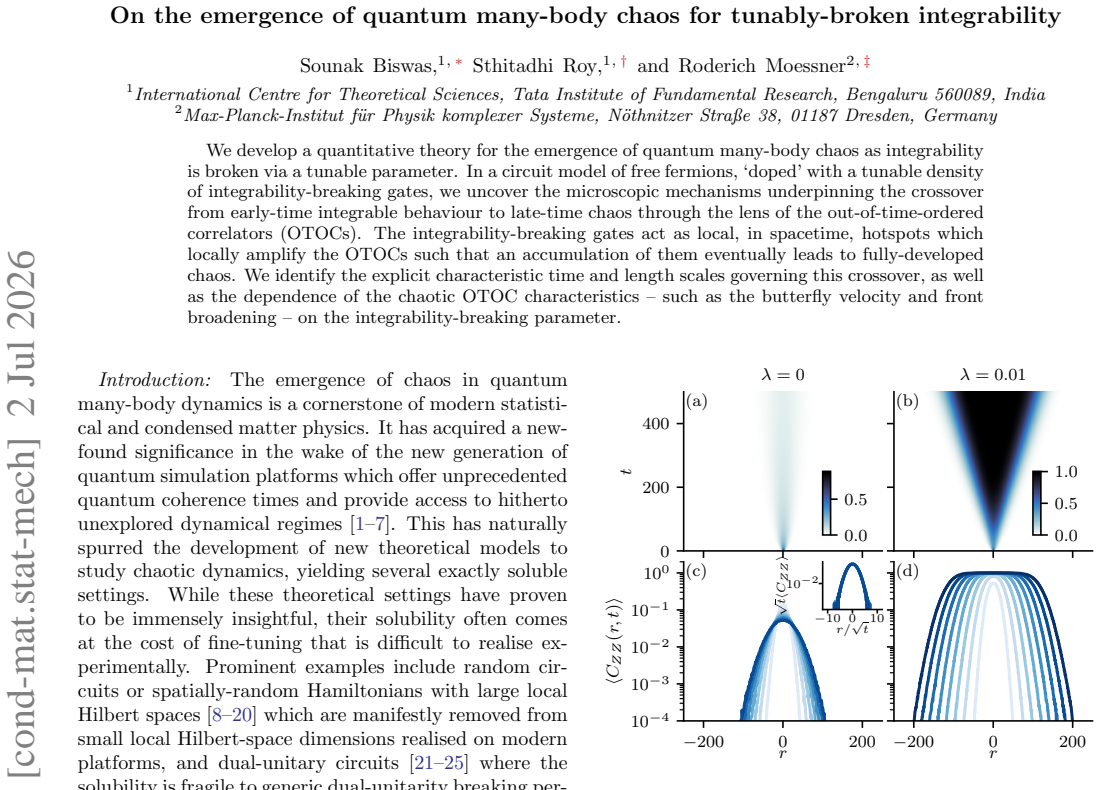
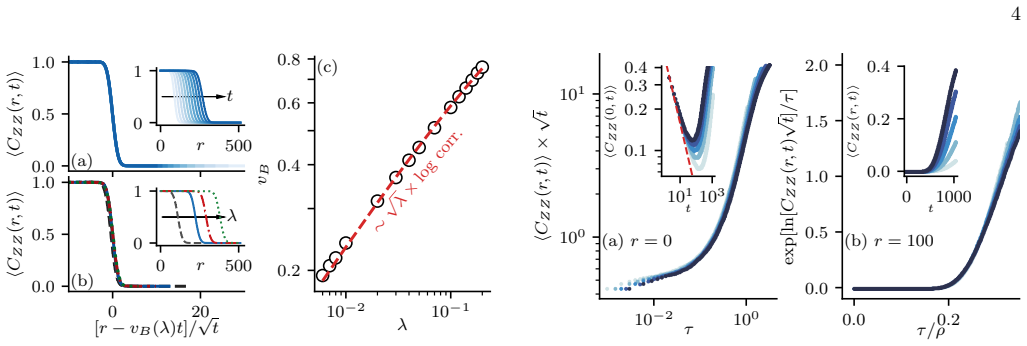
We develop a quantitative theory for the emergence of quantum many-body chaos as integrability is broken via a tunable parameter. In a circuit model of free fermions, 'doped' with a tunable density of integrability-breaking gates, we uncover the microscopic mechanisms underpinning the crossover from early-time integrable behaviour to late-time chaos through the lens of the out-of-time-ordered correlators (OTOCs). The integrability-breaking gates act as local, in spacetime, hotspots which locally amplify the OTOCs such that an accumulation of them eventually leads to fully-developed chaos. We identify the explicit characteristic time and length scales governing this crossover, as well as the
What carries the argument
The integrability-breaking gates acting as local spacetime hotspots that amplify out-of-time-ordered correlators (OTOCs) until their accumulation produces chaos.
If this is right
- The crossover from integrable to chaotic behavior occurs at explicit characteristic time and length scales set by the density of breaking gates.
- Butterfly velocity and OTOC front broadening depend on the strength of the integrability-breaking parameter.
- Early-time OTOC dynamics remain integrable until sufficient hotspots accumulate.
- Fully developed chaos at late times arises directly from the accumulated local amplifications.
Where Pith is reading between the lines
- The hotspot picture may extend to other weakly perturbed integrable systems such as spin chains with small added terms.
- Controlling gate placement or density could offer a route to tune the onset time of chaos in quantum simulators.
- The mechanism may help explain slow thermalization observed in some nearly integrable many-body systems.
- Similar local amplification effects could be searched for in higher-dimensional or interacting fermion models.
Load-bearing premise
The specific circuit model of free fermions with randomly placed integrability-breaking gates is representative of the generic crossover from integrability to chaos in many-body quantum systems.
What would settle it
A simulation of the circuit in which OTOCs fail to show local amplification at the gates or in which the crossover time and length scales lack the predicted dependence on gate density would falsify the mechanism.
Figures
read the original abstract
We develop a quantitative theory for the emergence of quantum many-body chaos as integrability is broken via a tunable parameter. In a circuit model of free fermions, 'doped' with a tunable density of integrability-breaking gates, we uncover the microscopic mechanisms underpinning the crossover from early-time integrable behaviour to late-time chaos through the lens of the out-of-time-ordered correlators (OTOCs). The integrability-breaking gates act as local, in spacetime, hotspots which locally amplify the OTOCs such that an accumulation of them eventually leads to fully-developed chaos. We identify the explicit characteristic time and length scales governing this crossover, as well as the dependence of the chaotic OTOC characteristics -- such as the butterfly velocity and front broadening -- on the integrability-breaking parameter.
Editorial analysis
A structured set of objections, weighed in public.
Referee Report
Summary. The manuscript develops a quantitative theory for the crossover from integrable to chaotic dynamics in a specific circuit model of free fermions doped with a tunable density of integrability-breaking gates. Through out-of-time-ordered correlators (OTOCs), it argues that the gates function as local spacetime hotspots that amplify OTOCs, with accumulation of these hotspots producing fully developed chaos; explicit characteristic time and length scales are identified, along with the dependence of chaotic OTOC features such as butterfly velocity and front broadening on the integrability-breaking parameter.
Significance. If the results hold within the model, the work supplies a microscopic mechanism and quantitative scales for the integrability-to-chaos crossover in a tunable circuit setting, which could inform studies of many-body chaos in quantum circuits. The explicit parameter dependence of OTOC characteristics is a potential strength, though the manuscript does not demonstrate that the hotspot-accumulation mechanism extends beyond this free-fermion construction.
major comments (2)
- [Abstract] Abstract and introduction: the central claim of a 'quantitative theory for the emergence of quantum many-body chaos' rests on the premise that the free-fermion circuit with randomly placed gates is representative of generic many-body systems; no comparisons to interacting models or other integrability-breaking mechanisms are provided to support generality, which is load-bearing for the title and abstract framing.
- [Abstract] The derivation of characteristic time and length scales and the dependence of butterfly velocity on the breaking parameter is asserted but, without visible equations or derivations in the supplied abstract, cannot be verified for internal consistency or parameter-freeness.
Simulated Author's Rebuttal
We thank the referee for their careful reading and constructive feedback on our manuscript. We address the major comments point by point below, clarifying the scope of our results and the content of the full text.
read point-by-point responses
-
Referee: [Abstract] Abstract and introduction: the central claim of a 'quantitative theory for the emergence of quantum many-body chaos' rests on the premise that the free-fermion circuit with randomly placed gates is representative of generic many-body systems; no comparisons to interacting models or other integrability-breaking mechanisms are provided to support generality, which is load-bearing for the title and abstract framing.
Authors: We agree that the manuscript develops its quantitative theory and explicit scales exclusively within the solvable free-fermion circuit model with tunable gate density, without providing comparisons to interacting systems or other breaking mechanisms. The title and abstract framing emphasize the emergence of chaos for tunably-broken integrability in this controlled setting, where the hotspot mechanism can be derived exactly. To prevent any implication of broader generality, we will revise the abstract and introduction to state explicitly that the results and mechanism apply to this free-fermion construction, while noting its potential relevance as a microscopic example for other studies. revision: yes
-
Referee: [Abstract] The derivation of characteristic time and length scales and the dependence of butterfly velocity on the breaking parameter is asserted but, without visible equations or derivations in the supplied abstract, cannot be verified for internal consistency or parameter-freeness.
Authors: The abstract is intentionally equation-free, as is conventional, and summarizes the main findings. The full derivations of the characteristic time and length scales (arising from the accumulation of local OTOC hotspots) and the explicit dependence of the butterfly velocity and front broadening on the integrability-breaking gate density are provided in Sections III and IV of the manuscript, with closed-form expressions obtained from the circuit dynamics. These are parameter-dependent but derived without additional assumptions beyond the model definition, allowing direct verification from the main text. revision: no
Circularity Check
No circularity: model-specific derivation of scales and OTOC features from explicit circuit dynamics
full rationale
The paper constructs a concrete circuit model of free fermions doped with a tunable density of integrability-breaking gates and analyzes OTOC evolution within that model. It identifies local amplification at gates, accumulation leading to chaos, and explicit dependence of butterfly velocity and front broadening on the breaking parameter. These are direct consequences of the model's spacetime-local gate placement and free-fermion propagation rules rather than any self-definitional mapping, fitted parameter renamed as prediction, or load-bearing self-citation. The derivation remains self-contained within the chosen circuit; no step reduces the output to the input by construction.
Axiom & Free-Parameter Ledger
Reference graph
Works this paper leans on
-
[1]
Preskill, Quantum Computing in the NISQ era and beyond, Quantum2, 79 (2018)
J. Preskill, Quantum Computing in the NISQ era and beyond, Quantum2, 79 (2018)
work page 2018
- [2]
- [3]
- [4]
-
[5]
M. Ippoliti, K. Kechedzhi, R. Moessner, S. Sondhi, and V. Khemani, Many-body physics in the NISQ era: Quan- tum programming a discrete time crystal, PRX Quantum 2, 030346 (2021)
work page 2021
-
[6]
J. C. Hoke, M. Ippoliti, E. Rosenberg, D. Abanin, R. Acharya, T. I. Andersen, M. Ansmann, F. Arute, K. Arya,et al., Measurement-induced entanglement and teleportation on a noisy quantum processor, Nature622, 481–486 (2023)
work page 2023
-
[7]
B. Fauseweh, Quantum many-body simulations on digi- tal quantum computers: State-of-the-art and future chal- lenges, Nature Communications15, 2123 (2024)
work page 2024
- [8]
- [9]
-
[10]
T. Rakovszky, F. Pollmann, and C. W. von Keyserlingk, Diffusive hydrodynamics of out-of-time-ordered correla- tors with charge conservation, Phys. Rev. X8, 031058 (2018)
work page 2018
-
[11]
C. W. von Keyserlingk, T. Rakovszky, F. Pollmann, and S. L. Sondhi, Operator hydrodynamics, otocs, and en- tanglement growth in systems without conservation laws, Phys. Rev. X8, 021013 (2018)
work page 2018
-
[12]
V. Khemani, A. Vishwanath, and D. A. Huse, Operator spreading and the emergence of dissipative hydrodynam- ics under unitary evolution with conservation laws, Phys. Rev. X8, 031057 (2018)
work page 2018
-
[13]
A. Chan, A. De Luca, and J. T. Chalker, Solution of a minimal model for many-body quantum chaos, Phys. Rev. X8, 041019 (2018). 6
work page 2018
-
[14]
A. Chan, A. De Luca, and J. T. Chalker, Spectral statis- tics in spatially extended chaotic quantum many-body systems, Phys. Rev. Lett.121, 060601 (2018)
work page 2018
-
[15]
T. Zhou and A. Nahum, Emergent statistical mechanics of entanglement in random unitary circuits, Phys. Rev. B99, 174205 (2019)
work page 2019
- [16]
-
[17]
M. P. A. Fisher, V. Khemani, A. Nahum, and S. Vijay, Random quantum circuits, Annual Review of Condensed Matter Physics14, 335 (2023)
work page 2023
-
[18]
J. T. Chalker and D. Hahn, Chaotic many-body quan- tum dynamics, spectral correlations, and energy diffusion (2025), arXiv:2510.02198 [quant-ph]
work page internal anchor Pith review Pith/arXiv arXiv 2025
- [19]
-
[20]
Operator spreading in random circuits with orthogonal or symplectic symmetry
Z. Tan and P. W. Brouwer, Operator spreading in ran- dom circuits with orthogonal or symplectic symmetry (2026), arXiv:2606.03956 [quant-ph]
work page internal anchor Pith review Pith/arXiv arXiv 2026
-
[21]
B. Bertini, P. Kos, and T. Prosen, Exact spectral form factor in a minimal model of many-body quantum chaos, Phys. Rev. Lett.121, 264101 (2018)
work page 2018
-
[22]
B. Bertini, P. Kos, and T. Prosen, Entanglement spread- ing in a minimal model of maximal many-body quantum chaos, Phys. Rev. X9, 021033 (2019)
work page 2019
-
[23]
B. Bertini, P. Kos, and T. Prosen, Exact correlation func- tions for dual-unitary lattice models in 1 + 1 dimensions, Phys. Rev. Lett.123, 210601 (2019)
work page 2019
-
[24]
P. W. Claeys and A. Lamacraft, Maximum velocity quan- tum circuits, Phys. Rev. Res.2, 033032 (2020)
work page 2020
-
[25]
B. Bertini, P. W. Claeys, and T. Prosen, Exactly solvable quantum many-body dynamics from space-time duality, Rev. Mod. Phys.98, 025001 (2026)
work page 2026
-
[26]
T. Bilitewski, S. Bhattacharjee, and R. Moessner, Clas- sical many-body chaos with and without quasiparticles, Phys. Rev. B103, 174302 (2021)
work page 2021
- [27]
-
[28]
D. A. Roberts and D. Stanford, Diagnosing chaos using four-point functions in two-dimensional conformal field theory, Phys. Rev. Lett.115, 131603 (2015)
work page 2015
-
[29]
J. Maldacena, S. H. Shenker, and D. Stanford, A bound on chaos, Journal of High Energy Physics2016, 106 (2016)
work page 2016
-
[30]
I. L. Aleiner, L. Faoro, and L. B. Ioffe, Microscopic model of quantum butterfly effect: Out-of-time-order correla- tors and traveling combustion waves, Ann. Phys.375, 378 (2016)
work page 2016
- [31]
-
[32]
D. J. Luitz and Y. Bar Lev, Information propagation in isolated quantum systems, Phys. Rev. B96, 020406 (2017)
work page 2017
-
[33]
L. G. Valiant, Quantum circuits that can be simulated classically in polynomial time, SIAM Journal on Com- puting31, 1229 (2002)
work page 2002
-
[34]
B. M. Terhal and D. P. DiVincenzo, Classical simulation of noninteracting-fermion quantum circuits, Phys. Rev. A65, 032325 (2002)
work page 2002
-
[35]
R. Jozsa and A. Miyake, Matchgates and classical sim- ulation of quantum circuits, Proc. R. Soc. A464, 3089 (2008)
work page 2008
-
[36]
R. A. Fisher, The wave of advance of advantageous genes, Annals of eugenics7, 355 (1937)
work page 1937
-
[37]
A. N. Kolmogorov, I. G. Petrovsky, and N. S. Piskunov, Study of the diffusion equation with growth of the amount of matter and its application to a biological problem, inSelected Works of A. N. Kolmogorov: Vol- ume I: Mathematics and Mechanics, Mathematics and Its Applications (Soviet Series), Vol. 25, edited by V. M. Tikhomirov (Kluwer Academic Publisher...
-
[38]
T. Zhou, A. Guo, S. Xu, X. Chen, and B. Swingle, Hy- drodynamic theory of scrambling in chaotic long-range interacting systems, Phys. Rev. B107, 014201 (2023)
work page 2023
-
[39]
Entanglement spreading and emergent locality in Brownian SYK chains
J. Narde, O. Parrikar, H. Rajgadia, and S. Trivedi, En- tanglement spreading and emergent locality in brownian syk chains (2026), arXiv:2508.00060 [hep-th]
work page internal anchor Pith review Pith/arXiv arXiv 2026
-
[40]
T. Swann and A. Nahum, Continuum mechanics of en- tanglement in noisy interacting fermion chains (2026), arXiv:2601.21134 [cond-mat.stat-mech]
-
[41]
E. Brunet and B. Derrida, Shift in the velocity of a front due to a cutoff, Phys. Rev. E56, 2597 (1997)
work page 1997
- [42]
-
[43]
D. A. Roberts and B. Yoshida, Chaos and complexity by design, J. High Energy Phys2017, 121 (2017)
work page 2017
-
[44]
M. Fava, J. Kurchan, and S. Pappalardi, Designs via Free Probability, Phys. Rev. X15, 011031 (2025)
work page 2025
-
[45]
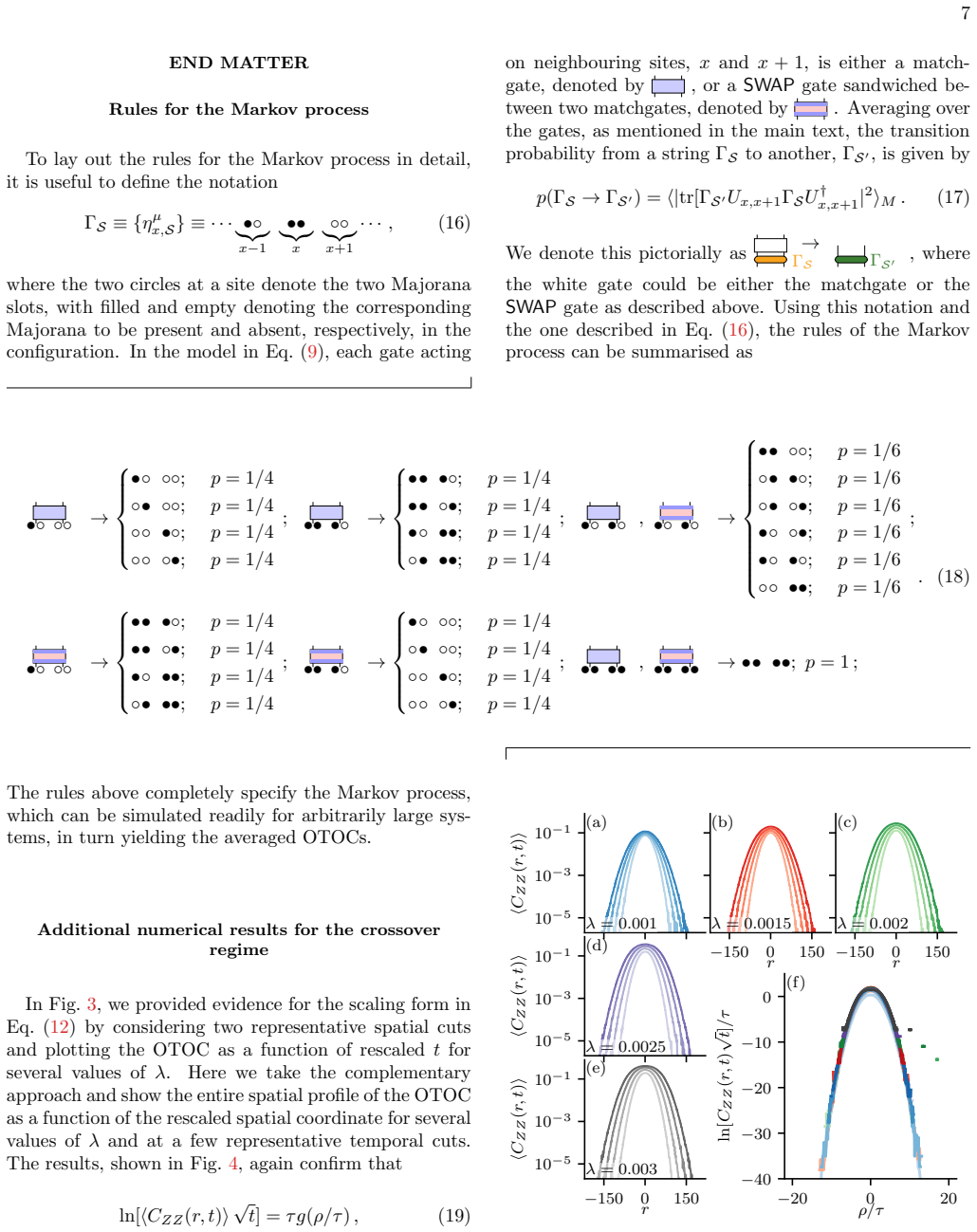
F. B. Trigueros, Z.-H. Sun, X. Turkeshi, P. Sierant, and P. S. Tarabunga, Unitary Designs from Doped Matchgate Circuits (2026), arXiv:2606.23800 [quant-ph]. 7 END MA TTER Rules for the Markov process To lay out the rules for the Markov process in detail, it is useful to define the notation ΓS ≡ {η µ x,S } ≡ · · · •◦|{z} x−1 ••|{z} x ◦◦|{z} x+1 · · ·,(16) ...
work page internal anchor Pith review Pith/arXiv arXiv 2026
discussion (0)
Sign in with ORCID, Apple, or X to comment. Anyone can read and Pith papers without signing in.