REVIEW 4 major objections 4 minor 16 references
Dually Interactive Matching Network for Personalized Response Selection in Retrieval-Based Chatbots
T0 review · 4 major / 4 minor · reviewed 2026-08-14 · deepseek-v4-flash
Pith's one-line read The paper shows that persona-aware response selection improves when the persona is matched directly against the response, not just fused into the context.
desk verdict DIM is a clean, well-engineered extension of IMN with real gains on PERSONA-CHAT, but the headline 14.5% improvement is probably inflated by lexical overlap between original personas and responses, and the paper never fully isolates dual matching from a stronger fusion baseline. read the letter →
The pith
A machine-rendered reading of the paper's core claim, the machinery that carries it, and where it could break.
The reading
What carries the argument
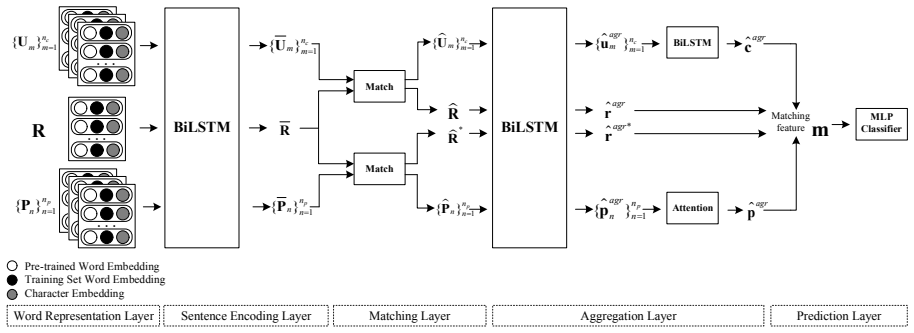
The central object is the dual matching architecture: two parallel interactive-matching streams, one between the response and the context utterances, the other between the response and the persona profile sentences. Each stream applies the IMN-style soft alignment (dot-product attention in Eq. 7, followed by local inference in Eqs. 8 and 9) to compute enhanced representations, which are aggregated by BiLSTMs and pooling, with the final feature vector concatenating context-response and persona-response features ([ĉ; r̂; p̂; r̂*]). This parallel treatment lets the persona act as an equal matching target rather than as a context-modifying side input.
What would settle it
Re-run the evaluation on a test split in which the true response and the matching profile sentence share no content words while remaining semantically persona-consistent; if DIM's hits@1 margin over the persona-fusion baseline collapses toward zero, the reported improvement is attributable to lexical overlap rather than to dual matching itself.
Extended reading notes
Core claim
The authors establish that, for the PERSONA-CHAT benchmark, the dual matching formulation is the decisive design choice for personalized response selection. Instead of using the persona only to enrich the context representation, DIM treats the persona as an equal counterpart and performs interactive matching between the response and the context and between the response and the persona in parallel. The final matching feature concatenates the enhanced representations from both streams, and the resulting hits@1 of 78.8% on original self-personas outperforms the context-level persona fusion baseline by 14.5 points and the previous state of the art by 27.7 points. Ablations confirm that both streams contribute, with context-response matching carrying more weight than persona-response matching.
Load-bearing premise
The headline gain rests on the assumption that whether a response fits a persona can be read off from shared words between the response and the profile sentences, through the soft attention the model applies to persona-response pairs.
Editorial extensions
If this is right
- Persona-conditioned response selection should be framed as a dual matching problem; fusing persona into the context representation is a weaker design.
- Direct persona-response matching contributes a large, measurable share of the accuracy: removing it drops hits@1 from 78.8 to 63.8, while removing context-response matching drops it to 48.8.
- A competitive persona-aware ranker can beat a large pretrained model (FT-PC) without external pretraining or knowledge, using end-to-end training on the task data alone.
- The method's effectiveness concentrates on the speaker's own original persona sentences; gains are much smaller on paraphrased personas and negligible on the partner's persona.
- The dual matching architecture can be built directly on an existing interactive matching network, reusing its encoding, attention, and aggregation layers for both streams.
Reading between the lines
- Editorial inference: The same dual-stream design can be applied to other side information besides persona—for example, user knowledge, emotional state, or document grounding—by adding one more parallel matching stream and concatenating its feature.
- Editorial inference: The sharp drop between original and revised personas suggests the soft alignment in Eqs. 7–9 mostly detects surface lexical overlap; replacing it with a semantic-similarity or entailment module is a testable way to keep the dual-matching gain under paraphrase.
- Editorial inference: The near-zero gains on partners' personas indicate that partner-persona modeling needs more than lexical matching—possibly reasoning about what the partner might want to hear—so DIM's success on self personas should not be read as solving persona-consistency generally.
- Editorial inference: DIM is a scoring module; in a generative chatbot, the same dual matching score could be used for reranking sampled candidate responses, reusing the architecture without retraining.
Signed reviews
Editorial analysis
A structured set of objections, weighed in public.
Referee Report
Summary. The paper proposes Dually Interactive Matching Network (DIM), an extension of the interactive matching network (IMN) for personalized response selection in retrieval-based chatbots. Instead of fusing persona information into the context representation, DIM performs two parallel matching processes: context-response matching and persona-response matching, then concatenates both matching features for scoring. On the PERSONA-CHAT dataset, the authors report that DIM improves over the IMN-based context-level persona fusion baseline by 14.5% in hits@1 (from 64.3 to 78.8) under original self personas, and claim it outperforms the previous state of the art by 27.7%. The paper also includes ablation tests, a transfer test across original and revised personas, and a qualitative attention visualization.
Significance. If the central claim is sustained, the paper makes a useful contribution: formulating personalized response selection as a dual matching problem is a clean and plausible idea, and the result that both matching branches contribute to performance is informative. The authors publish their code, which supports reproducibility, and the transfer test across original and revised personas is a valuable addition. However, the main explanatory claim—that the dual matching architecture, rather than surface lexical overlap between responses and profile sentences, is responsible for the large gains—is not fully established by the reported experiments. The revised-persona and their-persona results in Table 3, together with the token-level soft alignment in Eqs. (7)–(9), leave open a competing explanation based on shallow word overlap. The reported state-of-the-art margins also compare against much weaker pre-IMN baselines, so the headline numbers overstate the advance.
major comments (4)
- [§5.4, Eqs. (7)–(9); Table 3] The persona-response matching branch is implemented as token-level soft alignment between profile sentences and response words: Eq. (7) computes dot-product similarities, and Eqs. (8)–(9) produce weighted sums of word representations. This mechanism can detect shared vocabulary between a profile sentence and a response, but it contains no explicit mechanism for reasoning about persona consistency beyond such lexical overlap. The pattern in Table 3 is consistent with this concern: with original self personas, DIM gains 14.5 hits@1 over IMNctx, but with revised self personas the gain drops to 6.9, and with their personas the gain is near zero (64.0 vs. 63.7/63.5). Since revised personas are explicitly designed to reduce shared vocabulary, this pattern suggests that a substantial part of the headline improvement may be due to surface overlap rather than to the dual matching formulation. I ask the authors to add a controlled experiment that removes or neutralizes lexical overlap—for example, removing shared content words from the response or using paraphrase-only candidate sets—and to report DIM's performance under that condition.
- [§6.4, Fig. 1(a), Eq. (1)] The baseline IMNctx is weak by the authors' own analysis: they note that in IMN the context embeddings already contain information from the response because of the bidirectional attention between context and response, so fusing persona into that representation in Eq. (1) is inappropriate. This means the 14.5-point gap between DIM and IMNctx may partly reflect the poor placement of the fusion operation rather than the benefit of dual matching. To support the central claim, the authors should compare against a stronger fusion baseline, such as an IMN variant that fuses the persona at the word-representation or sentence-encoding layer before context-response interaction, or a model that encodes the context without response information before applying Eq. (1).
- [Abstract; §1; §6.4] The claim of outperforming the state of the art by 27.7% is misleading as stated. The comparison is against the pre-IMN methods in Table 3 (e.g., KV Profile at 51.1, Starspace at 48.1 on original self personas), while the authors' own IMN without persona already reaches 63.8 hits@1. The only modern comparison, FT-PC, is evaluated only on revised self personas (60.7 hits@1), where DIM's advantage is 10.0 points, not 27.7. The abstract and introduction should report the comparison that is actually apples-to-apples and should not present the 27.7% margin as a state-of-the-art result without specifying that the prior methods are much older and weaker baselines.
- [§7.1, Table 4] The ablation study removes entire matching branches, but it does not isolate the 'interactive' component of the matching from a simpler similarity function. The result that the persona-response branch alone reaches 48.8 hits@1 shows that persona information is useful, but it does not show that the bidirectional soft-alignment mechanism in Eqs. (7)–(9) is necessary; a simple pooling or cosine-similarity baseline between persona and response could behave similarly. I recommend adding an ablation that replaces the matching layer with a non-interactive pooling operator while keeping the rest of the architecture fixed, so that the contribution of the interactive matching mechanism itself can be assessed.
minor comments (4)
- [§5.3, Eq. (6)] In the definition of the encoded response, the index in '¯R = {¯rk}lr j=1' should be k=1, not j=1.
- [§7.1] The sentence 'It is reasonable that the context-persona matching is more important' appears to be a typo; the surrounding ablation removes context-response matching, so the text should say 'context-response matching'.
- [Fig. 3 and §7.2] The visualization is described as showing attention weights used in Eq. (9), but Eq. (9) is written for context-response matching; the persona-response case uses the same formula with P in place of C. Please clarify the notation or provide the analogous equation for the persona branch.
- [Table 3 and §6.4] The 'Their Persona' rows show near-zero differences for DIM, but the text does not discuss why partner persona might be irrelevant for this task or whether this is expected. Adding one or two sentences interpreting this result would help the reader.
Circularity Check
No significant circularity: DIM's reported gains are empirical results against re-implemented and external baselines, not reductions to its own inputs.
full rationale
This paper makes an empirical claim: the DIM model improves hits@1 over several retrieval-based response-selection baselines on the PERSONA-CHAT dataset. There is no derivation chain in which a predicted quantity is defined by the model's own fitted values. The matching operations in Eqs. (7)-(9) are standard soft attention followed by local inference, and the final matching feature in Eq. (24) is a concatenation of learned context-response and persona-response representations; the reported gains are measured on held-out test data, not implied by the construction. The IMN backbone is prior work by overlapping authors (Gu et al., 2019), but it is used as a reproducible component with published code and as a comparison baseline, not as an unverified uniqueness theorem or as the sole justification for the central empirical claim. The context-level persona fusion baseline in Eq. (1) and the utterance-level variant in Eq. (2) are explicitly defined and then tested; the paper even concedes a weakness of IMNctx in Section 6.4. Table 3 compares against numbers copied from Zhang et al. (2018) and Mazaré et al. (2018), and Table 4 provides ablations, all of which are empirical rather than self-fulfilling. No fitted parameter is renamed as a prediction, no ansatz is smuggled in via self-citation, and no result is equivalent to its inputs by construction. The strongest available critique is that the large gain may be driven by shallow lexical overlap between personas and responses, especially given the drop from 14.5% to 6.9% on revised personas in Table 3; that is a validity concern about what the model learns, not a circularity in the paper's reasoning. Accordingly, the circularity score is 0.
Assumptions & free parameters
free parameters (3)
- Model dimensions =
300/100/150 word embedding dims, 200 LSTM hidden, 256 MLP hidden
- Optimization hyperparameters =
batch size 16, lr 0.001 decaying 0.96 per 5000 steps, dropout 0.2
- Sequence length caps =
18 chars per word, 20 words per utterance, 15 utterances, 20 words per response, 15 words per profile, 5 profile…
assumptions (4)
- domain assumption BiLSTM encoders (Eq. 4-6) produce representations sufficient for word-level matching.
- domain assumption Soft attention alignment (Eq. 7-9) captures local relevance for both context-response and persona-response matching.
- domain assumption PERSONA-CHAT's random negative sampling (1:19) provides a fair test of persona-conditional response selection.
- domain assumption The original persona wording shares enough vocabulary with responses for the matching signal to be useful.
Cite this review
Pith. "Pith review of Dually Interactive Matching Network for Personalized Response Selection in Retrieval-Based Chatbots." pith.science (2026). https://pith.science/paper/NSSU2HWY
@misc{pith2026190805859,
  author       = {Pith},
  title        = {Pith review of: Dually Interactive Matching Network for Personalized Response Selection in Retrieval-Based Chatbots},
  year         = {2026},
  howpublished = {\url{https://pith.science/paper/NSSU2HWY}},
  note         = {Machine review of arXiv:1908.05859}
}
read the original abstract
This paper proposes a dually interactive matching network (DIM) for presenting the personalities of dialogue agents in retrieval-based chatbots. This model develops from the interactive matching network (IMN) which models the matching degree between a context composed of multiple utterances and a response candidate. Compared with previous persona fusion approaches which enhance the representation of a context by calculating its similarity with a given persona, the DIM model adopts a dual matching architecture, which performs interactive matching between responses and contexts and between responses and personas respectively for ranking response candidates. Experimental results on PERSONA-CHAT dataset show that the DIM model outperforms its baseline model, i.e., IMN with persona fusion, by a margin of 14.5% and outperforms the current state-of-the-art model by a margin of 27.7% in terms of top-1 accuracy hits@1.
Figures


Reference graph
Works this paper leans on
-
[4]
A persona-based neural conversation model. In Proceedings of the 54th Annual Meeting of the Association for Computational Linguistics, ACL 2016, August 7-12, 2016, Berlin, Germany, V olume 1: Long Papers. Ryan Lowe, Nissan Pow, Iulian Serban, and Joelle Pineau
work page 2016
-
[5]
The ubuntu dialogue corpus: A large dataset for research in unstructured multi-turn dialogue systems. In Proceedings of the SIGDIAL 2015 Conference, The 16th Annual Meeting of the Special Interest Group on Discourse and Dialogue, 2-4 September 2015, Prague, Czech Republic, pages 285–294. Pierre-Emmanuel Mazar ´e, Samuel Humeau, Martin Raison, and Antoine Bordes
work page 2015
-
[8]
Key-value memory networks for directly reading documents. In Proceedings of the 2016 Conference on Empirical Methods in Natural Language Processing, EMNLP 2016, Austin, Texas, USA, November 1-4, 2016 , pages 1400–1409. Vinod Nair and Geoffrey E. Hinton
work page 2016
-
[11]
Journal of Machine Learning Research, 15(1):1929–1958
Dropout: a simple way to prevent neural networks from overfitting. Journal of Machine Learning Research, 15(1):1929–1958. Ellen M. V oorhees
work page 1929
-
[13]
A dataset for research on short- text conversations. In Proceedings of the 2013 Conference on Empirical Methods in Natural Language Processing, EMNLP 2013, 18-21 October 2013, Grand Hyatt Seattle, Seattle, Washington, USA, A meeting of SIGDAT, a Special Interest Group of the ACL, pages 935–945. Yu Wu, Wei Wu, Chen Xing, Ming Zhou, and Zhoujun Li
work page 2013
-
[15]
Personalizing dialogue agents: I have a dog, do you have pets too? In Proceedings of the 56th Annual Meeting of the Association for Computational Linguistics, ACL 2018, Melbourne, Australia, July 15-20, 2018, V olume 1: Long Papers , pages 2204–
work page 2018
-
[16]
Multi-turn response selection for chatbots with deep attention matching network. In Proceedings of the 56th Annual Meeting of the Association for Computational Linguistics, ACL 2018, Melbourne, Australia, July 15-20, 2018, V olume 1: Long Papers, pages 1118–1127
work page 2018
-
[1999]
The TREC-8 question answering track report. In Proceedings of The Eighth Text REtrieval Conference, TREC 1999, Gaithersburg, Maryland, USA, November 17-19,
work page 1999
Show all 16 references
-
[2010]
In Proceedings of the 27th International Conference on Machine Learning (ICML-10), June 21-24, 2010, Haifa, Israel, pages 807–814
Rectified linear units improve restricted boltzmann machines. In Proceedings of the 27th International Conference on Machine Learning (ICML-10), June 21-24, 2010, Haifa, Israel, pages 807–814. Jeffrey Pennington, Richard Socher, and Christo- pher D. Manning
2010
-
[2013]
, pages 3111–
Proceedings of a meeting held December 5-8, 2013, Lake Tahoe, Nevada, United States. , pages 3111–
2013
-
[2014]
Glove: Global vectors for word representation. In Proceedings of the 2014 Conference on Empirical Methods in Natural Language Processing, EMNLP 2014, October 25- 29, 2014, Doha, Qatar , A meeting of SIGDAT, a Special Interest Group of the ACL , pages 1532–
2014
-
[2015]
In 3rd Inter- national Conference on Learning Representations, ICLR 2015, San Diego, CA, USA, May 7-9, 2015, Conference Track Proceedings
Adam: A method for stochastic optimization. In 3rd Inter- national Conference on Learning Representations, ICLR 2015, San Diego, CA, USA, May 7-9, 2015, Conference Track Proceedings. Jiwei Li, Michel Galley, Chris Brockett, Georgios P. Spithourakis, Jianfeng Gao, and William B. Dolan
2015
-
[2016]
In 12th USENIX Symposium on Operating Systems Design and Implementation, OSDI 2016, Savannah, GA, USA, November 2-4, 2016., pages 265–283
Tensorflow: A system for large-scale machine learning. In 12th USENIX Symposium on Operating Systems Design and Implementation, OSDI 2016, Savannah, GA, USA, November 2-4, 2016., pages 265–283. Jia-Chen Gu, Zhen-Hua Ling, and Quan Liu
2016
-
[2017]
In Proceedings of the 55th Annual Meeting of the Association for Computational Linguistics, ACL 2017, V ancouver , Canada, July 30 - August 4, V olume 1: Long Papers, pages 496–505
Sequential matching network: A new architecture for multi-turn response selection in retrieval-based chatbots. In Proceedings of the 55th Annual Meeting of the Association for Computational Linguistics, ACL 2017, V ancouver , Canada, July 30 - August 4, V olume 1: Long Papers,...
2017
-
[2018]
In Proceedings of the 2018 Conference on Empirical Methods in Natural Language Processing, Brussels, Belgium, October 31 - November 4, 2018 , pages 2775–2779
Training millions of personalized dialogue agents. In Proceedings of the 2018 Conference on Empirical Methods in Natural Language Processing, Brussels, Belgium, October 31 - November 4, 2018 , pages 2775–2779. Tomas Mikolov, Ilya Sutskever, Kai Chen, Gregory S. Corrado, and Je...
2018
-
[2019]
In Proceedings of the 28th ACM International Conference on Information and Knowledge Management, CIKM 2019, Beijing, China, November 3-7, 2019 , pages 2321–2324
In- teractive matching network for multi-turn response selection in retrieval-based chatbots. In Proceedings of the 28th ACM International Conference on Information and Knowledge Management, CIKM 2019, Beijing, China, November 3-7, 2019 , pages 2321–2324. Sepp Hochreiter and J...
2019
Reviewed August 14, 2026 · model on record in the stance chip above.
Discussion (0). Continue with ORCID to comment.