REVIEW 3 major objections 5 minor 34 references
Musical Rhythm Transcription Based on Bayesian Piece-Specific Score Models Capturing Repetitions
T0 review · 3 major / 5 minor · reviewed 2026-08-14 · deepseek-v4-flash
Pith's one-line read Rhythm transcription improves when the score model is inferred per piece from the performance itself, and the best tested model is the second-order Bayesian metrical Markov model.
desk verdict Useful, reproducible extension of the authors' DP score-model line, but the headline claim about repetitions is confounded with test-time adaptation and needs a non-sparse adapted control. read the letter →
The pith
A machine-rendered reading of the paper's core claim, the machinery that carries it, and where it could break.
The reading
What carries the argument
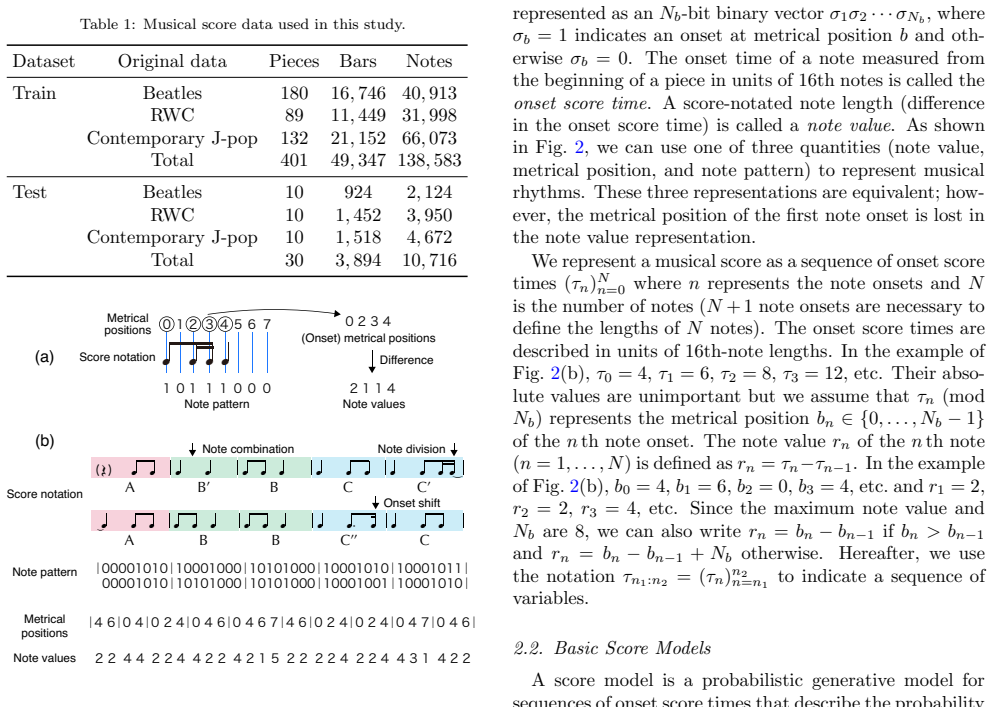
The load-bearing object is the Dirichlet process prior placed on the parameters of a Markov score model: for each piece, the initial and transition distributions (over note values, metrical positions, or note patterns) are drawn from $\mathrm{DP}(\alpha, \bar{\pi})$ with a small concentration parameter $\alpha$, making the per-piece distribution sparse and thereby encoding repetition without an explicit repeated-structure grammar. Inference couples Gibbs sampling, which estimates the piece-specific parameters from the input MIDI, with a Viterbi (or beam-searched Viterbi) step that decodes the most probable note values or metrical positions. Two note-modification operations, onset shifts and note divisions, are added as hidden variables to represent approximate repetitions.
What would settle it
Run the best model, MetMM2B, on a test corpus that includes triplet rhythms, rests, tempo changes, or rubato; if the repetition-driven Bayesian model no longer beats a generic non-Bayesian baseline, or if the error rate rises well above the roughly 2% reported for simplified data, the piece-specific repetition mechanism is not doing the work in realistic settings.
Extended reading notes
Core claim
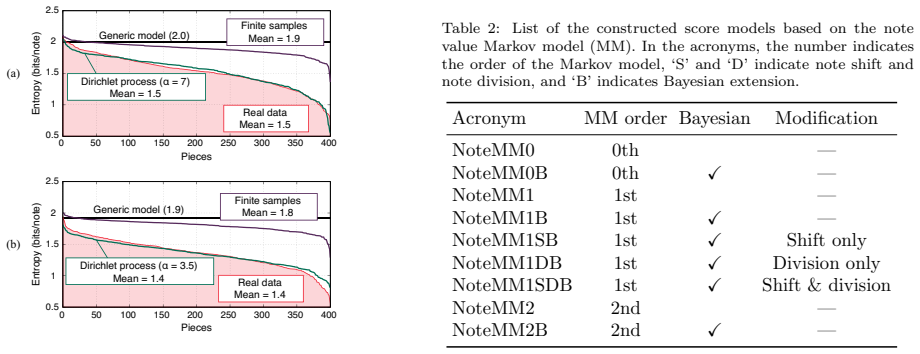
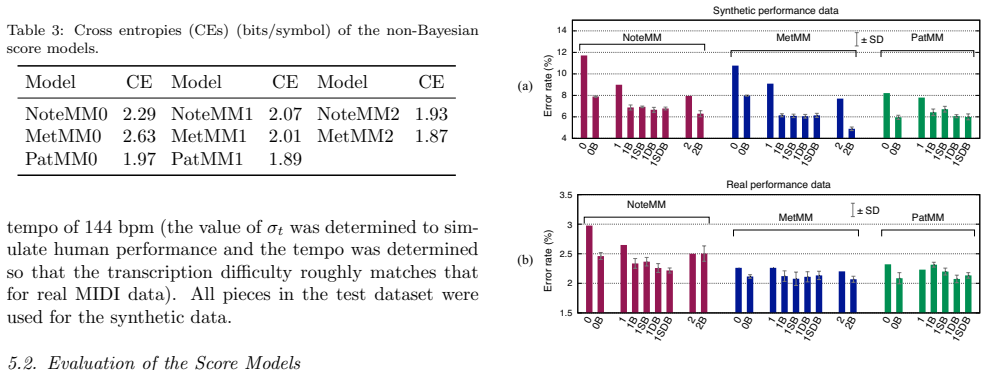
On its own terms, the paper establishes that a piece-specific score model inferred from the performed MIDI data, rather than a generic score model trained on other pieces, captures the repetitions that dominate real rhythms. The sparseness of these piece-specific distributions is quantitatively visible: their entropies are far lower than those of finite samples from the generic model, and the Dirichlet process with a small concentration parameter reproduces the observed entropy range. The central experimental result is that Bayesian extensions of the note-value, metrical, and note-pattern Markov models significantly reduce transcription error rates on both synthetic and human-performed MIDI, with MetMM2B the most accurate at roughly 2% error on real data. The paper also shows that explicitly modeling approximate repetitions through onset shifts and note divisions yields modest accuracy gains that do not justify their large computational cost for the model types tested.
Load-bearing premise
The evaluation assumes a simplified score world—2/4 time on a 16th-note grid, no rests, no triplets, no segments without onsets, and a constant known tempo with Gaussian onset deviations—and if the real rhythmic phenomena excluded here matter, the measured improvements may not transfer to practical transcription.
Editorial extensions
If this is right
- Bayesian piece-specific score models lower rhythm transcription error for most model types, often by more than raising the Markov order of a generic model.
- MetMM2B gives the best accuracy-computation trade-off and is the recommended practical model; note-pattern models are most accurate only at prohibitive cost.
- Explicitly modeling onset shifts and note divisions captures approximate repetitions but yields only small accuracy gains, so simpler Bayesian models without modifications are attractive.
- The approach extends to finer beat grids and longer note values for metrical MMs, since their cost grows polynomially in bar length, not exponentially as with note-pattern MMs.
- The same piece-specific Bayesian construction can be applied to other musical elements, such as pitches, chords, or polyphonic voices, where repetitions also guide recognition (stated as future work in the paper).
Reading between the lines
- A direct extension would test whether per-piece concentration parameters, learned from the input rather than fixed, push the error rate below the observed ~2% floor on real performances.
- The same Dirichlet-process piece-specific mechanism could be applied to pitch or chord sequences, where repetition is also common; if the rhythm results transfer, score models for full polyphonic transcription could be built the same way.
- Because the paper's simplification drops rests and triplets, a 'simplified score world' bias may inflate the benefit of repetition; a falsifying test is to add such rhythms and see whether the generic baseline catches up.
- One could measure the learned piece-specific distributions directly: if the sparse-transition mechanism is truly active, the inferred concentration parameters for pieces with little repetition should approach the generic case, which would be a checkable signature.
Signed reviews
Editorial analysis
A structured set of objections, weighed in public.
Referee Report
Summary. The paper develops Bayesian extensions of three families of Markov score models (note-value, metrical, and note-pattern MMs) for rhythm transcription from MIDI. The Bayesian formulation uses Dirichlet-process priors on piece-specific transition/unigram probabilities to induce sparsity, thereby capturing repetitive structure, and optionally models approximate repetitions through onset-shift and note-division processes. The authors derive Gibbs-sampling inference and Viterbi transcription algorithms, and evaluate the models on vocal-melody data from RWC, Beatles, and J-pop corpora using both synthetic and real performed MIDI. The main reported findings are that Bayesian piece-specific models improve transcription accuracy over non-Bayesian generic models for most model types, that the second-order Bayesian metrical Markov model (MetMM2B) is the most accurate, and that modification processes give only small accuracy gains at large computational cost.
Significance. If the central attribution claim holds, this is a useful contribution: it shows that a performance-adaptive, repetition-sensitive score prior can improve rhythm quantization, and it provides a systematic comparison of model families that practitioners could use to choose a tractable model. The paper's strengths include complete formal derivations for the generative models and inference algorithms, an entropy-based analysis connecting repetitive structure to sparsity, and publicly released data and source code. The experimental study is careful in distinguishing synthetic and real data and in reporting standard deviations. However, the headline comparison conflates test-time adaptation with the sparsity/repetition mechanism, and the real-data ranking rests on differences that are partly within statistical fluctuation and on hyperparameters that are partly tuned on the test data. These issues are fixable with additional controls and statistical reporting, but they currently limit the strength of the central claim.
major comments (3)
- [Secs. 4.2, 5.3, Fig. 7] The main comparison is confounded. For non-Bayesian models, the parameters are 'pretrained or preset and are fixed during the transcription step' (Sec. 4.2), whereas for Bayesian models the piece-specific parameters are estimated from the input performance by Gibbs sampling (Sec. 4.2 and Appendix A.2). The comparison therefore varies two factors at once: test-time adaptation of the score model and the sparsity-inducing Dirichlet-process prior that is claimed to capture repetitions. The entropy analysis in Sec. 2.3 shows that real piece-specific distributions are sparse, but that is a descriptive property of the corpus, not evidence that the sparse prior causes the transcription improvement. To support the claim that 'Bayesian score models capturing repetitions' are effective (Sec. 6), the paper needs a non-sparse adapted control, e.g., the same Bayesian inference with a large concentration parameter, a flat or weak Dirichlet prior, or an adapted non-Bayesian model trained by EM. Without such a baseline, the reported gains could be attributed to adaptation or regularization rather than to the repetition mechanism.
- [Secs. 5.1, 5.3, 5.4, Fig. 9] Several evaluation choices make the quantitative claims weaker than the text suggests. The real-data value sigma_t = 0.035 sec is 'roughly optimized' on the real test data (Sec. 5.3 and Fig. 9(c)), and all concentration parameters are fixed to 10 even though Fig. 9(a) shows model-dependent optima; the manuscript states that the differences from the fixed value are within one standard deviation, but the main result should be shown to be stable under the same variation for the other model families. More importantly, no significance tests are reported, and Sec. 5.3 itself concedes that many real-data differences are within statistical fluctuation and that error rates saturate around 2%. Statements such as 'most Bayesian models again significantly outperformed' (Sec. 5.3) and the selection of MetMM2B as 'the best' require pairwise confidence intervals or significance tests, especially because the best model is chosen on the same test set used for hyperparameter tuning.
- [Secs. 2.1, 5.5, Abstract] The scope of the empirical claim should be stated more carefully. The evaluation restricts pieces to 2/4 time on a 16th-note grid, discards rests, onsets finer than a 16th note, segments without onsets, and durations longer than a half note, and assumes a constant, known tempo with Gaussian onset deviations (Secs. 2.1 and 4.1). These restrictions are acknowledged in Sec. 5.5 as a limitation for practical applications, but the abstract's phrase 'universal efficacy of the proposed approach' goes beyond the evidence, which covers monophonic vocal melodies under a simplified score representation. I recommend softening the abstract and conclusion to state that the demonstrated gains hold for the tested representation and corpus, with extension to more general settings left as future work.
minor comments (5)
- [Sec. 5.3 vs. Table 4] The beam width for PatMM1DB and PatMM1SDB is reported as W = 200 in Sec. 5.3, but Table 4's caption states W = 1000 for the same models; please reconcile this discrepancy.
- [Supplemental Material, Sec. 4.2.2] There is a typo in the definition of the latent variables: 'zn = (kn.in,sn)' should read 'zn = (kn,in,sn)'.
- [Sec. 5.4, Fig. 9(a)] The figure compares the 'theoretically optimal' concentration parameters from entropy matching with the empirically optimal values, but no explanation is given for why the entropy-matched values are not expected to coincide with transcription-optimal values; a sentence describing this mismatch would help the reader interpret the plot.
- [Sec. 4.2] The modification hyperparameters are preset to ¯ξ0 = ¯ζ0 = 0.9 with no sensitivity analysis; since modification models are a central modeling component, reporting the effect of varying these values would strengthen the paper, even if only for one model family.
- [Fig. 8] The example in Fig. 8 is informative, but the selection criterion ('only bars with repeated rhythms') should be stated explicitly, and the transcription error markers should be described in the caption for clarity.
Circularity Check
No significant circularity: piece-specific parameters are inferred from unlabeled performance data and decoded with a distinct Viterbi step; the main self-citation is background, not load-bearing.
full rationale
The paper's derivation chain is self-contained. The piece-specific model parameters (Theta) are inferred from the observed performance durations X = d_{1:N} by Gibbs sampling from P(Z, Theta | X, Xi) (Sec. 4.2, Eq. 31), and the transcribed note values are then decoded by maximizing P(b_{0:N} | d_{1:N}) with the Viterbi algorithm (Appendix A.3, Eqs. A.15-A.19). The ground-truth score never enters the inference; the fitted quantity (Theta) and the predicted quantity (score note values) are distinct, so no prediction reduces to a fitted value by construction. The prior base distributions are estimated from a disjoint training split (Sec. 2.1) and the test pieces are held out, so the central comparison is not forced by the training data. The entropy analyses (Sec. 2.3, Figs. 3-5) are descriptive fits of a Dirichlet-process prior to training-data sparsity and are not used as the transcription evaluation. The only notable self-citation ([18]) is background: the paper explicitly re-evaluates and extends the earlier model with new model classes and its own held-out experiments; no load-bearing claim rests solely on [18]. The Bayesian-versus-non-Bayesian comparison does conflate test-time adaptation with the sparsity prior (a non-sparse adapted control is absent), but that is a validity or confound concern, not circularity: no equation equates a predicted transcription to a fitted input.
Assumptions & free parameters
free parameters (5)
- Concentration parameter alpha =
10 for all DP priors
- Performance noise sigma_t =
0.035 sec for real data, 0.04 sec for synthetic data
- Modification prior probabilities =
xi_0 = zeta_0 = 0.9, uniform elsewhere
- Beam width W =
200, with 1000 used in Table 4
- Smoothing constant and interpolation weight =
0.1; 0.8 unigram plus 0.2 transition
assumptions (5)
- domain assumption Scores are generated by low-order Markov models over note values, metrical positions, or note patterns, with piece-specific transition probabilities drawn from Dirichlet processes.
- domain assumption Timing deviations are independent Gaussian with a single constant tempo and fixed variance sigma_t^2.
- domain assumption Approximate repetitions are produced only by onset shifts and note divisions into at most two notes, with rare modifications.
- domain assumption The simplified score representation uses 2/4 meter, Nb=8 16th-note positions, no rests, no onsets finer than 16th notes, and a maximum half-note length.
- standard math Gibbs sampling and Viterbi decoding converge adequately with the chosen number of iterations and beam width.
Cite this review
Pith. "Pith review of Musical Rhythm Transcription Based on Bayesian Piece-Specific Score Models Capturing Repetitions." pith.science (2026). https://pith.science/paper/NTJNJACZ
@misc{pith2026190806969,
  author       = {Pith},
  title        = {Pith review of: Musical Rhythm Transcription Based on Bayesian Piece-Specific Score Models Capturing Repetitions},
  year         = {2026},
  howpublished = {\url{https://pith.science/paper/NTJNJACZ}},
  note         = {Machine review of arXiv:1908.06969}
}
read the original abstract
Most work on musical score models (a.k.a. musical language models) for music transcription has focused on describing the local sequential dependence of notes in musical scores and failed to capture their global repetitive structure, which can be a useful guide for transcribing music. Focusing on rhythm, we formulate several classes of Bayesian Markov models of musical scores that describe repetitions indirectly using the sparse transition probabilities of notes or note patterns. This enables us to construct piece-specific models for unseen scores with an unfixed repetitive structure and to derive tractable inference algorithms. Moreover, to describe approximate repetitions, we explicitly incorporate a process for modifying the repeated notes/note patterns. We apply these models as prior musical score models for rhythm transcription, where piece-specific score models are inferred from performed MIDI data by Bayesian learning, in contrast to the conventional supervised construction of score models. Evaluations using the vocal melodies of popular music showed that the Bayesian models improved the transcription accuracy for most of the tested model types, indicating the universal efficacy of the proposed approach. Moreover, we found an effective data representation for modelling rhythms that maximizes the transcription accuracy and computational efficiency.
Figures


Figures from the paper (6 more)




Reference graph
Works this paper leans on
-
[1]
Benetos, E., Dixon, S., Duan, Z., and Ewert, S. (2019). Auto- matic music transcription: An overview. IEEE Signal Processing Magazine, 36(1):20–30
work page 2019
-
[2]
Benetos, E., Dixon, S., Giannoulis, D., Kirchhoff, H., and Kla- puri, A. (2013). Automatic music transcription: Challenges and future directions. J. Intelligent Information Systems , 41(3):407– 434
work page 2013
-
[3]
Benetos, E. and Weyde, T. (2015). An efficient temporally- constrained probabilistic model for multiple-instrument music transcription. In Proc. ISMIR, pages 701–707. 13
work page 2015
-
[4]
Bishop, C. M. (2006). Pattern Recognition and Machine Learn- ing. Springer
work page 2006
- [5]
-
[6]
Cemgil, A. T., Desain, P., and Kappen, B. (2000). Rhythm quantization for transcription. Comp. Mus. J. , 24(2):60–76
work page 2000
-
[7]
Desain, P. and Honing, H. (1989). The quantization of musical time: A connectionist approach. Comp. Mus. J. , 13(3):56–66
work page 1989
-
[8]
Fine, S., Singer, Y., and Tishby, N. (1998). The hierarchical hid- den Markov model: Analysis and applications. Machine Learning, 32(1):41–62
work page 1998
Show all 34 references
-
[9]
Goto, M., Hashiguchi, H., Nishimura, T., and Oka, R. (2002). RWC music database: Popular, classical and jazz music databases. In Proc. ISMIR, pages 287–288
2002
-
[10]
Hamanaka, M., Goto, M., Asoh, H., and Otsu, N. (2003). A learning-based quantization: Unsupervised estimation of the model parameters. In Proc. ICMC, pages 369–372
2003
-
[11]
Hawthorne, C., Elsen, E., Song, J., Roberts, A., Simon, I., Raf- fel, C., Engel, J., Oore, S., and Eck, D. (2018). Onsets and frames: Dual-objective piano transcription. In Proc. ISMIR, pages 50–57
2018
-
[12]
Huron, D. (2006). Sweet Anticipation: Music and the Psychol- ogy of Expectation. The MIT Press
2006
-
[13]
and McDermott, J
Jacoby, N. and McDermott, J. H. (2017). Integer ratio priors on musical rhythm revealed cross-culturally by iterated reproduction. Current Biology, 27(3):359–370
2017
-
[14]
Jordan, M. I. (2005). Dirichlet processes, Chinese restaurant processes and all that. In Tutorial Presentation at the NIPS Con- ference
2005
-
[15]
Longuet-Higgins, H. (1987). Mental Processes: Studies in Cog- nitive Science. MIT Press
1987
-
[16]
Mari, J.-F., Haton, J.-P., and Kriouile, A. (1997). Automatic word recognition based on second-order hidden Markov models. IEEE Transactions on speech and Audio Processing , 5(1):22–25
1997
-
[17]
Nakamura, E., Benetos, E., Yoshii, K., and Dixon, S. (2018). Towards complete polyphonic music transcription: Integrating multi-pitch detection and rhythm quantization. In Proc. ICASSP, pages 101–105
2018
-
[18]
Nakamura, E., Itoyama, K., and Yoshii, K. (2016). Rhythm transcription of MIDI performances based on hierarchical Bayesian modelling of repetition and modification of musical note pattern. In Proc. EUSIPCO, pages 1946–1950
2016
-
[19]
Nakamura, E., Yoshii, K., and Sagayama, S. (2017). Rhythm transcription of polyphonic piano music based on merged-output HMM for multiple voices. IEEE/ACM TASLP, 25(4):794–806
2017
-
[20]
Nishikimi, R., Nakamura, E., Itoyama, K., and Yoshii, K. (2016). Musical note estimation for F0 trajectories of singing voices based on a Bayesian semi-beat-synchronous HMM. InProc. ISMIR, pages 461–467
2016
-
[21]
Rabiner, L. R. (1989). A tutorial on hidden Markov models and selected applications in speech recognition. Proceedings of the IEEE, 77(2):257–286
1989
-
[22]
Raczynski, S., Vincent, E., and Sagayama, S. (2013). Dy- namic Bayesian networks for symbolic polyphonic pitch modeling. IEEE/ACM TASLP, 21(9):1830–1840
2013
-
[23]
Raphael, C. (2002). A hybrid graphical model for rhythmic parsing. Artificial Intelligence, 137:217–238
2002
-
[24]
Raphael, C. (2005). A graphical model for recognizing sung melodies. In Proc. ISMIR, pages 658–663
2005
-
[25]
Ravignani, A., Thompson, B., Grossi, T., Delgado, T., and Kirby, S. (2018). Evolving building blocks of rhythm: how hu- man cognition creates music via cultural transmission. Annals of the New York Academy of Sciences , 1423:176–187
2018
-
[26]
E., Brown, S., Sakai, E., and Currie, T
Savage, P. E., Brown, S., Sakai, E., and Currie, T. E. (2015). Statistical universals reveal the structures and functions of human music. PNAS, 112(29):8987–8992
2015
-
[27]
Schramm, R., McLeod, A., Steedman, M., and Benetos, E. (2017). Multi-pitch detection and voice assignment for a Cappella recordings of multiple singers. In Proc. ISMIR, pages 552–559
2017
-
[28]
Sigtia, S., Benetos, E., and Dixon, S. (2016). An end-to-end neu- ral network for polyphonic piano music transcription.IEEE/ACM TASLP, 24(5):927–939
2016
-
[29]
Siorosa, G., Davies, M. E. P., and Guedes, C. (2018). A gener- ative model for the characterization of musical rhythms. J. New Music Res., 47(2):114–128
2018
-
[30]
Smith, L. M. and Honing, H. (2008). Time-frequency repre- sentation of musical rhythm by continuous wavelets. Journal of Mathematics and Music , 2(2):81–97
2008
-
[31]
Takeda, H., Otsuki, T., Saito, N., Nakai, M., Shimodaira, H., and Sagayama, S. (2002). Hidden Markov model for automatic transcription of MIDI signals. In Proc. MMSP, pages 428–431
2002
-
[32]
and Sleator, D
Temperley, D. and Sleator, D. (1999). Modeling meter and harmony: A preference-rule approach. Comp. Mus. J. , 23(1):10– 27
1999
-
[33]
Wu, Y.-T., Chen, B., and Su, L. (2019). Polyphonic music tran- scription with semantic segmentation. In Proc. ICASSP, pages 166–170
2019
-
[34]
Music Transcription Based on Bayesian Piece-Specific Score Models Capturing Repetitions
Ycart, A. and Benetos, E. (2017). A study on LSTM networks for polyphonic music sequence modelling. In Proc. ISMIR, pages 421–427. 14 Supplemental Material for “Music Transcription Based on Bayesian Piece-Specific Score Models Capturing Repetitions” Eita Nakamura1,2∗ and Kazuyo...
2017 arXiv
Reviewed August 14, 2026 · model on record in the stance chip above.
Discussion (0). Continue with ORCID to comment.