REVIEW 3 major objections 6 minor 6 cited by
Steering Rectified Flow Models in the Vector Field for Controlled Image Generation
T0 review · 3 major / 6 minor · reviewed 2026-08-12 · deepseek-v4-flash
Pith's one-line read Rectified flow models can be steered to a target by one cheap gradient at the predicted clean image — no solver backpropagation, no inversion, no extra training.
desk verdict Useful gradient-free steering heuristic for rectified flow models, but the theoretical derivation is largely post-hoc and the SOTA claim is broader than the tables support. read the letter →
The pith
A machine-rendered reading of the paper's core claim, the machinery that carries it, and where it could break.
The reading
What carries the argument
The load-bearing object is the gradient-skipping update rule $x_{t-\Delta t} = x_t + \Delta t\,u_\theta(x_t,t) - s'\nabla_{\hat{x}_0}L$ with the one-step clean-image estimate $\hat{x}_0 = x_t + t\,u_\theta(x_t,t)$, where $u_\theta$ is the pretrained rectified flow velocity field, $L$ is the task cost (e.g., $\|F(\hat{x}_0) - x^{\mathrm{ref}}_0\|^2_2$ for inverse problems or $-\log p_\phi(c\mid\hat{x}_0)$ for classifier guidance), and $s'$ absorbs the near-identity Jacobian factors $(I + \Delta t\,J_{u_\theta})(I + t\,J_{u_\theta})^T$. It is justified by the error-dynamics proposition, which shows that for straight, crossover-free trajectories the guidance term dominates the disturbance term, and by the gradient relationship $\nabla_{x_t}L = (I + t\,J_{u_\theta})^T\nabla_{\hat{x}_0}L$, which under Jacobian constancy lets the steering push be computed without backpropagating through the model.
What would settle it
Measure the cosine similarity between the true gradient $\nabla_{x_t}L$ (obtained by backpropagation) and the skipped gradient $\nabla_{\hat{x}_0}L$ at every denoising step on a large latent rectified flow model such as Flux, and track whether the error $E(t) = \|\hat{x}_0 - x^{\mathrm{ref}}_0\|^2$ actually decays when the alignment stays low; the paper's own Figure 9c shows the alignment initially degrades during steering, and its Section 18 reports Flux deblurring and super-resolution failures, so a model or task where the alignment never recovers would directly falsify the Jacobian-constancy justification.
Extended reading notes
Core claim
The paper's central claim is that for rectified flow models the control signal lives in the vector field itself, not in the solver. The authors formalize guided sampling as error dynamics $\frac{dE(t)}{dt} = -4sE(t) + 2e(t)^T\varepsilon(t)$, where the first term drives the squared error to zero exponentially and the second captures the disturbance from trajectory curvature and crossovers; for rectified flows, which are trained to have straight trajectories, the disturbance term is small enough that convergence survives even a crude gradient. Under the assumptions that the vector field is locally linear and its Jacobian $J_{u_\theta}$ is nearly constant along the path, Lemma 4.2 gives $\nabla_{x_t}L = (I + t\,J_{u_\theta})^T\nabla_{\hat{x}_0}L$, and because $I + t\,J_{u_\theta}$ is close to the identity the update collapses to $x_{t-\Delta t} = x_t + \Delta t\,u_\theta(x_t,t) - s'\nabla_{\hat{x}_0}L$. This 'gradient skipping' lets FlowChef start from random Gaussian noise and steer toward a target sample, a degraded observation, or an edit prompt, without inversion and without backpropagation through the ODE solver.
Load-bearing premise
Everything rests on the assumption that the model's velocity field barely changes direction within the small neighborhoods visited during sampling, so that the linear correction tying the intermediate sample to the estimated clean image is nearly the identity and the cheap gradient at the clean image can stand in for the true gradient.
Editorial extensions
If this is right
- One inference-time recipe now covers classifier guidance, linear inverse problems, and image editing on rectified flow models simultaneously, with no extra training, no inversion, and no solver backpropagation.
- Latent-space and large-scale models become reachable: FlowChef reports about 18 seconds per image at 14 GB VRAM on the InstaFlow latent model, where diffusion-based baselines take 1–3 minutes, and it runs on Flux at 1024$\times$1024, a scale where flow-based backpropagation baselines run out of memory.
- Increasing the number of function evaluations shrinks $\Delta t$ and keeps the Jacobian-constancy assumption intact, so guidance strength and integration stability trade off predictably; the paper finds a single optimization step per denoising step is usually enough.
- On pixel-space Rectified-Flow++ models, FlowChef reports consistent gains over DPS, D-Flow, PnP-Flow, and OT-ODE across easy and hard inpainting, deblurring, and super-resolution settings on PSNR, SSIM, and LPIPS.
Reading between the lines
- Editorial: if Jacobian constancy is the true mechanism, then how well gradient skipping converges doubles as a probe of a flow model's trajectory straightness and crossover frequency, and the same steering rule should transfer to other straight-trajectory generative paradigms such as distilled one-step flows and consistency models.
- Editorial: the paper's reported failures on Flux deblurring and super-resolution point at the latent VAE breaking the assumed linearity; a cost function computed in latent space with the known degradation operator rather than in pixel space would be the natural untested fix.
- Editorial: because FlowChef starts from random noise rather than an inverted image, the framework suggests that any attribute expressible as a differentiable cost could steer the trajectory, making attention-based or prompt-embedding losses a natural extension beyond the user-provided masks the paper currently requires.
Editorial analysis
A structured set of objections, weighed in public.
Referee Report
Summary. The paper proposes FlowChef, a method for steering rectified flow models (RFMs) during inference for classifier guidance, linear inverse problems, and image editing. The core idea is to replace the expensive gradient ∇_{x_t}L, which normally requires backpropagation through the ODE solver, with the gradient ∇_{\x0302x_0}L evaluated at the estimated clean sample \x0302x_0 = x_t + t·u_θ(x_t,t), using an update rule x_{t-Δt} = x_t + Δt·u_θ(x_t,t) − s'∇_{\x0302x_0}L. The authors provide a theoretical analysis based on error dynamics, local linearity, and Jacobian constancy assumptions, and they present extensive experiments on pixel-space and latent-space RFMs, including InstaFlow and Flux, showing state-of-the-art performance with reduced compute and memory compared to baselines.
Significance. If the central claim holds, FlowChef is a practically valuable contribution: it offers a unified, training-free, inversion-free, and backpropagation-free control mechanism for RFMs, extending to large-scale models like Flux where prior methods fail due to memory constraints. The empirical evaluation is broad, covering multiple tasks, models, and metrics, including human preference studies. However, the theoretical foundation as written contains gaps: the proof of the main update rule does not actually derive the scalar guidance scale used in the algorithm, and the key convergence proposition is an identity once its error term is defined. These issues do not invalidate the empirical results, but they weaken the paper's claim of a theoretically grounded guarantee.
major comments (3)
- [Section 9, Eq. (35)] Theorem 4.3's proof defines s' as (I + Δt·J_u)K^T, which is a matrix depending on both t and Δt, and then asserts that it is constant and 'can be predetermined.' The algorithm, however, uses a single scalar s' for all timesteps. The proof's constancy argument only appeals to Δt→0 and t→0, which is a smallness condition, not the constancy of J_u with respect to t stated in Assumption 2. Consequently, Eq. (9) is not actually derived from the stated assumptions; the scalar s' functions as a fitted hyperparameter that absorbs the unmodeled time dependence. This is load-bearing because the paper's central claim of a theoretically grounded, gradient-free steering rule rests on this derivation.
- [Section 8, Eq. (16), Proposition 4.1] The proof of Proposition 4.1 defines ϵ(t) as the residual between the exact gradient update and the approximate gradient update (Eq. 16). With this definition, the error dynamics dE/dt = −4sE + 2e^⊤ϵ is an algebraic identity, not a substantive dynamical statement. The proposition does not establish that ϵ(t) is small for RFMs; the claim that straight trajectories and minimal crossovers imply ϵ→0 is an empirical assertion. Figure 9c, which shows cosine similarity dropping to roughly 0.3 during active steering before recovering, indicates that the approximation error is not negligible precisely in the steering regime the method targets. Thus the convergence guarantee claimed via Proposition 4.1 is unsupported as stated.
- [Section 18 and Figure 13] The paper's own limitation section states that Flux.1[Dev] trajectories exhibit non-linearity and that FlowChef (Flux) 'faces difficulties in deblurring and super-resolution tasks,' attributing this to pixel-space loss and non-linear VAE behavior. This is exactly the regime where Assumption 2 (Jacobian constancy) fails, and Table 3 confirms the degradation (e.g., deblurring PSNR for FlowChef (Flux) is 18.98 versus 22.50 for FlowChef (InstaFlow)). The manuscript should either restrict its claims about general RFM applicability or provide a quantitative characterization of when the Jacobian-constancy assumption holds and when it breaks.
minor comments (6)
- [Algorithm 1] The vector field v is computed once before the inner optimization loop and then used again for the update in line 10 without recomputation, whereas Algorithm 2 recomputes v after optimization. This inconsistency should be resolved, and the update in Algorithm 1 should specify whether the optimized x_t is used to recompute v.
- [Section 4.2] The text refers to 'Preposition 4.1' rather than 'Proposition 4.1'; please correct the typo.
- [Section 9] The phrase 'where K is the constant matrics' should read 'where K is the constant matrix.'
- [Algorithm 1] Line 5 contains 'require grad (T rue)', which should be 'require grad (True)'.
- [References] The reference formatting appears inconsistent, with trailing section numbers attached to some entries; please standardize the bibliography style.
- [Table 8] The per-task hyperparameter table shows substantial sensitivity (e.g., edit guidance scale ranging from 0.0 to 10.0, max steps from 0 to 50). At least a brief discussion of this sensitivity in the main text would help users understand the practical tuning burden.
Circularity Check
No significant circularity: the central update rule is derived from stated linearity assumptions and validated against external baselines; the theorem-proof flaws are correctness issues, not circular reductions.
full rationale
FlowChef's central update rule x_{t-Δt} = x_t + Δt·u_θ(x_t,t) − s′∇_{x̂_0}L is not circular in the senses enumerated here. Lemma 4.2 derives the gradient relationship ∇_{x_t}L = (I + tJ_u)^T∇_{x̂_0}L from the definition x̂_0 = x_t + t·u_θ(x_t,t), and Theorem 4.3 groups the resulting terms into a single coefficient s′; neither step fits a parameter to the quantity being predicted. The paper's convergence claims are anchored by external empirical comparisons (IDDPM vs. RF++ in Table 1, gradient-similarity measurements in Figure 9, and benchmarks against DFlow, DPS, PnP-Flow, Ledits++, InfEdit, etc.), so the method is not validated only by its own assumptions. Proposition 4.1 defines ε(t) as the residual between the true gradient and the gradient-skipping approximation; the error-dynamics ODE is therefore a bookkeeping identity. That makes the proposition mathematically weak, but the substantive claim that ε(t) is small for rectified flow models is an empirical and architectural claim supported by Figure 9, not a consequence of the definition. Theorem 4.3 contains a real proof gap: s′ is derived as the time-dependent matrix (I + Δt·J_u)(I + t·J_u)^T and then treated as a constant scalar guidance scale, and Assumption 2 only asserts constancy of J_u with respect to x_t, not with respect to t. This undercuts the theoretical guarantee and is a correctness risk, but it is not a case where the conclusion is equivalent to the input by construction or where a fitted value is renamed as a prediction. Self-citations in the paper (refs. 20, 21, 32, 33) appear in related-work and ethics/personalization contexts and are not load-bearing for the main derivation. Overall, the central result has independent empirical content and is not circular; the theorem's invalid step should be reported as a proof flaw rather than circularity.
Assumptions & free parameters
free parameters (4)
- guidance scale s' (learning rate) =
0.02 to 500 depending on task (e.g., 500 for pixel inverse problems, 0.5 for latent, 0.4 to 0.5 for Flux editing)
- inner-loop optimization steps N =
1 for most tasks, up to 5 for editing
- total NFEs T =
10 to 200
- editing hyperparameters (max_fullstepsT, minT, edit guidance scale s) =
task-specific (Table 8)
assumptions (3)
- ad hoc to paper Assumption 1: the vector field u_θ is locally linear in x_t (Eq. 6).
- ad hoc to paper Assumption 2: the Jacobian J_u varies slowly with x_t and is effectively constant (Eq. 7).
- domain assumption Rectified flow models have straight, non-crossing trajectories so that ε(t) from Proposition 4.1 is negligible.
Cite this review
Pith. "Pith review of Steering Rectified Flow Models in the Vector Field for Controlled Image Generation." pith.science (2026). https://pith.science/paper/NTK43J7U
@misc{pith2026241200100,
  author       = {Pith},
  title        = {Pith review of: Steering Rectified Flow Models in the Vector Field for Controlled Image Generation},
  year         = {2026},
  howpublished = {\url{https://pith.science/paper/NTK43J7U}},
  note         = {Machine review of arXiv:2412.00100}
}
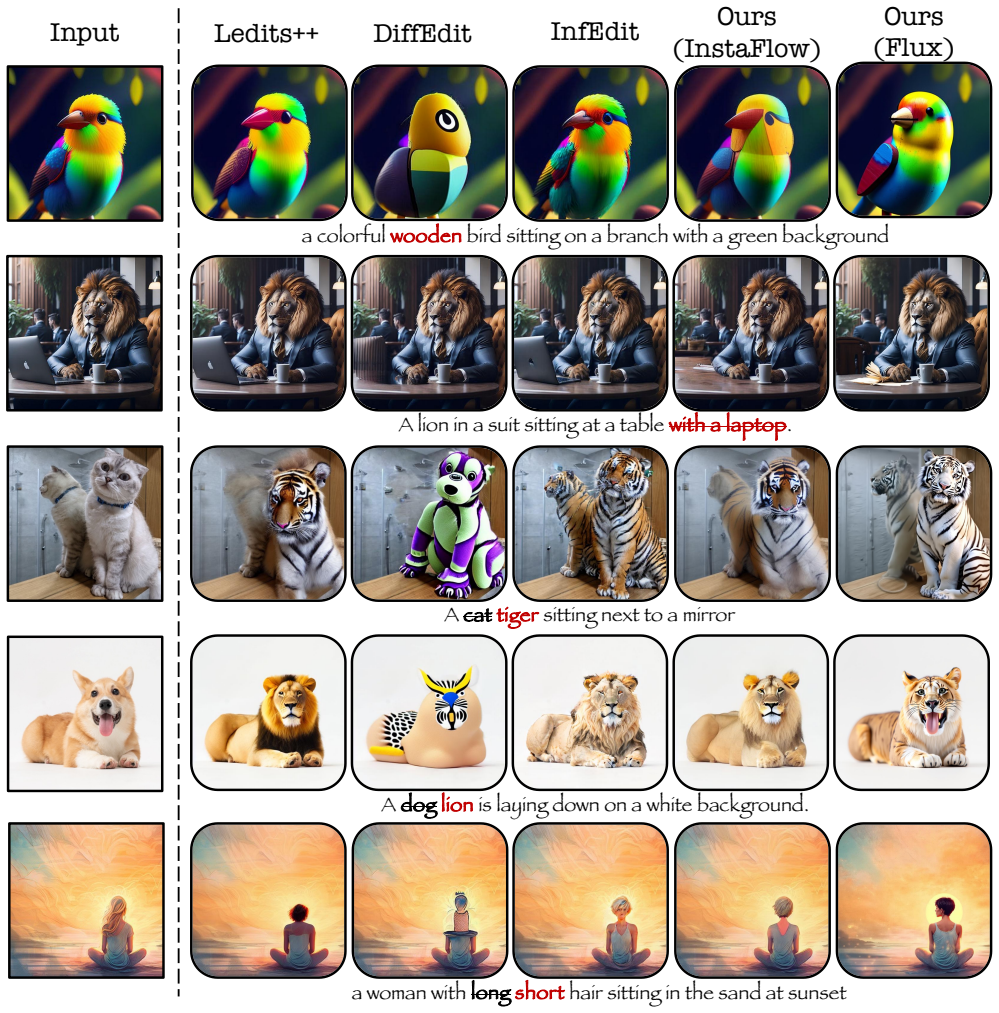
read the original abstract
Diffusion models (DMs) excel in photorealism, image editing, and solving inverse problems, aided by classifier-free guidance and image inversion techniques. However, rectified flow models (RFMs) remain underexplored for these tasks. Existing DM-based methods often require additional training, lack generalization to pretrained latent models, underperform, and demand significant computational resources due to extensive backpropagation through ODE solvers and inversion processes. In this work, we first develop a theoretical and empirical understanding of the vector field dynamics of RFMs in efficiently guiding the denoising trajectory. Our findings reveal that we can navigate the vector field in a deterministic and gradient-free manner. Utilizing this property, we propose FlowChef, which leverages the vector field to steer the denoising trajectory for controlled image generation tasks, facilitated by gradient skipping. FlowChef is a unified framework for controlled image generation that, for the first time, simultaneously addresses classifier guidance, linear inverse problems, and image editing without the need for extra training, inversion, or intensive backpropagation. Finally, we perform extensive evaluations and show that FlowChef significantly outperforms baselines in terms of performance, memory, and time requirements, achieving new state-of-the-art results. Project Page: \url{https://flowchef.github.io}.
Figures


Figures from the paper (17 more)




Forward citations
Cited by 6 Pith papers
-
Do Unified Multimodal Models Think in One Space? A Lens Through Cross-Branch Steering
Steering vectors from the understanding branch can control image generation, but vectors from the generation branch cannot control understanding, showing UMMs are architecturally unified but representationally asymmetric.
-
MPFlow: Multi-modal Posterior-Guided Flow Matching for Zero-Shot MRI Reconstruction
MPFlow guides flow-matching MRI reconstruction with self-supervised cross-modal feature alignment to an auxiliary scan, reducing hallucinations and using 20% of the sampling steps of diffusion baselines.
-
Solving Inverse Problems with Flow-based Models via Model Predictive Control
MPC-Flow applies model predictive control to guide pretrained flow models through inverse problems, with a single-step variant that avoids backpropagation and scales to 32B-parameter models on consumer hardware.
-
Align & Invert: Solving Inverse Problems with Diffusion and Flow-based Models via Representation Alignment
Adding DINOv2 representation alignment to diffusion/flow inverse-problem solvers, using corrupted measurements as proxies, improves LPIPS/FID and cuts required sampling steps.
-
The Aging Multiverse: Generating Condition-Aware Facial Aging Tree via Training-Free Diffusion
A training-free diffusion framework creates condition-aware facial aging trees from one photo, balancing identity, age, and prompt-controlled attributes.
-
DICT: Data Injection and Contrastive Trajectory Refinement for Conditional Image Generation with Diffusion Models
Noise-perturbed condition injection plus contrastive trajectory refinement improves training-free conditional diffusion sampling across style transfer, super-resolution and deblurring.
Reference graph
Works this paper leans on
-
[1]
D-flow: Differentiating through flows for controlled generation
Heli Ben-Hamu, Omri Puny, Itai Gat, Brian Karrer, Uriel Singer, and Yaron Lipman. D-flow: Differentiating through flows for controlled generation. In Forty-first International Conference on Machine Learning, 2024. 2, 3, 6, 7, 4
work page 2024
-
[2]
Synthetic faces high quality (sfhq) dataset,
David Beniaguev. Synthetic faces high quality (sfhq) dataset,
-
[3]
Ledits++: Limitless image editing using text-to-image models
Manuel Brack, Felix Friedrich, Katharia Kornmeier, Linoy Tsaban, Patrick Schramowski, Kristian Kersting, and Apolin´ario Passos. Ledits++: Limitless image editing using text-to-image models. In Proceedings of the IEEE/CVF Con- ference on Computer Vision and Pattern Recognition, pages 8861–8870, 2024. 2, 3, 8, 4
work page 2024
-
[4]
Large scale gan training for high fidelity natural image synthesis
Andrew Brock. Large scale gan training for high fidelity natural image synthesis. arXiv preprint arXiv:1809.11096 ,
-
[5]
In- structpix2pix: Learning to follow image editing instructions
Tim Brooks, Aleksander Holynski, and Alexei A Efros. In- structpix2pix: Learning to follow image editing instructions. In Proceedings of the IEEE/CVF Conference on Computer Vision and Pattern Recognition, pages 18392–18402, 2023. 2
2023
-
[6]
Stargan v2: Diverse image synthesis for multiple domains
Yunjey Choi, Youngjung Uh, Jaejun Yoo, and Jung-Woo Ha. Stargan v2: Diverse image synthesis for multiple domains. In Proceedings of the IEEE/CVF Conference on Computer Vision and Pattern Recognition (CVPR), 2020. 6
work page 2020
-
[7]
Diffusion posterior sam- pling for general noisy inverse problems
Hyungjin Chung, Jeongsol Kim, Michael T Mccann, Marc L Klasky, and Jong Chul Ye. Diffusion posterior sam- pling for general noisy inverse problems. arXiv preprint arXiv:2209.14687, 2022. 2, 3, 6, 4
arXiv 2022
-
[8]
Parallel diffusion models of operator and image for blind inverse problems
Hyungjin Chung, Jeongsol Kim, Sehui Kim, and Jong Chul Ye. Parallel diffusion models of operator and image for blind inverse problems. In Proceedings of the IEEE/CVF Con- ference on Computer Vision and Pattern Recognition, pages 6059–6069, 2023. 4
work page 2023
Show all 71 references
-
[9]
Diffedit: Diffusion-based semantic image editing with mask guidance
Guillaume Couairon, Jakob Verbeek, Holger Schwenk, and Matthieu Cord. Diffedit: Diffusion-based semantic image editing with mask guidance. In The Eleventh International Conference on Learning Representations, 2023. 3, 8, 4
2023
-
[10]
A survey on diffusion mod- els for inverse problems
Giannis Daras, Hyungjin Chung, Chieh-Hsin Lai, Yuki Mit- sufuji, Jong Chul Ye, Peyman Milanfar, Alexandros G Di- makis, and Mauricio Delbracio. A survey on diffusion mod- els for inverse problems. arXiv preprint arXiv:2410.00083,
-
[11]
Diffusion models beat gans on image synthesis
Prafulla Dhariwal and Alexander Nichol. Diffusion models beat gans on image synthesis. Advances in neural informa- tion processing systems, 34:8780–8794, 2021. 2, 3, 4
2021
-
[12]
Scaling recti- fied flow transformers for high-resolution image synthesis
Patrick Esser, Sumith Kulal, Andreas Blattmann, Rahim Entezari, Jonas M ¨uller, Harry Saini, Yam Levi, Dominik Lorenz, Axel Sauer, Frederic Boesel, et al. Scaling recti- fied flow transformers for high-resolution image synthesis. In Forty-first International Conference on Mach...
2024
-
[13]
Susskind, and Navdeep Jaitly
Jiatao Gu, Shuangfei Zhai, Yizhe Zhang, Joshua M. Susskind, and Navdeep Jaitly. Matryoshka diffusion mod- els. In The Twelfth International Conference on Learning Representations, 2024. 4
2024
-
[14]
Man- ifold preserving guided diffusion
Yutong He, Naoki Murata, Chieh-Hsin Lai, Yuhta Takida, Toshimitsu Uesaka, Dongjun Kim, Wei-Hsiang Liao, Yuki Mitsufuji, J Zico Kolter, Ruslan Salakhutdinov, et al. Man- ifold preserving guided diffusion. In The Twelfth Interna- tional Conference on Learning Representations, 2024. 3, 4
2024
-
[15]
Prompt-to-prompt image editing with cross-attention control
Amir Hertz, Ron Mokady, Jay Tenenbaum, Kfir Aberman, Yael Pritch, and Daniel Cohen-or. Prompt-to-prompt image editing with cross-attention control. In The Eleventh Inter- national Conference on Learning Representations, 2023. 4
2023
-
[16]
Classifier-free diffusion guidance
Jonathan Ho and Tim Salimans. Classifier-free diffusion guidance. arXiv preprint arXiv:2207.12598, 2022. 2, 4
2022 arXiv
-
[17]
Diffusion model-based image editing: A survey
Yi Huang, Jiancheng Huang, Yifan Liu, Mingfu Yan, Jiaxi Lv, Jianzhuang Liu, Wei Xiong, He Zhang, Shifeng Chen, and Liangliang Cao. Diffusion model-based image editing: A survey. arXiv preprint arXiv:2402.17525, 2024. 3
2024 arXiv
-
[18]
An edit friendly ddpm noise space: Inversion and manipulations
Inbar Huberman-Spiegelglas, Vladimir Kulikov, and Tomer Michaeli. An edit friendly ddpm noise space: Inversion and manipulations. In Proceedings of the IEEE/CVF Conference on Computer Vision and Pattern Recognition, pages 12469– 12478, 2024. 3, 4
2024
-
[19]
Direct inversion: Boosting diffusion-based edit- ing with 3 lines of code
Xuan Ju, Ailing Zeng, Yuxuan Bian, Shaoteng Liu, and Qiang Xu. Direct inversion: Boosting diffusion-based edit- ing with 3 lines of code. arXiv preprint arXiv:2310.01506,
-
[20]
Wouaf: Weight modulation for user attri- bution and fingerprinting in text-to-image diffusion models
Changhoon Kim, Kyle Min, Maitreya Patel, Sheng Cheng, and Yezhou Yang. Wouaf: Weight modulation for user attri- bution and fingerprinting in text-to-image diffusion models. In Proceedings of the IEEE/CVF Conference on Computer Vision and Pattern Recognition, pages 8974–8983, 2024. 9
2024
-
[21]
Race: Ro- bust adversarial concept erasure for secure text-to-image dif- fusion model
Changhoon Kim, Kyle Min, and Yezhou Yang. Race: Ro- bust adversarial concept erasure for secure text-to-image dif- fusion model. arXiv preprint arXiv:2405.16341, 2024. 9 10
2024 arXiv
-
[22]
Improving the training of rectified flows
Sangyun Lee, Zinan Lin, and Giulia Fanti. Improving the training of rectified flows. arXiv preprint arXiv:2405.20320,
-
[23]
Yaron Lipman, Ricky T. Q. Chen, Heli Ben-Hamu, Maxim- ilian Nickel, and Matthew Le. Flow matching for genera- tive modeling. In The Eleventh International Conference on Learning Representations, 2023. 2, 4
2023
-
[24]
Flow straight and fast: Learning to generate and transfer data with rectified flow
Xingchao Liu, Chengyue Gong, and qiang liu. Flow straight and fast: Learning to generate and transfer data with rectified flow. In The Eleventh International Conference on Learning Representations, 2023. 2, 4
2023
-
[25]
Instaflow: One step is enough for high-quality diffusion- based text-to-image generation
Xingchao Liu, Xiwen Zhang, Jianzhu Ma, Jian Peng, et al. Instaflow: One step is enough for high-quality diffusion- based text-to-image generation. In The Twelfth International Conference on Learning Representations, 2023. 3, 7, 4
2023
-
[26]
Deep learning face attributes in the wild
Ziwei Liu, Ping Luo, Xiaogang Wang, and Xiaoou Tang. Deep learning face attributes in the wild. In Proceedings of International Conference on Computer Vision (ICCV), 2015. 6
2015
-
[27]
Latent consistency models: Synthesizing high- resolution images with few-step inference
Simian Luo, Yiqin Tan, Longbo Huang, Jian Li, and Hang Zhao. Latent consistency models: Synthesizing high- resolution images with few-step inference. arXiv preprint arXiv:2310.04378, 2023. 4
2023 arXiv
-
[28]
Pnp-flow: Plug-and-play image restoration with flow matching
S ´egol`ene Martin, Anne Gagneux, Paul Hagemann, and Gabriele Steidl. Pnp-flow: Plug-and-play image restoration with flow matching. arXiv preprint arXiv:2410.02423, 2024. 2, 3, 6, 4
2024 arXiv
-
[29]
SDEdit: Guided image synthesis and editing with stochastic differential equa- tions
Chenlin Meng, Yutong He, Yang Song, Jiaming Song, Jia- jun Wu, Jun-Yan Zhu, and Stefano Ermon. SDEdit: Guided image synthesis and editing with stochastic differential equa- tions. In International Conference on Learning Representa- tions, 2022. 3
2022
-
[30]
Null-text inversion for editing real im- ages using guided diffusion models
Ron Mokady, Amir Hertz, Kfir Aberman, Yael Pritch, and Daniel Cohen-Or. Null-text inversion for editing real im- ages using guided diffusion models. In Proceedings of the IEEE/CVF Conference on Computer Vision and Pattern Recognition, pages 6038–6047, 2023. 3, 4
2023
-
[31]
Glide: Towards photorealistic image generation and editing with text-guided diffusion models.arXiv preprint arXiv:2112.10741, 2021
Alex Nichol, Prafulla Dhariwal, Aditya Ramesh, Pranav Shyam, Pamela Mishkin, Bob McGrew, Ilya Sutskever, and Mark Chen. Glide: Towards photorealistic image generation and editing with text-guided diffusion models.arXiv preprint arXiv:2112.10741, 2021. 3
2021 arXiv
-
[32]
λ-eclipse: Multi-concept personalized text-to-image diffusion models by leveraging clip latent space
Maitreya Patel, Sangmin Jung, Chitta Baral, and Yezhou Yang. λ-eclipse: Multi-concept personalized text-to-image diffusion models by leveraging clip latent space. ArXiv, abs/2402.05195, 2024. 1, 4
2024 arXiv
-
[33]
Eclipse: A resource-efficient text-to- image prior for image generations
Maitreya Patel, Changhoon Kim, Sheng Cheng, Chitta Baral, and Yezhou Yang. Eclipse: A resource-efficient text-to- image prior for image generations. In Proceedings of the IEEE/CVF Conference on Computer Vision and Pattern Recognition, pages 9069–9078, 2024. 4
2024
-
[34]
Improving dif- fusion models for inverse problems using optimal posterior covariance
Xinyu Peng, Ziyang Zheng, Wenrui Dai, Nuoqian Xiao, Chenglin Li, Junni Zou, and Hongkai Xiong. Improving dif- fusion models for inverse problems using optimal posterior covariance. In Forty-first International Conference on Ma- chine Learning, 2024. 4
2024
-
[35]
Muckley, Ricky T
Ashwini Pokle, Matthew J. Muckley, Ricky T. Q. Chen, and Brian Karrer. Training-free linear image inversion via flows,
-
[36]
Movie gen: A cast of media foundation models
Adam Polyak, Amit Zohar, Andrew Brown, Andros Tjandra, Animesh Sinha, Ann Lee, Apoorv Vyas, Bowen Shi, Chih- Yao Ma, Ching-Yao Chuang, et al. Movie gen: A cast of media foundation models. arXiv preprint arXiv:2410.13720,
-
[37]
Barron, and Ben Milden- hall
Ben Poole, Ajay Jain, Jonathan T. Barron, and Ben Milden- hall. Dreamfusion: Text-to-3d using 2d diffusion. In The Eleventh International Conference on Learning Representa- tions, 2023. 9
2023
-
[38]
Learning transferable visual models from natural language supervision
Alec Radford, Jong Wook Kim, Chris Hallacy, Aditya Ramesh, Gabriel Goh, Sandhini Agarwal, Girish Sastry, Amanda Askell, Pamela Mishkin, Jack Clark, Gretchen Krueger, and Ilya Sutskever. Learning transferable visual models from natural language supervision. In International Con...
2021
-
[39]
Hierarchical text-conditional image gener- ation with clip latents
Aditya Ramesh, Prafulla Dhariwal, Alex Nichol, Casey Chu, and Mark Chen. Hierarchical text-conditional image gener- ation with clip latents. arXiv preprint arXiv:2204.06125, 1 (2):3, 2022. 3
2022 arXiv
-
[40]
High-resolution image synthesis with latent diffusion models
Robin Rombach, Andreas Blattmann, Dominik Lorenz, Patrick Esser, and Bj ¨orn Ommer. High-resolution image synthesis with latent diffusion models. In Proceedings of the IEEE/CVF conference on computer vision and pattern recognition, pages 10684–10695, 2022. 1, 2, 3
2022
-
[41]
Beyond first-order tweedie: Solving inverse problems using latent diffusion
Litu Rout, Yujia Chen, Abhishek Kumar, Constantine Cara- manis, Sanjay Shakkottai, and Wen-Sheng Chu. Beyond first-order tweedie: Solving inverse problems using latent diffusion. In Proceedings of the IEEE/CVF Conference on Computer Vision and Pattern Recognition , pages 9472–...
2024
-
[42]
Semantic im- age inversion and editing using rectified stochastic differen- tial equations
Litu Rout, Yujia Chen, Nataniel Ruiz, Constantine Carama- nis, Sanjay Shakkottai, and Wen-Sheng Chu. Semantic im- age inversion and editing using rectified stochastic differen- tial equations. arXiv preprint arXiv:2410.10792 , 2024. 3, 8
-
[43]
Solving linear inverse problems provably via posterior sampling with latent diffusion models
Litu Rout, Negin Raoof, Giannis Daras, Constantine Cara- manis, Alex Dimakis, and Sanjay Shakkottai. Solving linear inverse problems provably via posterior sampling with latent diffusion models. Advances in Neural Information Process- ing Systems, 36, 2024. 2, 3, 7, 4
2024
-
[44]
Photorealistic text-to-image diffusion models with deep language understanding
Chitwan Saharia, William Chan, Saurabh Saxena, Lala Li, Jay Whang, Emily L Denton, Kamyar Ghasemipour, Raphael Gontijo Lopes, Burcu Karagol Ayan, Tim Salimans, et al. Photorealistic text-to-image diffusion models with deep language understanding. Advances in neural information...
2022
-
[45]
Make-a-video: Text-to-video generation without text-video data
Uriel Singer, Adam Polyak, Thomas Hayes, Xi Yin, Jie An, Songyang Zhang, Qiyuan Hu, Harry Yang, Oron Ashual, Oran Gafni, Devi Parikh, Sonal Gupta, and Yaniv Taigman. Make-a-video: Text-to-video generation without text-video data. In The Eleventh International Conference on Lea...
2023
-
[46]
Solving inverse problems with 11 latent diffusion models via hard data consistency
Bowen Song, Soo Min Kwon, Zecheng Zhang, Xinyu Hu, Qing Qu, and Liyue Shen. Solving inverse problems with 11 latent diffusion models via hard data consistency. In The Twelfth International Conference on Learning Representa- tions, 2024. 2, 3, 7, 4
2024
-
[47]
Pseudoinverse-guided diffusion models for inverse problems
Jiaming Song, Arash Vahdat, Morteza Mardani, and Jan Kautz. Pseudoinverse-guided diffusion models for inverse problems. In International Conference on Learning Repre- sentations, 2023. 2, 3, 4
2023
-
[48]
Rectifid: Personalizing rectified flow with anchored classifier guidance
Zhicheng Sun, Zhenhao Yang, Yang Jin, Haozhe Chi, Kun Xu, Liwei Chen, Hao Jiang, Yang Song, Kun Gai, and Yadong Mu. Rectifid: Personalizing rectified flow with anchored classifier guidance. arXiv preprint arXiv:2405.14677, 2024. 3, 7
2024
-
[49]
Instantstyle: Free lunch towards style-preserving in text-to-image generation
Haofan Wang, Matteo Spinelli, Qixun Wang, Xu Bai, Zekui Qin, and Anthony Chen. Instantstyle: Free lunch towards style-preserving in text-to-image generation. arXiv preprint arXiv:2404.02733, 2024. 4
2024 arXiv
-
[50]
Bovik, H.R
Zhou Wang, A.C. Bovik, H.R. Sheikh, and E.P. Simoncelli. Image quality assessment: from error visibility to structural similarity. IEEE Transactions on Image Processing , 13(4): 600–612, 2004. 6
2004
-
[51]
Turboedit: Instant text-based image editing
Zongze Wu, Nicholas Kolkin, Jonathan Brandt, Richard Zhang, and Eli Shechtman. Turboedit: Instant text-based image editing. arXiv preprint arXiv:2408.08332, 2024. 3, 4
2024 arXiv
-
[52]
Principled probabilistic imaging using diffusion models as plug-and-play priors
Zihui Wu, Yu Sun, Yifan Chen, Bingliang Zhang, Yisong Yue, and Katherine L Bouman. Principled probabilistic imaging using diffusion models as plug-and-play priors. arXiv preprint arXiv:2405.18782, 2024. 3
2024 arXiv
-
[53]
Inversion-free image editing with natural language
Sihan Xu, Yidong Huang, Jiayi Pan, Ziqiao Ma, and Joyce Chai. Inversion-free image editing with natural language. arXiv preprint arXiv:2312.04965, 2023. 3, 8, 4
2023 arXiv
-
[54]
Text-to-image rectified flow as plug-and-play priors
Xiaofeng Yang, Cheng Chen, Xulei Yang, Fayao Liu, and Guosheng Lin. Text-to-image rectified flow as plug-and-play priors. arXiv preprint arXiv:2406.03293, 2024. 3, 9
2024 arXiv
-
[55]
One-step diffusion with distribution matching distillation
Tianwei Yin, Micha ¨el Gharbi, Richard Zhang, Eli Shecht- man, Fredo Durand, William T Freeman, and Taesung Park. One-step diffusion with distribution matching distillation. In Proceedings of the IEEE/CVF Conference on Computer Vi- sion and Pattern Recognition, pages 6613–6623...
2024
-
[56]
Freedom: Training-free energy-guided condi- tional diffusion model
Jiwen Yu, Yinhuai Wang, Chen Zhao, Bernard Ghanem, and Jian Zhang. Freedom: Training-free energy-guided condi- tional diffusion model. In Proceedings of the IEEE/CVF In- ternational Conference on Computer Vision , pages 23174– 23184, 2023. 6, 4
2023
-
[57]
Stack- gan: Text to photo-realistic image synthesis with stacked generative adversarial networks
Han Zhang, Tao Xu, Hongsheng Li, Shaoting Zhang, Xiao- gang Wang, Xiaolei Huang, and Dimitris N Metaxas. Stack- gan: Text to photo-realistic image synthesis with stacked generative adversarial networks. In Proceedings of the IEEE international conference on computer vision , p...
2017
-
[58]
The unreasonable effectiveness of deep features as a perceptual metric
Richard Zhang, Phillip Isola, Alexei A Efros, Eli Shecht- man, and Oliver Wang. The unreasonable effectiveness of deep features as a perceptual metric. In Proceedings of the IEEE conference on computer vision and pattern recogni- tion, pages 586–595, 2018. 6 12 Steering Rectif...
2018
-
[59]
• Section 9: Theorem 4.3 proof
Supplementary Overview This supplementary material contains proofs, detailed re- sults, discussion, and qualitative results: • Section 8: Proposition 4.1 proof. • Section 9: Theorem 4.3 proof. • Section 10: Numerical accuracy analysis. • Section 11: Extended related works. • S...
-
[60]
Let p1 ∼ N(0, I) be the noise distribu- tion and p0 be the data distribution
Proof of the Proposition Proposition 4.1. Let p1 ∼ N(0, I) be the noise distribu- tion and p0 be the data distribution. Let xt denote an inter- mediate sample obtained from a predefined forward func- tion q as xt = q(x0, x1, t), where x0 ∼ p0 and x1 ∼ p1. Define a ODE sampling...
-
[61]
Let uθ : Rd × [0, T] → Rd be the velocity function with the parameter θ
Proof for Theorem Lemma 4.2 (Gradient Relationship) . Let uθ : Rd × [0, T] → Rd be the velocity function with the parameter θ. Then the gradient of the cost function L at any timestep t can be approximated as: ∇xt L = (I + t · Juθ )T ∇ˆx0 L. (23) Proof. Leveraging the straight...
-
[62]
(36) The accuracy of this numerical integration is crucial, as errors can accumulate over time, leading to deviations from the desired trajectory
Numerical Accuracy for Model Steering In our controlled generation framework, we aim to steer the generation process towards a reference sample xref 0 by solving the modified ODE: dx(t) dt = f (x(t), t) = uθ(x(t), t) − s′∇ˆx0 L. (36) The accuracy of this numerical integration ...
-
[63]
Extended Related Works Generative Models. Recent advances in generative mod- els, especially diffusion models like Latent Diffusion Model (LDM) [40], GLIDE [31], and DALL-E2 [39], have sig- nificantly improved photorealism compared to GAN-based methods such as StackGAN [57] an...
-
[64]
To com- plement the theory, we conducted an empirical analysis on large-scale RFMs to validate the Assumptions, Propo- sitions, Lemmas, and Theorems presented
Empirical Findings In Section 4, we provided theoretical insights into FlowChef along with an intuitive algorithm. To com- plement the theory, we conducted an empirical analysis on large-scale RFMs to validate the Assumptions, Propo- sitions, Lemmas, and Theorems presented. Th...
-
[65]
Image Editing
Algorithms This section provides an overview of the algorithms under- pinning FlowChef for image editing and its comparison to baseline methods for a comprehensive understanding. Image Editing. As described in Section 4.2, FlowChef can be easily extended to image editing. Revi...
-
[66]
To achieve this, we 5 Hyperparameter OT-ODE D-Flow PnP-Flow FlowChef Iterations / NFEs 200 20 50 200 Optimization per iteration 1 - - 1 Optimization per denoising - 50 - - Avg
(42) Preserving the original image structure is crucial for ed- its such as color or material changes. To achieve this, we 5 Hyperparameter OT-ODE D-Flow PnP-Flow FlowChef Iterations / NFEs 200 20 50 200 Optimization per iteration 1 - - 1 Optimization per denoising - 50 - - Av...
-
[67]
Pixel-Space Models
Experimental Setup This section outlines the hyperparameters used for FlowChef and baseline methods in solving inverse prob- lems. Pixel-Space Models. All evaluations were conducted us- ing the Rectified Flow++ checkpoint. Since public imple- mentations of OT-ODE and D-Flow ar...
-
[68]
wearing glasses
RF-Inversion vs. FlowChef In this section, we briefly compare FlowChef with the concurrent work, RF-Inversion, which introduces an in- version strategy for rectified flow models using a lin- ear quadratic regulator perspective from optimal trans- port, particularly for image e...
-
[69]
wearing glasses
Hyper-parameter Study Figures 10, 11, and 12 present an analysis of the impact of various hyperparameters on steering the InstaFlow model using FlowChef. Figure 10 demonstrates that a lower learning rate combined with a single optimization step is insufficient to effectively s...
-
[70]
For tasks such as changing materials or removing objects, FlowChef outperforms the baselines significantly
Qualitative Results Figure 14 showcases additional qualitative examples of im- age editing tasks. For tasks such as changing materials or removing objects, FlowChef outperforms the baselines significantly. However, some limitations are noted: while FlowChef (InstaFlow) struggl...
-
[71]
While FlowChef represents a significant leap in steering RFMs for controlled generation, it shares some limitations with its baseline counterparts
Limitations & Future Work Limitations. While FlowChef represents a significant leap in steering RFMs for controlled generation, it shares some limitations with its baseline counterparts. Hyper- parameter tuning remains a challenge, particularly due to differences in trajectory...
Reviewed August 12, 2026 · model on record in the stance chip above.
Discussion (0). Continue with ORCID to comment.