REVIEW 4 major objections 4 minor 36 references
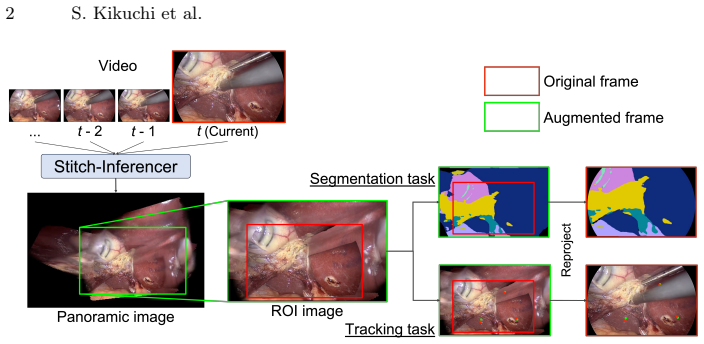
Stitch-Inferencer stitches valid endoscopic frames into an instrument-free panorama, then runs segmentation and tracking on that panorama and reprojects results, granting long-range context without retraining.
Reviewed by Pith at T0; open to challenge. T0 means a machine referee read the full paper against a public rubric. the ladder, T0–T4 →
T0 review · deepseek-v4-flash
2026-08-02 00:33 UTC pith:NUFCFGJT
load-bearing objection Useful inference wrapper with a real but fixable ablation gap: gains might come from masking, not stitching. the 4 major comments →
Stitch-Inferencer: Enhance Endoscopic Video Segmentation and Tracking via Panoramic Reconstruction
The pith
A machine-rendered reading of the paper's core claim, the machinery that carries it, and where it could break.
Core claim
The central claim is that an online, instrument-free panoramic canvas can serve as an explicit spatial memory for endoscopic video, replacing the implicit feature memory used by video models. By accumulating valid observations under a cumulative homography and masking tools, ports, and black borders, the method preserves pixels that are temporarily occluded or outside the field of view. Downstream segmentation or tracking models applied to a compact ROI on this canvas, with predictions warped back to the current frame, outperform the same models applied to the raw frame on CholecSeg8k anatomy segmentation and on STIR24/SurgT tracking benchmarks.
What carries the argument
The mechanism is an online panoramic canvas built by estimating the homography between consecutive frames, masking invalid regions (instruments, ports, dark borders), and alpha-blending each valid frame into a 3x canvas. A cumulative warp tracks the current frame's location on the canvas; a blur gate skips poor frames; inference runs on a compact region of interest and is inverse-warped back to the frame. The ROI sizing is load-bearing: too large a view dilutes local detail, too small loses context.
Load-bearing premise
The whole pipeline depends on the assumption that the laparoscopic view is approximately planar and perpendicular to the tissue, so consecutive frames can be aligned by a single homography; if deformation or parallax breaks that alignment, the panorama accumulates errors and the context becomes stale or warped.
What would settle it
Run the same inference without and with Stitch-Inferencer on a long clinical video with strong tissue deformation (e.g., organs being retracted or bowel peristalsis), and look for a sequence where the stitched panorama visibly misaligns and the downstream Dice on the reprojected frame falls below the per-frame baseline.
If this is right
- Single-frame segmentation and tracking models get temporal context at inference time with no retraining.
- Regions occluded by instruments or outside the field of view remain accessible through previously stitched pixels.
- The stitching module runs at over 60 FPS, so the pipeline stays real-time for intraoperative use.
- Consistent gains across CNN-based segmentation baselines and multiple trackers suggest the method is model-agnostic.
- ROI construction matters: a narrow ROI around the current frame outperforms the full stitched canvas.
Where Pith is reading between the lines
- If the panorama is treated as a persistent observation buffer, the same mechanism could support higher-level surgical understanding tasks such as phase recognition or surgical VQA, since the explicit canvas is interpretable and maskable.
- The method's main weakness suggests a natural extension: confidence-aware warping or adaptive reset policies could make it robust to deformable tissue and parallax, which the paper lists as future work.
- The core idea may transfer to other near-planar endoscopic or industrial scenes, where camera motion is moderate and a homography is a good local model, enabling similar training-free context for other models.
Editorial analysis
A structured set of objections, weighed in public.
Referee Report
Summary. The paper proposes Stitch-Inferencer, an inference-time, model-agnostic framework for endoscopic video. The method maintains an online panoramic canvas by masking invalid regions (image borders, surgical tools, trocar ports), estimating inter-frame homographies from ALIKED/LightGlue matches, and compositing masked valid observations. Downstream segmentation or tracking models are then applied to a compact ROI on the panorama, and their predictions are reprojected to the current frame, requiring no retraining. On CholecSeg8k, the method reports Dice gains for four of five single-frame segmentation baselines (e.g., UNet++ 0.6884→0.7436), while SegFormer's Dice drops from 0.7128 to 0.6995. On STIR24/SurgT, most trackers improve, though Litetracker shows a small STIR24 δ-avg decrease (0.76298→0.76215) and slightly worse SurgT Err2D/Err3D. A three-way ROI ablation (internal, external, entire canvas) is reported. The paper also states important limitations regarding planar homography and deformable tissue.
Significance. If the central causal claim is confirmed—that explicit panoramic accumulation of previously observed pixels improves downstream inference—Stitch-Inferencer would be a practically valuable, model-agnostic plug-in: it requires no retraining, runs in real time (45–52 FPS full pipeline), and provides an interpretable image-space memory alternative to learned video models. The manuscript is also transparent about its planar-homography limitations and evaluates across a broad set of baselines and two tasks. However, the current evidence does not isolate the contribution of panoramic stitching from the contribution of input sanitization (tool/port/border masking). A simple control condition is needed before the paper's central claim can be accepted.
major comments (4)
- [§3.3, Table 3; §2 (Invalid-region mask)] The central causal claim—that stitching/accumulation of panoramic context improves downstream inference—is not identified. The stitched variant differs from the baseline in two ways: it removes tools, ports, and borders via M_t, and it adds contextual pixels through the canvas. Since tools and ports are excluded from the evaluation metric, removing them could alone explain the reported Dice/tracking gains. Table 3 ablates the ROI definition (internal, external, entire canvas) but never includes a condition where only the current masked frame, without any accumulation, is passed through the same ROI crop/resize pipeline. This control is necessary to distinguish the effect of panoramic memory from the effect of input sanitization. Please add a 'masked current frame only' condition for both CholecSeg8k and STIR24.
- [Abstract; Table 1; Table 2] The abstract claims 'consistent improvements across diverse baselines,' but the paper's own tables contradict this. Table 1 shows SegFormer Dice dropping from 0.7128 to 0.6995. Table 2 shows Litetracker δ-avg on STIR24 decreasing from 0.76298 to 0.76215, with slightly worse Err2D (5.1→5.2) and Err3D (1.55→1.83) on SurgT. The body text in §3.1 correctly limits the segmentation claim to 'all evaluated single-frame baselines except SegFormer,' but the abstract and discussion state the stronger claim. This should be qualified, or the exceptions should be explicitly addressed (e.g., with variance estimates).
- [§2 (Inference ROI and reprojection); §3.3 Table 3] A second confound in the comparison is resolution/scale. The baseline is evaluated on the full frame at its native resolution, while the stitched variant resizes an ROI that contains the current frame plus additional context to the model input size. This changes the effective scale of the current-frame content and can independently influence segmentation and tracking performance. The internal-ROI condition in Table 3 should be compared against an internal-ROI applied to the current masked frame alone (no canvas accumulation). Without this control, the ROI size effect and the panoramic-context effect are entangled.
- [§2 (Matching and inter-frame homography); §3.2] For tracking experiments, the paper applies optical-flow-based keypoint filtering using NeuFlowv2, but it does not state explicitly between which frames the flow is computed. If the flow is computed between I_t and I_{t-1}, the text should say so. If the flow uses future frames, the real-time/online claim in Table 2 would be compromised. Please specify the temporal direction and the latency contribution of this filtering step, since the paper's practical contribution depends on online operation.
minor comments (4)
- [Throughout] The Tables contain formatting typos: 'T able 1', 'T able 2', 'T able 3'. Also, the p95 latency column does not specify units in the caption; should be milliseconds.
- [§2, Eq. (2)] The notation for the seam-aware blending weight is inconsistent. The text introduces 'α_t^C = W(α_t^I; H_{t→C})', but H_{t→C} is not defined; the paper earlier defines W_{It→C} using S^T G_t. Please unify the notation.
- [§3.3, Table 3] The ablation table does not report standard deviations or the number of sequences/frames used. Given the small mean differences for STIR24 (0.7778→0.7796), a variance estimate is important to assess whether the internal ROI gain is meaningful.
- [§4, Limitations] The limitations paragraph appropriately acknowledges the planar-homography vulnerability and the lack of long-duration dynamic-camera benchmarks. This is a strength of the paper's framing, but the authors might also note that their re-anchoring heuristic (shear>15°, rotation>15°, scale>2.0) is not an adaptive deformation correction, so the stated limitation is accurate.
Circularity Check
No significant circularity; central claim is an empirical wrapper, with only a minor non-load-bearing self-citation for the auxiliary port mask.
full rationale
The core derivation chain is not self-definitional: Stitch-Inferencer is an inference-time wrapper that feeds pre-trained single-frame models a stitched, masked ROI and reprojects outputs. The reported gains (Table 1: UNet++ 0.6884→0.7436; Table 2 STIR/SurgT) are measured against external baselines and datasets (CholecSeg8k, STIR24, SurgT), not derived from the method's equations; no fitted parameter is relabeled as a prediction. The improvement is not forced by construction—SegFormer degrades (0.7128→0.6995), showing the result is contingent. The only same-author citation is Cholec80-port [13], used to train the auxiliary port mask (Section 2, 'Invalid-region mask'); this mask is a component of input sanitization, is validated separately (Dice 0.77), and could in principle be replaced by an external port segmenter, so it is not load-bearing for the stitching claim. The paper's own limitation (Section 4: planar homography vulnerable to deformation/parallax, no correction for stale context) honestly scopes the method. The absence of an ablation isolating stitching from masking is an internal-validity concern, not circularity, since the gain is empirical rather than a mathematical consequence of the pipeline.
Axiom & Free-Parameter Ledger
free parameters (5)
- Blur threshold τ_blur =
30
- Blending decay radius r =
201 px
- Re-anchor thresholds =
shear > 15°, rotation > 15°, scale > 2.0
- Optical-flow outlier threshold =
2σ
- Canvas size =
3h × 3w
axioms (4)
- domain assumption Planar homography accurately models inter-frame alignment in laparoscopic video.
- domain assumption Tool, port, and border masks are accurate and transferable to the evaluation videos.
- domain assumption The panorama ROI preserves enough local detail and input distribution for off-the-shelf models trained on original frames.
- domain assumption Accumulated pixels remain geometrically consistent over time without a drift-correction mechanism.
read the original abstract
Surgical video understanding is fundamental to navigation systems. Endoscopic perception is often hindered by a limited field-of-view and frequent instrument occlusions, making spatio-temporal context essential for robust inference. These challenges have motivated video models that aggregate information across frames. However, existing video models typically store past observations implicitly in learned feature representations, often requiring task-specific video training, substantial annotated data, and increased computational cost. We propose Stitch-Inferencer, a real-time, model-agnostic inference framework that replaces implicit feature memory with an explicit image-space panoramic canvas. By stitching valid observations across frames, Stitch-Inferencer preserves previously observed pixels in an online, instrument-free view, expanding the effective field-of-view and providing direct access to regions that are temporarily occluded or absent from the current frame. Downstream segmentation or tracking models are applied to a compact region of interest on the panorama, and their predictions are reprojected to the current frame, enabling existing models to exploit long-range context without retraining. Experiments on anatomy segmentation and point/box tracking demonstrate consistent improvements across diverse baselines while preserving real-time throughput. The stitching module alone runs at over 60 FPS, providing a practical inference-time solution to enhance endoscopic perception in computationally constrained intraoperative environments. Source code will be made publicly available.
Figures


Reference graph
Works this paper leans on
-
[1]
Scientific Data12(1), 825 (2025)
Alabi, O., et al.: Cholecinstanceseg: A tool instance segmentation dataset for la- paroscopic surgery. Scientific Data12(1), 825 (2025)
2025
-
[2]
Allan, M., et al.: 2018 robotic scene segmentation challenge (2020), https://arxiv.org/abs/2001.11190
Pith/arXiv arXiv 2018
-
[3]
Carion, N., et al.: Sam 3: Segment anything with concepts (2025), https://arxiv.org/abs/2511.16719
Pith/arXiv arXiv 2025
-
[4]
Medical Image Analysis91, 102985 (2024)
Cartucho, J., et al.: Surgt challenge: Benchmark of soft-tissue trackers for robotic surgery. Medical Image Analysis91, 102985 (2024)
2024
-
[5]
In: ECCV
Chen, L.C., et al.: Encoder-decoder with atrous separable convolution for semantic image segmentation. In: ECCV. pp. 833–851 (2018)
2018
-
[6]
IJCARS19(2), 375–382 (2024)
Grammatikopoulou, M., et al.: A spatio-temporal network for video semantic seg- mentation in surgical videos. IJCARS19(2), 375–382 (2024)
2024
-
[7]
Hong, W.Y., et al.: Cholecseg8k: A semantic segmentation dataset for laparoscopic cholecystectomy based on cholec80 (2020), https://arxiv.org/abs/2012.12453
Pith/arXiv arXiv 2020
-
[8]
In: MICCAI (2024)
Hu, Q., et al.: Sali: Short-term alignment and long-term interaction network for colonoscopy video polyp segmentation. In: MICCAI (2024)
2024
-
[9]
Jiang, C., et al.: Medical sam3: A foundation model for universal prompt-driven medical image segmentation (2026), https://arxiv.org/abs/2601.10880
arXiv 2026
-
[10]
Ju, X., et al.: Segcol challenge: Semantic segmentation for tools and fold edges in colonoscopy data (2024), https://arxiv.org/abs/2412.16078
Pith/arXiv arXiv 2024
-
[11]
In: ICCV
Karaev, N., et al.: Cotracker3: Simpler and better point tracking by pseudo- labelling real videos. In: ICCV. pp. 6013–6022 (2025)
2025
-
[12]
In: MICCAI (2025)
Karaoglu, M.A., Ji, W., Abbas, A., Navab, N., et al.: Litetracker: Leveraging tem- poral causality for accurate low-latency tissue tracking. In: MICCAI (2025)
2025
-
[13]
Kikuchi, S., et al.: Cholec80-port: A geometrically consistent trocar port segmentation dataset for robust surgical scene understanding (2026), https://arxiv.org/abs/2602.17060
arXiv 2026
-
[14]
In: ICCV (2023)
Lindenberger, P., et al.: LightGlue: Local Feature Matching at Light Speed. In: ICCV (2023)
2023
-
[15]
CVPR (2022)
Liu, Z., et al.: A convnet for the 2020s. CVPR (2022)
2022
-
[16]
In: ICLR (2019)
Loshchilov, I., Hutter, F.: Decoupled weight decay regularization. In: ICLR (2019)
2019
-
[17]
International Journal of Computer Vision (2018)
Lukežič, A., et al.: Discriminative correlation filter tracker with channel and spatial reliability. International Journal of Computer Vision (2018)
2018
-
[18]
CoRR (2020)
Maqbool, S., et al.: m2caiseg: Semantic segmentation of laparoscopic images using convolutional neural networks. CoRR (2020)
2020
-
[19]
Mascagni, P., et al.: Endoscapes, a critical view of safety and surgical scene seg- mentation dataset for laparoscopic cholecystectomy. Sci. Data12(2025)
2025
-
[20]
Nasirihaghighi, S., et al.: Gynsurg: A comprehensive gynecology laparoscopic surgery dataset (2025), https://arxiv.org/abs/2506.11356
Pith/arXiv arXiv 2025
-
[21]
In: WACV
Neoral, M., et al.: MFT: Long-term tracking of every pixel. In: WACV. pp. 6837– 6847 (2024)
2024
-
[22]
In: ECCV
Park, J., et al.: Videomamba: Spatio-temporal selective state space model. In: ECCV. pp. 1–18 (2024)
2024
-
[23]
Psychogyios, D., et al.: Sar-rarp50: Segmentation of surgical instrumentation and action recognition on robot-assisted radical prostatectomy challenge (2024), https://arxiv.org/abs/2401.00496
Pith/arXiv arXiv 2024
-
[24]
In: MICCAI
Ronneberger, O., et al.: U-net: Convolutional networks for biomedical image seg- mentation. In: MICCAI. pp. 234–241 (2015) 10 S. Kikuchi et al
2015
-
[25]
arXiv:2511.06549 (2025), https://arxiv.org/abs/2511.06549
Rueckert, T., et al.: Video dataset for surgical phase, keypoint, and instru- ment recognition in laparoscopic surgery (phakir). arXiv:2511.06549 (2025), https://arxiv.org/abs/2511.06549
arXiv 2025
-
[26]
IEEE TMI43, 2634–2645 (2024)
Schmidt, A., et al.: Surgical tattoos in infrared: A dataset for quantifying tissue tracking and mapping. IEEE TMI43, 2634–2645 (2024)
2024
-
[27]
In: ICIP
Wang, H., et al.: Temporal memory attention for video semantic segmentation. In: ICIP. pp. 2254–2258. IEEE (2021)
2021
-
[28]
TPAMI (2019)
Wang, J., et al.: Deep high-resolution representation learning for visual recognition. TPAMI (2019)
2019
-
[29]
Computational Visual Media8(3), 415–424 (2022)
Wang, W., et al.: Pvt v2: Improved baselines with pyramid vision transformer. Computational Visual Media8(3), 415–424 (2022)
2022
-
[30]
In: ECCV
Xiao, T., et al.: Unified perceptual parsing for scene understanding. In: ECCV. pp. 432–448 (2018)
2018
-
[31]
In: NeurIPS (2021)
Xie, E., et al.: Segformer: Simple and efficient design for semantic segmentation with transformers. In: NeurIPS (2021)
2021
-
[32]
In: ICCV
Xu, X., et al.: Dual-temporal exemplar representation network for video semantic segmentation. In: ICCV. pp. 10775–10785 (2025)
2025
-
[33]
Zhang, Z., et al.: Neuflow v2: Push high-efficiency optical flow to the limit (2025)
2025
-
[34]
IEEE Transactions on Instrumentation & Measure- ment72, 1–16 (2023)
Zhao, X., et al.: Aliked: A lighter keypoint and descriptor extraction network via deformable transformation. IEEE Transactions on Instrumentation & Measure- ment72, 1–16 (2023)
2023
-
[35]
IEEE Transactions on Medical Imaging (2019)
Zhou, Z., et al.: Unet++: Redesigning skip connections to exploit multiscale fea- tures in image segmentation. IEEE Transactions on Medical Imaging (2019)
2019
-
[36]
Zia, A., et al.: Intuitive surgical surgtoolloc challenge results: 2022-2023 (2025), https://arxiv.org/abs/2305.07152
Pith/arXiv arXiv 2022
discussion (0)
Sign in with ORCID, Apple, or X to comment. Anyone can read and Pith papers without signing in.