REVIEW 3 major objections 4 minor 106 references
A study on the properties of hidden-charm pentaquarks with double strangeness
T0 review · 3 major / 4 minor · reviewed 2026-08-15 · deepseek-v4-flash
Pith's one-line read A quark-model calculation predicts five hidden-charm pentaquark resonances with double strangeness, with masses of 4600–4772 MeV and widths of 3–24 MeV.
desk verdict First QDCSM scan of the double-strange hidden-charm pentaquark sector, but the five-resonance claim depends on a channel-coupling choice the paper never justifies. read the letter →
The pith
A machine-rendered reading of the paper's core claim, the machinery that carries it, and where it could break.
The reading
What carries the argument
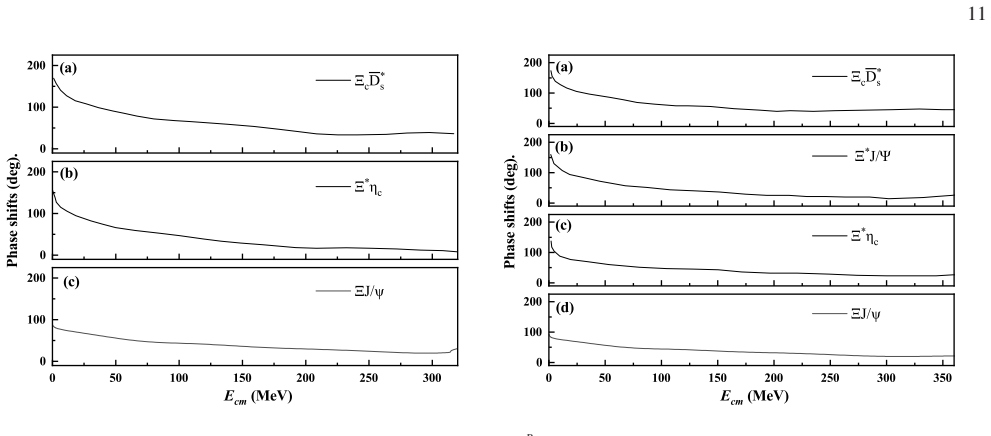
The machinery is the quark delocalization color screening model (QDCSM) solved with the resonating group method. The five quarks are split into a baryon cluster and a meson cluster; the confining interaction between clusters is softened by a color-screening parameter $\mu_{ij}$, and quark orbitals are allowed to delocalize across clusters. The resonating group method reduces the five-body problem to relative-motion equations, giving effective potentials that identify attractive channels and scattering phase shifts that expose resonances. The load-bearing diagnostic is a 180-degree phase-shift jump in a coupled open channel: that jump is what turns a would-be bound state into a predicted resonance with a mass and width.
What would settle it
Recompute the phase shifts with $\mu_{cc}$ set to $10^{-4}$ fm$^{-2}$ instead of $10^{-2}$ fm$^{-2}$: if the 180-degree jumps that define the five resonances vanish or move by more than the quoted mass ranges, the predictions depend critically on the hand-set charm screening parameter. Experimentally, a high-statistics scan of the $J/\psi\Xi$ invariant mass in $\Xi_b$ and $\Lambda_b$ decays that finds no narrow peaks near 4600, 4685, 4753, and 4771 MeV would exclude these states as predicted.
Extended reading notes
Core claim
The central claim is that the low-lying $nssc\bar c$ system contains five S-wave resonances that are meson-baryon molecules: $\Xi_c' \bar D_s^*$ with $J^P = 1/2^-$ (mass 4682–4688 MeV, width 6.4–24.2 MeV), $\Xi_c^* \bar D_s^*$ with $J^P = 1/2^-$ (4751–4756 MeV, width 3.2–18.7 MeV), $\Xi_c^* \bar D_s$ with $J^P = 3/2^-$ (about 4600 MeV, width 21.7 MeV), $\Xi_c^* \bar D_s^*$ with $J^P = 3/2^-$ (4749–4755 MeV, width 16.4 MeV), and $\Omega_c^* \bar D^*$ with $J^P = 3/2^-$ (4771–4772 MeV, width 18.8 MeV). Each appears as a sudden 180-degree jump in the scattering phase shift of at least one open channel, the signature used to classify it as a resonance rather than a bound state or a plain scattering variation. The states are not bound after full channel coupling; they sit above the lowest threshold and decay through channels such as $\Xi\eta_c$, $\Xi J/\psi$, and $\Xi_c \bar D_s^*$.
Load-bearing premise
The calculation assumes that the color-screening parameter for charm quarks, which controls how the confining force softens between clusters, can be extrapolated from light-quark values by setting $\mu_{cc}=0.01$ fm$^{-2}$ and scaling $\mu_{sc}^2=\mu_{ss}\mu_{cc}$ and $\mu_{nc}^2=\mu_{nn}\mu_{cc}$; if that extrapolation is wrong, the effective potentials and all five predicted masses and widths shift, and the states could disappear.
Editorial extensions
If this is right
- If the five resonances exist, the hidden-charm pentaquark family extends to strangeness $S=-2$, with molecular states built from a charmed baryon ($\Xi_c'$, $\Xi_c^*$, or $\Omega_c^*$) plus a $\bar D_s$ or $\bar D^*$ meson.
- The predicted masses and widths give concrete search windows: $J/\psi\Xi$ or $\eta_c\Xi$ mass spectra should show peaks near 4600, 4685, 4753, and 4771 MeV, each narrower than about 25 MeV.
- Each resonance has a distinctive discovery channel; for example, $\Xi_c^*\bar D_s$ is visible only through the $\Xi_c\bar D_s^*$ open channel, so that one search can confirm or exclude it.
- Confirmation would support the model's treatment of heavy-quark color screening and channel coupling as a reliable tool for multiquark predictions, extending its success on the observed $P_c$ and $P_{cs}$ states to an unexplored strangeness sector.
Reading between the lines
- My inference: the predicted widths are narrow enough that reanalyzing existing $\Xi_b$ and $\Lambda_b$ decay data, without waiting for new data, could already test the 4600 and 4685 MeV states.
- My inference: the hand-set charm screening parameter $\mu_{cc}=0.01\,\mathrm{fm}^{-2}$ is the dominant uncertainty; varying it over $10^{-4}$–$10^{-2}$ fm$^{-2}$ in the same calculation would show which of the five states are robust.
- My inference: since the calculation is S-wave only, tensor-force coupling to higher partial waves could split or shift the $3/2^-$ states, and the line shape of $\Xi_c^*\bar D_s^*$ would be the place to look for such an effect.
- My inference: the phase-shift method locates resonances from the jump energy rather than from a pole in the complex energy plane, so an analytic continuation of the scattering amplitude would give sharper widths.
Signed reviews
Editorial analysis
A structured set of objections, weighed in public.
Referee Report
Summary. The manuscript studies hidden-charm double-strange pentaquark systems with quark content nssc cbar using the quark delocalization color screening model (QDCSM) with the resonating group method. For each of JP=1/2-, 3/2-, and 5/2-, the authors compute effective hadron-hadron potentials, perform single- and multi-channel bound-state calculations, and then examine scattering phase shifts in open channels to identify resonances. The central claim is that five S-wave molecular resonances exist in the JP=1/2- and 3/2- sectors: Xi'_c D*_s and Xi*_c D*_s for 1/2-, and Xi*_c D_s, Xi*_c D*_s, and Omega*_c D* for 3/2-, with predicted masses in the range 4600-4772 MeV and widths of 3-24 MeV. The paper also presents the JP=5/2- sector, where no resonance is found.
Significance. If the five predicted resonances are robust, they would provide concrete, testable predictions for hidden-charm double-strange pentaquark searches at LHCb and CMS, particularly in J/psi Xi and related channels. A strength of the calculation is that the model parameters, including the color-screening parameters for light quarks, are fixed by previous fits to meson and baryon mass spectra and NN scattering, rather than fitted to the target sector. The phase-shift method for identifying resonances is standard, and the authors compare with several existing model results. However, the significance of the central five-state claim is currently undermined by an unresolved dependence on the channel-coupling truncation, as detailed in the major comments.
major comments (3)
- [Sec. III.B, Fig. 9, Tables V and VII] The six-channel coupling calculation described in Sec. III.B and shown in Fig. 9 finds no resonant phase-shift jump in the open channels Xi J/psi and Xi* eta_c, and for the open channel Xi_c D*_s finds only the Xi*_c D_s resonance. The text explicitly states that under six-channel coupling 'only bound state Xi*_c D_s transforms into a resonant state, while the others transition to scattering states,' yet Tables V and VII still list Xi*_c D*_s and Omega*_c D* as JP=3/2- resonances, with masses and widths taken from the two-channel coupling results of Figs. 7 and 8. No justification is given for preferring the two-channel result over the more complete six-channel result. This is load-bearing for the central claim, since adopting the six-channel coupling as the primary result reduces the number of claimed JP=3/2- states from three to one.
- [Sec. III.A, Figs. 3-4, Table III] For JP=1/2-, the three-channel coupling with open channels Xi* J/psi and Xi_c D*_s removes the Xi*_c D*_s resonance (the text states that 'resonance state Xi*_c D* disappears in the corresponding scattering processes after the three-channel coupling estimation'), yet Table VII lists Xi*_c D*_s as a resonance with a width range 3.2-18.7 MeV. Table III shows that the 3.2 MeV width comes from the two-channel coupling while the 18.7 MeV value comes from the three-channel coupling, so the quoted range mixes two different coupling schemes. The authors should specify which coupling scheme is physical and present a single consistent prediction, or quantify the truncation uncertainty in the resonance parameters.
- [Sec. II, after Eq. (6)] The color-screening parameter for charm quarks, mu_cc, is set to 0.01 fm^-2 by hand, and mu_sc and mu_nc are obtained through the geometric-mean relations mu^2_sc = mu_ss mu_cc and mu^2_nc = mu_nn mu_cc. The authors note that a previous study found weak dependence on mu_cc, but no sensitivity analysis is presented for the double-strange sector studied here. Since the existence and properties of all five predicted resonances follow from the effective potentials, some estimate of the uncertainty induced by the mu_cc choice (e.g., varying mu_cc over the range 10^-4 to 10^-2 fm^-2 used in Ref. [89]) is needed to support the quoted precision of the masses and widths.
minor comments (4)
- [Sec. III.B, text before Table IV] The text says 'Table II lists that lowest eigenvalues estimated for single-channel and all-channel coupling in the sector with a quantum number of 3/2-' but the relevant table is Table IV; Table II is for JP=1/2-.
- [Tables II, IV, VI, columns E_cc/EB and E'_cc] The column headers combine two quantities into one column (e.g., '4362/2 4300'); please split these into clearly labeled columns or add an explicit definition in the caption.
- [Throughout] The notation for channels is inconsistent in places, with the subscript 's' sometimes omitted from D*_s; please standardize the channel labels to avoid ambiguity.
- [Sec. III.B, paragraph after Fig. 9] The sentence 'Table V provides the masses and decay widths of the three obtained resonance states' appears immediately after a description in which only the Xi*_c D_s resonance is found; please revise to clearly separate the six-channel results from the two-channel results.
Circularity Check
No significant circularity: the five-state predictions are dynamical outputs of an RGM scattering calculation whose parameters were fitted to independent hadron and scattering data, not to the double-strange pentaquark sector.
full rationale
The paper's central claim is that five S-wave resonances in the nssc cbar system emerge from RGM/QDCSM phase-shift calculations. The model parameters are taken from Ref. [89], which is the authors' own prior work; however, the paper states these were 'determined by reproducing the mass spectrum of the ground states mesons and baryons in QDCSM,' and the color-screening parameters came from fitting deuteron properties, nucleon-nucleon, and nucleon-hyperon scattering phase shifts (Refs. [85,88]). These are external inputs, not the double-strange pentaquark sector, so using them to predict the pentaquark spectrum is a genuine extrapolation rather than a fit to the target result. The heavy-quark screening parameters mu_cc, mu_sc, and mu_nc are indeed set by an adjustable extrapolation, but this is a stated assumption with acknowledged uncertainty, not a hidden re-injection of the claimed five states. The resonance masses are derived from the open-channel threshold plus the incident energy at a scattering phase shift of pi/2, with a correction from experimental hadron masses; the widths come from phase-shift energy differences. None of these quantities is defined in terms of the claimed masses or widths. The self-citations are load-bearing for the model but are supported by externally fitted data and by the prior successful description of Pc states, so they constitute independent support rather than circularity. A separate internal inconsistency does exist: the six-channel JP=3/2- coupling (Fig. 9) removes the Xi*_c D*_s and Omega*_c D* resonances seen in two-channel coupling, yet Tables V and VII still list them. This is a robustness/correctness concern, not a circularity of the derivation.
Assumptions & free parameters
free parameters (2)
- mu_cc (color screening for cc pairs) =
0.01 fm^-2 (chosen by hand; mu_sc, mu_nc derived via geometric mean)
- QDCSM parameter set from Ref [89] =
Quark masses, ac, g_ch, b, etc., fixed to values from Ref [89]
assumptions (4)
- domain assumption The nssc cbar system can be described as two clusters, a baryon and a meson, with the resonating group method and generator-coordinate expansion.
- domain assumption S-wave truncation: spin-orbit and tensor contributions are neglected, restricting quantum numbers to I=1/2 and S=1/2, 3/2, 5/2.
- domain assumption The geometric-mean relation for color-screening parameters extends to heavy quarks: mu^2_sc = mu_ss mu_cc and mu^2_nc = mu_nn mu_cc.
- domain assumption A resonance is identified by a rapid 180-degree phase-shift jump in the open-channel scattering calculation.
Cite this review
Pith. "Pith review of A study on the properties of hidden-charm pentaquarks with double strangeness." pith.science (2026). https://pith.science/paper/NUXT4XZK
@misc{pith2026250508207,
  author       = {Pith},
  title        = {Pith review of: A study on the properties of hidden-charm pentaquarks with double strangeness},
  year         = {2026},
  howpublished = {\url{https://pith.science/paper/NUXT4XZK}},
  note         = {Machine review of arXiv:2505.08207}
}
abstract
Motivated by the LHCb observations of $P_c$ and $P_{cs}$ states, we systematically investigate the hidden-charm double-strange pentaquark system ($nssc\bar{c}$) using the resonating group method within the quark delocalization color screening model (QDCSM). By dynamically incorporating channel coupling effects, five resonance states are identified with $J^P = 1/2^-$ and $3/2^-$. Their masses, widths, and dominant decay channels are predicted, providing critical guidance for future experimental searches.
Figures


Figures from the paper (6 more)




Reference graph
Works this paper leans on
- [89]
-
[1]
Gell-Mann, Phys
M. Gell-Mann, Phys. Lett. 8, 214 (1964)
1964
-
[2]
S. K. Choi et al. (Belle), Phys. Rev. Lett. 91, 262001 (2003), hep-ex/0309032
arXiv 2003
- [3]
- [4]
- [5]
-
[6]
V . M. Abazov et al. (D0), Phys. Rev. Lett. 93, 162002 (2004), hep-ex/0405004
arXiv 2004
- [7]
Show all 106 references
- [8]
- [9]
-
[10]
Hosaka, T
A. Hosaka, T. Iijima, K. Miyabayashi, Y . Sakai, and S. Ya sui, PTEP 2016, 062C01 (2016), 1603.09229
2016 arXiv
-
[11]
H.-X. Chen, W. Chen, X. Liu, and S.-L. Zhu, Phys. Rept. 639, 1 (2016), 1601.02092
2016 arXiv
- [12]
-
[13]
R. F. Lebed, R. E. Mitchell, and E. S. Swanson, Prog. Part . Nucl. Phys. 93, 143 (2017), 1610.04528
2017 arXiv
-
[14]
S. L. Olsen, T. Skwarnicki, and D. Zieminska, Rev. Mod. Phys. 90, 015003 (2018), 1708.04012. 11 /s48 /s53/s48 /s49/s48/s48 /s49/s53/s48 /s50/s48/s48 /s50/s53/s48 /s51/s48/s48 /s48 /s49/s48/s48 /s50/s48/s48 /s40 /s99 /s41 /s80/s104/s97/s115 /s101 /s32/s115 /s104/s105 /s102 /s11...
2018 arXiv
-
[15]
F.-K. Guo, C. Hanhart, U.-G. Meißner, Q. Wang, Q. Zhao, and B.-S. Zou, Rev. Mod. Phys. 90, 015004 (2018), [Erratum: Rev.Mod.Phys. 94, 029901 (2022)], 1705.00141
2018 arXiv
-
[16]
Liu, H.-X
Y .-R. Liu, H.-X. Chen, W. Chen, X. Liu, and S.-L. Zhu, Pro g. Part. Nucl. Phys. 107, 237 (2019), 1903.11976
2019 arXiv
-
[17]
Brambilla, S
N. Brambilla, S. Eidelman, C. Hanhart, A. Nefediev, C.- P . Shen, C. E. Thomas, A. V airo, and C.-Z. Y uan, Phys. Rept. 873, 1 (2020), 1907.07583
2020 arXiv
-
[18]
L. Meng, B. Wang, G.-J. Wang, and S.-L. Zhu, Phys. Rept. 1019, 1 (2023), 2204.08716
2023 arXiv
-
[19]
H.-X. Chen, W. Chen, X. Liu, Y .-R. Liu, and S.-L. Zhu, Rep t. Prog. Phys. 86, 026201 (2023), 2204.02649
2023 arXiv
- [20]
-
[21]
Aaij et al
R. Aaij et al. (LHCb), Phys. Rev. Lett. 117, 082003 (2016), [Addendum: Phys.Rev.Lett. 117, 109902 (2016), Addendum: Phys.Rev.Lett. 118, 119901 (2017)], 1606.06999
2016 arXiv
- [22]
-
[23]
Aaij et al
R. Aaij et al. (LHCb), Phys. Rev. Lett. 128, 062001 (2022), 2108.04720
2022
-
[24]
Aaij et al
R. Aaij et al. (LHCb), Phys. Rev. D 102, 112012 (2020), 2007.11292
2020
-
[25]
Aaij et al
R. Aaij et al. (LHCb), Sci. Bull. 66, 1278 (2021), 2012.10380
2021
- [26]
-
[27]
R. Chen, X. Liu, and S.-L. Zhu, Nucl. Phys. A 954, 406 (2016), 1601.03233. 12 /s48 /s53/s48 /s49/s48/s48 /s49/s53/s48 /s50/s48/s48 /s50/s53/s48 /s51/s48/s48 /s48 /s49/s48/s48 /s50/s48/s48 /s51/s48/s48 /s69 /s99/s109 /s32 /s40 /s77 /s101 /s86/s41 /s32 /s74/s47 /s40 /s101 /s41 /...
2016 arXiv
-
[28]
Chen, E.-L
H.-X. Chen, E.-L. Cui, W. Chen, X. Liu, T. G. Steele, and S.-L. Zhu, Eur. Phys. J. C 76, 572 (2016), 1602.02433
2016 arXiv
- [29]
- [30]
- [31]
-
[32]
J. He, Eur. Phys. J. C 79, 393 (2019), 1903.11872. /s48 /s49 /s50 /s51 /s53/s48 /s50/s53 /s48 /s50/s53 /s53/s48 /s86/s40 /s83/s41 /s40 /s77 /s101 /s86/s41 /s83 /s109 /s40 /s102/s109/s41 /s32 /s42 /s99 /s68 /s42 /s115 /s32 /s42 /s74/s47 /s32 /s42 /s99 /s68 /s42 FIG. 10: The e ff...
2019 arXiv
- [33]
-
[34]
Liu, Y .-W
M.-Z. Liu, Y .-W. Pan, F.-Z. Peng, M. S´ anchez S´ anchez,L.-S. Geng, A. Hosaka, and M. Pavon V alderrama, Phys. Rev. Lett. 122, 242001 (2019), 1903.11560
2019 arXiv
-
[35]
C.-J. Xiao, Y . Huang, Y .-B. Dong, L.-S. Geng, and D.-Y . Chen, Phys. Rev. D 100, 014022 (2019), 1904.00872
2019 arXiv
- [36]
- [37]
-
[38]
L. Meng, B. Wang, G.-J. Wang, and S.-L. Zhu, in 18th Inter- national Conference on Hadron Spectroscopy and Structure (2020), pp. 313–317, 1911.09250
2020 arXiv
-
[39]
R. Chen, X. Liu, X.-Q. Li, and S.-L. Zhu, Phys. Rev. Lett. 115, 132002 (2015), 1507.03704
2015 arXiv
-
[40]
H.-X. Chen, W. Chen, X. Liu, T. G. Steele, and S.-L. Zhu, Phys. Rev. Lett. 115, 172001 (2015), 1507.03717
2015 arXiv
- [41]
- [42]
-
[43]
L. Roca, J. Nieves, and E. Oset, Phys. Rev. D 92, 094003 (2015), 1507.04249
2015 arXiv
- [44]
-
[45]
Yan, F.-Z
M.-J. Yan, F.-Z. Peng, M. S´ anchez S´ anchez, and M. Pavon V alderrama, Eur. Phys. J. C 82, 574 (2022), 2108.05306
2022 arXiv
- [46]
-
[47]
H.-X. Chen, W. Chen, X. Liu, and X.-H. Liu, Eur. Phys. J. C 81, 409 (2021), 2011.01079
2021 arXiv
-
[48]
Phumphan, K
K. Phumphan, K. Xu, W. Ruangyoo, C.-C. Chen, A. Limphi- rat, and Y . Yan (2021), 2105.03150
2021 arXiv
-
[49]
M.-L. Du, V . Baru, F.-K. Guo, C. Hanhart, U.-G. Meißner, J. A. Oller, and Q. Wang, JHEP 08, 157 (2021), 2102.07159
2021 arXiv
-
[50]
Lu, M.-Z
J.-X. Lu, M.-Z. Liu, R.-X. Shi, and L.-S. Geng, Phys. Rev . D 104, 034022 (2021), 2104.10303
2021 arXiv
- [51]
- [52]
-
[53]
M. I. Eides, V . Y . Petrov, and M. V . Polyakov, Mod. Phys. Lett. A 35, 2050151 (2020), 1904.11616
2020 arXiv
- [54]
- [55]
- [56]
-
[57]
Weng, X.-L
X.-Z. Weng, X.-L. Chen, W.-Z. Deng, and S.-L. Zhu, Phys. Rev. D 100, 016014 (2019), 1904.09891
2019 arXiv
-
[58]
R. Zhu, X. Liu, H. Huang, and C.-F. Qiao, Phys. Lett. B 797, 134869 (2019), 1904.10285
2019 arXiv
-
[59]
Pimikov, H.-J
A. Pimikov, H.-J. Lee, and P . Zhang, Phys. Rev. D 101, 014002 (2020), 1908.04459
2020 arXiv
-
[60]
Ruangyoo, K
W. Ruangyoo, K. Phumphan, C.-C. Chen, A. Limphirat, and Y . Yan, J. Phys. G49, 075001 (2022), 2105.14249
2022 arXiv
-
[61]
Fern´ andez-Ram´ ırez, A
C. Fern´ andez-Ram´ ırez, A. Pilloni, M. Albaladejo, A.Jackura, V . Mathieu, M. Mikhasenko, J. A. Silva-Castro, and A. P . Szczepaniak (JPAC), Phys. Rev. Lett. 123, 092001 (2019), 1904.10021
2019 arXiv
-
[62]
S. X. Nakamura, Phys. Rev. D 103, 111503 (2021), 2103.06817
2021 arXiv
-
[63]
T. J. Burns and E. S. Swanson, Phys. Rev. D 106, 054029 (2022), 2207.00511
2022 arXiv
-
[64]
Hayrapetyan et al
A. Hayrapetyan et al. (CMS), Eur. Phys. J. C 84, 1062 (2024), 2401.16303
2024 arXiv
-
[65]
F.-L. Wang, R. Chen, and X. Liu, Phys. Rev. D 103, 034014 (2021), 2011.14296
2021 arXiv
-
[66]
J. A. Mars´ e-V alera, V . K. Magas, and A. Ramos, Phys. Rev . Lett. 130, 091903 (2023), 2210.02792
2023 arXiv
-
[67]
L. Roca, J. Song, and E. Oset, Phys. Rev. D 109, 094005 (2024), 2403.08732
2024 arXiv
-
[68]
J. A. Mars´ e-V alera, V . K. Magas, and A. Ramos (2024), 2410.10682
2024 arXiv
-
[69]
Magas, A
V . Magas, A. Mars´ e-V alera, and A. Ramos, EPJ Web Conf. 291, 05002 (2024)
2024
-
[70]
P . G. Ortega, D. R. Entem, and F. Fernandez, Phys. Lett. B 838, 137747 (2023), 2210.04465
2023 arXiv
-
[71]
P .-P . Shi, F. Huang, and W.-L. Wang, Eur. Phys. J. A 57, 237 (2021), 2107.08680
2021 arXiv
- [72]
- [73]
- [74]
- [75]
-
[76]
E. Oset, L. Roca, and M. Whitehead, Phys. Rev. D 110, 034016 (2024), 2406.16504
2024 arXiv
-
[77]
J.-J. Wu, R. Molina, E. Oset, and B. S. Zou, Phys. Rev. C 84, 015202 (2011), 1011.2399
2011 arXiv
-
[78]
C. W. Xiao, J. Nieves, and E. Oset, Phys. Rev. D 88, 056012 (2013), 1304.5368
2013 arXiv
-
[79]
De Rujula, H
A. De Rujula, H. Georgi, and S. L. Glashow, Phys. Rev. D 12, 147 (1975)
1975
-
[80]
Isgur and G
N. Isgur and G. Karl, Phys. Rev. D 20, 1191 (1979)
1979
-
[81]
Isgur and G
N. Isgur and G. Karl, Phys. Rev. D 19, 2653 (1979), [Erratum: Phys.Rev.D 23, 817 (1981)]
1979
-
[82]
Isgur and G
N. Isgur and G. Karl, Phys. Rev. D 18, 4187 (1978)
1978
-
[83]
Wang, G.-h
F. Wang, G.-h. Wu, L.-j. Teng, and J. T. Goldman, Phys. Re v. Lett. 69, 2901 (1992), nucl-th /9210002
1992
-
[84]
L. Chen, H. Pang, H. Huang, J. Ping, and F. Wang, Phys. Rev . C 76, 014001 (2007), nucl-th /0703103
2007
-
[85]
M. Chen, H. Huang, J. Ping, and F. Wang, Phys. Rev. C 83, 015202 (2011)
2011
-
[86]
Wu, L.-J
G.-H. Wu, L.-J. Teng, J. L. Ping, F. Wang, and J. T. Goldma n, Phys. Rev. C 53, 1161 (1996)
1996
-
[87]
Huang, P
H. Huang, P . Xu, J. Ping, and F. Wang, Phys. Rev. C 84, 064001 (2011), 1109.5607
2011 arXiv
-
[88]
F. Wang, D. Qing, P . Xu, and J.-L. Ping, Nucl. Phys. A 631, 462C (1998)
1998
- [90]
-
[91]
X. Liu, D. Chen, H. Huang, J. Ping, X. Chen, and Y . Yang, Sci. China Phys. Mech. Astron. 66, 221012 (2023), 2204.08104
2023 arXiv
-
[92]
Tanabashi et al
M. Tanabashi et al. (Particle Data Group), Phys. Rev. D 98, 030001 (2018)
2018
-
[93]
Vijande, F
J. Vijande, F. Fernandez, and A. V alcarce, J. Phys. G 31, 481 (2005), hep-ph/0411299
2005 arXiv
-
[94]
Fernandez and E
F. Fernandez and E. Oset, Nucl. Phys. A 455, 720 (1986)
1986
-
[95]
Wu, J.-L
G.-h. Wu, J.-L. Ping, L.-j. Teng, F. Wang, and J. T. Goldm an, Nucl. Phys. A 673, 279 (2000), nucl-th /9812079
2000
-
[96]
J.-L. Ping, F. Wang, and J. T. Goldman, Nucl. Phys. A 657, 95 (1999), nucl-th/9812068
1999 arXiv
-
[97]
H. R. Pang, J. L. Ping, F. Wang, and J. T. Goldman, Phys. Re v. C 65, 014003 (2002), nucl-th /0106056
2002
- [98]
-
[99]
M. Xu, M. Y u, and L. Liu, Phys. Rev. Lett. 100, 092301 (2008), 0712.1641
2008 arXiv
-
[100]
Z. Xia, S. Fan, X. Zhu, H. Huang, and J. Ping, Phys. Rev. C 105, 025201 (2022), 2105.14723
2022 arXiv
-
[101]
Huang, J
H. Huang, J. Ping, X. Zhu, and F. Wang, Eur. Phys. J. C 82, 805 (2022), 2011.00513
2022 arXiv
-
[102]
Kamimura, Prog
M. Kamimura, Prog. Theor. Phys. Suppl. 62, 236 (1977)
1977
-
[103]
J. A. Wheeler, Physical Review 52, 1083 (1937)
1937
-
[104]
D. L. Hill and J. A. Wheeler, Phys. Rev. 89, 1102 (1953)
1953
-
[105]
J. J. Gri ffin and J. A. Wheeler, Phys. Rev. 108, 311 (1957)
1957
-
[106]
X. Liu, Y . Tan, X. Chen, D. Chen, H. Huang, and J. Ping, Phys. Rev. D 108, 094008 (2023)
2023
Reviewed August 15, 2026 · model on record in the stance chip above.
Discussion (0). Continue with ORCID to comment.