REVIEW 3 major objections 4 minor 44 references
New families of non-parity-time-symmetric complex potentials with all-real spectra
T0 review · 3 major / 4 minor · reviewed 2026-08-14 · deepseek-v4-flash
Pith's one-line read A supersymmetry formula gives non-PT-symmetric potentials with all-real spectra.
desk verdict Useful explicit families of non-PT-symmetric complex potentials, but the SUSY isospectrality that carries the main result is asserted rather than proved. read the letter →
The pith
A machine-rendered reading of the paper's core claim, the machinery that carries it, and where it could break.
The reading
What carries the argument
The machinery is non-unique factorization of the one-dimensional Schrödinger operator. Writing $$-\partial_{xx}-V_0=(-\partial_x+W)(\partial_x+W)$$ with a second superpotential $W$ related to $h$ by the Riccati equation $W'-W^2=h'-h^2$ gives, after solving through $W=h+\frac{d}{dx}\ln\left(c+\int e^{2\int h}\right)$, the partner operator $(\partial_x+W)(-\partial_x+W)$ whose potential is (2). This operator-order reversal is the supersymmetry map that transfers the spectrum. The second family is carried by a pseudo-Hermiticity relation $\eta L=L^\dagger\eta$ with $\eta=P[\partial_{xx}+a\partial_x+b]$; matching orders of derivatives yields the closed form (23) for $V$ in terms of a PT-symmetric $a$ and real constant $c_2$. The eigenvalue conjugate-pair symmetry produced by this relation is what forces all-real spectra in the wide parameter range.
What would settle it
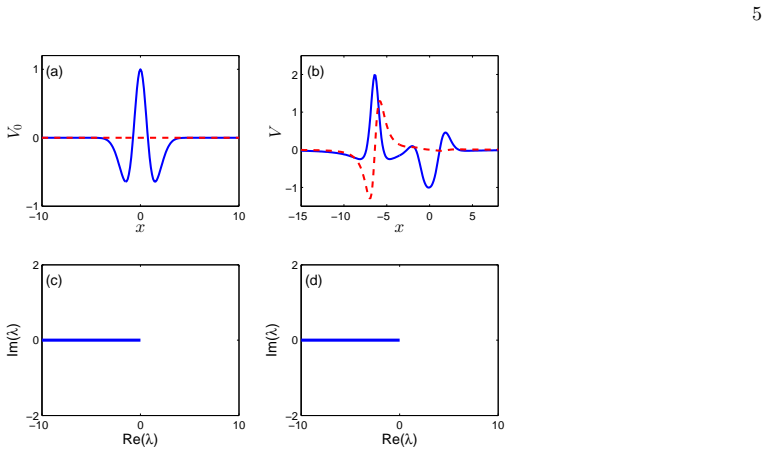
For a localized complex $h$ such as $h=\mathrm{sech}(2x)+i\,\mathrm{sech}(x)\tanh(x)$ with a complex $c$, compute the partner potential (2) and discretize its spectrum on a large interval; if any complex eigenvalue appears while the base potential $h'-h^2$ has only real eigenvalues, or if a discrete eigenvalue of $V_0$ is missing from $V$ because the transformed eigenfunction is not localized, the spectrum-sharing claim fails.
Extended reading notes
Core claim
The paper's central claim is Proposition 1: for an arbitrary complex function $h$ and arbitrary complex constant $c$, the potential $$V(x)=-h'(x)-$h^{2}$(x)+2\frac{$d^{2}$}{$dx^{2}$}\ln\left(c+\int_0^x $e^{{2\int_0^\xi h(\eta)\,d\eta}}$\,d\xi\right)$$ is the supersymmetric partner of $$V_0(x)=h'(x)-$h^{2}$(x),$$ obtained by reversing the order of two first-order factors of the Schrödinger operator $-\partial_{xx}-V_0$. In generic cases the two potentials share exactly the same spectrum, so if $V_0$ is known to have all-real spectrum (for real $h$, for Wadati $h=ig$ with real $g$, or for PT-symmetric $h$), the explicit partner $V$ also has all-real spectrum even though it is generically non-PT-symmetric. Previously such SUSY constructions required a discrete eigenmode of the base potential; here the partner is fully explicit and contains free functions. The paper further derives a pseudo-Hermitian family $$V(x)=a'-\$frac14a^{2}$+\frac{a'^2-2a''a+c_2}{$4a^{2}$}$$ with PT-symmetric $a$ and real $c_2$, whose eigenvalues come in conjugate pairs; the paper argues this symmetry often forces all-real spectra, with phase transition possible under parameter tuning.
Load-bearing premise
The argument rests on the unproven premise that reversing the order of the two first-order factors gives operators with exactly the same full spectrum, including continuous spectrum and localization of transformed eigenfunctions; for the second family it rests on the premise that conjugate-pair eigenvalue symmetry forces an all-real spectrum in the claimed parameter range.
Editorial extensions
If this is right
- Any real function $h$ yields an explicit non-PT-symmetric partner $V$ with all-real spectrum, for any complex constant $c$.
- Any Wadati base $h=ig$ with real $g$, or any PT-symmetric $h$, yields a non-PT-symmetric partner with the same all-real spectrum as the base.
- If the base potential has an exceptional point where two real eigenvalues collide, the partner potential generically has the same exceptional point; spectral singularities, by contrast, are generically not inherited.
- The pseudo-Hermitian family (23) has eigenvalues in complex-conjugate pairs, and tuning its free function and constants can move the system through a phase transition where conjugate-pair complex eigenvalues appear.
- Because the SUSY construction needs no discrete eigenmode of the base potential, the partner potential is given explicitly as an integral formula rather than through solving an eigenproblem.
Reading between the lines
- The partner formula may be applied iteratively, generating a chain of non-PT-symmetric potentials that all share one base spectrum; each step would only need the integrals defining the next $W$ to remain finite.
- The construction invites a numerical test in the optics picture: with $h$ chosen as a single-humped real function, the real part of $V$ would be a non-even refractive index and the imaginary part a gain-loss profile, and the predicted real spectrum could be compared with direct discretization.
- For the pseudo-Hermitian family, the $\beta=1$ versus $\beta=2$ example suggests a critical parameter where the phase transition occurs; locating that boundary as a function of $a$ and $c_2$ would turn the qualitative claim into a sharp criterion.
- One could ask whether the conjugate-pair symmetry in family (23) is also necessary for its all-real spectra, or whether some members have all-real spectra even when the symmetry is broken.
Signed reviews
Editorial analysis
A structured set of objections, weighed in public.
Referee Report
Summary. The paper proposes two constructions of new non-PT-symmetric complex potentials with real spectra. The first, based on supersymmetry, considers the base potential V0 = h' - h^2 for an arbitrary complex function h and constructs an explicit partner potential V = -h' - h^2 + 2 d^2/dx^2 ln(c + ∫ e^{2∫h}) via an alternative factorization of the Schrödinger operator. The second, based on a pseudo-Hermiticity-like relation with eta = P(∂xx + a∂x + b), derives the family V = a' - a^2/4 + (a'^2 - 2a''a + c2)/(4a^2) with PT-symmetric a and real c2, and argues that this family exhibits conjugate-pair eigenvalue symmetry that often forces all-real spectra. The paper claims that the SUSY construction avoids using eigenmodes of the base potential, yielding explicit potentials with free functions and constants, and provides numerical examples illustrating all-real spectra and a phase transition.
Significance. If rigorously established, the SUSY family would provide a broad, explicit class of non-PT-symmetric complex potentials with all-real spectra, extending earlier SUSY constructions that require discrete eigenmodes of a base potential. The pseudo-Hermiticity family adds a new tractable class with a clear algebraic origin. The algebraic derivations are mostly transparent, and the numerical examples support the claims in the displayed cases. However, the central spectral-inheritance assertion for the SUSY family is not proven, and the pseudo-Hermiticity family's all-real-spectrum claim is not characterized. The paper's value lies in the explicit formulas and the demonstration that these families can be tuned; the missing spectral arguments are the main obstacle to accepting the paper's central claims.
major comments (3)
- [Section II, Proposition 1 and Remark 1] The proof of Proposition 1 establishes only the algebraic factorizations (3) and (4); it does not prove that the operators associated with V0 and V have the same spectrum. Remark 1 itself states that an eigenfunction ψ of V0 maps to an eigenfunction of V only if (∂x+W)ψ is localized and nonzero, and similarly in the reverse direction, and that this gives identical spectra only 'in generic cases.' Since every example in the paper uses the unqualified statement that V and V0 share exactly the same spectrum, and since this is the sole mechanism by which the new potentials inherit all-real spectra from V0, the central claim of the SUSY construction is not established. The authors need to state and prove sufficient conditions on h (and c) under which the intertwining operators map the full spectrum, including continuous spectrum, between V0 and V, or at least prove the needed spectral equality for a well-defined class of h.
- [Section II, Eq. (2) and the examples] The formula (2) contains a logarithm of c + ∫ e^{2∫h} dξ, which may vanish, have branch cuts, or produce singularities in the potential for arbitrary complex h and c. The paper claims that h can be an arbitrary complex function and c an arbitrary complex constant, but no regularity or non-vanishing conditions are given. The examples choose specific h and c, so they do not demonstrate that the stated general claim is well-posed. This is load-bearing because the spectral equality, even if proven for smooth W, requires W and the resulting potential to be globally defined and sufficiently well-behaved.
- [Section III, Eq. (23) and the abstract] For the pseudo-Hermiticity family, the derivation shows that the potential (23) satisfies the pseudo-Hermitian relation (14), which implies that complex eigenvalues appear as conjugate pairs when the kernel of η is empty. However, the abstract says this symmetry 'forces the spectrum to be all-real for a wide range of choices,' while the body states only that it 'often forces' all-real spectra and that phase transitions can occur. No criterion is given for distinguishing parameter regimes with all-real spectra from those with conjugate-pair complex eigenvalues. Since the title and abstract promise 'new families ... with all-real spectra,' the paper should either provide a precise condition under which the family (23) has all-real spectra, or substantially weaken the claim for the pseudo-Hermiticity family.
minor comments (4)
- [Abstract and Section III] The abstract's phrasing 'This eigenvalue symmetry forces the spectrum to be all-real for a wide range of choices' is stronger than the body's 'this conjugate-pair eigenvalue symmetry does not guarantee a real spectrum, but it does often force the spectrum to be all-real.' The author should align these statements to avoid overclaiming.
- [Section II, Example 1] In Example 1, the text states that both V0 and V are non-PT-symmetric and that the spectrum of V is the same as that of V0. The figure captions show spectra with no discrete eigenvalues, but the text says 'the spectrum of V0 is all-real' without distinguishing continuous from discrete spectrum. A brief clarification of what spectral data are plotted would help.
- [Section III, Eq. (23) derivation] The sentence 'Neglecting an overall constant c1' is slightly misleading: c1 appears as an additive constant in the integrated expression for V, which simply shifts all eigenvalues, so it is reasonable to drop it, but this should be stated explicitly rather than as a neglect without explanation.
- [General] The paper uses the convention [∂xx+V]ψ = λψ in Eq. (10), while factorizations in Eqs. (3)-(4) are written as -∂xx - V0 = (-∂x+W)(∂x+W). The sign conventions are consistent, but a short remark would help readers not familiar with the SUSY literature.
Circularity Check
No significant circularity: the potentials are explicit and their all-real spectra inherit from cited external results; remaining gaps are unproven spectral-equality claims, not circular reductions.
full rationale
The SUSY construction uses h and c as free inputs and derives V explicitly through the Riccati equation; Proposition 1 is an algebraic factorization identity, not a fit or a definition of V in terms of its own spectrum. The all-real spectral inputs for the base V0 come from external results (Hermitian theory for real h, Wadati potentials for h=ig, and known classes for PT-symmetric h), including earlier papers by these authors, but those are independent published results and are not invoked as an unverified self-citation chain. Section III derives the potential family (23) by solving operator equations, with the condition that c2 is real following from Eq. (17), and the claimed conjugate-pair symmetry is a consequence of the pseudo-Hermiticity relation. Any mathematical gaps--Remark 1 only asserts spectral equality 'in generic cases' without proving localization, and the claim that conjugate-pair symmetry 'often forces' all-real spectra lacks a criterion--are omissions of proof or overstatements, not circular reductions by construction. No fitted parameter is renamed as a prediction, and no uniqueness is imported from the authors' own prior work.
Assumptions & free parameters
free parameters (5)
- h(x) =
arbitrary complex function
- c =
arbitrary complex constant; 3e^{2i}, 2e^{i tanh(1)}, (5+i)e^2 in examples
- a(x) =
arbitrary PT-symmetric function
- c2 =
arbitrary real constant; 3 in the example
- beta =
1 and 2 in the example
assumptions (5)
- standard math The factorization -d_xx - V0 = (-d_x + h)(d_x + h) is valid for any h, and interchanging the factors gives a partner Schrödinger operator.
- domain assumption The nonzero spectra of the two partner operators AB and BA coincide.
- domain assumption The base potentials V0 = h' - h^2 have all-real spectra for the cited choices (Wadati potentials, PT-symmetric h, real h).
- domain assumption An operator satisfying eta L = L-dagger eta has eigenvalues in conjugate pairs when the kernel of eta is empty.
- domain assumption The PT-symmetric function a(x) in (23) has no zeros on the real axis, so the potential (23) is nonsingular.
Cite this review
Pith. "Pith review of New families of non-parity-time-symmetric complex potentials with all-real spectra." pith.science (2026). https://pith.science/paper/NVEVJGQW
@misc{pith2026190803758,
  author       = {Pith},
  title        = {Pith review of: New families of non-parity-time-symmetric complex potentials with all-real spectra},
  year         = {2026},
  howpublished = {\url{https://pith.science/paper/NVEVJGQW}},
  note         = {Machine review of arXiv:1908.03758}
}
read the original abstract
New families of non-parity-time-symmetric complex potentials with all-real spectra are derived by the supersymmetry method and the pseudo-Hermiticity method. With the supersymmetry method, we find families of non-parity-time-symmetric complex partner potentials which share the same spectrum as base potentials with known real spectra, such as the (complex) Wadati potentials. Different from previous supersymmetry derivations of potentials with real spectra, our derivation does not utilize discrete eigenmodes of base potentials. As a result, our partner potentials feature explicit analytical expressions which contain free functions. With the pseudo-Hermiticity method, we derive a new class of non-parity-time-symmetric complex potentials with free functions and constants, whose eigenvalues appear as conjugate pairs. This eigenvalue symmetry forces the spectrum to be all-real for a wide range of choices of these functions and constants in the potential. Tuning these free functions and constants, phase transition can also be induced, where conjugate pairs of complex eigenvalues emerge in the spectrum.
Figures


Figures from the paper (1 more)

Reference graph
Works this paper leans on
-
[1]
L. Infeld and T. E. Hull, “The Factorization Method”, Rev . Mod. Phys. 23, 21 (1951)
work page 1951
-
[2]
A class of solva ble potentials
A. Bhattacharjie and E. C. G. Sudarshan, “A class of solva ble potentials”, Nuovo Cimento 25, 864 (1962)
work page 1962
-
[3]
On some exactly solvable potentials derived f rom supersymmetric quantum mechanics
G. Levai, “On some exactly solvable potentials derived f rom supersymmetric quantum mechanics”, J. Phys. A 22, 689 (1989)
work page 1989
-
[4]
Supersymmetry and q uantum mechanics
F. Cooper, A. Khare and U. Sukhatme, “Supersymmetry and q uantum mechanics”, Phys. Rep. 251, 267 (1995)
work page 1995
-
[5]
Real spectra in non-Hermi tian Hamiltonians having PT symmetry
C. M. Bender and S. Boettcher, “Real spectra in non-Hermi tian Hamiltonians having PT symmetry”, Phys. Rev. Lett. 80, 5243 (1998)
work page 1998
-
[6]
Pseudo-Hermitian representation of quantum mechanics
A. Mostafazadeh, “Pseudo-Hermitian representation of quantum mechanics”, Int. J. Geom. Methods Mod. Phys. 7, 11911306 (2010)
work page 2010
-
[7]
Moiseyev, Non-Hermitian Quantum Mechanics (Cambridge University Press, Cambridge, 2011)
N. Moiseyev, Non-Hermitian Quantum Mechanics (Cambridge University Press, Cambridge, 2011)
work page 2011
-
[8]
Consistency of PT-symmetric quantum mecha nics
D.C. Brody, “Consistency of PT-symmetric quantum mecha nics”, J. Phys. A 49, 1751 (2016)
work page 2016
Show all 44 references
-
[9]
sl(2, C) as a complex Lie algebra and the associated non-Hermitian Hamiltonians with real eigenvalues
B. Bagchi and C. Quesne, “sl(2, C) as a complex Lie algebra and the associated non-Hermitian Hamiltonians with real eigenvalues”, Phys. Lett. A 273, 285 (2000)
2000
-
[10]
Generating Complex Potentials with Real Eigenvalues in Supersymmetric Quantu m Mechanics
B. Bagchi, S. Mallik and C. Quesne, “Generating Complex Potentials with Real Eigenvalues in Supersymmetric Quantu m Mechanics”, Int. J. Mod. Phys. A 16, 2859 (2001)
2001
-
[11]
Real and Complex discrete eigenvalues in an e xactly solvable one-dimensional complex PT-invariant pot ential
Z. Ahmed, “Real and Complex discrete eigenvalues in an e xactly solvable one-dimensional complex PT-invariant pot ential”, Phys. Lett. A 282, 343 (2001)
2001
-
[12]
Non-Hermitian Hamiltonians w ith real and complex eigenvalues in a Lie-algebraic framewo rk
B. Bagchi and C. Quesne, “Non-Hermitian Hamiltonians w ith real and complex eigenvalues in a Lie-algebraic framewo rk”, Phys. Lett. A 300, 18 (2002)
2002
-
[13]
Construction of parity-time symmetric pot ential through the soliton theory
M. Wadati, “Construction of parity-time symmetric pot ential through the soliton theory”, J. Phys. Soc. Jpn. 77, 07 4005 (2008)
2008
-
[14]
New supersy mmetry-generated complex potentials with real spectra
O. Rosas-Ortiz, O. Castanos and D. Schuch, “New supersy mmetry-generated complex potentials with real spectra”, J . Phys. A 48, 445302 (2015)
2015
-
[15]
Optical solitons in PT periodic potentials
Z.H. Musslimani, K.G. Makris, R. El-Ganainy and D.N. Ch ristodoulides, “Optical solitons in PT periodic potentials”, Phys. Rev. Lett. 100, 030402 (2008)
2008
-
[16]
Visualizatio n of branch points in PT -symmetric waveguides
S. Klaiman, U. G¨ unther and N. Moiseyev, “Visualizatio n of branch points in PT -symmetric waveguides”, Phys. Rev. Lett. 101, 080402 (2008)
2008
-
[17]
Observation of parity-time sy m- metry in optics
C.E. R¨ uter, K.G. Makris, R. El-Ganainy, D.N. Christod oulides, M. Segev and D. Kip, “Observation of parity-time sy m- metry in optics”, Nature Physics 6, 192–195 (2010)
2010
-
[18]
Paritytime syntheti c photonic lattices
A. Regensburger, C. Bersch, M.A. Miri, G. Onishchukov, D.N. Christodoulides and U. Peschel, “Paritytime syntheti c photonic lattices”, Nature 488, 167–171 (2012)
2012
-
[19]
Experimental demonstration of a unidirectional reflectionless parity-t ime metamaterial at optical frequencies
L. Feng, Y.L. Xu, W.S. Fegadolli, M.H. Lu, J.E.B. Olivei ra, V.R. Almeida, Y.F. Chen, and A. Scherer, “Experimental demonstration of a unidirectional reflectionless parity-t ime metamaterial at optical frequencies”, Nature Material s, 12, 108–113 (2013)
2013
-
[20]
Single- mode laser by parity-time symmetry breaking
L. Feng, Z.J. Wong, R. Ma, Y. Wang, and X. Zhang, “Single- mode laser by parity-time symmetry breaking”, Science 346, 972–975 (2014)
2014
-
[21]
PT -symmetric micro-ring laser
H. Hodaei, M.-A. Miri, M. Heinrich, D. N. Christodoulid es and M. Khajavikhan, “ PT -symmetric micro-ring laser”, Science 346, 975–978 (2014). 8
2014
-
[22]
Parity- time-symmetric whispering-gallery microcavities
B. Peng, S.K. ¨Ozdemir, F. Lei, F. Monifi, M. Gianfreda, G.L. Long, S. Fan, F. Nori, C.M. Bender and L. Yang, “Parity- time-symmetric whispering-gallery microcavities”, Nat. Phys. 10, 394–398 (2014)
2014
-
[23]
Nonlinear wav es in PT -symmetric systems
V.V. Konotop, J. Yang and D.A. Zezyulin, “Nonlinear wav es in PT -symmetric systems”, Rev. Mod. Phys. 88, 035002 (2016)
2016
-
[24]
Nonlinear switching and solitons in PT -symmetric photonic systems
S.V. Suchkov, A.A. Sukhorukov, J. Huang, S.V. Dmitriev , C. Lee and Y.S. Kivshar, “Nonlinear switching and solitons in PT -symmetric photonic systems”, Laser Photon. Rev. 10, 177 (2 016)
-
[25]
Christodoulides and J
D.N. Christodoulides and J. Yang (Eds), Parity-time Symmetry and Its Applications (Springer, Singapore, 2018)
2018
-
[26]
Bender, PT Symmetry in Quantum and Classical Physics (World Scientific, Singapore, 2019)
C.M. Bender, PT Symmetry in Quantum and Classical Physics (World Scientific, Singapore, 2019)
2019
-
[27]
Bagarello, J.P
F. Bagarello, J.P. Gazeau, F.H. Szafraniec and M. Znoji l (Eds), Non-Self-Adjoint Operators in Quantum Physics: Mathe- matical Aspects (Wiley, 2015)
2015
-
[28]
Dynamical breaking of supersymmetry
E. Witten, “Dynamical breaking of supersymmetry”, Nuc l. Phys. B 188, 513 (1981)
1981
-
[29]
Factorization method and new potentials w ith the oscillator spectrum
B. Mielnik, “Factorization method and new potentials w ith the oscillator spectrum”, J. Math. Phys. 25, 3387 (1984)
1984
-
[30]
New hydrogen-like potentials
D. J. Fernandez, “New hydrogen-like potentials”, Lett . Math. Phys. 8, 337 (1984)
1984
-
[31]
Nonuniquen ess of the factorization scheme in quantum mechanics
A. Mitra, A. Lahiri, P. K. Roy and B. Bagchi, “Nonuniquen ess of the factorization scheme in quantum mechanics”, Int. J. Theor. Phys. 28, 911 (1989)
1989
-
[32]
Phase-equivalent potential s obtained from supersymmetry
A. Khare and U. Sukhatme, “Phase-equivalent potential s obtained from supersymmetry”, J. Phys. A 22, 2847–2860 (19 89)
-
[33]
Schr¨ odinger opera tors with complex potential but real spectrum
F. Cannata, G. Junker and J. Trost, “Schr¨ odinger opera tors with complex potential but real spectrum”, Phys. Lett. A 246, 219–226 (1998)
1998
-
[34]
Supers ymmetry-generated complex optical potentials with real sp ectra
M. Miri, M. Heinrich and D.N. Christodoulides, “Supers ymmetry-generated complex optical potentials with real sp ectra”, Phys. Rev. A 87, 043819 (2013)
2013
-
[35]
Necessity of PT symmetry for soliton families in one-dimensional complex p otentials
J. Yang, “Necessity of PT symmetry for soliton families in one-dimensional complex p otentials”, Phys. Lett. A 378, 367–373 (2014)
2014
-
[36]
Pseudo-Hermiticity versus PT symmetry: The necessary condition for the reality of the spe ctrum of a non-Hermitian Hamiltonian
A. Mostafazadeh, “Pseudo-Hermiticity versus PT symmetry: The necessary condition for the reality of the spe ctrum of a non-Hermitian Hamiltonian”, J. Math. Phys. 43, 205 (2002)
2002
-
[37]
Pseudo-Hermiticity versus PT -symmetry. II. A complete characterization of non-Hermiti an Hamilto- nians with a real spectrum
A. Mostafazadeh, “Pseudo-Hermiticity versus PT -symmetry. II. A complete characterization of non-Hermiti an Hamilto- nians with a real spectrum”, J. Math. Phys. 43, 2814 (2002)
2002
-
[38]
Pseudo-Hermiticity, weak pse udo-Hermiticity and eta-orthogonailty condition
B. Bagchi and C. Quesne, “Pseudo-Hermiticity, weak pse udo-Hermiticity and eta-orthogonailty condition”, Phys. Lett. A 301, 173 (2002)
2002
-
[39]
All-real spectra in optical syste ms with arbitrary gain-and-loss distributions
S. Nixon and J. Yang, “All-real spectra in optical syste ms with arbitrary gain-and-loss distributions”, Phys. Rev . A 93, 031802(R) (2016)
2016
-
[40]
Classes of non-parity-time-symmetric optic al potentials with exceptional-point-free phase transiti ons
J. Yang, “Classes of non-parity-time-symmetric optic al potentials with exceptional-point-free phase transiti ons”, Opt. Lett. 42, 4067 (2017)
2017
-
[41]
Stable localized modes in asymmetric waveguides with gain and loss
E.N. Tsoy, I.M. Allayarov and F. Kh. Abdullaev, “Stable localized modes in asymmetric waveguides with gain and loss ”, Opt. Lett. 39, 4215 (2014)
2014
-
[42]
Purely imaginary eigenvalues o f Zakharov-Shabat systems
M. Klaus and J. K. Shaw, “Purely imaginary eigenvalues o f Zakharov-Shabat systems”, Phys. Rev. E 65, 036607 (2002)
2002
-
[43]
Construction of non- PT -symmetric complex potentials with all-real spectra
J. Yang, “Construction of non- PT -symmetric complex potentials with all-real spectra”, boo k chapter in Parity-Time Symmetry and Its Applications (D. Christodoulides and J. Yang (Eds), Springer, Singapore ), pp. 513–534 (2018)
2018
-
[44]
A universal form of loc alized complex potentials with spectral singularities
D.A. Zezyulin and V.V. Konotop, “A universal form of loc alized complex potentials with spectral singularities”, N ew J. Phys. 22 013057 (2020)
2020
Reviewed August 14, 2026 · model on record in the stance chip above.
Discussion (0). Continue with ORCID to comment.