REVIEW 3 major objections 4 minor 20 references
Multi-terminal Strong Coordination over Noisy Channels with Encoder Co-operation
T0 review · 3 major / 4 minor · reviewed 2026-08-10 · deepseek-v4-flash
Pith's one-line read This paper derives the first strong-coordination rate regions for noisy multi-access channels with encoder cribbing, and proves cribbing strictly reduces the shared randomness needed.
desk verdict Solid extension of strong coordination to noisy MACs with cribbing, but the tight no-cribbing characterization is not fully proven because achievability is delegated to a point-to-point result; a referee should ask for the details. read the letter →
The pith
A machine-rendered reading of the paper's core claim, the machinery that carries it, and where it could break.
The reading
What carries the argument
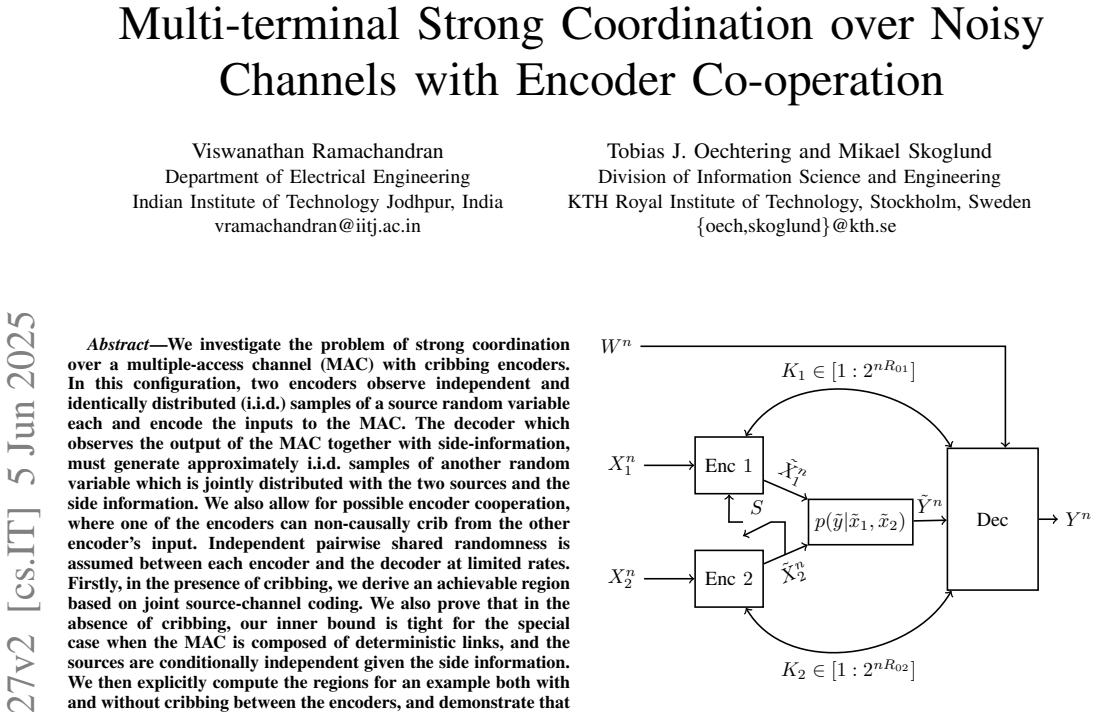
The load-bearing object is the Output Statistics of Random Binning (OSRB) protocol, a random-binning construction used to prove Theorem 1. The cribbing enters through Encoder 1's conditional distribution $p(u_1,\tilde x_1|x_1,\tilde x_2,t)$, which lets its codebook depend on Encoder 2's channel input; a Slepian-Wolf decoder at the receiver recovers both source descriptions, and Fourier-Motzkin elimination of auxiliary binning rates yields the rate constraints. For the converse of Theorem 2, the deterministic-link structure and the conditional independence $p(x_1,x_2,w)=p(w)p(x_1|w)p(x_2|w)$ allow the auxiliary variables to be identified as $U_{1i}=(K_1,\tilde Y_{1\sim i},W_{\sim i})$ and $U_{2i}=(K_2,\tilde Y_{2\sim i})$, which decouples the two encoder channels and produces a single-letter outer bound that matches the inner bound.
What would settle it
Run the no-cribbing version of Example 1 with $\tilde X_1$ of entropy less than 2 bits and $\tilde X_2$ of entropy 1 bit and check whether the output can still be made to approximate $Y=X_1B$ in total variation; Proposition 1 says it cannot, so any successful scheme would refute the Theorem 2 region.
Extended reading notes
Core claim
The paper claims the first strong-coordination rate regions for noisy multiple-access channels with encoder cooperation. Theorem 1 gives an achievable set of shared-randomness rate pairs $(R_{01}, R_{02})$ for any discrete memoryless MAC when Encoder 1 cribs Encoder 2's channel input, stated as the eight inequalities (3a)-(3h) over a joint distribution of the form (4). Theorem 2 shows that without cribbing, when the channel is composed of deterministic links $\tilde Y=(f_1(\tilde X_1), f_2(\tilde X_2))$ and $I(X_1;X_2|W)=0$, the region with unlimited $R_{02}$ is exactly the three inequalities (5a)-(5c). The paper then works out both regions for a concrete target distribution $Y=X_1B$ and shows cribbing strictly improves the feasible region, reducing the required entropy of $\tilde X_1$ from 2 bits to 1 bit.
Load-bearing premise
The exactness of Theorem 2 rests on two structural assumptions, the channel output being a pair of deterministic functions of the two encoder inputs and the sources being conditionally independent given the side information, and on borrowing the achievability proof from a prior channel-simulation result; if any of these fails, the paper's tight region and its cribbing-helps conclusion do not follow.
Editorial extensions
If this is right
- With cribbing, every rate pair satisfying Theorem 1's eight inequalities is achievable for any finite-alphabet discrete memoryless MAC, giving a computable inner bound for the coordination region.
- Without cribbing, under the two structural assumptions, Theorem 2's three inequalities exactly describe the region, meaning no alternative scheme can do better in that setting.
- In Example 1, cribbing reduces the required entropy of $\tilde X_1$ from 2 bits to 1 bit while keeping $\tilde X_2$ at 1 bit, so encoder cooperation strictly enlarges the feasible set.
- The results extend channel simulation from point-to-point links to a three-terminal multi-access setting and bring the classic cribbing model from MAC information theory into strong coordination.
Reading between the lines
- The auxiliary-variable identification used in the converse, setting $U_{1i}=(K_1,\tilde Y_{1\sim i},W_{\sim i})$, suggests a general recipe for other networks whose channel output factors across encoders, but this extension is not explored in the paper.
- For non-deterministic MACs or sources with $I(X_1;X_2|W)>0$, the gap between Theorem 1's inner bound and any outer bound remains open, so whether cribbing still helps there is untested.
- The numerical gain in the example, one bit, equals the entropy of the cribbed source $X_2$, hinting that cribbing may generically save up to $H(X_2)$ bits of encoder-1 randomness, though the paper does not claim this.
Editorial analysis
A structured set of objections, weighed in public.
Referee Report
Summary. The paper studies strong coordination of two encoders over a discrete memoryless multiple-access channel with decoder side information and pairwise shared randomness at limited rates. In the cribbing configuration, Encoder 1 non-causally sees Encoder 2's channel input; the paper gives an inner bound (Theorem 1) based on the Output Statistics of Random Binning. Without cribbing, for a MAC composed of deterministic links and sources satisfying I(X1;X2|W)=0, it claims an exact rate region in the limit R02->infinity (Theorem 2). The paper then evaluates the regions on a binary example and concludes that cribbing strictly reduces the required channel-input entropy.
Significance. If the theorems are correct, this would be one of the first multi-terminal strong-coordination characterizations over noisy channels with encoder cooperation, and it would quantify when cribbing reduces shared-randomness requirements. The paper's strengths include a structurally standard OSRB achievability argument for Theorem 1, a detailed single-letterized converse for Theorem 2, and an explicit numerical example. The proofs are not parameter-fitted and the claims are falsifiable. However, the achievability direction of Theorem 2 is delegated to an external point-to-point result, and several Fourier-Motzkin eliminations are asserted without display, so the current version is not yet a complete characterization.
major comments (3)
- [Section III, Theorem 2] Theorem 2 is stated as a characterization, but only the converse is proved in Section VI; the achievability half is dismissed with “The achievability largely follows from [9, Theorem 3], by also accounting for the decoder side information and enforcing the conditional independence...” This is load-bearing because exactness of the no-cribbing region and the cribbing-helps comparison in Section IV depend on it. The manuscript must either provide a self-contained code construction for the two-encoder cribbing-free MAC with decoder side information, or a precise reduction showing that [9, Theorem 3] applies to this multi-terminal setting. Until then, (5a)–(5c) is only an outer bound.
- [Section V, after Eq. (20)] The elimination of (R~1,R~2) from (9)–(10), (12)–(14), (18)–(20) is asserted as “the FME procedure” and the resulting eight inequalities (3a)–(3h) are not derived. Since these inequalities define the claimed achievable region, the FME output should be displayed or supplied in an appendix. Without this, the reader cannot verify that no constraint is missing or incorrectly simplified.
- [Section IV, after Eq. (7)] The three displayed constraints are said to be the specialization of Theorem 1 to independent sources, a perfect channel, and unlimited shared randomness. Substituting W=empty and Y~=(X~1,X~2) into (3a)–(3c) does not directly yield these expressions, and the derivation is not shown. Because this is the quantitative basis for the claim that cribbing reduces H(X~1) from 2 to 1, please prove the displayed constraints or, alternatively, verify directly that the chosen distributions satisfy (3a)–(3c).
minor comments (4)
- [Section VI] The proof of the second inequality in Theorem 2, H(Y~2|W,T) >= I(U2,Y~2;X2|W,T), is not written out; “follows analogously” is acceptable only if the exact auxiliary variable and the same chain are specified. Please add the derivation or a sentence with the exact substitutions.
- [Section IV, Proposition 1] The heading contains a typo: “F or” should be “For.”
- [Equation (24)] The definition of g(epsilon) has an unmatched parenthesis; it should read g(epsilon) = 2*sqrt(epsilon) * ( H(S) + log|S| + log(1/sqrt(epsilon)) ).
- [Theorem 2] The cardinality bounds for U1, U2, and T are stated, but the justification is a brief reference to [8] and [18]; please provide enough of the perturbation argument for the reader to see how the bound on |T| is obtained.
Circularity Check
No significant circularity; Theorem 2's delegated achievability is a completeness gap, not a circular reduction.
full rationale
The central derivations are not circular. Theorem 1's achievable region is derived from first principles using the OSRB framework and the Slepian-Wolf theorem: the rate constraints (9)-(20) are combined via Fourier-Motzkin elimination to obtain (3a)-(3h), with no parameter fitted to the target quantity and no prediction that is equivalent by construction to an input. Theorem 2's converse is self-contained in Section VI, with the auxiliary-variable identifications U1i=(K1,Y1~i,W~i) and U2i=(K2,Y2~i) producing single-letter bounds that match the inner-bound inequalities. The achievability half of Theorem 2 is delegated to the external reference [9, Theorem 3] rather than proved in the paper; this is a real completeness gap, but it is not circularity because [9] is an independent prior result by other authors and does not presuppose the present theorem. The example in Section IV uses explicit choices U1=X1B and U2=B to exhibit feasibility, which is an existence construction rather than a fitted-input-as-prediction step. The paper's self-citations are limited to background and methodological comparisons, such as [3]-[7] and [19], and they are not load-bearing for the main rate-region derivations. Thus no step reduces to its own input by definition or by self-citation.
Assumptions & free parameters
assumptions (6)
- standard math Shannon entropy and mutual information identities and inequalities hold for finite-alphabet random variables.
- domain assumption The OSRB framework of Yassaee, Aref, and Gohari [15, Theorem 1 and Lemma 4] is valid and applicable to the binning protocol.
- standard math The Slepian-Wolf theorem [16] gives the decoding conditions (12)-(14).
- domain assumption The per-letter total-variation closeness lemma of Cervia et al. [17, Lemma 6] controls inter-symbol dependencies in the converse.
- domain assumption The channel is a discrete memoryless MAC p(y~|x~1,x~2) and sources are i.i.d. with product distribution q.
- domain assumption For Theorem 2, the MAC is composed of deterministic links Y~=(f1(X~1),f2(X~2)) and I(X1;X2|W)=0.
Cite this review
Pith. "Pith review of Multi-terminal Strong Coordination over Noisy Channels with Encoder Co-operation." pith.science (2026). https://pith.science/paper/NVWWXP4M
@misc{pith2026250112227,
  author       = {Pith},
  title        = {Pith review of: Multi-terminal Strong Coordination over Noisy Channels with Encoder Co-operation},
  year         = {2026},
  howpublished = {\url{https://pith.science/paper/NVWWXP4M}},
  note         = {Machine review of arXiv:2501.12227}
}
read the original abstract
We investigate the problem of strong coordination over a multiple-access channel (MAC) with cribbing encoders. In this configuration, two encoders observe independent and identically distributed (i.i.d.) samples of a source random variable each and encode the inputs to the MAC. The decoder which observes the output of the MAC together with side-information, must generate approximately i.i.d. samples of another random variable which is jointly distributed with the two sources and the side information. We also allow for possible encoder cooperation, where one of the encoders can non-causally crib from the other encoders input. Independent pairwise shared randomness is assumed between each encoder and the decoder at limited rates. Firstly, in the presence of cribbing, we derive an achievable region based on joint source-channel coding. We also prove that in the absence of cribbing, our inner bound is tight for the special case when the MAC is composed of deterministic links, and the sources are conditionally independent given the side information. We then explicitly compute the regions for an example both with and without cribbing between the encoders, and demonstrate that cribbing strictly improves upon the achievable region.
Figures
Reference graph
Works this paper leans on
-
[9]
When is it possible to simulate a DMC channel from another?
F. Haddadpour, M. H. Yassaee, M. R. Aref, and A. Gohari, “When is it possible to simulate a DMC channel from another?” inIEEE Information Theory Workshop, 2013, pp. 1–5
work page 2013
-
[1]
P. Cuff, H. Permuter, and T. Cover, “Coordination capacity,”IEEE Transactions on Information Theory, vol. 56, no. 9, pp. 4181–4206, 2010
work page 2010
-
[2]
Secure cascade channel synthesis,
S. Satpathy and P. Cuff, “Secure cascade channel synthesis,”IEEE Transactions on Information Theory, vol. 62, no. 11, pp. 6081–6094, 2016
work page 2016
-
[3]
Multiple access channel simulation,
G. R. Kurri, V . Ramachandran, S. R. B. Pillai, and V . M. Prabhakaran, “Multiple access channel simulation,”IEEE Transactions on Information Theory, vol. 68, no. 11, pp. 7575–7603, 2022
work page 2022
-
[4]
Strong coor- dination with side information,
V . Ramachandran, S. R. B. Pillai, and V . M. Prabhakaran, “Strong coor- dination with side information,” in2020 IEEE International Symposium on Information Theory (ISIT), 2020, pp. 1564–1569
work page 2020
-
[5]
Multi-terminal strong coordination over noiseless networks with secrecy constraints,
V . Ramachandran, T. J. Oechtering, and M. Skoglund, “Multi-terminal strong coordination over noiseless networks with secrecy constraints,” in 2024 International Zurich Seminar on Information and Communication (IZS). ETH Z ¨urich Library, 2024, pp. 159–163
work page 2024
-
[6]
Multi-terminal strong coordination with degraded source obser- vations,
——, “Multi-terminal strong coordination with degraded source obser- vations,” in2024 IEEE Information Theory Workshop (ITW), 2024, pp. 103–108
work page 2024
-
[7]
Multi-terminal Strong Coordination subject to Secrecy Constraints
——, “Multi-terminal strong coordination subject to secrecy con- straints,”arXiv preprint arXiv:2411.14123, 2024
work page Pith review arXiv 2024
Show all 20 references
-
[8]
Distributed channel synthesis,
P. Cuff, “Distributed channel synthesis,”IEEE Transactions on Informa- tion Theory, vol. 59, no. 11, pp. 7071–7096, 2013
2013
-
[10]
Simulation of a channel with another channel,
F. Haddadpour, M. H. Yassaee, S. Beigi, A. Gohari, and M. R. Aref, “Simulation of a channel with another channel,”IEEE Transactions on Information Theory, vol. 63, no. 5, pp. 2659–2677, 2017
2017
-
[11]
The discrete memoryless multiple- access channel with cribbing encoders,
F. Willems and E. Van der Meulen, “The discrete memoryless multiple- access channel with cribbing encoders,”IEEE Transactions on Informa- tion Theory, vol. 31, no. 3, pp. 313–327, 1985
1985
-
[12]
Multiple-access channel with partial and controlled cribbing encoders,
H. Asnani and H. H. Permuter, “Multiple-access channel with partial and controlled cribbing encoders,”IEEE Transactions on Information Theory, vol. 59, no. 4, pp. 2252–2266, 2012
2012
-
[13]
Multiple access channel with unreliable cribbing,
W. Huleihel and Y . Steinberg, “Multiple access channel with unreliable cribbing,” in2016 IEEE International Symposium on Information Theory (ISIT). IEEE, 2016, pp. 1491–1495
2016
-
[14]
Multiterminal source coding,
T. Berger, “Multiterminal source coding,”The information theory ap- proach to communications, vol. 229, pp. 171–231, 1977
1977
-
[15]
Achievability proof via output statistics of random binning,
M. Yassaee, M. Aref, and A. Gohari, “Achievability proof via output statistics of random binning,”IEEE Transactions on Information Theory, vol. 60, no. 11, pp. 6760–6786, 2014
2014
-
[16]
Noiseless coding of correlated information sources,
D. Slepian and J. Wolf, “Noiseless coding of correlated information sources,”IEEE Transactions on information Theory, vol. 19, no. 4, pp. 471–480, 1973
1973
-
[17]
Strong coordi- nation of signals and actions over noisy channels with two-sided state information,
G. Cervia, L. Luzzi, M. Le Treust, and M. R. Bloch, “Strong coordi- nation of signals and actions over noisy channels with two-sided state information,”IEEE Transactions on Information Theory, vol. 66, no. 8, pp. 4681–4708, 2020
2020
-
[18]
Evaluation of Marton’s inner bound for the general broadcast channel,
A. A. Gohari and V . Anantharam, “Evaluation of Marton’s inner bound for the general broadcast channel,”IEEE Transactions on Information Theory, vol. 58, no. 2, pp. 608–619, 2012
2012
-
[19]
Multi-terminal strong coordination over noisy channels with secrecy constraints,
V . Ramachandran, T. J. Oechtering, and M. Skoglund, “Multi-terminal strong coordination over noisy channels with secrecy constraints,” in 2024 IEEE International Symposium on Information Theory (ISIT), 2024, pp. 1925–1930
2024
-
[20]
Feedback-capacity of degraded Gaussian vector BC using directed information and concave envelopes,
V . Ramachandran and S. R. B. Pillai, “Feedback-capacity of degraded Gaussian vector BC using directed information and concave envelopes,” in2017 Twenty-third National Conference on Communications (NCC). IEEE, 2017, pp. 1–6. APPENDIXA CONVERSEPROOF OFPROPOSITION1 For the conve...
2017
Reviewed August 10, 2026 · model on record in the stance chip above.
Discussion (0). Continue with ORCID to comment.