REVIEW 4 major objections 5 minor 161 references
Reconsidering the consistent use of precessing, higher order multipole models for gravitational wave analyses
T0 review · 4 major / 5 minor · reviewed 2026-08-03 · deepseek-v4-flash
Pith's one-line read Gravitational-wave analyses can use cheaper waveform models for most signals and still recover unbiased black hole mass and spin distributions, cutting analysis cost by about 20%.
desk verdict Practical model-selection rule with a real cost saving, but the threshold is calibrated in-sample and the 'unchanged' claim needs a quantitative test before the spin results are fully credible. read the letter →
The pith
A machine-rendered reading of the paper's core claim, the machinery that carries it, and where it could break.
The reading
What carries the argument
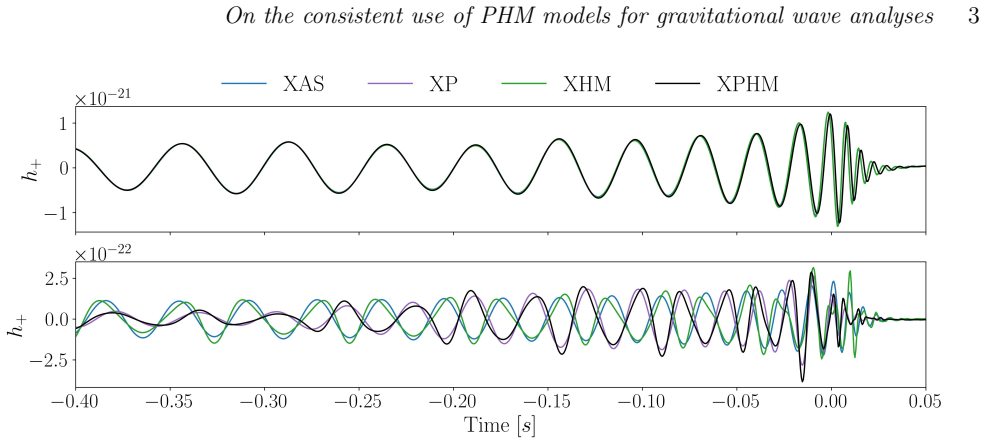
The selection function built on simple-pe, a fast matched-filtering tool that extracts ρp and ρHM from strain data. simple-pe's outputs assign each event to the cheapest model that still captures its observable physics: PhenomXAS when both SNRs are low, PhenomXHM or PhenomXP when only one is high, and PhenomXPHM when both are high. A companion reweighting-and-conditioning step converts aligned-spin posterior samples from XAS/XHM into comparable precessing-spin distributions, enabling unbiased hierarchical population inference.
What would settle it
Applying the recommended selection function to a set of real gravitational-wave events (e.g., from GWTC-4) and comparing the hierarchical population hyperparameters against those obtained with consistent PhenomXPHM analysis; if the inferred spin magnitude or tilt distributions differ beyond statistical fluctuations, the central claim fails. Alternatively, injecting a large set of signals with ρp just below 1.5 and checking whether the reweighted XAS posteriors reproduce XPHM posteriors.
Extended reading notes
Core claim
This paper claims that a simple SNR threshold on the matched-filtered precession SNR ρp and higher-order-multipole SNR ρHM can safely dictate when to use cheaper waveform models. For a worst-case population of 90 rapidly spinning, asymmetric binary black holes, analysing events below the threshold with models that neglect precession and/or higher-order multipoles—and reweighting their spin posteriors—yields inferred mass and spin distributions consistent with consistently using the full PhenomXPHM model. The threshold ρthres = 1.5 produces comparable population estimates and reduces the total cost of hierarchical Bayesian inference by ~20%.
Load-bearing premise
The reweighting-and-conditioning step that converts aligned-spin posterior samples into precessing-spin-like distributions must faithfully reconstruct the spin posterior for events that pass the SNR threshold; App. B shows it visibly biases spin magnitudes and tilts at threshold 2.0.
Editorial extensions
If this is right
- If the central claim holds, the standard practice of analysing every binary black hole with precessing, higher-order-multipole models can be relaxed without biasing mass and spin population measurements.
- The ~20% cost reduction measured on a worst-case population implies larger savings (the paper estimates up to 78%) for real populations where most events have weak precession and multipole power.
- The selection function may extend to other inference targets, such as the Hubble constant or gravitational lensing, where the same unbiasedness should apply.
- The matched-filter approach could be incorporated into the sampling itself, avoiding a separate pre-selection step.
- As waveform models become more accurate and more expensive, the relative computational benefit of this selection strategy will grow.
- The reweighting-and-conditioning procedure's reliability is only demonstrated for one moderate-precession case; testing it on a suite of injections with varying ρp and ρHM values and comparing against full XPHM posteriors would sharpen confidence in the population-level result.
- The threshold of 1.5 is tuned to current detector sensitivities; for next-generation detectors with louder signals, the fraction of events with measurable precession/multipoles grows, and the selection approach may need re-optimization.
Reading between the lines
- A natural extension would be to include the total network SNR in the threshold, since the paper notes that for loud misidentified events, the cheaper model could bias spins; this trade-off is not yet fully quantified.
- The reweighting-and-conditioning procedure's reliability is only demonstrated for one moderate-precession case; testing it on a suite of injections with varying ρp and ρHM values and comparing against full XPHM posteriors would sharpen confidence in the population-level result.
- The threshold of 1.5 is tuned to current detector sensitivities; for next-generation detectors with louder signals, the fraction of events with measurable precession/multipoles grows, and the selection approach may need re-optimization or fail to yield large savings.
Editorial analysis
A structured set of objections, weighed in public.
Referee Report
Summary. The paper proposes a selection function for gravitational-wave population analyses: using the matched-filter SNRs rho_p and rho_HM (computed with simple-pe) to decide which waveform model to use for each event, reserving the most expensive precessing higher-order-multipole model (PhenomXPHM) for events where these effects are measurable. The selection rule is tested on a simulated 90-event 'worst-case' population of high-spin, asymmetric binaries. The authors report that a threshold rho_thres = 1.5 on rho_p and rho_HM yields inferred mass and spin distributions comparable to those obtained by consistently using XPHM, at a reduced computational cost of about 20% for this population, with larger projected savings for more astrophysical populations. The paper includes single-event and hierarchical Bayesian inference methodology, a reweighting-and-conditioning procedure to convert aligned-spin posteriors from XAS/XHM into approximate precessing-spin posteriors, and appendices examining alternative thresholds, a misidentified event, and a GWTC-like population.
Significance. If the central claim is robust, the paper offers a practical and timely way to reduce the growing computational cost of Bayesian GW population inference without biasing mass and spin measurements. The use of publicly available code and posterior samples is a significant strength, as is the choice of a deliberately pessimistic simulated population. The paper also engages with existing literature on model selection and waveform systematics. However, the validation is currently based on a single simulated catalog, the recommended threshold is selected after inspecting the same data, and the spin-reweighting step is validated on only one moderate-precession case while showing visible bias at a nearby threshold. These issues need quantitative and independent testing before the 'unchanged' population-inference claim can be accepted. The paper's practical value is clear, but at present the evidence is suggestive rather than definitive.
major comments (4)
- [Sec. 4, Fig. 5] The recommended threshold rho_thres = 1.5 is chosen after inspecting the results for six thresholds applied to the same 90-event population. The claim that the inferred mass and spin distributions are 'unchanged' rests on visual overlap of 90% credible intervals in a single realization. Since the same data are used to select and to demonstrate performance, this is post-hoc calibration. Please provide an independent validation (e.g., a second simulated population, or a quantitative metric such as the shift in hyperposterior means, a Bayes factor, or a coverage test) that distinguishes 'no detectable difference with 90 events' from 'no bias'.
- [Sec. 4, Fig. 4 and App. B] The reweighting-and-conditioning procedure used to convert XAS/XHM aligned-spin posteriors into full spin posteriors is validated only on one moderate-precession case (rho_p = 2.0, rho_HM = 0.6). Appendix B explicitly states that at rho_thres = 2.0 this procedure produces visibly biased spin magnitudes and tilts. Since the same procedure is applied to every event analysed with XAS or XHM at the recommended rho_thres = 1.5, the central claim of unbiased population spin inference depends on this approximation being accurate at the recommended threshold. The manuscript does not quantify the residual bias at rho_thres = 1.5 (e.g., by comparing the reweighted XAS/XHM posteriors to the XPHM posteriors on a population of events with rho_p or rho_HM just below 1.5). Please add such a test.
- [App. C] The paper concedes that for a misidentified event with network SNR > 20, XAS would likely recover biased spin estimates, and floats the idea of adding a total-SNR guard ('we could always use XPHM if the total signal power is greater than e.g. 20') but does not implement it. This is a load-bearing caveat because the selection function uses only rho_p and rho_HM, and the worst-case population deliberately contains loud, extreme events. Either implement the total-SNR guard and re-run the population analysis, or demonstrate quantitatively that such loud misidentified events are rare enough in the target population that the population-level spin inference is unaffected.
- [Sec. 3 and App. A2] The validation population contains only 90 events, and detectability is modelled by a simplified cut (network SNR > 12) rather than an injection campaign into realistic search pipelines. The 6% false-negative rate is also computed on the same simulated catalog used for the main inference. This is acceptable as a first test, but it means the paper currently demonstrates consistency for one noise realization of one population, not a general property. Please clarify how the quoted 20% cost reduction and the population-level consistency would be affected by a different noise realization, a different population draw, or a more realistic detection selection function.
minor comments (5)
- [Abstract and throughout] The phrase 'worse-case scenario' appears repeatedly; this should be 'worst-case scenario'.
- [Eq. (1)] The definition of chi_p contains a typo: the second term in the max should be A2 * chi_2 * sin(theta_2), not A2 * chi_1 * sin(theta_1).
- [Sec. 2.3] The text says 'Bayes factor’s between the different models' and elsewhere uses an apostrophe in plural forms (e.g., 'binary’s'); please correct the grammar.
- [Fig. 5 and Fig. B1] The green/orange/dashed line styles may be difficult to distinguish for color-blind readers; consider adding different line types or markers, and ensure the caption explicitly describes the credibility levels.
- [Sec. 4] The claim that 'it is unlikely that the uncertainties will shrink enough to expose differences' for O(1000)-event catalogs is speculative. The cited Monte-Carlo error concerns are real, but they do not remove the need for a quantitative null test at the current 90-event scale.
Assumptions & free parameters
free parameters (3)
- rho_thres =
1.5
- detection threshold =
SNR > 12
- significant-effect definition =
rho_p = rho_HM = 2.0
assumptions (5)
- domain assumption The simulated worst-case population (90 events, high spins, isotropic tilts, asymmetric masses) is representative of the most challenging population for which the selection criterion must work.
- domain assumption simple-pe matched-filter rho_p and rho_HM reliably measure the observability of precession and higher multipoles in the strain data.
- domain assumption Idealized Gaussian noise and the SNR>12 detection cut are sufficient to validate the method for real detector data.
- ad hoc to paper The reweighting-and-conditioning procedure recovers the spin posterior that would have been obtained with a precessing-spin prior.
- domain assumption Waveform models PhenomXAS/XP/XHM/XPHM form a nested set of sufficient approximations to GR for the purposes of inference.
Cite this review
Pith. "Pith review of Reconsidering the consistent use of precessing, higher order multipole models for gravitational wave analyses." pith.science (2026). https://pith.science/paper/NVZIRSO7
@misc{pith2026260118916,
  author       = {Pith},
  title        = {Pith review of: Reconsidering the consistent use of precessing, higher order multipole models for gravitational wave analyses},
  year         = {2026},
  howpublished = {\url{https://pith.science/paper/NVZIRSO7}},
  note         = {Machine review of arXiv:2601.18916}
}
abstract
The growing number of gravitational-wave (GW) observations allows for constraints to be placed on the underlying population of black holes; current estimates show that black hole spins are small, with binaries more likely to have comparable component masses. Since general relativistic effects, such as spin-induced orbital precession and higher order multipole moments, are more likely to be observed for asymmetric binary systems, a direct measurement remains unlikely. Nevertheless, we continue to consistently probe these effects by performing Bayesian inference with our most accurate and computationally expensive models. As the number of GW detections increases, it may soon become infeasible to consistently use these models for analyses. In this paper, we provide a selection criterion that determines when less accurate and computationally cheaper models can be used without giving biased estimates for the population properties of black holes in the Universe. We show that when using our selection criterion, comparable estimates can be obtained for the underlying mass and spin distribution of black holes for a simulated ``worst-case'' scenario population, while reducing the overall cost of performing Bayesian inference on our population by $\sim 20\%$. We anticipate a reduction of up to $78\%$ in the overall cost for an astrophysically motivated population, since there are fewer events with observable spin-precession and higher order multipole power.
Figures


Figures from the paper (3 more)


Reference graph
Works this paper leans on
-
[1]
Aasi J., et al., 2015, @doi [Class. Quant. Grav.] 10.1088/0264-9381/32/7/074001 , 32, 074001
- [2]
- [3]
- [4]
- [5]
- [6]
-
[7]
G., et al., 2025f, @doi [Astrophys
Abac A. G., et al., 2025f, @doi [Astrophys. J. Lett.] 10.3847/2041-8213/ae0d54 , 993, L21
-
[8]
Abbott R., et al., 2020a, @doi [Phys. Rev. D] 10.1103/PhysRevD.102.043015 , 102, 043015
Show all 161 references
-
[9]
Abbott R., et al., 2020b, @doi [Astrophys. J. Lett.] 10.3847/2041-8213/ab960f , 896, L44
-
[10]
Abbott R., et al., 2021, @doi [Astrophys. J. Lett.] 10.3847/2041-8213/abe949 , 913, L7
2021 doi
-
[11]
Abbott R., et al., 2023a, @doi [Phys. Rev. X] 10.1103/PhysRevX.13.011048 , 13, 011048
-
[12]
Abbott R., et al., 2023b, @doi [Phys. Rev. X] 10.1103/PhysRevX.13.041039 , 13, 041039
-
[13]
Abbott R., et al., 2024, @doi [Phys. Rev. D] 10.1103/PhysRevD.109.022001 , 109, 022001
2024 doi
-
[14]
Acernese F., et al., 2015, @doi [Class. Quant. Grav.] 10.1088/0264-9381/32/2/024001 , 32, 024001
2015 doi
-
[15]
Adams T., et al., 2016, @doi [Class. Quant. Grav.] 10.1088/0264-9381/33/17/175012 , 33, 175012
2016 doi
-
[16]
J.] 10.3847/1538-4357/adda3a , 987, 47
Agarwal A., et al., 2025, @doi [Astrophys. J.] 10.3847/1538-4357/adda3a , 987, 47
2025 doi
-
[17]
Ajith P., et al., 2011, @doi [Phys. Rev. Lett.] 10.1103/PhysRevLett.106.241101 , 106, 241101
2011 doi
-
[18]
Ak c ay S., Hoy C., Mac Uilliam J., 2025, @doi [Phys. Rev. D] 10.1103/rkgr-psrt , 112, 084032
2025 doi
-
[19]
Akutsu T., et al., 2021, @doi [PTEP] 10.1093/ptep/ptaa125 , 2021, 05A101
2021 doi
-
[20]
A., Cutler C., Sussman G
Apostolatos T. A., Cutler C., Sussman G. J., Thorne K. S., 1994, @doi [Phys. Rev. D] 10.1103/PhysRevD.49.6274 , 49, 6274
1994 doi
-
[21]
Ashton G., et al., 2019, @doi [Astrophys. J. Suppl.] 10.3847/1538-4365/ab06fc , 241, 27
2019 doi
-
[22]
Babak S., Taracchini A., Buonanno A., 2017, @doi [Phys. Rev. D] 10.1103/PhysRevD.95.024010 , 95, 024010
2017 doi
-
[23]
Babak S., Petiteau A., Hewitson M., 2021, arXiv:2108.01167
2021 arXiv
-
[24]
Baird E., Fairhurst S., Hannam M., Murphy P., 2013, @doi [Phys. Rev. D] 10.1103/PhysRevD.87.024035 , 87, 024035
2013 doi
-
[25]
M., Capano C
Biwer C. M., Capano C. D., De S., Cabero M., Brown D. A., Nitz A. H., Raymond V., 2019, @doi [Publ. Astron. Soc. Pac.] 10.1088/1538-3873/aaef0b , 131, 024503
2019 doi
-
[26]
Boh\'e A., et al., 2017, @doi [Phys. Rev. D] 10.1103/PhysRevD.95.044028 , 95, 044028
2017 doi
-
[27]
A., 2004, Other thesis ( @eprint arXiv 0705.1514 )
Brown D. A., 2004, Other thesis ( @eprint arXiv 0705.1514 )
2004 arXiv
-
[28]
M., P \"u rrer M., 2016, @doi [Phys
Calder \'o n Bustillo J., Husa S., Sintes A. M., P \"u rrer M., 2016, @doi [Phys. Rev. D] 10.1103/PhysRevD.93.084019 , 93, 084019
2016 doi
-
[29]
E., Gair J
Canizares P., Field S. E., Gair J. R., Tiglio M., 2013, @doi [Phys. Rev. D] 10.1103/PhysRevD.87.124005 , 87, 124005
2013 doi
-
[30]
E., Gair J., Raymond V., Smith R., Tiglio M., 2015, @doi [Phys
Canizares P., Field S. E., Gair J., Raymond V., Smith R., Tiglio M., 2015, @doi [Phys. Rev. Lett.] 10.1103/PhysRevLett.114.071104 , 114, 071104
2015 doi
-
[31]
J.] 10.1088/0004-637X/748/2/136 , 748, 136
Cannon K., et al., 2012, @doi [Astrophys. J.] 10.1088/0004-637X/748/2/136 , 748, 136
2012 doi
-
[32]
Chatziioannou K., Cornish N., Klein A., Yunes N., 2015, @doi [Astrophys. J. Lett.] 10.1088/2041-8205/798/1/L17 , 798, L17
2015 doi
-
[33]
Chu Q., et al., 2022, @doi [Phys. Rev. D] 10.1103/PhysRevD.105.024023 , 105, 024023
2022 doi
-
[34]
Chua A. J. K., Vallisneri M., 2020, @doi [Phys. Rev. Lett.] 10.1103/PhysRevLett.124.041102 , 124, 041102
2020 doi
-
[35]
Colleoni M., Vidal F. A. R., Garc \' a-Quir \'o s C., Ak c ay S., Bera S., 2025, @doi [Phys. Rev. D] 10.1103/PhysRevD.111.104019 , 111, 104019
2025 doi
-
[36]
Colpi M., et al., 2024, arXiv:2402.07571
2024 arXiv
- [37]
-
[38]
J., 2021, @doi [Phys
Cornish N. J., 2021, @doi [Phys. Rev. D] 10.1103/PhysRevD.104.104054 , 104, 104054
2021 doi
-
[39]
Cotesta R., Buonanno A., Boh\'e A., Taracchini A., Hinder I., Ossokine S., 2018, @doi [Phys. Rev. D] 10.1103/PhysRevD.98.084028 , 98, 084028
2018 doi
-
[40]
Cotesta R., Marsat S., P\"urrer M., 2020, @doi [Phys. Rev. D] 10.1103/PhysRevD.101.124040 , 101, 124040
2020 doi
-
[41]
R., Gair J., Macke J
Dax M., Green S. R., Gair J., Macke J. H., Buonanno A., Sch \"o lkopf B., 2021, @doi [Phys. Rev. Lett.] 10.1103/PhysRevLett.127.241103 , 127, 241103
2021 doi
-
[42]
R., Louppe G., 2020, arXiv:2010.12931
Delaunoy A., Wehenkel A., Hinderer T., Nissanke S., Weniger C., Williamson A. R., Louppe G., 2020, arXiv:2010.12931
2020 arXiv
-
[43]
H., Buonanno A., Estelles H., Gair J., Pfeiffer H
Dhani A., V \"o lkel S. H., Buonanno A., Estelles H., Gair J., Pfeiffer H. P., Pompili L., Toubiana A., 2025, @doi [Phys. Rev. X] 10.1103/5pks-qz6b , 15, 031036
2025 doi
-
[44]
K., Dudi R., Tichy W., 2019, @doi [Phys
Dietrich T., Samajdar A., Khan S., Johnson-McDaniel N. K., Dudi R., Tichy W., 2019, @doi [Phys. Rev. D] 10.1103/PhysRevD.100.044003 , 100, 044003
2019 doi
-
[45]
Essick R., 2023, @doi [Phys. Rev. D] 10.1103/PhysRevD.108.043011 , 108, 043011
2023 doi
-
[46]
Essick R., Farr W., 2022, arXiv:2204.00461
2022 arXiv
-
[47]
J.] 10.3847/1538-4357/ad1604 , 962, 169
Essick R., Fishbach M., 2024, @doi [Astrophys. J.] 10.3847/1538-4357/ad1604 , 962, 169
2024 doi
-
[48]
Estell\'es H., Ramos-Buades A., Husa S., Garc\' a-Quir\'os C., Colleoni M., Haegel L., Jaume R., 2021, @doi [Phys. Rev. D] 10.1103/PhysRevD.103.124060 , 103, 124060
2021 doi
-
[49]
Estell\'es H., Husa S., Colleoni M., Keitel D., Mateu-Lucena M., Garc\' a-Quir\'os C., Ramos-Buades A., Borchers A., 2022a, @doi [Phys. Rev. D] 10.1103/PhysRevD.105.084039 , 105, 084039
-
[50]
Estell\'es H., Colleoni M., Garc\' a-Quir\'os C., Husa S., Keitel D., Mateu-Lucena M., Planas M. d. L., Ramos-Buades A., 2022b, @doi [Phys. Rev. D] 10.1103/PhysRevD.105.084040 , 105, 084040
-
[51]
Estell \'e s H., Buonanno A., Enficiaud R., Foo C., Pompili L., 2025, arXiv:2506.19911
2025
-
[52]
Fairhurst S., Green R., Hoy C., Hannam M., Muir A., 2020a, @doi [Phys. Rev. D] 10.1103/PhysRevD.102.024055 , 102, 024055
-
[53]
Fairhurst S., Green R., Hannam M., Hoy C., 2020b, @doi [Phys. Rev. D] 10.1103/PhysRevD.102.041302 , 102, 041302
-
[54]
A., 2023, @doi [Phys
Fairhurst S., Hoy C., Green R., Mills C., Usman S. A., 2023, @doi [Phys. Rev. D] 10.1103/PhysRevD.108.082006 , 108, 082006
2023 doi
-
[55]
Fairhurst S., Mills C., Colpi M., Schneider R., Sesana A., Trinca A., Valiante R., 2024, @doi [Mon. Not. Roy. Astron. Soc.] 10.1093/mnras/stae443 , 529, 2116
2024 doi
-
[56]
S., Tonolini F., Murray-Smith R., 2022, @doi [Nature Phys.] 10.1038/s41567-021-01425-7 , 18, 112
Gabbard H., Messenger C., Heng I. S., Tonolini F., Murray-Smith R., 2022, @doi [Nature Phys.] 10.1038/s41567-021-01425-7 , 18, 112
2022 doi
-
[57]
Gamboa A., et al., 2025, @doi [Phys. Rev. D] 10.1103/jxrc-z298 , 112, 044038
2025 doi
-
[58]
Garc\' a-Quir\'os C., Colleoni M., Husa S., Estell\'es H., Pratten G., Ramos-Buades A., Mateu-Lucena M., Jaume R., 2020, @doi [Phys. Rev. D] 10.1103/PhysRevD.102.064002 , 102, 064002
2020 doi
-
[59]
Gerosa D., Bellotti M., 2024, @doi [Class. Quant. Grav.] 10.1088/1361-6382/ad4509 , 41, 125002
2024 doi
-
[60]
M., 2021, @doi [Phys
Gerosa D., Mould M., Gangardt D., Schmidt P., Pratten G., Thomas L. M., 2021, @doi [Phys. Rev. D] 10.1103/PhysRevD.103.064067 , 103, 064067
2021 doi
-
[61]
N., MacFarlane A
Goldberg J. N., MacFarlane A. J., Newman E. T., Rohrlich F., Sudarshan E. C. G., 1967, @doi [J. Math. Phys.] 10.1063/1.1705135 , 8, 2155
1967 doi
-
[62]
R., Gair J., 2021, @doi [Mach
Green S. R., Gair J., 2021, @doi [Mach. Learn. Sci. Tech.] 10.1088/2632-2153/abfaed , 2, 03LT01
2021 doi
-
[63]
R., Simpson C., Gair J., 2020, @doi [Phys
Green S. R., Simpson C., Gair J., 2020, @doi [Phys. Rev. D] 10.1103/PhysRevD.102.104057 , 102, 104057
2020 doi
-
[64]
K., Du Z., Wen L., Gu Y., 2018, @doi [Comput
Guo X., Chu Q., Chung S. K., Du Z., Wen L., Gu Y., 2018, @doi [Comput. Phys. Commun.] 10.1016/j.cpc.2018.05.002 , 231, 62
2018 doi
-
[65]
Hamilton E., et al., 2021, @doi [Phys. Rev. D] 10.1103/PhysRevD.104.124027 , 104, 124027
2021 doi
-
[66]
Hamilton E., et al., 2025, arXiv:2507.02604
2025 arXiv
-
[67]
Hanna C., et al., 2020, @doi [Phys. Rev. D] 10.1103/PhysRevD.101.022003 , 101, 022003
2020 doi
-
[68]
Hannam M., Schmidt P., Boh\'e A., Haegel L., Husa S., Ohme F., Pratten G., P\"urrer M., 2014, @doi [Phys. Rev. Lett.] 10.1103/PhysRevLett.113.151101 , 113, 151101
2014 doi
-
[69]
Hannam M., et al., 2022, @doi [Nature] 10.1038/s41586-022-05212-z , 610, 652
2022 doi
-
[70]
R., et al., 2020, @doi [Nature] 10.1038/s41586-020-2649-2 , 585, 357
Harris C. R., et al., 2020, @doi [Nature] 10.1038/s41586-020-2649-2 , 585, 357
2020 doi
-
[71]
Harry I., Hoy C., 2025, arXiv: 2503.09773
2025
-
[72]
Heinzel J., Vitale S., 2025, arXiv:2509.07221
2025 arXiv
-
[73]
Hild S., et al., 2011, @doi [Class. Quant. Grav.] 10.1088/0264-9381/28/9/094013 , 28, 094013
2011 doi
-
[74]
Hoy C., 2022, @doi [Phys. Rev. D] 10.1103/PhysRevD.106.083003 , 106, 083003
2022 doi
-
[75]
Hoy C., Leyde K., 2025, arXiv:2511.07551
2025 arXiv
-
[76]
Hoy C., Raymond V., 2021, @doi [SoftwareX] 10.1016/j.softx.2021.100765 , 15, 100765
2021
-
[77]
Hoy C., Mills C., Fairhurst S., 2022, @doi [Phys. Rev. D] 10.1103/PhysRevD.106.023019 , 106, 023019
2022 doi
-
[78]
R., Nuttall L
Hoy C., Weaving C. R., Nuttall L. K., Harry I., 2024, @doi [Class. Quant. Grav.] 10.1088/1361-6382/ad8f26 , 41, 245012
2024 doi
-
[79]
E., 2025a, @doi [Nature Astron.] 10.1038/s41550-025-02579-7 , 9, 1256
Hoy C., Akcay S., Mac Uilliam J., Thompson J. E., 2025a, @doi [Nature Astron.] 10.1038/s41550-025-02579-7 , 9, 1256
-
[80]
Hoy C., Fairhurst S., Mandel I., 2025b, @doi [Phys. Rev. D] 10.1103/PhysRevD.111.023037 , 111, 023037
-
[81]
D., 2007, @doi [CSE] 10.1109/MCSE.2007.55 , http://adsabs.harvard.edu/abs/2007CSE.....9...90H 9, 90
Hunter J. D., 2007, @doi [CSE] 10.1109/MCSE.2007.55 , http://adsabs.harvard.edu/abs/2007CSE.....9...90H 9, 90
2007 doi
-
[82]
Husa S., Khan S., Hannam M., P\"urrer M., Ohme F., Jim\'enez Forteza X., Boh\'e A., 2016, @doi [Phys. Rev. D] 10.1103/PhysRevD.93.044006 , 93, 044006
2016 doi
-
[83]
Iyer B., et al., 2011, LIGO-India, Proposal of the Consortium for Indian Initiative in Gravitational-wave Observations (IndIGO), DCC, https://dcc.ligo.org/LIGO-M1100296/public
2011
-
[84]
Kalaghatgi C., Hannam M., Raymond V., 2020, @doi [Phys. Rev. D] 10.1103/PhysRevD.101.103004 , 101, 103004
2020 doi
-
[85]
Khan S., Husa S., Hannam M., Ohme F., P\"urrer M., Jim\'enez Forteza X., Boh\'e A., 2016, @doi [Phys. Rev. D] 10.1103/PhysRevD.93.044007 , 93, 044007
2016 doi
-
[86]
Khan S., Chatziioannou K., Hannam M., Ohme F., 2019, @doi [Phys. Rev. D] 10.1103/PhysRevD.100.024059 , 100, 024059
2019 doi
-
[87]
Khan S., Ohme F., Chatziioannou K., Hannam M., 2020, @doi [Phys. Rev. D] 10.1103/PhysRevD.101.024056 , 101, 024056
2020 doi
-
[88]
N., Williams N., Zimmerman A., 2023, arXiv:2312.06009
Krishna K., Vijaykumar A., Ganguly A., Talbot C., Biscoveanu S., George R. N., Williams N., Zimmerman A., 2023, arXiv:2312.06009
2023 arXiv
-
[89]
V., Ohme F., 2022, @doi [Phys
Krishnendu N. V., Ohme F., 2022, @doi [Phys. Rev. D] 10.1103/PhysRevD.105.064012 , 105, 064012
2022 doi
-
[90]
Lange J., O'Shaughnessy R., Rizzo M., 2018, arXiv:1805.10457
2018 arXiv
-
[91]
K., Hooper S., Blair D., Wen L., 2012, @doi [Class
Liu Y., Du Z., Chung S. K., Hooper S., Blair D., Wen L., 2012, @doi [Class. Quant. Grav.] 10.1088/0264-9381/29/23/235018 , 29, 235018
2012 doi
-
[92]
London L., et al., 2018, @doi [Phys. Rev. Lett.] 10.1103/PhysRevLett.120.161102 , 120, 161102
2018 doi
-
[93]
E., 2024, @doi [Phys
Mac Uilliam J., Akcay S., Thompson J. E., 2024, @doi [Phys. Rev. D] 10.1103/PhysRevD.109.084077 , 109, 084077
2024 doi
-
[94]
Maggiore M., et al., 2020, @doi [JCAP] 10.1088/1475-7516/2020/03/050 , 03, 050
2020 doi
-
[95]
M., Gair J
Mandel I., Farr W. M., Gair J. R., 2019, @doi [Mon. Not. Roy. Astron. Soc.] 10.1093/mnras/stz896 , 486, 1086
2019 doi
-
[96]
Matas A., et al., 2020, @doi [Phys. Rev. D] 10.1103/PhysRevD.102.043023 , 102, 043023
2020 doi
-
[97]
McIsaac C., Hoy C., Harry I., 2023, @doi [Phys. Rev. D] 10.1103/PhysRevD.108.123016 , 108, 123016
2023 doi
-
[98]
K., Olsen S., Wadekar D., Roulet J., Venumadhav T., Mushkin J., Zackay B., Zaldarriaga M., 2025, @doi [Phys
Mehta A. K., Olsen S., Wadekar D., Roulet J., Venumadhav T., Mushkin J., Zackay B., Zaldarriaga M., 2025, @doi [Phys. Rev. D] 10.1103/PhysRevD.111.024049 , 111, 024049
2025 doi
-
[99]
Messick C., et al., 2017, @doi [Phys. Rev. D] 10.1103/PhysRevD.95.042001 , 95, 042001
2017 doi
-
[100]
Metropolis N., Ulam S., 1949, Journal of the American statistical association, 44, 335
1949
-
[101]
Mills C., Fairhurst S., 2021, @doi [Phys. Rev. D] 10.1103/PhysRevD.103.024042 , 103, 024042
2021 doi
-
[102]
K., Kela A., Arun K
Mishra C. K., Kela A., Arun K. G., Faye G., 2016, @doi [Phys. Rev. D] 10.1103/PhysRevD.93.084054 , 93, 084054
2016 doi
-
[103]
Morisaki S., 2021, @doi [Phys. Rev. D] 10.1103/PhysRevD.104.044062 , 104, 044062
2021 doi
-
[104]
Morisaki S., Smith R., Tsukada L., Sachdev S., Stevenson S., Talbot C., Zimmerman A., 2023, @doi [Phys. Rev. D] 10.1103/PhysRevD.108.123040 , 108, 123040
2023 doi
-
[105]
J., Gerosa D., 2024, @doi [Phys
Mould M., Moore C. J., Gerosa D., 2024, @doi [Phys. Rev. D] 10.1103/PhysRevD.109.063013 , 109, 063013
2024 doi
-
[106]
E., Vitale S., 2025, @doi [Phys
Mould M., Wolfe N. E., Vitale S., 2025, @doi [Phys. Rev. D] 10.1103/xk1z-fxnm , 111, 123049
2025 doi
-
[107]
H., Dent T., Dal Canton T., Fairhurst S., Brown D
Nitz A. H., Dent T., Dal Canton T., Fairhurst S., Brown D. A., 2017, @doi [Astrophys. J.] 10.3847/1538-4357/aa8f50 , 849, 118
2017 doi
-
[108]
H., Dal Canton T., Davis D., Reyes S., 2018, @doi [Phys
Nitz A. H., Dal Canton T., Davis D., Reyes S., 2018, @doi [Phys. Rev. D] 10.1103/PhysRevD.98.024050 , 98, 024050
2018 doi
-
[109]
H., Kumar S., Wang Y.-F., Kastha S., Wu S., Sch \"a fer M., Dhurkunde R., Capano C
Nitz A. H., Kumar S., Wang Y.-F., Kastha S., Wu S., Sch \"a fer M., Dhurkunde R., Capano C. D., 2023, @doi [Astrophys. J.] 10.3847/1538-4357/aca591 , 946, 59
2023 doi
-
[110]
Olsen S., Venumadhav T., Mushkin J., Roulet J., Zackay B., Zaldarriaga M., 2022, @doi [Phys. Rev. D] 10.1103/PhysRevD.106.043009 , 106, 043009
2022 doi
-
[111]
Ossokine S., et al., 2020, @doi [Phys. Rev. D] 10.1103/PhysRevD.102.044055 , 102, 044055
2020 doi
-
[112]
E., Mrou\'e A
Pan Y., Buonanno A., Taracchini A., Kidder L. E., Mrou\'e A. H., Pfeiffer H. P., Scheel M. A., Szil\'agyi B., 2014, @doi [Phys. Rev. D] 10.1103/PhysRevD.89.084006 , 89, 084006
2014 doi
-
[113]
Pankow C., Brady P., Ochsner E., O'Shaughnessy R., 2015, @doi [Phys. Rev. D] 10.1103/PhysRevD.92.023002 , 92, 023002
2015 doi
-
[114]
G., Tomson S
Patterson B. G., Tomson S. M., Fairhurst S., 2025, @doi [Phys. Rev. D] 10.1103/PhysRevD.111.044073 , 111, 044073
2025 doi
-
[115]
Pompili L., et al., 2023, @doi [Phys. Rev. D] 10.1103/PhysRevD.108.124035 , 108, 124035
2023 doi
-
[116]
M., 2020a, @doi [Phys
Pratten G., Schmidt P., Buscicchio R., Thomas L. M., 2020a, @doi [Phys. Rev. Res.] 10.1103/PhysRevResearch.2.043096 , 2, 043096
-
[117]
Pratten G., Husa S., Garcia-Quiros C., Colleoni M., Ramos-Buades A., Estelles H., Jaume R., 2020b, @doi [Phys. Rev. D] 10.1103/PhysRevD.102.064001 , 102, 064001
-
[118]
Pratten G., et al., 2021, @doi [Phys. Rev. D] 10.1103/PhysRevD.103.104056 , 103, 104056
2021 doi
-
[119]
Privitera S., et al., 2014, @doi [Phys. Rev. D] 10.1103/PhysRevD.89.024003 , 89, 024003
2014 doi
-
[120]
Punturo M., et al., 2010, @doi [Class. Quant. Grav.] 10.1088/0264-9381/27/8/084007 , 27, 084007
2010 doi
-
[121]
P \"u rrer M., Hannam M., Ohme F., 2016, @doi [Phys. Rev. D] 10.1103/PhysRevD.93.084042 , 93, 084042
2016 doi
-
[122]
Qi H., Raymond V., 2021, @doi [Phys. Rev. D] 10.1103/PhysRevD.104.063031 , 104, 063031
2021 doi
-
[123]
Racine E., 2008, @doi [Phys. Rev. D] 10.1103/PhysRevD.78.044021 , 78, 044021
2008 doi
-
[124]
P., Ossokine S., Pompili L., Shiferaw M., 2023, @doi [Phys
Ramos-Buades A., Buonanno A., Estell \'e s H., Khalil M., Mihaylov D. P., Ossokine S., Pompili L., Shiferaw M., 2023, @doi [Phys. Rev. D] 10.1103/PhysRevD.108.124037 , 108, 124037
2023 doi
-
[125]
Reitze D., et al., 2019, Bull. Am. Astron. Soc., 51, 035
2019
-
[126]
M., et al., 2020, @doi [Mon
Romero-Shaw I. M., et al., 2020, @doi [Mon. Not. Roy. Astron. Soc.] 10.1093/mnras/staa2850 , 499, 3295
2020 doi
-
[127]
Sachdev S., et al., 2019, arXiv:1901.08580
2019 arXiv
-
[128]
Schmidt P., Ohme F., Hannam M., 2015, @doi [Phys. Rev. D] 10.1103/PhysRevD.91.024043 , 91, 024043
2015 doi
-
[129]
K., Kapadia S
Singh M. K., Kapadia S. J., Vijaykumar A., Ajith P., 2024, @doi [Astrophys. J.] 10.3847/1538-4357/ad499b , 971, 23
2024 doi
-
[130]
K., Patterson B
Singh M. K., Patterson B. G., Fairhurst S., 2025, arXiv:2512.07688
2025
-
[131]
AIP , @doi 10.1063/1.1835238 , https://doi.org/10.1063/1.1835238
Skilling J., 2004, in AIP Conference Proceedings. AIP , @doi 10.1063/1.1835238 , https://doi.org/10.1063/1.1835238
2004 doi
-
[132]
Skilling J., 2006, @doi [Bayesian Analysis] 10.1214/06-BA127 , 1, 833
2006 doi
-
[133]
E., Blackburn K., Haster C.-J., P \"u rrer M., Raymond V., Schmidt P., 2016, @doi [Phys
Smith R., Field S. E., Blackburn K., Haster C.-J., P \"u rrer M., Raymond V., Schmidt P., 2016, @doi [Phys. Rev. D] 10.1103/PhysRevD.94.044031 , 94, 044031
2016 doi
-
[134]
S., 2020, @doi [Mon
Speagle J. S., 2020, @doi [Mon. Not. Roy. Astron. Soc.] 10.1093/mnras/staa278 , 493, 3132
2020 doi
-
[135]
Talbot C., Golomb J., 2023, @doi [Mon. Not. Roy. Astron. Soc.] 10.1093/mnras/stad2968 , 526, 3495
2023 doi
-
[136]
J.] 10.3847/1538-4357/aab34c , 856, 173
Talbot C., Thrane E., 2018, @doi [Astrophys. J.] 10.3847/1538-4357/aab34c , 856, 173
2018 doi
-
[137]
B., 2019, @doi [ ] 10.1103/PhysRevD.100.043030 , 100, 043030
Talbot C., Smith R., Thrane E., Poole G. B., 2019, @doi [ ] 10.1103/PhysRevD.100.043030 , 100, 043030
2019 doi
-
[138]
M., Schmidt P., Pratten G., 2021, @doi [Phys
Thomas L. M., Schmidt P., Pratten G., 2021, @doi [Phys. Rev. D] 10.1103/PhysRevD.103.083022 , 103, 083022
2021 doi
-
[139]
E., Fauchon-Jones E., Khan S., Nitoglia E., Pannarale F., Dietrich T., Hannam M., 2020, @doi [Phys
Thompson J. E., Fauchon-Jones E., Khan S., Nitoglia E., Pannarale F., Dietrich T., Hannam M., 2020, @doi [Phys. Rev. D] 10.1103/PhysRevD.101.124059 , 101, 124059
2020 doi
-
[140]
E., Hamilton E., London L., Ghosh S., Kolitsidou P., Hoy C., Hannam M., 2024, @doi [Phys
Thompson J. E., Hamilton E., London L., Ghosh S., Kolitsidou P., Hoy C., Hannam M., 2024, @doi [Phys. Rev. D] 10.1103/PhysRevD.109.063012 , 109, 063012
2024 doi
-
[141]
E., Hoy C., Fauchon-Jones E., Hannam M., 2025, @doi [Phys
Thompson J. E., Hoy C., Fauchon-Jones E., Hannam M., 2025, @doi [Phys. Rev. D] 10.1103/ddz7-x9zz , 112, 064011
2025 doi
-
[142]
S., 1980, @doi [Rev
Thorne K. S., 1980, @doi [Rev. Mod. Phys.] 10.1103/RevModPhys.52.299 , 52, 299
1980 doi
-
[143]
Thrane E., Talbot C., 2019, @doi [Publ. Astron. Soc. Austral.] 10.1017/pasa.2019.2 , 36, e010
2019 doi
-
[144]
Tiwari V., 2018, @doi [Class. Quant. Grav.] 10.1088/1361-6382/aac89d , 35, 145009
2018 doi
-
[145]
Tiwari V., Hoy C., Fairhurst S., MacLeod D., 2023, @doi [Phys. Rev. D] 10.1103/PhysRevD.108.023001 , 108, 023001
2023 doi
-
[146]
K., 2025, arXiv:2510.15048
Ursell R., Hoy C., Harry I., Nuttall L. K., 2025, arXiv:2510.15048
2025
-
[147]
A., et al., 2016, @doi [Class
Usman S. A., et al., 2016, @doi [Class. Quant. Grav.] 10.1088/0264-9381/33/21/215004 , 33, 215004
2016 doi
-
[148]
E., Scheel M
Varma V., Field S. E., Scheel M. A., Blackman J., Gerosa D., Stein L. C., Kidder L. E., Pfeiffer H. P., 2019a, @doi [Phys. Rev. Research.] 10.1103/PhysRevResearch.1.033015 , 1, 033015
-
[149]
E., Scheel M
Varma V., Field S. E., Scheel M. A., Blackman J., Kidder L. E., Pfeiffer H. P., 2019b, @doi [Phys. Rev. D] 10.1103/PhysRevD.99.064045 , 99, 064045
-
[150]
Veitch J., et al., 2015, @doi [Phys. Rev. D] 10.1103/PhysRevD.91.042003 , 91, 042003
2015 doi
-
[151]
Vinciguerra S., Veitch J., Mandel I., 2017, @doi [Class. Quant. Grav.] 10.1088/1361-6382/aa6d44 , 34, 115006
2017 doi
-
[152]
Virtanen P., et al., 2020, @doi [Nature Methods] 10.1038/s41592-019-0686-2 , https://rdcu.be/b08Wh 17, 261
2020 doi
-
[153]
Vitale S., Mould M., 2025, @doi [Phys. Rev. D] 10.1103/drsl-n3wz , 112, 083015
2025 doi
-
[154]
M., Taylor S
Vitale S., Gerosa D., Farr W. M., Taylor S. R., 2020, @doi [arXiv:2007.05579] 10.1007/978-981-15-4702-7_45-1
2020 arXiv
- [155]
-
[156]
J., Karamanis M., Luo Y., Seljak U., 2025, @doi [Mon
Williams M. J., Karamanis M., Luo Y., Seljak U., 2025, @doi [Mon. Not. Roy. Astron. Soc.] 10.1093/mnras/staf1458 , 1479, 1493
2025 doi
-
[157]
E., Mould M., Heinzel J., Vitale S., 2025, arXiv:2510.06220
Wolfe N. E., Mould M., Heinzel J., Vitale S., 2025, arXiv:2510.06220
2025
-
[158]
Wysocki D., Lange J., O'Shaughnessy R., 2019, @doi [Phys. Rev. D] 10.1103/PhysRevD.100.043012 , 100, 043012
2019 doi
-
[159]
B., Shaughnessy R
Yelikar A. B., Shaughnessy R. O., Lange J., Jan A. Z., 2024, @doi [Phys. Rev. D] 10.1103/PhysRevD.110.064024 , 110, 064024
2024 doi
-
[160]
Zackay B., Dai L., Venumadhav T., 2018, arXiv:1806.08792
2018 arXiv
-
[161]
write newline
" write newline "" before.all 'output.state := FUNCTION fin.entry write newline FUNCTION new.block output.state before.all = 'skip after.block 'output.state := if FUNCTION new.sentence output.state after.block = 'skip output.state before.all = 'skip after.sentence 'output.stat...
Reviewed August 3, 2026 · model on record in the stance chip above.
Discussion (0). Continue with ORCID to comment.