REVIEW 2 major objections 1 minor 6 cited by
Exploring Model-based Planning with Policy Networks
T0 review · 2 major / 1 minor · reviewed 2026-05-25 · grok-4.3
Pith's one-line read Optimizing planning over policy networks inside a dynamics model yields state-of-the-art sample efficiency on MuJoCo tasks.
desk verdict POPLIN's direct optimization over policy parameters during planning is a clear technical step, but the 3x sample-efficiency claim rests on an unverified assumption about model accuracy over the horizon. read the letter →
The pith
A machine-rendered reading of the paper's core claim, the machinery that carries it, and where it could break.
The reading
What carries the argument
Policy network used to initialize or directly parameterize the optimization of actions inside the learned dynamics model at every time step.
What would settle it
An experiment that measures model prediction error over the planning horizon and shows that the reported performance gains disappear once that error exceeds a modest threshold while all other algorithmic choices remain fixed.
Extended reading notes
Core claim
Formulating each planning step as an optimization problem over a policy network—either by refining action sequences that the network proposes or by directly adjusting the network parameters—inside the learned dynamics model produces action sequences that transfer to the real environment more effectively than random search in action space.
Load-bearing premise
The learned dynamics model must stay accurate enough over the chosen planning horizon for the optimized actions or parameters to produce useful behavior when executed in the real environment.
Editorial extensions
If this is right
- Planning becomes more efficient in high-dimensional continuous action spaces because the policy network supplies a structured starting point or parameterization.
- The smoother optimization landscape in parameter space reduces the number of samples needed to reach high-performing policies.
- For some locomotion tasks the distilled policy can be deployed directly without repeated online planning at test time.
- The same planning procedure can be applied on top of any differentiable dynamics model that supports gradient-based optimization.
Reading between the lines
- Policy networks may act as a useful regularizer that keeps planned trajectories within regions where the model is more reliable.
- The approach could be combined with ensemble or uncertainty-aware dynamics models to further extend the reliable planning horizon.
- Similar parameter-space planning might improve efficiency in other sequential decision problems where an approximate model exists but exhaustive search is intractable.
Signed reviews
Editorial analysis
A structured set of objections, weighed in public.
Referee Report
Summary. The manuscript proposes POPLIN, a model-based RL method that formulates online planning as optimization over action sequences initialized from a policy network or directly over policy parameters. It reports state-of-the-art results on MuJoCo locomotion tasks, claiming approximately 3x greater sample efficiency than PETS, TD3, and SAC; attributes gains to a smoother optimization landscape in parameter space; shows that a distilled policy can sometimes be deployed without MPC at test time; and releases code.
Significance. If the empirical claims hold after verification of model fidelity, the work would usefully demonstrate that parameter-space planning can outperform pure action-space search in MBRL while retaining the sample-efficiency advantages of model-based methods. The open-source code is a clear strength that enables direct reproduction and extension.
major comments (2)
- [Abstract] Abstract: the central claim that POPLIN is 'about 3x more sample efficient' than PETS, TD3, and SAC is load-bearing for the contribution yet is presented without reported multi-step dynamics-model error, held-out trajectory prediction accuracy, planning-horizon length, or statistical significance tests on the performance differences.
- [Abstract] Abstract / experiments: the transfer assumption that optimizing inside the learned model produces actions that succeed in the real environment is invoked without any reported planned-vs-executed discrepancy or compounding-error diagnostics on the MuJoCo tasks; this directly affects whether the 3x efficiency gain can be attributed to the planning component.
minor comments (1)
- [Abstract] Abstract: 'Further more' should be 'Furthermore'.
Simulated Author's Rebuttal
We thank the referee for the constructive comments. We agree that additional empirical details will strengthen the presentation of our results and will revise the manuscript accordingly. Our point-by-point responses follow.
read point-by-point responses
-
Referee: [Abstract] Abstract: the central claim that POPLIN is 'about 3x more sample efficient' than PETS, TD3, and SAC is load-bearing for the contribution yet is presented without reported multi-step dynamics-model error, held-out trajectory prediction accuracy, planning-horizon length, or statistical significance tests on the performance differences.
Authors: We agree these details should be reported. The planning horizon length is 10 steps for POPLIN, PETS, and the model-free baselines (Section 4.1). We will add multi-step model prediction error and held-out trajectory accuracy metrics in the revised version. For statistical significance, the learning curves already aggregate 5 seeds with standard-deviation shading; we will add explicit discussion of the performance gaps in the text and caption. revision: yes
-
Referee: [Abstract] Abstract / experiments: the transfer assumption that optimizing inside the learned model produces actions that succeed in the real environment is invoked without any reported planned-vs-executed discrepancy or compounding-error diagnostics on the MuJoCo tasks; this directly affects whether the 3x efficiency gain can be attributed to the planning component.
Authors: All reported returns are obtained by executing the first planned action in the true MuJoCo environment at every step (standard MPC procedure). The sample-efficiency comparison therefore already reflects real-environment performance. To address the request for explicit diagnostics, we will add planned-versus-executed trajectory discrepancy plots over the horizon in the appendix of the revision. revision: yes
Circularity Check
No circularity; empirical algorithm with benchmark results
full rationale
The paper introduces the POPLIN algorithm combining policy networks with model-based planning and reports empirical results on MuJoCo environments showing improved sample efficiency over baselines. No derivation chain, first-principles prediction, or uniqueness theorem is claimed. Performance claims rest on external benchmark comparisons rather than any quantity fitted inside the paper and then renamed as a prediction. No self-definitional steps, fitted-input predictions, or load-bearing self-citations appear in the provided text. The central result is therefore self-contained against external benchmarks.
Assumptions & free parameters
assumptions (1)
- domain assumption The environment can be modeled by a differentiable dynamics function that remains valid over the multi-step planning horizon.
Cite this review
Pith. "Pith review of Exploring Model-based Planning with Policy Networks." pith.science (2026). https://pith.science/paper/NYJHYOBH
@misc{pith2026190608649,
  author       = {Pith},
  title        = {Pith review of: Exploring Model-based Planning with Policy Networks},
  year         = {2026},
  howpublished = {\url{https://pith.science/paper/NYJHYOBH}},
  note         = {Machine review of arXiv:1906.08649}
}
read the original abstract
Model-based reinforcement learning (MBRL) with model-predictive control or online planning has shown great potential for locomotion control tasks in terms of both sample efficiency and asymptotic performance. Despite their initial successes, the existing planning methods search from candidate sequences randomly generated in the action space, which is inefficient in complex high-dimensional environments. In this paper, we propose a novel MBRL algorithm, model-based policy planning (POPLIN), that combines policy networks with online planning. More specifically, we formulate action planning at each time-step as an optimization problem using neural networks. We experiment with both optimization w.r.t. the action sequences initialized from the policy network, and also online optimization directly w.r.t. the parameters of the policy network. We show that POPLIN obtains state-of-the-art performance in the MuJoCo benchmarking environments, being about 3x more sample efficient than the state-of-the-art algorithms, such as PETS, TD3 and SAC. To explain the effectiveness of our algorithm, we show that the optimization surface in parameter space is smoother than in action space. Further more, we found the distilled policy network can be effectively applied without the expansive model predictive control during test time for some environments such as Cheetah. Code is released in https://github.com/WilsonWangTHU/POPLIN.
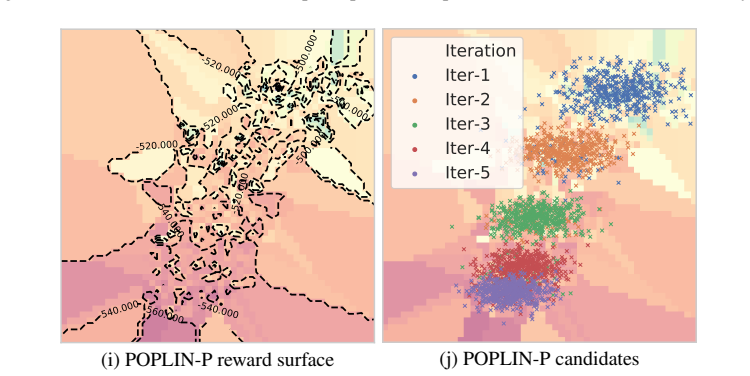
Figures


Figures from the paper (18 more)




Forward citations
Cited by 6 Pith papers
-
Mastering Atari with Discrete World Models
DreamerV2 reaches human-level performance on 55 Atari games by learning behaviors inside a separately trained discrete-latent world model.
-
MODIP: Efficient Model-Based Optimization for Diffusion Policies
MODIP fine-tunes diffusion policies offline-to-online by training a world model, running MPC with terminal state values inside it to create targets, and using policy-independent TD critics, yielding gains over BC on D...
-
RT-HCP: Dealing with Inference Delays and Sample Efficiency to Learn Directly on Robotic Platforms
RT-HCP combines a physics-informed model, multi-step planning, and an actor-critic policy to learn a swing-up controller on a real Furuta pendulum under strict time and sample limits.
-
Rapidly Adapting Policies to the Real World via Simulation-Guided Fine-Tuning
SGFT uses a simulation-trained value function to guide real-world exploration via potential-based reward shaping and short-horizon objectives, substantially improving fine-tuning sample efficiency.
-
First Order Model-Based RL through Decoupled Backpropagation
By computing gradients through a learned dynamics model while unrolling trajectories in the real simulator, DMO achieves SHAC-level sample efficiency with standard simulators and deploys on a real quadruped.
-
Bounding Distributional Shifts in World Modeling through Novelty Detection
Attaching a VAE novelty detector to the DINO-WM world model and penalizing out-of-distribution predicted states in CEM planning lowers Chamfer distance on small-data robot manipulation benchmarks.
Reference graph
Works this paper leans on
-
[1]
The cross-entropy method for optimization
Zdravko I Botev, Dirk P Kroese, Reuven Y Rubinstein, and Pierre L’Ecuyer. The cross-entropy method for optimization. In Handbook of statistics, volume 31, pages 35–59. Elsevier, 2013
work page 2013
-
[2]
Greg Brockman, Vicki Cheung, Ludwig Pettersson, Jonas Schneider, John Schulman, Jie Tang, and Wojciech Zaremba. Openai gym. arXiv preprint arXiv:1606.01540, 2016
work page Pith review arXiv 2016
-
[3]
Sample- efficient reinforcement learning with stochastic ensemble value expansion
Jacob Buckman, Danijar Hafner, George Tucker, Eugene Brevdo, and Honglak Lee. Sample- efficient reinforcement learning with stochastic ensemble value expansion. In Advances in Neural Information Processing Systems, pages 8224–8234, 2018
work page 2018
-
[4]
Combining model-based and model-free updates for trajectory-centric reinforcement learning
Yevgen Chebotar, Karol Hausman, Marvin Zhang, Gaurav Sukhatme, Stefan Schaal, and Sergey Levine. Combining model-based and model-free updates for trajectory-centric reinforcement learning. In Proceedings of the 34th International Conference on Machine Learning-V olume 70, pages 703–711. JMLR. org, 2017
work page 2017
-
[5]
Deep Reinforcement Learning in a Handful of Trials using Probabilistic Dynamics Models
Kurtland Chua, Roberto Calandra, Rowan McAllister, and Sergey Levine. Deep reinforce- ment learning in a handful of trials using probabilistic dynamics models. arXiv preprint arXiv:1805.12114, 2018
work page Pith review arXiv 2018
-
[6]
A tutorial on the cross-entropy method
Pieter-Tjerk De Boer, Dirk P Kroese, Shie Mannor, and Reuven Y Rubinstein. A tutorial on the cross-entropy method. Annals of operations research, 134(1):19–67, 2005
work page 2005
-
[7]
Pilco: A model-based and data-efficient approach to policy search
Marc Deisenroth and Carl E Rasmussen. Pilco: A model-based and data-efficient approach to policy search. In Proceedings of the 28th International Conference on machine learning (ICML-11), pages 465–472, 2011
work page 2011
-
[8]
Model-Based Value Estimation for Efficient Model-Free Reinforcement Learning
Vladimir Feinberg, Alvin Wan, Ion Stoica, Michael I Jordan, Joseph E Gonzalez, and Sergey Levine. Model-based value estimation for efficient model-free reinforcement learning. arXiv preprint arXiv:1803.00101, 2018
work page Pith review arXiv 2018
Show all 43 references
-
[9]
Addressing function approximation error in actor-critic methods
Scott Fujimoto, Herke van Hoof, and David Meger. Addressing function approximation error in actor-critic methods. arXiv preprint arXiv:1802.09477, 2018
2018 arXiv
-
[10]
Generative adversarial nets
Ian Goodfellow, Jean Pouget-Abadie, Mehdi Mirza, Bing Xu, David Warde-Farley, Sherjil Ozair, Aaron Courville, and Yoshua Bengio. Generative adversarial nets. In Advances in neural information processing systems, pages 2672–2680, 2014
2014
-
[11]
Continuous deep q-learning with model-based acceleration
Shixiang Gu, Timothy Lillicrap, Ilya Sutskever, and Sergey Levine. Continuous deep q-learning with model-based acceleration. In International Conference on Machine Learning , pages 2829–2838, 2016
2016
-
[12]
Recurrent world models facilitate policy evolution
David Ha and Jürgen Schmidhuber. Recurrent world models facilitate policy evolution. In Advances in Neural Information Processing Systems , pages 2450–2462, 2018
2018
-
[13]
World models
David Ha and Jürgen Schmidhuber. World models. arXiv preprint arXiv:1803.10122, 2018
2018 arXiv
-
[14]
Soft actor-critic: Off- policy maximum entropy deep reinforcement learning with a stochastic actor
Tuomas Haarnoja, Aurick Zhou, Pieter Abbeel, and Sergey Levine. Soft actor-critic: Off- policy maximum entropy deep reinforcement learning with a stochastic actor. arXiv preprint arXiv:1801.01290, 2018
2018 arXiv
-
[15]
Learning latent dynamics for planning from pixels
Danijar Hafner, Timothy Lillicrap, Ian Fischer, Ruben Villegas, David Ha, Honglak Lee, and James Davidson. Learning latent dynamics for planning from pixels. arXiv preprint arXiv:1811.04551, 2018
2018 arXiv
-
[16]
Emergence of locomotion behaviours in rich environments
Nicolas Heess, Srinivasan Sriram, Jay Lemmon, Josh Merel, Greg Wayne, Yuval Tassa, Tom Erez, Ziyu Wang, Ali Eslami, Martin Riedmiller, et al. Emergence of locomotion behaviours in rich environments. arXiv preprint arXiv:1707.02286, 2017
2017 arXiv
-
[17]
Learning continuous control policies by stochastic value gradients
Nicolas Heess, Gregory Wayne, David Silver, Timothy Lillicrap, Tom Erez, and Yuval Tassa. Learning continuous control policies by stochastic value gradients. In Advances in Neural Information Processing Systems, pages 2944–2952, 2015
2015
-
[18]
Model- based reinforcement learning for atari
Lukasz Kaiser, Mohammad Babaeizadeh, Piotr Milos, Blazej Osinski, Roy H Campbell, Konrad Czechowski, Dumitru Erhan, Chelsea Finn, Piotr Kozakowski, Sergey Levine, et al. Model- based reinforcement learning for atari. arXiv preprint arXiv:1903.00374, 2019
1903
-
[19]
Auto-encoding variational bayes
Diederik P Kingma and Max Welling. Auto-encoding variational bayes. arXiv preprint arXiv:1312.6114, 2013. 9
2013 arXiv
-
[20]
Model-ensemble trust-region policy optimization
Thanard Kurutach, Ignasi Clavera, Yan Duan, Aviv Tamar, and Pieter Abbeel. Model-ensemble trust-region policy optimization. arXiv preprint arXiv:1802.10592, 2018
2018 arXiv
-
[21]
Learning neural network policies with guided policy search under unknown dynamics
Sergey Levine and Pieter Abbeel. Learning neural network policies with guided policy search under unknown dynamics. In Advances in Neural Information Processing Systems , pages 1071–1079, 2014
2014
-
[22]
End-to-end training of deep visuomotor policies
Sergey Levine, Chelsea Finn, Trevor Darrell, and Pieter Abbeel. End-to-end training of deep visuomotor policies. The Journal of Machine Learning Research , 17(1):1334–1373, 2016
2016
-
[23]
Guided policy search
Sergey Levine and Vladlen Koltun. Guided policy search. In International Conference on Machine Learning, pages 1–9, 2013
2013
-
[24]
Visualizing the loss landscape of neural nets
Hao Li, Zheng Xu, Gavin Taylor, Christoph Studer, and Tom Goldstein. Visualizing the loss landscape of neural nets. In Advances in Neural Information Processing Systems , pages 6389–6399, 2018
2018
-
[25]
Iterative linear quadratic regulator design for nonlinear biological movement systems
Weiwei Li and Emanuel Todorov. Iterative linear quadratic regulator design for nonlinear biological movement systems. In ICINCO (1), pages 222–229, 2004
2004
-
[26]
Continuous control with deep reinforcement learning
Timothy P Lillicrap, Jonathan J Hunt, Alexander Pritzel, Nicolas Heess, Tom Erez, Yuval Tassa, David Silver, and Daan Wierstra. Continuous control with deep reinforcement learning. arXiv preprint arXiv:1509.02971, 2015
2015 arXiv
-
[27]
Algo- rithmic framework for model-based deep reinforcement learning with theoretical guarantees
Yuping Luo, Huazhe Xu, Yuanzhi Li, Yuandong Tian, Trevor Darrell, and Tengyu Ma. Algo- rithmic framework for model-based deep reinforcement learning with theoretical guarantees. ICLR, 2019
2019
-
[28]
Playing atari with deep reinforcement learning
V olodymyr Mnih, Koray Kavukcuoglu, David Silver, Alex Graves, Ioannis Antonoglou, Daan Wierstra, and Martin Riedmiller. Playing atari with deep reinforcement learning. arXiv preprint arXiv:1312.5602, 2013
2013 arXiv
-
[29]
Neural network dynamics for model-based deep reinforcement learning with model-free fine-tuning
Anusha Nagabandi, Gregory Kahn, Ronald S Fearing, and Sergey Levine. Neural network dynamics for model-based deep reinforcement learning with model-free fine-tuning. arXiv preprint arXiv:1708.02596, 2017
2017 arXiv
-
[30]
The loss surface of deep and wide neural networks
Quynh Nguyen and Matthias Hein. The loss surface of deep and wide neural networks. In Proceedings of the 34th International Conference on Machine Learning-V olume 70 , pages 2603–2612. JMLR. org, 2017
2017
-
[31]
Robust constrained model predictive control
Arthur George Richards. Robust constrained model predictive control . PhD thesis, Mas- sachusetts Institute of Technology, 2005
2005
-
[32]
Improved techniques for training gans
Tim Salimans, Ian Goodfellow, Wojciech Zaremba, Vicki Cheung, Alec Radford, and Xi Chen. Improved techniques for training gans. In Advances in neural information processing systems , pages 2234–2242, 2016
2016
-
[33]
Trust region policy optimization
John Schulman, Sergey Levine, Pieter Abbeel, Michael Jordan, and Philipp Moritz. Trust region policy optimization. In Proceedings of the 32nd International Conference on Machine Learning (ICML-15), pages 1889–1897, 2015
2015
-
[34]
Proximal policy optimization algorithms
John Schulman, Filip Wolski, Prafulla Dhariwal, Alec Radford, and Oleg Klimov. Proximal policy optimization algorithms. arXiv preprint arXiv:1707.06347, 2017
2017 arXiv
-
[35]
Mas- tering the game of go with deep neural networks and tree search
David Silver, Aja Huang, Chris J Maddison, Arthur Guez, Laurent Sifre, George Van Den Driess- che, Julian Schrittwieser, Ioannis Antonoglou, Veda Panneershelvam, Marc Lanctot, et al. Mas- tering the game of go with deep neural networks and tree search. Nature, 529(7587):484–489, 2016
2016
-
[36]
Mastering the game of go without human knowledge
David Silver, Julian Schrittwieser, Karen Simonyan, Ioannis Antonoglou, Aja Huang, Arthur Guez, Thomas Hubert, Lucas Baker, Matthew Lai, Adrian Bolton, et al. Mastering the game of go without human knowledge. Nature, 550(7676):354–359, 2017
2017
-
[37]
Exponentially vanishing sub-optimal local minima in multilayer neural networks
Daniel Soudry and Elad Hoffer. Exponentially vanishing sub-optimal local minima in multilayer neural networks. arXiv preprint arXiv:1702.05777, 2017
2017 arXiv
-
[38]
Integrated architectures for learning, planning, and reacting based on approximating dynamic programming
Richard S Sutton. Integrated architectures for learning, planning, and reacting based on approximating dynamic programming. In Machine Learning Proceedings 1990, pages 216–224. Elsevier, 1990
1990
-
[39]
Dyna, an integrated architecture for learning, planning, and reacting
Richard S Sutton. Dyna, an integrated architecture for learning, planning, and reacting. ACM SIGART Bulletin, 2(4):160–163, 1991. 10
1991
-
[40]
Synthesis and stabilization of complex behaviors through online trajectory optimization
Yuval Tassa, Tom Erez, and Emanuel Todorov. Synthesis and stabilization of complex behaviors through online trajectory optimization. InIntelligent Robots and Systems (IROS), 2012 IEEE/RSJ International Conference on, pages 4906–4913. IEEE, 2012
2012
-
[41]
Mujoco: A physics engine for model-based control
Emanuel Todorov, Tom Erez, and Yuval Tassa. Mujoco: A physics engine for model-based control. In Intelligent Robots and Systems (IROS), 2012 IEEE/RSJ International Conference on , pages 5026–5033. IEEE, 2012
2012
-
[42]
A generalized iterative lqg method for locally-optimal feedback control of constrained nonlinear stochastic systems
Emanuel Todorov and Weiwei Li. A generalized iterative lqg method for locally-optimal feedback control of constrained nonlinear stochastic systems. In Proceedings of the 2005, American Control Conference, 2005., pages 300–306. IEEE, 2005
2005
-
[43]
Cheetah", and the HalfCHeetah from OpenAI Gym is named as
Marvin Zhang, Sharad Vikram, Laura Smith, Pieter Abbeel, Matthew J Johnson, and Sergey Levine. Solar: Deep structured latent representations for model-based reinforcement learning. arXiv preprint arXiv:1808.09105, 2018. 11 A Appendix A.1 Algorithm Diagrams To better illustrate...
2018 arXiv
Reviewed May 25, 2026 · model on record in the stance chip above.
Discussion (0). Continue with ORCID to comment.