From Phase to Phenomenon: Self-Supervised Learning of Subsurface Scattering with Minimal Phase-shift Inputs
Pith reviewed 2026-06-30 07:29 UTC · model grok-4.3
The pith
Self-supervised pretraining on eight phase-shift images produces generalizable subsurface scattering representations.
A machine-rendered reading of the paper's core claim, the machinery that carries it, and where it could break.
Core claim
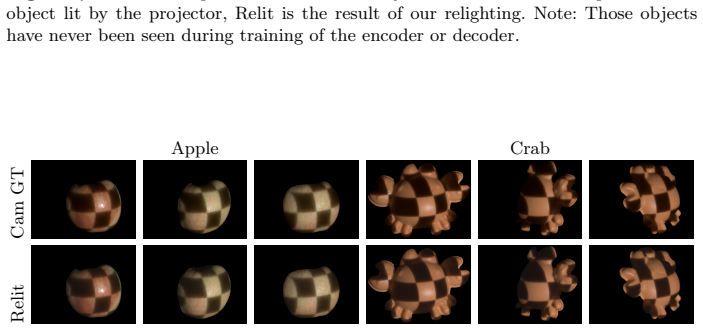
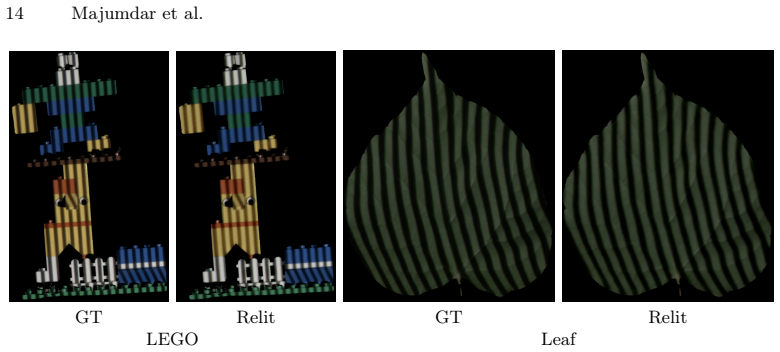
The pretrained encoder learns generalizable SSS representations that transfer effectively to downstream tasks, including spatially varying relighting and representation evaluation using a kNN classifier; combined with a decoder the model reconstructs dense scattering footprint responses achieving high-fidelity reconstructions on unseen objects with complex geometry and material properties using only eight input images per view.
What carries the argument
The self-supervised pretraining framework with tailored augmentations on high-frequency phase-shift profilometry images in a multi-view, multi-object setting to learn light-transport features.
Load-bearing premise
The tailored augmentation strategy for PSP-based SSS data combined with multi-view multi-object self-supervised pretraining is sufficient to extract generalizable light-transport features without requiring additional supervision or larger input sets.
What would settle it
A demonstration that the pretrained representations fail to transfer to relighting or produce low-fidelity reconstructions on objects with material properties not represented in the pretraining data would falsify the generalization claim.
Figures
read the original abstract
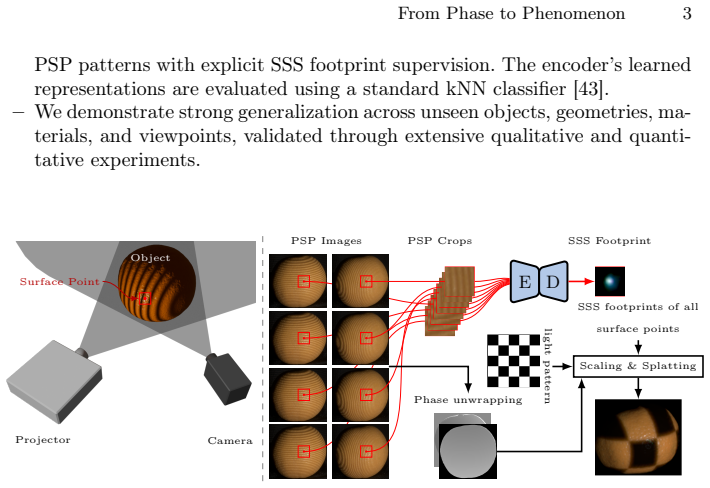
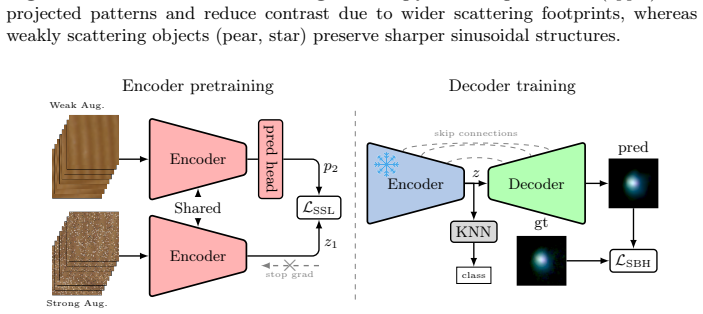
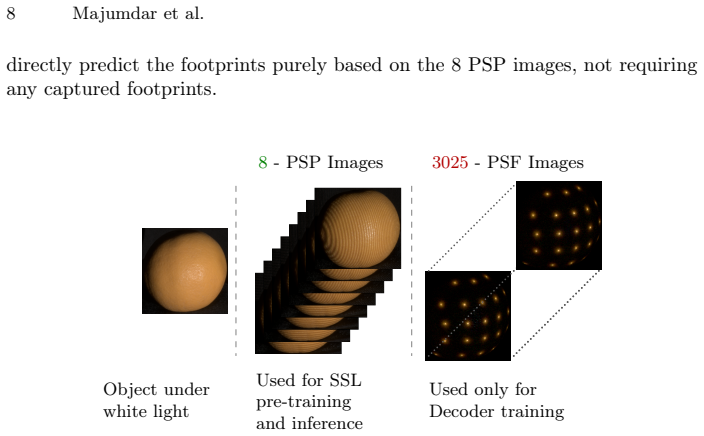
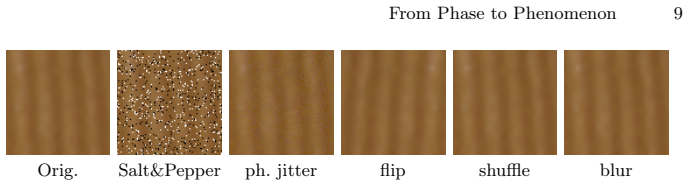
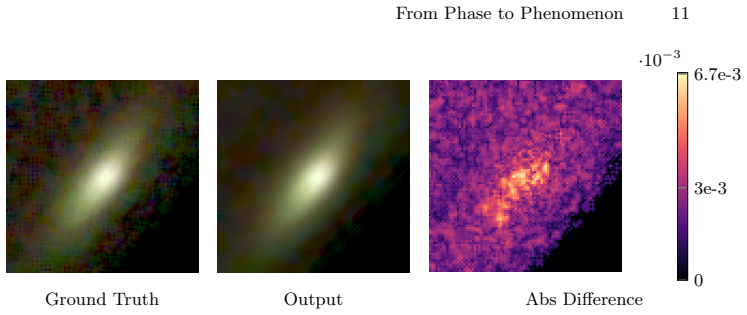
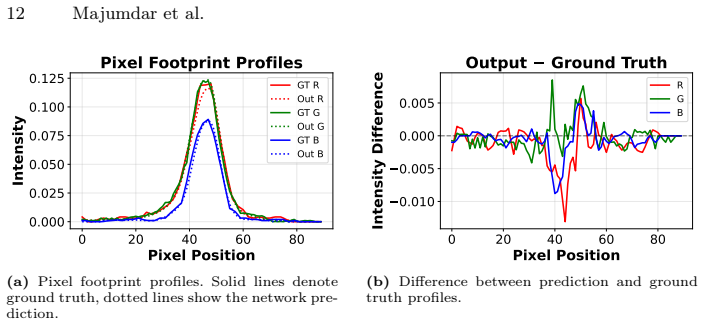
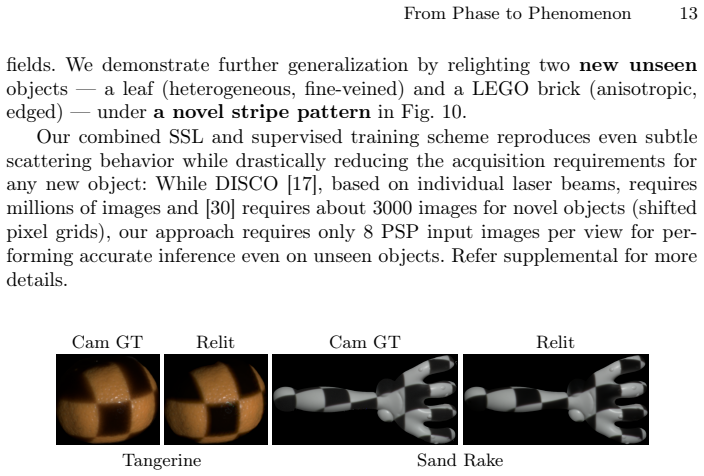
We propose a self-supervised pretraining framework for learning sub-surface scattering (SSS) light transport representations from minimal input. Our method leverages a stereo projector-camera setup that captures only eight high-frequency phase-shift profilometry (PSP) images per view to pretrain an encoder in a multi-view, multi-object setting. We introduce a tailored augmentation strategy for PSP-based SSS data, and show that it significantly outperforms standard ImageNet-style augmentations for SSL pretraining. The pretrained encoder learns generalizable SSS representations that transfer effectively to downstream tasks, including spatially varying relighting and representation evaluation using a kNN classifier. Combined with a decoder, the model reconstructs dense scattering footprint responses, trained using a dedicated cost function that improves accuracy, particularly for anisotropic footprints. Despite using only eight input images per view, our approach generalizes to unseen objects with complex geometry and material properties, achieving high-fidelity reconstructions while requiring orders of magnitude fewer images than prior methods.
Editorial analysis
A structured set of objections, weighed in public.
Referee Report
Summary. The paper proposes a self-supervised pretraining framework for learning subsurface scattering (SSS) light transport representations from a stereo projector-camera setup that captures only eight high-frequency phase-shift profilometry (PSP) images per view. In a multi-view, multi-object setting, it introduces a tailored augmentation strategy for PSP-based SSS data that is claimed to significantly outperform standard ImageNet-style augmentations. The pretrained encoder is said to learn generalizable SSS representations that transfer to downstream tasks such as spatially varying relighting and kNN-based representation evaluation. Combined with a decoder and a dedicated cost function, the model reconstructs dense scattering footprint responses, generalizing to unseen objects with complex geometry and material properties while using orders of magnitude fewer images than prior methods.
Significance. If the central claims are substantiated with quantitative evidence, the work would be significant for computer vision and graphics by demonstrating that self-supervised learning with minimal PSP inputs and tailored augmentations can extract transferable light-transport features for SSS, substantially lowering data acquisition costs compared to supervised or dense-sampling approaches. The multi-view multi-object pretraining and kNN evaluation protocol could provide a template for physics-informed SSL in other light-transport domains.
major comments (3)
- [Abstract] Abstract: The claim that the tailored augmentation strategy 'significantly outperforms standard ImageNet-style augmentations for SSL pretraining' is presented without any quantitative results, error bars, ablation tables, or statistical tests. This directly undermines assessment of whether the augmentation (vs. the multi-view multi-object setup or data volume alone) drives the reported generalization.
- [Abstract] Abstract and downstream evaluation sections: The central claim that the encoder learns representations capturing 'subsurface scattering light transport' (rather than low-level image statistics or dataset correlations) is load-bearing, yet the manuscript offers downstream success on relighting and kNN classification as evidence without controls that isolate the tailored PSP augmentations from standard augmentations or additional data. This leaves the physics-based interpretation under-supported.
- [Abstract] Abstract: The statement that the dedicated cost function 'improves accuracy, particularly for anisotropic footprints' and that the approach achieves 'high-fidelity reconstructions' on unseen objects lacks any reported metrics, comparisons to baselines, or details on the reconstruction error, making verification of the minimal-input advantage impossible from the given text.
minor comments (1)
- [Abstract] The abstract refers to 'representation evaluation using a kNN classifier' without specifying the feature space, distance metric, or how the classifier is trained/evaluated on the pretrained embeddings.
Simulated Author's Rebuttal
We thank the referee for the thoughtful comments, which highlight opportunities to better substantiate the abstract claims with explicit references to the quantitative evidence in the main text. We address each point below and will revise the manuscript accordingly.
read point-by-point responses
-
Referee: [Abstract] Abstract: The claim that the tailored augmentation strategy 'significantly outperforms standard ImageNet-style augmentations for SSL pretraining' is presented without any quantitative results, error bars, ablation tables, or statistical tests. This directly undermines assessment of whether the augmentation (vs. the multi-view multi-object setup or data volume alone) drives the reported generalization.
Authors: We agree the abstract would benefit from direct pointers to the supporting evidence. The main manuscript contains dedicated ablation studies (Section 4.2, Table 2) that compare the tailored PSP augmentations against standard ImageNet-style augmentations on the same multi-view multi-object pretraining data, reporting downstream task metrics with standard deviations across three random seeds. We will revise the abstract to reference these results and ensure error bars are visible in the corresponding figures. revision: yes
-
Referee: [Abstract] Abstract and downstream evaluation sections: The central claim that the encoder learns representations capturing 'subsurface scattering light transport' (rather than low-level image statistics or dataset correlations) is load-bearing, yet the manuscript offers downstream success on relighting and kNN classification as evidence without controls that isolate the tailored PSP augmentations from standard augmentations or additional data. This leaves the physics-based interpretation under-supported.
Authors: The manuscript does provide isolating controls: Section 4.3 reports kNN classification and relighting performance for encoders pretrained with tailored PSP augmentations versus standard augmentations (and versus no pretraining), using identical data volume and architecture. These ablations are designed to separate the contribution of the augmentation strategy. We will expand the discussion in the downstream sections to more explicitly connect these controls to the light-transport interpretation and add a short paragraph addressing potential low-level statistic confounds. revision: partial
-
Referee: [Abstract] Abstract: The statement that the dedicated cost function 'improves accuracy, particularly for anisotropic footprints' and that the approach achieves 'high-fidelity reconstructions' on unseen objects lacks any reported metrics, comparisons to baselines, or details on the reconstruction error, making verification of the minimal-input advantage impossible from the given text.
Authors: Quantitative reconstruction results, including L1 and angular error metrics, baseline comparisons, and an ablation of the dedicated cost function, appear in Section 5 and Table 3, with particular gains shown for anisotropic cases in Figure 6. The abstract summarizes these findings. We will revise the abstract to include key metric values and explicit references to the tables and figures that substantiate the minimal-input advantage. revision: yes
Circularity Check
No circularity; claims rest on empirical transfer to downstream tasks rather than definitional reduction
full rationale
The paper describes a self-supervised pretraining pipeline that uses eight PSP images per view, tailored augmentations, and a multi-view multi-object setup to train an encoder, followed by transfer to relighting, kNN evaluation, and decoder-based reconstruction with a dedicated cost function. No load-bearing step equates a prediction to its own fitted input by construction, invokes a self-citation as an unverified uniqueness theorem, or renames an input as an output. The derivation chain is self-contained against external benchmarks (unseen objects, complex geometry/materials) and does not reduce to tautology.
Axiom & Free-Parameter Ledger
axioms (1)
- domain assumption Eight high-frequency phase-shift images per view from a stereo projector-camera setup contain sufficient information to pretrain generalizable SSS representations.
Reference graph
Works this paper leans on
-
[1]
In: ICLR
Bardes, A., Ponce, J., LeCun, Y.: Vicreg: Variance-invariance-covariance regular- ization for self-supervised learning. In: ICLR. OpenReview.net (2022)
2022
-
[2]
In: Larochelle, H., Ranzato, M., Hadsell, R., Balcan, M.F., Lin, H.T
Caron, M., Misra, I., Mairal,J., Goyal, P., Bojanowski, P., Joulin, A.: Unsupervised learning of visual features by contrasting cluster assignments. In: Larochelle, H., Ranzato, M., Hadsell, R., Balcan, M.F., Lin, H.T. (eds.) NeurIPS (2020)
2020
-
[3]
In: ICCV (2021)
Caron, M., Touvron, H., Misra, I., Jégou, H., Mairal, J., Bojanowski, P., Joulin, A.: Emerging properties in self-supervised vision transformers. In: ICCV (2021)
2021
-
[4]
A Simple Framework for Contrastive Learning of Visual Representations
Chen, T., Kornblith, S., Norouzi, M., Hinton, G.E.: A simple framework for con- trastive learning of visual representations. CoRRabs/2002.05709(2020)
work page internal anchor Pith review Pith/arXiv arXiv 2002
-
[5]
Chen, T., Kornblith, S., Swersky, K., Norouzi, M., Hinton, G.E.: Big self-supervised models are strong semi-supervised learners. CoRRabs/2006.10029(2020)
-
[7]
In: 2008 IEEE Conference on Computer Vision and Pattern Recognition
Chen, T., Seidel, H.P., Lensch, H.P.A.: Modulated phase-shifting for 3d scanning. In: 2008 IEEE Conference on Computer Vision and Pattern Recognition. pp. 1–8 (2008).https://doi.org/10.1109/CVPR.2008.4587836
-
[8]
In: CVPR
Chen, X., He, K.: Exploring simple siamese representation learning. In: CVPR. pp. 15750–15758. Computer Vision Foundation / IEEE (2021)
2021
-
[9]
ACM TOG37(2018)
Christensen, P., Fong, J., Shade, J., Wooten, W., Schubert, B., Kensler, A., Fried- man, S., Kilpatrick, C., Ramshaw, C., Bannister, M., Rayner, B., Brouillat, J., Liani, M.: Renderman: An advanced path-tracing architecture for movie render- ing. ACM TOG37(2018)
2018
-
[10]
In: Proceedings of the 27th annual conference on Computer graphics and interactive techniques
Debevec, P., Hawkins, T., Tchou, C., Duiker, H.P., Sarokin, W., Sagar, M.: Ac- quiring the reflectance field of a human face. In: Proceedings of the 27th annual conference on Computer graphics and interactive techniques. pp. 145–156 (2000)
2000
-
[11]
In: The Thirty-eighth Annual Conference on Neural Information Processing Systems (2025)
Dihlmann, J.N., Majumdar, A., Engelhardt, A., Braun, R., Lensch, H.: Subsur- face scattering for gaussian splatting. In: The Thirty-eighth Annual Conference on Neural Information Processing Systems (2025)
2025
-
[12]
In: Meila, M., Zhang, T
Ermolov, A., Siarohin, A., Sangineto, E., Sebe, N.: Whitening for self-supervised representation learning. In: Meila, M., Zhang, T. (eds.) Proceedings of the 38th International Conference on Machine Learning. Proceedings of Machine Learning Research, vol. 139, pp. 3015–3024. PMLR (18–24 Jul 2021)
2021
-
[13]
ACM TOG37(2018)
Fascione, L., Hanika, J., Leone, M., Droske, M., Schwarzhaupt, J., Davidovič, T., Weidlich, A., Meng, J.: Manuka: A batch-shading architecture for spectral path tracing in movie production. ACM TOG37(2018)
2018
-
[14]
In: Computer Graphics Forum
Fuchs, C., Heinz, M., Levoy, M., Seidel, H.P., Lensch, H.P.: Combining confocal imaging and descattering. In: Computer Graphics Forum. vol. 27, pp. 1245–1253. Wiley Online Library (2008)
2008
-
[15]
In: Proceedings of the Eurographics Symposium on Rendering
Garg, G., Talvala, E.V., Levoy, M., Lensch, H.P.A.: Symmetric photography: Ex- ploiting data-sparseness in reflectance fields. In: Proceedings of the Eurographics Symposium on Rendering. pp. 251–262. Eurographics Association (2006)
2006
-
[16]
Journal of the Optical Society of America A39(2022)
Geiger, S., Hank, P., Kienle, A.: Improved topography reconstruction of volume scattering objects using structured light. Journal of the Optical Society of America A39(2022)
2022
-
[17]
In: ACM SIGGRAPH 2004 Papers, pp
Goesele, M., Lensch, H.P., Lang, J., Fuchs, C., Seidel, H.P.: Disco: acquisition of translucent objects. In: ACM SIGGRAPH 2004 Papers, pp. 835–844. ACM (2004) From Phase to Phenomenon 17
2004
-
[18]
In: Larochelle, H., Ranzato, M., Hadsell, R., Balcan, M.F., Lin, H.T
Grill, J.B., Strub, F., Altché, F., Tallec, C., Richemond, P.H., Buchatskaya, E., Doersch, C., Pires, B.Á., Guo, Z., Azar, M.G., Piot, B., Kavukcuoglu, K., Munos, R., Valko, M.: Bootstrap your own latent - a new approach to self-supervised learning. In: Larochelle, H., Ranzato, M., Hadsell, R., Balcan, M.F., Lin, H.T. (eds.) NeurIPS (2020)
2020
-
[19]
In: 2012 IEEE Conference on Com- puter Vision and Pattern Recognition
Gupta, M., Nayar, S.K.: Micro phase shifting. In: 2012 IEEE Conference on Com- puter Vision and Pattern Recognition. pp. 813–820 (2012).https://doi.org/10. 1109/CVPR.2012.6247753
-
[20]
In: CVPR
He, K., Fan, H., Wu, Y., Xie, S., Girshick, R.B.: Momentum contrast for unsuper- vised visual representation learning. In: CVPR. pp. 9726–9735. Computer Vision Foundation / IEEE (2020)
2020
-
[21]
In: Leibe, B., Matas, J., Sebe, N., Welling, M
He, K., Zhang, X., Ren, S., Sun, J.: Identity mappings in deep residual networks. In: Leibe, B., Matas, J., Sebe, N., Welling, M. (eds.) Computer Vision – ECCV
-
[22]
pp. 630–645. Springer International Publishing, Cham (2016)
2016
-
[23]
Optics and Lasers in Engineering142 (2021).https://doi.org/10.1016/j.optlaseng.2021.106613
He, X., Kemao, Q.: A comparative study on temporal phase unwrapping methods in high-speed fringe projection profilometry. Optics and Lasers in Engineering142 (2021).https://doi.org/10.1016/j.optlaseng.2021.106613
-
[24]
In: Proceedings of the 28th Annual Conference on Computer Graphics and Interactive Techniques
Jensen, H.W., Marschner, S.R., Levoy, M., Hanrahan, P.: A practical model for subsurface light transport. In: Proceedings of the 28th Annual Conference on Computer Graphics and Interactive Techniques. pp. 511–518. SIGGRAPH ’01, Association for Computing Machinery, New York, NY, USA (2001).https: //doi.org/10.1145/383259.383319
-
[25]
In: Proceedings of the 28th annual conference on Com- puter graphics and interactive techniques
Jensen, H.W., Marschner, S.R., Levoy, M., Hanrahan, P.: A practical model for subsurface light transport. In: Proceedings of the 28th annual conference on Com- puter graphics and interactive techniques. pp. 511–518 (2001)
2001
-
[26]
Applied optics35(13), 2304–2314 (1996)
Kienle, A., Lilge, L., Patterson, M.S., Hibst, R., Steiner, R., Wilson, B.C.: Spatially resolved absolute diffuse reflectance measurements for noninvasive determination of the optical scattering and absorption coefficients of biological tissue. Applied optics35(13), 2304–2314 (1996)
1996
-
[27]
In: Biomedical Imaging and Sensing Conference
Kikuchi, K., Katsuyama, M., Shibata, T., Hardeberg, J., Yuasa, T., Aizu, Y.: Development of measurement system for subsurface scattering light of skin and analysis of its age-related changes. In: Biomedical Imaging and Sensing Conference. vol. 12608, pp. 123–126. SPIE (2023)
2023
-
[28]
InProceedings of the SIGGRAPH Asia 2025 Conference Papers (SA Conference Papers ’25)
Kirillov, A., Mintun, E., Ravi, N., Mao, H., Rolland, C., Gustafson, L., Xiao, T., Whitehead, S., Berg, A.C., Lo, W.Y., Dollár, P., Girshick, R.: Segment anything. 2023 IEEE/CVF International Conference on Computer Vision (ICCV) (2023). https://doi.org/10.1109/iccv51070.2023.00371
-
[29]
In: ICCV
Koohpayegani, S.A., Tejankar, A., Pirsiavash, H.: Mean shift for self-supervised learning. In: ICCV. pp. 10306–10315. IEEE (2021)
2021
-
[30]
In: European Conference on Computer Vision
Lyu, L., Tewari, A., Leimkühler, T., Habermann, M., Theobalt, C.: Neural radi- ance transfer fields for relightable novel-view synthesis with global illumination. In: European Conference on Computer Vision. pp. 153–169. Springer (2022)
2022
-
[31]
In: Egger, B., Günther, T
Majumdar, A., Braun, R., Lensch, H.: Neural Acquisition & Representation of Subsurface Scattering. In: Egger, B., Günther, T. (eds.) Vision, Modeling, and Visualization. The Eurographics Association (2025).https://doi.org/10.2312/ vmv.20251228
2025
-
[32]
Malvar, H.S., wei He, L., Cutler, R.: High-quality linear interpolation for demo- saicing of Bayer-patterned color images. In: Proceedings of the 2004 IEEE Interna- tional Conference on Acoustics, Speech, and Signal Processing (ICASSP). vol. 4, pp. iv–485–8 (May 2004).https://doi.org/10.1109/ICASSP.2004.1326587 18 Majumdar et al
-
[33]
Moreno, D., Son, K., Taubin, G.: Embedded phase shifting: Robust phase shifting with embedded signals. In: 2015 IEEE Conference on Computer Vision and Pattern Recognition (CVPR). pp. 2301–2309 (2015).https://doi.org/10.1109/CVPR. 2015.7298843
-
[34]
Nayar, S., Krishnan, G., Grossberg, M., Raskar, R.: Fast separation of direct and global components of a scene using high frequency illumination. ACM Trans. Graph.25, 935–944 (Jul 2006).https://doi.org/10.1145/1179352.1141977
-
[35]
ACM Trans
O’Toole, M., Kutulakos, K.N.: Optical computing for fast light transport analysis. ACM Trans. Graph.29(6), 164 (2010)
2010
-
[36]
ACM Trans
O’Toole, M., Raskar, R., Kutulakos, K.N.: Primal-dual coding to probe light trans- port. ACM Trans. Graph.31(4), 39–1 (2012)
2012
-
[37]
In: Proceedings of the 14th Eurographics workshop on Rendering
Peers, P., Dutré, P.: Wavelet environment matting. In: Proceedings of the 14th Eurographics workshop on Rendering. pp. 157–166 (2003)
2003
-
[38]
ACM Transactions on Graphics (ToG)28(1), 1–18 (2009)
Peers, P., Mahajan, D.K., Lamond, B., Ghosh, A., Matusik, W., Ramamoorthi, R., Debevec, P.: Compressive light transport sensing. ACM Transactions on Graphics (ToG)28(1), 1–18 (2009)
2009
-
[39]
U-Net: Convolutional Networks for Biomedical Image Segmentation
Ronneberger, O., Fischer, P., Brox, T.: U-net: Convolutional networks for biomed- ical image segmentation. CoRRabs/1505.04597(2015)
work page internal anchor Pith review Pith/arXiv arXiv 2015
-
[40]
ACM Transactions on Graphics24(3), 745–755 (2005).https://doi.org/10.1145/1073204.1073257
Sen,P.,Chen,B.,Garg,G.,Marschner,S.,Sen,M.,Zoras,P.,Lunsford,P.,Genetti, J., Levoy, M.: Dual photography. ACM Transactions on Graphics24(3), 745–755 (2005).https://doi.org/10.1145/1073204.1073257
-
[41]
In: 2016 IEEE Conference on Computer Vision and Pattern Recognition (CVPR)
Shi, W., Caballero, J., Huszár, F., Totz, J., Aitken, A.P., Bishop, R., Rueckert, D., Wang, Z.: Real-time single image and video super-resolution using an efficient sub-pixel convolutional neural network. In: 2016 IEEE Conference on Computer Vision and Pattern Recognition (CVPR). pp. 1874–1883 (2016).https://doi. org/10.1109/CVPR.2016.207
-
[42]
ACM TOG38(2019)
Vicini, D., Koltun, V., Jakob, W.: A learned shape-adaptive subsurface scattering model. ACM TOG38(2019)
2019
-
[43]
ACM Transactions on Graphics (ToG) 25(3), 1013–1024 (2006)
Weyrich, T., Matusik, W., Pfister, H., Bickel, B., Donner, C., Tu, C., McAnd- less, J., Lee, J., Ngan, A., Jensen, H.W., et al.: Analysis of human faces using a measurement-based skin reflectance model. ACM Transactions on Graphics (ToG) 25(3), 1013–1024 (2006)
2006
-
[44]
In: 2018 IEEE/CVF Conference on Computer Vision and Pattern Recognition
Wu, Z., Xiong, Y., Yu, S.X., Lin, D.: Unsupervised feature learning via non- parametric instance discrimination. In: 2018 IEEE/CVF Conference on Computer Vision and Pattern Recognition. pp. 3733–3742 (2018).https://doi.org/10. 1109/CVPR.2018.00393
- [45]
-
[46]
In: Meila, M., Zhang, T
Zbontar, J., Jing, L., Misra, I., LeCun, Y., Deny, S.: Barlow twins: Self-supervised learning via redundancy reduction. In: Meila, M., Zhang, T. (eds.) ICML. Pro- ceedings of Machine Learning Research, vol. 139, pp. 12310–12320. PMLR (2021)
2021
-
[47]
Advances in Neural Information Processing Systems34, 15203–15215 (2021)
Zheng,Q.,Singh,G.,Seidel,H.P.:Neuralrelightableparticipatingmediarendering. Advances in Neural Information Processing Systems34, 15203–15215 (2021)
2021
-
[48]
arXiv preprint arXiv:2306.09322 (2023)
Zhu, S., Saito, S., Bozic, A., Aliaga, C., Darrell, T., Lassner, C.: Neural relight- ing with subsurface scattering by learning the radiance transfer gradient. arXiv preprint arXiv:2306.09322 (2023)
-
[49]
Zuo, C., Feng, S., Huang, L., Tao, T., Yin, W., Chen, Q.: Phase shifting algorithms for fringe projection profilometry: A review. Optics and Lasers in Engineering109 (2018).https://doi.org/10.1016/j.optlaseng.2018.04.019 From Phase to Phenomenon 19
-
[50]
Optics and Lasers in Engineering85(2016).https://doi.org/10.1016/j.optlaseng.2016
Zuo, C., Huang, L., Zhang, M., Chen, Q., Asundi, A.: Temporal phase unwrapping algorithms for fringe projection profilometry: A comparative review. Optics and Lasers in Engineering85(2016).https://doi.org/10.1016/j.optlaseng.2016. 04.022
discussion (0)
Sign in with ORCID, Apple, or X to comment. Anyone can read and Pith papers without signing in.