REVIEW 3 major objections 5 minor 4 cited by
Any-Order GPT as Masked Diffusion Model: Decoupling Formulation and Architecture
T0 review · 3 major / 5 minor · reviewed 2026-08-15 · deepseek-v4-flash
Pith's one-line read Masked diffusion models and any-order autoregressive models are the same formulation, and a decoder-only implementation of that formulation generates about 25 times faster than an encoder-only one while reaching comparable perplexity…
desk verdict Useful empirical findings (10% L2R mix, ~25x speedup, order-ensemble) paired with an over-sold equivalence claim that breaks for the order-dependent decoder model the paper actually trains. read the letter →
The pith
A machine-rendered reading of the paper's core claim, the machinery that carries it, and where it could break.
The reading
What carries the argument
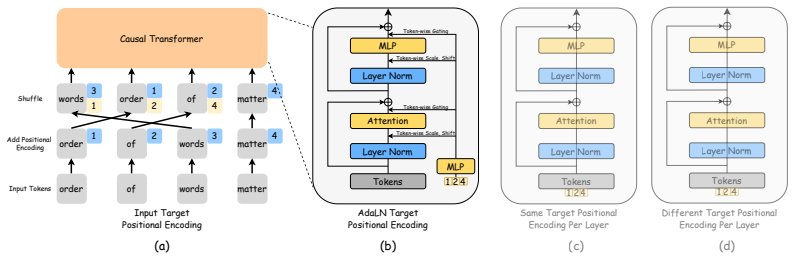
The load-bearing identity is Eq. (5), which chains two existing derivations: the RADD derivation showing that the masked-diffusion ELBO equals a nested expectation over mask levels, and the NADE derivation showing that nested expectation equals the uniform average over all $n!$ generation orders. The supporting mechanism is AO-GPT's decoder-only any-order architecture: causal attention plus adaptive LayerNorm conditioned on the target token's original position, so the network can predict any position conditioned on any ordered prefix. The speed mechanism is the pairing of a KV-cache with Lemma 1's two-stage sampling, which replaces a per-token model evaluation by a Bernoulli draw that often leaves the token masked, and a specialized parallel attention mask that predicts all simultaneously unmasked tokens in one forward pass.
What would settle it
Enumerate all $n!$ orders for short sequences and compare the exact AO-AR loss with a high-precision numerical evaluation of the MDM ELBO for the same trained decoder-only network; any mismatch would show Eq. (5) fails for finite models. Alternatively, train AO-GPT and an encoder-only MDM at the same scale with the same token budget and compare zero-shot perplexity after context-order ensembling: if the decoder-only gap persists, the cause is not the larger order-dependent conditional space.
Extended reading notes
Core claim
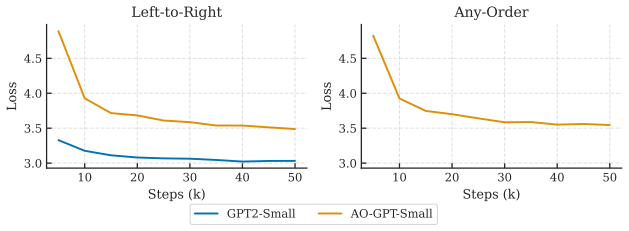
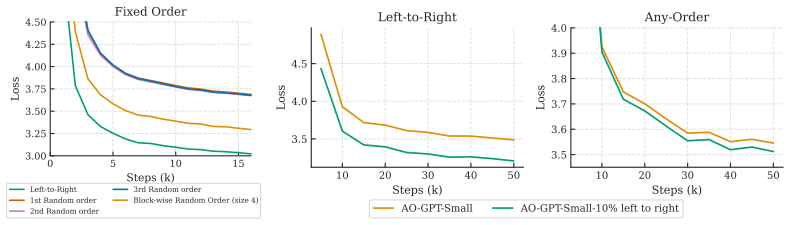
On the paper's own terms, the central discovery is captured by Eq. (5): $\mathcal{L}_{\mathrm{MDM}} = \mathcal{L}_{\mathrm{AO-AR}}$, so a masked diffusion language model trained with causal attention is exactly an autoregressive model trained on all $n!$ token permutations, and any empirical difference from standard left-to-right AR in the same architecture comes from the distribution over orders. With architecture held fixed, left-to-right order converges faster than uniform any-order, and mixing 10% left-to-right data into any-order training improves both objectives. With formulation held fixed, an encoder-only MDM parameterizes $n \cdot 2^{n-1}$ order-invariant univariate conditionals while a decoder-only MDM parameterizes roughly $e \cdot n!$ order-dependent conditionals; ensembling over context orders largely closes the perplexity gap, showing the decoder's harder task is the main source of the gap. The practical consequence is that a decoder-only MDM with KV-caching and the Lemma 1 sampling shortcut generates a sequence of length $n$ in $O(n)$ time instead of $O(n^2)$, yielding the observed ~25x wall-clock speedup and comparable generation perplexity ($4.611$ vs. $5.051$ at 1024 steps with temperature 0.7).
Load-bearing premise
The load-bearing premise is that Eq. (5) holds for the actual trained network, so the slower convergence and higher perplexity of decoder-only AO-GPT are caused by the uniform token-order distribution rather than by optimization failure, Monte Carlo noise, or approximation error in the objective.
Editorial extensions
If this is right
- Any architectural or training improvement to any-order autoregressive models transfers directly to masked diffusion models, because their objectives are the same expectation.
- Comparisons between AR and MDM that change architecture at the same time as formulation are uninformative; the paper's paired experiments provide the clean separation.
- Uniform order sampling is a poor default for language; non-uniform or left-to-right-biased order distributions are a promising axis for improving MDM training.
- Decoder-only MDMs offer a practical efficiency-accuracy trade-off: linear-time generation with comparable perplexity after annealing, at the cost of a larger conditional probability space.
- Adding a small fraction of left-to-right data can serve as a cheap regularizer that improves even any-order performance.
Reading between the lines
- The paper does not test this, but the identity in Eq. (5) suggests that any token-order curriculum for AR models (block-wise order, learned orders, insertion orders) can be read as a masked-diffusion schedule, making order-distribution design a shared lever for both families.
- The context-order ensembling result is evaluated at inference, but it points to a training-side extension: augmenting decoder-only any-order training with random context permutations could close the remaining perplexity gap without switching to full attention.
- The equal-loss-lower-bound argument implies the left-to-right advantage is an optimization and inductive-bias effect, so at larger scale or with much longer training the gap may shrink; this is an inference, since the paper only reports models up to about 350M parameters.
- For discrete modalities without a natural left-to-right order, the uniform any-order objective may fit better than it does for language, but the paper does not test this.
Signed reviews
Editorial analysis
A structured set of objections, weighed in public.
Referee Report
Summary. The paper introduces AO-GPT, a decoder-only transformer trained with an any-order autoregressive (AO-AR) objective, and argues that because masked diffusion models (MDMs) and AO-AR models are equivalent formulations (Eq. 5), this setup permits a fair comparison of AR versus MDM paradigms within a decoder-only architecture and an architectural comparison of encoder-only versus decoder-only MDMs. Experiments on OpenWebText at 125M and 350M scales report that uniform-order training converges more slowly than left-to-right training, that mixing 10% left-to-right data improves both left-to-right and any-order perplexity, and that AO-GPT-Medium achieves roughly a 25x generation speedup over SEDD-Medium with comparable generation perplexity after temperature annealing. The paper concludes that MDM's uniform order-agnosticism is suboptimal for natural language and that decoder-only MDMs offer a favorable speed/quality trade-off.
Significance. If the central equivalence held, this would be a valuable clean separation of generative formulation from architectural choice, plus a practical decoder-only masked diffusion model with a large inference speedup. The paper has genuine strengths: the combinatorial count in Finding 4 is correct, the proof of Lemma 1 is sound, the ablation study of target-position injection and EMA is informative, and the code is released. However, the central theoretical identification is not established for the actually trained decoder-only model. Because AO-GPT's conditionals are order-dependent (Finding 4 and Eq. 6) and ensembling over context order is needed to approach encoder-only performance (Finding 5), the right-hand side of Eq. (5) is not the MDM ELBO for this network. The empirical findings remain potentially useful, but the paper's main interpretive claim and its comparison of AO-GPT with SEDD need substantial reframing and additional uncertainty quantification.
major comments (3)
- [Section 3, Eq. (5), and Section 4.1, Finding 4] The equivalence L_MDM = L_AO-AR is derived for conditionals p_theta(x_i|x_S) that depend on the context only as an unordered set. The paper itself shows that decoder-only AO-GPT conditionals are order-dependent, p_theta(x_j|x_E, sigma_E), and counts approximately e*n! such conditionals versus n*2^(n-1) for the encoder. Finding 5 then shows that averaging over M context permutations is required to bring the decoder's perplexity in line with encoder-only models. Therefore, for the actual AO-GPT network, the right-hand side of Eq. (5) is not equal to the left-hand side: the trained model is not optimizing the MDM ELBO. This undermines the claim that comparing AO-GPT with SEDD isolates the architectural variable, and also undermines the title's identification of any-order GPT with a masked diffusion model. The authors should either prove the equivalence for order-dependent conditionals or explicitly reframe the paper's contribution as a comparison of decoder-only AO-AR with encoder-only MDM, adjusting the abstract and title accordingly.
- [Section 4.3, Table 2 and Figure 4] The headline quantitative claims of a ~25x speedup and comparable perplexity under annealing rest on single training runs and point estimates without error bars or multiple seeds. Given the confound described in the previous comment, it is especially important to know whether the observed differences are stable. Please report means and standard deviations over at least three seeds for the generation perplexity measurements, and state the hardware and measurement conditions for the timing results. If multi-seed experiments are not feasible at this scale, the claims should be softened to single-run observations rather than presented as general findings.
- [Section 3, Remark 1 and Findings 1-3] Remark 1 correctly notes that the optimal loss is the same for every permutation only for a perfect model. With finite capacity and stochastic optimization, the observed convergence gap between left-to-right and any-order training may reflect optimization difficulty rather than the intrinsic informativeness of the order distribution. The claim that many permutations are 'less informative' would be strengthened by a controlled comparison that matches the number of gradient steps per token and by ablating the 10% L2R fraction to show that the benefit is not simply a data-level trade-off. As written, the causal interpretation in Findings 1-3 is plausible but not fully established.
minor comments (5)
- [Section 4.3] The findings numbering is inconsistent: the text defines Finding 6 and Finding 7.1/7.2, but later refers to 'Findings 8.1 and 8.2'. Please renumber to avoid confusion.
- [Figures 9-11] Several figure captions use 'OA-GPT' instead of 'AO-GPT'. Please correct these typos.
- [Section 4.2, Eq. (7)] The ensemble definition always includes the identity permutation, so for M=1 the 'ensemble' is not an average. The text should clarify this point, as it affects the interpretation of the leftmost point in Figure 3.
- [Section 2.3] The statement that data processing 'exactly follow[s] SEDD' makes reproducibility difficult. Please include a brief description of tokenization, packing, and the exact train/evaluation split in the appendix.
- [Table 2] Please specify whether the generated perplexity is computed on the same output samples for both models and whether any decoding randomness (e.g., Gumbel noise) is controlled across runs.
Circularity Check
No circular step found; Eq. (5) is an imported, independently supported equivalence and the empirical claims are external measurements.
full rationale
I find no circular step that reduces a predicted quantity to a fitted input or to the paper's own definitions. Equation (5), which identifies the MDM ELBO with the AO-AR loss, is imported from prior derivations (NADE [11], MDLM [16-18], RADD [19]); although RADD shares authors with the present paper, the equivalence is independently supported by NADE and by the cited MDLM line, and the paper's own contributions (Findings 1-7, Tables 1-3, Figure 4) are empirical measurements against external benchmarks. The temperature and top-p settings in Table 2 are post hoc choices, not fitted parameters relabeled as predictions, and the paper also reports the un-annealed results, so the annealing comparison is transparent. The order-invariance limitation of Eq. (5) for decoder-only models is explicitly acknowledged and studied in Section 4 (Findings 4-5, Eq. 7); it is a correctness or assumption concern, not a circularity. The paper's stated limitations about scale and language-only experiments do not reveal any reduction of conclusions to their inputs.
Assumptions & free parameters
free parameters (4)
- L2R data fraction =
10%
- EMA decay =
0.9999
- Annealing temperature =
0.7
- Target PE hidden dim =
128
assumptions (3)
- domain assumption MDM and AO-AR training objectives are equivalent (L_MDM = L_AO-AR)
- ad hoc to paper Decoder-only and encoder-only architectures differ in the number of distinct univariate conditionals they can represent (e*n! vs n*2^(n-1)), and this capacity difference is the dominant cause of the observed perplexity gap
- domain assumption The reverse process factorizes as a product of independent univariate conditionals q_{s|t}(x_s|xt)
Cite this review
Pith. "Pith review of Any-Order GPT as Masked Diffusion Model: Decoupling Formulation and Architecture." pith.science (2026). https://pith.science/paper/NZ7T6YEF
@misc{pith2026250619935,
  author       = {Pith},
  title        = {Pith review of: Any-Order GPT as Masked Diffusion Model: Decoupling Formulation and Architecture},
  year         = {2026},
  howpublished = {\url{https://pith.science/paper/NZ7T6YEF}},
  note         = {Machine review of arXiv:2506.19935}
}
abstract
Large language models (LLMs) predominantly use autoregressive (AR) approaches, but masked diffusion models (MDMs) are emerging as viable alternatives. A key challenge in comparing AR and MDM paradigms is their typical architectural difference: AR models are often decoder-only, while MDMs have largely been encoder-only. This practice of changing both the modeling paradigm and architecture simultaneously makes direct comparisons unfair, as it's hard to distinguish whether observed differences stem from the paradigm itself or the architectural shift. This research evaluates MDMs within a decoder-only framework to: (1) equitably compare MDM (as Any-Order AR, or AO-AR) and standard AR paradigms. Our investigation suggests that the standard AO-AR objective, which averages over all token permutations, may benefit from refinement, as many permutations appear less informative compared to the language's inherent left-to-right structure. (2) Investigate architectural influences (decoder-only vs. encoder-only) within MDMs. We demonstrate that while encoder-only MDMs model a simpler conditional probability space, decoder-only MDMs can achieve dramatic generation speedups ($\sim25\times$) and comparable perplexity with temperature annealing despite modeling a vastly larger space, highlighting key trade-offs. This work thus decouples core paradigm differences from architectural influences, offering insights for future model design. Code is available at https://github.com/scxue/AO-GPT-MDM.
Figures

Figures from the paper (8 more)



Forward citations
Cited by 4 Pith papers
-
Hierarchical Domain Generalization
Over infinite domains, hierarchy-uniform domain generalization is impossible for every nontrivial hypothesis class; a length-generalization bound is a property of the length hierarchy, not a hierarchy-free guarantee.
-
Nemotron-Labs-Diffusion: A Tri-Mode Language Model Unifying Autoregressive, Diffusion, and Self-Speculation Decoding
Joint AR–diffusion training yields one tri-mode LM that switches AR, diffusion, and self-speculation, beating open AR/diffusion models on accuracy and tokens-per-forward.
-
Diffusion-Inspired Masked Fine-Tuning for Knowledge Injection in Autoregressive LLMs
Masked fine-tuning enables autoregressive LLMs to inject new factual knowledge without paraphrases and with reversal-curse resistance, matching diffusion LLM advantages on QA tasks.
-
Discrete Diffusion Models: A Unified Framework from Tokenization to Generation
Discrete diffusion models are re-framed as instances of a tokenization-centric, four-component design space (corruption, denoiser, objective, sampler) in a broad survey with no new experimental or theoretical results.
Reference graph
Works this paper leans on
-
[1]
Deep unsupervised learning using nonequilibrium thermodynamics,
J. Sohl-Dickstein, E. Weiss, N. Maheswaranathan, and S. Ganguli, “Deep unsupervised learning using nonequilibrium thermodynamics,” inInternational conference on machine learning, pp. 2256–2265, pmlr, 2015
2015
-
[2]
Denoising diffusion probabilistic models,
J. Ho, A. Jain, and P. Abbeel, “Denoising diffusion probabilistic models,”Advances in neural information processing systems, vol. 33, pp. 6840–6851, 2020. 14
work page 2020
-
[3]
Score-based gen- erative modeling through stochastic differential equations,
Y . Song, J. Sohl-Dickstein, D. P. Kingma, A. Kumar, S. Ermon, and B. Poole, “Score-based gen- erative modeling through stochastic differential equations,”arXiv preprint arXiv:2011.13456, 2020
arXiv 2011
-
[4]
Structured denoising diffusion models in discrete state-spaces,
J. Austin, D. D. Johnson, J. Ho, D. Tarlow, and R. Van Den Berg, “Structured denoising diffusion models in discrete state-spaces,”Advances in neural information processing systems, vol. 34, pp. 17981–17993, 2021
work page 2021
-
[5]
A continuous time framework for discrete denoising models,
A. Campbell, J. Benton, V . De Bortoli, T. Rainforth, G. Deligiannidis, and A. Doucet, “A continuous time framework for discrete denoising models,”Advances in Neural Information Processing Systems, vol. 35, pp. 28266–28279, 2022
work page 2022
-
[6]
Discrete diffusion modeling by estimating the ratios of the data distribution,
A. Lou, C. Meng, and S. Ermon, “Discrete diffusion modeling by estimating the ratios of the data distribution,”arXiv preprint arXiv:2310.16834, 2023
arXiv 2023
-
[7]
Large language diffusion models,
S. Nie, F. Zhu, Z. You, X. Zhang, J. Ou, J. Hu, J. Zhou, Y . Lin, J.-R. Wen, and C. Li, “Large language diffusion models,”arXiv preprint arXiv:2502.09992, 2025
arXiv 2025
- [8]
Show all 38 references
-
[9]
Entp: Encoder-only next token prediction,
E. Ewer, D. Chae, T. Zeng, J. Kim, and K. Lee, “Entp: Encoder-only next token prediction,” arXiv preprint arXiv:2410.01600, 2024
2024 arXiv
-
[10]
Autoregressive image generation without vector quan- tization,
T. Li, Y . Tian, H. Li, M. Deng, and K. He, “Autoregressive image generation without vector quan- tization,”Advances in Neural Information Processing Systems, vol. 37, pp. 56424–56445, 2024
2024
-
[11]
Neural autoregressive distri- bution estimation,
B. Uria, M.-A. Côté, K. Gregor, I. Murray, and H. Larochelle, “Neural autoregressive distri- bution estimation,”Journal of Machine Learning Research, vol. 17, no. 205, pp. 1–37, 2016
2016
-
[12]
Xlnet: Generalized autoregressive pretraining for language understanding,
Z. Yang, Z. Dai, Y . Yang, J. Carbonell, R. R. Salakhutdinov, and Q. V . Le, “Xlnet: Generalized autoregressive pretraining for language understanding,”Advances in neural information processing systems, vol. 32, 2019
2019
-
[13]
Autoregressive diffusion models,
E. Hoogeboom, A. A. Gritsenko, J. Bastings, B. Poole, R. v. d. Berg, and T. Salimans, “Autoregressive diffusion models,”arXiv preprint arXiv:2110.02037, 2021
2021 arXiv
-
[14]
σ-gpts: A new approach to autoregressive models,
A. Pannatier, E. Courdier, and F. Fleuret, “σ-gpts: A new approach to autoregressive models,” inJoint European Conference on Machine Learning and Knowledge Discovery in Databases, pp. 143–159, Springer, 2024
2024
-
[15]
Argmax flows and multinomial diffusion: Learning categorical distributions,
E. Hoogeboom, D. Nielsen, P. Jaini, P. Forré, and M. Welling, “Argmax flows and multinomial diffusion: Learning categorical distributions,”Advances in neural information processing systems, vol. 34, pp. 12454–12465, 2021
2021
-
[16]
Simplified and generalized masked diffusion for discrete data,
J. Shi, K. Han, Z. Wang, A. Doucet, and M. Titsias, “Simplified and generalized masked diffusion for discrete data,”Advances in neural information processing systems, vol. 37, pp. 103131–103167, 2024
2024
-
[17]
Simple and effective masked diffusion language models,
S. Sahoo, M. Arriola, Y . Schiff, A. Gokaslan, E. Marroquin, J. Chiu, A. Rush, and V . Kuleshov, “Simple and effective masked diffusion language models,”Advances in Neural Information Processing Systems, vol. 37, pp. 130136–130184, 2024
2024
-
[18]
Masked diffusion models are secretly time-agnostic masked models and exploit inaccurate categorical sampling,
K. Zheng, Y . Chen, H. Mao, M.-Y . Liu, J. Zhu, and Q. Zhang, “Masked diffusion models are secretly time-agnostic masked models and exploit inaccurate categorical sampling,”arXiv preprint arXiv:2409.02908, 2024
2024 arXiv
-
[19]
Your absorbing discrete diffusion secretly models the conditional distributions of clean data,
J. Ou, S. Nie, K. Xue, F. Zhu, J. Sun, Z. Li, and C. Li, “Your absorbing discrete diffusion secretly models the conditional distributions of clean data,”arXiv preprint arXiv:2406.03736, 2024
2024 arXiv
-
[20]
Bert: Pre-training of deep bidirectional transformers for language understanding,
J. Devlin, M.-W. Chang, K. Lee, and K. Toutanova, “Bert: Pre-training of deep bidirectional transformers for language understanding,” inProceedings of the 2019 conference of the North American chapter of the association for computational linguistics: human language technologie...
2019
-
[21]
Scaling laws for neural language models,
J. Kaplan, S. McCandlish, T. Henighan, T. B. Brown, B. Chess, R. Child, S. Gray, A. Rad- ford, J. Wu, and D. Amodei, “Scaling laws for neural language models,”arXiv preprint arXiv:2001.08361, 2020
2001 arXiv
-
[22]
Discrete copula diffusion,
A. Liu, O. Broadrick, M. Niepert, and G. V . d. Broeck, “Discrete copula diffusion,”arXiv preprint arXiv:2410.01949, 2024
2024 arXiv
-
[23]
Energy- based diffusion language models for text generation,
M. Xu, T. Geffner, K. Kreis, W. Nie, Y . Xu, J. Leskovec, S. Ermon, and A. Vahdat, “Energy- based diffusion language models for text generation,”arXiv preprint arXiv:2410.21357, 2024
2024 arXiv
-
[24]
Openwebtext corpus
A. Gokaslan and V . Cohen, “Openwebtext corpus.” http://Skylion007.github.io/ OpenWebTextCorpus, 2019
2019
-
[25]
The lambada dataset: Word prediction requiring a broad discourse context,
D. Paperno, G. Kruszewski, A. Lazaridou, Q. N. Pham, R. Bernardi, S. Pezzelle, M. Baroni, G. Boleda, and R. Fernández, “The lambada dataset: Word prediction requiring a broad discourse context,”arXiv preprint arXiv:1606.06031, 2016
2016 arXiv
-
[26]
Pointer sentinel mixture models,
S. Merity, C. Xiong, J. Bradbury, and R. Socher, “Pointer sentinel mixture models,” 2016
2016
-
[27]
Building a large annotated corpus of english: The penn treebank,
M. Marcus, B. Santorini, and M. A. Marcinkiewicz, “Building a large annotated corpus of english: The penn treebank,”Computational linguistics, vol. 19, no. 2, pp. 313–330, 1993
1993
-
[28]
One billion word benchmark for measuring progress in statistical language modeling,
C. Chelba, T. Mikolov, M. Schuster, Q. Ge, T. Brants, P. Koehn, and T. Robinson, “One billion word benchmark for measuring progress in statistical language modeling,”arXiv preprint arXiv:1312.3005, 2013
2013 arXiv
-
[29]
Block diffusion: Interpolating between autoregressive and diffusion language models,
M. Arriola, A. Gokaslan, J. T. Chiu, Z. Yang, Z. Qi, J. Han, S. S. Sahoo, and V . Kuleshov, “Block diffusion: Interpolating between autoregressive and diffusion language models,”arXiv preprint arXiv:2503.09573, 2025
2025 arXiv
-
[30]
Film: Visual reasoning with a general conditioning layer,
E. Perez, F. Strub, H. De Vries, V . Dumoulin, and A. Courville, “Film: Visual reasoning with a general conditioning layer,” inProceedings of the AAAI conference on artificial intelligence, vol. 32, 2018
2018
-
[31]
Scalable diffusion models with transformers,
W. Peebles and S. Xie, “Scalable diffusion models with transformers,” inProceedings of the IEEE/CVF international conference on computer vision, pp. 4195–4205, 2023
2023
-
[32]
Made: Masked autoencoder for distribu- tion estimation,
M. Germain, K. Gregor, I. Murray, and H. Larochelle, “Made: Masked autoencoder for distribu- tion estimation,” inInternational conference on machine learning, pp. 881–889, PMLR, 2015
2015
-
[33]
Arbitrary conditional distributions with energy,
R. Strauss and J. B. Oliva, “Arbitrary conditional distributions with energy,”Advances in Neural Information Processing Systems, vol. 34, pp. 752–763, 2021
2021
-
[34]
Training and inference on any-order autoregressive models the right way,
A. Shih, D. Sadigh, and S. Ermon, “Training and inference on any-order autoregressive models the right way,”Advances in Neural Information Processing Systems, vol. 35, pp. 2762–2775, 2022
2022
-
[35]
Insertion-based decoding with automatically inferred generation order,
J. Gu, Q. Liu, and K. Cho, “Insertion-based decoding with automatically inferred generation order,”Transactions of the Association for Computational Linguistics, vol. 7, pp. 661–676, 2019
2019
-
[36]
Train for the worst, plan for the best: Understanding token ordering in masked diffusions,
J. Kim, K. Shah, V . Kontonis, S. Kakade, and S. Chen, “Train for the worst, plan for the best: Understanding token ordering in masked diffusions,”arXiv preprint arXiv:2502.06768, 2025
2025 arXiv
-
[37]
Randomized autoregressive visual generation,
Q. Yu, J. He, X. Deng, X. Shen, and L.-C. Chen, “Randomized autoregressive visual generation,” arXiv preprint arXiv:2411.00776, 2024
2024 arXiv
-
[38]
Randar: Decoder-only autoregressive visual generation in random orders,
Z. Pang, T. Zhang, F. Luan, Y . Man, H. Tan, K. Zhang, W. T. Freeman, and Y .-X. Wang, “Randar: Decoder-only autoregressive visual generation in random orders,”arXiv preprint arXiv:2412.01827, 2024. 16 Table 4: AO-GPT Model Specifications Parameter Small Medium nlayers 12 24 d...
2024 arXiv
Reviewed August 15, 2026 · model on record in the stance chip above.
Discussion (0). Continue with ORCID to comment.