REVIEW 3 major objections 5 minor 100 references
Regular Rotating Black Hole: Probing the boundaries of the Radiative Signatures and Jet Power
T0 review · 3 major / 5 minor · reviewed 2026-08-06 · deepseek-v4-flash
Pith's one-line read The paper claims that jet-power and radiative-efficiency data from six Galactic X-ray binaries bound the MOG regular black hole deviation parameter to beta below about 0.4, and that GRS 1915+105 is left with no common parameter space.
desk verdict First combined radiative-efficiency + BZ jet-power constraints for regular rotating MOG black holes, but the bounds are conditional on Kerr-calibrated spins and a Kerr-fitted jet-power normalization; the GRS 1915+105 tension is the one result that probably survives. read the letter →
The pith
A machine-rendered reading of the paper's core claim, the machinery that carries it, and where it could break.
The reading
What carries the argument
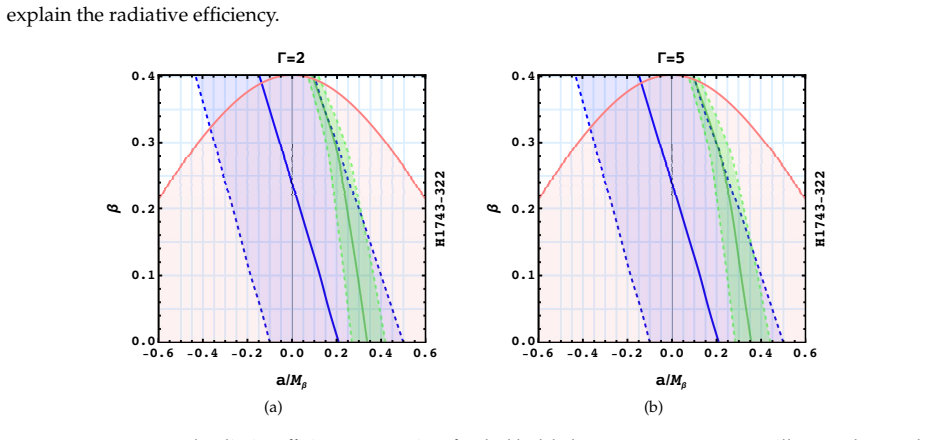
The argument runs through three linked pieces: the regular rotating MOG metric obtained by a modified Newman-Janis procedure, the Novikov-Thorne radiative efficiency set by the innermost stable circular orbit, and a Blandford-Znajek jet-power calculation carried out in horizon-regular Kerr-Schild coordinates. The new object is the regularization factor $\xi = 1 - F(r_H)$, which multiplies the jet power as $P = \frac{1}{6\pi}\,\xi\,\Phi_{\mathrm{tot}}^2\,\Omega_H^2$, where $\Omega_H$ is the horizon angular frequency. Because both $\Omega_H$ and the ISCO radius depend on $\beta$ and the spin $a$, the overlapping allowed regions in the $(\beta,a)$ plane from the two observables carry the constraint.
What would settle it
Fit GRS 1915+105's thermal continuum and reflection spectrum directly with the regular MOG metric rather than the Kerr metric, and recalibrate the Blandford-Znajek normalization $K$ inside that metric. If a solution with $\beta > 0.08$ simultaneously reproduces the observed radiative efficiency and jet power within errors, the paper's central exclusion is refuted.
Extended reading notes
Core claim
On the paper's own terms, the central result is that the same geometry cannot freely explain both how efficiently matter radiates while spiraling into the hole and how much power the Blandford-Znajek mechanism extracts from the horizon. For the five systems with moderate spins the intersection of the two constraints forces the deviation parameter below about $\beta \simeq 0.4$, close to the horizonless threshold $\beta_c \simeq 0.402$. For GRS 1915+105, whose continuum-fitting spin exceeds 0.98, the efficiency contour alone limits $\beta$ to roughly 0.08, and there is no point in the allowed horizon region that simultaneously reproduces the measured jet power and the measured efficiency. The paper also derives a modified jet-power formula for regular black holes, in which the regularization factor $1 - F(r_H)$ multiplies the usual $\Omega_H^2$ dependence.
Load-bearing premise
The load-bearing premise is that continuum-fitting spins, Novikov-Thorne efficiencies, and the jet-power normalization $K$ measured under the Kerr metric remain unchanged when the spacetime is replaced by the regular MOG metric; if those calibrations must be redone from scratch in the new geometry, the $\beta$ bounds drawn from the overlap regions do not follow.
Editorial extensions
If this is right
- For the five lower-spin binaries, requiring jet power and radiative efficiency simultaneously forces $\beta \lesssim 0.4$, so the horizonless part of the MOG parameter space ($\beta > \beta_c$) is excluded by these data.
- GRS 1915+105, with a continuum-fitting spin above 0.98, cannot be described by the regular MOG black hole with both jet power and efficiency matched, so either its Kerr-based spin estimate or the model itself has to give.
- Regular black holes do not inherit the Kerr Blandford-Znajek scaling unchanged: the factor $1 - F(r_H)$ suppresses jet power at fixed spin, so high observed jet power cannot be read directly as high spin in this geometry.
- The method of overlapping jet-power and efficiency regions gives a reusable diagnostic for confronting other non-Kerr geometries with electromagnetic observations of accreting black holes.
Reading between the lines
- Editorial inference: if the $\beta \lesssim 0.4$ bound holds, spin values routinely quoted for stellar-mass black holes under the Kerr assumption cannot simply be transplanted into regular MOG models; the high-spin tail becomes the sharpest discriminator between the two geometries.
- Editorial inference: the same two-observable overlap test can be applied to other regular metrics, such as Bardeen, Hayward, or loop-quantum-corrected holes, replacing $F(r)$ in the jet-power formula; their survival against these data would follow from the same plots.
- Editorial inference: an independent measurement of horizon angular frequency, for example through future gravitational-wave ringdown observations of a comparable-mass merger, could test the $\Omega_H^2$ dependence of the jet-power formula without relying on efficiency assumptions.
Editorial analysis
A structured set of objections, weighed in public.
Referee Report
Summary. The paper studies regular rotating black holes in scalar-tensor-vector gravity (MOG), parametrized by a deviation parameter β in addition to spin a. It computes the ISCO radius, Novikov-Thorne radiative efficiency η_NT(a,β), and Blandford-Znajek jet power including a 'regularization factor' 1−F(r_H). These theoretical predictions are then compared with observed radiative efficiencies and radio jet powers of six Galactic X-ray binaries (A0620-00, H1743-322, XTE J1550-564, GRS 1124-683, GRO J1655-40, GRS 1915+105). The central results are stated in Section 5: most sources allow β ≲ 0.38–0.4, the near-extremal source GRS 1915+105 requires β ≲ 0.08, and for GRS 1915+105 no simultaneous parameter space can explain both the radiative efficiency and the jet power. The paper also presents a modified Newman-Janis procedure for generating rotating regular solutions and an analytic BZ jet-power formula.
Significance. The paper's theoretical machinery is a useful contribution: the ISCO/efficiency and jet-power derivations are explicitly presented, internally consistent, and reduce to the Kerr results in the β→0 limit, and the regularization factor in Eq. (68) is a clear new element of the BZ formula. If the constraints were model-independent, the exclusion of large β for near-extremal sources and the apparent tension for GRS 1915+105 would be interesting observational tests of regular black holes and MOG. However, both observational arms of the comparison import quantities that are calibrated under the Kerr metric, so the headline β bounds are conditional on deviations from Kerr being small. The paper therefore currently offers a promising consistency-check framework rather than a fully model-independent constraint.
major comments (3)
- [Section 4, Table 2, Eq. (32)] The radiative-efficiency arm equates the MOG-theory efficiency η_NT(a,β) with the observed efficiencies listed in Table 2, but the table explicitly states that those spins and efficiencies are 'calculated under the assumption of the Kerr metric.' A continuum-fitting spin is not a spacetime-independent observable: it is inferred using the Kerr ISCO, so the same spectral data analyzed in the MOG metric would in general yield a different spin and a different efficiency. The blue regions in Figs. 6–11 therefore show where MOG reproduces a Kerr-derived quantity, not where MOG reproduces the observed spectrum. The β bounds and the claimed no-overlap for GRS 1915+105 depend on this re-interpretation. A concrete fix would be to forward-model the thermal continuum in the MOG metric for at least GRS 1915+105 and one lower-spin source, or to explicitly reframe all constraints as conditional consistency checks and soften the abstract and conclusion accordingly.
- [Section 4, Eqs. (36)–(37)] The jet-power arm imports the normalization log K = 2.94 ± 0.22 (Γ = 2) and log K = 4.19 ± 0.22 (Γ = 5) from ref. [73], which are fits to jet powers under the Kerr metric, with the stated assumption that 'K is independent of the spacetime geometry.' This assumption is load-bearing: K encodes Φ_tot² and the field-line angular-velocity distribution, both of which can depend on the near-horizon geometry. A shift in log K comparable to its quoted uncertainty would move the green regions in Figs. 6–11 substantially, and the claimed absence of an overlap region for GRS 1915+105 depends on this calibration. The authors should quantify this systematic uncertainty or provide a physical argument for why K is universal across Kerr and MOG spacetimes before presenting the bounds as observational constraints on β.
- [Section 5, Eq. (19), Fig. 1] The headline bound β ≲ 0.38–0.4 for most sources is only slightly below the theoretical horizon cap β_c ≈ 0.402 derived in Eq. (19). For five of the six sources the observational analysis excludes only a narrow strip of parameter space that is already nearly excluded by the existence of a horizon, so the claim of 'stringent observational bounds' in the abstract is supported mainly by GRS 1915+105. The paper should quantify how much of the allowed β range is excluded by data versus by the horizon condition, and should distinguish the weak typical constraint from the strong GRS 1915+105 constraint in the summary of results.
minor comments (5)
- [Appendix A.2.2, Eq. (25a)] Equation (25a) uses f(r,θ), but f was defined as f(r) in Eq. (21b); please define f(r,θ) explicitly and check the Kerr limit of the displayed coordinate transformation, which as written does not reduce to the usual Kerr-Schild shift combination.
- [Fig. 7 caption] The caption refers to 'T ab. 2' for the jet-power values, but the jet powers are listed in Table 3; please correct the cross-reference.
- [Section 4.1.1, Table 2] For A0620-00 the text reports a 90% spin range −0.59 < a < 0.49 while Table 2 lists a = 0.12 ± 0.19; please clarify which range is used for the efficiency error bars and how the asymmetric errors in Table 2 are propagated into the blue regions.
- [Abstract and Section 4] The abstract states that the analysis uses 'updated measurements from continuum fitting and Fe-line methods,' but the constraints in Section 4 are based on continuum-fitting spins for all sources; the Fe-line values are mentioned only in the text for XTE J1550-564 and GRO J1655-40. Please reconcile this wording.
- [Appendix A.1] The abstract and Section 5 describe the rotating-solution construction as a 'modified method,' but the procedure presented is the Azreg-Aïnou method of ref. [50] applied to a known static solution; the novelty should be stated more modestly or the differences should be made explicit.
Circularity Check
No significant circularity: the beta constraints are intersections of MOG model curves with externally adopted (Kerr-calibrated) observables, not fits renamed as predictions.
full rationale
The paper's central derivation is self-contained: the ISCO radius, radiative efficiency, horizon angular velocity, and Blandford-Znajek jet power are all computed from the explicit MOG metric functions given in Eqs. (16), (20)-(24), (32), and (68), with the regularization factor xi = 1 - F(rH) appearing in the jet power formula. The observational inputs are treated as external: spins and efficiencies are taken from the literature (Table 2), and the jet-power normalization K is imported from the independent calibration in reference [73]. The paper explicitly discloses that these inputs are Kerr-derived ('calculated under the assumption of the Kerr metric' and 'Assuming K is independent of the spacetime geometry'), which makes the resulting beta bounds conditional on those calibration choices. However, this is a model-dependence limitation, not a circular reduction by construction: the blue and green regions in Figs. 6-11 are obtained by solving the model equations for parameter combinations that reproduce the adopted observables, and beta=0 is not imposed as an identity but is merely one boundary of the allowed region. Moreover, the common beta ≲ 0.4 bound for most sources is dominated by the theory's own horizon cap beta_c = 0.402186 (Eq. 19), which is derived within the paper, rather than by a fitted parameter. The GRS 1915+105 bound (beta ≲ 0.08) reflects a genuine high-efficiency, high-spin tension. Because the paper neither fits beta to the same quantity it later predicts nor relies on a load-bearing chain of self-citations, no significant circularity is found.
Assumptions & free parameters
free parameters (3)
- K, magnetic flux normalization =
log K = 2.94 ± 0.22 (Gamma=2) and 4.19 ± 0.22 (Gamma=5)
- Jet Lorentz factor Gamma =
2 and 5
- Jet-power uncertainty =
0.3 dex
assumptions (7)
- domain assumption MOG/STVG reduces to Einstein gravity plus a massless Proca vector field near compact objects
- domain assumption The static regular MOG spacetime F(r) in Eq. (16) is the correct seed for rotation
- standard math The Azreg-Ainou non-complexification method with Psi = r^2 + a^2 cos^2 theta produces a valid rotating MOG metric
- domain assumption Novikov-Thorne disk with ISCO as inner edge describes the observed disk emission
- domain assumption Blandford-Znajek split-monopole magnetosphere with field line angular velocity omega = Omega_H/2
- ad hoc to paper The Kerr-calibrated normalization K is independent of spacetime geometry and universal across sources
- ad hoc to paper Radiative efficiencies listed in Table 2, computed from Kerr spin measurements, can be applied to MOG without re-fitting
Cite this review
Pith. "Pith review of Regular Rotating Black Hole: Probing the boundaries of the Radiative Signatures and Jet Power." pith.science (2026). https://pith.science/paper/NZC74YK2
@misc{pith2026250803473,
  author       = {Pith},
  title        = {Pith review of: Regular Rotating Black Hole: Probing the boundaries of the Radiative Signatures and Jet Power},
  year         = {2026},
  howpublished = {\url{https://pith.science/paper/NZC74YK2}},
  note         = {Machine review of arXiv:2508.03473}
}
abstract
We perform a detailed observational analysis of several galactic X-ray binaries, focusing on the interplay between black hole spin, jet power, and radiative efficiency within the context of Blandford-Znajek-powered jets. Using updated measurements from continuum fitting and Fe-line methods, we constrain the spin parameter a and the deviation parameter $\beta$ for five key black hole systems: H1743-322, XTE J1550-564, GRS 1124-683, GRO J1655-40, and GRS 1915+105. For each system, we compare the allowed parameter spaces derived independently from observed radiative efficiencies and emitted jet powers under different assumptions for the jet Lorentz factor $\Gamma=2,5$. By overlapping these observational constraints with theoretical expectations for regular black holes, we assess the viability of various spin-deviation combinations in explaining the observed phenomena. Our results reveal significant restrictions on the allowed values of $\beta$, with typical upper bounds around 0.38 - 0.4, except for rapidly spinning sources where the constraint becomes notably tighter. We further present a modified method for generating rotating solutions from static regular black hole spacetimes and provide a robust theoretical framework for relating jet power to black hole angular frequency in curved geometries. We also find that the theoretical jet power is modified by regularization factor for regular black holes. These findings place stringent observational bounds on deviations from the Kerr geometry and provide important insight into the astrophysical mechanisms powering accreting stellar-mass black holes.
Figures


Figures from the paper (9 more)




Reference graph
Works this paper leans on
-
[73]
M. Middleton, J. Miller-Jones, and R. Fender, “The low o r retrograde spin of the first extragalactic microquasar: implications for Blandford–Znajek powering of jets,” Mon. Not. Roy. Astron. Soc. 439 no. 2, (2014) 1740–1748 , arXiv:1401.1829 [astro-ph.HE]
work page Pith review arXiv 2014
-
[1]
Observation of Gravitational W aves from a Binary Black Hole Merger,
LIGO Scientific, Virgo Collaboration, B. P . Abbottet al., “Observation of Gravitational W aves from a Binary Black Hole Merger,” Phys. Rev. Lett. 116 no. 6, (2016) 061102 , arXiv:1602.03837 [gr-qc]
arXiv 2016
-
[2]
Observation of Gravitational W aves from Two Neutron Star–Black Hole Coalescences,
LIGO Scientific, KAGRA, VIRGO Collaboration, R. Abbott et al., “Observation of Gravitational W aves from Two Neutron Star–Black Hole Coalescences,” Astrophys. J. Lett. 915 no. 1, (2021) L5 , arXiv:2106.15163 [astro-ph.HE]
arXiv 2021
-
[3]
Gw190412: Observation of a binary-black-hole coalescenc e with asymmetric masses,
LIGO Scientific Collaboration and Virgo Collaboration Collaboration, R. Abbott et al., “Gw190412: Observation of a binary-black-hole coalescenc e with asymmetric masses,” Phys. Rev. D 102 (Aug, 2020) 043015. https://link.aps.org/doi/10.1103/PhysRevD.102.043015
-
[4]
R. Abbott, others, L. S. Collaboration, and V . Collabora tion, “Gw190814: Gravitational waves from the coalescence of a 23 solar mass black hole with a 2.6 solar m ass compact object,” The Astrophysical Journal Letters 896 no. 2, (Jun, 2020) L44 . https://dx.doi.org/10.3847/2041-8213/ab960f
-
[5]
LIGO Scientific Collaboration and Virgo Collaboration Collaboration, R. Abbott et al., “T ests of general relativity with binary black holes from the second l igo-virgo gravitational-wave transient catalog,” Phys. Rev. D 103 (Jun, 2021) 122002 . https://link.aps.org/doi/10.1103/PhysRevD.103.122002
-
[6]
Gw150914: First results from the search for binary black ho le coalescence with advanced ligo,
LIGO Scientific Collaboration and Virgo Collaboration Collaboration, R. Abbott et al., “Gw150914: First results from the search for binary black ho le coalescence with advanced ligo,” Phys. Rev. D 93 (Jun, 2016) 122003 . https://link.aps.org/doi/10.1103/PhysRevD.93.122003
-
[7]
Observing---and Imaging---Active Galactic Nuclei with the Event Horizon Telescope
Event Horizon T elescopeCollaboration, V . L. Fish, K. Akiyama, K. L. Bouman, A. A. Cha el, M. D. Johnson, S. S. Doeleman, L. Blackburn, J. F . C. W ardle, and W .T. Freeman, “Observing—and Imaging—Active Galactic Nuclei with the Event Horizon T elescope,” Galaxies 4 no. 4, (2016) 54 , arXiv:1607.03034 [astro-ph.IM] . 27
work page Pith review arXiv 2016
Show all 100 references
-
[8]
First M87 Event Horizon T elescope Results. I. The Shadow of the Supermassive Black Hole,
Event Horizon T elescopeCollaboration, K. Akiyama et al., “First M87 Event Horizon T elescope Results. I. The Shadow of the Supermassive Black Hole,” Astrophys. J. Lett. 875 (2019) L1, arXiv:1906.11238 [astro-ph.GA]
2019 arXiv
-
[9]
First M87 Event Horizon T elescope Results. II. Array and Instrumentation,
Event Horizon T elescopeCollaboration, K. Akiyama et al., “First M87 Event Horizon T elescope Results. II. Array and Instrumentation,” Astrophys. J. Lett. 875 no. 1, (2019) L2 , arXiv:1906.11239 [astro-ph.IM]
2019 arXiv
-
[10]
First M87 Event Horizon T elescope Results. VI. The Shadow and Mass of the Central Black Hole,
Event Horizon T elescopeCollaboration, K. Akiyama et al., “First M87 Event Horizon T elescope Results. VI. The Shadow and Mass of the Central Black Hole,” Astrophys. J. Lett. 875 no. 1, (2019) L6 , arXiv:1906.11243 [astro-ph.GA]
2019 arXiv
-
[11]
First Sagittarius A* Event Horizon T elescope Results. I. The Shadow of the Supermassive Black H ole in the Center of the Milky W ay,
Event Horizon T elescopeCollaboration, K. Akiyama et al., “First Sagittarius A* Event Horizon T elescope Results. I. The Shadow of the Supermassive Black H ole in the Center of the Milky W ay,” Astrophys. J. Lett. 930 no. 2, (2022) L12 , arXiv:2311.08680 [astro-ph.HE]
2022 arXiv
-
[12]
First Sagittarius A* Event Horizon T elescope Results. V . T esting Astrophysical Models of the Galactic Center Black Hole,
Event Horizon T elescopeCollaboration, K. Akiyama et al., “First Sagittarius A* Event Horizon T elescope Results. V . T esting Astrophysical Models of the Galactic Center Black Hole,” Astrophys. J. Lett. 930 no. 2, (2022) L16 , arXiv:2311.09478 [astro-ph.HE]
2022 arXiv
-
[13]
What is a singularity in general relativity ?,
R. Geroch, “What is a singularity in general relativity ?,” Annals of Physics 48 no. 3, (1968) 526–540 . https://www.sciencedirect.com/science/article/pii/0003491668901449
1968
-
[14]
Motion and structure of sin gularities in general relativity ,
E. T. NEWMAN and R. POSADAS, “Motion and structure of sin gularities in general relativity ,” Phys. Rev. 187 (Nov , 1969) 1784–1791. https://link.aps.org/doi/10.1103/PhysRev.187.1784
1969 doi
-
[15]
Regular black hole in gene ral relativity coupled to nonlinear electrodynamics,
E. Ayón-Beato and A. García, “Regular black hole in gene ral relativity coupled to nonlinear electrodynamics,” Phys. Rev. Lett. 80 (Jun, 1998) 5056–5059. https://link.aps.org/doi/10.1103/PhysRevLett.80.5056
1998 doi
-
[16]
Formation and evaporation of nonsingul ar black holes,
S. A. Hayward, “Formation and evaporation of nonsingul ar black holes,” Phys. Rev. Lett. 96 (Jan, 2006) 031103. https://link.aps.org/doi/10.1103/PhysRevLett.96.031103
2006 doi
-
[17]
Regular phantom black holes,
K. A. Bronnikov and J. C. Fabris, “Regular phantom black holes,” Phys. Rev. Lett. 96 (Jun, 2006) 251101 . https://link.aps.org/doi/10.1103/PhysRevLett.96.251101
2006 doi
-
[18]
Loop quantum dynamics of the schwarzschild interior,
C. G. Böhmer and K. V andersloot, “Loop quantum dynamics of the schwarzschild interior,” Phys. Rev. D 76 (Nov , 2007) 104030. https://link.aps.org/doi/10.1103/PhysRevD.76.104030
2007 doi
-
[19]
Charged rotating noncommu tative black holes,
L. Modesto and P . Nicolini, “Charged rotating noncommu tative black holes,” Phys. Rev. D 82 (Nov , 2010) 104035. https://link.aps.org/doi/10.1103/PhysRevD.82.104035
2010 doi
-
[20]
Rotating black holes in semiclassi cal gravity,
P . G. S. Fernandes, “Rotating black holes in semiclassi cal gravity,” Phys. Rev. D 108 no. 6, (2023) L061502 , arXiv:2305.10382 [gr-qc]
2023 arXiv
-
[21]
Sifting quantum black holes t hrough the principle of least action,
B. Knorr and A. Platania, “Sifting quantum black holes t hrough the principle of least action,” Phys. Rev. D 106 (Jul, 2022) L021901. https://link.aps.org/doi/10.1103/PhysRevD.106.L021901
2022 doi
-
[22]
Quantum Corrected Black Holes from String T-Duality,
P . Nicolini, E. Spallucci, and M. F . W ondrak, “Quantum Corrected Black Holes from String T-Duality,” Phys. Lett. B 797 (2019) 134888, arXiv:1902.11242 [gr-qc] . 28
2019 arXiv
-
[23]
Renormalization group impro ved black hole spacetimes,
A. Bonanno and M. Reuter, “Renormalization group impro ved black hole spacetimes,” Phys. Rev. D 62 (Jul, 2000) 043008 . https://link.aps.org/doi/10.1103/PhysRevD.62.043008
2000 doi
-
[24]
Dust coll apse in asymptotic safety: A path to regular black holes,
A. Bonanno, D. Malafarina, and A. Panassiti, “Dust coll apse in asymptotic safety: A path to regular black holes,” Phys. Rev. Lett. 132 (Jan, 2024) 031401. https://link.aps.org/doi/10.1103/PhysRevLett.132.031401
2024 doi
-
[25]
The MOG weak field approximat ion and observational test of galaxy rotation curves,
J. W . Moffat and S. Rahvar, “The MOG weak field approximat ion and observational test of galaxy rotation curves,” Mon. Not. Roy. Astron. Soc. 436 (2013) 1439–1451, arXiv:1306.6383 [astro-ph.GA]
2013 arXiv
-
[26]
Rotational velocity curvesin the Milky W ay as a test of modified gravity,
J. W . Moffat and V . T. T oth, “Rotational velocity curvesin the Milky W ay as a test of modified gravity,” Phys. Rev. D 91 no. 4, (2015) 043004 , arXiv:1411.6701 [astro-ph.GA]
2015 arXiv
-
[27]
The MOG weak field approximat ion – II. Observational test of Chandra X-ray clusters,
J. W . Moffat and S. Rahvar, “The MOG weak field approximat ion – II. Observational test of Chandra X-ray clusters,” Mon. Not. Roy. Astron. Soc. 441 no. 4, (2014) 3724–3732 , arXiv:1309.5077 [astro-ph.CO]
2014 arXiv
-
[28]
The Bullet Cluster 1E 0657-558 evidence shows Modified Gravity in the absence of Dark Matter,
J. R. Brownstein and J. W . Moffat, “The Bullet Cluster 1E 0657-558 evidence shows Modified Gravity in the absence of Dark Matter,” Mon. Not. Roy. Astron. Soc. 382 (2007) 29–47, arXiv:astro-ph/0702146
2007 arXiv
-
[29]
Shadow of a regular black hole in scalar-tensor-vector gravity theory,
S. Sau and J. W . Moffat, “Shadow of a regular black hole in scalar-tensor-vector gravity theory,” Phys. Rev. D 107 no. 12, (2023) 124003 , arXiv:2211.15040 [gr-qc]
2023 arXiv
-
[30]
MOG cosmology without dark mat ter and the cosmological constant,
Z. Davari and S. Rahvar, “MOG cosmology without dark mat ter and the cosmological constant,” Mon. Not. Roy. Astron. Soc. 507 no. 3, (2021) 3387–3399 , arXiv:2108.00266 [astro-ph.CO]
2021 arXiv
-
[31]
Structure Growth and the CMB in Modified Gr avity (MOG),
J. W . Moffat, “Structure Growth and the CMB in Modified Gr avity (MOG),” arXiv:1409.0853 [astro-ph.CO]
-
[32]
Modified Gravity: Cosmologywithout dark matter or Einstein’s cosmological constant,
J. W . Moffat and V . T. T oth, “Modified Gravity: Cosmologywithout dark matter or Einstein’s cosmological constant,” arXiv:0710.0364 [astro-ph]
-
[33]
Cosmological observationsin a modified theory of gravity (MOG),
J. W . Moffat and V . T. T oth, “Cosmological observationsin a modified theory of gravity (MOG),” Galaxies 1 (2013) 65–82, arXiv:1104.2957 [astro-ph.CO]
2013 arXiv
-
[34]
Scalar–T ensor–V ector Modified Gravity in Light of the Planck 2018 Data,
J. W . Moffat and V . T oth, “Scalar–T ensor–V ector Modified Gravity in Light of the Planck 2018 Data,” Universe 7 no. 10, (2021) 358 , arXiv:2104.12806 [gr-qc]
2021 arXiv
-
[35]
Regular Rotating MOG Dark Compact Object ,
J. W . Moffat, “Regular Rotating MOG Dark Compact Object ,” Eur. Phys. J. C 81 (2021) 119, arXiv:1806.01903 [gr-qc]
2021 arXiv
-
[36]
T esting the space-time geometry around blac k hole candidates with the analysis of the broad Kα iron line,
C. Bambi, “T esting the space-time geometry around blac k hole candidates with the analysis of the broad Kα iron line,” Phys. Rev. D 87 (Jan, 2013) 023007. https://link.aps.org/doi/10.1103/PhysRevD.87.023007
2013 doi
-
[37]
Rotating black holes: Locally nonrotating frames, energy extraction, and scalar synchrotron radiation,
J. M. Bardeen, W . H. Press, and S. A. T eukolsky , “Rotating black holes: Locally nonrotating frames, energy extraction, and scalar synchrotron radiation,” The Astrophysical Journal 178 (1972) 347–370. https://api.semanticscholar.org/CorpusID:122183015
1972
-
[38]
Signatures of Einstein-Maxwell dilaton-axion gravity from the observed jet power and the radiative efficiency,
I. Banerjee, B. Mandal, and S. SenGupta, “Signatures of Einstein-Maxwell dilaton-axion gravity from the observed jet power and the radiative efficiency,” Phys. Rev. D 103 no. 4, (2021) 044046 , arXiv:2007.03947 [gr-qc] . 29
2021 arXiv
-
[39]
Kerr-T aub-NUT spacetime to explain the jet power and the radiative efficiency of astroph ysical black holes,
B. Narzilloev , A. Abdujabbarov , B. Ahmedov , and C. Bambi, “Kerr-T aub-NUT spacetime to explain the jet power and the radiative efficiency of astroph ysical black holes,” Phys. Rev. D 108 no. 10, (2023) 103013 , arXiv:2310.10554 [gr-qc]
2023 arXiv
-
[40]
Signatures from the obse rved jet power and the radiative efficiency for rotating black holes in loop quantum gravity,
Z. Cheng, S. Chen, and J. Jing, “Signatures from the obse rved jet power and the radiative efficiency for rotating black holes in loop quantum gravity, ” Eur. Phys. J. C 84 no. 11, (2024) 1182 , arXiv:2409.06950 [gr-qc]
2024 arXiv
-
[41]
Electrodynamics of black hole magne tospheres,
S. S. Komissarov , “Electrodynamics of black hole magne tospheres,” Monthly Notices of the Royal Astronomical Society 350 no. 2, (05, 2004) 427–448 , https://academic.oup.com/mnras/article-pdf/350/2/427/3884469/350-2-427.pdf. https://doi.org/10.1111/j.1365-2966.2004.07598.x
2004
-
[42]
Black-hole electrodyna mics: an absolute-space/universal-time formulation,
D. MacDonald and K. S. Thorne, “Black-hole electrodyna mics: an absolute-space/universal-time formulation,” Monthly Notices of the Royal Astronomical Society 198 no. 2, (02, 1982) 345–382 , https://academic.oup.com/mnras/article-pdf/198/2/345/3170779/mnras198-0345.pdf. https:/...
1982 doi
-
[43]
Scalar-tensor-vector gravity theory,
J. W . Moffat, “Scalar-tensor-vector gravity theory,” JCAP 03 (2006) 004, arXiv:gr-qc/0506021
2006 arXiv
-
[44]
Black Holes in Modified Gravity (MOG),
J. W . Moffat, “Black Holes in Modified Gravity (MOG),” Eur. Phys. J. C 75 (2015) 175, arXiv:1412.5424 [gr-qc]
2015 arXiv
-
[45]
LIGO GW150914 and GW151226 Gravitationa l W ave Detection and Generalized Gravitation Theory (MOG),
J. W . Moffat, “LIGO GW150914 and GW151226 Gravitationa l W ave Detection and Generalized Gravitation Theory (MOG),” Phys. Lett. B 763 (2016) 427–433, arXiv:1603.05225 [gr-qc]
2016 arXiv
-
[46]
Neutron stars in S calar-T ensor-V ector Gravity,
F . G. Lopez Armengol and G. E. Romero, “Neutron stars in S calar-T ensor-V ector Gravity,” Gen. Rel. Grav. 49 no. 2, (2017) 1–15 , arXiv:1611.05721 [gr-qc]
2017 arXiv
-
[47]
Accret ion disks around black holes in Scalar-T ensor-V ector Gravity,
D. Pérez, F . G. Lopez Armengol, and G. E. Romero, “Accret ion disks around black holes in Scalar-T ensor-V ector Gravity,”Phys. Rev. D 95 (2017) 104047, arXiv:1705.02713 [astro-ph.HE]
2017 arXiv
-
[48]
Effects of Scalar -T ensor-V ector Gravity on relativistic jets,
F . G. Lopez Armengol and G. E. Romero, “Effects of Scalar -T ensor-V ector Gravity on relativistic jets,” Astrophys. Space Sci. 362 (2017) 214, arXiv:1611.09918 [astro-ph.HE]
2017 arXiv
-
[49]
Scalar and V ector Field Constraints, Deflection of Light and Lensing in Modified Gravity (MOG),
J. W . Moffat, “Scalar and V ector Field Constraints, Deflection of Light and Lensing in Modified Gravity (MOG),” arXiv:1410.2464 [gr-qc]
-
[50]
Generating rotating regular black ho le solutions without complexification,
M. Azreg-Aïnou, “Generating rotating regular black ho le solutions without complexification,” Phys. Rev. D 90 no. 6, (2014) 064041 , arXiv:1405.2569 [gr-qc]
2014 arXiv
-
[51]
Electromagnetic extr action of energy from Kerr black holes.,
R. D. Blandford and R. L. Znajek, “Electromagnetic extr action of energy from Kerr black holes.,” Mon. Not. Roy. Astron. Soc. 179 (May , 1977) 433–456
1977
-
[52]
A Measurement of the ele ctromagnetic luminosity of a Kerr black hole,
J. C. McKinney and C. F . Gammie, “A Measurement of the ele ctromagnetic luminosity of a Kerr black hole,” Astrophys. J. 611 (2004) 977–995, arXiv:astro-ph/0404512
2004 arXiv
-
[53]
Astrophysics and black h oles,
I. D. Novikov and K. S. Thorne, “Astrophysics and black h oles,” in Les Houches Summer School of Theoretical Physics: Black Holes , pp. 343–550. 1973
1973
-
[54]
Astrophysics of black ho les.,
I. D. Novikov and K. S. Thorne, “Astrophysics of black ho les.,” in Black Holes (Les Astres Occlus) , C. Dewitt and B. S. Dewitt, eds., pp. 343–450. Jan., 1973
1973
-
[55]
Disk-Accretion onto a Black Hole. Time-Averaged Structure of Accretion Disk,
D. N. Page and K. S. Thorne, “Disk-Accretion onto a Black Hole. Time-Averaged Structure of Accretion Disk,” The Astrophysical Journal 191 (July , 1974) 499–506
1974
-
[56]
Bambi, Black Holes: A Laboratory for T esting Strong Gravity
C. Bambi, Black Holes: A Laboratory for T esting Strong Gravity. 2017. 30
2017
-
[57]
Decodin g signatures of extra dimensions and estimating spin of quasars from the continuum spectrum,
I. Banerjee, S. Chakraborty , and S. SenGupta, “Decodin g signatures of extra dimensions and estimating spin of quasars from the continuum spectrum,” Phys. Rev. D 100 no. 4, (2019) 044045 , arXiv:1905.08043 [gr-qc]
2019 arXiv
-
[58]
Observed jet power and radiative efficiency of black hole candidates in Kerr + PFDM model,
B. Narzilloev , A. Abdujabbarov , B. Ahmedov , and C. Bambi, “Observed jet power and radiative efficiency of black hole candidates in Kerr + PFDM model,” arXiv:2408.05576 [gr-qc]
-
[59]
Black hole spin in X-ray binaries: Observational consequences,
S. N. Zhang, W . Cui, and W . Chen, “Black hole spin in X-ray binaries: Observational consequences,” Astrophys. J. Lett. 482 (1997) L155, arXiv:astro-ph/9704072
1997 arXiv
-
[60]
Black H ole Spin via Continuum Fitting and the Role of Spin in Powering Transient Jets,
J. E. McClintock, R. Narayan, and J. F . Steiner, “Black H ole Spin via Continuum Fitting and the Role of Spin in Powering Transient Jets,” Space Sci. Rev. 183 (2014) 295–322, arXiv:1303.1583 [astro-ph.HE]
2014 arXiv
-
[61]
The spin of the black hole in the soft x-ray transient a0620–00,
L. Gou, J. E. McClintock, J. F . Steiner, R. Narayan, A. G. Cantrell, C. Bailyn, and J. A. Orosz, “The spin of the black hole in the soft x-ray transient a0620–00,” The Astrophysical Journal Letters 718 (2010) L122 – L126. https://api.semanticscholar.org/CorpusID:51692416
2010
-
[62]
The dist ance, inclination, and spin of the black hole microquasar h1743–322,
J. F . Steiner, J. E. McClintock, and M. J. Reid, “The dist ance, inclination, and spin of the black hole microquasar h1743–322,” The Astrophysical Journal Letters 745 (2011) . https://api.semanticscholar.org/CorpusID:118613338
2011
-
[63]
The spin of the black hole microquasar XTE J1550-564 via the continuum-fitting and Fe-line methods,
J. F . Steiner, R. C. Reis, J. E. McClintock, R. Narayan, R . A. Remillard, J. A. Orosz, L. Gou, A. C. Fabian, and M. A. P . T orres, “The spin of the black hole microquasar XTE J1550-564 via the continuum-fitting and Fe-line methods,” Mon. Not. Roy. Astron. Soc. 416 no. 2, (Se...
2011 arXiv
-
[64]
The spin of the black hole in the x-ray binary nova muscae 1991,
Z. Chen, L. Gou, J. E. McClintock, J. F . Steiner, J. Wu, W . Xu, J. A. Orosz, and Y . Y . Xiang, “The spin of the black hole in the x-ray binary nova muscae 1991,” The Astrophysical Journal 825 (2015) . https://api.semanticscholar.org/CorpusID:119179715
2015
-
[65]
Estimating the spin of stellar-mass black holes via spectral fitting of the x -ray continuum,
R. Shafee, J. E. McClintock, R. Narayan, S. W . Davis, L.- X. Li, and R. A. Remillard, “Estimating the spin of stellar-mass black holes via spectral fitting of the x -ray continuum,” Astrophys. J. Lett. 636 (2006) L113–L116, arXiv:astro-ph/0508302
2006 arXiv
-
[66]
The Spin of the Near-Extreme Kerr Black Hole GRS 1915+105,
J. E. McClintock, R. Shafee, R. Narayan, R. A. Remillard , S. W . Davis, and L.-X. Li, “The Spin of the Near-Extreme Kerr Black Hole GRS 1915+105,” Astrophys. J. 652 (2006) 518–539, arXiv:astro-ph/0606076
2006 arXiv
-
[67]
Jet pow er and black hole spin: T esting an empirical relationship and using it to predict the spins of six black ho les,
J. F . Steiner, J. E. McClintock, and R. Narayan, “Jet pow er and black hole spin: T esting an empirical relationship and using it to predict the spins of six black ho les,” The Astrophysical Journal 762 no. 2, (Dec, 2012) 104 . https://dx.doi.org/10.1088/0004-637X/762/2/104
2012 doi
-
[68]
A superluminal sourc e in the Galaxy,
I. F . Mirabel and L. F . Rodríguez, “A superluminal sourc e in the Galaxy,” Nature 371 no. 6492, (Sept., 1994) 46–48
1994
-
[69]
Observational Eviden ce for a Correlation Between Jet Power and Black Hole Spin,
R. Narayan and J. E. McClintock, “Observational Eviden ce for a Correlation Between Jet Power and Black Hole Spin,” Mon. Not. Roy. Astron. Soc. 419 (2012) L69–L73, arXiv:1112.0569 [astro-ph.HE]
2012 arXiv
-
[70]
Jet pow er and black hole spin: T esting an empirical relationship and using it to predict the spins of six black ho les,
J. F . Steiner, J. E. McClintock, and R. Narayan, “Jet pow er and black hole spin: T esting an empirical relationship and using it to predict the spins of six black ho les,” The Astrophysical Journal 762 (2012) . https://api.semanticscholar.org/CorpusID:21713199. 31
2012
-
[71]
Sources of relativis tic jets in the galaxy,
I. F . Mirabel and L. F . Rodriguez, “Sources of relativis tic jets in the galaxy,” Ann. Rev. Astron. Astrophys. 37 (1999) 409–443, arXiv:astro-ph/9902062
1999 arXiv
-
[72]
B landford-Znajek mechanism in black holes in alternative theories of gravity,
G. Pei, S. Nampalliwar, C. Bambi, and M. J. Middleton, “B landford-Znajek mechanism in black holes in alternative theories of gravity,” Eur. Phys. J. C 76 no. 10, (2016) 534 , arXiv:1606.04643 [gr-qc]
2016 arXiv
-
[74]
Efficient generation of jets from magnetically arrested accretion on a rapidly spinning black hole,
A. T chekhovskoy , R. Narayan, and J. C. McKinney , “Efficient generation of jets from magnetically arrested accretion on a rapidly spinning black hole,” Monthly Notices of the Royal Astronomical Society: Letters 418 no. 1, (11, 2011) L79–L83 , https://academic.oup.com/mnrasl/a...
2011
-
[75]
The Inclination of the Soft X-Ray Tr ansient A0620-00 and the Mass of its Black Hole,
A. G. Cantrell, C. D. Bailyn, J. A. Orosz, J. E. McClintoc k, R. A. Remillard, C. S. Froning, J. Neilsen, D. M. Gelino, and L. Gou, “The Inclination of the Soft X-Ray Tr ansient A0620-00 and the Mass of its Black Hole,” The Astrophysical Journal 710 no. 2, (Feb., 2010) 1127–11...
2010 arXiv
-
[76]
What is the closest black-hole to the sun?,
C. Foellmi, “What is the closest black-hole to the sun?, ” New Astron. 14 (2009) 674–691, arXiv:0812.4232 [astro-ph]
2009 arXiv
-
[77]
The Black Hole Bin ary A0620-00,
J. E. McClintock and R. A. Remillard, “The Black Hole Bin ary A0620-00,” The Astrophysical Journal 308 (Sept., 1986) 110
1986
-
[78]
The Spin of the Black Hole in the Soft X-ray Transient A0620- 00,
L. Gou, J. E. McClintock, J. F . Steiner, R. Narayan, A. G. Cantrell, C. D. Bailyn, and J. A. Orosz, “The Spin of the Black Hole in the Soft X-ray Transient A0620- 00,” The Astrophysical Journal Letters 718 no. 2, (Aug., 2010) L122–L126 , arXiv:1002.2211 [astro-ph.HE]
2010 arXiv
-
[79]
Multiple ejections during the 1975 outburst of a0620-00,
E. Kuulkers, R. P . Fender, R. E. Spencer, R. J. Davis, and I. Morison, “Multiple ejections during the 1975 outburst of a0620-00,” Mon. Not. Roy. Astron. Soc. 306 (1999) 919, arXiv:astro-ph/9902360
1999 arXiv
-
[80]
A new model for QPOs in accreting black holes: application to the microquasar GRS 1915+105,
J. Petri, “A new model for QPOs in accreting black holes: application to the microquasar GRS 1915+105,” Astrophys. Space Sci. 318 (2008) 181–186, arXiv:0809.3115 [astro-ph]
2008 arXiv
-
[81]
Infrared study of H 1743-322 in outburst: a radio-quiet and NIR-dim microquasar,
S. Chaty , A. J. Muñoz Arjonilla, and G. Dubus, “Infrared study of H 1743-322 in outburst: a radio-quiet and NIR-dim microquasar,” Astron. Astrophys. 577 (2015) A101, arXiv:1504.01390 [astro-ph.HE]
2015 arXiv
-
[82]
Following the 2008 outburst decay of the black hole candidate H 1743-322in X-ra y and radio,
P . G. Jonker, J. Miller-Jones, J. Homan, E. Gallo, M. Rup en, J. T omsick, R. P . Fender, P . Kaaret, D. T. H. Steeghs, M. A. P . T orres, R. Wijnands, S. Markoff, andW . H. G. Lewin, “Following the 2008 outburst decay of the black hole candidate H 1743-322in X-ra y and radio...
2008 arXiv
-
[83]
An Improved Dynamical Model for the Microquasar XT E J1550-564,
J. A. Orosz, J. F . Steiner, J. E. McClintock, M. A. P . T orres, R. A. Remillard, C. D. Bailyn, and J. M. Miller, “An Improved Dynamical Model for the Microquasar XT E J1550-564,” The Astrophysical Journal 730 no. 2, (Apr., 2011) 75 , arXiv:1101.2499 [astro-ph.SR] . 32
2011 arXiv
-
[84]
Dynamical evidence for a black hole in the microquasar XTE J1550-564,
J. A. Orosz, P . J. Groot, M. van der Klis, J. E. McClintock , M. R. Garcia, P . Zhao, R. K. Jain, C. D. Bailyn, and R. A. Remillard, “Dynamical evidence for a black hole in the microquasar XTE J1550-564,” Astrophys. J. 568 (2002) 845, arXiv:astro-ph/0112101
2002 arXiv
-
[85]
The Mass of the Black Hole in the X-ray Binary Nova Muscae 1991,
J. Wu, J. A. Orosz, J. E. McClintock, I. Hasan, C. D. Baily n, L. Gou, and Z. Chen, “The Mass of the Black Hole in the X-ray Binary Nova Muscae 1991,” Astrophys. J. 825 no. 1, (2016) 46 , arXiv:1601.00616 [astro-ph.HE]
2016 arXiv
-
[86]
Evi dence for a Black Hole in the X-Ray Binary Nova MUSCAE 1991,
R. A. Remillard, J. E. McClintock, and C. D. Bailyn, “Evi dence for a Black Hole in the X-Ray Binary Nova MUSCAE 1991,” The Astrophysical Journal 399 (Nov ., 1992) L145
1991
-
[87]
Optical and inf rared photometry of the micro-quasar gro j1655-40 in quiescence,
J. Greene, C. D. Bailyn, and J. A. Orosz, “Optical and inf rared photometry of the micro-quasar gro j1655-40 in quiescence,” Astrophys. J. 554 (2001) 1290, arXiv:astro-ph/0101337
2001 arXiv
-
[88]
Optical observations of GR O J1655-40 in quiescence I: A Precise mass for the black hole primary,
J. A. Orosz and C. D. Bailyn, “Optical observations of GR O J1655-40 in quiescence I: A Precise mass for the black hole primary,” Astrophys. J. 477 (1997) 876, arXiv:astro-ph/9610211
1997 arXiv
-
[89]
Episodic Ejection of Re lativistic Jets by the X-Ray Transient GRO:J1655-40,
R. M. Hjellming and M. P . Rupen, “Episodic Ejection of Re lativistic Jets by the X-Ray Transient GRO:J1655-40,” Nature 375 (1995) 464–468
1995
-
[90]
Det ermining the spin of two stellar-mass black holes from disc reflection signatures,
R. C. Reis, A. C. Fabian, R. R. Ross, and J. M. Miller, “Det ermining the spin of two stellar-mass black holes from disc reflection signatures,” Mon. Not. Roy. Astron. Soc. 395 no. 3, (May , 2009) 1257–1264
2009
-
[91]
Precise mass and spin measurements for a stellar-mass black hole through X-ray ti ming: the case of GRO J1655 −40,
S. E. Motta, T. M. Belloni, L. Stella, T. Muñoz-Darias, a nd R. Fender, “Precise mass and spin measurements for a stellar-mass black hole through X-ray ti ming: the case of GRO J1655 −40,” Mon. Not. Roy. Astron. Soc. 437 no. 3, (2014) 2554–2565 , arXiv:1309.3652 [astro-ph.HE]
2014 arXiv
-
[92]
Identification of the donor in the x-ray binary grs 1915+105 ,
J. Greiner, J. G. Cuby , M. J. McCaughrean, A. J. Castro-T irado, and R. E. Mennickent, “Identification of the donor in the x-ray binary grs 1915+105 ,” Astron. Astrophys. 373 (2001) L37, arXiv:astro-ph/0105467
2001 arXiv
-
[93]
A Parallax Distance to the Microquasar GRS 1915+105 and a Re vised Estimate of its Black Hole Mass,
M. J. Reid, J. E. McClintock, J. F . Steiner, D. Steeghs, R . A. Remillard, V . Dhawan, and R. Narayan, “A Parallax Distance to the Microquasar GRS 1915+105 and a Re vised Estimate of its Black Hole Mass,” Astrophys. J. 796 (2014) 2, arXiv:1409.2453 [astro-ph.GA]
2014 arXiv
-
[94]
Electromagnetic extr actions of energy from Kerr black holes,
R. D. Blandford and R. L. Znajek, “Electromagnetic extr actions of energy from Kerr black holes,” Mon. Not. Roy. Astron. Soc. 179 (1977) 433–456
1977
-
[95]
Efficiency of magnetic to kinetic energy conversion in a monopole magnetosphere,
A. T chekhovskoy , J. C. McKinney , and R. Narayan, “Efficiency of magnetic to kinetic energy conversion in a monopole magnetosphere,” The Astrophysical Journal 699 (2009) 1789 – 1808. https://api.semanticscholar.org/CorpusID:17907066
2009
-
[96]
Magnetohydrodynamic simulations of gamma-ray burst jets: Beyond the progenitor star,
A. T chekhovskoy , R. Narayan, J. C. M. Harvard-CfA, D. of Physics, K. I. for Astrophysics, Cosmology , and S. University , “Magnetohydrodynamic simulations of gamma-ray burst jets: Beyond the progenitor star,” New Astronomy 15 (2009) 749–754. https://api.semanticscholar.org/C...
2009
-
[97]
Blackhole spin and the radio loud/quiet dichotomy of active galactic nuclei,
A. T chekhovskoy , R. Narayan, and J. C. McKinney , “Blackhole spin and the radio loud/quiet dichotomy of active galactic nuclei,” The Astrophysical Journal 711 (2009) 50 – 63. https://api.semanticscholar.org/CorpusID:51689655
2009
-
[98]
Spacetime approach to for ce-free magnetospheres,
S. E. Gralla and T. Jacobson, “Spacetime approach to for ce-free magnetospheres,” Mon. Not. Roy. Astron. Soc. 445 no. 3, (2014) 2500–2534 , arXiv:1401.6159 [astro-ph.HE] . [Erratum: Mon.Not.Roy .Astron.Soc. 534, 1541 (2024)]. 33
2014 arXiv
-
[99]
Force-free pulsar magnetosphere–i: T he s teady , a xisymmetric t heory for the c harge-separated p lasma,
I. Okamoto, “Force-free pulsar magnetosphere–i: T he s teady , a xisymmetric t heory for the c harge-separated p lasma,” Monthly Notices of the Royal Astronomical Society 167 no. 3, (06, 1974) 457–474 , https://academic.oup.com/mnras/article-pdf/167/3/457/8079721/mnras167-0457...
1974 doi
-
[100]
On the Blandford-Znajek mechanism of the energy loss of a rotating black hole,
V . S. Beskin and I. V . Kuznetsova, “On the Blandford-Znajek mechanism of the energy loss of a rotating black hole,” Nuovo Cimento B Serie 115 no. 70809, (July , 2000) 795, arXiv:astro-ph/0004021 [astro-ph] . 34
2000 arXiv
Reviewed August 6, 2026 · model on record in the stance chip above.
Discussion (0). Sign in to comment.