Guiding Design Choices for Wide-Field IFS: Trade-Offs Between Replication and Complexity for WST
Pith reviewed 2026-06-26 19:10 UTC · model grok-4.3
The pith
Replicating simpler spectrographs outperforms using fewer complex units for wide-field integral field spectroscopy.
A machine-rendered reading of the paper's core claim, the machinery that carries it, and where it could break.
Core claim
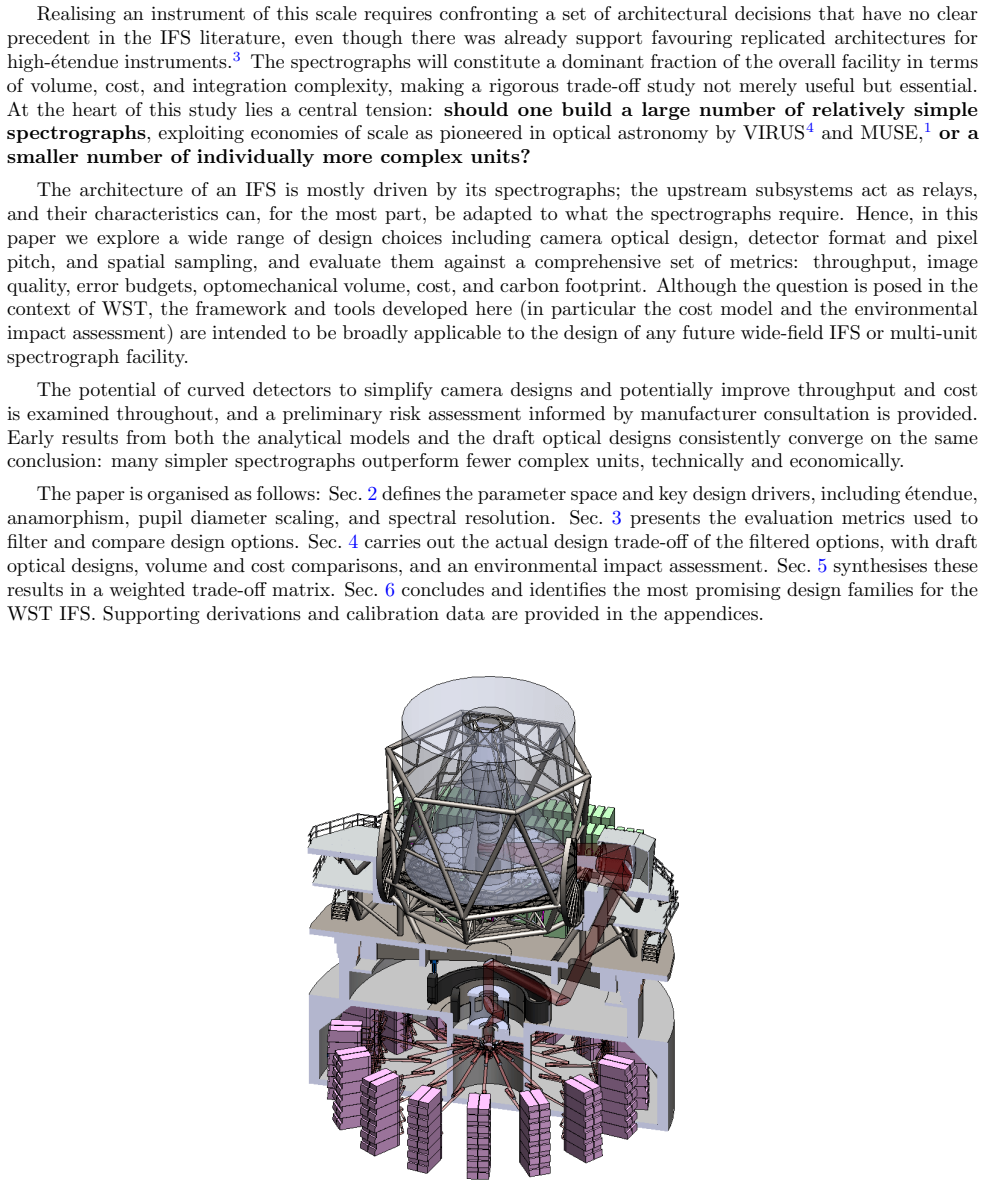
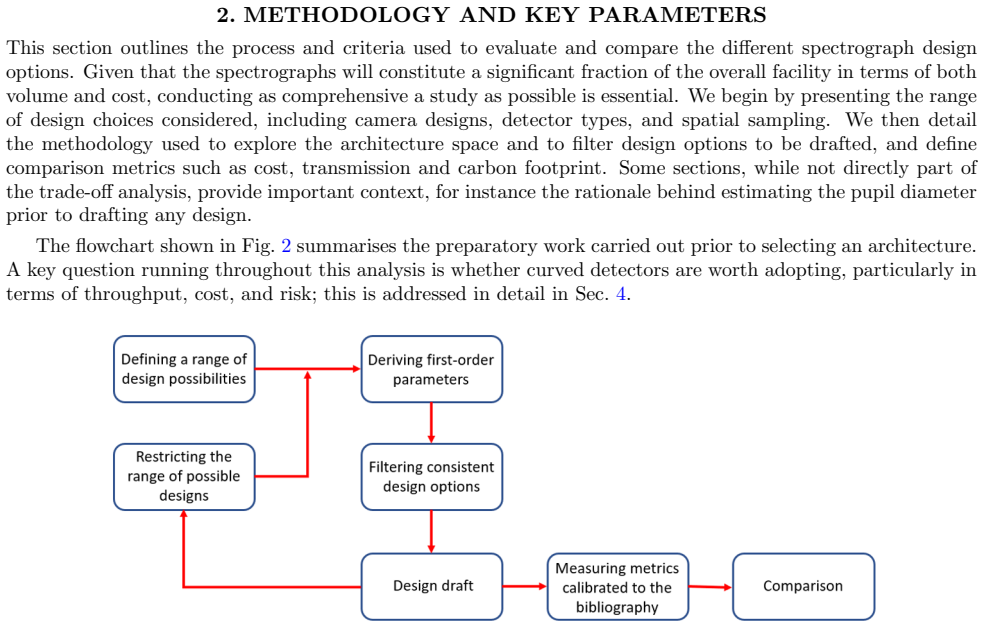
The IFS concept uses field splitters and image slicers to reformat a large field into pseudo-slits feeding spectrographs with two optimized spectral channels. The integrated design approach focuses on a trade study of spectrograph architectures. Design choices such as pixel pitch, detector format, and camera optical design are evaluated against throughput, image quality, error budgets, volume, cost, and the carbon footprint of building each spectrograph. Early results suggest that many simpler spectrographs outperform fewer complex units technically and economically.
What carries the argument
The trade study of spectrograph architectures that ranks replication versus complexity by throughput, image quality, cost, and carbon footprint as functions of parameters such as pixel pitch and detector format.
If this is right
- Architectures relying on replication of simpler units achieve better overall system performance in throughput and image quality.
- Lower per-unit complexity reduces manufacturing costs and error risks across the instrument.
- Accounting for carbon footprint as a metric favors designs with more but simpler spectrographs.
- Exploration of curved detectors can be incorporated into the same ranking process to refine the preferred architecture.
Where Pith is reading between the lines
- Similar trade studies could guide design choices for other wide-field instruments where the number of units is scalable.
- Validating the performance models against real hardware would strengthen in the ranking of architectures.
- The preference for simplicity might influence development of detector formats that support easier replication.
Load-bearing premise
The models that predict throughput, image quality, cost, and carbon footprint from design parameters such as pixel pitch and detector format are accurate enough to rank the different spectrograph architectures.
What would settle it
Construction and testing of prototype spectrographs based on the modeled designs to compare actual measured throughput, image quality, cost, and carbon footprint against the model predictions.
Figures
read the original abstract
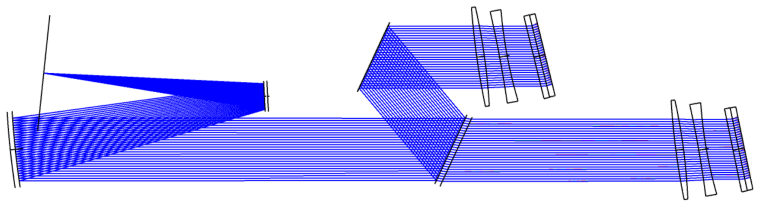
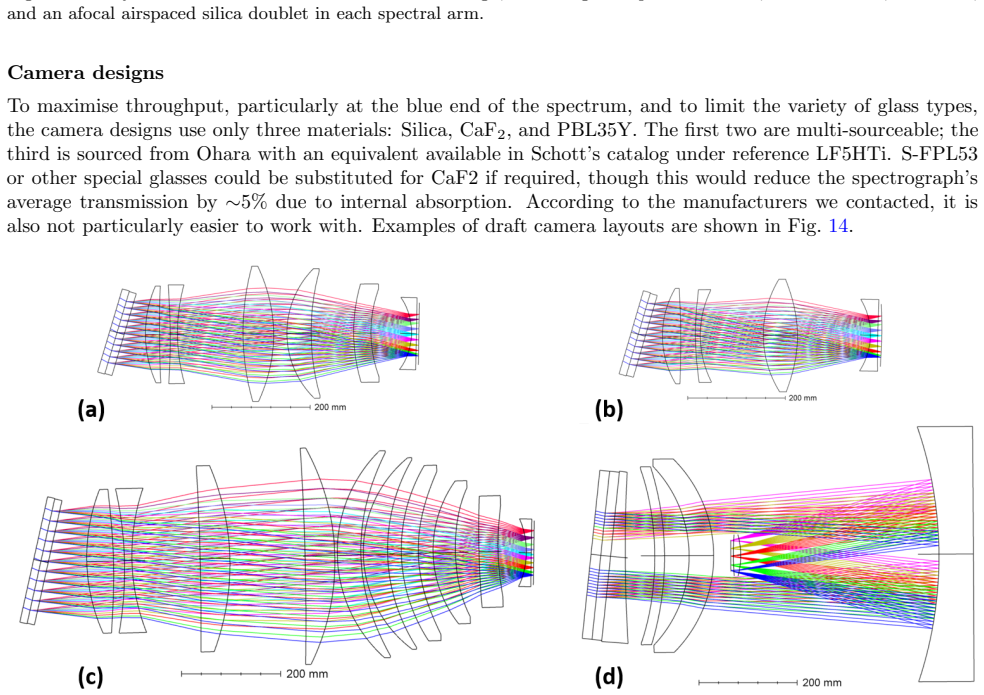
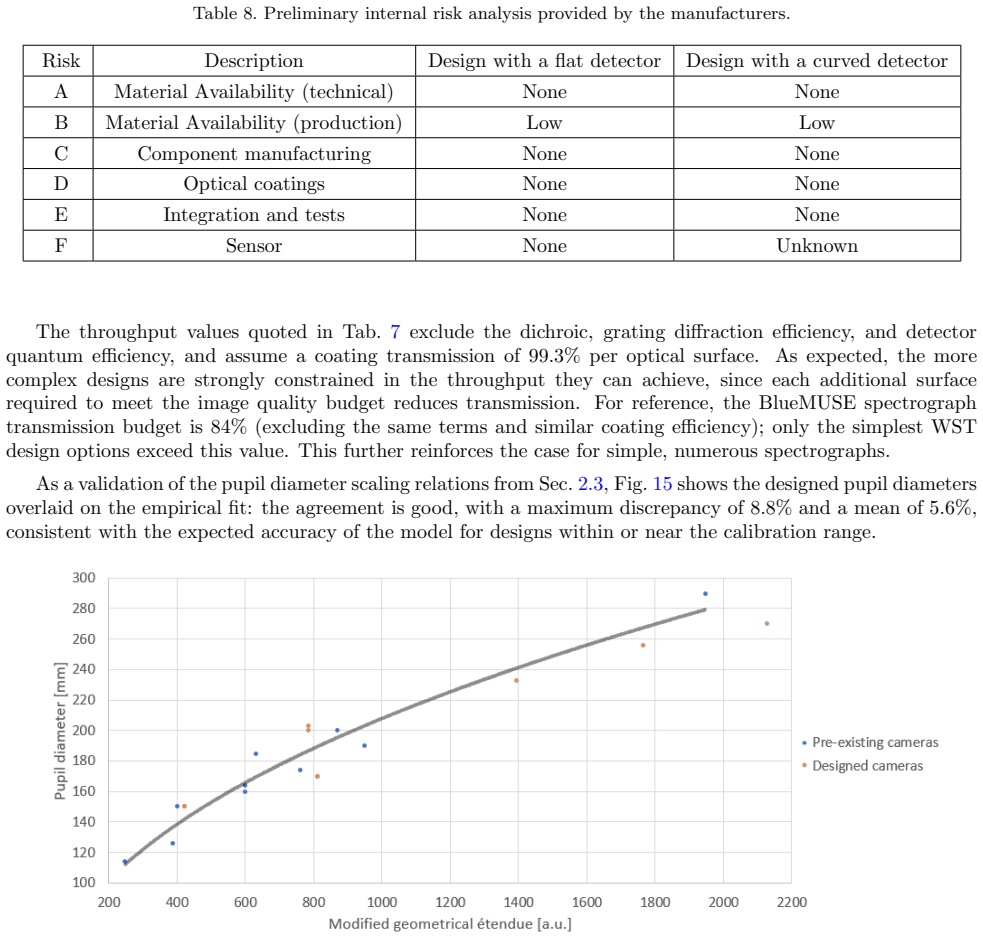
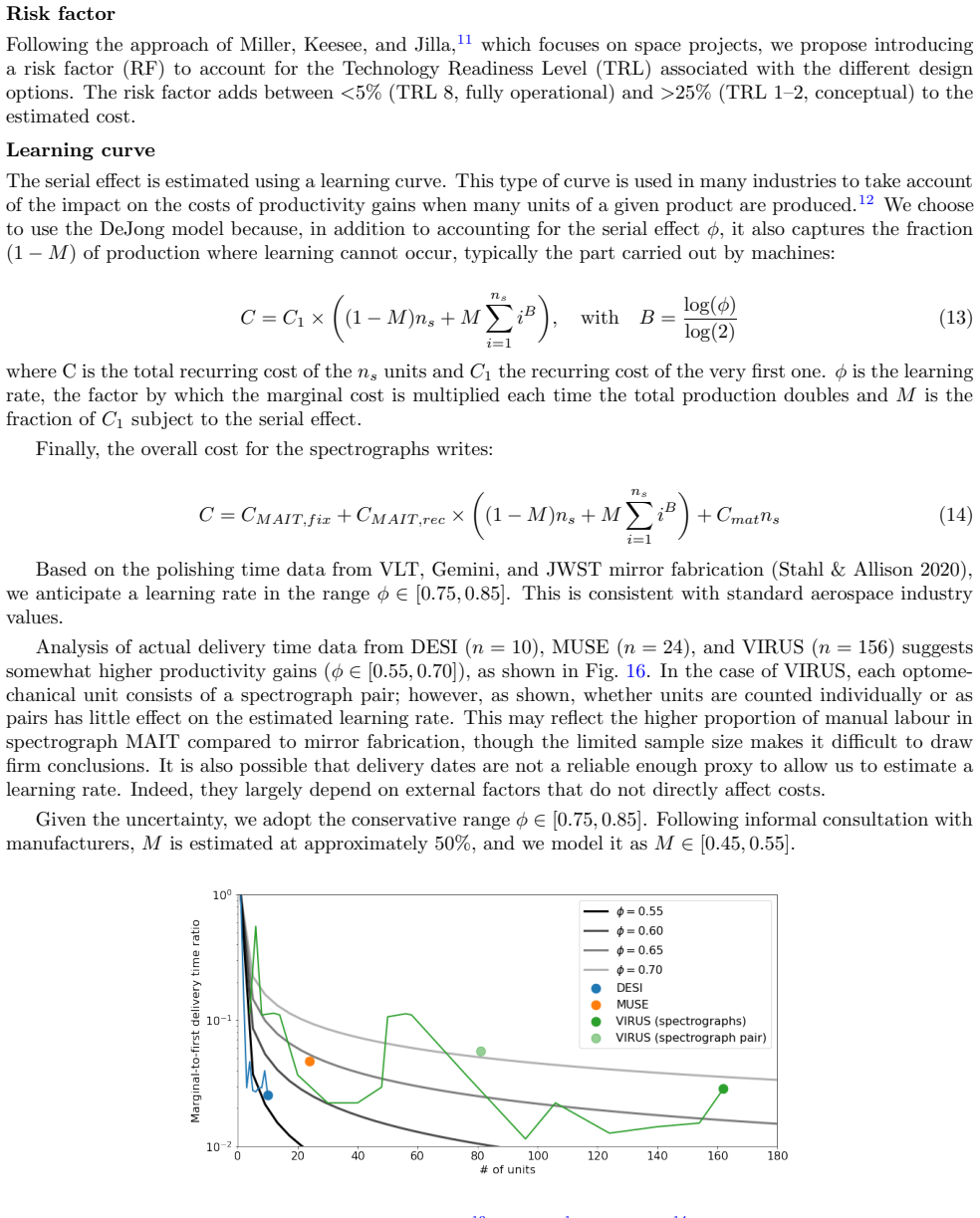
The Wide-field Spectroscopic Telescope (WST) is a proposed 12-meter segmented facility optimized for seeing- and Ground Layer Adaptive Optics-limited observations in the visible and designed to operate both a high-multiplex multi-object spectrograph and a panoramic integral field spectrograph (IFS). The WST IFS concept builds on instruments such as MUSE at the VLT (Very Large Telescope), using field splitters and image slicers to reformat a large field into pseudo-slits feeding spectrographs with two optimized spectral channels. This paper presents the integrated design approach adopted for the IFS, focusing on a trade study of spectrograph architectures. We explore design choices such as pixel pitch, detector format, and camera optical design against throughput, image quality, error budgets, volume, cost. The study adds one ecological metric: the carbon footprint of building each spectrograph, to inform design sustainability. The study also explores the potential of curved detectors. Early results suggest that many simpler spectrographs outperform fewer complex units technically and economically.
Editorial analysis
A structured set of objections, weighed in public.
Referee Report
Summary. The manuscript outlines an integrated design approach for the panoramic IFS on the proposed 12-m WST, building on MUSE-style field splitters and image slicers. It presents a trade study evaluating spectrograph architectures through parametric choices (pixel pitch, detector format, camera design, curved detectors) against throughput, image quality, error budgets, volume, cost, and carbon footprint, with the central suggestion that replicating many simpler spectrographs outperforms fewer complex units.
Significance. If the underlying models are shown to be reliable, the work could usefully inform architecture decisions for future wide-field IFS instruments by incorporating sustainability metrics alongside conventional performance and cost criteria.
major comments (2)
- [Abstract] Abstract: the claim that 'many simpler spectrographs outperform fewer complex units technically and economically' is presented as an 'early result' yet the manuscript supplies no figures, tables, numerical rankings, error budgets, or derivation details that would allow verification of the models or the ranking.
- [Abstract] Trade-study description (Abstract and implied methods): the parametric models that convert design parameters (pixel pitch, detector format, camera design) into throughput, image quality, cost, and carbon footprint are not calibrated or compared against measured performance of reference instruments such as MUSE; without such validation, unmodeled effects (alignment tolerances, coating variations, QE deviations) could systematically alter the architecture rankings.
minor comments (1)
- [Abstract] The abstract would be clearer if it briefly enumerated the specific spectrograph architectures that were compared.
Simulated Author's Rebuttal
We thank the referee for the constructive report and the recommendation for major revision. We address each major comment below, providing clarifications on the content of the full manuscript and outlining targeted revisions to improve verifiability and validation of the trade-study models.
read point-by-point responses
-
Referee: [Abstract] Abstract: the claim that 'many simpler spectrographs outperform fewer complex units technically and economically' is presented as an 'early result' yet the manuscript supplies no figures, tables, numerical rankings, error budgets, or derivation details that would allow verification of the models or the ranking.
Authors: The full manuscript (Sections 3–5) contains the parametric models, figures comparing throughput/image quality/cost/carbon footprint across architectures, tables with numerical rankings, and explicit error budget derivations. The abstract labels these 'early results' to reflect the preliminary nature of the ongoing WST design study. To improve accessibility, we will revise the abstract to reference the key quantitative outcomes and add explicit cross-references to the relevant figures and tables. revision: yes
-
Referee: [Abstract] Trade-study description (Abstract and implied methods): the parametric models that convert design parameters (pixel pitch, detector format, camera design) into throughput, image quality, cost, and carbon footprint are not calibrated or compared against measured performance of reference instruments such as MUSE; without such validation, unmodeled effects (alignment tolerances, coating variations, QE deviations) could systematically alter the architecture rankings.
Authors: The models are built from first-principles ray-tracing and published component specifications, with conservative margins applied for throughput and image quality. A direct calibration against MUSE on-sky data is not included in the current version. We will add a dedicated subsection comparing model outputs for a MUSE-equivalent configuration to the instrument's published requirements and available performance metrics, explicitly discussing sensitivity to the listed unmodeled effects. revision: yes
Circularity Check
No circularity: parametric trade study uses independent external metrics
full rationale
The paper performs a comparative trade study of IFS spectrograph architectures by mapping design parameters (pixel pitch, detector format, camera design) to independent performance metrics (throughput, image quality, error budgets, volume, cost, carbon footprint) via parametric models. No derivation chain reduces the central claim—that many simpler units outperform fewer complex ones—to a self-definition, fitted input renamed as prediction, or self-citation load-bearing step. The models are presented as forward evaluations against external criteria rather than quantities defined by the ranking outcome itself, and the provided text contains no equations or citations that close a loop back to the inputs.
Axiom & Free-Parameter Ledger
axioms (1)
- domain assumption Optical performance metrics such as throughput and image quality can be predicted from design parameters including pixel pitch, detector format, and camera optics.
Reference graph
Works this paper leans on
-
[1]
The MUSE second-generation VLT instrument,
Bacon, R. et al., “The MUSE second-generation VLT instrument,” in [Ground-based and Airborne Instru- mentation for Astronomy III],Proc. SPIE7735(773508) (July 14, 2010). DOI:https://doi.org/10. 1117/12.856027
2010
-
[2]
The wide-field spectroscopic telescope (WST) science white paper,
Mainieri, V. et al., “The wide-field spectroscopic telescope (WST) science white paper,” DOI:https: //doi.org/10.48550/arXiv.2403.05398
-
[3]
Replicated Spectrographs in Astronomy
Hill, G., “Replicated spectrographs in astronomy,” DOI:https://doi.org/10.48550/arXiv.1408.4625
work page internal anchor Pith review Pith/arXiv arXiv doi:10.48550/arxiv.1408.4625
-
[4]
Hill, G. et al., “VIRUS: production and deployment of a massively replicated fiber integral field spectrograph for the upgraded hobby-eberly telescope,” in [Ground-based and Airborne Instrumentation for Astronomy V],Proc. SPIE9147(91470Q) (July 10, 2014). DOI:https://doi.org/10.1117/12.2056911
-
[5]
2012, A&A, 543, A92, doi: 10.1051/0004-6361/201219040
Noll, S. et al., “An atmospheric radiation model for cerro paranal,”Astronomy and Astrophysics543, 23 (2012). DOI:https://doi.org/10.1051/0004-6361/201219040
-
[6]
2013, A&A, 560, A91, doi: 10.1051/0004-6361/201322433
Jones, A. et al., “An advanced scattered moonlight model for cerro paranal,”Astronomy and Astro- physics560, 11 (2013). DOI:https://doi.org/10.1051/0004-6361/201322433
-
[7]
Cudennec, C. et al., “IFS spectrograph designs for the wide-field spectroscopic telescope: Architecture and performance gains from curved sensors,” in [Optical Design and Engineering X],Proc. SPIE14106(141060L) (May 26, 2026). DOI:https://doi.org/10.1117/12.3098300
-
[8]
Highly curved image sensors: a practical approach for improved optical performance,
Guenter, B. et al., “Highly curved image sensors: a practical approach for improved optical performance,” Opt. Express25(12), 13010–13023 (2017). DOI:https://doi.org/10.1364/OE.25.013010
-
[9]
The challenge of highly curved monolithic imaging detectors,
Iwert, O. and Delabre, B., “The challenge of highly curved monolithic imaging detectors,” in [High Energy, Optical, and Infrared Detectors for Astronomy IV],Proc. SPIE7742(774227) (July 19, 2010). DOI:https: //doi.org/10.1117/12.856719
-
[10]
Design of optical systems with toroidal curved detectors,
Muslimov, E. et al., “Design of optical systems with toroidal curved detectors,”Opt. Lett.43, 3092–3095 (2018). DOI:https://doi.org/10.1364/OL.43.003092
-
[11]
Space Systems Cost Modeling
Miller, D. W., Keesee, J., and Jilla, C., “Space Systems Cost Modeling.” MIT Open- CourseWare,https://ocw.mit.edu/courses/16-851-satellite-engineering-fall-2003/ 48d9bf8fdee0a10cafa7578bac23d73f_l15_costmodellec.pdf(2003)
2003
-
[12]
Space Mission Analysis and Design
Wertz, J. R. and Larson, W. J., “Space Mission Analysis and Design.” Book,https://www.abebooks.com/ Space-Mission-Analysis-Design-3rd-edition/31966898595/bd(1999)
arXiv 1999
-
[13]
Testing the 10 spectrograph units for DESI: approach and results,
Perruchot, S. et al., “Testing the 10 spectrograph units for DESI: approach and results,” in [Ground-based and Airborne Instrumentation for Astronomy VIII],Proc. SPIE11447(1144786) (December 13, 2020). DOI: https://doi.org/10.1117/12.2561275
-
[14]
The construction, alignment, and installation of the VIRUS spectrograph,
Tuttle, S. et al., “The construction, alignment, and installation of the VIRUS spectrograph,” in [Ground- based and Airborne Instrumentation for Astronomy V],Proc. SPIE9147(91470R) (July 14, 2014). DOI: https://doi.org/10.1117/12.2056503
-
[15]
The MUSE instrument detector system,
Reiss, R. et al., “The MUSE instrument detector system,” in [Airborne Instrumentation for Astronomy IV], Proc. SPIE8446(84462P) (Sept 24, 2012). DOI:https://doi.org/10.1117/12.925388
-
[16]
Sustainability as a design parameter in the early development of the wide-field spectro- scopic telescope,
Fr´ eour, L. et al., “Sustainability as a design parameter in the early development of the wide-field spectro- scopic telescope,” in [This conference],Proc. SPIE(2026)
2026
-
[17]
Richard, J. et al., “The blue multi unit spectroscopic explorer (blueMUSE) on the VLT: science drivers and overview of instrument design,” in [Ground-based and Airborne Instrumentation for Astronomy X],Proc. SPIE13096(1309622) (July 18, 2024). DOI:https://doi.org/10.1117/12.3019831
-
[18]
4MOST low-resolution spectrograph: design and performances,
Laurent, F. et al., “4MOST low-resolution spectrograph: design and performances,” in [Ground-based and Airborne Instrumentation for Astronomy VI],Proc. SPIE9908(99087V) (August 9, 2016). DOI:https: //doi.org/10.1117/12.2231688
-
[19]
The design of the WEAVE spectrograph,
Rogers, K. et al., “The design of the WEAVE spectrograph,” in [Ground-based and Airborne Instrumenta- tion for Astronomy V],Proc. SPIE9147(91476H) (July 24, 2014). DOI:https://doi.org/10.1117/12. 2055860
work page doi:10.1117/12 2014
-
[20]
The DESI spectrograph system and production,
Edelstein, J. et al., “The DESI spectrograph system and production,” in [Ground-based and Airborne In- strumentation for Astronomy VII],Proc. SPIE10702(107027G) (July 9, 2018). DOI:https://doi.org/ 10.1117/12.2311821
-
[21]
Smee, S. et al., “The multi-object, fiber-fed spectrographs for SDSS and the baryon oscillation spectroscopic survey,”The Astronomical Journal146, 2 (2013). DOI:https://doi.org/10.1088/0004-6256/146/2/32
-
[22]
Optical design for MEGARA: a multi-object spectrograph for the GTC,
Carrasco, E. et al., “Optical design for MEGARA: a multi-object spectrograph for the GTC,” in [22nd Congress of the International Commission for Optics: Light for the Development of the World],Proc. SPIE 8011(80112D) (October 25, 2011). DOI:https://doi.org/10.1117/12.903436
-
[23]
Design and development of WFOS, the wide-field optical spectrograph for the thirty meter telescope,
Steidel, C. et al., “Design and development of WFOS, the wide-field optical spectrograph for the thirty meter telescope,” in [Ground-based and Airborne Instrumentation for Astronomy IX],Proc. SPIE12184(1218423) (August 29, 2022). DOI:https://doi.org/10.1117/12.2629464
-
[24]
2018, in SPIE Conference Series, Vol
Content, R. et al., “Optical design of the highly cost optimized new hector spectrograph,” in [Ground- based and Airborne Instrumentation for Astronomy VII],Proc. SPIE10702(107028I) (July 27, 2018). DOI: https://doi.org/10.1117/12.2314436
-
[25]
A novel design of a fibre-fed high-resolution spectrograph for WFMOS,
Lee, H. et al., “A novel design of a fibre-fed high-resolution spectrograph for WFMOS,” in [Ground-based and Airborne Instrumentation for Astronomy II],Proc. SPIE7014(70144E) (July 11, 2008). DOI:https: //doi.org/10.1117/12.787982
-
[26]
IMACS: the multiobject spectrograph and imager for the magellan i telescope,
Bigelow, B. et al., “IMACS: the multiobject spectrograph and imager for the magellan i telescope,” in [Optical Astronomical Instrumentation],Proc. SPIE3355(July 9, 1998). DOI:https://doi.org/10. 1117/12.316760
1998
-
[27]
Status update of LLAMAS: a wide field-of-view visible passband IFU for the 6.5m magellan telescopes,
Furesz, G. et al., “Status update of LLAMAS: a wide field-of-view visible passband IFU for the 6.5m magellan telescopes,” in [Ground-based and Airborne Instrumentation for Astronomy VIII],Proc. SPIE 11447(114470A) (December 13, 2020). DOI:https://doi.org/10.1117/12.2562803
-
[28]
Optical design of the suMIRe/PFS spectrograph,
Pascal, S. et al., “Optical design of the suMIRe/PFS spectrograph,” in [Ground-based and Airborne Instru- mentation for Astronomy V],Proc. SPIE9147(914747) (July 8, 2014). DOI:https://doi.org/10.1117/ 12.2055738
2014
-
[29]
AAOmega: a scientific and optical overview,
Saunders, W. et al., “AAOmega: a scientific and optical overview,” in [Ground-based Instrumentation for Astronomy],Proc. SPIE5492(September 30, 2004). DOI:https://doi.org/10.1117/12.550871
-
[30]
Hill, G. et al., “Design, construction, and performance of VIRUS-p: the prototype of a highly replicated integral-field spectrograph for HET,” in [Ground-based and Airborne Instrumentation for Astronomy II], Proc. SPIE7014(701470) (July 9, 2008). DOI:https://doi.org/10.1117/12.790235
-
[31]
Oliva, E. et al., “Updated optical design and trade-off study for MOONS, the multi-object optical and near infrared spectrometer for the VLT,” in [Ground-based and Airborne Instrumentation for Astronomy V],Proc. SPIE9147(91472C) (July 28, 2014). DOI:https://doi.org/10.1117/12.2054425
-
[32]
The LAMOST middle resolution spectrograph,
Hou, Y. et al., “The LAMOST middle resolution spectrograph,” in [Ground-based and Airborne Instrumen- tation for Astronomy VII],Proc. SPIE10702(107021I) (July 6, 2018). DOI:https://doi.org/10.1117/ 12.2312279
2018
-
[33]
FOBOS: A Next-Generation Spectroscopic Facility at the W. M. Keck Observatory
Bundy, K. et al., “FOBOS: A next-generation spectroscopic facility at the w. m. keck observatory,” DOI: https://doi.org/10.48550/arXiv.1907.07195
work page internal anchor Pith review Pith/arXiv arXiv doi:10.48550/arxiv.1907.07195 1907
discussion (0)
Sign in with ORCID, Apple, or X to comment. Anyone can read and Pith papers without signing in.