REVIEW 4 major objections 6 minor 2 cited by
MedGen: Unlocking Medical Video Generation by Scaling Granularly-annotated Medical Videos
T0 review · 4 major / 6 minor · reviewed 2026-08-06 · deepseek-v4-flash
Pith's one-line read With 55,803 captioned medical clips, MedGen rivals Sora on medical accuracy
desk verdict A genuinely useful medical video dataset, but the "leading open-source model" claim needs a stronger evaluation before it can be trusted. read the letter →
The pith
A machine-rendered reading of the paper's core claim, the machinery that carries it, and where it could break.
The reading
What carries the argument
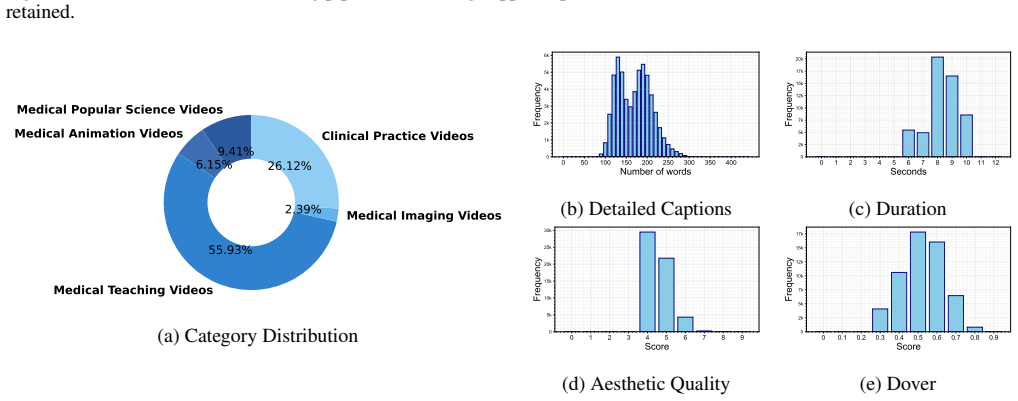
The load-bearing mechanism is the pairing of granular text captions with medical video clips. The construction pipeline filters 25 million YouTube videos down to 55,803 clips through a medical keyword and embedding classifier, per-frame medical classification, temporal consistency checks, and quality filters (black borders, OCR subtitles, aesthetic scores, and Dover technical scores), then uses a multimodal LLM to write both brief and detailed captions from eight sampled frames plus title, description, and transcript. Fine-tuning a latent video diffusion model on these caption-clip pairs is what converts general visual priors into medically grounded generation, and Med-VBench reuses VBench's hierarchical metrics on 200 medical prompts to measure that grounding.
What would settle it
Have independent clinicians write a held-out set of prompts from textbooks and clinical guidelines, never expose those prompts or their captions to MedVideoCap-55K, and compare MedGen against HunyuanVideo and Sora on medical accuracy; if the advantage shrinks to the base model's level, the claim that caption-rich medical pretraining transfers generally is falsified.
Extended reading notes
Core claim
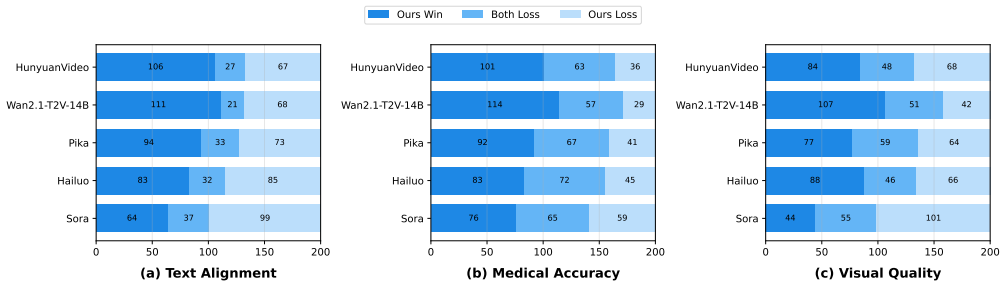
The paper's central claim is that domain-specific data, not model architecture, is the bottleneck for medical video generation. It constructs MedVideoCap-55K, 55,803 curated clips from public medical videos, each paired with brief and detailed captions produced by a multimodal LLM from sampled frames plus the video's title, description, and transcript, then fine-tunes the open HunyuanVideo model with LoRA on these caption-clip pairs to produce MedGen. The authors report that MedGen outperforms 15 open-source video generators on Med-VBench and approaches Sora, Kling, Pika, and Hailuo, while three doctor evaluators rate it best or tied on text alignment, medical accuracy, and visual quality for most tested prompts. A transfer experiment with Mochi-1-preview shows that fine-tuning on MedVideoCap-55K also improves another base model on warping error, image quality, and subject consistency.
Load-bearing premise
The 200 Med-VBench test prompts were authored by the same group that built the training captions, and the paper does not show that these prompts are independent of the MedVideoCap-55K caption distribution; if they overlap with training, MedGen's measured lead may reflect benchmark familiarity rather than general medical video ability.
Editorial extensions
If this is right
- Generalist text-to-video models can be specialized to medicine with modest compute (LoRA fine-tuning on eight GPUs), making domain adaptation more a data problem than a model-size problem.
- MedVideoCap-55K transfers across base models: the same fine-tuning setup improves Mochi-1-preview on warping error, image quality, and subject consistency.
- MedGen-generated clips can augment small labeled medical video datasets, lifting F1 by up to 15.3 points on HyperKvasir and 11.7 on SurgVisDom relative to training on the original data alone.
- Open-source medical video generation can reach commercial-level scores on Med-VBench, a VBench-derived benchmark that omits aesthetic quality because it is less relevant to medical content.
Reading between the lines
- If the 200 Med-VBench prompts are genuinely independent of the training captions, medical video generation may be closer to a data-scaling problem than a modeling problem, and a similar captioning pipeline could transfer to other high-stakes domains such as radiology reporting or surgical rehearsal.
- The paper's own transfer experiment hints at a diversity ceiling: fine-tuning on 55K clips slightly lowered background consistency and motion smoothness, suggesting that mixing general video data into the training set would preserve broad visual priors while adding medical grounding.
- A stricter evaluation would separate prompt-caption overlap from genuine domain knowledge by testing on procedure names and anatomical terms that are rare in YouTube titles and descriptions, which would clarify whether the measured gains reflect learned medical semantics or benchmark familiarity.
- For clinical use, synthetic medical footage raises unresolved ethical and safety questions; the authors restrict the dataset to research purposes, but the same technology could generate convincing misinformation if released without controls.
Editorial analysis
A structured set of objections, weighed in public.
Referee Report
Summary. The paper introduces MedVideoCap-55K, a large-scale (55,803 clips) medical video dataset with detailed captions, and MedGen, a medical video generation model obtained by fine-tuning HunyuanVideo with LoRA on this dataset. The authors claim leading performance among open-source models and competitive performance with commercial systems, evaluated on a medical-adapted VBench (Med-VBench), a human expert study, VideoScore, and a downstream data-augmentation experiment. The paper also presents a transferability experiment fine-tuning Mochi-1-preview on the dataset.
Significance. If the claims hold, this is a valuable contribution: MedVideoCap-55K is, to the best of my knowledge, the first large-scale, captioned medical video dataset for text-to-video generation, and the authors release code and data. The transferability experiment (Section 4.3) is a good check that the dataset benefits a second base model, and the use of an external benchmark (VideoScore) plus human evaluation with reported inter-rater agreement are strengths. However, the central performance claim depends on an author-constructed benchmark whose prompts may overlap with the training data, and the baseline set omits the domain-specific medical video generators cited in the Related Work. These issues need to be resolved before the headline claims can be accepted.
major comments (4)
- [Section 4.1 and Appendix A.3] The Med-VBench evaluation uses 200 author-designed prompts, but the paper provides no evidence that these prompts are disjoint from the MedVideoCap-55K captions used to train MedGen. Since both the dataset captions and the evaluation prompts are derived from the same broad YouTube medical video categories (clinical practice, teaching, imaging, animation), the benchmark may be evaluating MedGen on its training distribution while the baselines see those prompts for the first time. This would inflate the reported margin and undermine the 'leading among open-source models' claim. Please report a quantitative overlap analysis (e.g., embedding similarity between the 200 prompts and the training captions) and, ideally, evaluate on a held-out prompt set created independently of the dataset construction process.
- [Section 4.2, Table 2 and Section 6] The main comparison omits the domain-specific medical video generators cited in the Related Work (Bora, MedSora, Endora, Surgen, SurgSora). As a result, the claim of 'leading performance among open-source models' is only supported against general text-to-video baselines, not against existing medical-domain generators. Either include these models in the benchmark (where possible, e.g., Bora and SurgSora have open checkpoints) or explicitly limit the claim to general-purpose open-source models.
- [Section 4.1 and Table 2] The Med-VBench total score is recomputed after dropping the VBench aesthetic dimension, but the paper does not report the original VBench total or a sensitivity analysis showing how the ranking changes when the aesthetic dimension is included. Since the authors define the prompt set and the metric aggregation, the benchmark is at least partly self-adapted; reporting only the post-hoc total without the unmodified version makes it difficult for readers to assess how much of the improvement is driven by the choice of omitted dimension.
- [Section 5.1, Table 3] The downstream data-augmentation results are reported as single-run deltas without error bars, confidence intervals, or significance tests. Given the small base accuracies (e.g., HyperKvasir ACC 44.44, SurgVisDom ACC 14.29), the claimed improvements (up to +15.3 F1) may be within run-to-run variation. Please provide variance estimates over multiple augmentation seeds or repeated training runs, and report significance tests.
minor comments (6)
- [Appendix A.4] The sentence 'The results are shown in Figure 8' is incorrect: Figure 8 is the training-efficiency figure in Appendix A.1, while the VideoScore results are in Table 8. Please fix the cross-reference.
- [Section 3.2] The statement 'Videos with a Dover score greater than 0 are excluded' is confusing because Dover quality scores are typically higher-is-better. If a normalized or inverted score is being used, please define the range explicitly; otherwise the later 'Dover score >0.3' combined filter appears inconsistent.
- [Section 4.3, Table 4] The table caption says the comparison is 'on VBench', but the metrics (Total, WE, IQ, SC, BC, MS) are the Med-VBench metrics described in Section 4.1. Please use consistent terminology so readers know which prompt set was used.
- [Appendix A.4, Table 8] The 'Warping Error' column in the VideoScore table repeats the same values as in Table 2. If this is the same human annotation reused across both benchmarks, please state that; if it is new, please clarify why the numbers are identical.
- [Section 4.3] There is a typo in 'warping wrror' and a grammatical error in 'Experiments demonstrates' in the same section; please proofread.
- [Appendix A.3] Only one of the 200 evaluation prompts is shown. For reproducibility and transparency, please release the full prompt list (or a large representative sample) with the code/data release.
Circularity Check
Med-VBench prompt set lacks demonstrated independence from MedGen's training captions, partially circular for the headline open-source claim.
-
fitted input called prediction
[Section 4.1 (Evaluation Metrics) and Appendix A.3 (Evaluation Details)]
"Building on this framework, we introduce medical video prompts and rename the benchmark Med-VBench ... To prompt all models to generate medical videos for evaluation, we designed 200 different prompts, covering a variety of medical video categories and medical scenarios."
MedGen is fine-tuned on the GPT-4o-generated detailed captions of MedVideoCap-55K (Sec 3.1). The Med-VBench benchmark that underwrites the 'leading open-source' claim is constructed by the same authors from 200 prompts covering the same medical video categories, with no reported check that the prompts are disjoint from or distributionally independent of the training captions. The A.3 example prompt ('The short video depicts a surgical procedure taking place in an operating room...') is stylistically and topically nearly indistinguishable from the Fig. 2 dataset caption ('The video shows a surgical procedure in a sterile operating room...').
full rationale
The paper is an empirical systems contribution rather than a formal derivation, so the main circularity risk is in the evaluation protocol. MedGen is trained on MedVideoCap-55K, whose captions are generated by GPT-4o from medical videos. The authors then introduce Med-VBench by adding 200 author-designed medical prompts to VBench and omitting the aesthetic dimension; they do not establish that these prompts are held out from, or even distributionally different from, the training captions. The example prompt in Appendix A.3 is strikingly similar in style and content to the sample caption in Figure 2, supporting the concern that MedGen is being evaluated on its own training distribution while baselines are zero-shot. This makes the Med-VBench comparison partially circular for the headline claim. However, the paper also reports results on VideoScore, an external benchmark, and a human doctor evaluation with high inter-rater agreement; both provide independent evidence that MedGen improves medical video generation. No self-citation chains, imported uniqueness claims, or ansatz-by-citation patterns are present. The downstream augmentation experiments are not circular in the derivation sense, though they would benefit from error bars and contamination checks. Overall, the central claim has genuine independent support, but the self-constructed Med-VBench weakens the strength of the 'leading open-source' statement.
Assumptions & free parameters
free parameters (6)
- Temporal consistency threshold τ =
not reported (described as threshold τ)
- Minimum clip length =
6 frames
- OCR subtitle threshold =
20 words
- Aesthetic score threshold =
3.0
- Dover score exclusion threshold =
0 (and >0.3 for combined filter)
- LoRA rank =
32
assumptions (4)
- domain assumption The frame-level medical classifier C, trained on human-annotated data using CLIP embeddings, correctly distinguishes medical from non-medical frames.
- domain assumption CLIP embedding similarity between adjacent frames is a valid proxy for temporal coherence.
- domain assumption GPT-4o captions, generated from 8 sampled frames plus title, description, and transcript, are sufficiently accurate for training and evaluation.
- domain assumption VBench metrics, when applied to medical prompts, measure medical video quality without modification beyond dropping the aesthetic dimension.
Cite this review
Pith. "Pith review of MedGen: Unlocking Medical Video Generation by Scaling Granularly-annotated Medical Videos." pith.science (2026). https://pith.science/paper/O2ARR3XD
@misc{pith2026250705675,
  author       = {Pith},
  title        = {Pith review of: MedGen: Unlocking Medical Video Generation by Scaling Granularly-annotated Medical Videos},
  year         = {2026},
  howpublished = {\url{https://pith.science/paper/O2ARR3XD}},
  note         = {Machine review of arXiv:2507.05675}
}
read the original abstract
Recent advances in video generation have shown remarkable progress in open-domain settings, yet medical video generation remains largely underexplored. Medical videos are critical for applications such as clinical training, education, and simulation, requiring not only high visual fidelity but also strict medical accuracy. However, current models often produce unrealistic or erroneous content when applied to medical prompts, largely due to the lack of large-scale, high-quality datasets tailored to the medical domain. To address this gap, we introduce MedVideoCap-55K, the first large-scale, diverse, and caption-rich dataset for medical video generation. It comprises over 55,000 curated clips spanning real-world medical scenarios, providing a strong foundation for training generalist medical video generation models. Built upon this dataset, we develop MedGen, which achieves leading performance among open-source models and rivals commercial systems across multiple benchmarks in both visual quality and medical accuracy. We hope our dataset and model can serve as a valuable resource and help catalyze further research in medical video generation. Our code and data is available at https://github.com/FreedomIntelligence/MedGen
Figures


Figures from the paper (6 more)



Forward citations
Cited by 2 Pith papers
-
From Articulated Kinematics to Routed Visual Control for Action-Conditioned Surgical Video Generation
A kinematic-to-visual lifting paradigm combined with hierarchically routed control generates action-conditioned surgical videos with better faithfulness, fidelity, and efficiency.
-
UniReason-Med: A Shared Grounded Reasoning Interface for 2D-to-3D Transfer in Medical VQA
UniReason-Med introduces a unified framework for 2D and 3D medical VQA with shared grounded reasoning, trained on a 220K dataset, claiming that joint 2D+3D supervision improves 3D performance over 3D-only training.
Reference graph
Works this paper leans on
-
[1]
, " * write output.state after.block = add.period write newline
ENTRY address archivePrefix author booktitle chapter edition editor eid eprint howpublished institution isbn journal key month note number organization pages publisher school series title type volume year label extra.label sort.label short.list INTEGERS output.state before.all mid.sentence after.sentence after.block FUNCTION init.state.consts #0 'before.a...
-
[2]
write newline
" write newline "" before.all 'output.state := FUNCTION n.dashify 't := "" t empty not t #1 #1 substring "-" = t #1 #2 substring "--" = not "--" * t #2 global.max substring 't := t #1 #1 substring "-" = "-" * t #2 global.max substring 't := while if t #1 #1 substring * t #2 global.max substring 't := if while FUNCTION word.in bbl.in capitalize " " * FUNCT...
-
[3]
Bain, M.; Nagrani, A.; Varol, G.; and Zisserman, A. 2022. Frozen in Time: A Joint Video and Image Encoder for End-to-End Retrieval. arXiv:2104.00650
work page Pith review arXiv 2022
-
[4]
The SARAS Endoscopic Surgeon Action Detection (ESAD) dataset: Challenges and methods
Bawa, V. S.; Singh, G.; KapingA, F.; Skarga-Bandurova, I.; Oleari, E.; Leporini, A.; Landolfo, C.; Zhao, P.; Xiang, X.; Luo, G.; et al. 2021. The saras endoscopic surgeon action detection (esad) dataset: Challenges and methods. arXiv preprint arXiv:2104.03178
work page Pith review arXiv 2021
-
[5]
Blattmann, A.; Dockhorn, T.; Kulal, S.; Mendelevitch, D.; Kilian, M.; Lorenz, D.; Levi, Y.; English, Z.; Voleti, V.; Letts, A.; et al. 2023. Stable video diffusion: Scaling latent video diffusion models to large datasets. arXiv preprint arXiv:2311.15127
arXiv 2023
-
[6]
H.; Hicks, S.; Jha, D.; Eskeland, S
Borgli, H.; Thambawita, V.; Smedsrud, P. H.; Hicks, S.; Jha, D.; Eskeland, S. L.; Randel, K. R.; Pogorelov, K.; Lux, M.; Nguyen, D. T. D.; et al. 2020. HyperKvasir, a comprehensive multi-class image and video dataset for gastrointestinal endoscopy. Scientific data, 7(1): 283
work page 2020
-
[7]
Chen, H.; Zhang, Y.; Cun, X.; Xia, M.; Wang, X.; Weng, C.; and Shan, Y. 2024 a . VideoCrafter2: Overcoming Data Limitations for High-Quality Video Diffusion Models. arXiv:2401.09047
arXiv 2024
-
[8]
Chen, T.; Yang, S.; Wang, J.; Bai, L.; Ren, H.; and Zhou, L. 2024 b . Surgsora: Decoupled rgbd-flow diffusion model for controllable surgical video generation. arXiv preprint arXiv:2412.14018
work page Pith review arXiv 2024
Show all 45 references
-
[9]
Cho, J.; Schmidgall, S.; Zakka, C.; Mathur, M.; Kaur, D.; Shad, R.; and Hiesinger, W. 2024. SurGen: Text-Guided Diffusion Model for Surgical Video Generation. arXiv:2408.14028
2024 arXiv
-
[10]
Z.; Psychogyios, D.; Zhang, Y.; Hanrahan, J
Das, A.; Khan, D. Z.; Psychogyios, D.; Zhang, Y.; Hanrahan, J. G.; Vasconcelos, F.; Pang, Y.; Chen, Z.; Wu, J.; Zou, X.; et al. 2024. Pitvis-2023 challenge: Workflow recognition in videos of endoscopic pituitary surgery. arXiv preprint arXiv:2409.01184
2024 arXiv
-
[11]
Fan, W.; Si, C.; Song, J.; Yang, Z.; He, Y.; Zhuo, L.; Huang, Z.; Dong, Z.; He, J.; Pan, D.; et al. 2025. Vchitect-2.0: Parallel Transformer for Scaling Up Video Diffusion Models. arXiv preprint arXiv:2501.08453
2025 arXiv
-
[12]
Ghamsarian, N.; Taschwer, M.; Putzgruber-Adamitsch, D.; Sarny, S.; and Schoeffmann, K. 2021. Relevance detection in cataract surgery videos by spatio-temporal action localization. In 2020 25th International conference on pattern recognition (ICPR), 10720--10727. IEEE
2021
-
[13]
Gupta, D.; Attal, K.; and Demner-Fushman, D. 2023. A dataset for medical instructional video classification and question answering. Scientific Data, 10(1): 158
2023
-
[14]
HaCohen, Y.; Chiprut, N.; Brazowski, B.; Shalem, D.; Moshe, D.; Richardson, E.; Levin, E.; Shiran, G.; Zabari, N.; Gordon, O.; et al. 2024. Ltx-video: Realtime video latent diffusion. arXiv preprint arXiv:2501.00103
2024 arXiv
-
[15]
He, X.; Jiang, D.; Zhang, G.; Ku, M.; Soni, A.; Siu, S.; Chen, H.; Chandra, A.; Jiang, Z.; Arulraj, A.; et al. 2024. Videoscore: Building automatic metrics to simulate fine-grained human feedback for video generation. arXiv preprint arXiv:2406.15252
2024 arXiv
-
[16]
Huang, Z.; He, Y.; Yu, J.; Zhang, F.; Si, C.; Jiang, Y.; Zhang, Y.; Wu, T.; Jin, Q.; Chanpaisit, N.; et al. 2024. Vbench: Comprehensive benchmark suite for video generative models. In Proceedings of the IEEE/CVF Conference on Computer Vision and Pattern Recognition, 21807--21818
2024
-
[17]
Jin, Y.; Sun, Z.; Li, N.; Xu, K.; Xu, K.; Jiang, H.; Zhuang, N.; Huang, Q.; Song, Y.; Mu, Y.; and Lin, Z. 2024. Pyramidal Flow Matching for Efficient Video Generative Modeling. arXiv:2410.05954
2024
-
[18]
Kong, W.; Tian, Q.; Zhang, Z.; Min, R.; Dai, Z.; Zhou, J.; Xiong, J.; Li, X.; Wu, B.; Zhang, J.; et al. 2024. Hunyuanvideo: A systematic framework for large video generative models. arXiv preprint arXiv:2412.03603
2024 arXiv
-
[19]
Kuaishou. 2025. Kling. https://klingai.kuaishou.com/
2025
-
[20]
Y.; Li, W.; Liu, X.; Chen, Z.; Shao, J.; and Yuan, Y
Li, C.; Liu, H.; Liu, Y.; Feng, B. Y.; Li, W.; Liu, X.; Chen, Z.; Shao, J.; and Yuan, Y. 2024 a . Endora: Video generation models as endoscopy simulators. In International Conference on Medical Image Computing and Computer-Assisted Intervention, 230--240. Springer
2024
-
[21]
Li, L.; Qiu, J.; Saha, A.; Li, L.; Li, P.; He, M.; Guo, Z.; and Yuan, W. 2024 b . Artificial Intelligence for Biomedical Video Generation. arXiv:2411.07619
2024 arXiv
-
[22]
Lin, B.; Ge, Y.; Cheng, X.; Li, Z.; Zhu, B.; Wang, S.; He, X.; Ye, Y.; Yuan, S.; Chen, L.; et al. 2024. Open-sora plan: Open-source large video generation model. arXiv preprint arXiv:2412.00131
2024 arXiv
-
[23]
Ma, X.; Wang, Y.; Jia, G.; Chen, X.; Liu, Z.; Li, Y.-F.; Chen, C.; and Qiao, Y. 2024. Latte: Latent Diffusion Transformer for Video Generation. arXiv preprint arXiv:2401.03048
2024 arXiv
-
[24]
Merrick, L.; Xu, D.; Nuti, G.; and Campos, D. 2024. Arctic-embed: Scalable, efficient, and accurate text embedding models. arXiv preprint arXiv:2405.05374
2024 arXiv
-
[25]
Mesejo, P.; Pizarro, D.; Abergel, A.; Rouquette, O.; Beorchia, S.; Poincloux, L.; and Bartoli, A. 2016. Computer-aided classification of gastrointestinal lesions in regular colonoscopy. IEEE transactions on medical imaging, 35(9): 2051--2063
2016
-
[26]
MiniMax. 2025. Hailuo. https://hailuoai.com/video
2025
-
[27]
Nan, K.; Xie, R.; Zhou, P.; Fan, T.; Yang, Z.; Chen, Z.; Li, X.; Yang, J.; and Tai, Y. 2024. Openvid-1m: A large-scale high-quality dataset for text-to-video generation. arXiv preprint arXiv:2407.02371
2024 arXiv
-
[28]
I.; Yu, T.; Gonzalez, C.; Seeliger, B.; Mascagni, P.; Mutter, D.; Marescaux, J.; and Padoy, N
Nwoye, C. I.; Yu, T.; Gonzalez, C.; Seeliger, B.; Mascagni, P.; Mutter, D.; Marescaux, J.; and Padoy, N. 2022. Rendezvous: Attention mechanisms for the recognition of surgical action triplets in endoscopic videos. Medical Image Analysis, 78: 102433
2022
-
[29]
OpenAI. 2025. Video generation models as world simulators. https://openai.com/sora/
2025
-
[30]
W.; Hallacy, C.; Ramesh, A.; Goh, G.; Agarwal, S.; Sastry, G.; Askell, A.; Mishkin, P.; Clark, J.; et al
Radford, A.; Kim, J. W.; Hallacy, C.; Ramesh, A.; Goh, G.; Agarwal, S.; Sastry, G.; Askell, A.; Mishkin, P.; Clark, J.; et al. 2021. Learning transferable visual models from natural language supervision. In International conference on machine learning, 8748--8763. PmLR
2021
-
[31]
Schoeffmann, K.; Husslein, H.; Kletz, S.; Petscharnig, S.; Muenzer, B.; and Beecks, C. 2018. Video retrieval in laparoscopic video recordings with dynamic content descriptors. Multimedia Tools and Applications, 77: 16813--16832
2018
-
[32]
Sharma, A.; Yu, A.; Razavi, A.; Toor, A.; Pierson, A.; Gupta, A.; Waters, A.; van den Oord, A.; Tanis, D.; Erhan, D.; Lau, E.; Shaw, E.; Barth-Maron, G.; Shaw, G.; Zhang, H.; Nandwani, H.; Moraldo, H.; Kim, H.; Blok, I.; Bauer, J.; Donahue, J.; Chung, J.; Mathewson, K.; David,...
2024
-
[33]
Sun, W.; You, X.; Zheng, R.; Yuan, Z.; Li, X.; He, L.; Li, Q.; and Sun, L. 2024. Bora: Biomedical generalist video generation model. arXiv preprint arXiv:2407.08944
2024 arXiv
-
[34]
Team, G. 2024. Mochi 1. https://github.com/genmoai/models
2024
-
[35]
Team, P. 2025 a . Pika. https://pika.art/
2025
-
[36]
Team, W. 2025 b . Wan: Open and Advanced Large-Scale Video Generative Models. https://github.com/Wan-Video/Wan2.1
2025
-
[37]
P.; Shehata, S.; Mutter, D.; Marescaux, J.; De Mathelin, M.; and Padoy, N
Twinanda, A. P.; Shehata, S.; Mutter, D.; Marescaux, J.; De Mathelin, M.; and Padoy, N. 2016. Endonet: a deep architecture for recognition tasks on laparoscopic videos. IEEE transactions on medical imaging, 36(1): 86--97
2016
-
[38]
Wang, J.; Yuan, H.; Chen, D.; Zhang, Y.; Wang, X.; and Zhang, S. 2023. Modelscope text-to-video technical report. arXiv preprint arXiv:2308.06571
2023 arXiv
-
[39]
J.; Dai, Q.; and Fang, L
Wang, X.; Zhang, X.; Zhu, Y.; Guo, Y.; Yuan, X.; Xiang, L.; Wang, Z.; Ding, G.; Brady, D. J.; Dai, Q.; and Fang, L. 2020. PANDA: A Gigapixel-level Human-centric Video Dataset. arXiv:2003.04852
2020 arXiv
-
[40]
Wang, Z.; Zhang, L.; Wang, L.; Zhu, M.; and Zhang, Z. 2024. Optical flow representation alignment mamba diffusion model for medical video generation. arXiv preprint arXiv:2411.01647
2024 arXiv
-
[41]
H.; Wang, A.; Sun, W
Wu, H.; Zhang, E.; Liao, L.; Chen, C.; Hou, J. H.; Wang, A.; Sun, W. S.; Yan, Q.; and Lin, W. 2023. Exploring Video Quality Assessment on User Generated Contents from Aesthetic and Technical Perspectives. In International Conference on Computer Vision (ICCV)
2023
-
[42]
Yang, Z.; Teng, J.; Zheng, W.; Ding, M.; Huang, S.; Xu, J.; Yang, Y.; Hong, W.; Zhang, X.; Feng, G.; et al. 2024. Cogvideox: Text-to-video diffusion models with an expert transformer. arXiv preprint arXiv:2408.06072
2024 arXiv
-
[43]
Zheng, Z.; Peng, X.; Yang, T.; Shen, C.; Li, S.; Liu, H.; Zhou, Y.; Li, T.; and You, Y. 2024. Open-sora: Democratizing efficient video production for all. arXiv preprint arXiv:2412.20404
2024 arXiv
-
[44]
Zhou, Y.; Wang, Q.; Cai, Y.; and Yang, H. 2024. Allegro: Open the Black Box of Commercial-Level Video Generation Model. arXiv preprint arXiv:2410.15458
2024 arXiv
-
[45]
Zia, A.; Bhattacharyya, K.; Liu, X.; Berniker, M.; Wang, Z.; Nespolo, R.; Kondo, S.; Kasai, S.; Hirasawa, K.; Liu, B.; et al. 2023. Surgical tool classification and localization: results and methods from the miccai 2022 surgtoolloc challenge. arXiv preprint arXiv:2305.07152
2023 arXiv
Reviewed August 6, 2026 · model on record in the stance chip above.
Discussion (0). Sign in to comment.