REVIEW 4 major objections 5 minor 57 references
Combining transfer learning with mobile-scale CNNs reaches 97–99% accuracy on Arabic handwritten character benchmarks while using roughly two orders of magnitude fewer parameters than the heavyweight predecessors it is compared against.
Reviewed by Pith at T0; open to challenge. T0 means a machine referee read the full paper against a public rubric. the ladder, T0–T4 →
T0 review · deepseek-v4-flash
2026-08-05 05:39 UTC pith:O2Q2E7RZ
load-bearing objection Useful benchmark of mobile CNNs for Arabic character recognition, but best-fold/best-epoch selection and an abstract/table mismatch make the reported rankings unreliable. the 4 major comments →
Leveraging Transfer Learning and Mobile-enabled Convolutional Neural Networks for Improved Arabic Handwritten Character Recognition
The pith
A machine-rendered reading of the paper's core claim, the machinery that carries it, and where it could break.
Core claim
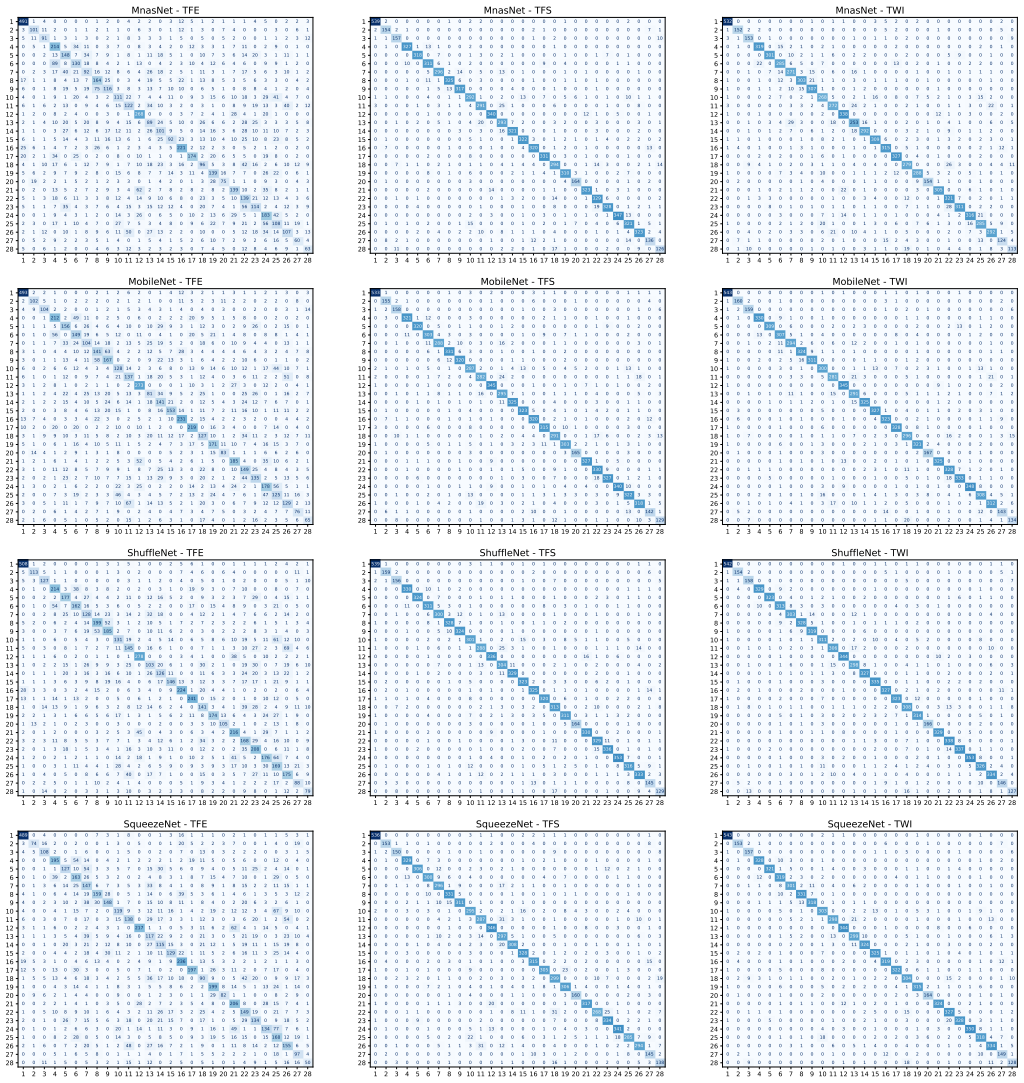
The central discovery is empirical: the fusion of transfer learning with mobile-enabled ConvNets is sufficient for competitive Arabic handwritten character recognition. On IFHCDB, MnasNet under full fine-tuning reaches 99% test accuracy; on AHCD, ShuffleNet reaches 97% under both full fine-tuning and training from scratch; on HIJJA, the most challenging set because each of the 28 letters appears in multiple positional forms and the handwriting comes from children, ShuffleNet under full fine-tuning reaches 92%. The paper argues that full fine-tuning (TWI) is the best general strategy—matching training-from-scratch accuracy while converging faster—and that freezing the feature extractor (TFE)
What carries the argument
The machinery is a 3-by-4 experimental grid: three transfer-learning strategies—TWI (full fine-tuning of pretrained weights), TFE (frozen feature extractor with only the classifier trained), and TFS (random initialization)—applied to four mobile CNN architectures (MobileNetV3-small, ShuffleNetV2, MnasNet0.5, SqueezeNet1.1). The load-bearing device is the TWI strategy itself: ImageNet-scale pretrained weights re-tuned on all layers. The paper's rankings and efficiency claims rest on TWI's consistent superiority over TFE, and its near-parity with TFS at shorter training time. Evaluation uses 5-fold cross-validation within each dataset's fixed training split, with the test set scored by the che
Load-bearing premise
The reported accuracies rest on a selection rule: for each model and dataset the authors pick the single cross-validation fold and checkpoint with the highest validation accuracy and report that checkpoint's test score; if this rule overfits the validation signal, the headline numbers are optimistic and some model rankings could flip.
What would settle it
Rerun the same protocol while reporting mean and standard deviation of test accuracy across all five folds (or across multiple seeds) instead of the best fold's best-epoch checkpoint; if the IFHCDB figure falls well below 99%, or the model rankings change under the averaged protocol, the central efficiency claim is weakened. A second check: apply the paper's own dropout 0.3–0.4 and batch-normalization modifications to the AHCD baseline and see whether the reported 0.97 accuracy improves as the ablation suggests it should.
If this is right
- Arabic handwriting recognition is achievable at mobile scale: 97–99% accuracy on benchmark character datasets with models of 1–2.5 million parameters, roughly 50–100 times smaller than the AlexNet/VGG-class networks that previously held the best results.
- The frozen-feature-extractor approach is a poor default for this domain; practitioners should fine-tune all layers rather than freeze the backbone.
- Full fine-tuning buys speed and accuracy together: the paper reports about 97 seconds per epoch on average for TWI versus 248–255 seconds for the other two strategies.
- HIJJA, with its multiple positional letter forms, is the binding constraint; the 92% ceiling there indicates that character-form variability, not model capacity, is the remaining bottleneck.
- The character-to-word pilot (87.2% word accuracy on IFN/ENIT via segmentation plus bigram correction) indicates the lightweight models generalize beyond isolated characters, though segmentation quality is the critical link.
Where Pith is reading between the lines
- If the TFE failure is truly a domain-mismatch effect, then pretraining on handwriting-specific or synthetic Arabic script data should shrink the TWI-versus-TFS gap further and push HIJJA accuracy past the reported ceiling—a testable prediction the paper itself hints at.
- The headline accuracies are selected from the best fold and best epoch; a protocol reporting mean and standard deviation across all five folds would likely lower the point estimates and could reorder the models, so cross-paper comparisons using the same optimistic rule may exaggerate the advantage.
- The dropout and batch-normalization ablations imply that cheap regularization, not added capacity, accounts for most of the remaining AHCD error; an augmentation study on the small datasets is the natural next experiment.
- The reported high-noise sensitivity values are unstable across models and datasets, which suggests the robustness metric itself needs a more principled definition before it can guide model choice.
Editorial analysis
A structured set of objections, weighed in public.
Referee Report
Summary. The paper empirically combines three transfer-learning strategies (TWI, TFE, TFS) with four mobile CNN backbones (MobileNet, ShuffleNet, MnasNet, SqueezeNet) for isolated Arabic handwritten character recognition on AHCD, HIJJA, and IFHCDB. It reports test accuracies up to 0.99, 0.97, and 0.92 on these datasets, together with precision/recall/F1, calibration, noise sensitivity, runtime, an end-to-end word-level experiment, and an ablation. The central claim is that lightweight mobile-enabled CNNs with transfer learning match or exceed heavier models at a fraction of the computational cost, and that full fine-tuning (TWI) is the best strategy.
Significance. If the reported numbers are trustworthy, the paper provides a useful indication that mobile-scale CNNs with transfer learning are competitive on isolated Arabic character benchmarks while using orders of magnitude fewer parameters and FLOPs than VGG/AlexNet-style baselines. The manuscript includes direct empirical measurements on three public benchmarks, comparisons with prior work, robustness/calibration metrics, and an ablation study, which are strengths. However, the evaluation protocol and several internal contradictions currently prevent the comparative conclusions from being accepted: the headline accuracies are selected as maxima over folds and epochs, and the abstract's claims about MobileNet and TWI are not supported by Table IV.
major comments (4)
- [§IV.D.3 and Table IV] The protocol selects, for each model/dataset, the single cross-validation fold with the highest validation accuracy and then the checkpoint (epoch) with the highest validation accuracy; that checkpoint is evaluated on the test set. The reported test accuracy is thus a maximum over 5 folds × 50 epochs of validation scores. This is an upper order statistic, not an unbiased estimator, and models with noisier validation curves (e.g., MnasNet under TFE: 0.26 on AHCD, 0.38 on IFHCDB) are disproportionately favored by this selection. No fold-level or run-level variance is reported, so the rankings and headline accuracies (0.99/0.97/0.92) cannot be statistically checked. I request fold-level mean±std (or repeated-run mean±std), model selection based on validation average or nested CV, and evaluation of the predefined test set only once.
- [Abstract vs. Table IV] The abstract states that 'MobileNet emerged as the top-performing model', but Table IV shows ShuffleNet achieving the highest accuracy on AHCD (0.97 TFS/TWI) and HIJJA (0.92 TWI), while MnasNet achieves the highest on IFHCDB (0.99 TWI); MobileNet is not first on any dataset. The abstract also states that 'full fine-tuning demonstrated the best overall performance', but TFS equals or exceeds TWI on AHCD for all four models (e.g., MobileNet 0.96 vs 0.96, MnasNet 0.90 vs 0.73) and on HIJJA for three of four models; the overall TFS average is slightly higher. These claims must be revised or supported with significance testing.
- [Table V vs. Table IV] Section V.C's conclusion that ImageNet pretraining (TWI) consistently improves accuracy is not supported by the main results. Table V reports gains of +1.1 (MobileNet, AHCD), +0.8 (ShuffleNet, AHCD), +1.7 (MobileNet, HIJJA), and +1.6 (ShuffleNet, HIJJA), but Table IV shows TFS and TWI accuracies that are equal or nearly equal for those exact configurations (e.g., AHCD MobileNet 0.96 vs 0.96; HIJJA MobileNet 0.90 vs 0.90; AHCD ShuffleNet 0.97 vs 0.97). The two tables cannot both describe the same experiments. The numbers or the selection criteria used for the 'controlled comparison' must be reconciled.
- [Table III/IV hyperparameter selection] Hyperparameters are tuned per model, strategy, and dataset, and the 'Best LR' is defined as the learning rate at the validation-best epoch. Combined with the best-fold/best-epoch selection in §IV.D.3, the evaluation has many validation-based degrees of freedom. Even if each individual choice is reasonable, reporting a single test number without variance or a description of how many configurations were tried makes the reported accuracies difficult to interpret. Please provide the full selection procedure and, ideally, confidence intervals or repeated seeds.
minor comments (5)
- [Algorithm 1 vs. §IV.D.3] Algorithm 1 states 'Augment data using transformations T, e.g., rotation and flipping', but §IV.D.3 says 'original dataset images are used without any preprocessing, except for resizing'. Please clarify whether augmentation was used; this affects reproducibility and the claimed fair comparison with prior work.
- [§V.F] The text expands 'TWI' as 'Transfer Within IFHCDB'; the correct expansion is 'Training as Weight Initializer'. Also, the cross-reference 'as noted in Section E' should be Section G (Comparison With Existing Works).
- [Conclusion] The conclusion refers to 'four MobileNet variants'; the paper actually studies four different mobile-enabled CNNs (MobileNet, ShuffleNet, MnasNet, SqueezeNet). Please correct the terminology.
- [References] Reference [22] has a garbled author field ('M. A. K. o and S. Poruran'), and reference [44] is incomplete (a URL with no authors or venue). Please complete these citations.
- [Table V vs. Table IV units] Table V reports accuracy in percent while Table IV reports fractions; please use consistent units and make explicit how the 'controlled comparison' differs from the main results.
Circularity Check
No circularity: all reported accuracies are direct empirical measurements on public benchmarks.
full rationale
The paper's central claims are empirical: model accuracies, FLOP/parameter counts, and training times are measured or taken from benchmark comparisons. No predictive quantity is computed from a fitted parameter and then renamed as a prediction. The three transfer-learning strategies (TFS, TFE, TWI) are standard protocol definitions, and the comparison between them is direct experiment, not a derivation from the paper's own assumptions. Self-citations ([1], [26], and related background citations) support only contextual claims about Arabic handwriting difficulty and potential applications, not the load-bearing results. The best-fold/best-epoch selection protocol in Section IV.D.3 is a methodological choice that can inflate and bias reported accuracies, and the paper lacks fold-level variance reporting; however, this is an evaluation-optimism concern, not circular reasoning, because the reported numbers remain measurements on held-out test data rather than quantities forced by construction. No uniqueness theorem, imported ansatz, or renaming of known results appears. The internal inconsistency between the abstract's claim that full fine-tuning is best and Table IV's TFS averages is a correctness/consistency issue, not circularity.
Axiom & Free-Parameter Ledger
free parameters (4)
- Best learning rate per model/strategy/dataset =
2.45e-05 to 0.01 (Table III)
- Batch size, momentum, weight decay, optimizer per scenario =
Table III
- Dropout rate (ablation study) =
0.2 to 0.6, optimal 0.3 to 0.4
- Selected best fold and best epoch =
Selected per model and dataset
axioms (4)
- domain assumption ImageNet-pretrained weights provide a useful initialization for Arabic handwritten characters.
- domain assumption The predefined 80/20 train/test splits and the 5-fold split of the training set are representative of the task.
- domain assumption Consolidating Hijja's 108 shape classes into 28 character classes preserves a meaningful AHCR task.
- domain assumption Using IFHCDB, primarily a Farsi dataset, is valid as an Arabic character benchmark.
Cite this review
Pith. "Pith review of Leveraging Transfer Learning and Mobile-enabled Convolutional Neural Networks for Improved Arabic Handwritten Character Recognition." pith.science (2026). https://pith.science/paper/O2Q2E7RZ
@misc{pith2026250905019,
  author       = {Pith},
  title        = {Pith review of: Leveraging Transfer Learning and Mobile-enabled Convolutional Neural Networks for Improved Arabic Handwritten Character Recognition},
  year         = {2026},
  howpublished = {\url{https://pith.science/paper/O2Q2E7RZ}},
  note         = {Machine review of arXiv:2509.05019}
}
read the original abstract
The study explores the integration of transfer learning (TL) with mobile-enabled convolutional neural networks (MbNets) to enhance Arabic Handwritten Character Recognition (AHCR). Addressing challenges like extensive computational requirements and dataset scarcity, this research evaluates three TL strategies--full fine-tuning, partial fine-tuning, and training from scratch--using four lightweight MbNets: MobileNet, SqueezeNet, MnasNet, and ShuffleNet. Experiments were conducted on three benchmark datasets: AHCD, HIJJA, and IFHCDB. MobileNet emerged as the top-performing model, consistently achieving superior accuracy, robustness, and efficiency, with ShuffleNet excelling in generalization, particularly under full fine-tuning. The IFHCDB dataset yielded the highest results, with 99% accuracy using MnasNet under full fine-tuning, highlighting its suitability for robust character recognition. The AHCD dataset achieved competitive accuracy (97%) with ShuffleNet, while HIJJA posed significant challenges due to its variability, achieving a peak accuracy of 92% with ShuffleNet. Notably, full fine-tuning demonstrated the best overall performance, balancing accuracy and convergence speed, while partial fine-tuning underperformed across metrics. These findings underscore the potential of combining TL and MbNets for resource-efficient AHCR, paving the way for further optimizations and broader applications. Future work will explore architectural modifications, in-depth dataset feature analysis, data augmentation, and advanced sensitivity analysis to enhance model robustness and generalizability.
Figures



Reference graph
Works this paper leans on
-
[1]
Cnn-based methods for offline arabic handwriting recognition: A review,
M. El Khayati, I. Kich, and Y . Taouil, “Cnn-based methods for offline arabic handwriting recognition: A review,”Neural Processing Letters, vol. 56, no. 2, p. 115, 2024
work page 2024
-
[2]
A steerable directional local profile technique for extraction of handwritten arabic text lines,
Z. Shi, S. Setlur, and V . Govindaraju, “A steerable directional local profile technique for extraction of handwritten arabic text lines,” in2009 10th International Conference on Document Analysis and Recognition, (Barcelona, Spain), pp. 176–180, IEEE, 2009
work page 2009
-
[3]
Deepahr: a deep neural network approach for recognizing arabic handwritten recognition,
H. AlShehri, “Deepahr: a deep neural network approach for recognizing arabic handwritten recognition,”Neural Computing and Applications, pp. 1–13, 2024
work page 2024
-
[4]
Advancing arabic handwriting recognition with convolutional and recurrent neural network ensembles,
M. G. Mahdi, A. Sleem, I. Elhenawy, and S. Safwat, “Advancing arabic handwriting recognition with convolutional and recurrent neural network ensembles,”Information Sciences with Applications, vol. 3, pp. 43–63, 2024
work page 2024
-
[5]
Conv-vit fusion for improved handwritten arabic character classifica- tion,
S. Rouabhi, A. Azerine, R. Tlemsani, M. Essaid, and L. Idoumghar, “Conv-vit fusion for improved handwritten arabic character classifica- tion,”Signal, Image and Video Processing, pp. 1–18, 2024
work page 2024
-
[6]
Automatic speech recognition using advanced deep learning approaches: A survey,
H. Kheddar, M. Hemis, and Y . Himeur, “Automatic speech recognition using advanced deep learning approaches: A survey,”Information Fusion, p. 102422, 2024
work page 2024
-
[7]
An innovative deep anomaly detection of building energy consumption using energy time-series images,
A. Copiaco, Y . Himeur, A. Amira, W. Mansoor, F. Fadli, S. Atalla, and S. S. Sohail, “An innovative deep anomaly detection of building energy consumption using energy time-series images,”Engineering Applications of Artificial Intelligence, vol. 119, p. 105775, 2023
work page 2023
-
[8]
Y . Himeur, S. Al-Maadeed, I. Varlamis, N. Al-Maadeed, K. Abualsaud, and A. Mohamed, “Face mask detection in smart cities using deep and transfer learning: Lessons learned from the covid-19 pandemic,” Systems, vol. 11, no. 2, p. 107, 2023
work page 2023
-
[9]
Winograd transform-based fast detection of heart disease using ecg signals and chest x-ray images,
R. Anand, A. Rath, P. K. Sahoo, P. Jain, G. Panda, X. Wang, and H. Liu, “Winograd transform-based fast detection of heart disease using ecg signals and chest x-ray images,”IEEE Access, vol. 13, p. 57119–57140, 2025
work page 2025
-
[10]
Pali: A jointly-scaled multilingual language-image model,
X. Chen, X. Wang, S. Changpinyo, A. Piergiovanni, P. Padlewski, D. Salz, S. Goodman, A. Grycner, B. Mustafa, L. Beyer,et al., “Pali: A jointly-scaled multilingual language-image model,”arXiv preprint arXiv:2209.06794, 2022
Pith/arXiv arXiv 2022
-
[11]
X. Zhai, A. Kolesnikov, N. Houlsby, and L. Beyer, “Scaling vision transformers,”arXiv:2106.04560 [cs], 2021
Pith/arXiv arXiv 2021
-
[12]
Y . Himeur, S. Al-Maadeed, H. Kheddar, N. Al-Maadeed, K. Abualsaud, A. Mohamed, and T. Khattab, “Video surveillance using deep transfer learning and deep domain adaptation: Towards better generalization,” Engineering Applications of Artificial Intelligence, vol. 119, p. 105698, 2023
work page 2023
-
[13]
H. Kheddar, Y . Himeur, and A. I. Awad, “Deep transfer learning for intrusion detection in industrial control networks: A comprehensive review,”Journal of Network and Computer Applications, vol. 220, p. 103760, 2023
work page 2023
-
[14]
A survey on deep transfer learning,
C. Tan, F. Sun, T. Kong, W. Zhang, C. Yang, and C. Liu, “A survey on deep transfer learning,” inArtificial Neural Networks and Machine Learning – ICANN 2018, p. 207, Springer International Publishing, 2018
work page 2018
-
[15]
A survey of transfer learning,
K. Weiss, T. Khoshgoftaar, and D. Wang, “A survey of transfer learning,”Journal of Big Data, vol. 3, p. 9, 2016
work page 2016
-
[16]
Deep visual social distancing monitor- ing to combat covid-19: A comprehensive survey,
Y . Himeur, S. Al-Maadeed, N. Almaadeed, K. Abualsaud, A. Mohamed, T. Khattab, and O. Elharrouss, “Deep visual social distancing monitor- ing to combat covid-19: A comprehensive survey,”Sustainable cities and society, vol. 85, p. 104064, 2022
work page 2022
-
[17]
N. Asmamaw Shiferaw, Z. Lazarus Mayaluri, P. Kumar Sahoo, G. Panda, P. Jain, A. Rath, M. S. Islam, and M. Tariqul Islam, “Handwritten amharic character recognition through transfer learning: Integrating cnn models and machine learning classifiers,”IEEE Access, vol. 13, p. 52134–52148, 2025
work page 2025
-
[18]
F. Soumia, G. Djamel, and M. Haddad, “Handwritten arabic character recognition: Comparison of conventional machine learning and deep learning approaches,” inInnovative Systems for Intelligent Health Informatics(F. Saeed, F. Mohammed, and A. Al-Nahari, eds.), (Cham), pp. 1127–1138, Springer International Publishing, 2021
work page 2021
-
[19]
Deep convolutional neural networks transfer learning comparison on arabic handwriting recognition system,
S. Masruroh, M. Syahid, F. Munthaha, A. Muharram, and R. Putri, “Deep convolutional neural networks transfer learning comparison on arabic handwriting recognition system,”JOIV: International Journal on Informatics Visualization, vol. 7, pp. 330–337, 2023
2023
-
[20]
Offline arabic handwritten word recognition: A transfer learning approach,
M. Awni, M. I. Khalil, and H. M. Abbas, “Offline arabic handwritten word recognition: A transfer learning approach,”Journal of King Saud University - Computer and Information Sciences, vol. 34, pp. 9654– 9661, 2022
2022
-
[21]
Investigation on deep learning for off-line handwritten arabic character recognition,
C. Boufenar, A. Kerboua, and M. Batouche, “Investigation on deep learning for off-line handwritten arabic character recognition,”Cogni- tive Systems Research, vol. 50, pp. 180–195, 2018
work page 2018
-
[22]
Ocr-nets: Variants of pre-trained cnn for urdu handwritten character recognition via transfer learning,
M. A. K. o and S. Poruran, “Ocr-nets: Variants of pre-trained cnn for urdu handwritten character recognition via transfer learning,”Procedia Computer Science, vol. 171, pp. 2294–2301, 2020
2020
-
[23]
Arabic handwritten characters recognition using convolutional neural network,
A. Elsawy, M. Loey, and H. El-Bakry, “Arabic handwritten characters recognition using convolutional neural network,”WSEAS Transactions on Computer Research, vol. 5, pp. 11–19, 2017
2017
-
[24]
Arabic handwriting recognition system using convolutional neural network,
N. Altwaijry and I. Al-Turaiki, “Arabic handwriting recognition system using convolutional neural network,”Neural Computing and Applica- tions, vol. 33, pp. 2249–2261, 2021
2021
-
[25]
A comprehensive isolated farsi/arabic character database for handwritten ocr research,
S. Mozaffari, K. Faez, F. Faradji, M. Ziaratban, and S. M. Golzan, “A comprehensive isolated farsi/arabic character database for handwritten ocr research,” inProceedings of the 10th International Workshop on Frontiers in Handwriting Recognition, (La Baule, France), pp. 385– 389, 2006
work page 2006
-
[26]
M. El Khayati, I. Kich, and Y . Elkettani,Isolated Handwritten Ara- bic Character Recognition Using Convolutional Neural Networks: An Overview, p. 134–144. Springer Nature Switzerland, 2024
work page 2024
-
[27]
Deep learning for visual understanding: A review,
Y . Guo, Y . Liu, A. Oerlemans, S. Lao, S. Wu, and M. S. Lew, “Deep learning for visual understanding: A review,”Neurocomputing, vol. 187, pp. 27–48, 2016
work page 2016
-
[28]
Cnn based common approach to handwritten character recognition of multiple scripts,
D. S. Maitra, U. Bhattacharya, and S. K. Parui, “Cnn based common approach to handwritten character recognition of multiple scripts,” in2015 13th International Conference on Document Analysis and Recognition (ICDAR), pp. 1021–1025, 2015
work page 2015
-
[29]
H.-C. Shin, R. M. Summers,et al., “Deep convolutional neural networks for computer-aided detection: Cnn architectures, dataset characteristics and transfer learning,”IEEE Transactions on Medical Imaging, vol. 35, pp. 1285–1298, 2016
work page 2016
-
[30]
J. Bai, Z. Chen, B. Feng, and B. Xu, “Image character recognition using deep convolutional neural network learned from different languages,” in2014 IEEE International Conference on Image Processing (ICIP), pp. 2560–2564, 2014
work page 2014
-
[31]
Breathai: Transfer learning- based thermal imaging for automated breathing pattern recognition,
H. Kheddar, Y . Himeur, and A. Amira, “Breathai: Transfer learning- based thermal imaging for automated breathing pattern recognition,” in2025 IEEE International Conference on Image Processing (ICIP), pp. 2612–2617, IEEE, 2025
work page 2025
-
[32]
Exploring 2d representation and transfer learning techniques for indoor localization,
O. Kerdjidj, Y . Himeur, S. Atalla, A. Copiaco, S. S. Sohail, A. Amira, F. Fadli, W. Mansoor, and A. Gawanmeh, “Exploring 2d representation and transfer learning techniques for indoor localization,”Multimedia Tools and Applications, pp. 1–13, 2025
work page 2025
-
[33]
Federated and transfer learning for cancer detection based on image analysis,
A. Bechar, R. Medjoudj, Y . Elmir, Y . Himeur, and A. Amira, “Federated and transfer learning for cancer detection based on image analysis,” Neural Computing and Applications, vol. 37, no. 4, pp. 2239–2284, 2025
2025
-
[34]
Advancing 3d point cloud understanding through deep transfer learning: A comprehensive survey,
S. S. Sohail, Y . Himeur, H. Kheddar, A. Amira, F. Fadli, S. Atalla, A. Copiaco, and W. Mansoor, “Advancing 3d point cloud understanding through deep transfer learning: A comprehensive survey,”Information Fusion, vol. 113, p. 102601, 2025
work page 2025
-
[35]
Review of deep learning: concepts, cnn architectures, challenges, applications, future directions,
L. Alzubaidi, J. Zhang,et al., “Review of deep learning: concepts, cnn architectures, challenges, applications, future directions,”Journal of Big Data, vol. 8, p. 53, 2021
work page 2021
-
[36]
Learning transferable features with deep adaptation networks,
M. Long, Y . Cao, J. Wang, and M. I. Jordan, “Learning transferable features with deep adaptation networks,” inProceedings of the 32nd International Conference on Machine Learning - Volume 37, (Lille, France), pp. 97–105, JMLR.org, 2015
work page 2015
-
[37]
Deep transfer learning with joint adaptation networks,
M. Long, H. Zhu, J. Wang, and M. I. Jordan, “Deep transfer learning with joint adaptation networks,” inInternational Conference on Ma- chine Learning, pp. 2208–2217, PMLR, 2017
work page 2017
-
[38]
Simultaneous deep transfer across domains and tasks,
E. Tzeng, J. Hoffman, T. Darrell, and K. Saenko, “Simultaneous deep transfer across domains and tasks,” in2015 IEEE International Conference on Computer Vision (ICCV), pp. 4068–4076, 2015
work page 2015
-
[39]
Label efficient learning of transferable representations across domains and tasks,
Z. Luo, Y . Zou, J. Hoffman, and L. F. Fei-Fei, “Label efficient learning of transferable representations across domains and tasks,”Advances in Neural Information Processing Systems, vol. 30, 2017
work page 2017
-
[40]
A unified framework for metric transfer learning,
Y . Xu, S. J. Pan, H. Xiong, Q. Wu, R. Luo, H. Min, and H. Song, “A unified framework for metric transfer learning,”IEEE Transactions on Knowledge and Data Engineering, vol. 29, pp. 1158–1171, 2017
work page 2017
-
[41]
Ensemble transfer learning algorithm,
X. Liu, Z. Liu, G. Wang, Z. Cai, and H. Zhang, “Ensemble transfer learning algorithm,”IEEE Access, vol. 6, pp. 2389–2396, 2018
work page 2018
-
[42]
H. Chang, J. Han, C. Zhong, A. M. Snijders, and J.-H. Mao, “Unsuper- vised transfer learning via multi-scale convolutional sparse coding for biomedical applications,”IEEE Transactions on Pattern Analysis and Machine Intelligence, vol. 40, pp. 1182–1194, 2018
work page 2018
-
[43]
How transferable are features in deep neural networks?,
J. Yosinski, J. Clune, Y . Bengio, and H. Lipson, “How transferable are features in deep neural networks?,” inAdvances in Neural Infor- mation Processing Systems(Z. Ghahramani, M. Welling, C. Cortes, N. Lawrence, and K. Q. Weinberger, eds.), Curran Associates, Inc., 2014
work page 2014
-
[44]
Transfer learning to improve arabic handwriting text recognition
“Transfer learning to improve arabic handwriting text recognition.” Last accessed 2023/09/23
work page 2023
-
[45]
A new arabic handwritten character recognition deep learning system (ahcr-dls),
H. M. Balaha, H. A. Ali, M. Saraya, and M. Badawy, “A new arabic handwritten character recognition deep learning system (ahcr-dls),” Neural Comput & Applic, vol. 33, pp. 6325–6367, 2021
work page 2021
-
[46]
M. Alheraki, R. Al-Matham, and H. Al-Khalifa, “Handwritten arabic character recognition for children writing using convolutional neu- ral network and stroke identification,”Hum-Cent Intell Syst, vol. 3, pp. 147–159, 2023
work page 2023
-
[47]
An enhanced artificial learning framework for moving object detection in challenging video scenes,
U. Panigrahi, P. K. Sahoo, M. K. Panda, S. R. Parija, P. Jain, L. Lu, and H. Liu, “An enhanced artificial learning framework for moving object detection in challenging video scenes,”Alexandria Engineering Journal, vol. 129, p. 329–345, Oct. 2025
work page 2025
-
[48]
Coatnet: Marrying convolution and attention for all data sizes,
Z. Dai, H. Liu, Q. V . Le, and M. Tan, “Coatnet: Marrying convolution and attention for all data sizes,” 2021
2021
-
[49]
Davit: Dual attention vision transformers,
M. Ding, B. Xiao, N. Codella, P. Luo, J. Wang, and L. Yuan, “Davit: Dual attention vision transformers,” 2022
work page 2022
-
[50]
Squeezenet: Alexnet-level accuracy with 50x fewer parameters and <0.5mb model size,
F. N. Iandola, S. Han, M. W. Moskewicz, K. Ashraf, W. J. Dally, and K. Keutzer, “Squeezenet: Alexnet-level accuracy with 50x fewer parameters and <0.5mb model size,” 2016
2016
-
[51]
Searching for mobilenetv3,
A. Howard, M. Sandler, G. Chu, L.-C. Chen, B. Chen, M. Tan, W. Wang, Y . Zhu, R. Pang, V . Vasudevan, Q. V . Le, and H. Adam, “Searching for mobilenetv3,” 2019
2019
-
[52]
Mnasnet: Platform-aware neural architecture search for mobile,
M. Tan, B. Chen, R. Pang, V . Vasudevan, M. Sandler, A. Howard, and Q. V . Le, “Mnasnet: Platform-aware neural architecture search for mobile,” 2019
2019
-
[53]
Shufflenet v2: Practical guidelines for efficient cnn architecture design,
N. Ma, X. Zhang, H.-T. Zheng, and J. Sun, “Shufflenet v2: Practical guidelines for efficient cnn architecture design,” 2018
work page 2018
-
[54]
Shufflenet: An extremely efficient convolutional neural network for mobile devices,
X. Zhang, X. Zhou, M. Lin, and J. Sun, “Shufflenet: An extremely efficient convolutional neural network for mobile devices,” in2018 IEEE/CVF Conference on Computer Vision and Pattern Recognition, pp. 6848–6856, 2018
work page 2018
-
[55]
Mobilenets: Efficient convo- lutional neural networks for mobile vision applications,
A. G. Howard, M. Zhu, B. Chen, D. Kalenichenko, W. Wang, T. Weyand, M. Andreetto, and H. Adam, “Mobilenets: Efficient convo- lutional neural networks for mobile vision applications,” 2017
work page 2017
-
[56]
Mo- bilenetv2: Inverted residuals and linear bottlenecks,
M. Sandler, A. Howard, M. Zhu, A. Zhmoginov, and L.-C. Chen, “Mo- bilenetv2: Inverted residuals and linear bottlenecks,” in2018 IEEE/CVF Conference on Computer Vision and Pattern Recognition, pp. 4510– 4520, 2018
work page 2018
-
[57]
Hyperband: A novel bandit-based approach to hyperparameter opti- mization,
L. Li, K. Jamieson, G. DeSalvo, A. Rostamizadeh, and A. Talwalkar, “Hyperband: A novel bandit-based approach to hyperparameter opti- mization,”Journal of Machine Learning Research, vol. 18, no. 185, pp. 1–52, 2018
2018
discussion (0)
Sign in with ORCID, Apple, or X to comment. Anyone can read and Pith papers without signing in.