REVIEW 3 major objections 4 minor 1 cited by
Measurement-Induced Randomness and Structure in Controlled Qubit Processes
T0 review · 3 major / 4 minor · reviewed 2026-08-14 · deepseek-v4-flash
Pith's one-line read Measuring qubits turns simple finite-state sources into infinitely complex prediction problems.
desk verdict A clear, honest paper that identifies measurement-induced nonunifilarity as the mechanism behind infinite predictive complexity in measured qubit streams, but the headline quantitative claim about a quantifiable divergence rate leans on an unpublished companion and an upper bound. read the letter →
The pith
A machine-rendered reading of the paper's core claim, the machinery that carries it, and where it could break.
The reading
What carries the argument
Measurement-induced nonunifilarity is the engine: composing the controller's labeled transition matrices with measurement probabilities gives matrices $T^{(x)} = \sum_{\rho_j} T_{\rho_j} \Pr(x|\rho_j)$ in which the same symbol can be emitted along several state paths. The workhorse is the mixed-state presentation, built from the conditional distributions $\eta(w) = \Pr(S_\ell = s | w)$ over the hidden controller states after seeing word $w$; the presentation is unifilar even when the original HMM is not. Because recurrent mixed states form the causal states, the uncountability of this set is what makes $C_\mu$ diverge. The paper controls the divergence with the statistical complexity dimension $d_\mu$, the scaling of the coarse-grained Shannon entropy of the Blackwell measure on the mixed-state simplex, and bounds it by the Lyapunov dimension $d_{\mathrm{LCE}}$ of the mixed-state dynamics.
What would settle it
Generate a very long measurement sequence from the Fig. 2(b) cCQS at a generic angle, compute the time-averaged entropy rate of Eq. (6) for many independent initial mixed states, and box-count the recurrent mixed states at decreasing scales; if the average depends on the initial state or fails to converge while the box-counting dimension is finite, the claimed quantification is falsified.
Extended reading notes
Core claim
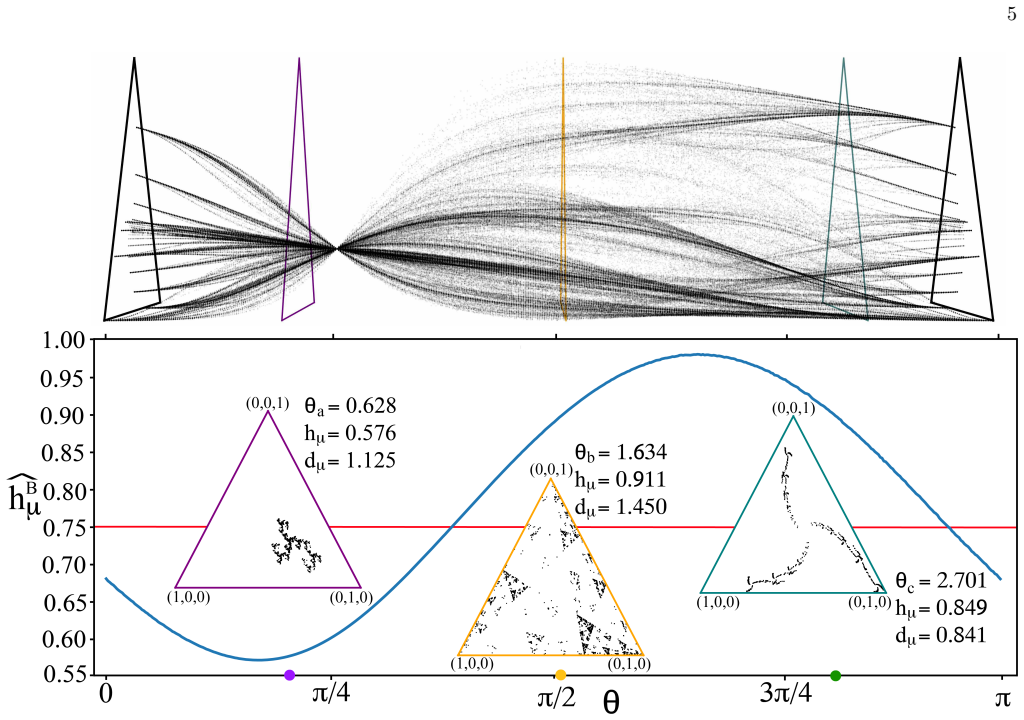
Even when the qubit generator is a finite-state classically-controlled qubit source (cCQS)—a hidden Markov model whose emitted symbols are pure qubit states—performing a projective measurement on each output qubit generically produces a measured process that is nonunifilar. In such a process, a measurement string does not determine the sequence of hidden controller states; the set of mixed states, each encoding the observer's probability distribution over controller states given the past, forms an uncountable fractal set. The recurrent mixed states are exactly the process's causal states, so the minimal optimal predictor has infinitely many states and the statistical complexity $C_\mu$ diverges. The paper shows the divergence rate is finite and quantifiable via the statistical complexity dimension $d_\mu$, estimated from the measured process's entropy rate and the Lyapunov spectrum of the mixed-state dynamics. The central demonstration uses a three-state cCQS emitting $|0\rangle$ and $|+\rangle$ qubits: sweeping the measurement angle, the entropy rate and dimension vary smoothly, with special angles yielding a single-state iid process or finite-complexity processes.
Load-bearing premise
The quantitative claims stand on the assumption that as measurement records grow, the observer's probability distribution over the hidden states settles into a unique, stable, and ergodic pattern—a property the paper inherits from an unpublished companion work; if that fails, the reported rates and dimensions are not established.
Editorial extensions
If this is right
- A generic measured qubit process cannot be optimally predicted by any finite-state model, even though the underlying source is finite-state; the minimal predictor is uncountably infinite.
- The entropy rate of a nonunifilar hidden Markov model can be estimated from the mixed-state dynamics by averaging over one long realization, rather than by integrating over an abstract invariant measure.
- Choosing the measurement basis is a way of tuning the observed process: some bases erase all memory, producing an iid biased coin, while others preserve finite complexity, and generic bases give divergent complexity with a finite dimension.
- The estimation algorithms apply to any ergodic nonunifilar HMM, giving a constructive route to entropy rates and statistical complexity dimensions that previously had only formal solutions.
Reading between the lines
- A natural extension would test whether the same generic divergence appears when the emitted states are mixed rather than pure; if nonunifilarity is the mechanism, the divergence should persist, though the dimension formula may need modification.
- For experimental work, the result implies that model-order selection from measured qubit streams will systematically under-estimate memory: any finite-Markov approximation is biased, and the bias should grow with sequence length as the complexity dimension dictates.
- One could formulate measurement-basis optimization: because the paper's angle sweep shows smooth variation in $d_\mu$, a basis that minimizes or maximizes the complexity dimension can be sought for tasks that need predictable or random outputs.
Signed reviews
Editorial analysis
A structured set of objections, weighed in public.
Referee Report
Summary. The paper studies classically controlled qubit sources (cCQSs): finite-state hidden Markov models that emit pure qubit states, which are then measured projectively to produce binary classical stochastic processes. The central claim is that, even when the controller is finite-state, measurement generically induces nonunifilarity in the resulting hidden Markov model, so that the measured process's minimal predictor (its epsilon-machine) requires an uncountable infinity of causal states and its statistical complexity C_mu diverges. To quantify this divergence the paper introduces an entropy-rate estimator, Eq. (6), based on time-averaging over mixed states, and the statistical complexity dimension d_mu, bounded by a modified Lyapunov dimension d_LCE in Eqs. (S8)-(S9). The ideas are illustrated on a three-state example, sweeping the measurement angle theta and plotting mixed-state sets, entropy rates, and complexity dimensions.
Significance. If the qualitative claim holds, this is an interesting and potentially important observation: a finite-state controlled quantum source can appear to a classical observer to require an infinite number of predictive features, and the measurement choice can both add and remove apparent randomness and structure. The paper's explicit example and the numerical mixed-state sets provide concrete evidence for the nonunifilarity mechanism and for the divergence of the causal-state count. The framing in terms of epsilon-machines and computational mechanics is appropriate and makes the operational meaning of the quantities clear. However, the paper's quantitative headline—that the divergence rate is 'quantifiable'—is not yet established: the entropy-rate estimator and the d_LCE bound are both deferred to an unpublished companion manuscript (Ref. [22]), and the paper itself states that the bound can be strict. The manuscript would be strengthened by a self-contained proof of the deferred results or, failing that, by an explicit downgrade of the quantitative claims to upper-bound statements.
major comments (3)
- [SM IID and Eq. (6)] The central entropy-rate estimator h^B_mu in Eq. (6) is load-bearing for all reported quantitative randomness values, but its validity is not established in this manuscript. SM IID states: 'The development of that expression and the proof that it is correct is given in Ref. [22].' Since Ref. [22] is an unpublished companion by the same authors, the reader cannot verify the contractivity and ergodicity conditions on which the time-average estimator rests. The revision should either include the proof (even in the SM) or cite a publicly available derivation; otherwise the reported h^B_mu values are unsupported.
- [SM IIE and Eqs. (S8)-(S9)] The statistical complexity dimension d_mu is not actually computed; only the upper bound d_mu <= d_LCE is reported, and SM IIE explicitly states that at theta_b = 1.634 the relationship becomes a strict inequality, d_mu < d_LCE. The insets of Fig. 3 present these d_LCE values as the 'statistical complexity dimensions,' but they are not demonstrated rates of divergence. To support the claim of a 'quantifiable rate,' the paper needs either direct estimates of d_mu (with a documented convergence criterion) or a proof that equality d_mu = d_LCE holds for the displayed cases. The box-counting estimates in SM IIE are finite-epsilon approximations and do not close this gap.
- [Main text, 'Uncountable Predictive Features'] The statement that 'nonunifilarity is generic to cCQSs and even to more general qubit sources' is presented as a first result, but no proof or precise formal statement is given. The paper demonstrates nonunifilarity for one explicit example and shows numerically that its mixed-state set is fractal, yet the genericity claim is stronger. A rigorous statement of the generic property, or at least a precise conjecture with supporting evidence, is needed for this to be a theorem rather than an observation about a single family.
minor comments (4)
- [Introduction] There is a typo in the phrase 'should also beefficient'; it should read 'should also be efficient.'
- [Main text, 'Measured Qubit Processes'] The sentence 'composing the measurement operator with the the qubit controller HMM' contains a duplicated 'the.'
- [SM IIC] In the definition of mixed states, the phrase 'the the nonunifilar HMM’s internal states' contains a duplicated 'the.'
- [Figure 3 caption and SM IIE] The caption says complexity measures were computed with '𝓁 = 10^6 iterates,' but iterates are not the same as block length; this should be clarified, and the distinction between direct estimates and upper bounds should be stated in the caption.
Circularity Check
No by-construction circularity in the worked example, but the quantitative 'rate of divergence' claims rest on unpublished same-author Ref. [22] and on an upper bound that is sometimes strict.
-
self citation load bearing
[Main text, 'Measurement-Induced Randomness and Statistical Complexity'; SM IID, Eq. (6)]
"Recently, Ref. [22] introduced a constructive approach to evaluate this integral by establishing contractivity of the simplex maps—the substochastic transition matrices of Eq. (4)—and showing that the mixed-state process is ergodic. ... SM IID: 'The development of that expression and the proof that it is correct is given in Ref. [22].'"
Equation (6) is the estimator for the entropy rate h^B_mu, which then feeds the reported randomness values and the d_LCE-based statistical complexity dimension. The paper does not derive Eq. (6) or prove its correctness in the manuscript; it explicitly defers that proof to Ref. [22], an unpublished companion by two of the present authors (Jurgens and Crutchfield). The quantitative content of the central claim therefore reduces, at its point of justification, to a same-author citation that the reader cannot verify from the preprint. This is load-bearing self-citation, even though it is not an identity-by-construction circularity.
-
self citation load bearing
[SM IIC, SM IIE, Eqs. (S7)-(S9)]
"With a small number of exceptions, the MSP of a process generated by a nonunifilar HMM has an uncountable infinity of states η[23]. ... Reference [22] introduces this bound for an HMM's statistical complexity dimension, interprets the conditions required for its proper use, and explains in fuller detail how to calculate an HMM's LCE spectrum."
The paper's second headline result—divergent C_mu requiring an uncountable number of causal states—is inherited from Ref. [23] (Marzen and Crutchfield), and the quantitative divergence rate is computed through the bound d_mu <= d_LCE introduced in unpublished Ref. [22] by the same group. The paper itself concedes in SM IIE that the bound can be strict, as at theta_b=1.634. Thus the 'quantifiable rate' is not independently derived in this paper; it is imported from same-author prior work and presented as established, with an acknowledged upper-bound gap. This is not a pure definitional circularity, but the quantitative claim is justificationally dependent on self-citations.
full rationale
The worked example is self-contained: the measured HMM of Fig. 2(c) is constructed by directly applying Eqs. (3) and (4) to the cCQS of Fig. 2(b), and the mixed-state sets and box-counting checks are described from the paper's own simulations. The nonunifilarity mechanism is illustrated explicitly rather than assumed by construction. However, the quantitative headline—that C_mu diverges at a quantifiable rate—is not established within the paper. The entropy-rate estimator Eq. (6) is proved, according to SM IID, only in Ref. [22], an unpublished companion by the same authors. The statistical complexity dimension d_mu is not directly estimated; the paper reports d_LCE upper bounds via Eq. (S8), and SM IIE explicitly notes that d_mu < d_LCE when the open set condition fails, as in the theta_b=1.634 inset. This is an overstatement and a reproducibility gap, but it is not a case where a fitted parameter was renamed as a prediction or where an equation reduces to its own input. I therefore score the circularity as moderate: the central qualitative claim has independent supporting content, but the quantitative claims lean heavily on same-author, partially unpublished citations.
Assumptions & free parameters
assumptions (5)
- ad hoc to paper Measured cCQSs form stationary, ergodic hidden Markov models whose mixed-state dynamics are contractive.
- ad hoc to paper Generically, a cCQS measurement yields a nonunifilar HMM.
- domain assumption For nonunifilar HMMs, the set of recurrent mixed states is generically uncountable and C_mu diverges.
- ad hoc to paper The statistical complexity dimension d_mu is bounded by the modified LCE dimension d_LCE, and the bound is a good estimate in typical cases.
- domain assumption Qubits are emitted in pure states with no temporal entanglement, so the total state is a tensor product and single-qubit projective measurements do not disturb other qubits.
Cite this review
Pith. "Pith review of Measurement-Induced Randomness and Structure in Controlled Qubit Processes." pith.science (2026). https://pith.science/paper/O3HKYKY3
@misc{pith2026190809053,
  author       = {Pith},
  title        = {Pith review of: Measurement-Induced Randomness and Structure in Controlled Qubit Processes},
  year         = {2026},
  howpublished = {\url{https://pith.science/paper/O3HKYKY3}},
  note         = {Machine review of arXiv:1908.09053}
}
read the original abstract
When an experimentalist measures a time series of qubits, the outcomes generate a classical stochastic process. We show that measurement induces high complexity in these processes in two specific senses: they are inherently unpredictable (positive Shannon entropy rate) and they require an infinite number of features for optimal prediction (divergent statistical complexity). We identify nonunifilarity as the mechanism underlying the resulting complexities and examine the influence that measurement choice has on the randomness and structure of measured qubit processes. We introduce new quantitative measures of this complexity and provide efficient algorithms for their estimation.
Figures

Forward citations
Cited by 1 Pith paper
-
Fraudulent White Noise: Flat power spectra belie arbitrarily complex processes
Structured hidden-Markov processes can have exactly flat power spectra, so flat spectra cannot certify randomness; the paper characterizes, constructs, and demonstrates such processes.
Reference graph
Works this paper leans on
- [22]
- [1]
-
[2]
(c) HMM presentation for the classical stochastic process resulting from measurement (θ=π/2) of the quantum process generated by (b). (d) Mixed states for the stochastic process generated by (c) in that HMM’s state distribution simplex. Each mixed state is a point of the form(pA,pB,pC ) with probabilities of being in stateA, B, orC of (c). Measured Qubit ...
-
[3]
of inconsistencies between quantum mechanics and local hidden variable theories [4]. Complementing their scientific role, entangled qubits are now recognized as basic resources for quantum technologies—quantum key distribution [5], teleportation [6], metrology [7], and com- puting [8]. The quest there is for qubit sources that allow on-demand generation: a...
arXiv 1908
-
[4]
C. S. Wu and I. Shaknov.Phys. Rev., 77:136, 1950
work page 1950
-
[5]
J. S. Bell. On the Einstein Podolsky Rosen paradox. Physics, 1:195, 1964
work page 1964
- [6]
-
[7]
A. K. Ekert.Phys. Rev. Lett., 67:661, 1991
work page 1991
Show all 41 references
-
[8]
C. H. Bennett, G. Brassard, C. Crepeau, R. Jozsa, A. Peres, and W. K. Wootters.Phys. Rev. Lett., 70:1895, 1993
1993
-
[9]
Giovannetti, S
V. Giovannetti, S. Lloyd, and L. Maccone.Phys. Rev. Lett., 96:010401, 2006
2006
-
[10]
Raussendorf and H
R. Raussendorf and H. J. Briegel. Phys. Rev. Lett., 86:5188, 2001
2001
-
[11]
Lindemann, G
M. Lindemann, G. Xu, T. Pusch, R. Michalzik, M. R. Hofmann, I. Zutic, and N. C. Gerhardt.Nature, 5678:212, 2019
2019
-
[12]
S. J. Freedman and J. F. Clauser.Phys. Rev. Lett., 28:938, 1972
1972
-
[13]
Miller, T
R. Miller, T. E. Northup, K. M. Birnbaum, A. Boca, A. D. Boozer, and H. J. Kimble.J. Phys. B: At. Mol. Opt. Phys., 38(9):S551–S565, 2005
2005
-
[14]
P. G. Kwiat, K. Mattle, H. Weinfurter, A. Zeilinger, A. V. Sergienko, and Y. Shih.Phys. Rev. Lett., 75:4337, 1995
1995
-
[15]
Benson, C
O. Benson, C. Santori, M. Pelton, and Y. Yamamoto. Phys. Rev. Lett., 84:2513, 2000
2000
-
[16]
Walther, B
H. Walther, B. T. H. Varcoe, B.-G. Englert, and T. Becker. Rep. Prog. Phys., 69(5):1325–1382, 2006
2006
-
[17]
M. D. Eisaman, J. Fan, A. Migdall, and S. V. Polyakov. Rev. Sci. Instr., 82(071101), 2011
2011
-
[18]
F. A. Pollock, C. Rodriguez-Rosario, T. Frauenheim, M. Paternostro, and K. Modi.Phys. Rev. A, 97:012127, 2018
2018
-
[19]
Galland, Y
C. Galland, Y. Ghosh, A. Steinbru, M. Sykora, J. A. Hollingsworth, V. I. Klimov, and H. Htoon. Nature, 479:203–207, 2011
2011
-
[20]
A. L. Efros and D. J. Nesbitt.Nature Nanotech., 11:661– 671, 2016
2016
-
[21]
J. P. Crutchfield. Nature Physics, 8(January):17–24, 2012
2012
-
[23]
C. J. Ellison, J. R. Mahoney, and J. P. Crutchfield.J. Stat. Phys., 136(6):1005–1034, 2009
2009
-
[24]
Jurgens and J
A. Jurgens and J. P. Crutchfield.in preparation, 2019
2019
-
[25]
S. E. Marzen and J. P. Crutchfield. Phys. Rev. E, 95(5):051301(R), 2017
2017
-
[26]
M. Gu, K. Wiesner, E. Rieper, and V. Vedral.Nature Comm., 3(762):1–5, 2012
2012
-
[27]
Scientific Reports, 6:20495, 2016
J.R.Mahoney, C.Aghamohammadi, andJ.P.Crutchfield. Scientific Reports, 6:20495, 2016
2016
-
[28]
P. M. Riechers, J. R. Mahoney, C. Aghamohammadi, and J. P. Crutchfield.Phys. Rev. A, 93(5):052317, 2016
2016
-
[29]
Physics Letters A, 381(14):1223–1227, 2017
C.Aghamohammadi, J.R.Mahoney, andJ.P.Crutchfield. Physics Letters A, 381(14):1223–1227, 2017
2017
-
[30]
Strongandweakoptimiza- tions in classical and quantum models of stochastic pro- cesses
S.LoomisandJ.P.Crutchfield. Strongandweakoptimiza- tions in classical and quantum models of stochastic pro- cesses. J. Stat. Phys., pages1–26, 2019. arXiv:1808.08639
2019 arXiv
-
[31]
T. M. Cover and J. A. Thomas.Elements of Information Theory. Wiley-Interscience, New York, 1991
1991
-
[32]
C. E. Shannon.Bell Sys. Tech. J., 27:379–423, 623–656, 1948
1948
-
[33]
J. P. Crutchfield and D. P. Feldman.CHAOS, 13(1):25–54, 2003
2003
-
[34]
R. G. James, C. J. Ellison, and J. P. Crutchfield.CHAOS, 21(3):037109, 2011
2011
-
[35]
Frederickson, J
P. Frederickson, J. Kaplan, E Yorke, and J. Yorke.J. Diff. Eqs, 49(2):185–207, 1983
1983
-
[36]
Kaplan and J
J. Kaplan and J. Yorke. InFunctional Differential Equa- tions and Approximation of Fixed Points, volume 730 of 7 Lecture Notes in Mathematics, pages 204–227. Springer, 1979
1979
-
[37]
D.FengandH.Hu. Comm. Pure App. Math., 62(11):1435– 1500, 2009
2009
-
[38]
Falconer.Fractal geometry: mathematical foundations and applications
K. Falconer.Fractal geometry: mathematical foundations and applications. John Wiley, Chichester, 1990. 1 Supplementary Materials Measurement-Induced Randomness and Structure in Controlled Qubit Processes Ariadna Venegas-Li, Alexandra Jurgens, and James P. Crutchfield The Supple...
1990
-
[39]
The state of the entire bi-infinite time series lies in the Hilbert space isH = lim𝓁→∞ ⨂+𝓁 t=−𝓁Ht
-
[40]
In our setting, aclassically controlled qubit source(cCQS) emits a qubit at each time step
And, when considering a finite part of the time series of length𝓁, the Hilbert space of interest is a truncation ofH denoted Ht:t+l =⨂t+l−1 k=t Hk 2. In our setting, aclassically controlled qubit source(cCQS) emits a qubit at each time step. The cCQS also determines stateρt of ...
-
[41]
unhidden
Hidden Markov Models and Unifilarity A hidden Markov model(HMM) is a quadruple(S,A,{Tx},π) consisting of: • S is the set of hidden states. •A the alphabet of symbols that the HMM emits on state-to-state transitions at each time step. •{Tx :x∈A}is the set of labeled transition m...
Reviewed August 14, 2026 · model on record in the stance chip above.
Discussion (0). Continue with ORCID to comment.