REVIEW 4 major objections 4 minor 49 references
Soil Characterization of Watermelon Field through Internet of Things: A New Approach to Soil Salinity Measurement
T0 review · 4 major / 4 minor · reviewed 2026-08-12 · deepseek-v4-flash
Pith's one-line read Soil salinity can be predicted from a simple resistivity measurement
desk verdict A routine IoT soil-monitoring build with an unvalidated, internally inconsistent salinity-resistivity model that should be desk-rejected until the authors supply raw data, fix the coefficient mismatch, and test the setup against a standard resistivity method. read the letter →
The pith
A machine-rendered reading of the paper's core claim, the machinery that carries it, and where it could break.
The reading
What carries the argument
The load-bearing object is the resistivity-to-salinity relationship. Resistivity is defined by $\rho = RA/L$ from a two-probe multimeter reading $R$ across a known probe spacing $L$ and bowl cross-section $A$. For each moisture level the paper fits an exponential curve $Y = A e^{-BX}$ to the measured points, inverts it logarithmically, and also trains an ANN with one hidden layer, tan-sigmoid activations, and a linear output using Levenberg-Marquardt backpropagation to predict salinity from pH, moisture, temperature, and resistivity. The exponential equations carry the simple field-use claim; the ANN is the paper's evidence that the multi-variable relationship is stable enough to learn.
What would settle it
Take soil samples with known salinity, measure resistivity with the same two-probe bowl setup across the six moisture levels, and compare the salinity predicted by Eqs. (2)-(7) with the known values; if the predictions drift systematically with sample batch, probe placement, or bowl size, or fail outside the 5-50% moisture range, the central claim is falsified. A simpler version is to run one blind sample through the multimeter setup and the ANN and check whether the predicted salinity matches an independent lab conductivity measurement.
Extended reading notes
Core claim
On the paper's own terms, the discovery is that soil electrical resistivity and soil salinity are linked by a simple exponential decay for each fixed moisture level: $Y = A e^{-BX}$, where $Y$ is resistivity in kΩ·m, $X$ is salinity in percent, and $A$ and $B$ are fitted constants. Inverting these equations gives $X = \frac{1}{B}\ln(A/Y)$, so a single resistance reading from two probes in a soil sample yields an estimated salinity. The paper also trains a feed-forward ANN with inputs pH, moisture, temperature, and resistivity to predict salinity, and reports high regression $R^2$ values and low mean squared errors for moisture levels up to 30%. The IoT system's pH, moisture, and temperature readings are shown to match laboratory and field-meter values closely, supporting the claim that the whole chain from sensor to cloud to mobile app is serviceable.
Load-bearing premise
The entire salinity model rests on the assumption that the resistance values from an analog multimeter and two probes in a small bowl are accurate and reproducible measures of the soil's true resistivity; the paper gives only one worked example and no raw data table, so if that measurement is noisy or setup-dependent, every fitted equation and the ANN inherit the error.
Editorial extensions
If this is right
- A farmer with a multimeter and a fixed-volume bowl could estimate soil salinity on site rather than waiting for lab results.
- The salinity estimate depends on knowing the moisture level, because the fitted equations differ for 5%, 10%, 20%, 30%, 40%, and 50% moisture.
- The IoT system gives real-time pH, moisture, and temperature data through a mobile app, so the salinity estimate could be combined with live moisture readings.
- If the ANN generalizes beyond its training samples, salinity prediction can use several soil properties jointly instead of relying on resistivity alone.
- The fitted equations are calibrated to the tested watermelon-field soil, so applying them to other soils would require refitting on local samples.
Reading between the lines
- The exponential form hints at a physically plausible picture: dissolved salts add charge carriers, so resistivity falls rapidly as salinity rises, but the rate of fall depends on how much water is available to dissolve the salt, which is why the paper needs a separate equation per moisture level.
- A direct extension would be to compare the two-probe resistivity estimates against a standard electrical-conductivity meter on the same samples; agreement would let the method be calibrated without a laboratory.
- The ANN results reported for 40% and 50% moisture are weaker than for lower moisture levels, so a field deployment would likely need more data in those ranges before relying on the model there.
- Because soil resistivity is temperature-dependent, the fitted equations may need a temperature correction when used at times of day far from the lab conditions under which the data were collected.
Editorial analysis
A structured set of objections, weighed in public.
Referee Report
Summary. The paper reports an IoT-based soil characterization system for watermelon fields, measuring moisture, temperature, and pH with sensors, uploading data to ThingSpeak, and displaying it via a web page and mobile app. The authors compare these measurements with field meters and laboratory analyses and claim close agreement. The central scientific claim is a new model for estimating soil salinity from soil resistivity: for six moisture levels (5% to 50%), the paper fits exponential curves to resistivity-versus-salinity data and then algebraically inverts these curves to obtain salinity from resistivity; separately, an artificial neural network (ANN) is trained on the same data to predict salinity from moisture, pH, temperature, and resistivity. The conclusion is that soil salinity can be determined from resistivity measurements, which would permit low-cost, real-time salinity assessment.
Significance. If the salinity-resistivity relationship were valid and transferable, the proposed method could be practically valuable for watermelon farmers in coastal Bangladesh, where salinity is a known production constraint. The IoT data-collection and visualization pipeline, and the comparison of sensor, field-meter, and laboratory values, are reasonable engineering contributions. However, the significance of the paper's central claim is nullified by three load-bearing weaknesses: the resistivity measurements are not physically meaningful soil resistivities, the 'prediction' equations are simply inversions of curves fitted to the same data (with an internal coefficient mismatch), and the ANN is trained and evaluated on the same samples used for the curve fits, so the reported high R² values are expected and not evidence of predictive skill. Consequently, the manuscript does not establish a reliable method for salinity estimation.
major comments (4)
- [§III.C.1] The soil resistivity values used throughout the paper are not valid soil resistivities. The method measures resistance with a two-probe analog multimeter in a small bowl and computes resistivity via ρ = RA/L (Eq. 1), using the probe spacing as L and the bowl's cross-sectional area as A. This formula is only valid for a uniform sample with parallel current flow; a two-electrode cell in a bowl produces a non-uniform current distribution and an unknown geometric factor, and the DC multimeter adds electrode polarization and contact resistance. The single worked example (150 kΩ for 20% salinity at 5% moisture) gives 23.52 kΩ·m, which is about three orders of magnitude higher than physically plausible for a soil with 20% salt; the discrepancy strongly suggests contact resistance rather than bulk soil resistivity. Since Eqs. (2)-(7) and the ANN are fitted to these values, the entire salinity model is calibrated to an instrument-dependent measurement, not to a soil property. No independent validation against a standard solution, a four-electrode setup, or any reference resistivity method is provided.
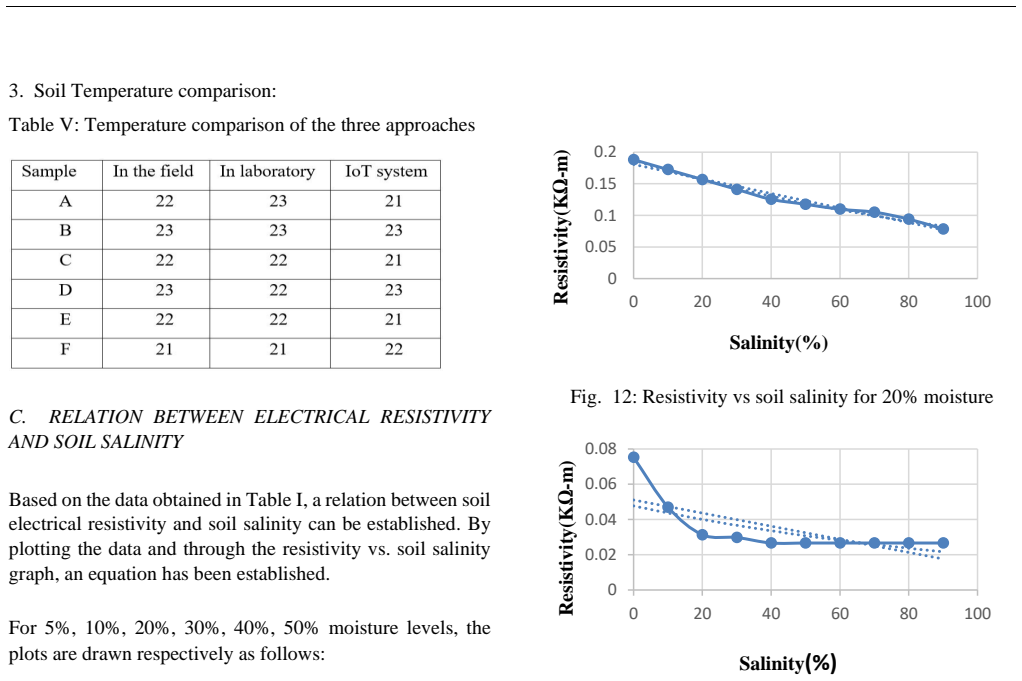
- [§IV.C] Equations (8)-(13) are not independent predictive models; they are algebraic inversions of the exponential curves (2)-(7) fitted to the same dataset. For example, Eq. (8) is obtained by solving Y = 26.213e^(-0.007X) for X, and the other equations are analogous. Thus the 'prediction' of salinity from resistivity simply reproduces the fitted curve and cannot serve as validation. Additionally, Eq. (9) uses coefficients A = 1.6843 and B = 0.006, but its source Eq. (3) has A = 1.7002 and B = 0.007; even the inversion is internally inconsistent. The reader cannot reproduce the inversion from the reported fit.
- [§IV.C, Eqs. (5)-(7)] The fits at 30%, 40%, and 50% moisture have R² values of 0.607, 0.442, and 0.477, respectively. These values indicate that the exponential model explains less than half of the variance for the 40% and 50% cases, so the claimed relationship between resistivity and salinity is effectively absent at higher moisture contents. The text does not discuss this limitation, instead asserting that the equations provide 'a quantitative method for assessing soil salinity based on resistivity'; this is not supported by the reported fit quality for these moisture levels.
- [§III.C.2 and §IV.C (ANN)] The ANN is trained, validated, and tested on the same 100-sample dataset that was used to derive the exponential resistivity-salinity curves. Because the inputs include resistivity, which is itself a direct function of salinity through the fitted curves, the high training and test R² values (e.g., 0.99519 at 5% moisture) are expected and do not demonstrate that the model learns a generalizable salinity relationship. No independent test set from separate samples or field measurements is used, so the claim that the ANN can 'predict' soil salinity is unsubstantiated. The paper also omits details on the dataset itself: only one worked example is given, and Table II, which should contain the full resistivity measurements, is not included in the text, so the entire analysis is not reproducible.
minor comments (4)
- [§III.B] The text contains an apparent typo: 'data can be con Fig. d as public or private' should read 'configured as public or private'.
- [References] The reference list has numbering issues: [18] appears twice (one is the STM32 paper and another is the Singh et al. paper), and the in-text citations are not consistently matched to the reference list.
- [Figures 10-15] The axes labels and legends in the resistivity-versus-salinity plots are not readable in the provided figures, and the plotted data points are not shown; only fitted curves appear, preventing the reader from assessing scatter or outliers.
- [Tables III-V] The pH, moisture, and temperature comparison tables list values but do not include uncertainty estimates or statistical measures (e.g., mean absolute error, standard deviation), so the claim that the three methodologies are 'practically the same' is only qualitatively supported.
Circularity Check
No circularity: the resistivity-salinity equations are empirical calibrations with independent lab measurements, not self-referential predictions.
full rationale
Walking the derivation chain, the paper measures resistance on laboratory soil samples with known salinity and moisture, converts resistance to resistivity via Eq. (1), fits exponential regressions (Eqs. 2-7), and then algebraically inverts those regressions to express salinity as a function of resistivity (Eqs. 8-13). This is a standard calibration procedure: the fitted curves summarize a measured empirical association between independently prepared salinity values and measured resistivity values, and the inversion is a mathematical rearrangement of the fitted curve rather than an assumption that presupposes the target result. The ANN is trained with known salinity labels and evaluated on a held-out split of the same dataset; while this is not external validation, it is not circular. The self-citations in the reference list, e.g., [43] and [45] by co-authors, are background support for the general resistivity-soil property connection and are not load-bearing for the paper's own fitted equations. The physical validity of the two-probe resistivity measurement is a correctness and measurement-concern, not a circularity concern under the review rules.
Assumptions & free parameters
free parameters (13)
- A_5 (Eq. 2) =
26.213
- B_5 (Eq. 2) =
0.007
- A_10 (Eq. 3) =
1.7002
- B_10 (Eq. 3) =
0.007
- A_20 (Eq. 4) =
0.1873
- B_20 (Eq. 4) =
0.009
- A_30 (Eq. 5) =
0.0477
- B_30 (Eq. 5) =
0.009
- A_40 (Eq. 6) =
0.0258
- B_40 (Eq. 6) =
0.003
- A_50 (Eq. 7) =
0.0332
- B_50 (Eq. 7) =
0.008
- ANN weights and biases =
not specified
assumptions (4)
- domain assumption Soil resistivity is a deterministic function of salinity and moisture for the tested soil.
- domain assumption Resistivity measured with an analog multimeter and a small bowl equals the bulk resistivity of the soil.
- domain assumption Soil samples prepared in the laboratory represent field conditions.
- domain assumption The ANN generalizes from 100 samples to unseen fields.
Cite this review
Pith. "Pith review of Soil Characterization of Watermelon Field through Internet of Things: A New Approach to Soil Salinity Measurement." pith.science (2026). https://pith.science/paper/O4FQJJL7
@misc{pith2026241117731,
  author       = {Pith},
  title        = {Pith review of: Soil Characterization of Watermelon Field through Internet of Things: A New Approach to Soil Salinity Measurement},
  year         = {2026},
  howpublished = {\url{https://pith.science/paper/O4FQJJL7}},
  note         = {Machine review of arXiv:2411.17731}
}
read the original abstract
In the modern agricultural industry, technology plays a crucial role in the advancement of cultivation. To increase crop productivity, soil require some specific characteristics. For watermelon cultivation, soil needs to be sandy and of high temperature with proper irrigation. This research aims to design and implement an intelligent IoT-based soil characterization system for the watermelon field to measure the soil characteristics. IoT based developed system measures moisture, temperature, and pH of soil using different sensors, and the sensor data is uploaded to the cloud via Arduino and Raspberry Pi, from where users can obtain the data using mobile application and webpage developed for this system. To ensure the precision of the framework, this study includes the comparison between the readings of the soil parameters by the existing field soil meters, the values obtained from the sensors integrated IoT system, and data obtained from soil science laboratory. Excessive salinity in soil affects the watermelon yield. This paper proposes a model for the measurement of soil salinity based on soil resistivity. It establishes a relationship between soil salinity and soil resistivity from the data obtained in the laboratory using artificial neural network (ANN).
Figures
Reference graph
Works this paper leans on
-
[1]
IOT Based Smart Agriculture And Soil Nutrient Detection System,
A. Badhe, S. Kharadkar, R. Ware, and P. Kamble, “IOT Based Smart Agriculture And Soil Nutrient Detection System,” pp. 774–777, 2018
work page 2018
-
[2]
BFSF: A secure IoT based framework for smart farming using blockchain,
S. Shreya, K. Chatterjee, and A. Singh, “BFSF: A secure IoT based framework for smart farming using blockchain,” Sustainable Computing: Informatics and Systems, vol. 40, Dec. 2023, doi: 10.1016/j.suscom.2023.100917
arXiv 2023
-
[3]
A. Morchid, I. G. Muhammad Alblushi, H. M. Khalid, R. El Alami, S. R. Sitaramanan, and S. M. Muyeen, “High - technology agriculture system to enhance food security: A concept of smart irrigation system using Internet of Things and cloud computing,” Journal of the Saudi Society of Agricultural Sciences , 2024, doi: 10.1016/j.jssas.2024.02.001
-
[4]
IoT -based agriculture management techniques for sustainable farming: A comprehensive review,
H. Shahab, M. Iq bal, A. Sohaib, F. Ullah Khan, and M. Waqas, “IoT -based agriculture management techniques for sustainable farming: A comprehensive review,” Comput Electron Agric , vol. 220, p. 108851, May 2024, doi: 10.1016/j.compag.2024.108851
-
[5]
Review of agricultural IoT technology,
J. Xu, B. Gu, and G. Ti an, “Review of agricultural IoT technology,” Artificial Intelligence in Agriculture , vol. 6. KeAi Communications Co., pp. 10–22, Jan. 01, 2022. doi: 10.1016/j.aiia.2022.01.001
-
[6]
IOT Based Real -Time Monitoring System for Precision Agriculture,
S. Vijh, Arpita, J. P. Bora, P. K. Gupta, and S. Kumar, “IOT Based Real -Time Monitoring System for Precision Agriculture,” in 2024 14th International Conference on Cloud Computing, Data Science & Engineering (Confluence), IEEE, Jan. 2024, pp. 53 –58. doi: 10.1109/Confluence60223.2024.10463399
-
[7]
Ag-IoT for crop and environment monitoring: Past, present, and future,
N. Chamara, M. D. Islam, G. (Frank) Bai, Y. Shi, and Y. Ge, “Ag-IoT for crop and environment monitoring: Past, present, and future,” Agricultural Systems , vol. 203. Elsevier Ltd, Dec. 01, 2022. doi: 10.1016/j.agsy.2022.103497
arXiv 2022
-
[8]
IoT based Agriculture (Ag - IoT): A detailed study on Architecture, Security and Forensics,
S. Rudrakar and P. Rughani, “IoT based Agriculture (Ag - IoT): A detailed study on Architecture, Security and Forensics,” Information Processing in Agriculture. China Agricultural University, 2023. doi: 10.1016/j.inpa.2023.09.002
Show all 49 references
-
[9]
Smart Soil Property Analysis Using IoT: A Case Study Implementation in Backyard Gardening,
R. Aarthi, D. Sivakumar, and V. Mariappan, “Smart Soil Property Analysis Using IoT: A Case Study Implementation in Backyard Gardening,” in Procedia Computer Science, Elsevier B.V., 2022, pp. 2842–2851. doi: 10.1016/j.procs.2023.01.255
2022 doi
-
[10]
IoT -based Water Harvesting, Moisture Monitoring, and Crop Monitoring System for Precision Agriculture,
D. B. Anil Kumar, N. Doddabasappa, B. Bairwa, C. S. Anil Kumar, G. Raju, and Madhu, “IoT -based Water Harvesting, Moisture Monitoring, and Crop Monitoring System for Precision Agriculture,” in 2nd IEEE International Conference on Distributed Computing and Electrical Circuits a...
2023
-
[11]
Precision Agriculture: IoT Based System for Real-Time Monitoring of Paddy Growth,
R. Thirisha et al. , “Precision Agriculture: IoT Based System for Real-Time Monitoring of Paddy Growth,” in 2023 International Conference on Sustainable Emerging Innovations in Engineering and Technology, ICSEIET 2023, Institute of Electrical and Electronics Engineers Inc., 20...
2023
-
[12]
IoT based Soil Monitoring and Control Systems,
K. Sakthi, Y. M. S. Zain, S. M. S. Raj, and M. Manickavasakar, “IoT based Soil Monitoring and Control Systems,” in Proceedings - 5th International Conference on Smart Systems and Inventive Technology, ICSSIT 2023, Institute of Electrical and Electronics Engineers Inc., 2023, p...
2023
-
[13]
An IOT -Based Soil Moisture Management System for Precision Agricu lture: Real-Time Monitoring and Automated Irrigation Control,
S. R. Laha, B. K. Pattanayak, S. Pattnaik, D. Mishra, D. S. Kumar Nayak, and B. B. Dash, “An IOT -Based Soil Moisture Management System for Precision Agricu lture: Real-Time Monitoring and Automated Irrigation Control,” in Proceedings of the 4th International Conference on Sma...
2023
-
[14]
Monitoring the soil parameters using IoT and Android based application for smart agriculture,
V. D. Bachuwar, A. D. Shligram, and L. P. Deshmukh, “Monitoring the soil parameters using IoT and Android based application for smart agriculture,” AIP Conf. Proc., vol. 1989, 2018, doi: 10.1063/1.5047679
1989 doi
-
[15]
Soil NPK and Moisture analysis using Wireless Sensor Networks,
R. Madhumathi, T. Arumuganathan, and R. Shruthi, “Soil NPK and Moisture analysis using Wireless Sensor Networks,” 2020 11th Int. Conf. Comput. Commun. Netw. Technol. ICCCNT 2020 , 2020, doi: 10.1109/ICCCNT49239.2020.9225547
2020
-
[16]
IoT based smart soil monitoring system for agricultural production,
N. Ananthi, J. Divya, M. Divya, and V. Janani, “IoT based smart soil monitoring system for agricultural production,” Proc. - 2017 IEEE Technol. Innov. ICT Agric. Rural Dev. TIAR 2017 , vol. 2018 -Janua, pp. 209 –214, 2018, doi: 10.1109/TIAR.2017.8273717
2017
-
[17]
A remotely operated Soil Monitoring System : An Internet of Things ( IoT ) Application,
S. Biswas, “A remotely operated Soil Monitoring System : An Internet of Things ( IoT ) Application,” Int. J. Internet Things Web Serv., vol. 3, pp. 32–38, 2018
2018
-
[18]
An IoT based system for remote monitoring of soil characteristics,
A. Na, W. Isaac, S. Varshney, and E. Khan, “An IoT based system for remote monitoring of soil characteristics,” 2016 Int. Conf. Inf. Technol. InCITe 2016 - Next Gener. IT Summit Theme - Internet Things Connect your Worlds, no. October, pp. 316 –320, 2017, doi: 10.1109/INCITE.2...
2016
-
[19]
Introduction to artificial neural networks,
E. Grossi and M. Buscema, “Introduction to artificial neural networks,” European Journal of Gastroenterology and Hepatology , vol. 19, no. 12. pp. 1046 –1054, Dec
-
[20]
Hyperspectral image processing to detect the soil salinity in coastal watershed,
P. N. Rekha, R. Gangadharan, S. M. Pillai, G. Ramanathan, and A. Panigrahi, “Hyperspectral image processing to detect the soil salinity in coastal watershed,” in 4th International Conference on Advanced Computing, ICoAC 2012, 2012. doi: 10.1109/ICoAC.2012.6416859
2012
-
[21]
Comparison between regression and ANN models for relationship of soil properties and electrical resistivity,
F. I. Siddiqui, D. M. Pathan, S. B. A. B. S. Osman, M. A. Pinjaro, and S. Memon, “Comparison between regression and ANN models for relationship of soil properties and electrical resistivity,” Arabian Journal of Geosciences , vol. 8, no. 8, pp. 6145 –6155, Aug. 2015, doi: VOLUM...
2015 doi
-
[22]
Comparison of artific ial neural network and regression pedotransfer functions for prediction of soil water retention and saturated hydraulic conductivity,
H. Merdun, Ö. Çinar, R. Meral, and M. Apan, “Comparison of artific ial neural network and regression pedotransfer functions for prediction of soil water retention and saturated hydraulic conductivity,” Soil Tillage Res, vol. 90, no. 1–2, pp. 108–116, Nov. 2006, doi: 10.1016/j....
2006 doi
-
[23]
Comparison of artificial neural network and multivariate regression models for prediction of Azotobacteria population in soil under different land uses,
M. Ebrahimi, A. A. Safari Sinegani, M. R. Sarikhani, and S. A. Mohammadi, “Comparison of artificial neural network and multivariate regression models for prediction of Azotobacteria population in soil under different land uses,” Comput Electron Agric , vol. 140, pp. 409 –421, ...
2017 doi
-
[24]
Prediction of Soil Deformation in Tunnelling Using Artificial Neural Networks,
J. Lai, J. Qiu, Z. Feng, J. Chen, and H. Fan, “Prediction of Soil Deformation in Tunnelling Using Artificial Neural Networks,” Computational Intelligence and Neuroscience, vol. 2016. Hindawi Limited, 2016. do i: 10.1155/2016/6708183
2016 doi
-
[25]
Predicting the spatial distribution of soil profile in Adapazari/Turkey by artificial neural networks using CPT data,
E. Arel, “Predicting the spatial distribution of soil profile in Adapazari/Turkey by artificial neural networks using CPT data,” Comput Geosci , vol. 43, pp. 90 –100, Jun. 2012, doi: 10.1016/j.cageo.2012.01.021
2012 doi
-
[26]
Application of hybrid ANN paradigms built with nature inspired meta -heuristics for modelling soil compaction parameters,
A. Bardhan and P. G. Asteris, “Application of hybrid ANN paradigms built with nature inspired meta -heuristics for modelling soil compaction parameters,” Transportation Geotechnics, vol. 41, Jul. 2023, doi: 10.1016/j.trgeo.2023.100995
2023
-
[27]
Prediction of soil’s compaction parameter using artificial neural network,
R. Al -saffar and S. Khattab , “Prediction of soil’s compaction parameter using artificial neural network,” Al- Rafidain Engineering Journal (AREJ) , vol. 21, no. 3, pp. 15–27, 2013
2013
-
[29]
Increasing the Yield in Crop Production,
R. Singh, S. Srivastava, and R. Mishra, “Increasing the Yield in Crop Production,” pp. 301–305, 2020
2020
-
[30]
Dewi and R
C. Dewi and R. C. Chen, Decision making based on IoT data collection for precision agriculture , vol. 830. Springer International Publishing, 2020
2020
-
[31]
Water usage approximation of Automated Irrigation System using IOT and ANN’s,
C. Kishor, H. U. Sunil Kumar, H. S. Praveena, S. P. Kavya, G. B. Apeksha, and D. J. Nayaka, “Water usage approximation of Automated Irrigation System using IOT and ANN’s,” Proc. Int. Conf. I -SMAC (IoT Soc. Mobile, Anal. Cloud), I -SMAC 2018 , pp. 76 –80, 2019, doi: 10.1109/I-...
2018
-
[32]
Study of soil resistivity variation with salinity,
N. K. Kishore and M. Bhagat, “Study of soil resistivity variation with salinity,” in First International Conference on Industrial and Information Systems, IEEE, 2006, pp. 1– 5
2006
-
[33]
Determination of Soil Ph ysical Properties and Pre - Sowing Irrigation Depth from Electrical Resistivity, Moisture, and Salinity Measurements,
C. Y. Cordero -Vázquez, O. Delgado -Rodríguez, R. Cisneros-Almazán, and H. J. Peinado -Guevara, “Determination of Soil Ph ysical Properties and Pre - Sowing Irrigation Depth from Electrical Resistivity, Moisture, and Salinity Measurements,” Land (Basel), vol. 12, no. 4, Apr. 2...
2023 doi
-
[34]
Quantification of Arctic Soil and Permafrost Properties Using Ground-Penetrating Radar and Electrical Resistivity Tomography Datasets,
E. Leger, B. Dafflon, F. Soom, J. Peterson, C. Ulrich, and S. Hubbard, “Quantification of Arctic Soil and Permafrost Properties Using Ground-Penetrating Radar and Electrical Resistivity Tomography Datasets,” IEEE J Sel Top Appl Earth Obs Remote Sens , vol. 10, no. 10, pp. 4348...
2017
-
[35]
Electrical resistivity survey in soil science: A review,
A. Samouëlian, I. Cousin, A. Tabbagh, A. Bruand, and G. Richard, “Electrical resistivity survey in soil science: A review,” Soil and Tillage Research, vol. 83, no. 2. pp. 173– 193, Sep. 2005. doi: 10.1016/j.still.2004.10.004
2005 doi
-
[36]
Low -cost Soil Moisture and EC Sensor Design for Soil Salinity Assessment,
V. K. Bodasingi, B. Rao, and H. K. Pillai, “Low -cost Soil Moisture and EC Sensor Design for Soil Salinity Assessment,” in 2023 19th IEEE International Colloquium on Signal Processing and Its Applications, CSPA 2023 - Conference Proceedings , Institute of Electrical and Electr...
2023
-
[37]
Analysis of spatiotemporal variations of drought and soil salinity via integrated multiscale and remote sensing-based techniques (Case study: Urmia Lake basin),
R. Ghasempour, M. T. Aalami, S. M. Saghebian, and V. S. O. Kirca, “Analysis of spatiotemporal variations of drought and soil salinity via integrated multiscale and remote sensing-based techniques (Case study: Urmia Lake basin),” Ecol Inform , vol. 81, Jul. 2024, doi: 10.1016/j...
2024
-
[38]
A novel method for detecting so il salinity using AVIRIS -NG imaging spectroscopy and ensemble machine learning,
A. Das, B. K. Bhattacharya, R. Setia, G. Jayasree, and B. Sankar Das, “A novel method for detecting so il salinity using AVIRIS -NG imaging spectroscopy and ensemble machine learning,” ISPRS Journal of Photogrammetry and Remote Sensing , vol. 200, pp. 191 –212, Jun. 2023, doi:...
2023 doi
-
[39]
Soil Salinity Detection and Mapping in an Environment under Water Stress between 1984 and 2018 (Case of the Largest Oasis in Africa -Morocco),
A. Rafik et al., “Soil Salinity Detection and Mapping in an Environment under Water Stress between 1984 and 2018 (Case of the Largest Oasis in Africa -Morocco),” Remote Sens (Basel) , vol. 14, no. 7, Apr. 2022, doi: 10.3390/rs14071606
1984 doi
-
[40]
Partial least-squares regression for soil salinity mapping in Bangladesh,
S. K. Sarkar, R. R. Rudra, M. S. Nur, and P. C. Das, “Partial least-squares regression for soil salinity mapping in Bangladesh,” Ecol Indic , vol. 154, Oct. 2023, doi: 10.1016/j.ecolind.2023.110825
2023
-
[41]
Estimating soil salinity using hyperspectral data in the Western Australian wheat belt,
C. Kobayashi et al. , “Estimating soil salinity using hyperspectral data in the Western Australian wheat belt,” in International Geoscience and Remote Sensing Symposium (IGARSS) , 2013, pp. 4325 –4328. doi: 10.1109/IGARSS.2013.6723791
2013
-
[42]
A quarter century experience in soil salinity mapping and its contribution to sustainable soil management and food security in Morocco,
F. B. T. Silatsa and F. Kebede, “A quarter century experience in soil salinity mapping and its contribution to sustainable soil management and food security in Morocco,” Geoderma Regional , vol. 34. Elsevier B.V., Sep. 01, 2023. doi: 10.1016/j.geodrs.2023.e00695
2023 doi
-
[43]
Modeling of electrical resistivity and maximum dry density in soil compaction measurement,
T. Islam, Z. Chik, M. M. Mustafa, and H. Sanusi, “Modeling of electrical resistivity and maximum dry density in soil compaction measurement,” Environ. Earth VOLUME XX, 2017 9 Sci., vol. 67, no. 5, pp. 1299 –1305, 2012, doi: 10.1007/s12665-012-1573-7
2017 doi
-
[44]
Acheampong Aning and K
A. Acheampong Aning and K. Sackey, “Implications Of Soil Resistivity Measurements Using The Electrical Resistivity Method: A Case Study Of A Maize Farm U.... Implications Of Soil Resistivity Measurements Using The Electrical Resistivity Method: A Case Stud y Of A Maize Farm Un...
2015
-
[45]
Study of chemical effects on soil compaction characterizations through electrical conductivity,
Z. Chik and T. Islam, “Study of chemical effects on soil compaction characterizations through electrical conductivity,” Int. J. Electrochem. Sci., vol. 6, no. 12, pp. 6733–6740, 2011
2011
-
[46]
Effects of salinity on the soil microbial community and soil fertility,
Z. Wen -wen, W. Chong, X. U. E. Rui, and W. Li -jie, “Effects of salinity on the soil microbial community and soil fertility,” J. Integr. Agric., vol. 18, no. 6, pp. 1360 – 1368, 2019, doi: 10.1016/S2095-3119(18)62077-5
2019 doi
-
[48]
Levenberg‐Marquardt backpropagation algorithm for parameter identification of solid oxide fuel cells,
B. Yang, Y. Chen, Z. Guo, J. Wang, C. Zeng, D. Li, H. Shu, J. Shan, T. Fu, and X. Zhang, "Levenberg‐Marquardt backpropagation algorithm for parameter identification of solid oxide fuel cells," International Journal of Energy Research, Wiley Online Library, vol. 45, no. 12, pp....
2021
-
[167]
doi: 10.1109/CSPA57446.2023.10087387
2023
-
[2007]
doi: 10.1097/MEG.0b013e3282f198a0
-
[2015]
He also served as the Head of Statistics Discipline of Khulna University. His research a rea/interests include (i) Metallization for Si -ULSI Circuits/ Thin Film Technology, (ii) Noise Modeling for Interconnects in Deep Sub -Micron VLSI Circuits, (iii) Biomedical Signal/ Image...
Reviewed August 12, 2026 · model on record in the stance chip above.
Discussion (0). Continue with ORCID to comment.