REVIEW 3 major objections 4 minor 31 references
A Neural Operator based Hybrid Microscale Model for Multiscale Simulation of Rate-Dependent Materials
T0 review · 3 major / 4 minor · reviewed 2026-08-06 · deepseek-v4-flash
Pith's one-line read This paper argues that a POD-DeepONet hybrid can replace the microscale finite-element solve inside FE2 for rate-dependent viscoelastic composites, keeping homogenized stresses under 6% error on about 94% of held-out trajectories while…
desk verdict Solid incremental step for neural-operator surrogates in rate-dependent FE2, but the equilibrium and generalization claims are not as strong as the abstract implies. read the letter →
The pith
A machine-rendered reading of the paper's core claim, the machinery that carries it, and where it could break.
The reading
What carries the argument
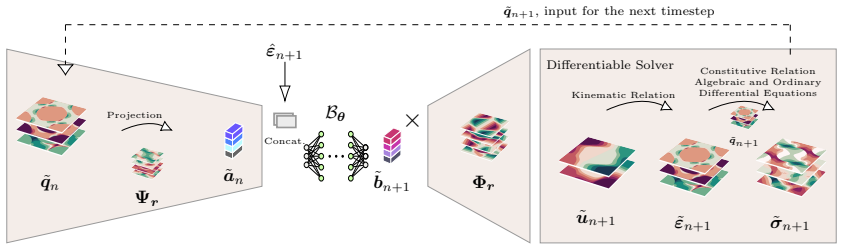
The load-bearing object is a POD-DeepONet with a latent internal-variable loop. A branch network maps the pair of macroscale strain and projected internal-variable coefficients to coefficients of a displacement field expanded in POD modes, with the trunk network replaced by precomputed POD bases. The displacement is then differentiated through the kinematic relation projected onto the modes, and the evolution equation for viscous strain, the internal variable, plus the viscoelastic constitutive law are solved as physical post-processing, so the model is not a black-box stress predictor. The POD truncation, using 16 modes for both the displacement and internal-variable fields, sets the latent dimension and the reconstruction error floor.
What would settle it
Feed the trained hybrid microscale model strain histories produced by a coupled macroscale finite-element computation, including non-sinusoidal loading, unloading, and rate changes, and compare homogenized stresses and internal-variable states against full FE2 reference solutions over many time steps; if the errors exceed the reported 6% or accumulate with recursion, the central claim is falsified.
Extended reading notes
Core claim
The central claim is that a POD-DeepONet can serve as the microscale constitutive engine in a hybrid model for rate-dependent materials: it learns a map from the current macroscale strain and the latent projection of internal variables at time $t_n$ to the displacement field at $t_{n+1}$, while the strain is obtained by applying the linearized kinematic relation to the POD modes, the internal variables are advanced by solving their thermodynamically consistent evolution ordinary differential equation, and the stresses follow from the viscoelastic constitutive law. Because the internal variables are represented by their coefficients on POD modes, the high-dimensional state is compressed and updated recursively. The paper reports mean relative $\ell^2$ errors on held-out trajectories of about 2.3% for displacements, about 3% for strains, about 4.5 to 5% for internal variables, and about 3 to 5.5% for stresses, with homogenized stresses below 6% error for about 94% of test trajectories. The authors describe this as the first hybrid model to integrate internal variables using a combination of surrogate and assistant strategies within a multiscale framework.
Load-bearing premise
The model never enforces the physical equilibrium condition, the balance of linear momentum, in its architecture; it assumes the neural network learned that condition from the training data, and the only tests use sinusoidal macroscale strains of fixed frequency with amplitudes inside a narrow range.
Editorial extensions
If this is right
- Within the tested family of sinusoidal loading paths, homogenized stress error stays below 6% for about 94% of unseen trajectories, so the surrogate can replace microscale finite-element solves for that input distribution.
- Per-trajectory cost drops from about 53 seconds with the reference Fortran solver to about 0.59 seconds, roughly a 100x speedup, making concurrent nonlinear multiscale simulation more practical.
- Internal variables are stored as projection coefficients on POD modes instead of full fields, reducing the memory footprint at every macroscale integration point.
- The framework is modular with respect to the constitutive law: the same kinematic, constitutive, and evolution pipeline could host other material models, including data-driven ones.
- The methodology is demonstrated in two dimensions but the authors state it generalizes to three dimensions.
Reading between the lines
- Going beyond the paper: a coupled macroscale solver will produce strain histories that are not single-frequency sinusoids, so the reported 6% bound would need to be revalidated for out-of-distribution paths before relying on the speedup in full FE2.
- Going beyond the paper: the tests cover a limited recursive window, so long rollouts could accumulate error in the latent internal-variable coefficients; re-projecting onto reference finite-element states or adding an equilibrium residual term would be a natural safeguard.
- Going beyond the paper: the low-dimensional internal-variable coefficients could be exploited as compressed memory in large structural simulations, a benefit the authors mention but do not quantify.
Editorial analysis
A structured set of objections, weighed in public.
Referee Report
Summary. The paper proposes a hybrid microscale surrogate for FE2 multiscale simulations of rate-dependent viscoelastic composites. A POD-DeepONet maps the current macroscale strain and a low-dimensional latent representation of the internal variables to POD coefficients of the microscale displacement field; the microscale strain, internal-variable evolution, and stress are then computed from the kinematic relation, the viscoelastic constitutive ODE, and the constitutive law, respectively. The model is trained on 1000 finite-element RVE trajectories with sinusoidal macroscale strain histories (Eq. 21), and evaluated on 100 held-out trajectories. The authors report displacement, strain, internal-variable, and stress field errors in the 2--6% range, with about 94% of test trajectories having homogenized-stress error below 6%, and a roughly 100x speedup relative to a Fortran RVE solver.
Significance. If the claims hold, the paper makes a useful contribution to hybrid machine-learning-based computational homogenization: it combines a data-driven displacement operator with physics-based constitutive and internal-variable updates, stores internal variables in a low-dimensional latent form, and demonstrates the approach on a nonlinear rate-dependent material with a small training set. The release of training code and data on Zenodo is a strength for reproducibility, although the evaluation code is withheld. I agree with the reader that the training procedure is standard supervised learning and not circular. However, the central claim that the model can replace the microscale FE solve in an FE2 framework is not yet established: equilibrium is not enforced or checked, and the numerical evidence is confined to the sinusoidal, fixed-frequency, fixed-time-step family on which the model was trained.
major comments (3)
- [Section 2.2, Eqs. (2), (10)--(14), and Section 3.3] The balance of linear momentum, Eq. (2), is the governing equation for the microscale problem, but it does not enter the training loss (Eq. 12) and it is not restored by the post-processing steps (Eqs. 13--20). The predicted displacement field is therefore not guaranteed to satisfy equilibrium, and no equilibrium residual is reported. Since the claimed application is replacement of the microscale FE solve in FE2, this is a load-bearing validation gap. I recommend reporting the divergence of the predicted stress field on test trajectories (e.g., mean and maximum residual relative to the FE reference) or adding a residual-based term to the loss; without one of these, the surrogate's stress predictions are only regression outputs, not equilibrium solutions.
- [Section 3.2, Eq. (21), and Section 3.3] All training and test inputs are sinusoidal macroscale strain histories with amplitude A sampled from U(-0.04, 0.04), fixed angular frequency omega = 2*pi*0.05 s^-1, and fixed time step Delta t = 0.1 s. A coupled FE2 macroscale solver would generate non-sinusoidal strain histories, variable time-step increments, and trial increments during Newton iterations, all outside the tested distribution. The reported 94%-below-6% homogenized-stress statistic and the field errors therefore do not establish performance in an actual FE2 simulation. The manuscript itself lists arbitrary trajectories and variable time steps as future work, which is an explicit limitation; please either add tests on non-sinusoidal and variable-step histories or revise the claims to state that the surrogate is currently validated only on the training-family inputs.
- [Section 3.3, speedup comparison] The claimed ~100x speedup (0.59 s vs 53 s per trajectory) is not sufficiently documented to be verifiable. The comparison appears to be between a GPU-based Python implementation and a Fortran solver run with 16 MPI processes and 1 OpenMP thread per process, but the hardware, compiler flags, timing methodology, number of repeated runs, and whether the time includes the full 100-step trajectory or a shorter sequence are not stated. The computational cost of training and POD construction is also omitted. Please report a more controlled timing study with the same physical problem and comparable computational resources, or at minimum provide full wall-clock details so the speedup claim can be evaluated.
minor comments (4)
- [Section 3.3] The text states that 100 test trajectories 'each consisting of ten time steps' were analyzed, whereas the training data consist of trajectories of 100 time steps. If the test trajectories were truncated to 10 steps, the reported errors do not reflect recursive accumulation over the full temporal horizon; if this is a typo, please correct it.
- [Section 2.2, Eqs. (8)--(12)] The notation is overloaded: s denotes both the total number of snapshots in Eq. (7) and the number of samples in the loss function (12), and the subscript of a_i,n in Eq. (8) conflicts with the vector a_n defined in Eq. (9). Please clarify.
- [Section 3.3, Figure 6] The definition of the homogenized-stress error used in Figure 6 is not given; please state the exact metric (e.g., relative l2 norm over the trajectory, per-component or combined).
- [Code Availability] The statement that evaluation and visualization routines are 'reserved for future work' prevents independent verification of the headline error statistics. I encourage the authors to release the evaluation code alongside the training code and data.
Circularity Check
No significant circularity: the POD-DeepONet is trained and evaluated against the same FE reference in a standard supervised manner, and the physical post-processing steps are not fitted to the reported stress errors.
full rationale
The paper's load-bearing numerical claim is that a POD-DeepONet can reproduce microscale displacement fields sufficiently accurately that the subsequent kinematic, constitutive, and evolution-equation post-processing yields homogenized stresses below 6% error with a large speedup. This claim is not circular: the branch network is trained by least-squares regression on POD displacement coefficients (Eq. 12), where the reference coefficients are obtained from FE training data, and the reported test errors are computed against FE reference fields not used in training. The strain, internal-variable, stress, and homogenized quantities are obtained from explicit physical equations (Eqs. 14 and 16-20) and volume averaging, not from parameters fitted to the reported error statistics. The self-citations (e.g., [4], [6]) point to prior methodological work by the same group, but the architecture, loss, and numerical experiment in this paper are self-contained and do not reduce to those citations; no uniqueness theorem or unverified imported ansatz is invoked. The main limitation, that accuracy is demonstrated only on the sinusoidal, fixed-frequency, fixed-time-step family of Eq. (21) and that balance of linear momentum (Eq. 2) is not enforced in the architecture, is a generalization and validation gap rather than a circularity: the test error is a genuine out-of-sample measure on that family, not a rescaling of a fitted input. Accordingly, the paper receives a circularity score of 0.
Assumptions & free parameters
free parameters (2)
- POD truncation rank r =
16
- Branch network architecture =
2 hidden layers x 128 neurons, swish
assumptions (4)
- domain assumption Small-strain, plane-strain, periodic boundary conditions, quasi-static equilibrium with no body forces (Eqs. 1-2).
- ad hoc to paper Sinusoidal strain histories with random amplitudes from U(-0.04,0.04) and fixed angular frequency 0.1*pi are representative of macroscale integration point loading.
- ad hoc to paper POD modes of order r=16 span the displacement and internal variable fields accurately enough.
- domain assumption The constitutive and evolution equations (Eqs. 16-20) correctly describe the viscoelastic matrix.
Cite this review
Pith. "Pith review of A Neural Operator based Hybrid Microscale Model for Multiscale Simulation of Rate-Dependent Materials." pith.science (2026). https://pith.science/paper/O4XFUOQN
@misc{pith2026250616918,
  author       = {Pith},
  title        = {Pith review of: A Neural Operator based Hybrid Microscale Model for Multiscale Simulation of Rate-Dependent Materials},
  year         = {2026},
  howpublished = {\url{https://pith.science/paper/O4XFUOQN}},
  note         = {Machine review of arXiv:2506.16918}
}
abstract
The behavior of materials is influenced by a wide range of phenomena occurring across various time and length scales. To better understand the impact of microstructure on macroscopic response, multiscale modeling strategies are essential. Numerical methods, such as the $\text{FE}^2$ approach, account for micro-macro interactions to predict the global response in a concurrent manner. However, these methods are computationally intensive due to the repeated evaluations of the microscale. This challenge has led to the integration of deep learning techniques into computational homogenization frameworks to accelerate multiscale simulations. In this work, we employ neural operators to predict the microscale physics, resulting in a hybrid model that combines data-driven and physics-based approaches. This allows for physics-guided learning and provides flexibility for different materials and spatial discretizations. We apply this method to time-dependent solid mechanics problems involving viscoelastic material behavior, where the state is represented by internal variables only at the microscale. The constitutive relations of the microscale are incorporated into the model architecture and the internal variables are computed based on established physical principles. The results for homogenized stresses ($<6\%$ error) show that the approach is computationally efficient ($\sim 100 \times$ faster).
Figures


Figures from the paper (3 more)


Reference graph
Works this paper leans on
-
[1]
Kaushik Bhattacharya, Bamdad Hosseini, Nikola B. Kovachki, and Andrew M. Stuart. Model Reduction and Neural Networks for Parametric PDEs, June 2021. arXiv:2005.03180 [math]
arXiv 2021
-
[2]
Tianping Chen and Hong Chen. Universal approximation to nonlinear operators by neural networks with arbitrary activation functions and its application to dynamical systems. IEEE Transactions on Neural Networks , 6(4):911–917, July 1995. ISSN 1941-0093. doi: 10.1109/ 72.392253
work page 1995
-
[3]
Aymen Danoun, Etienne Pruli` ere, and Yves Chemisky. FE-LSTM: A hybrid approach to accelerate multiscale simulations of architectured materials using Recurrent Neural Networks and Finite Element Analysis. Computer Methods in Applied Mechanics and Engineering , 429: 117192, September 2024. ISSN 0045-7825. doi: 10.1016/j.cma.2024.117192
-
[4]
Hamidreza Eivazi, Jendrik-Alexander Tr¨ oger, Stefan Wittek, Stefan Hartmann, and Andreas Rausch. FE2 Computations with Deep Neural Networks: Algorithmic Structure, Data Gener- ation, and Implementation. Mathematical and Computational Applications , 28(4):91, August
-
[5]
Nonlinear model reduction for operator learning
Hamidreza Eivazi, Stefan Wittek, and Andreas Rausch. Nonlinear model reduction for operator learning. In The Second Tiny Papers Track at ICLR 2024 , 2024. doi: https: //doi.org/10.48550/arXiv.2403.18735
-
[6]
Hamidreza Eivazi, Jendrik-Alexander Tr¨ oger, Stefan Wittek, Stefan Hartmann, and Andreas Rausch. Equino: A physics-informed neural operator for multiscale simulations.arXiv preprint arXiv:2504.07976, 2025. doi: https://doi.org/10.48550/arXiv.2504.07976
-
[7]
Multiscale FE2 elastoviscoplastic analysis of composite structures
Fr´ ed´ eric Feyel. Multiscale FE2 elastoviscoplastic analysis of composite structures. Compu- tational Materials Science , 16(1):344–354, December 1999. ISSN 0927-0256. doi: 10.1016/ S0927-0256(99)00077-4
work page 1999
-
[8]
A remark on the application of the Newton-Raphson method in non- linear finite element analysis
Stefan Hartmann. A remark on the application of the Newton-Raphson method in non- linear finite element analysis. Computational Mechanics, 36(2):100–116, 2005. doi: 10.1007/ s00466-004-0630-9
work page 2005
Show all 31 references
-
[9]
P. Haupt. Continuum Mechanics and Theory of Materials. Springer, Berlin, 2nd edition, 2002. ISBN 978-3-540-43111-4. doi: 10.1007/978-3-662-04775-0. 11
2002 doi
-
[10]
Physics informed neural networks for continuum micromechanics
Alexander Henkes, Henning Wessels, and Rolf Mahnken. Physics informed neural networks for continuum micromechanics. Computer Methods in Applied Mechanics and Engineering , 393:114790, 2022. ISSN 0045-7825. doi: https://doi.org/10.1016/j.cma.2022.114790
2022
-
[11]
Generalizing universal function approximators
Irina Higgins. Generalizing universal function approximators. Nature Machine Intelligence , 3 (3):192–193, March 2021. ISSN 2522-5839. doi: 10.1038/s42256-021-00318-x
2021 doi
-
[12]
Kochmann, Jonathan B
Dennis M. Kochmann, Jonathan B. Hopkins, and Lorenzo Valdevit. Multiscale modeling and optimization of the mechanics of hierarchical metamaterials. MRS Bulletin , 44(10):773–781, October 2019. ISSN 1938-1425. doi: 10.1557/mrs.2019.228
2019 doi
-
[13]
On universal approximation and error bounds for Fourier Neural Operators, July 2021
Nikola Kovachki, Samuel Lanthaler, and Siddhartha Mishra. On universal approximation and error bounds for Fourier Neural Operators, July 2021. arXiv:2107.07562 [math]
2021 arXiv
-
[14]
Combining Physics-based and Data-driven Modeling for Building Energy Systems
Leandro Von Krannichfeldt, Kristina Orehounig, and Olga Fink. Combining Physics-based and Data-driven Modeling for Building Energy Systems. Applied Energy, 391:125853, August
-
[15]
In vitro and in vivo study of additive manufactured porous Ti6Al4V scaffolds for repairing bone defects
Guoyuan Li, Lei Wang, Wei Pan, Fei Yang, Wenbo Jiang, Xianbo Wu, Xiangdong Kong, Kerong Dai, and Yongqiang Hao. In vitro and in vivo study of additive manufactured porous Ti6Al4V scaffolds for repairing bone defects. Scientific Reports, 6(1):34072, September 2016. ISSN 2045-23...
2016 doi
-
[16]
DeepONet: Learning nonlinear oper- ators for identifying differential equations based on the universal approximation theorem of operators, October 2019
Lu Lu, Pengzhan Jin, and George Em Karniadakis. DeepONet: Learning nonlinear oper- ators for identifying differential equations based on the universal approximation theorem of operators, October 2019
2019
-
[17]
Learning nonlinear operators via DeepONet based on the universal approximation theorem of operators
Lu Lu, Pengzhan Jin, Guofei Pang, Zhongqiang Zhang, and George Em Karniadakis. Learning nonlinear operators via DeepONet based on the universal approximation theorem of operators. Nature Machine Intelligence , 3(3):218–229, March 2021. ISSN 2522-5839. doi: 10.1038/ s42256-021-...
2021
-
[18]
A comprehensive and fair comparison of two neural operators (with practical extensions) based on F AIR data
Lu Lu, Xuhui Meng, Shengze Cai, Zhiping Mao, Somdatta Goswami, Zhongqiang Zhang, and George Em Karniadakis. A comprehensive and fair comparison of two neural operators (with practical extensions) based on F AIR data. Computer Methods in Applied Mechanics and Engineering, 393:1...
2022
-
[19]
M. D. McKay, R. J. Beckman, and W. J. Conover. Comparison of Three Methods for Selecting Values of Input Variables in the Analysis of Output from a Computer Code. Technometrics, 21(2):239–245, May 1979. ISSN 0040-1706. doi: 10.1080/00401706.1979.10489755. Publisher: ASA Websit...
1979
-
[20]
Patel, Nathaniel A
Ravi G. Patel, Nathaniel A. Trask, Mitchell A. Wood, and Eric C. Cyr. A physics-informed operator regression framework for extracting data-driven continuum models. Computer Meth- ods in Applied Mechanics and Engineering , 373:113500, January 2021. ISSN 0045-7825. doi: 10.1016/...
2021
-
[21]
Grace C. Y. Peng, Mark Alber, Adrian Buganza Tepole, William R. Cannon, Suvranu De, Savador Dura-Bernal, Krishna Garikipati, George Karniadakis, William W. Lytton, Paris Perdikaris, Linda Petzold, and Ellen Kuhl. Multiscale modeling meets machine learning: What can we learn? A...
-
[22]
Rokoˇ s, R.H.J
O. Rokoˇ s, R.H.J. Peerlings, J.P.M. Hoefnagels, and M.G.D. Geers. Integrated digital image correlation for micro-mechanical parameter identification in multiscale experiments. Inter- national Journal of Solids and Structures , 267:112130, 2023. doi: https://doi.org/10.1016/j....
2023
-
[23]
Kalina, J¨ org Brummund, and Markus K¨ astner
Max Rosenkranz, Karl A. Kalina, J¨ org Brummund, and Markus K¨ astner. A comparative study on different neural network architectures to model inelasticity. International Journal for Numerical Methods in Engineering , 124(21):4802–4840, 2023. doi: 10.1002/nme.7319
2023 doi
-
[24]
Kalina, J¨ org Brummund, WaiChing Sun, and Markus K¨ astner
Max Rosenkranz, Karl A. Kalina, J¨ org Brummund, WaiChing Sun, and Markus K¨ astner. Vis- coelasticty with physics-augmented neural networks: model formulation and training methods without prescribed internal variables. Computational Mechanics, 74(6):1279–1301, 2024. doi: 10.1...
2024 doi
-
[25]
Staub, H
S. Staub, H. Andr¨ a, M. Kabel, and T. Zangmeister. Multi-Scale Simulation of Viscoelas- tic Fiber-Reinforced Composites. Technische Mechanik - European Journal of Engineering Mechanics, 32(1):70–83, 2012. ISSN 2199-9244. Number: 1
2012
-
[26]
Tikarrouchine, G
E. Tikarrouchine, G. Chatzigeorgiou, Y. Chemisky, and F. Meraghni. Fully coupled thermo- viscoplastic analysis of composite structures by means of multi-scale three-dimensional finite element computations. International Journal of Solids and Structures , 164:120–140, June
-
[27]
Iterated learning and multiscale modeling of history-dependent architectured metamaterials
Yupeng Zhang and Kaushik Bhattacharya. Iterated learning and multiscale modeling of history-dependent architectured metamaterials. Mechanics of Materials , 197:105090, Octo- ber 2024. ISSN 0167-6636. doi: 10.1016/j.mechmat.2024.105090. A Appendix The stress–strain response at ...
2024
- [2019]
-
[2020]
doi: 10.1007/s11831-020-09405-5
-
[2023]
doi: 10.3390/mca28040091
ISSN 2297-8747. doi: 10.3390/mca28040091. Number: 4 Publisher: Multidisciplinary Digital Publishing Institute
-
[2025]
doi: 10.1016/j.apenergy.2025.125853
ISSN 03062619. doi: 10.1016/j.apenergy.2025.125853. arXiv:2411.01055 [eess]
2025
Reviewed August 6, 2026 · model on record in the stance chip above.
Discussion (0). Sign in to comment.