REVIEW 3 major objections 4 minor 78 references
From Koszul-Complex Stabilizer Models to Superselection Profiles: Topological Rigidity and Nonsplit Extensions
T0 review · 3 major / 4 minor · reviewed 2026-08-15 · deepseek-v4-flash
Pith's one-line read For single-layer topological CSS codes, the nonzero superselection layer and its degree determine the stable translation-invariant Clifford class; multi-layer extensions hide extra phase data in inter-layer gluing.
desk verdict A substantial, mostly correct rigidity theorem for single-layer CSS codes, with a sharp multi-layer counterexample; the main gap is the unproved Frobenius-extension step in Corollary 4. read the letter →
The pith
A machine-rendered reading of the paper's core claim, the machinery that carries it, and where it could break.
The reading
What carries the argument
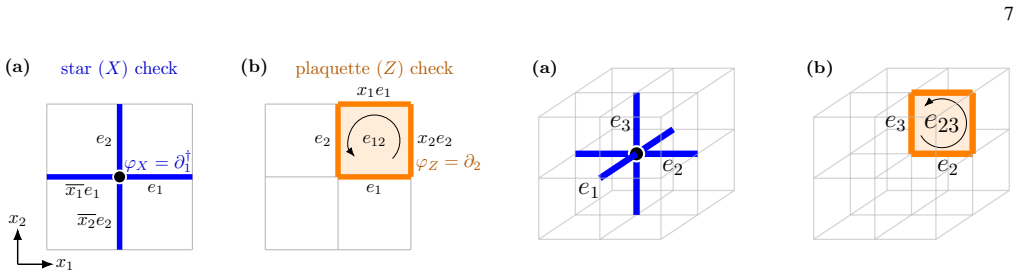
The central object is the topological superselection profile, a positive-degree derived-dual object built from the reduced Pauli modules; its cohomology layers are Ext modules that encode fusion and translation action. The arguments run on three mechanisms: the Koszul complex $K_\bullet(f)$ of a regular sequence, whose exactness makes the associated stabilizer model topological and whose structure module $S=R/(f)$ controls all its superselection layers; a matrix-level generalized Schanuel lemma, which turns stable $R$-isomorphism of cokernels into stable equivalence of stabilizer matrices, together with Whitehead's lemma, which upgrades stable $R$-equivalence to stable Clifford equivalence after adding ancillas; and the natural symmetry of Tor, which expresses finite-size logical modules as $\operatorname{Tor}_j^R(S,R_L)$ and ties size-dependent ground-state degeneracy to the translation action. A final construction couples Koszul models in different degrees by an off-diagonal matrix block, producing the split and nonsplit extensions that exhibit inter-layer gluing.
What would settle it
A concrete test: find two prime-qudit translation-invariant topological CSS codes with single-layer $X$-profiles supported in the same degree $j$ and isomorphic $j$-th superselection layers whose size-dependent logical dimensions differ on some torus; Theorem 2 predicts they must be stably translation-invariant Clifford equivalent, so unequal logical dimensions would refute the rigidity claim. Alternatively, a computation showing a sub-threshold translation subgroup (one that acts nontrivially on the layer $E$) nevertheless decoupling the code to a toric-code stack would refute Corollary 4.
Extended reading notes
Core claim
On the paper's own terms, the central discovery is that the topological superselection data of a translation-invariant topological CSS code is largely contained in one derived object $\mathcal{S}_\sigma=\tau_{\ge1}\mathbf{R}\operatorname{Hom}_R(\overline{\operatorname{coker}\varphi_\sigma},R)$ and its cohomology layers $E^\ell_\sigma\cong_R\operatorname{Ext}_R^\ell(\overline{\operatorname{coker}\varphi_\sigma},R)$. For codes whose $X$-sector profile is single-layer in degree $j$ and whose reduced module has a finite-length free resolution, Theorem 2 states that $E=\operatorname{Ext}_R^j(\overline{\operatorname{coker}\varphi_X},R)$, together with $j$, determines the stable translation-invariant Clifford class: $\varphi_X\sim_{R,\mathrm{Cl},\mathrm{st}}\partial_j^\dagger$ for any partial resolution of $E$. For prime qudits this yields an unconditional phase-identification criterion, and when $E$ is finite the translation kernel of $E$ is exactly the minimal coarse-graining subgroup needed to reach a toric-code stack. The paper's eight degree-$(1,2)$ extensions of the three-dimensional qubit toric code show that the single-layer hypothesis is essential: all eight have identical layers $E^\ell_\sigma$ with trivial translation action, but their ground-state degeneracies depend differently on the torus size, so they realize distinct translation SET orders that individual layers cannot detect.
Load-bearing premise
The argument's load-bearing premise is that passing to a finite-index translation subgroup preserves the code's topological exactness and keeps the higher-level excitation modules identified with the original ones; if this ring-theoretic identification fails, the claimed exact minimum for coarse graining is unsupported.
Editorial extensions
If this is right
- Every full-length regular Koszul-complex model with structure module $S$ is stably Clifford equivalent, after coarse graining by the mobility lattice $\Lambda_S$, to $\operatorname{rank}_{\mathbb{Z}_{p^m}}S$ copies of the degree-$j$ toric code.
- Over prime qudits, any two translation-invariant topological CSS codes with single-layer $X$-sector profiles supported in the same degree $j$ and with isomorphic $j$-th layers are connected by a finite-depth translation-invariant Clifford circuit up to ancillas.
- When the nonzero layer $E$ is finite, a translation subgroup can decouple the code to the toric-code-stack normal form if and only if it acts trivially on $E$; hence $\Lambda_E$ is the exact minimal coarse-graining scale.
- In two dimensions every nonvanishing $X$-sector profile is single-layer in degree one, so the first superselection layer, including anyon permutation data, fixes the stable translation-invariant Clifford class; in one dimension every such code is stably Clifford trivial.
- The eight qubit degree-$(1,2)$ toric-code extensions have identical individual layers but eight different size-dependent ground-state degeneracy functions, so they are pairwise distinct translation SET orders with the original translation symmetry fixed, although uniform $2\times2\times2$ blocking brings all eight to the same decoupled toric-code stack.
Reading between the lines
- A direct extension would classify multi-layer profiles by finite Postnikov stages, with inter-layer gluing encoded by Maurer-Cartan equations; this would recover the single-layer rigidity theorem as the base case.
- The eight-model degeneracy tables suggest a numerical protocol: compute logical dimensions on tori of varying parity for a fixed coupling vector and check that the predicted parity classes appear, giving an experimental distinguisher for inter-layer gluing.
- Over $\mathbb{Z}_{p^m}$, replacing the free-resolution hypothesis by a projective-dimension condition, or moving to general finite-depth local unitaries, may extend rigidity to the cases where vanishing layers are Clifford nontrivial, since the paper's appendix shows the obstruction is real.
- The criterion that retained translations are exactly those acting trivially on the layer suggests an algorithm for minimal cellulation: compute the mobility lattice $\Lambda_E$ from a presentation, then verify toric-code-stack equivalence by testing periodicity of logical dimensions along $\Lambda_E$.
Signed reviews
Editorial analysis
A structured set of objections, weighed in public.
Referee Report
Summary. The paper develops a homological framework for translation-invariant CSS codes over Laurent polynomial rings, centered on the topological superselection profile S_sigma = tau_{>=1} R Hom_R(coker phi_sigma, R) and its cohomology layers E_sigma^ell = Ext^ell_R(coker phi_sigma, R). It computes these layers for regular Koszul-complex stabilizer models, relates finite-size logical spaces to Tor, and proves a rigidity theorem (Theorem 2) asserting that for single-layer profiles with a finite-resolution hypothesis the nonzero layer and its degree determine the stable translation-invariant Clifford class. The paper also proves a realizability criterion (Proposition 4), derives an exact minimal coarse-graining result to toric-code stacks (Corollary 4), and constructs eight qubit degree-(1,2) toric-code extensions that share identical layers and translation actions but have different size-dependent ground-state degeneracies, thereby demonstrating that inter-layer gluing carries information invisible to individual layers.
Significance. If correct, the paper gives a substantial unification of toric-code hierarchies and bivariate-bicycle codes within one homological framework, and its rigidity theorem provides a sharp classification of single-layer translation-invariant CSS codes at the stable Clifford level. The core computations, including Fact 1 (Ext layers of regular Koszul models), Facts 3 and 4 (Tor formulation), Fact 10 (common layers of the extensions), and Fact 11 (size-dependent ground-state degeneracies of the eight models), are internally consistent and were checked in detail. The paper is unusually honest about its scope: Appendix F explicitly demonstrates that the finite-resolution hypothesis is necessary for m>1, and the limitation to Clifford circuits is stated repeatedly. The third-dimensional multi-degree extension result is a valuable counterexample to the naive expectation that individual superselection layers classify translation SET order.
major comments (3)
- [§VII C 2, proof of Corollary 4] The central proof step asserts that restriction of scalars to a finite-index translation subgroup Lambda preserves topological exactness and 'identifies the positive-degree Ext modules over R_Lambda with those over R'. This is not a formal consequence of R being a finite free Frobenius extension of R_Lambda. The Frobenius property gives an isomorphism Hom_{R_Lambda}(R, R_Lambda) ≅ R as bimodules, but one must prove that for every M admitting a finite free resolution P_bullet, the complex Hom_{R_Lambda}(P_bullet|_{Lambda}, R_Lambda) computes the same Ext groups in the same degrees and with the same R_Lambda-module structure as Ext_R(M,R) restricted to Lambda. If restriction shifted the nonzero Ext degree or introduced extra layers, the 'if' direction of the iff would fail and the claimed exact minimal coarse graining at Lambda_E would be unsupported. The converse direction likewise assumes without proof that stable translation-invariant Clifford equivalence preserves the layer E together with its translation action. Because Corollary 5 and the headline minimal-coarse-graining threshold inherit this step, a complete proof using the Frobenius-extension adjunction, or a precise citation to a stated theorem, is required.
- [§VII B 1, Theorem 2 and Corollary 3] The rigidity theorem is conditional on coker phi_X admitting a finite-length free resolution, and the paper correctly notes that this is automatic for prime qudits and essential for m>1 (Appendix F). However, as stated, Corollary 3 is formulated only for prime qudits, so the m>1 statements in Section VII C 1 are a source of potential over-reading: for prime-power qudits the paper does not prove that identical single-layer profiles imply stable Clifford equivalence unless the finite-resolution hypothesis is verified. I recommend that the abstract and Section I state this scope limitation more prominently, so that the headline 'nonzero layer and degree determine the stable translation-invariant Clifford class' is not interpreted as applying unconditionally beyond prime qudits.
- [§VII A 2–3; Proposition 1 and Proposition 2] The stable-equivalence framework is sound, but the proof of Proposition 1 invokes Whitehead's lemma without a citation or a brief justification, and Proposition 2's forward implication is asserted while its converse is deferred to Appendix C. Since the rigidity theorem depends on the dictionary between matrix equivalence, module stable isomorphism, and Clifford equivalence, these two results deserve short self-contained proofs or explicit references in the main text rather than a sentence referring to standard K-theory facts.
minor comments (4)
- [§IV C, bullet list after Eq. (81)] The phrase 'local order parameters of a classical code' in the 0-th superselection layer is not defined elsewhere; a brief physical definition would improve readability.
- [Table I] The asterisk in the table row for E_sigma^ell is attached to a footnote-like sentence inside the table entry; it should be formatted as a standard table footnote to avoid ambiguity.
- [§III C, Eqs. (46b) and (53b)] The cyclic ordering of the basis of K_2 in three and four dimensions is natural, but a one-sentence explanation of why this ordering is chosen would help readers verify the matrix signs in the Koszul differentials.
- [§VII B 1, Proposition 3 proof] The identity pd_R(M) = max{ell : Ext^ell_R(M,R) != 0} in Eq. (131) is used without proof; it is standard for finite-projective-dimension modules over Gorenstein rings, but a citation or one-line justification would make the argument self-contained.
Circularity Check
No significant circularity: the rigidity theorem is proved by independent homological arguments, and the paper's self-citations are not load-bearing.
full rationale
The paper's central rigidity claim is not an artifact of its definitions. The superselection profile is defined from the same cokernel module coker φ_X via Ext, but Theorem 2 does not simply restate that definition: it proves that, under the single-layer and finite-resolution hypotheses, any code with the same nonzero layer E and degree j has coker φ_X stably R-isomorphic to coker(∂^∨_j) for any partial free resolution of E. The resolution-independence at the heart of this statement is exactly the content of the generalized Schanuel lemma (Lemma 3), and the upgrade from stable R-equivalence to stable Clifford equivalence is made by Whitehead's lemma (Proposition 1), not by the definition of the profile. Corollaries 3 and 4 then follow from Theorem 2 and the mobility-lattice definition; the reader's concern about the asserted Frobenius-extension identification of Ext modules in Corollary 4 is a legitimate proof gap or correctness risk, but it is not a circular reduction: no equation is being defined in terms of the conclusion. The self-citations [7] and [14] supply mobility-lattice terminology and are not load-bearing, while the Ext charge-module framework [13] is external and is independently re-derived in Theorem 1 and Appendix E. Section VIII provides a genuine counterexample in which individual layers coincide while size-dependent ground-state degeneracies differ, so that conclusion cannot be a prediction forced by the layers. Appendix F is an honest scope limitation rather than a disguised input. Overall, the derivations are self-contained against the claimed rigidity result, and I find no circular step.
Assumptions & free parameters
assumptions (9)
- standard math Regular sequences give exact Koszul complexes, so K_bullet(f) is a free resolution of R/(f).
- standard math Z_N is a finite Frobenius ring, hence self-injective, so Hom_{Z_N}(-,Z_N) is exact.
- standard math Finitely generated projective modules over Z_p[Z^D] and Z_pm[Z^D] are free (Quillen-Suslin / Swan for Laurent polynomial rings).
- standard math Whitehead's lemma: diag(Xi, Xi^{-1}) is a product of elementary matrices over a ring.
- standard math Hilbert syzygy theorem: Z_p[Z^D] has finite global dimension, so every finitely generated module admits a finite free resolution for m=1.
- standard math For finite-pd modules over the Gorenstein rings Z_pm[Z^D], pd_R(M) = max{ell : Ext^ell_R(M,R) != 0}.
- domain assumption Topological exactness (Eq. 17), im phi = ker phi-dagger, correctly captures the absence of finite-support logical operators and determines one sector from the other.
- domain assumption Stable translation-invariant Clifford equivalence is an adequate proxy for translation SET order; general FDLU equivalence is left open.
- domain assumption Restriction of scalars to a finite-index translation subgroup Lambda identifies the relevant positive-degree Ext modules (finite free Frobenius extension), preserving topological exactness.
Cite this review
Pith. "Pith review of From Koszul-Complex Stabilizer Models to Superselection Profiles: Topological Rigidity and Nonsplit Extensions." pith.science (2026). https://pith.science/paper/O5SLJXHK
@misc{pith2026260809913,
  author       = {Pith},
  title        = {Pith review of: From Koszul-Complex Stabilizer Models to Superselection Profiles: Topological Rigidity and Nonsplit Extensions},
  year         = {2026},
  howpublished = {\url{https://pith.science/paper/O5SLJXHK}},
  note         = {Machine review of arXiv:2608.09913}
}
abstract
Koszul-complex stabilizer models unify the toric-code hierarchy and bivariate-bicycle codes in one homological framework. To study translation-symmetry-enriched topological (SET) phases in these models and, more generally, in translation-invariant Calderbank-Shor-Steane (CSS) codes with stabilizer maps $(\varphi_X,\varphi_Z)$, we introduce the associated topological superselection profile $\mathscr S_\sigma:=\tau_{\geq1}\mathbf R\!\operatorname{Hom}_R(\overline{\operatorname{coker}\varphi_\sigma},R),\ \sigma=X,Z$. Its cohomology layers $E_\sigma^\ell:=H^\ell(\mathscr S_\sigma)\cong_R\operatorname{Ext}_R^\ell(\overline{\operatorname{coker}\varphi_\sigma},R)$ encode sectors, fusion, and translation action. When finite, the $\ell=1,2,\ldots$ layers describe pointlike, looplike, and higher-dimensional excitations; $\mathscr S_\sigma$ retains inter-layer gluing. For regular Koszul models, we compute $E_\sigma^\ell$ explicitly, find $\mathscr S_\sigma$ single-layer, and obtain finite-size $Z$-logicals from $\operatorname{Tor}$. Single-layer means that at most one positive-degree layer $E_\sigma^\ell$ is nonzero. Our matrix-level Schanuel-lemma method proves rigidity: under a finite-resolution hypothesis, the nonzero layer and degree uniquely determine a topological CSS code's translation SET order at the stable translation-invariant Clifford level. For prime qudits the hypothesis is automatic, and a finite layer's translation kernel gives the exact minimal coarse graining to a toric-code stack. We realize admissible single-layer data. Beyond this regime, split and nonsplit extensions of 3D qubit toric codes yield eight models sharing all identical $E_\sigma^\ell$ layers with trivial translation action but having distinct size-dependent ground-state degeneracies, hence distinct translation SET phases. Thus inter-layer gluing carries SET data invisible to individual layers.
Figures

Reference graph
Works this paper leans on
-
[1]
The matricesφandφ ′ are freely stably R-equivalent (φ∼ R,st φ′)
-
[2]
The modulescokerφandcokerφ ′ are freely stably R- isomorphic (cokerφ R,st cokerφ′). Proof.The implication (1)⇒(2) follows because free stable R-equivalence allows paddingφandφ ′ with identity blocks (Iβ) or zero blocks (0α,η), which distributes over the cokernel and maps directly to adding free module summands (R α) to the cokernel. The reverse implicatio...
-
[3]
Free stable R-isomorphism of modules Although∼ R,st is basis-independent, it is still expressed in terms of presentation maps that retain explicit choices of stabi- lizer generators. Passing to their cokernels recasts the problem in module-theoretic language and makes the tools of homo- logical algebra available. For a topological CSS code with sta- biliz...
-
[4]
Rigidity theorem Topological exactness fixes theZ-stabilizer submodule via imφ Z =kerφ † X, reducing the analysis entirely to theX-sector. Crucially, we observe that a generalized version of Schanuel’s lemma provides a powerful tool for classifying topological codes, once recast in terms of maps and translated into physics using Propositions 1 and 2. The ...
-
[5]
Then φX∼R,Cl,st ∂† j.(139) Proof.The ringRis unital, commutative, and Noetherian
Fix j≥1and suppose that the X-sector superselection profile is single-layer, supported in degree j, meaning Extℓ R cokerφ X,R =0 (ℓ>0, ℓ,j).(137) Set EBExt j R cokerφ X,R , and let G j ∂ j −→Gj−1−→···−→G 0−→E−→0 (138) be any partial resolution of E by finitely generated free R- modules, exact except possibly at Gj. Then φX∼R,Cl,st ∂† j.(139) Proof.The rin...
-
[6]
Realizability and construction Rigidity begins with a code and asks what its profile deter- mines. We now reverse the question: which modules occur in single-layer profiles, and can a realizing code be constructed from their free resolutions, as suggested by the normal form in Eq. (139)? For a finitely generatedR-moduleE, recall that its grade is defined ...
-
[7]
Scope and limits of Clifford classification The grade bound applies to every topological CSS code without the finite-length free-resolution hypothesis, whereas the construction above produces a representative satisfying it. This hypothesis is needed only when rigidity is invoked to compare an arbitrary code with that representative. For prime qudits (m=1)...
-
[8]
Phase identification via Clifford circuits For prime qudits (m=1), matching single-layerX-sector superselection profiles give an unconditional criterion for sta- ble, translation-invariant Clifford equivalence between topo- logical CSS codes. Corollary 3(Translation-invariant Clifford equivalence).Let (φ1,X,φ 1,Z)and(φ 2,X,φ 2,Z)be two translation-invaria...
Show all 78 references
-
[9]
Minimal coarse graining to toric-code stacks When theX-sector superselection profile is single-layer, supported in degreej, with a finitej-th superselection layer E, its topological excitation data closely mirror a stack of toric codes. This raises two natural physical questio...
-
[10]
Entanglement-renormalization perspective Rigidity constrains the possible form of real-space entan- glement renormalization directly from superselection data. For a topological qubit CSS code with a single finite nonzero X-sector layerEin degreej, the layer degree (equivalentl...
-
[11]
It generates an (ℓ−1)-dimensional extended excitation along the boundary of that hypercube
This element represents a Pauli operatorξsupported on an ℓ-dimensional hypercube. It generates an (ℓ−1)-dimensional extended excitation along the boundary of that hypercube. By patching togetherξand its translations, one can construct operators that generate arbitrarily large ...
-
[12]
Haah, Commuting Pauli hamiltonians as maps between free modules, Communications in Mathematical Physics324, 351 (2013)
J. Haah, Commuting Pauli hamiltonians as maps between free modules, Communications in Mathematical Physics324, 351 (2013)
2013
-
[13]
N. P. Breuckmann and J. N. Eberhardt, Quantum low- density parity-check codes, PRX Quantum2, 040101 (2021), arXiv:2103.06309 [quant-ph]
2021 arXiv
-
[14]
M. B. Hastings, J. Haah, and R. O’Donnell, Fiber bundle codes: Breaking theN 1/2 polylog(N) barrier for quantum LDPC codes, inProceedings of the 53rd Annual ACM SIGACT Symposium on Theory of Computing(Association for Computing Machinery,
-
[15]
Bombin, G
H. Bombin, G. Duclos-Cianci, and D. Poulin, Universal topo- logical phase of two-dimensional stabilizer codes, New Journal of Physics14, 073048 (2012), arXiv:1103.4606 [quant-ph]
2012 arXiv
-
[16]
Panteleev and G
P. Panteleev and G. Kalachev, Quantum LDPC codes with al- most linear minimum distance, IEEE Transactions on Informa- tion Theory68, 213 (2022), arXiv:2012.04068 [cs.IT]
2022 arXiv
-
[17]
Panteleev and G
P. Panteleev and G. Kalachev, Asymptotically good quantum and locally testable classical LDPC codes, inProceedings of the 54th Annual ACM SIGACT Symposium on Theory of Comput- ing, STOC ’22 (Association for Computing Machinery, 2022) pp. 375–388, arXiv:2111.03654 [cs.IT]
2022 arXiv
-
[18]
Liang, Y
Z. Liang, Y . Xu, J. T. Iosue, and Y .-A. Chen, Extracting topo- logical orders of generalized Pauli stabilizer codes in two di- mensions, PRX Quantum5, 030328 (2024), arXiv:2312.11170 [quant-ph]
2024 arXiv
-
[19]
K. Chen, Y . Liu, Y . Zhang, Z. Liang, Y .-A. Chen, K. Liu, and H. Song, Anyon theory and topological frustration of high- efficiency quantum low-density parity-check codes, Phys. Rev. Lett.135, 076603 (2025)
2025
-
[20]
Liang, K
Z. Liang, K. Liu, H. Song, and Y .-A. Chen, Generalized toric codes on twisted tori for quantum error correction, PRX Quan- tum6, 020357 (2025), arXiv:2503.03827 [quant-ph]
2025
-
[21]
Bravyi, A
S. Bravyi, A. W. Cross, J. M. Gambetta, D. Maslov, P. Rall, and T. J. Yoder, High-threshold and low-overhead fault-tolerant quantum memory, Nature627, 778 (2024), arXiv:2308.07915 [quant-ph]
2024 arXiv
-
[22]
Barkeshli, P
M. Barkeshli, P. Bonderson, M. Cheng, and Z. Wang, Sym- metry fractionalization, defects, and gauging of topological phases, Phys. Rev. B100, 115147 (2019)
2019
-
[23]
Wen, Quantum orders in an exact soluble model, Phys
X.-G. Wen, Quantum orders in an exact soluble model, Phys. Rev. Lett.90, 016803 (2003), arXiv:quant-ph/0205004
2003 arXiv
-
[24]
Watanabe, M
H. Watanabe, M. Cheng, and Y . Fuji, Ground state degener- acy on torus in a family ofZ N toric code, Journal of Mathe- matical Physics64, 051901 (2023), arXiv:2211.00299 [cond- mat.other]
2023 arXiv
-
[25]
Ruba and B
B. Ruba and B. Yang, Homological invariants of Pauli stabi- lizer codes, Communications in Mathematical Physics405, 126 (2024)
2024
-
[26]
He and H
S. He and H. Song, Symmetry-enriched topological order and quasifractonic behavior inZ N stabilizer codes, Phys. Rev. B 113, 205110 (2026)
2026
-
[27]
Menon, J
V . Menon, J. P. Bonilla Ataides, R. Mehta, A. Gu, D. B. Tan, and M. D. Lukin, Magic tricycles: Efficient magic-state gener- ation with finite block-length quantum LDPC codes, Phys. Rev. X16, 021014 (2026), arXiv:2508.10714 [quant-ph]. 34
2026 arXiv
-
[28]
Bombin, Structure of 2D topological stabilizer codes, Communications in Mathematical Physics327, 387 (2014), arXiv:1107.2707 [quant-ph]
H. Bombin, Structure of 2D topological stabilizer codes, Communications in Mathematical Physics327, 387 (2014), arXiv:1107.2707 [quant-ph]
2014 arXiv
-
[29]
Haah, Algebraic methods for quantum codes on lat- tices, Revista Colombiana de Matemáticas50, 299 (2016), arXiv:1607.01387 [quant-ph]
J. Haah, Algebraic methods for quantum codes on lat- tices, Revista Colombiana de Matemáticas50, 299 (2016), arXiv:1607.01387 [quant-ph]
2016 arXiv
-
[30]
J. Haah, Classification of translation invariant topological Pauli stabilizer codes for prime dimensional qudits on two- dimensional lattices, Journal of Mathematical Physics62, 012201 (2021), arXiv:1812.11193 [quant-ph]
2021 arXiv
-
[31]
A. Dua, I. H. Kim, M. Cheng, and D. J. Williamson, Sorting topological stabilizer models in three dimensions, Phys. Rev. B 100, 155137 (2019), arXiv:1908.08049 [quant-ph]
2019 arXiv
-
[32]
T. D. Ellison, Y .-A. Chen, A. Dua, W. Shirley, N. Tanti- vasadakarn, and D. J. Williamson, Pauli stabilizer models of twisted quantum doubles, PRX Quantum3, 010353 (2022), arXiv:2112.11394 [quant-ph]
2022 arXiv
-
[33]
Ruba and B
B. Ruba and B. Yang, Witt groups and bulk-boundary cor- respondence for stabilizer states (2025), arXiv:2509.10418 [math-ph]
2025
-
[34]
Geiko and G
R. Geiko and G. Shuklin, A classification of invertible stabilizer codes (2025), arXiv:2512.01142 [math-ph]
2025
-
[35]
Yang and M
B. Yang and M. Yu, The classification of Pauli stabilizer codes: A lattice and continuum treatise (2026), arXiv:2604.24847 [math-ph]
2026 arXiv
-
[36]
F. A. Mian, O. Gwilliam, and S. Krastanov, Multivariate multicycle codes for complete single-shot decoding (2026), arXiv:2601.18879 [quant-ph]
2026 arXiv
-
[37]
V oss, S
L. V oss, S. J. Xian, T. Haug, and K. Bharti, Multivariate bicycle codes, Phys. Rev. A111, L060401 (2025), arXiv:2406.19151 [quant-ph]
2025 arXiv
-
[38]
Jacob, C
A. Jacob, C. McLauchlan, and D. E. Browne, Single-shot de- coding and fault-tolerant gates with trivariate tricycle codes (2025), arXiv:2508.08191 [quant-ph]
2025
-
[39]
Dennis, A
E. Dennis, A. Kitaev, A. Landahl, and J. Preskill, Topological quantum memory, Journal of Mathematical Physics43, 4452 (2002)
2002
-
[40]
A. A. Kovalev and L. P. Pryadko, Quantum kronecker sum- product low-density parity-check codes with finite rate, Phys. Rev. A88, 012311 (2013), arXiv:1212.6703 [quant-ph]
2013 arXiv
-
[41]
Lin and L
H.-K. Lin and L. P. Pryadko, Quantum two-block group alge- bra codes, Phys. Rev. A109, 022407 (2024), arXiv:2306.16400 [quant-ph]
2024 arXiv
-
[42]
Y . Wang, Z. Ni, M. He, J. Liu, and Y . Gu, Decoupling 2D translation-invariant topological CSS codes (2026), unpub- lished manuscript
2026
-
[43]
A. R. Calderbank and P. W. Shor, Good quantum error- correcting codes exist, Phys. Rev. A54, 1098 (1996), arXiv:quant-ph/9512032
1996 arXiv
-
[44]
A. M. Steane, Error correcting codes in quantum theory, Phys. Rev. Lett.77, 793 (1996)
1996
-
[45]
After choosing anF p-basis, this system is on-site equivalent to a system ofmF p-qudits carrying the inducedk- linear structure
Finite-field (Galois) qudits overk=F pm define a different Pauli system [66]. After choosing anF p-basis, this system is on-site equivalent to a system ofmF p-qudits carrying the inducedk- linear structure. The Koszul, Ext, Tor, and rigidity construc- tions have a parallel for...
-
[46]
Eisenbud,Commutative Algebra: with a View Toward Al- gebraic Geometry, Graduate Texts in Mathematics, V ol
D. Eisenbud,Commutative Algebra: with a View Toward Al- gebraic Geometry, Graduate Texts in Mathematics, V ol. 150 (Springer-Verlag, New York, 1995)
1995
-
[47]
C. A. Weibel,An Introduction to Homological Algebra, Cam- bridge Studies in Advanced Mathematics, V ol. 38 (Cambridge University Press, Cambridge, 1994)
1994
-
[48]
A. Y . Kitaev, Fault-tolerant quantum computation by anyons, Annals of Physics303, 2 (2003), arXiv:quant-ph/9707021
2003 arXiv
-
[49]
Bombin and M
H. Bombin and M. A. Martin-Delgado, Topological quantum distillation, Phys. Rev. Lett.97, 180501 (2006), arXiv:quant- ph/0605138
2006
-
[50]
Haah, Local stabilizer codes in three dimensions without string logical operators, Phys
J. Haah, Local stabilizer codes in three dimensions without string logical operators, Phys. Rev. A83, 042330 (2011)
2011
-
[51]
J. W. Milnor,Introduction to Algebraic K-theory, Annals of Mathematics Studies No. 72 (Princeton University Press, Princeton, NJ, 1971)
1971
-
[52]
M. B. Hastings, Topological order at nonzero temperature, Physical Review Letters107, 210501 (2011)
2011
-
[53]
B. J. Brown, D. Loss, J. K. Pachos, C. N. Self, and J. R. Woot- ton, Quantum memories at finite temperature, Reviews of Mod- ern Physics88, 045005 (2016)
2016
-
[54]
D. J. Williamson, Fractal symmetries: Ungauging the cu- bic code, Phys. Rev. B94, 155128 (2016), arXiv:1603.05182 [quant-ph]
2016 arXiv
-
[55]
Vijay, J
S. Vijay, J. Haah, and L. Fu, Fracton topological order, general- ized lattice gauge theory, and duality, Phys. Rev. B94, 235157 (2016)
2016
-
[56]
Shirley, K
W. Shirley, K. Slagle, and X. Chen, Foliated fracton order from gauging subsystem symmetries, SciPost Physics6, 041 (2019), arXiv:1806.08679 [cond-mat.str-el]
2019 arXiv
-
[57]
Canossa, L
G. Canossa, L. Pollet, M. A. Martin-Delgado, H. Song, and K. Liu, Exotic symmetry breaking properties of self-dual fracton spin models, Phys. Rev. Research6, 013304 (2024), arXiv:2311.11066 [quant-ph]
2024 arXiv
-
[58]
Chen, Z.-C
X. Chen, Z.-C. Gu, and X.-G. Wen, Local unitary transforma- tion, long-range quantum entanglement, wave function renor- malization, and topological order, Phys. Rev. B82, 155138 (2010)
2010
-
[59]
M. B. Hastings and X.-G. Wen, Quasiadiabatic continuation of quantum states: The stability of topological ground-state degeneracy and emergent gauge invariance, Phys. Rev. B72, 045141 (2005)
2005
-
[60]
T. J. Osborne, Simulating adiabatic evolution of gapped spin systems, Phys. Rev. A75, 032321 (2007)
2007
-
[61]
Verstraete, J
F. Verstraete, J. I. Cirac, J. I. Latorre, E. Rico, and M. M. Wolf, Renormalization-group transformations on quantum states, Phys. Rev. Lett.94, 140601 (2005)
2005
-
[62]
ForZ N qudits, this generalized CNOT is also commonly called the controlled-addition or qudit SUM gate; forN=2, it reduces to the usual qubit CNOT
-
[63]
B. Ide, M. G. Gowda, P. J. Nadkarni, and G. Dauphinais, Fault- tolerant logical measurements via homological measurement, Phys. Rev. X15, 021088 (2025), arXiv:2410.02753 [quant-ph]
2025 arXiv
-
[64]
C. A. Weibel,The K-book: An Introduction to Algebraic K- theory, Graduate Studies in Mathematics, V ol. 145 (American Mathematical Society, Providence, RI, 2013)
2013
-
[65]
Lam,Lectures on Modules and Rings, Graduate Texts in Mathematics, V ol
T.-Y . Lam,Lectures on Modules and Rings, Graduate Texts in Mathematics, V ol. 189 (Springer-Verlag, New York, 1999)
1999
-
[66]
R. G. Swan, Projective modules over Laurent polynomial rings, Trans. Amer. Math. Soc.237, 111 (1978)
1978
-
[67]
Aguado and G
M. Aguado and G. Vidal, Entanglement renormalization and topological order, Phys. Rev. Lett.100, 070404 (2008), arXiv:0712.0348 [cond-mat.str-el]
2008 arXiv
-
[68]
Aguado, From entanglement renormalisation to the disen- tanglement of quantum double models, Ann
M. Aguado, From entanglement renormalisation to the disen- tanglement of quantum double models, Ann. Phys.326, 2444 (2011), arXiv:1101.0527 [cond-mat.str-el]
2011 arXiv
-
[69]
Haah, Bifurcation in entanglement renormalization group flow of a gapped spin model, Phys
J. Haah, Bifurcation in entanglement renormalization group flow of a gapped spin model, Phys. Rev. B89, 075119 (2014), arXiv:1310.4507 [cond-mat.str-el]
2014 arXiv
-
[70]
Shirley, K
W. Shirley, K. Slagle, Z. Wang, and X. Chen, Fracton models on general three-dimensional manifolds, Phys. Rev. X8, 031051 (2018), arXiv:1712.05892 [cond-mat.str-el]
2018 arXiv
-
[71]
Audoux, An application of Khovanov homology to quantum codes, Annales de l’Institut Henri Poincaré D1, 185 (2014), arXiv:1307.4677 [cs.IT]
B. Audoux, An application of Khovanov homology to quantum codes, Annales de l’Institut Henri Poincaré D1, 185 (2014), arXiv:1307.4677 [cs.IT]
2014 arXiv
-
[72]
M. B. Hastings, On quantum weight reduction (2021), arXiv:2102.10030 [quant-ph]
2021 arXiv
-
[73]
E. Sabo, L. G. Gunderman, B. Ide, M. Vasmer, and G. Dauphi- nais, Weight-reduced stabilizer codes with lower overhead, PRX Quantum5, 040302 (2024), arXiv:2402.05228 [quant- ph]
2024 arXiv
-
[74]
Kubica and M
A. Kubica and M. Vasmer, Single-shot quantum error correction with the three-dimensional subsystem toric code, Nature Com- munications13, 6272 (2022), arXiv:2106.02621 [quant-ph]
2022 arXiv
-
[76]
Yoshida, Exotic topological order in fractal spin liquids, Phys
B. Yoshida, Exotic topological order in fractal spin liquids, Phys. Rev. B88, 125122 (2013)
2013
-
[77]
H. Song, N. Tantivasadakarn, W. Shirley, and M. Hermele, Fracton self-statistics, Phys. Rev. Lett.132, 016604 (2024)
2024
-
[78]
Ketkar, A
A. Ketkar, A. Klappenecker, S. Kumar, and P. K. Sarvepalli, Nonbinary stabilizer codes over finite fields, IEEE Transac- tions on Information Theory52, 4892 (2006), arXiv:quant- ph/0508070
2006
- [2021]
Reviewed August 15, 2026 · model on record in the stance chip above.
Discussion (0). Continue with ORCID to comment.