REVIEW 5 major objections 6 minor 1 cited by
SMOGAN: Synthetic Minority Oversampling with GAN Refinement for Imbalanced Regression
T0 review · 5 major / 6 minor · reviewed 2026-08-16 · deepseek-v4-flash
Pith's one-line read SMOGAN claims that a GAN-based filtering layer, DistGAN, refines the synthetic samples of an existing oversampler to match the true joint feature-target distribution, and that this consistently improves imbalanced-regression performance…
desk verdict A credible but under-quantified incremental contribution: SMOGAN's win counts point in the right direction, but missing effect sizes and an untested per-sample feature-target coupling assumption make the 'consistently outperforms' claim stronger than the evidence warrants. read the letter →
The pith
A machine-rendered reading of the paper's core claim, the machinery that carries it, and where it could break.
The reading
What carries the argument
The load-bearing object is DistGAN, a WGAN-GP whose generator takes each SMOGN-produced synthetic sample as a fixed seed and outputs a refined sample, while the critic is trained only on real minority samples. The generator minimizes the adversarial loss plus an RBF-kernel Maximum Mean Discrepancy term with $\alpha=1$, which aligns the refined pool with the real minority distribution; the critic minimizes the Wasserstein loss with a gradient penalty of $\lambda_{gp}=10$. DistGAN's filtering role is to move synthetic points off the interpolation and jitter artifacts of Stage 1 and onto the empirical minority manifold. Because Stage 1 is modular, DistGAN operates as a refinement layer that can sit on top of any oversampler.
What would settle it
Fit a model for the conditional relationship between features and target on real minority samples, then measure how well it predicts the target of SMOGAN-refined samples from their features; if the refined samples reproduce the real feature-target relationship, this prediction error should be comparable to real-data error, whereas a pool that merely matches the marginal distribution but scrambles feature-target pairs will show much larger error.
Extended reading notes
Core claim
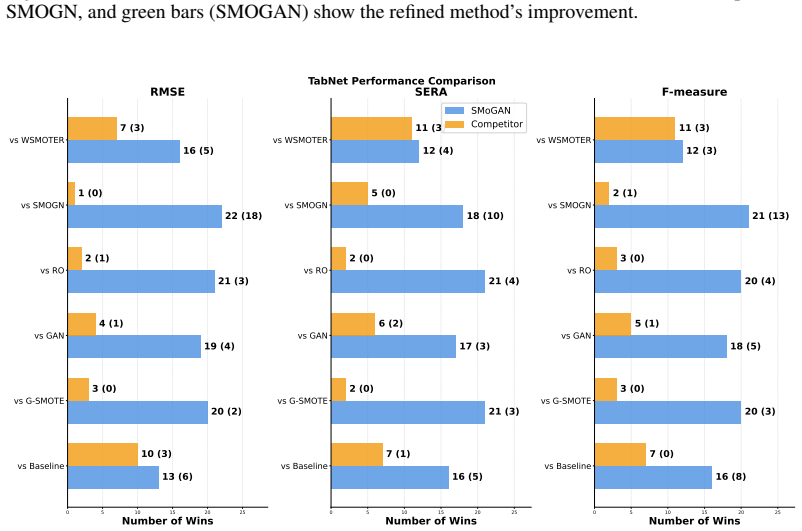
The central discovery is that adversarial refinement of oversampled minority data is what makes the difference: SMOGAN consistently outperforms the default oversampler without the DistGAN filtering layer. Across 23 datasets, aggregate pairwise comparisons show SMOGAN winning the majority of comparisons against SMOGN, G-SMOTE, WSMOTER, random oversampling, a GAN-only approach, and no oversampling, with the majority of the statistically significant wins on RMSE, SERA, and F-measure (the single exception being WSMOTER on SERA with Random Forest). On the Boston dataset, the refined samples intermix with real minority points in PCA and t-SNE embeddings, reduce the Frobenius norm of the correlation-matrix difference from 2.5060 to 0.7130, and improve univariate mean, standard deviation, skewness, and kurtosis alignment by 75 to 90 percent.
Load-bearing premise
The method assumes that making the whole pool of synthetic samples look statistically similar to the real minority samples is enough to guarantee that each individual synthetic sample pairs its features with its target correctly; if that is false, the refined data could look realistic in bulk while containing internally mismatched samples.
Editorial extensions
If this is right
- SMOGAN improves RMSE, SERA, and regression F-measure over plain SMOGN on most of the 23 datasets for both TabNet and Random Forest.
- The GAN-only baseline is consistently worse than SMOGAN, so the initial oversampler's seed samples and the DistGAN refinement layer are both load-bearing.
- The refined synthetic pool preserves inter-feature correlations and univariate moments much more closely than the initial pool, so downstream models are trained on minority data that resembles the real distribution.
- Because the design is modular, other data-level oversamplers can be plugged into Stage 1 and receive the same adversarial refinement, making DistGAN a general filtering layer for imbalanced regression.
Reading between the lines
- Because DistGAN is trained only to match the joint distribution, a direct test of per-sample fidelity would be to check whether a refined sample's target stays close to its SMOGN seed's target; adding a reconstruction or conditional loss is a natural variant if it does not.
- The reported wins are aggregate over datasets with one relevance threshold ($t_R=0.8$) and one GAN setting; the size of the refinement benefit at other minority definitions and hyperparameter choices is an open question the paper does not resolve.
- The same two-stage idea could be applied to oversamplers that generate candidates in learned or clustered feature spaces; whether DistGAN's filtering benefit transfers to those seed distributions is not established by the paper.
Signed reviews
Editorial analysis
A structured set of objections, weighed in public.
Referee Report
Summary. The paper proposes SMOGAN, a two-stage oversampling framework for imbalanced regression. In Stage 1, an existing oversampler (SMOGN) generates synthetic samples in sparse target regions. In Stage 2, a Wasserstein GAN with gradient penalty and an added maximum mean discrepancy (MMD) term, called DistGAN, refines these samples by aligning the generated joint feature-target distribution with that of real minority samples. The authors evaluate SMOGAN against SMOGN, WSMOTER, random oversampling, G-SMOTE, a GAN-only baseline, and no oversampling, on 23 benchmark datasets, using RMSE, SERA, and regression F-measure with TabNet and Random Forest regressors. They also provide qualitative analyses on the Boston dataset (PCA, t-SNE, correlation matrices, univariate statistics). The central claim is that SMOGAN consistently outperforms the corresponding oversampler without the DistGAN filtering layer.
Significance. If the reported improvements are robust and practically meaningful, SMOGAN would be a valuable modular refinement layer that can be attached to any existing imbalanced-regression oversampler. The paper's empirical scope is broad (23 datasets, 25 splits per dataset, two regressors, three metrics), and the two-stage idea of using a distribution-matching GAN to polish synthetic samples is natural and potentially useful. The study also ships a concrete implementation concept that could be adopted by practitioners. However, the significance is currently limited by the absence of effect sizes and by the partly circular qualitative evidence; the independent evidence for the central claim rests on win counts and significance counts, which are not sufficient to judge practical impact.
major comments (5)
- [Section 6, Figures 8-9] The headline claim that SMOGAN 'consistently outperforms' the base oversampler is supported only by win counts and counts of statistically significant wins. The paper reports no mean or median metric values, no standard deviations, no confidence intervals, and no effect sizes for any comparison. For example, the TabNet RMSE comparison against SMOGN reports 19 wins of which only 4 are statistically significant; the Random Forest SERA comparison reports 15 wins with 9 significant. Without the magnitude of the differences (e.g., relative improvement in RMSE/SERA averaged over datasets), the reader cannot distinguish a robust, meaningful advantage from a consistent but negligible one. This is load-bearing for the abstract's claim, and the authors should report full summary statistics and effect sizes for the key comparisons.
- [Section 6, paragraph 1 and Figures 8-9] The aggregation rule for wins is contradictory. The text states that comparisons are conducted 'at relevance thresholds tR = 0.8' and then immediately says 'each dataset contributes one win per threshold and two wins in total across both thresholds.' If only one threshold was used, each dataset should contribute at most one win per regressor per metric, not two. If two thresholds were actually used, the paper must specify both thresholds and report per-threshold results. This ambiguity affects the interpretation of every number in Figures 8 and 9 and must be resolved.
- [Section 5, Figures 4-7 and Table 2] The qualitative fidelity evidence is in large part circular. DistGAN's generator is trained explicitly to minimize an adversarial loss plus an MMD term against real minority samples, so the refined samples will by construction have univariate statistics, correlation matrices, and PCA/t-SNE overlap closer to the real data than the SMOGN starting points. These results therefore demonstrate that the optimization objective was achieved, but they are not independent evidence of sample quality or of downstream predictive benefit. The paper should frame Section 5 as a sanity check of the training objective, and should place the primary evidential weight on the held-out predictive comparisons.
- [Section 3.2 and Section 4.3] The DistGAN training procedure is underspecified: the paper does not state the number of training epochs, batch size, optimizer and learning rate for the generator and critic, the number of critic iterations per generator update, or the convergence criterion. The architecture is given, but not the training schedule. In addition, the GAN-only baseline is not described: when Stage 1 is skipped, what are the inputs to the generator? These details are required for reproducibility and for a fair assessment of the GAN-only comparison.
- [Section 3.2.2, Eq. for L_G] The generator objective contains no term that preserves the identity or per-sample feature-target coupling of the input SMOGN sample x; G is a free mapping from the initial synthetic pool to the real-data distribution. This is acceptable if the goal is only to produce a set of samples that matches the real joint distribution, but the paper repeatedly describes the process as 'refining' individual samples and preserving 'the true feature-target relationship.' The authors should state explicitly that DistGAN only matches the population-level joint distribution, and discuss whether individual-sample consistency is needed for the downstream task. If it is needed, an evaluation of per-sample feature-target plausibility should be added.
minor comments (6)
- [Section 5.2] The text says t-SNE projections were computed with perplexities 20, 40, and 60, but Figure 5 also includes a panel for perplexity 80. Please align the text with the figure.
- [Figures 8 and 9] The figure captions and the running text use 'SMoGAN' instead of 'SMOGAN'. Please make the naming consistent throughout.
- [Section 6, first paragraph after Figures 8-9] The sentence 'SMOGAN outperforms all competitors across all three metrics ... except against WSMOTER for SERA in the Random Forest model' is internally inconsistent because the exception contradicts the preceding 'all'. Please rephrase to present the exception before the general claim.
- [Section 4.2.3] The definitions of precision and recall for regression use the relevance threshold tR, but the utility U(y_hat, y) is not defined in the text. Please provide the definition or a reference.
- [Section 5.4, Table 2] The improvements in Table 2 are reported as point estimates without any measure of variability. Reporting standard errors or confidence intervals over features or over the 25 splits would strengthen the comparison.
- [Section 6, statistical test description] The Wilcoxon signed-rank test is applied to the 25-split metric differences for each dataset, but the paper does not state whether any multiple-comparison correction was applied across datasets and metrics. Given the large number of pairwise tests, this should be addressed or justified.
Circularity Check
Qualitative fidelity evidence reduces to DistGAN's own training objective, but the central held-out performance claim is independent.
-
fitted input called prediction
[Section 3.2.2 (generator objective) and Section 5.3 (Feature Correlation Analysis); also Sections 5.1, 5.2 and 5.4]
"LG =−Ex∼D(0) syn D (G(x)) + α \MMD 2 ({G(xi)},{zj}) ... A lower Frobenius norm indicates a closer match to the real data’s correlation structure. In our experiments, the norm for the |Real− SMOGN| matrix is 2.5060 versus 0.7130 for |Real− SMOGAN|, representing a 72% reduction in overall discrepancy."
The generator's objective is exactly to minimize a Wasserstein adversarial loss plus an RBF-kernel MMD between {G(xi)} and real minority samples {zj}. MMD with a characteristic kernel measures, in an RKHS sense, whether two distributions agree on moment-type statistics; the correlation matrices and univariate statistics in Section 5 are the same kind of moment-based discrepancy. Therefore the reported 'closer match' of SMOGAN-refined samples to real minority data in PCA, t-SNE, Frobenius correlation norms, and mean/std/skew/kurtosis is the value of the fitted objective evaluated on the same D_real used for training, not an independent prediction.
full rationale
The paper's central claim, that SMOGAN consistently outperforms the base oversampler without the DistGAN filtering layer, is supported by held-out test comparisons across 25 random splits with Wilcoxon signed-rank tests on RMSE, SERA, and F-measure for both TabNet and Random Forest. That evidence is not circular: the training and evaluation distributions are separated, and the reported wins are not implied by the SMOGAN loss by construction. The qualitative evaluations in Sections 5.1-5.4, however, do reduce to the training objective: DistGAN's generator is explicitly trained with adversarial loss plus an RBF-MMD term against the real minority samples, so reporting that refined samples match real minority moments, correlations, PCA, and t-SNE is a measure of fit to the training distribution, not an independent confirmation. No load-bearing self-citation chain or imported uniqueness theorem appears; the authors' earlier LDAO work is cited only as related work. The absence of effect sizes or confidence intervals for the held-out wins is a reporting weakness and a correctness-risk concern, but it is not a circularity issue. Overall, the central contribution remains independently tested, so the circularity score is moderate rather than high.
Assumptions & free parameters
free parameters (4)
- MMD weight alpha =
1
- Gradient penalty weight lambda_gp =
10
- Relevance threshold tR =
0.8
- GAN training schedule (epochs, batch size, critic iterations)
assumptions (5)
- standard math WGAN-GP with gradient penalty enforces the 1-Lipschitz constraint and stabilizes GAN training.
- domain assumption RBF-kernel MMD with median bandwidth is a valid and computable measure of joint distribution mismatch.
- domain assumption SMOGN generates an initial synthetic pool that lies close enough to the minority manifold for the generator to refine it usefully.
- domain assumption TabNet and Random Forest are representative regressors for benchmarking imbalanced regression methods.
- domain assumption The 23 datasets from Keel, DataSets-IR, and imbalancedRegression form a representative benchmark for imbalanced regression.
invented entities (1)
-
DistGAN
Cite this review
Pith. "Pith review of SMOGAN: Synthetic Minority Oversampling with GAN Refinement for Imbalanced Regression." pith.science (2026). https://pith.science/paper/O5WN4XE3
@misc{pith2026250421152,
  author       = {Pith},
  title        = {Pith review of: SMOGAN: Synthetic Minority Oversampling with GAN Refinement for Imbalanced Regression},
  year         = {2026},
  howpublished = {\url{https://pith.science/paper/O5WN4XE3}},
  note         = {Machine review of arXiv:2504.21152}
}
read the original abstract
Imbalanced regression refers to prediction tasks where the target variable is skewed. This skewness hinders machine learning models, especially neural networks, which concentrate on dense regions and therefore perform poorly on underrepresented (minority) samples. Despite the importance of this problem, only a few methods have been proposed for imbalanced regression. Many of the available solutions for imbalanced regression adapt techniques from the class imbalance domain, such as linear interpolation and the addition of Gaussian noise, to create synthetic data in sparse regions. However, in many cases, the underlying distribution of the data is complex and non-linear. Consequently, these approaches generate synthetic samples that do not accurately represent the true feature-target relationship. To overcome these limitations, we propose SMOGAN, a two-step oversampling framework for imbalanced regression. In Stage 1, an existing oversampler generates initial synthetic samples in sparse target regions. In Stage 2, we introduce DistGAN, a distribution-aware GAN that serves as SMOGAN's filtering layer and refines these samples via adversarial loss augmented with a Maximum Mean Discrepancy objective, aligning them with the true joint feature-target distribution. Extensive experiments on 23 imbalanced datasets show that SMOGAN consistently outperforms the default oversampling method without the DistGAN filtering layer.
Figures


Figures from the paper (6 more)



Forward citations
Cited by 1 Pith paper
-
Regression Augmentation With Data-Driven Segmentation
A GAN plus Mahalanobis-GMM segmentation framework for imbalanced regression outperforms prior augmentation baselines on 32 benchmark datasets.
Reference graph
Works this paper leans on
-
[1]
write newline
" write newline "" before.all 'output.state := FUNCTION n.dashify 't := "" t empty not t #1 #1 substring "-" = t #1 #2 substring "--" = not "--" * t #2 global.max substring 't := t #1 #1 substring "-" = "-" * t #2 global.max substring 't := while if t #1 #1 substring * t #2 global.max substring 't := if while FUNCTION word.in bbl.in ":" * " " * FUNCTION f...
-
[2]
Local distribution-based adaptive oversampling for imbalanced regression, April 2025
Shayan Alahyari and Mike Domaratzki. Local distribution-based adaptive oversampling for imbalanced regression, April 2025
work page 2025
-
[3]
Regression augmentation with data-driven segmentation, August 2025
Shayan Alahyari, Shiva Mehdipour Ghobadlou, and Mike Domaratzki. Regression augmentation with data-driven segmentation, August 2025
work page 2025
-
[4]
Alcalá-Fdez, A
J. Alcalá-Fdez, A. Fernandez, J. Luengo, J. Derrac, S. García, L. Sánchez, and F. Herrera. Keel data-mining software tool: Data set repository, integration of algorithms and experimental analysis framework. Journal of Multiple-Valued Logic and Soft Computing, 17 0 (2-3): 0 255--287, 2011
2011
-
[5]
Sercan \"O . Ar k and Tomas Pfister. Tabnet: Attentive interpretable tabular learning. In Proceedings of the AAAI Conference on Artificial Intelligence, volume 35, pages 6679--6687, 2021. doi:10.1609/aaai.v35i8.16826
-
[6]
Martin Arjovsky, Soumith Chintala, and Léon Bottou. Wasserstein GAN . arXiv preprint arXiv:1701.07875v3 [stat.ML], 2017
arXiv 2017
-
[7]
J. G. Avelino, G. D. C. Cavalcanti, and R. M. O. Cruz. Resampling strategies for imbalanced regression: a survey and empirical analysis. Artificial Intelligence Review, 57: 0 Article 82, 2024
work page 2024
-
[8]
Branco, L
P. Branco, L. Torgo, and R. P. Ribeiro. A survey of predictive modeling under imbalanced distributions. ACM Computing Surveys, 49 0 (2): 0 Article 31, 2016
2016
Show all 49 references
-
[9]
Branco, L
P. Branco, L. Torgo, and R. P. Ribeiro. Smogn: A pre-processing approach for imbalanced regression. In Proceedings of Machine Learning Research: LIDTA, volume 74, pages 36--50, 2017
2017
-
[10]
Branco, L
P. Branco, L. Torgo, and R. P. Ribeiro. Pre-processing approaches for imbalanced distributions in regression. Neurocomputing, 343: 0 76--99, 2019
2019
-
[11]
Random forests
Leo Breiman. Random forests. Machine Learning, 45 0 (1): 0 5--32, 2001. doi:10.1023/A:1010933404324
2001 doi
-
[12]
M. Buda, A. Maki, and M. A. Mazurowski. A systematic study of the class imbalance problem in convolutional neural networks. Neural Networks, 106: 0 249--259, 2018
2018
-
[13]
Camacho and F
L. Camacho and F. Bacao. WSMOTER : A novel approach for imbalanced regression. Applied Intelligence, 54: 0 8789--8799, 2024
2024
-
[14]
Camacho, G
L. Camacho, G. Douzas, and F. Bacao. Geometric SMOTE for regression. Expert Systems with Applications, 193: 0 116387, 2022
2022
-
[15]
N. V. Chawla, K. W. Bowyer, L. O. Hall, and W. P. Kegelmeyer. SMOTE : Synthetic minority over-sampling technique. Journal of Artificial Intelligence Research, 16: 0 321--357, 2002
2002
-
[16]
N. V. Chawla, N. Japkowicz, and A. Kolcz. Editorial: Special issue on learning from imbalanced data sets. ACM SIGKDD Explorations Newsletter, 6 0 (1): 0 1--6, 2004
2004
-
[17]
Domingos
P. Domingos. Metacost: A general method for making classifiers cost-sensitive. In Proceedings of the 5th ACM SIGKDD International Conference on Knowledge Discovery and Data Mining (KDD), pages 155--164, 1999
1999
-
[18]
C. Elkan. The foundations of cost-sensitive learning. In Proceedings of the 17th International Joint Conference on Artificial Intelligence (IJCAI), pages 973--978, 2001
2001
-
[19]
Conditional wasserstein GAN ‐based oversampling of tabular data for imbalanced learning
Justin Engelmann and Stefan Lessmann. Conditional wasserstein GAN ‐based oversampling of tabular data for imbalanced learning. Preprint arXiv:2008.09202v1, 2020
2008 arXiv
-
[20]
Goodfellow, Jean Pouget‐Abadie, Mehdi Mirza, Bing Xu, David Warde‐Farley, Sherjil Ozair, Aaron Courville, and Yoshua Bengio
Ian J. Goodfellow, Jean Pouget‐Abadie, Mehdi Mirza, Bing Xu, David Warde‐Farley, Sherjil Ozair, Aaron Courville, and Yoshua Bengio. Generative adversarial nets. In Advances in Neural Information Processing Systems, volume 27, pages 2672--2680, 2014
2014
-
[21]
Improved training of Wasserstein GANs
Ishaan Gulrajani, Faruk Ahmed, Martin Arjovsky, Vincent Dumoulin, and Aaron Courville. Improved training of Wasserstein GANs . In Advances in Neural Information Processing Systems 30 (NeurIPS 2017), pages 5767--5777, 2017
2017
-
[22]
H. Guo, Y. Li, J. Shang, M. Gu, Y. Huang, and B. Gong. Learning from class-imbalanced data: Review of methods and applications. Expert Systems with Applications, 73: 0 220--239, 2017
2017
-
[23]
He and E
H. He and E. A. Garcia. Learning from imbalanced data. IEEE Transactions on Knowledge and Data Engineering, 21 0 (9): 0 1263--1284, 2009
2009
-
[24]
A GAN ‐based anomaly detection approach for imbalanced industrial time series
Wenqian Jiang, Yang Hong, Beitong Zhou, Xin He, and Cheng Cheng. A GAN ‐based anomaly detection approach for imbalanced industrial time series. IEEE Access, 7: 0 143608--143619, 2019
2019
-
[25]
J. M. Johnson and T. M. Khoshgoftaar. Survey on deep learning with class imbalance. Journal of Big Data, 6 0 (1): 0 1--54, 2019
2019
-
[26]
Sams, B.\, Nuno Dokoozlian, Luis Sanchez, and M
Hossein Kamangir, S. Sams, B.\, Nuno Dokoozlian, Luis Sanchez, and M. Earles, J.\. Large-scale spatio-temporal yield estimation via deep learning using satellite and management data fusion in vineyards. Computers and Electronics in Agriculture, 216: 0 108439, 2024
2024
-
[27]
Krawczyk
B. Krawczyk. Learning from imbalanced data: open challenges and future directions. Progress in Artificial Intelligence, 5 0 (4): 0 221--232, 2016
2016
-
[28]
N. Kunz. Smogn: Synthetic minority over-sampling technique for regression with Gaussian noise. PyPI, version v0.1.2, 2020
2020
-
[29]
GAN -based imbalanced data intrusion detection system
JooHwa Lee and KeeHyun Park. GAN -based imbalanced data intrusion detection system. Personal and Ubiquitous Computing, 25 0 (1): 0 121--128, 2021
2021
-
[30]
X.-Y. Liu, J. Wu, and Z.-H. Zhou. Exploratory undersampling for class-imbalance learning. IEEE Transactions on Systems, Man, and Cybernetics, Part B (Cybernetics), 39 0 (2): 0 539--550, 2009
2009
-
[31]
Yihong Ma, Xiaobao Huang, Bozhao Nan, Nuno Moniz, Xiangliang Zhang, Olaf Wiest, and Nitesh V. Chawla. Are we making much progress? revisiting chemical reaction yield prediction from an imbalanced regression perspective. In Companion Proceedings of the ACM Web Conference 2024 (...
2024
-
[32]
BAGAN : Data augmentation with balancing GAN
Giovanni Mariani, Florian Scheidegger, Roxana Istrate, Costas Bekas, and Cristiano Malossi. BAGAN : Data augmentation with balancing GAN . Preprint arXiv:1803.09655v2, 2018
2018 arXiv
-
[33]
Moniz, L
N. Moniz, L. Torgo, and C. Soares. SMOTEBoost for regression: Improving the prediction of extreme values. In Proceedings of the 5th International Conference on Data Science and Advanced Analytics (DSAA), pages 127--136, 2018
2018
-
[34]
Tackling small imbalanced regression datasets by stability selection and smogn: A case study of ventilation-free days prediction in a pediatric intensive care unit
Valentina Radovanovi \'c , Alireza Rafiei, Jocelyn Grunwell, and Rishikesan Kamaleswaran. Tackling small imbalanced regression datasets by stability selection and smogn: A case study of ventilation-free days prediction in a pediatric intensive care unit. International Journal ...
2025
-
[35]
M. Ren, W. Luo, and R. Urtasun. Balanced mse for imbalanced visual regression. In Proceedings of the IEEE/CVF Conference on Computer Vision and Pattern Recognition (CVPR), pages 418--427, 2022
2022
-
[36]
R. P. Ribeiro and N. Moniz. Imbalanced regression and extreme value prediction. Machine Learning, 109 0 (9-10): 0 1803--1835, 2020
2020
-
[37]
R. P. A. Ribeiro. Utility-based regression. PhD thesis, Faculty of Sciences, University of Porto, Porto, 2011
2011
-
[38]
SMOTified - GAN for class imbalanced pattern classification problems
Anuraganand Sharma, Prabhat Kumar Singh, and Rohitash Chandra. SMOTified - GAN for class imbalanced pattern classification problems. IEEE Access, 10: 0 30655--30665, 2022
2022
-
[39]
Steininger, K
M. Steininger, K. Kobs, P. Davidson, A. Krause, and A. Hotho. Density-based weighting for imbalanced regression. Machine Learning, 110 0 (8): 0 2187--2210, 2021
2021
-
[40]
Data augmentation using GANs
Fabio Henrique Kiyoiti dos Santos Tanaka and Claus Aranha. Data augmentation using GANs . In Proceedings of Machine Learning Research, volume XXX, pages 1--16, 2019
2019
-
[41]
Torgo, R
L. Torgo, R. P. Ribeiro, J. P. da Costa, and S. Pal. SMOTE for regression. In Intelligent Data Engineering and Automated Learning (IDEAL 2013). Lecture Notes in Computer Science, volume 8206, pages 378--387, 2013
2013
-
[42]
Utility-based regression
Luis Torgo and Rita Ribeiro. Utility-based regression. In Proceedings of the 11th European Conference on Principles and Practice of Knowledge Discovery in Databases (PKDD 2007), pages 597--604, 2007
2007
-
[43]
Precision and recall for regression
Luis Torgo and Rita Ribeiro. Precision and recall for regression. In Discovery Science (DS 2009), volume 5808 of Lecture Notes in Artificial Intelligence, pages 332--346. Springer‑Verlag Berlin Heidelberg, 2009
2009
-
[44]
Visualizing data using t-sne
Laurens van der Maaten and Geoffrey Hinton. Visualizing data using t-sne. Journal of Machine Learning Research, 9: 0 2579--2605, 2008
2008
-
[45]
Wilcoxon
F. Wilcoxon. Individual comparisons by ranking methods. Biometrics Bulletin, 1 0 (6): 0 80--83, 1945
1945
-
[46]
W. Wu, N. Kunz, and P. Branco. Imbalancedlearningregression-a python package to tackle the imbalanced regression problem. In Joint European Conference on Machine Learning and Knowledge Discovery in Databases, pages 645--648, 2022
2022
-
[47]
J. Yang, L. Xie, Q. Yu, X. He, and J. Liu. Delving into deep imbalanced regression. In Proceedings of the 38th International Conference on Machine Learning (ICML), pages 8437--8447, 2021
2021
-
[48]
Weighted support vector regression for high ozone concentration forecasting
Ling Zhen, Baihua Chen, Lin Wang, Lin Yang, Wei Xu, and Ru-Jin Huang. Weighted support vector regression for high ozone concentration forecasting. Atmospheric Environment, 343: 0 120952, 2025
2025
-
[49]
Zhou and X.-Y
Z.-H. Zhou and X.-Y. Liu. On multi-class cost-sensitive learning. Computational Intelligence, 26 0 (3): 0 232--257, 2010
2010
Reviewed August 16, 2026 · model on record in the stance chip above.
Discussion (0). Continue with ORCID to comment.