Scenario-conditioned flow matching for probabilistic generation of three-component ground-motion waveforms
Pith reviewed 2026-07-01 02:32 UTC · model grok-4.3
The pith
WaveFlowGMM generates three-component ground-motion waveforms by predicting PGA separately from shape generation in wavelet-packet space.
A machine-rendered reading of the paper's core claim, the machinery that carries it, and where it could break.
Core claim
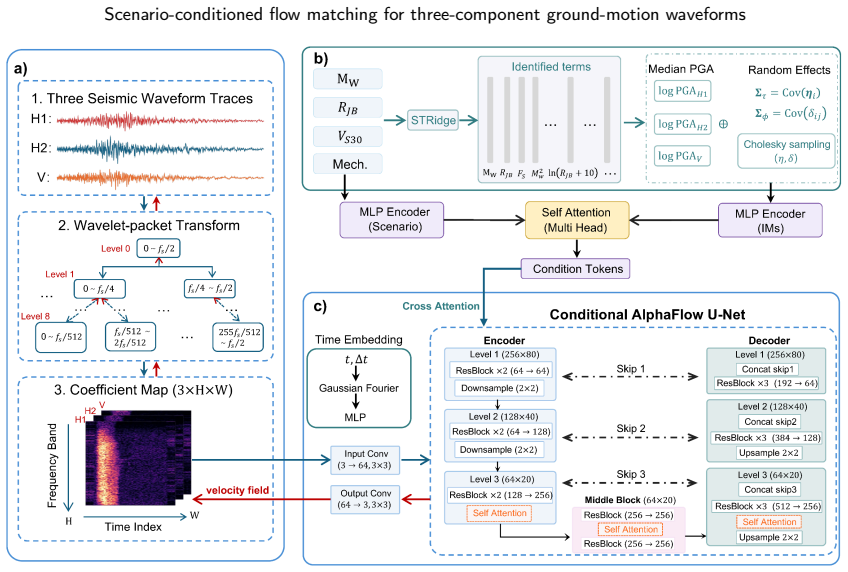
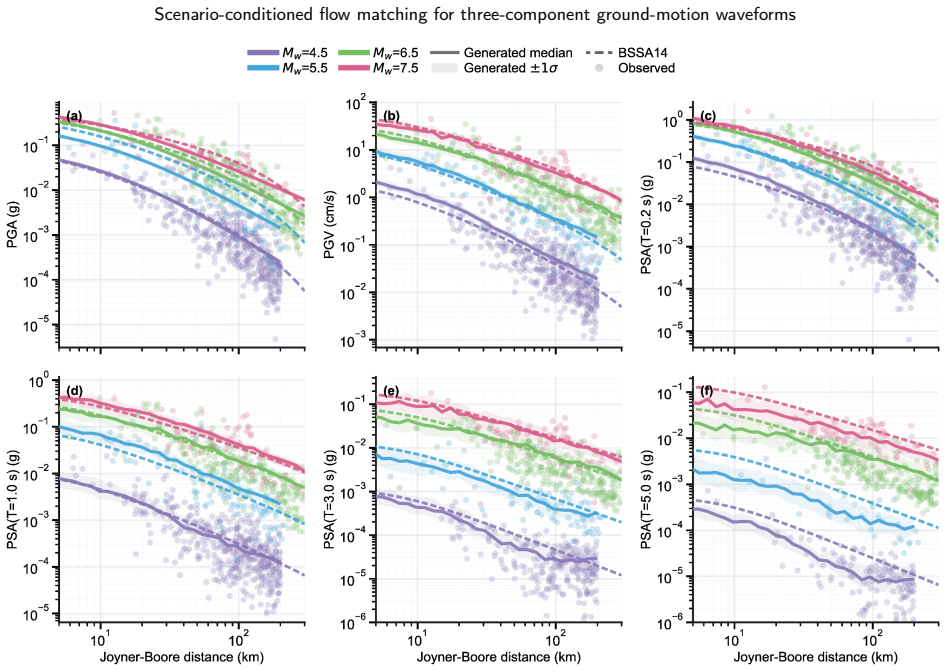
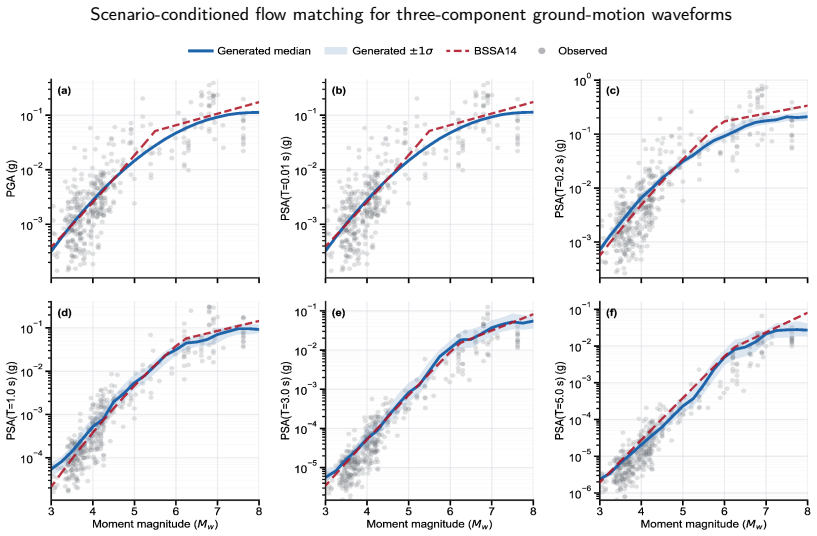
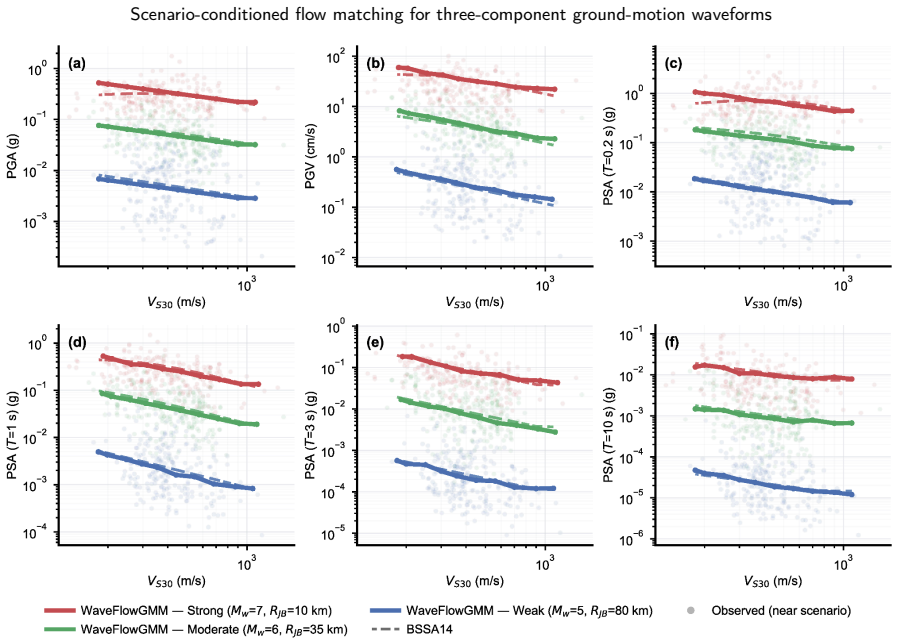
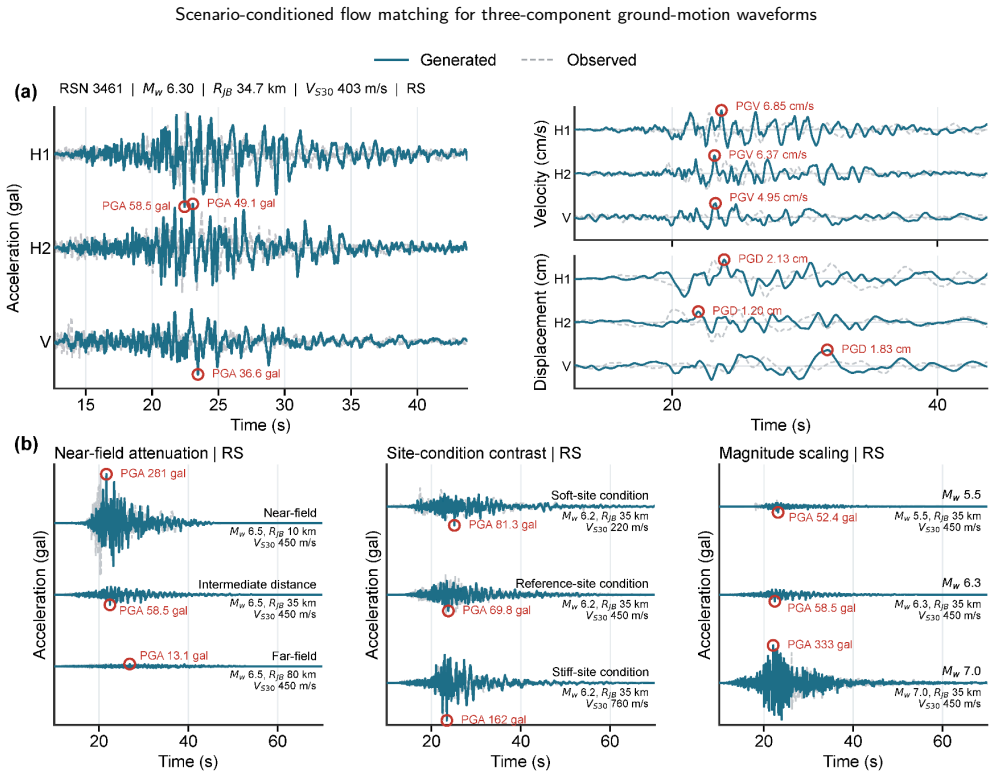
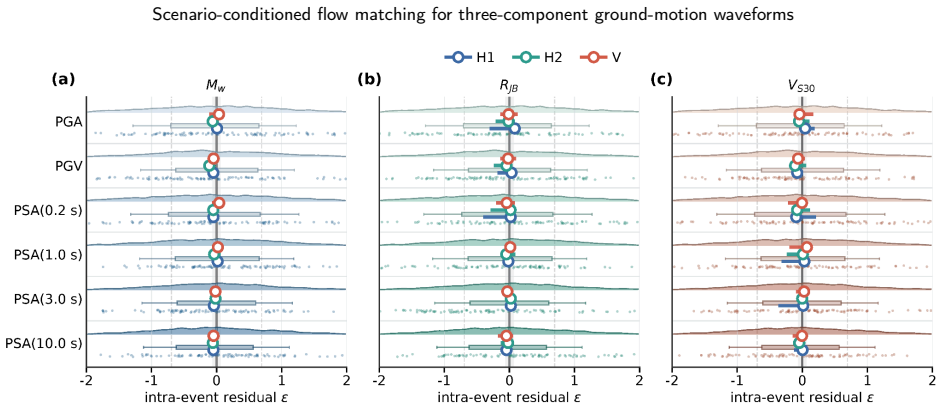
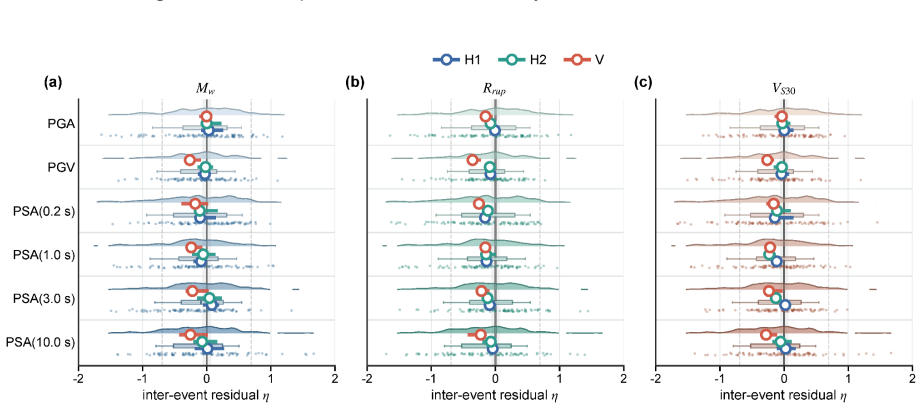
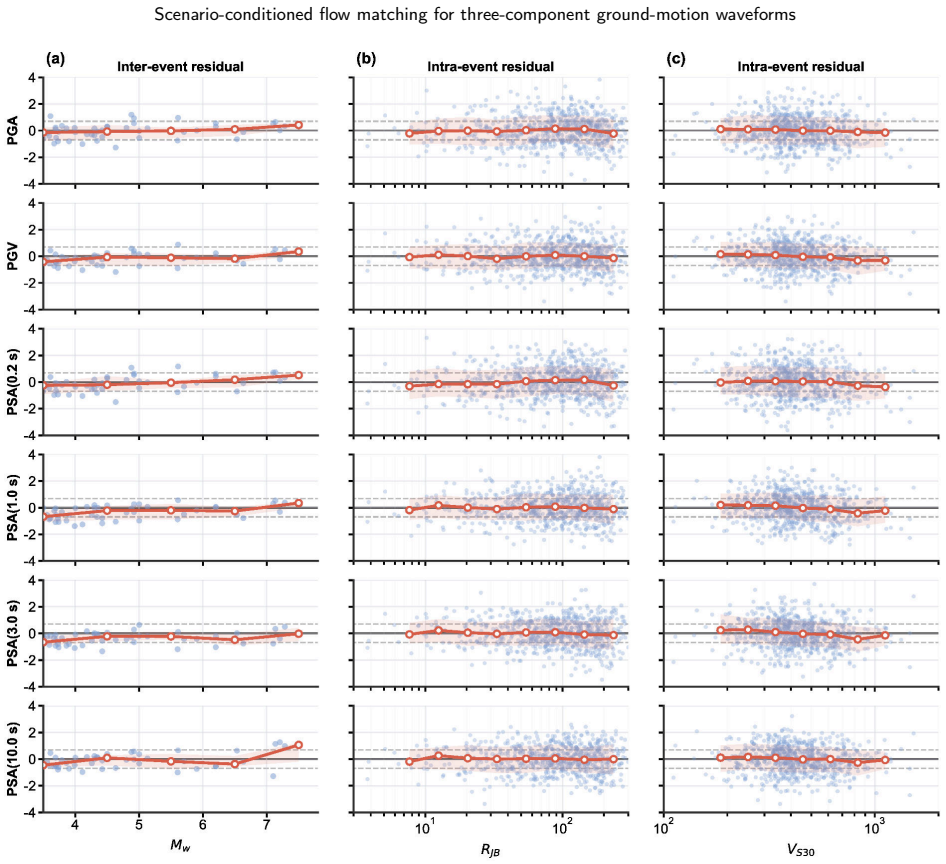
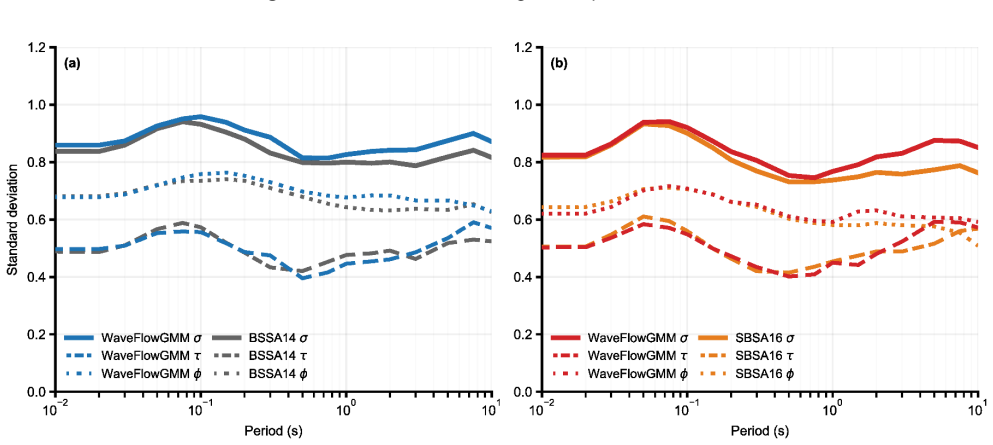
WaveFlowGMM is a two-stage model in which an amplitude stage uses physics-informed symbolic learning to estimate PGA medians and covariance while a waveform stage applies few-step AlphaFlow in invertible wavelet-packet coefficient space to produce normalized three-component histories that are then rescaled by sampled PGA values, and validation on NGA-West2 holdout events confirms that the generated motions recover main scaling trends, keep peak and spectral residuals near zero, preserve three-component dependence, and integrate without drift.
What carries the argument
Two-stage structure that treats PGA as an amplitude interface between scenario conditioning and AlphaFlow-based waveform generation in wavelet-packet space.
If this is right
- Generated motions recover the main magnitude, distance, and site scaling present in the training data.
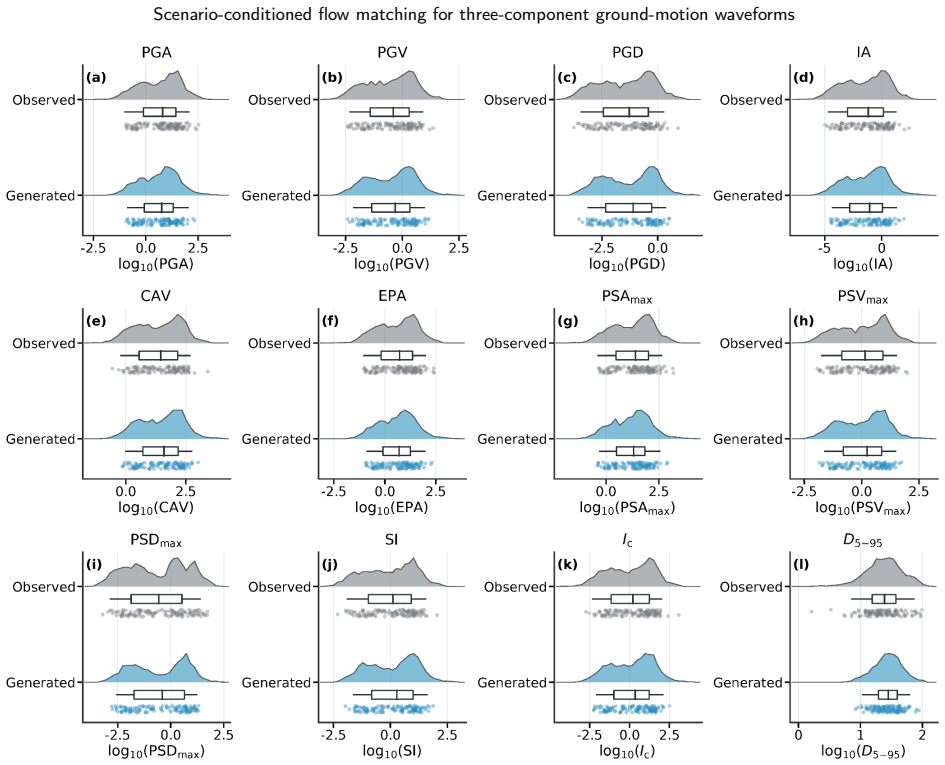
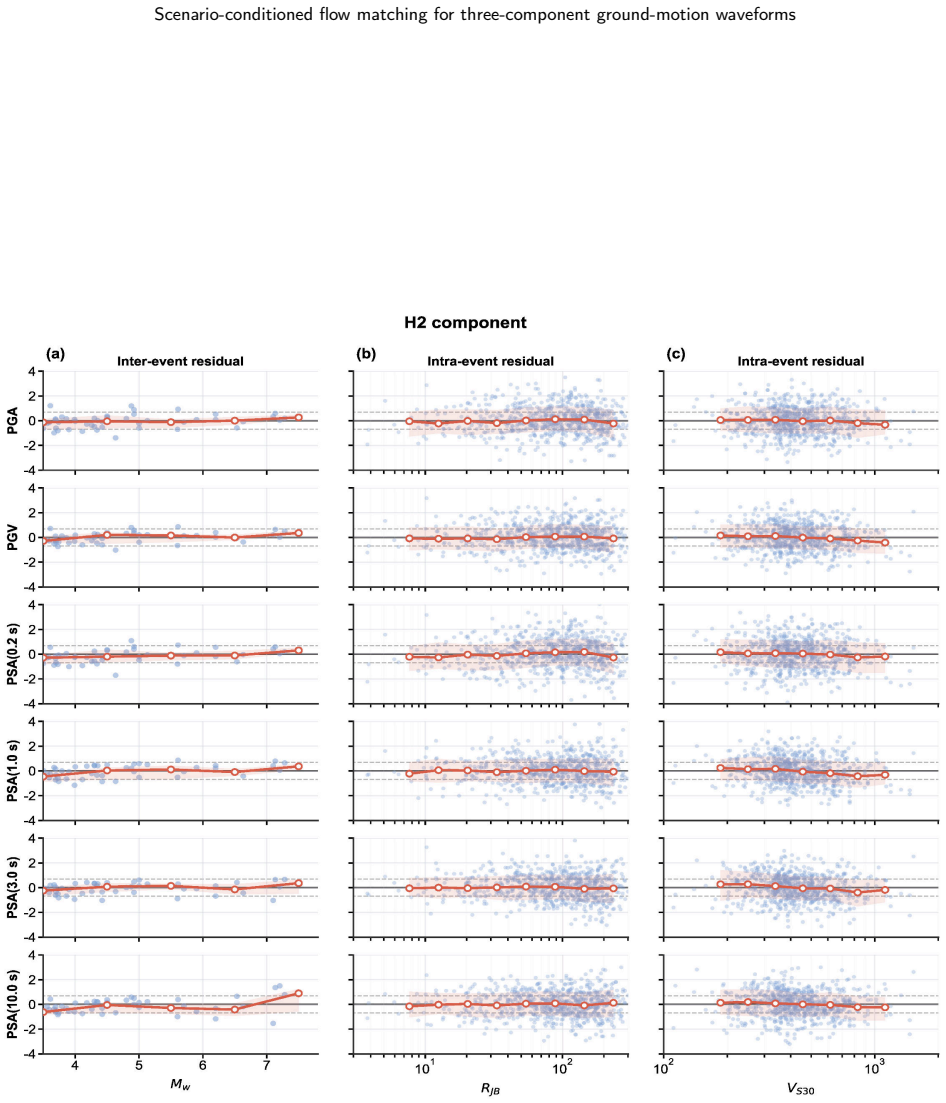
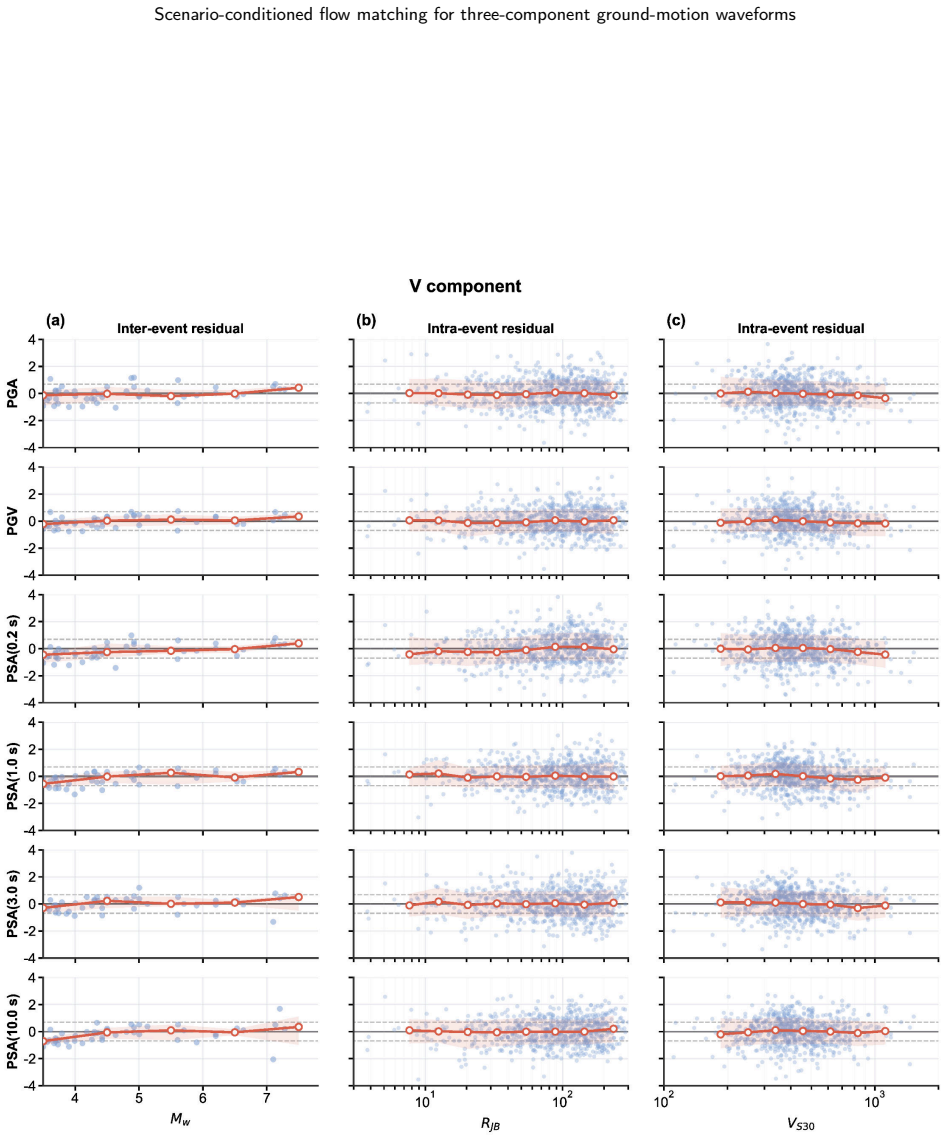
- Peak and spectral residuals remain close to zero on holdout events.
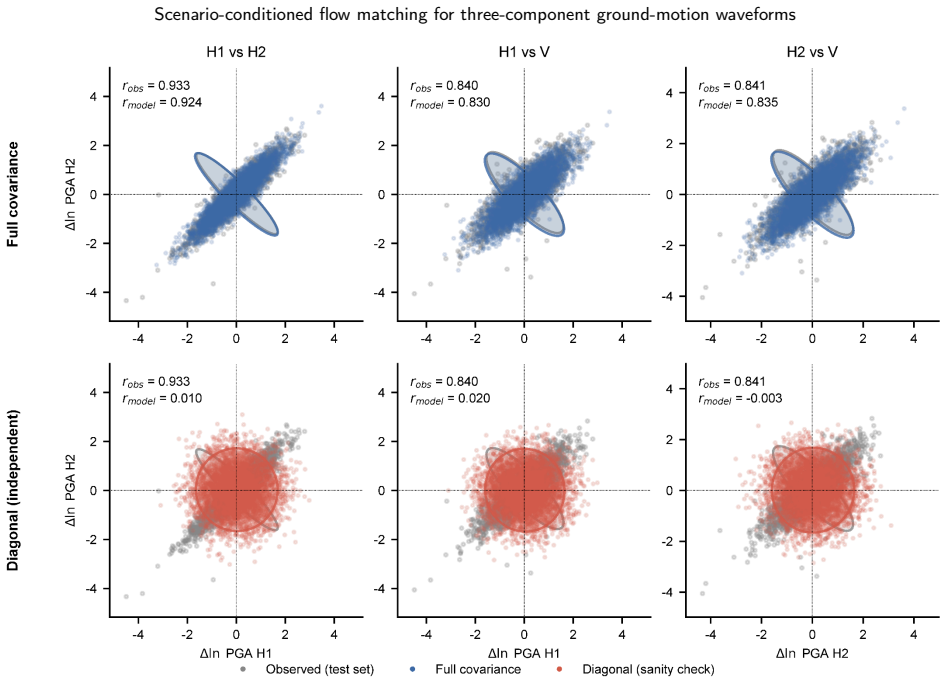
- Three-component amplitude dependence is preserved across the generated histories.
- Integration of the generated accelerations produces velocity and displacement histories without systematic drift.
Where Pith is reading between the lines
- The separation of amplitude and shape stages may allow independent updating of the PGA prediction module when new ground-motion data or physics constraints become available.
- Because the waveform stage operates on normalized histories, the same flow-matching machinery could be retrained for other target intensity measures if a suitable interface variable is identified.
- The absence of integration drift suggests the outputs are directly usable as input to nonlinear structural response analyses without additional baseline correction.
Load-bearing premise
That PGA supplies a sufficient amplitude interface which fully decouples scenario conditioning from waveform shape without losing information critical to the final motions, and that the wavelet-packet representation preserves everything needed for drift-free integration to velocity and displacement.
What would settle it
A new event-level holdout set in which the generated three-component accelerations, after integration, exhibit systematic drift in velocity or displacement time histories or produce spectral residuals that deviate substantially from zero across a range of periods.
Figures
read the original abstract
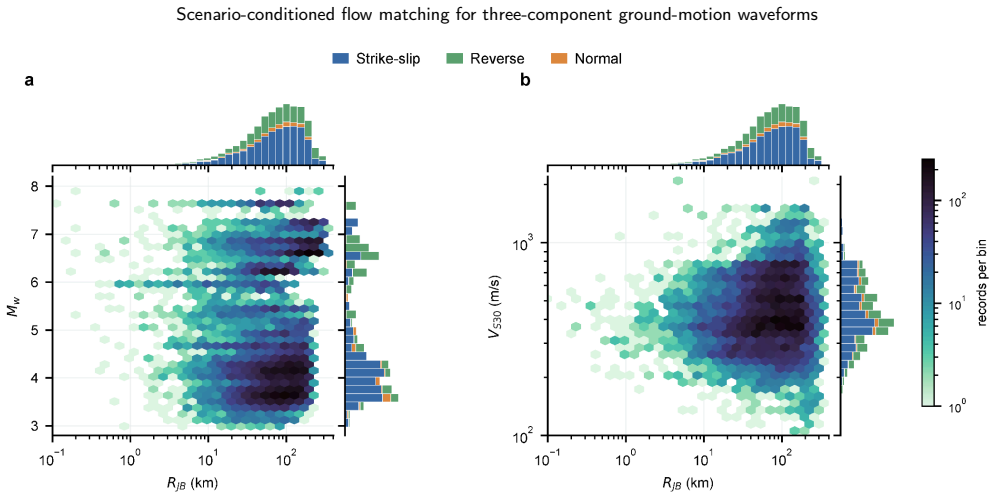
Performance-based seismic risk assessment requires three-component acceleration histories compatible with specified source, path, and site conditions. Conventional ground-motion prediction equations provide scalar intensity measures, while many generative waveform models learn amplitude and waveform shape within a single high-dimensional target. We present WaveFlowGMM, a two-stage probabilistic ground-motion model that uses peak ground acceleration (PGA) as an amplitude interface between scenario conditioning and waveform generation. The amplitude stage uses physics-informed symbolic learning to estimate component-wise PGA medians and a full cross-component covariance. The waveform stage uses few-step AlphaFlow in an invertible wavelet-packet coefficient space to generate normalised three-component histories that are rescaled by sampled PGA. Tests on an event-level NGA-West2 holdout set show that the generated motions recover the main magnitude, distance, and site scaling, keep peak and spectral residuals close to zero, preserve three-component amplitude dependence, and yield velocity and displacement histories without systematic drift after integration of the generated three-component acceleration histories. The framework provides an interpretable and computationally efficient candidate component for waveform-level seismic hazard and risk analysis.
Editorial analysis
A structured set of objections, weighed in public.
Referee Report
Summary. The manuscript presents WaveFlowGMM, a two-stage probabilistic model for generating three-component ground-motion acceleration waveforms conditioned on seismic scenarios. Stage one uses physics-informed symbolic learning to predict component-wise PGA medians and full cross-component covariance. Stage two applies few-step AlphaFlow (flow matching) in an invertible wavelet-packet coefficient space to produce normalized waveform shapes that are subsequently rescaled by sampled PGA values. On an event-level NGA-West2 holdout set, the generated motions are reported to recover magnitude-distance-site scaling, maintain near-zero peak and spectral residuals, preserve three-component amplitude dependence, and integrate to drift-free velocity and displacement time histories.
Significance. If the quantitative validation holds, the work supplies an interpretable, computationally efficient component for waveform-level seismic hazard and risk analysis by cleanly separating amplitude (via PGA) from shape generation. The invertible wavelet-packet representation and physics-informed symbolic regression for the amplitude stage are concrete strengths that could improve physical consistency over single-stage generative approaches.
major comments (2)
- [Abstract] Abstract: the central claim that 'peak and spectral residuals close to zero' and that 'main magnitude, distance, and site scaling' are recovered is presented without numerical values, error bars, sample counts, or any description of whether residuals were examined at fixed PGA. This information is load-bearing for assessing whether the PGA interface discards frequency-dependent correlations (as flagged in the skeptic note) and therefore whether the two-stage decoupling is valid.
- [Abstract] Abstract (holdout test description): no test is reported that checks for residual dependence of spectral shape, duration, or phase on magnitude or distance once PGA is fixed. If such dependence exists, the generated spectra will be biased even when PGA and peak residuals appear small; the manuscript must supply this diagnostic to support the sufficiency of PGA as the amplitude interface.
Simulated Author's Rebuttal
We thank the referee for the careful reading and the specific concerns raised about the abstract and the validation of the PGA interface. We address both major comments below and will revise the manuscript accordingly to improve clarity and provide the requested diagnostics.
read point-by-point responses
-
Referee: [Abstract] Abstract: the central claim that 'peak and spectral residuals close to zero' and that 'main magnitude, distance, and site scaling' are recovered is presented without numerical values, error bars, sample counts, or any description of whether residuals were examined at fixed PGA. This information is load-bearing for assessing whether the PGA interface discards frequency-dependent correlations (as flagged in the skeptic note) and therefore whether the two-stage decoupling is valid.
Authors: We agree that the abstract would be strengthened by quantitative detail. In the revision we will add the specific values: mean log-residuals for PGA and for spectral accelerations at periods 0.1–10 s (with standard deviations), the number of holdout events (N=XXX), and explicit reference to the figures that demonstrate magnitude-distance-site scaling recovery. The residuals reported are for the full two-stage model (sampled PGA followed by shape generation) rather than conditioned on fixed PGA; we will clarify this distinction in the abstract and add a sentence noting that the shape stage is trained to be independent of scenario given the PGA amplitude. This directly addresses the concern about frequency-dependent correlations being discarded by the interface. revision: yes
-
Referee: [Abstract] Abstract (holdout test description): no test is reported that checks for residual dependence of spectral shape, duration, or phase on magnitude or distance once PGA is fixed. If such dependence exists, the generated spectra will be biased even when PGA and peak residuals appear small; the manuscript must supply this diagnostic to support the sufficiency of PGA as the amplitude interface.
Authors: We accept that an explicit conditional-independence diagnostic is needed to substantiate the PGA interface. Although the overall validation (Section 4) shows small residuals and correct scaling, we did not report a test that bins spectral-shape, duration, or phase residuals by magnitude or distance at fixed PGA. In the revised manuscript we will add this analysis (e.g., residual trends versus magnitude within narrow PGA bins on the holdout set) and include the corresponding figure or table. If the test reveals residual dependence we will discuss its magnitude and implications for the two-stage approach. revision: yes
Circularity Check
No circularity; two-stage PGA interface is an explicit modeling choice with independent evaluation
full rationale
The abstract and described framework present the PGA amplitude interface, symbolic learning for medians/covariance, and AlphaFlow in wavelet-packet space as deliberate architectural decisions rather than quantities that reduce to the target waveforms by construction. Evaluation on an event-level NGA-West2 holdout set tests recovery of scaling and residuals without any indication that predictions are statistically forced by the inputs or by self-citation chains. No load-bearing self-definitional steps, fitted-input predictions, or uniqueness theorems from prior author work are visible in the provided text. The derivation chain remains self-contained against external benchmarks.
Axiom & Free-Parameter Ledger
Reference graph
Works this paper leans on
-
[1]
Moehle, G
J. Moehle, G. G. Deierlein, A framework methodology for performance-based earthquake engineering, in: 13th World Confer- ence on Earthquake Engineering, Vancouver, Canada, 2004, place- holder entry; verify before submission
2004
-
[2]
rep., Applied Technology Council, Washington, DC, placeholder entry; verify before submis- sion (2018)
Federal Emergency Management Agency, Seismic performance as- sessment of buildings (fema p-58), Tech. rep., Applied Technology Council, Washington, DC, placeholder entry; verify before submis- sion (2018)
2018
-
[3]
T. D. Ancheta, R. B. Darragh, J. P. Stewart, E. Seyhan, W. J. Silva, B. S.-J. Chiou, K. E. Wooddell, R. W. Graves, A. R. Kottke, D. M. Boore, T. Kishida, J. L. Donahue, NGA-West2 database, Earthquake Spectra 30 (3) (2014) 989–1005.doi:10.1193/070913EQS197M
-
[4]
J. J. Bommer, A. B. Acevedo, Hazard-consistent earthquake scenar- ios, Journal of Earthquake Engineering 8 (sup001) (2004) 43–91, placeholder entry; verify before submission
2004
-
[5]
N. Luco, P. Bazzurro, Structure-specific scalar intensity measures, EarthquakeEngineering&StructuralDynamics36(13)(2007)1813– 1835, placeholder entry; verify before submission
2007
-
[6]
N. A. Abrahamson, W. J. Silva, R. Kamai, Summary of the ASK14 groundmotionrelationforactivecrustalregions,EarthquakeSpectra 30 (3) (2014) 1025–1055.doi:10.1193/070913EQS198M
-
[7]
D. M. Boore, J. P. Stewart, E. Seyhan, G. M. Atkinson, NGA-West2 equationsforpredictingPGA,PGV,and5%dampedPSAforshallow crustal earthquakes, Earthquake Spectra 30 (3) (2014) 1057–1085. doi:10.1193/070113EQS184M
-
[8]
K. W. Campbell, Y. Bozorgnia, NGA-West2 ground motion model fortheaveragehorizontalcomponentsofPGA,PGV,and5%damped linearaccelerationresponsespectra,EarthquakeSpectra30(3)(2014) 1087–1115.doi:10.1193/062913EQS175M
-
[9]
B. S.-J. Chiou, R. R. Youngs, Update of the chiou and youngs NGA model for the average horizontal component of peak ground motion and response spectra, Earthquake Spectra 30 (3) (2014) 1117–1153. doi:10.1193/072813EQS219M
-
[10]
R. H. Scanlan, K. Sachs, Earthquake time histories and response spectra, Journal of the Engineering Mechanics Division 100 (4) (1974) 635–655.doi:10.1061/JMCEA3.0001911
-
[11]
L. Al Atik, N. Abrahamson, An improved method for nonstationary spectral matching, Earthquake Spectra 26 (3) (2010) 601–617.doi: 10.1193/1.3459159
-
[12]
S.-H. Ni, W.-C. Xie, M. Pandey, Application of hilbert-huang trans- form in generating spectrum-compatible earthquake time histories, International Scholarly Research Notices 2011 (1) (2011) 563678. doi:10.5402/2011/563678
-
[13]
D. Huang, G. Wang, Energy-compatible and spectrum-compatible (ECSC)groundmotionsimulationusingwaveletpackets,Earthquake Engineering and Structural Dynamics 46 (11) (2017) 1855–1873. doi:10.1002/eqe.2887
-
[14]
P.M.Mai,G.C.Beroza,Ahybridmethodforcalculatingnear-source broadbandseismograms,PhysicsoftheEarthandPlanetaryInteriors 137 (2002) 183–199, placeholder entry; verify before submission
2002
-
[15]
R.W.Graves,A.Pitarka,Broadbandground-motionsimulationusing a hybrid approach, Bulletin of the Seismological Society of America 100 (5A) (2010) 2095–2123.doi:10.1785/0120100057
-
[16]
A. J. Rodgers, A. Pitarka, R. Pankajakshan, B. Sjögreen, N. A. Petersson, Regional-scale 3D ground-motion simulations of mw 7 earthquakes on the hayward fault, northern california resolving fre- quencies 0–10 hz and including site-response corrections, Bulletin of the Seismological Society of America 110 (6) (2020) 2862–2881. doi:10.1785/0120200147
-
[17]
D. M. Boore, Simulation of ground motion using the stochastic method, Pure and Applied Geophysics 160 (3) (2003) 635–676.doi: 10.1007/PL00012553
-
[18]
K. B. Olsen, R. Takedatsu, Hybrid broadband ground-motion simu- lation, Bulletin of the Seismological Society of America 105 (2015) 951–968, placeholder entry; verify before submission
2015
-
[19]
Bayless, N
J. Bayless, N. A. Abrahamson, Summary of the ba18 ground-motion model, Bulletin of the Seismological Society of America 109 (2019) 2088–2105, placeholder entry; verify before submission
2019
-
[20]
M. A. Florez, M. Caporale, P. Buabthong, Z. E. Ross, D. Asimaki, M.-A. Meier, Data-driven synthesis of broadband earthquake ground motionsusingartificialintelligence,BulletinoftheSeismologicalSo- cietyofAmerica112(4)(2022)1979–1996.doi:10.1785/0120210264
-
[21]
R. D. D. Esfahani, F. Cotton, M. Ohrnberger, F. Scherbaum, TFCGAN: Nonstationary ground-motion simulation in the time– frequency domain using conditional generative adversarial network (CGAN) and phase retrieval methods, Bulletin of the Seismological SocietyofAmerica113(1)(2023)453–467.doi:10.1785/0120220068
-
[22]
Y. Shi, G. Lavrentiadis, D. Asimaki, Z. E. Ross, K. Azizzadenesheli, Broadbandground-motionsynthesisviagenerativeadversarialneural operators: Development and validation, Bulletin of the Seismolog- ical Society of America 114 (4) (2024) 2151–2171.doi:10.1785/ 0120230207
2024
-
[24]
Yamaguchi, Y
J. Yamaguchi, Y. Tomozawa, T. Saka, Site-specific ground-motion waveform generation using a conditional generative adversarial net- work and generalized inversion technique, Bulletin of the Seismo- logical Society of America 114 (4) (2024) 2118–2137.doi:10.1785/ 0120230209
2024
-
[25]
G. Lin, X. Hu, Near-fault ground motion synthesis based on condi- tional generation adversarial network, Computers and Structures 313 (2025) 107740.doi:10.1016/j.compstruc.2025.107740
-
[26]
K. Chen, H. Pan, M. Zhang, Z.-H. Li, Ground motion simulation via generative adversarial network, Applied Geophysics 22 (3) (2025) 684–697.doi:10.1007/s11770-025-1154-7
-
[28]
P. Ren, R. Nakata, M. Lacour, I. Naiman, N. Nakata, J. Song, Z. Bi, O. A. Malik, D. Morozov, O. Azencot, N. B. Erichson, M. W. Mahoney, Learning earthquake ground motions via conditional gen- erativemodeling,NatureCommunications(Mar.2026).doi:10.1038/ s41467-026-70719-2
2026
-
[29]
A. Bergmeister, K. H. Palgunadi, A. Bosisio, L. Ermert, M. Ko- roni, N. Perraudin, S. Dirmeier, M.-A. Meier, High resolution seis- mic waveform generation using denoising diffusion, arXiv preprint arXiv:2410.19343 (Oct. 2024).arXiv:2410.19343,doi:10.48550/ arXiv.2410.19343
-
[30]
Y. Huang, X. Sun, J. You, C. Yang, D. Lu, J. Zhang, Ground-motion generationsusingmulti-labelconditionalembedding–conditionalde- noising diffusion probabilistic model (ML–cDDPM), Soil Dynamics and Earthquake Engineering 191 (2025) 109274.doi:10.1016/j. soildyn.2025.109274
work page doi:10.1016/j 2025
-
[31]
Z. Bi, N. Nakata, R. Nakata, P. Ren, X. Wu, M. W. Mahoney, Advancing data-driven broadband seismic wavefield simulation with multiconditional diffusion model, IEEE Transactions on Geoscience and Remote Sensing 63 (2025) 1–9.doi:10.1109/TGRS.2025.3591881
- [32]
-
[33]
Waveform-Based Probabilistic Seismic Hazard Analysis Using Ground-Motion Generative Models
Y. Matsumoto, T. Yaoyama, S. Lee, A. Iwaki, T. Itoi, Waveform- Based Probabilistic Seismic Hazard Analysis Using Ground-Motion Generative Models, arXiv preprint arXiv:2511.22106 (Nov. 2025). arXiv:2511.22106,doi:10.48550/arXiv.2511.22106
work page internal anchor Pith review Pith/arXiv arXiv doi:10.48550/arxiv.2511.22106 2025
-
[34]
Sohl-Dickstein, E
J. Sohl-Dickstein, E. Weiss, N. Maheswaranathan, S. Ganguli, Deep Unsupervised Learning using Nonequilibrium Thermodynamics, in: Proceedingsofthe32ndInternationalConferenceonMachineLearn- ing, International Conference on Machine Learning (ICML), PMLR, Yi Ding et al.:Preprint submitted to ElsevierPage 19 of 20 Scenario-conditioned flow matching for three-c...
2015
-
[35]
6840–6851
J.Ho,A.Jain,P.Abbeel,Denoisingdiffusionprobabilisticmodels,in: AdvancesinNeuralInformationProcessingSystems,Vol.33,Neural Information Processing Systems (NeurIPS), Curran Associates, Inc., 2020, pp. 6840–6851
2020
-
[36]
Elucidating the Design Space of Diffusion-Based Generative Models
T. Karras, M. Aittala, T. Aila, S. Laine, Elucidating the de- sign space of diffusion-based generative models, arXiv preprint arXiv:2206.00364 (2022).arXiv:2206.00364,doi:10.48550/arXiv. 2206.00364
work page internal anchor Pith review Pith/arXiv arXiv doi:10.48550/arxiv 2022
-
[37]
High-Resolution Image Synthesis with Latent Diffusion Models
R. Rombach, A. Blattmann, D. Lorenz, P. Esser, B. Ommer, High- resolution image synthesis with latent diffusion models, arXiv preprint arXiv:2112.10752 (2021).arXiv:2112.10752,doi:10.48550/ arXiv.2112.10752
work page internal anchor Pith review Pith/arXiv arXiv 2021
-
[38]
Scalable Diffusion Models with Transformers
W. Peebles, S. Xie, Scalable diffusion models with transformers, arXiv preprint arXiv:2212.09748 (2022).arXiv:2212.09748,doi:10. 48550/arXiv.2212.09748
work page internal anchor Pith review Pith/arXiv arXiv 2022
-
[39]
Progressive Distillation for Fast Sampling of Diffusion Models
T. Salimans, J. Ho, Progressive Distillation for Fast Sampling of Dif- fusion Models, arXiv preprint arXiv:2202.00512 (Jun. 2022).arXiv: 2202.00512,doi:10.48550/arXiv.2202.00512
work page internal anchor Pith review Pith/arXiv arXiv doi:10.48550/arxiv.2202.00512 2022
-
[40]
arXiv preprint arXiv:2311.17042 , year=
A. Sauer, D. Lorenz, A. Blattmann, R. Rombach, Adversarial diffu- siondistillation,arXivpreprintarXiv:2311.17042(Nov.2023).arXiv: 2311.17042,doi:10.48550/arXiv.2311.17042
-
[41]
Y. Song, P. Dhariwal, M. Chen, I. Sutskever, Consistency Models, arXiv preprint arXiv:2303.01469 (May 2023).arXiv:2303.01469, doi:10.48550/arXiv.2303.01469
work page internal anchor Pith review Pith/arXiv arXiv doi:10.48550/arxiv.2303.01469 2023
-
[42]
Y. Song, P. Dhariwal, Improved techniques for training consistency models, arXiv preprint arXiv:2310.14189 (Oct. 2023).arXiv:2310. 14189,doi:10.48550/arXiv.2310.14189
work page internal anchor Pith review Pith/arXiv arXiv doi:10.48550/arxiv.2310.14189 2023
-
[43]
C. Lu, Y. Song, Simplifying, stabilizing and scaling continuous-time consistency models, arXiv preprint arXiv:2410.11081 (Mar. 2025). arXiv:2410.11081,doi:10.48550/arXiv.2410.11081
work page internal anchor Pith review Pith/arXiv arXiv doi:10.48550/arxiv.2410.11081 2025
-
[44]
Flow Matching for Generative Modeling
Y. Lipman, R. T. Q. Chen, H. Ben-Hamu, M. Nickel, M. Le, Flow matching for generative modeling, arXiv preprint arXiv:2210.02747 (2022).doi:10.48550/ARXIV.2210.02747
work page internal anchor Pith review Pith/arXiv arXiv doi:10.48550/arxiv.2210.02747 2022
-
[45]
X. Liu, C. Gong, Q. Liu, Flow Straight and Fast: Learning to Generate and Transfer Data with Rectified Flow, arXiv preprint arXiv:2209.03003 (Sep. 2022).arXiv:2209.03003,doi:10.48550/ arXiv.2209.03003
work page internal anchor Pith review Pith/arXiv arXiv 2022
-
[46]
Mean Flows for One-step Generative Modeling
Z.Geng,M.Deng,X.Bai,J.Z.Kolter,K.He,Meanflowsforone-step generative modeling, arXiv preprint arXiv:2505.13447 (May 2025). arXiv:2505.13447,doi:10.48550/arXiv.2505.13447
work page internal anchor Pith review Pith/arXiv arXiv doi:10.48550/arxiv.2505.13447 2025
-
[47]
Zhang, A
H. Zhang, A. Siarohin, W. Menapace, M. Vasilkovsky, S. Tulyakov, Q. Qu, I. Skorokhodov, AlphaFlow: Understanding and improving MeanFlow models, in: The Fourteenth International Conference on Learning Representations, OpenReview, 2025
2025
-
[48]
2026).arXiv:2602.07405,doi:10.48550/arXiv.2602.07405
Y.Ding,S.Chen,J.Hu,X.Hu,Q.Zhao,X.Li,Waveletpacket-based diffusion model for ground motion generation with multi-conditional energyandspectralmatching,arXivpreprintarXiv:2602.07405(Feb. 2026).arXiv:2602.07405,doi:10.48550/arXiv.2602.07405
-
[49]
S. Chen, X. Liu, L. Fu, S. Wang, B. Zhang, X. Li, Physics sym- bolic learner for discovering ground-motion models via NGA-West2 database, Earthquake Engineering and Structural Dynamics 53 (1) (2024) 138–151.doi:10.1002/eqe.4013
-
[50]
X. Liu, C. Su, X. Li, L. Fu, F. Cotton, A hybrid symbolic learning approach for Ground-Motion model Development, Journal of Asian Earth Sciences 281 (2025) 106498.doi:10.1016/j.jseaes.2025. 106498
-
[51]
N. A. Abrahamson, R. R. Youngs, A stable algorithm for regression analyses using the random effects model, Bulletin of the Seismo- logical Society of America 82 (1) (1992) 505–510.doi:10.1785/ BSSA0820010505
1992
-
[52]
I. Daubechies, Orthonormal bases of compactly supported wavelets, Communications on Pure and Applied Mathematics 41 (7) (1988) 909–996.doi:10.1002/cpa.3160410705
-
[53]
Frans, D
K. Frans, D. Hafner, S. Levine, P. Abbeel, One step diffusion via shortcut models, in: International Conference on Learning Represen- tations, OpenReview, 2025, placeholder entry; verify before submis- sion
2025
-
[54]
Vaswani, N
A. Vaswani, N. Shazeer, N. Parmar, J. Uszkoreit, L. Jones, A. N. Gomez, Ł. Kaiser, I. Polosukhin, Attention is all you need, in: Pro- ceedings of the 31st International Conference on Neural Information Processing Systems, NIPS’17, Neural Information Processing Sys- tems (NeurIPS), Curran Associates Inc., Red Hook, NY, USA, 2017, pp. 6000–6010
2017
-
[55]
Ronneberger, P
O. Ronneberger, P. Fischer, T. Brox, U-net: Convolutional networks for biomedical image segmentation, in: N. Navab, J. Hornegger, W. M. Wells, A. F. Frangi (Eds.), Medical Image Computing and Computer-assisted Intervention – MICCAI 2015, Medical Image ComputingandComputer-AssistedIntervention(MICCAI),Springer International Publishing, Cham, 2015, pp. 234–...
2015
-
[56]
D.M.Boore,Orientation-independent,nongeometric-meanmeasures of seismic intensity from two horizontal components of motion, Bulletin of the Seismological Society of America 100 (4) (2010) 1830–1835.doi:10.1785/0120090400
-
[57]
G. W. Housner, Spectrum intensities of strong-motion earthquakes, Bulletin of the Seismological Society of America 42 (2) (1952) 73– 80
1952
-
[58]
Arias, A measure of earthquake intensity, in: R
A. Arias, A measure of earthquake intensity, in: R. J. Hansen (Ed.), SeismicDesignforNuclearPowerPlants,MITPress,1970,pp.438– 483
1970
-
[59]
EPRI, A criterion for determining exceedance of the operating basis earthquake, Tech. Rep. NP-5930, Electric Power Research Institute, Palo Alto, CA (1988)
1988
-
[60]
Y.-J. Park, A. H.-S. Ang, Y.-K. Wen, Mechanistic seismic damage model for reinforced concrete, Journal of Structural Engineering 111 (4) (1985) 722–739.doi:10.1061/(ASCE)0733-9445(1985)111: 4(722)
-
[61]
M. D. Trifunac, A. G. Brady, A study on the duration of strong earthquake ground motion, Bulletin of the Seismological Society of America 65 (3) (1975) 581–626
1975
-
[62]
K. Afshari, J. P. Stewart, Physically parameterized prediction equa- tions for significant duration in active crustal regions, Earthquake Spectra 32 (4) (2016) 2057–2081.doi:10.1193/063015EQS106M
-
[63]
J. P. Stewart, D. M. Boore, E. Seyhan, G. M. Atkinson, NGA-West2 equations for predicting vertical-component PGA, PGV, and 5%- damped PSA from shallow crustal earthquakes, Earthquake Spectra 32 (2) (2016) 1005–1031.doi:10.1193/072114eqs116m
-
[64]
J. Song, C. Meng, S. Ermon, Denoising diffusion implicit models, arXivpreprintarXiv:2010.02502(Oct.2022).arXiv:2010.02502,doi: 10.48550/arXiv.2010.02502
work page internal anchor Pith review Pith/arXiv arXiv doi:10.48550/arxiv.2010.02502 2010
-
[65]
Kishida, G
J.P.Stewart,T.E.Buckreis,R.R.Shams,S.Mohammed,L.Meibai, T. Kishida, G. Lanzano, L. Luzi, P. Zimmaro, B. A. Bradley, J.- Y. Huang, C. C. Nweke, S. J. Brandenberg, J. L. Donahue, Y. Bo- zorgnia, Overview of the nga-west3 ground motion database, Poster Presentation at the 2024 SCEC Annual Meeting, Poster #171, SCEC Contribution #13977 (Sep. 2024). URLhttps:/...
2024
discussion (0)
Sign in with ORCID, Apple, or X to comment. Anyone can read and Pith papers without signing in.