REVIEW 4 major objections 5 minor 1 cited by
Impact of Primordial Magnetic Fields on the First-Order Electroweak Phase Transition
T0 review · 4 major / 5 minor · reviewed 2026-08-05 · deepseek-v4-flash
Pith's one-line read The paper claims that a pre-existing helical hypermagnetic field slows the first-order electroweak phase transition, forms Higgs vortices above a threshold, and can generate the baryon asymmetry through the chiral anomaly.
desk verdict Genuinely new lattice results on AO vortices and PT slowing, but the baryogenesis claim overreaches: simulated eta_B is orders of magnitude too big and the hand-set bubble seeding makes the quantitative rates conditional. read the letter →
The pith
A machine-rendered reading of the paper's core claim, the machinery that carries it, and where it could break.
The reading
What carries the argument
The argument runs on three linked mechanisms. First, the external hypermagnetic field enters the Higgs potential through the covariant derivative, adding $\frac{g'^4}{4}Y^{\rm ex}_\mu Y^{\mu\,{\rm ex}}\Phi^\dagger\Phi$; this is what slows the transition and, above threshold, drives the Ambjørn-Olesen vortex lattice. Second, the chiral anomaly relation $\partial_\mu j_B^\mu = N_g\left(\frac{g^2}{16\pi^2}\mathrm{Tr}\,W_{\mu\nu}\tilde W^{\mu\nu} - \frac{g'^2}{32\pi^2}Y_{\mu\nu}\tilde Y^{\mu\nu}\right)$ ties baryon number to the Chern-Simons number, whose U(1) part is the hypermagnetic helicity $h_Y = \frac{1}{V}\int d^3x\,(Y+Y_{\rm ex})\cdot(B_Y+B_Y^{\rm ex})$. Third, the lattice evolution trac
What would settle it
Run the same lattice code with bubbles nucleated by the Euclidean tunneling rate derived from the magnetized potential (3), instead of the fixed $p_{\rm bubble}=5\times10^{-8}$ and tanh profile (22), and compare the transition completion time and final $\langle|\Phi|^2\rangle$. If the slowdown and the threshold $g'B_Y^{\rm ex}/m_W^2\gtrsim3.63$ disappear under realistic nucleation, the reported dynamics are an artifact of the seeding scheme; if they survive, the central claims are robust.
Extended reading notes
Core claim
The paper claims that a pre-existing helical hypermagnetic field changes both the dynamics of the first-order electroweak phase transition and its outcome for baryon production. In lattice simulations of the SU(2)$_L\times$U(1)$_Y$ electroweak theory, an external hypermagnetic field lowers the true vacuum through the term $\Delta V\supset \frac{g'^4}{4}Y^{\rm ex}_\mu Y^{\mu\,{\rm ex}}\Phi^\dagger\Phi$, slowing bubble expansion; the weaker the Higgs expectation, the more bubbles nucleate. Above $g'B_Y^{\rm ex}/m_W^2\gtrsim3.63$, the broken phase develops the hexagonal vortex pattern known as Ambjørn-Olesen condensation. When the external field is helical, bubble collisions drive large excursi
Load-bearing premise
All results depend on bubbles being placed by hand at a fixed per-site probability with a fixed wall shape, rather than nucleating from the actual quantum tunneling rate in the magnetized vacuum.
Editorial extensions
If this is right
- The electroweak phase transition in a magnetized region lasts longer and produces more bubbles than in a field-free region, so bubble-dynamics predictions for gravitational waves and baryogenesis should be re-evaluated with magnetic-field-dependent speeds.
- A helical hypermagnetic field of sufficient strength turns the transition itself into a baryogenesis engine: $\eta_B$ and $\eta_L$ are generated with signs set by the field helicity while $B-L$ stays conserved.
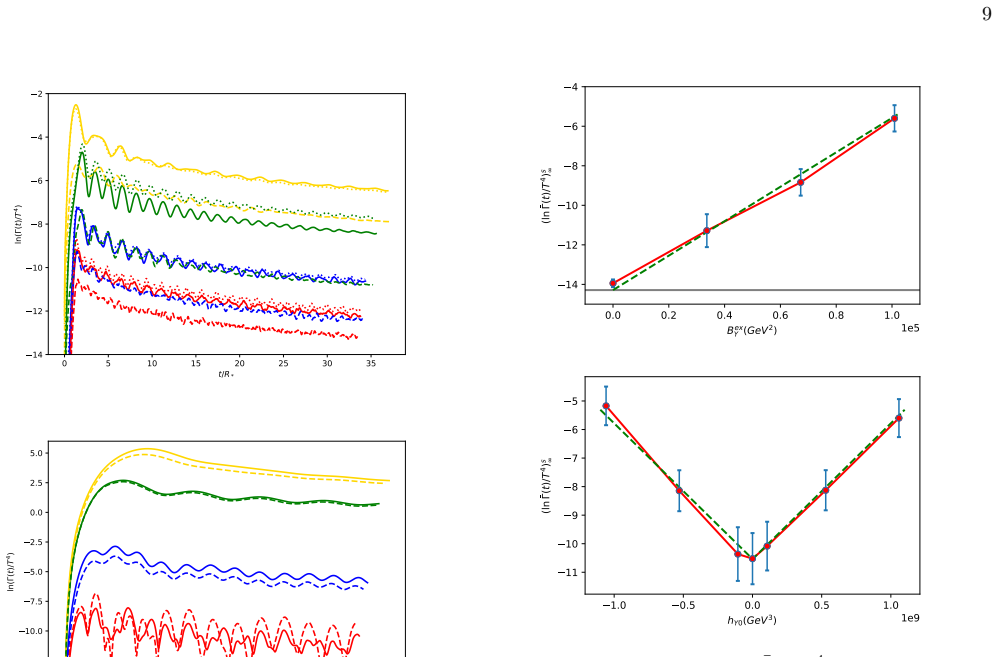
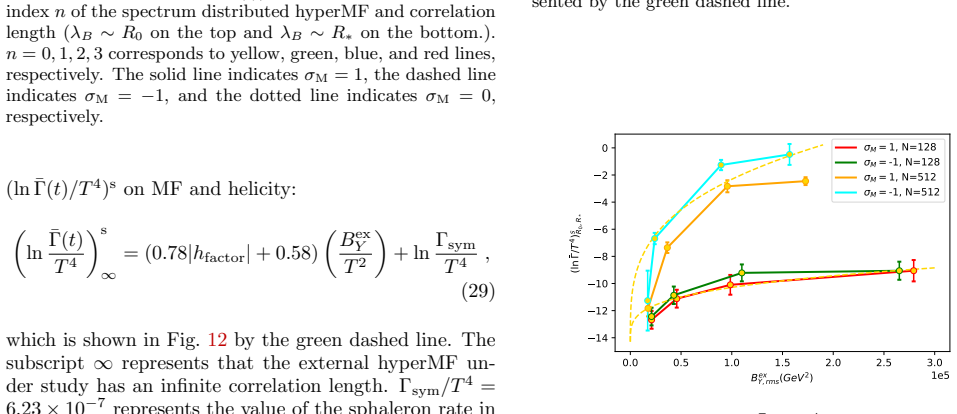
- The sphaleron-rate enhancement is quantified by explicit fits: for homogeneous helical fields, $\ln(\bar\Gamma/T^4)_s \simeq (0.78|h_{\rm factor}|+0.58)\,B_Y^{\rm ex}/T^2 + \ln(\Gamma_{\rm sym}/T^4)$, and for spectral fields it grows as a power law in the rms field, with larger correlation length giving a larger rate.
- The vortex phase appears only when the background field has a definite direction; random finite-correlation-length fields suppress the pattern and leave regions where the transition stalls with restored symmetry.
Reading between the lines
- Because bubble nucleation is imposed by hand rather than derived from tunneling, the quantitative slowdown factors and the vortex threshold are the parts most likely to shift in a fully dynamical treatment; a simulation using bubbles nucleated by the computed Euclidean action of the magnetized potential would settle this.
- If the enhanced sphaleron rate persists under realistic nucleation, the same mechanism should leave behind a helical magnetic field and a net lepton asymmetry; future searches for cosmic neutrino asymmetries or CMB polarization from helical fields could test this channel.
- The slower transition implies the gravitational-wave spectrum from a magnetized first-order electroweak transition would peak at a lower frequency and possibly different amplitude than the no-field prediction; a direct calculation of the sound-wave and turbulence contributions would make this testable.
- The mechanism needs no new CP-violating phases beyond the Standard Model: the helicity sign of the pre-existing field supplies the arrow of time. That could relieve a main pressure on electroweak baryogenesis, but shifts the question to how the helical field itself was created.
Editorial analysis
A structured set of objections, weighed in public.
Referee Report
Summary. This manuscript presents 3D lattice simulations of a first-order electroweak phase transition in the presence of a fixed external hypermagnetic field. The scalar potential contains a cubic term that generates the first-order transition, and vacuum bubbles are seeded by hand with a fixed per-site probability p_bubble and a tanh profile. Three headline results are reported: (1) the external hypermagnetic field slows the phase transition and increases the number of nucleated bubbles; (2) for g'B/m_W^2 ≳ 3.63, vortex-like Higgs/gauge structures interpreted as Ambjørn-Olesen condensation appear; (3) helical hypermagnetic fields enhance the extracted sphaleron rate by many orders of magnitude and, via the chiral anomaly, produce a baryon asymmetry. Quantitative fits for the sphaleron rate are given in Eqs. (29)-(31), and observational constraints on the magnetic field are discussed in Sec. IV E.
Significance. If quantitatively validated, the paper would provide a concrete numerical link between primordial helical hypermagnetic fields, the first-order electroweak transition, and baryogenesis through the chiral anomaly. The manuscript has real strengths: explicit lattice equations of motion and Gauss-law initialization in the appendices, multiple ensembles for several field configurations, and explicit fits for the sphaleron-rate dependence. The anomaly equations used are standard and are not circular; the problem is not that η_B is imposed but that its simulated magnitude is unphysically large. The qualitative trends, especially the PT slowdown and the appearance of vortex structures, may be useful, but the headline baryogenesis claim is currently unsupported because the simulated η_B is about eight orders of magnitude above the observed value and no washout or dilution mechanism is presented. The hand-seeded nucleation prescription further makes the PT dynamics and all derived rates conditional on an unvalidated choice.
major comments (4)
- [Sec. IV D / Eq. (12)] The baryon asymmetry shown in Fig. 14 reaches η_B ~ 1.7×10^-2 for g'B/m_W^2 = 7.26, while the observed asymmetry is η_B ≈ 6×10^-10. The abstract's third bullet claims that the helical field can 'validate the generation of the baryon asymmetry through the chiral anomaly,' but Eq. (12) is used directly and no washout, dilution, or subsequent evolution that would suppress η_B by roughly seven to eight orders of magnitude is modeled. Reference [97] is cited for the observationally viable range, but its results are not incorporated quantitatively. A quantitative baryogenesis claim requires either a concrete suppression mechanism or a demonstration that parameters exist for which Eq. (12) yields the observed value.
- [Sec. III / Eq. (22) and Table I] Bubble nucleation is implemented with a fixed probability p_bubble = 5×10^-8 and a fixed tanh profile, independent of the external hypermagnetic field. The same paper argues in Eq. (4) that the external field modifies the effective Higgs potential and hence the transition dynamics. Physical nucleation in a field-dependent potential would have a rate proportional to exp[-S_3(T,B)/T] that depends on B and on position/time. Since the simulated order-parameter history and ΔN_CS source are generated by this hand-seeded prescription, the PT slowdown, the vortex threshold, and the sphaleron-rate enhancement are all conditional. The authors should show that p_bubble reproduces the physical nucleation rate for the potential of Eq. (3), or at minimum scan p_bubble and demonstrate that the qualitative and quantitative conclusions are robust.
- [Sec. IV A and Sec. IV E] Several homogeneous runs use field strengths that exceed the paper's own radiation-energy bound. Equation (33) gives g'B/m_W^2 ≤ 7.07 for T=125 GeV, yet Fig. 3 includes g'B/m_W^2 up to 12.71 and Fig. 4 includes helical runs up to 9.08. The large sphaleron-rate enhancement and the large η_B values partly come from configurations whose magnetic energy density exceeds that of radiation, which are not physically realizable at the electroweak epoch. The claims should be restricted to the allowed range, or the unphysical runs should be clearly separated and excluded from the fits in Eqs. (29)-(31).
- [Sec. IV B / Eq. (24)] The paper defines the first critical field for Ambjørn-Olesen condensation as g'B_c1 = m_W^2, i.e., g'B/m_W^2 = 1 in the simulation units, but the observed onset of the vortex structure is quoted as g'B/m_W^2 ≳ 3.63 in the abstract and in Fig. 6. No explanation is given for the discrepancy of roughly a factor of 3.6. Either the theoretical criterion in Eq. (24) is not the one realized in the simulations, or the quoted threshold is mislabeled. This needs to be reconciled because the vortex threshold is one of the three headline quantitative claims.
minor comments (5)
- [Abstract] Typo: 'homogenesis hypermagentic field' should be 'homogeneous hypermagnetic field'.
- [Throughout] The spelling 'Ambjørn-Oleson' is used in the main text, while the standard spelling in the references is 'Ambjørn-Olesen'. Please make it consistent.
- [Eq. (4)] The overall factor g'^4 appears dimensionally questionable for a term g'^4 Y_ex^μ Y_exμ |Φ|^2. If this is intended as the covariant-derivative contribution, it should presumably be g'^2/4 times |g' Y_ex|^2 |Φ|^2; please check and clarify the notation.
- [Sec. IV C, Eqs. (29)-(31)] The fits are presented without uncertainties or goodness-of-fit measures. Given that the N=512 runs have only 4 realizations and the N=128 runs have 20, reporting error bars or at least the scatter would help the reader judge the significance of the fitted exponents 0.28 and 0.30.
- [Sec. IV E / Fig. 16] The observational constraints and the radiation-energy bound are discussed, but the reader has to infer which simulation points lie outside the allowed window. A version of Fig. 16 with the simulated parameter points overlaid, or a table stating which runs satisfy g'B/m_W^2 ≤ 7.07, would greatly improve clarity.
Circularity Check
No significant circularity: the PT speed, vortex threshold, sphaleron rate, and baryon asymmetry are simulation outputs converted with standard anomaly relations; self-citations are contextual, not load-bearing.
full rationale
The paper's central quantitative results (PT slowdown, vortex condensation threshold, sphaleron-rate enhancement, and baryon asymmetry) are outputs of lattice simulations rather than quantities imposed by construction. Baryon asymmetry is obtained from the simulated Chern-Simons-number difference through the standard anomaly relation, Eqs. (7) and (12), with no parameter fitted to a target baryon number. The sphaleron rate is measured as the ensemble variance of ΔNCS, Eqs. (26)-(28); the fitting formulas (29)-(31) are post-hoc summaries of the simulation data, not fitted inputs that force the claimed outcome. The chiral-anomaly relations (6)-(13) are textbook physics (Adler, Bell-Jackiw, 't Hooft) and are used as conversion formulas. The two self-citations ([19] and [97]) are contextual: [19] is invoked to interpret magnetic-field generation from bubble collisions, but the present simulation explicitly evolves the gauge fields and does not rely on that citation for its central results; [97] maps the hyperMF parameter space to present-day observability and is not the derivation of η_B. The hand-set bubble-nucleation probability p_bubble=5×10^-8 (Table I) is a modeling approximation that may affect the physical realism of the PT dynamics, but it does not make the measured NCS, sphaleron rate, or baryon number equal to an input by construction; it is a correctness or robustness concern, not a circularity. No uniqueness theorem or ansatz is imported from the authors' prior work, and no known result is merely renamed. Therefore no circular step is identified.
Assumptions & free parameters
free parameters (7)
- Potential cubic coefficient A =
2.59
- Potential mass and quartic parameters mu^2, lambda =
0.68, 1.60
- Bubble nucleation probability p_bubble =
5e-8
- Bubble radius and wall thickness R0, lw =
13 Delta x, 6 Delta x
- Helicity fraction h_factor =
-1 to 1 (scanned)
- Sphaleron fit coefficients in Eq. (29) =
0.78 |h_factor| + 0.58
- Sphaleron fit coefficients in Eqs. (30)-(31) =
2.38/6.86 and exponents 0.28/0.30
assumptions (7)
- standard math Chiral anomaly equations (6)-(13) connect Chern-Simons number and hypermagnetic helicity to baryon and lepton number.
- ad hoc to paper The electroweak transition is first order because of the cubic term A|Phi|^3 in the potential (3).
- domain assumption The external hypermagnetic field is a fixed, time-independent classical background; cosmic expansion and temperature change are neglected.
- domain assumption Classical lattice fields with thermal initial fluctuations approximate the quantum field dynamics.
- ad hoc to paper Bubble nucleation is modeled by a hand-set probability p_bubble with a tanh profile (22).
- domain assumption The helical homogeneous external field is realized by the vector potential Y_ex = (0,0,xB,h_factor L B) with boundary patching in Appendix C.
- standard math The symmetric-phase sphaleron rate Gamma_sym/T^4 = 6.23e-7 from Ref. [95] is used as a baseline.
Cite this review
Pith. "Pith review of Impact of Primordial Magnetic Fields on the First-Order Electroweak Phase Transition." pith.science (2026). https://pith.science/paper/O7CECILP
@misc{pith2026250807416,
  author       = {Pith},
  title        = {Pith review of: Impact of Primordial Magnetic Fields on the First-Order Electroweak Phase Transition},
  year         = {2026},
  howpublished = {\url{https://pith.science/paper/O7CECILP}},
  note         = {Machine review of arXiv:2508.07416}
}
abstract
We numerically study how the primordial magnetic field affects the first-order electroweak phase transition in the early Universe. We observe that: 1) the phase transition process would be slowed down by the magnetic field; 2) the phenomenon of vortex structure of the Higgs condensation appears when the homogenesis hypermagentic field $g'B_Y^{ex}/m_W^2\gtrsim3.63$; and, 3) the helical hypermagnetic field can dramatically enhance the sphaleron rate and validate the generation of the baryon asymmetry through the chiral anomaly.
Figures


Figures from the paper (9 more)




Forward citations
Cited by 1 Pith paper
-
Electroweak Baryogenesis: Advances in Sphaleron Rate Calculations and Implications of Thermal Phase Transitions
Sphaleron rates can be computed gauge-invariantly in 3D thermal EFT, yielding a new baryon-washout criterion x = lambda3/g3^2 that replaces v_c/T_c > 1 for electroweak baryogenesis.
Reference graph
Works this paper leans on
- [88]
-
[97]
Baryon asymmetry from electroweak tachyonic preheating
A. Tranberg and J. Smit, JHEP11, 016 (2003), arXiv:hep-ph/0310342
work page Pith review arXiv 2003
-
[1]
transition
However, to satisfy the Gausan constraint (Eq. (15)), we must assign an initial value to the conjugate momen- tum field of the gauge field according to certain rules. For specific details onInitialization of gauge fields, see Appendix B. When PT occurs, the Higgs field quantum tunnels from the false vacuum|Φ| ≃0 to the true vacuum|Φ|=v, nucleating a bubbl...
-
[2]
D. J. Reardon et al., Astrophys. J. Lett.951, L6 (2023), arXiv:2306.16215 [astro-ph.HE]
arXiv 2023
-
[3]
J. Antoniadis et al. (EPTA, InPTA:), Astron. Astro- phys.678, A50 (2023), arXiv:2306.16214 [astro-ph.HE]
arXiv 2023
-
[4]
G. Agazie et al. (NANOGrav), Astrophys. J. Lett.951, L8 (2023), arXiv:2306.16213 [astro-ph.HE]
arXiv 2023
-
[5]
H. Xu et al., Res. Astron. Astrophys.23, 075024 (2023), arXiv:2306.16216 [astro-ph.HE]
arXiv 2023
-
[6]
L. Bian, S. Ge, J. Shu, B. Wang, X.-Y. Yang, and J. Zong, Phys. Rev. D109, L101301 (2024), arXiv:2307.02376 [astro-ph.HE]
arXiv 2024
Show all 100 references
-
[7]
Ghosh, A
T. Ghosh, A. Ghoshal, H.-K. Guo, F. Hajkarim, S. F. King, K. Sinha, X. Wang, and G. White, JCAP05, 100 (2024), arXiv:2307.02259 [astro-ph.HE]
2024 arXiv
-
[8]
S. He, L. Li, S. Wang, and S.-J. Wang, Sci. China Phys. Mech. Astron.68, 210411 (2025), arXiv:2308.07257 [hep-ph]
2025 arXiv
-
[9]
Zheng, F
H.-w. Zheng, F. Gao, L. Bian, S.-x. Qin, and Y.-x. Liu, Phys. Rev. D111, L021303 (2025), arXiv:2407.03795 [hep-ph]
2025 arXiv
-
[10]
M. W. Winkler and K. Freese, Phys. Rev. D111, 083509 (2025), arXiv:2401.13729 [astro-ph.CO]
2025 arXiv
-
[11]
Chen, S.-L
Z.-C. Chen, S.-L. Li, P. Wu, and H. Yu, Phys. Rev. D 109, 043022 (2024), arXiv:2312.01824 [astro-ph.CO]
2024 arXiv
-
[12]
Bringmann, P
T. Bringmann, P. F. Depta, T. Konstandin, K. Schmidt- Hoberg, and C. Tasillo, JCAP11, 053 (2023), arXiv:2306.09411 [astro-ph.CO]
2023 arXiv
-
[13]
Mazumdar and G
A. Mazumdar and G. White, Reports on Progress in Physics82, 076901 (2019)
2019
-
[14]
Caprini et al., Journal of Cosmology and Astropar- ticle Physics2016, 001–001 (2016)
C. Caprini et al., Journal of Cosmology and Astropar- ticle Physics2016, 001–001 (2016)
2016
-
[15]
Caprini et al., Journal of Cosmology and Astropar- ticle Physics2020, 024–024 (2020)
C. Caprini et al., Journal of Cosmology and Astropar- ticle Physics2020, 024–024 (2020)
2020
- [16]
-
[17]
Ruan, Z.-K
W.-H. Ruan, Z.-K. Guo, R.-G. Cai, and Y.-Z. Zhang, International Journal of Modern Physics A35, 2050075 (2020), https://doi.org/10.1142/S0217751X2050075X
2020 doi
-
[18]
Luo et al., Classical and Quantum Gravity33, 035010 (2016)
J. Luo et al., Classical and Quantum Gravity33, 035010 (2016)
2016
-
[19]
C. J. Hogan, Phys. Rev. Lett.51, 1488 (1983)
1983
-
[21]
Enqvist and P
K. Enqvist and P. Olesen, Phys. Lett. B319, 178 (1993), arXiv:hep-ph/9308270
1993 arXiv
- [22]
-
[23]
Vachaspati, Phys
T. Vachaspati, Phys. Lett. B265, 258 (1991)
1991
-
[24]
G. Baym, D. Bodeker, and L. D. McLerran, Phys. Rev. D53, 662 (1996), arXiv:hep-ph/9507429
1996 arXiv
- [25]
-
[26]
N. K. Nielsen and P. Olesen, Nucl. Phys. B144, 376 (1978)
1978
-
[27]
S. W. MacDowell and O. T¨ ornkvist, Phys. Rev. D45, 3833 (1992)
1992
-
[28]
Salam and J
A. Salam and J. Strathdee, Nuclear Physics B90, 203 (1975)
1975
-
[29]
Linde, Physics Letters B62, 435 (1976)
A. Linde, Physics Letters B62, 435 (1976)
1976
-
[30]
Ambjørn, Physics Letters B: Particle Physics, Nu- clear Physics and Cosmology220, 659 (1989)
J. Ambjørn, Physics Letters B: Particle Physics, Nu- clear Physics and Cosmology220, 659 (1989)
1989
-
[32]
Annala and K
J. Annala and K. Rummukainen, Phys. Rev. D107, 073006 (2023), arXiv:2301.08626 [hep-ph]
2023 arXiv
-
[33]
D. L. J. Ho and A. Rajantie, Phys. Rev. D102, 053002 (2020), arXiv:2005.03125 [hep-th]
2020 arXiv
-
[34]
Comelli, D
D. Comelli, D. Grasso, M. Pietroni, and A. Riotto, Phys. Lett. B458, 304 (1999), arXiv:hep-ph/9903227
1999 arXiv
-
[35]
Grasso and H
D. Grasso and H. R. Rubinstein, Physics Reports348, 163–266 (2001)
2001
-
[36]
L. M. Widrow, Reviews of Modern Physics74, 775–823 (2002)
2002
-
[37]
R. M. Kulsrud and E. G. Zweibel, Reports on Progress in Physics71, 046901 (2008)
2008
-
[38]
Kandus, K
A. Kandus, K. E. Kunze, and C. G. Tsagas, Physics Reports505, 1–58 (2011)
2011
-
[39]
L. M. Widrow, D. Ryu, D. R. G. Schleicher, K. Sub- ramanian, C. G. Tsagas, and R. A. Treumann, Space Science Reviews166, 37–70 (2011)
2011
-
[40]
Durrer and A
R. Durrer and A. Neronov, The Astronomy and Astro- physics Review21(2013), 10.1007/s00159-013-0062-7
2013 doi
-
[41]
Magnetic fields in the milky way, de- rived from radio continuum observations and faraday rotation studies,
R. Wielebinski, “Magnetic fields in the milky way, de- rived from radio continuum observations and faraday rotation studies,” in Cosmic Magnetic Fields, edited by R. Wielebinski and R. Beck (Springer Berlin Heidelberg, Berlin, Heidelberg, 2005) pp. 89–112
2005
-
[42]
T. E. Clarke, P. P. Kronberg, and H. B¨ ohringer, The Astrophysical Journal547, L111–L114 (2001)
2001
-
[43]
Bonafede et al., Astronomy and Astrophysics513, A30 (2010)
A. Bonafede et al., Astronomy and Astrophysics513, A30 (2010)
2010
-
[44]
Feretti, G
L. Feretti, G. Giovannini, F. Govoni, and M. Murgia, The Astronomy and Astrophysics Review20(2012), 10.1007/s00159-012-0054-z
2012 doi
-
[45]
Dolag, M
K. Dolag, M. Kachelriess, S. Ostapchenko, and R. Tom` as, The Astrophysical Journal727, L4 (2010)
2010
-
[46]
Tavecchio, G
F. Tavecchio, G. Ghisellini, L. Foschini, G. Bonnoli, G. Ghirlanda, and P. Coppi, Monthly Notices of the Royal Astronomical Society: Letters406, L70–L74 (2010)
2010
-
[47]
Tavecchio, G
F. Tavecchio, G. Ghisellini, G. Bonnoli, and L. Foschini, Monthly Notices of the Royal Astronomical Society414, 3566–3576 (2011)
2011
-
[48]
I. Vovk, A. M. Taylor, D. Semikoz, and A. Neronov, The Astrophysical Journal747, L14 (2012)
2012
-
[49]
C. D. Dermer, M. Cavadini, S. Razzaque, J. D. Finke, J. Chiang, and B. Lott, The Astrophysical Journal733, L21 (2011)
2011
-
[50]
A. M. Taylor, I. Vovk, and A. Neronov, Astronomy amp; Astrophysics529, A144 (2011)
2011
-
[51]
Neronov and I
A. Neronov and I. Vovk, Science328, 73–75 (2010)
2010
-
[52]
Hindmarsh, M
M. Hindmarsh, M. L¨ uben, J. Lumma, and M. Pauly, SciPost Physics Lecture Notes (2021), 10.21468/sci- postphyslectnotes.24
2021 doi
-
[53]
Caldwell et al., Gen
R. Caldwell et al., Gen. Rel. Grav.54, 156 (2022), arXiv:2203.07972 [gr-qc]
2022 arXiv
-
[54]
Athron, C
P. Athron, C. Bal´ azs, A. Fowlie, L. Morris, and L. Wu, Progress in Particle and Nuclear Physics135, 104094 (2024)
2024
-
[55]
A. D. Sakharov, Pisma Zh. Eksp. Teor. Fiz.5, 32 (1967). 16
1967
-
[56]
D. E. Morrissey and M. J. Ramsey-Musolf, New Journal of Physics14, 125003 (2012)
2012
-
[57]
Cohen, D
T. Cohen, D. E. Morrissey, and A. Pierce, Physical Review D86(2012), 10.1103/physrevd.86.013009
2012 doi
-
[58]
Giovannini and M
M. Giovannini and M. E. Shaposhnikov, Physical Re- view Letters80, 22–25 (1998)
1998
-
[59]
Giovannini and M
M. Giovannini and M. E. Shaposhnikov, Phys. Rev. D 57, 2186 (1998), arXiv:hep-ph/9710234
1998 arXiv
-
[60]
Joyce and M
M. Joyce and M. E. Shaposhnikov, Phys. Rev. Lett.79, 1193 (1997), arXiv:astro-ph/9703005
1997 arXiv
-
[61]
Fujita and K
T. Fujita and K. Kamada, Phys. Rev. D93, 083520 (2016), arXiv:1602.02109 [hep-ph]
2016 arXiv
-
[62]
Kamada and A
K. Kamada and A. J. Long, Phys. Rev. D94, 063501 (2016), arXiv:1606.08891 [astro-ph.CO]
2016 arXiv
-
[63]
Kamada and A
K. Kamada and A. J. Long, Phys. Rev. D94, 123509 (2016), arXiv:1610.03074 [hep-ph]
2016 arXiv
-
[64]
Zhang, F
Y. Zhang, F. Ferrer, and T. Vachaspati, Physical Re- view D (2017), 10.1103/physrevd.96.043014
2017 doi
-
[65]
S. L. Adler, Phys. Rev.177, 2426 (1969)
1969
-
[66]
J. S. Bell and R. Jackiw, Nuovo Cim. A60, 47 (1969)
1969
-
[67]
’t Hooft, Phys
G. ’t Hooft, Phys. Rev. Lett.37, 8 (1976)
1976
-
[68]
’t Hooft, Phys
G. ’t Hooft, Phys. Rev. D14, 3432 (1976), [Erratum: Phys.Rev.D 18, 2199 (1978)]
1976
-
[69]
G. D. Moore, Physical Review D (2002), 10.1103/phys- revd.59.014503
2002 doi
-
[70]
Turok and J
N. Turok and J. Zadrozny, Nuclear Physics B358, 471 (1991)
1991
-
[71]
Z.-G. Mou, P. M. Saffin, and A. Tranberg, Journal of High Energy Physics (2018), 10.1007/jhep05(2018)197
2018 doi
-
[72]
M. M. Anber and E. Sabancilar, Phys. Rev. D92, 101501 (2015), arXiv:1507.00744 [hep-th]
2015 arXiv
- [73]
- [74]
-
[75]
Boyarsky, J
A. Boyarsky, J. Frohlich, and O. Ruchayskiy, Phys. Rev. Lett.108, 031301 (2012), arXiv:1109.3350 [astro- ph.CO]
2012 arXiv
-
[76]
Brustein and D
R. Brustein and D. H. Oaknin, Phys. Rev. Lett.82, 2628 (1999), arXiv:hep-ph/9809365
1999 arXiv
-
[77]
Boyarsky, J
A. Boyarsky, J. Fr¨ ohlich, and O. Ruchayskiy, Phys. Rev. Lett.108, 031301 (2012)
2012
-
[78]
M. S. Turner and L. M. Widrow, Phys. Rev. D37, 2743 (1988)
1988
-
[79]
Adshead, J
P. Adshead, J. T. Giblin, T. R. Scully, and E. I. Sfakianakis, JCAP10, 039 (2016), arXiv:1606.08474 [astro-ph.CO]
2016 arXiv
- [80]
-
[81]
Kanno, J
S. Kanno, J. Soda, and M.-a. Watanabe, JCAP12, 009 (2009), arXiv:0908.3509 [astro-ph.CO]
2009 arXiv
-
[82]
Ratra, Astrophys
B. Ratra, Astrophys. J. Lett.391, L1 (1992)
1992
-
[83]
J. M. Quashnock, A. Loeb, and D. N. Spergel, Astro- phys. J. Lett.344, L49 (1989)
1989
-
[85]
Ambjorn and P
J. Ambjorn and P. Olesen, Phys. Lett. B214, 565 (1988)
1988
-
[86]
Ambjorn and P
J. Ambjorn and P. Olesen, Phys. Lett. B218, 67 (1989), [Erratum: Phys.Lett.B 220, 659 (1989)]
1989
-
[87]
Ambjorn and P
J. Ambjorn and P. Olesen, Nucl. Phys. B315, 606 (1989)
1989
-
[89]
Kajantie, M
K. Kajantie, M. Laine, J. Peisa, K. Rummukainen, and M. E. Shaposhnikov, Nucl. Phys. B544, 357 (1999), arXiv:hep-lat/9809004
1999 arXiv
-
[90]
M. N. Chernodub, J. Van Doorsselaere, and H. Verschelde, Phys. Rev. D88, 065006 (2013), arXiv:1203.5963 [hep-ph]
2013 arXiv
-
[91]
Van Doorsselaere, Phys
J. Van Doorsselaere, Phys. Rev. D88, 025013 (2013), arXiv:1206.6205 [hep-ph]
2013 arXiv
-
[92]
C. J. Copi, F. Ferrer, T. Vachaspati, and A. Ach´ ucarro, Phys. Rev. Lett.101, 171302 (2008)
2008
-
[93]
Vachaspati, Phys
T. Vachaspati, Phys. Rev. Lett.87, 251302 (2001)
2001
-
[94]
Vachaspati and G
T. Vachaspati and G. B. Field, Phys. Rev. Lett.73, 373 (1994), arXiv:hep-ph/9401220
1994 arXiv
-
[95]
Barriola, Phys
M. Barriola, Phys. Rev. D51, 300 (1995), arXiv:hep- ph/9403323
1995
-
[96]
Annala and K
J. Annala and K. Rummukainen, Phys. Rev. D107, 073006 (2023)
2023
-
[98]
Y. Di, L. Bian, and R.-G. Cai, (2024), arXiv:2409.16124 [hep-ph]
2024 arXiv
-
[99]
Kahniashvili, A
T. Kahniashvili, A. Brandenburg, and A. G. Tevzadze, Physica Scripta , 104008 (2016)
2016
-
[100]
Brandenburg, R
A. Brandenburg, R. Durrer, Y. Huang, T. Kahniashvili, S. Mandal, and S. Mukohyama, Physical Review D (2020), 10.1103/physrevd.102.023536
2020 doi
-
[101]
Brandenburg, Y
A. Brandenburg, Y. He, and R. Sharma, Astrophys. J. 922, 192 (2021), arXiv:2107.12333 [astro-ph.CO]
2021 arXiv
-
[102]
P. A. R. Ade et al., Astron. Astrophys594, A13 (2016)
2016
-
[103]
G. S. Bali et al., Journal of High Energy Physics (2012), 10.1007/jhep02(2012)044
2012 doi
Reviewed August 5, 2026 · model on record in the stance chip above.
Discussion (0). Sign in to comment.