REVIEW 3 major objections 4 minor 2 cited by
This paper shows ICON, a transformer trained on condition–solution pairs, implicitly computes the mean of a Bayesian posterior predictive distribution, and that a generative extension can sample the full distribution to quantify uncertainty
Reviewed by Pith at T0; open to challenge. T0 means a machine referee read the full paper against a public rubric. the ladder, T0–T4 →
ICON is shown to compute the posterior predictive mean of differential equation solutions, and a generative extension, GenICON, provides samples from this distribution for uncertainty quantification.
T0 review reviewed 2026-08-05 challenge →
load-bearing objection A clean Bayesian reinterpretation of ICON with a generative extension; the theory is correct, the empirical support is thin, but the paper deserves refereeing. the 3 major comments →
Probabilistic operator learning: generative modeling and uncertainty quantification for foundation models of differential equations
The pith
A machine-rendered reading of the paper's core claim, the machinery that carries it, and where it could break.
The reading
Core claim
On its own terms, the paper establishes that ICON approximates the mean of the posterior predictive distribution over solution operators, conditioned on the provided context. Conditions, parameters, and quantities of interest are modeled as Banach- or Hilbert-space-valued random variables, and the ICON joint distribution factorizes as a prior over hidden operators times independent likelihoods. Theorem 3.1 shows that the unique L2 minimizer of the ICON training objective is exactly the conditional expectation of the new solution given the new condition and the demo pairs; since that same conditional distribution coincides with the Bayesian posterior predictive, ICON performs implicit Bayesia
What carries the argument
The load-bearing object is the ICON conditional distribution Q_{z^J | y^J, {(y^j,z^j)}}, obtained by marginalizing the hidden operator parameters out of a random differential equation, together with the Hilbert-space projection theorem that equates least-squares regression with conditional expectation. The generative extension relies on a pushforward map G(·, y^J, context) such that G(·, y^J, context)♯Pη equals that conditional distribution; existence follows from a kernel-representation lemma for Polish spaces, and training uses an (f,Γ)-divergence GAN objective.
Load-bearing premise
The key assumption is that the finite transformer trained on the empirical loss actually reaches the global least-squares minimizer T* in Theorem 3.1; without approximation or optimization error bounds, the Bayesian interpretation applies exactly only if training has converged.
What would settle it
Train ICON on a random ODE whose true posterior predictive is analytically computable, such as a linear ODE with Gaussian coefficients and Gaussian observation noise, and compare ICON's output to the exact conditional mean on held-out prompts. If the trained model systematically deviates while the training loss is small, the equivalence fails. Separately, average many GenICON samples on the same prompt and compare the average to ICON's output; a significant gap would contradict Theorem 4.2 in practice.
If this is right
- ICON's predictions are meaningful for both forward and inverse problems, even when the posterior over parameters is degenerate or non-identifiable, because the conditional mean is well-defined.
- Averaging many GenICON samples reproduces the ICON point prediction, so the generative model extends, rather than replaces, existing ICON checkpoints.
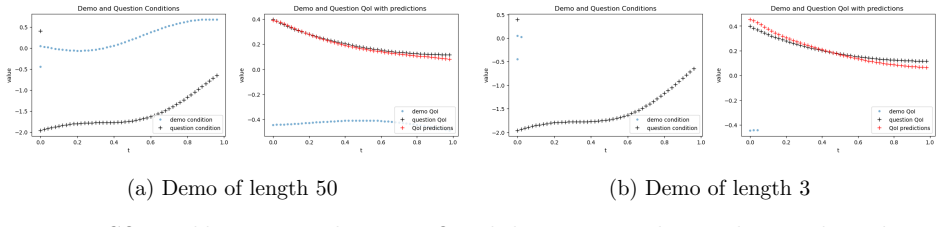
- The Bayesian view gives guidance on context size J: for identifiable problems with exact likelihoods, even a single demo can suffice, which the paper demonstrates numerically.
- Adding zero-mean observation noise to the quantity of interest leaves the conditional mean unchanged, explaining observed denoising behavior with partial, noisy observations.
- Sampling from GenICON provides empirical variances and credible bands for PDE solutions, delivering uncertainty quantification without redesigning the solver.
Where Pith is reading between the lines
- The same random-differential-equation reading could be exported to other multi-operator foundation models, turning their deterministic predictions into posterior means and proposing generative counterparts; the paper only gestures at this.
- GenICON's sample variance gives a testable calibration target: train on a family with a known posterior and check that the empirical variance matches the true posterior variance, not just the observation-noise level.
- Since Theorem 4.1 is agnostic to the generator architecture, GenICON could be combined with diffusion or normalizing-flow generators on function spaces rather than GANs alone.
- A more ambitious extension is using GenICON as a likelihood-free posterior sampler for model parameters: conditioning on quantities of interest and sampling latent codes could estimate posterior distributions on coefficients, an inverse-problem use case the paper raises but does not implement.
Editorial analysis
A structured set of objections, weighed in public.
Referee Report
Summary. The paper develops a probabilistic operator-learning framework based on random differential equations, shows that the least-squares objective used to train in-context operator networks is the L2 projection onto the conditional expectation of the posterior predictive distribution, and introduces GenICON, a conditional generative model to sample from that distribution. The main theoretical results (Theorems 3.1, 4.1, 4.2) establish the conditional-expectation interpretation, the existence of a generative map, and the equivalence of its mean to the deterministic ICON. Numerical experiments on 1D ODE/PDE problems illustrate robustness to non-identifiability and noise and demonstrate that GenICON's empirical variance tracks the injected noise level.
Significance. The probabilistic interpretation is a useful conceptual contribution: it connects ICON to Bayesian inference and likelihood-free inference in function spaces, and it motivates a generative extension with potential UQ benefits. The theorems are correctly stated and their proofs are standard. The existence theorem for infinite-dimensional conditional generative models is simple but worth stating. However, the practical UQ claims are not supported by the current experimental evidence, and the central identification relies on an unquantified approximation.
major comments (3)
- [Section 3.1–3.2, Theorem 3.1 and Eq. (16)] The paper claims ICON computes/approximates the posterior predictive mean. Theorem 3.1 characterizes the population minimizer T* over all Σ-measurable functions, but the trained model T_θ solves the finite-sample, parametric least-squares problem (16). No approximation or generalization error bound is given, and no validation criterion checks whether T_θ is close to T*. The same gap affects GenICON: Theorem 4.1 guarantees an exact generative map, while (31) trains a parametric GAN on finite data. Section 6 acknowledges 'approximation and finite-sample error,' but the abstract and Section 3.3 state the identification without this caveat. The claims should be reformulated as approximate/implicit, or supported by consistency/generalization analysis.
- [Section 5.3, Table 2 and Section 5.4] The quantitative evaluation of GenICON's UQ reduces to comparing the average empirical variance of generated samples to the prescribed observation-noise variance. This is a single-moment, self-consistency check; it does not demonstrate that the conditional distribution is calibrated. No coverage of credible intervals, proper scoring rules, or distributional distance to the true posterior predictive is reported. Section 5.4 reports boundary-variance behavior, but again no calibration metric. Given that the paper's central practical contribution is 'principled uncertainty quantification,' this evidence is insufficient. Either add proper UQ metrics or substantially temper the claims.
- [Section 5 and Appendix A] All numerical demonstrations are on 1D ODE/PDE problems, and no code or data are released. The claims about foundation-model capabilities and general applicability would be better supported by a benchmark on a higher-dimensional problem and by releasing code/data for reproducibility. The absence of baselines (e.g., ensemble ICON, dropout UQ, Gaussian processes) makes it hard to judge the benefit of GenICON over simpler alternatives.
minor comments (4)
- [Theorem 4.1] Notation mismatch: the theorem states a reference random variable η∼P_η on H, but the pushforward is written as P_x. Use P_η consistently throughout the statement and proof.
- [Section 5.2] The text refers to '1000 source terms k(x,ω)', but in the random BVP of Section 2.3 k is a coefficient/permeability field and c is the source term. Please clarify the terminology.
- [Figure 7 caption] The boundary values are given with excessive precision (u_0 = -0.38746364, u_1 = -0.14212306). Round to a reasonable number of digits.
- [Appendix A] The target Lipschitz constant L appearing in Eq. (32) is never specified; only the penalty weight λ=0.1 is listed in Table 4. State the value of L (presumably 1) and the precise form of the noise input dimension.
Circularity Check
No significant circularity: the main claims follow from standard L2 projection theory and explicit definitions, while the acknowledged approximation gaps are correctness risks rather than circular reasoning.
full rationale
The paper's central derivation, that ICON approximates the posterior predictive mean, rests on Theorem 3.1, which is the standard Hilbert-space characterization of conditional expectation as the minimizer of mean-squared error. This is a mathematical identity, not an assumption equivalent to the conclusion. The training objective (16) is an empirical Monte Carlo version of that L2 minimization; the paper does not claim that finite transformers provably attain the true minimizer, and indeed Section 6 explicitly states: 'Our method assumes the GenICON model exactly characterizes the posterior predictive, but practical implementations incur approximation and finite-sample error.' That is a transparent limitation, not a disguised circular premise. The identification of the ICON conditional measure (19) with the posterior predictive distribution (25) follows directly from the definitions of the generative model and Bayes' rule; it is an interpretive equivalence, not an input to the training argument. Theorem 4.1 is a standard measurable-map existence result for non-atomic probability measures, and Theorem 4.2 is explicitly proved 'immediately by the definition of a pushforward measure' — a consistency check, not a predictive claim. The cited prior work by the authors, including the original ICON papers and the (f,Γ)-divergence, supplies architectures and divergence tools; it is not the load-bearing justification for the Bayesian inference claim. No fitted parameter is renamed as a prediction, and the GenICON uncertainty estimates are empirically compared against known noise levels. Therefore, no circular step meeting the stated evidentiary standard is present.
Axiom & Free-Parameter Ledger
free parameters (3)
- gradient penalty coefficient lambda =
0.1
- Lipschitz constant L =
not specified
- training ratio (discriminator:generator) =
5:1
axioms (5)
- standard math Separability of the Banach and Hilbert spaces (A, Y, Z, H) is required for regular conditional probabilities and Bochner integration.
- standard math Hilbert space projection theorem characterizes conditional expectation as an L2 projection.
- standard math Borel isomorphism theorem for non-atomic probability measures on Polish spaces.
- standard math Kernel representation lemma for regular conditional probability kernels.
- domain assumption The data generating process for ICON follows the random differential equation formalism with independent parameters and conditions.
Cite this review
Pith. "Pith review of Probabilistic operator learning: generative modeling and uncertainty quantification for foundation models of differential equations." pith.science (2026). https://pith.science/paper/O7HAV35L
@misc{pith2026250905186,
  author       = {Pith},
  title        = {Pith review of: Probabilistic operator learning: generative modeling and uncertainty quantification for foundation models of differential equations},
  year         = {2026},
  howpublished = {\url{https://pith.science/paper/O7HAV35L}},
  note         = {Machine review of arXiv:2509.05186}
}
read the original abstract
In-context operator networks (ICON) are a class of operator learning methods based on the novel architectures of foundation models. Trained on a diverse set of datasets of initial and boundary conditions paired with corresponding solutions to ordinary and partial differential equations (ODEs and PDEs), ICON learns to map example condition-solution pairs of a given differential equation to an approximation of its solution operator. Here, we present a probabilistic framework that reveals ICON as implicitly performing Bayesian inference, where it computes the mean of the posterior predictive distribution over solution operators conditioned on the provided context, i.e., example condition-solution pairs. The formalism of random differential equations provides the probabilistic framework for describing the tasks ICON accomplishes while also providing a basis for understanding other multi-operator learning methods. This probabilistic perspective provides a basis for extending ICON to \emph{generative} settings, where one can sample from the posterior predictive distribution of solution operators. The generative formulation of ICON (GenICON) captures the underlying uncertainty in the solution operator, which enables principled uncertainty quantification in the solution predictions in operator learning.
Figures




Forward citations
Cited by 2 Pith papers
-
Harness In-Context Operator Learning with Chain of Operators
CHOP reduces relative inference error on OOD operator tasks for scalar conservation laws and mean-field control by composing frozen ICON with explicit closed-form elementary operators that remain interpretable.
-
Multiple Neural Operators Achieve Near-Optimal Rates for Multi-Task Learning
Multiple Neural Operators achieve near-optimal approximation and generalization rates for multi-task operator learning, matching single-task scaling laws and performing similarly to a multi-task DeepONet extension.
Reference graph
Works this paper leans on
-
[1]
Fourier Neural Operator for parametric partial differential equations
Zongyi Li, Nikola Borislavov Kovachki, Kamyar Azizzadenesheli, Kaushik Bhattacharya, An- drew Stuart, Anima Anandkumar, et al. Fourier Neural Operator for parametric partial differential equations. InInternational Conference on Learning Representations, 2021
work page 2021
-
[2]
Lu Lu, Pengzhan Jin, and George Em Karniadakis. DeepONet: Learning nonlinear oper- ators for identifying differential equations based on the universal approximation theorem of operators.arXiv preprint arXiv:1910.03193, 2019. 25
Pith/arXiv arXiv 1910
-
[3]
In-context operator learning with data prompts for differential equation problems.Proceedings of the National Academy of Sciences, 120(39):e2310142120, 2023
Liu Yang, Siting Liu, Tingwei Meng, and Stanley J Osher. In-context operator learning with data prompts for differential equation problems.Proceedings of the National Academy of Sciences, 120(39):e2310142120, 2023
2023
-
[4]
Liu Yang, Siting Liu, and Stanley J Osher. Fine-tune language models as multi-modal differ- ential equation solvers.arXiv preprint arXiv:2308.05061, 2023
Pith/arXiv arXiv 2023
-
[5]
PDE Generalization of In-Context Operator Networks: A Study on 1D Scalar Nonlinear Conservation Laws
Liu Yang and Stanley J Osher. PDE generalization of in-context operator networks: A study on 1D scalar nonlinear conservation laws.arXiv preprint arXiv:2401.07364, 2024
work page internal anchor Pith review Pith/arXiv arXiv 2024
-
[6]
Poseidon: Efficient foundation models for PDEs
Maximilian Herde, Bogdan Raoni´ c, Tobias Rohner, Roger K¨ appeli, Roberto Molinaro, Em- manuel de B´ ezenac, and Siddhartha Mishra. Poseidon: Efficient foundation models for PDEs. arXiv preprint arXiv:2405.19101, 2024
Pith/arXiv arXiv 2024
-
[7]
Jingmin Sun, Yuxuan Liu, Zecheng Zhang, and Hayden Schaeffer. Towards a foundation model for partial differential equation: Multi-operator learning and extrapolation.arXiv preprint arXiv:2404.12355, 2024
Pith/arXiv arXiv 2024
-
[8]
Shashank Subramanian, Peter Harrington, Kurt Keutzer, Wahid Bhimji, Dmitriy Morozov, Michael W Mahoney, and Amir Gholami. Towards foundation models for scientific machine learning: Characterizing scaling and transfer behavior.Advances in Neural Information Pro- cessing Systems, 36, 2024
work page 2024
-
[9]
Prose: Predicting multiple operators and symbolic expressions using multimodal transformers.Neural Networks, 180:106707, 2024
Yuxuan Liu, Zecheng Zhang, and Hayden Schaeffer. Prose: Predicting multiple operators and symbolic expressions using multimodal transformers.Neural Networks, 180:106707, 2024
2024
-
[10]
Yuxuan Liu, Jingmin Sun, and Hayden Schaeffer. BCAT: A block causal transformer for PDE foundation models for fluid dynamics.arXiv preprint arXiv:2501.18972, 2025
Pith/arXiv arXiv 2025
-
[11]
A foundation model for the Earth system.Nature, pages 1–8, 2025
Cristian Bodnar, Wessel P Bruinsma, Ana Lucic, Megan Stanley, Anna Allen, Johannes Brand- stetter, Patrick Garvan, Maik Riechert, Jonathan A Weyn, Haiyu Dong, et al. A foundation model for the Earth system.Nature, pages 1–8, 2025
work page 2025
-
[12]
Zhongkai Hao, Chang Su, Songming Liu, Julius Berner, Chengyang Ying, Hang Su, Anima Anandkumar, Jian Song, and Jun Zhu. Dpot: Auto-regressive denoising operator transformer for large-scale PDE pre-training.arXiv preprint arXiv:2403.03542, 2024
Pith/arXiv arXiv 2024
-
[13]
Multiple physics pretraining for physical surrogate models.arXiv preprint arXiv:2310.02994, 2023
Michael McCabe, Bruno R´ egaldo-Saint Blancard, Liam Holden Parker, Ruben Ohana, Miles Cranmer, Alberto Bietti, Michael Eickenberg, Siavash Golkar, Geraud Krawezik, Francois Lanusse, et al. Multiple physics pretraining for physical surrogate models.arXiv preprint arXiv:2310.02994, 2023
Pith/arXiv arXiv 2023
-
[14]
Operator learning: Algorithms and analysis.arXiv preprint arXiv:2402.15715, 2024
Nikola B Kovachki, Samuel Lanthaler, and Andrew M Stuart. Operator learning: Algorithms and analysis.arXiv preprint arXiv:2402.15715, 2024
Pith/arXiv arXiv 2024
-
[15]
Language models are unsupervised multitask learners.OpenAI Blog, 1(8):9, 2019
Alec Radford, Jeffrey Wu, Rewon Child, David Luan, Dario Amodei, Ilya Sutskever, et al. Language models are unsupervised multitask learners.OpenAI Blog, 1(8):9, 2019
work page 2019
-
[16]
Tom Brown, Benjamin Mann, Nick Ryder, Melanie Subbiah, Jared D Kaplan, Prafulla Dhari- wal, Arvind Neelakantan, Pranav Shyam, Girish Sastry, Amanda Askell, et al. Language models are few-shot learners.Advances in Neural Information Processing Systems, 33:1877– 1901, 2020. 26
work page 1901
- [17]
-
[18]
An explanation of in-context learning as implicit Bayesian inference
Sang Michael Xie, Aditi Raghunathan, Percy Liang, and Tengyu Ma. An explanation of in-context learning as implicit Bayesian inference. InInternational Conference on Learning Representations, 2022
work page 2022
-
[19]
The frontier of simulation-based inference
Kyle Cranmer, Johann Brehmer, and Gilles Louppe. The frontier of simulation-based inference. Proceedings of the National Academy of Sciences, 117(48):30055–30062, 2020
work page 2020
-
[20]
Katsoulakis, and Luc Rey-Bellet
Panagiota Birmpa, Jinchao Feng, Markos A. Katsoulakis, and Luc Rey-Bellet. Model uncer- tainty and correctability for directed graphical models.SIAM/ASA Journal on Uncertainty Quantification, 10(4):1461–1512, 2022
work page 2022
-
[21]
Sang Michael Xie, Aditi Raghunathan, Percy Liang, and Tengyu Ma. An explanation of in-context learning as implicit Bayesian inference.arXiv preprint arXiv:2111.02080, 2021
Pith/arXiv arXiv 2021
-
[22]
Transformers can do Bayesian inference
Samuel M¨ uller, Noah Hollmann, Sebastian Pineda Arango, Josif Grabocka, and Frank Hutter. Transformers can do Bayesian inference. InInternational Conference on Learning Represen- tations, 2022
work page 2022
-
[23]
Neural operator: Learning maps between function spaces with applications to PDEs.Journal of Machine Learning Research, 24(89):1–97, 2023
Nikola Kovachki, Zongyi Li, Burigede Liu, Kamyar Azizzadenesheli, Kaushik Bhattacharya, Andrew Stuart, and Anima Anandkumar. Neural operator: Learning maps between function spaces with applications to PDEs.Journal of Machine Learning Research, 24(89):1–97, 2023
2023
- [24]
-
[25]
Springer Science & Business Media, 2012
Nicholas Vakhania, Vazha Tarieladze, and Sergei Chobanyan.Probability Distributions on Banach Spaces, volume 14. Springer Science & Business Media, 2012
work page 2012
-
[26]
Springer Cham, 3 edition, 2021
Olav Kallenberg.Foundations of Modern Probability, volume 99 ofProbability Theory and Stochastic Modelling. Springer Cham, 3 edition, 2021
work page 2021
-
[27]
Springer Science & Business Media, 2013
Michel Ledoux and Michel Talagrand.Probability in Banach Spaces: Isoperimetry and Pro- cesses. Springer Science & Business Media, 2013
2013
-
[28]
Naimeng Ye, Hanming Yang, Andrew Siah, and Hongseok Namkoong. Exchangeable se- quence models can naturally quantify uncertainty over latent concepts.arXiv preprint arXiv:2408.03307, 2024
Pith/arXiv arXiv 2024
-
[29]
Fabian Falck, Ziyu Wang, and Chris Holmes. Is in-context learning in large language models Bayesian? a martingale perspective.arXiv preprint arXiv:2406.00793, 2024
Pith/arXiv arXiv 2024
-
[30]
Ankush Ganguly, Sanjana Jain, and Ukrit Watchareeruetai. Amortized variational inference: A systematic review.Journal of Artificial Intelligence Research, 78:167–215, 2023
work page 2023
-
[31]
Condi- tional sampling with monotone GANs: From generative models to likelihood-free inference
Ricardo Baptista, Bamdad Hosseini, Nikola B Kovachki, and Youssef M Marzouk. Condi- tional sampling with monotone GANs: From generative models to likelihood-free inference. SIAM/ASA Journal on Uncertainty Quantification, 12(3):868–900, 2024
work page 2024
-
[32]
Bamdad Hosseini, Alexander W Hsu, and Amirhossein Taghvaei. Conditional optimal trans- port on function spaces.SIAM/ASA Journal on Uncertainty Quantification, 13(1):304–338, 2025. 27
work page 2025
-
[33]
Conditional generative adversarial nets.arXiv preprint arXiv:1411.1784, 2014
Mehdi Mirza and Simon Osindero. Conditional generative adversarial nets.arXiv preprint arXiv:1411.1784, 2014
Pith/arXiv arXiv 2014
-
[34]
Christian Jacobsen, Yilin Zhuang, and Karthik Duraisamy. Cocogen: Physically consistent and conditioned score-based generative models for forward and inverse problems.SIAM Journal on Scientific Computing, 47(2):C399–C425, 2025
work page 2025
-
[35]
Generative adversarial neural operators.Transactions on Machine Learning Research, 2022
Md Ashiqur Rahman, Manuel A Florez, Anima Anandkumar, Zachary E Ross, and Kamyar Azizzadenesheli. Generative adversarial neural operators.Transactions on Machine Learning Research, 2022
work page 2022
-
[36]
Infinite-dimensional diffusion models.Journal of Machine Learning Research, 25(414):1–52, 2024
Jakiw Pidstrigach, Youssef Marzouk, Sebastian Reich, and Sven Wang. Infinite-dimensional diffusion models.Journal of Machine Learning Research, 25(414):1–52, 2024
2024
-
[37]
Score-based diffusion models in function space.arXiv preprint arXiv:2302.07400, 2023
Jae Hyun Lim, Nikola B Kovachki, Ricardo Baptista, Christopher Beckham, Kamyar Aziz- zadenesheli, Jean Kossaifi, Vikram Voleti, Jiaming Song, Karsten Kreis, Jan Kautz, et al. Score-based diffusion models in function space.arXiv preprint arXiv:2302.07400, 2023
Pith/arXiv arXiv 2023
-
[38]
Paul Hagemann, Sophie Mildenberger, Lars Ruthotto, Gabriele Steidl, and Nicole Tianjiao Yang. Multilevel diffusion: Infinite dimensional score-based diffusion models for image gener- ation.SIAM Journal on Mathematics of Data Science, 7(3):1337–1366, 2025
work page 2025
-
[39]
Christopher KI Williams and Carl Edward Rasmussen.Gaussian Processes for Machine Learn- ing, volume 2. MIT Press Cambridge, MA, 2006
work page 2006
-
[40]
Jeremiah Birrell, Paul Dupuis, Markos A Katsoulakis, Yannis Pantazis, and Luc Rey-Bellet. (f,Γ)-divergences: Interpolating betweenf-divergences and integral probability metrics.Jour- nal of Machine Learning Research, 23(39):1–70, 2022
work page 2022
-
[41]
Wasserstein generative adversarial networks
Martin Arjovsky, Soumith Chintala, and L´ eon Bottou. Wasserstein generative adversarial networks. InInternational Conference on Machine Learning, pages 214–223. PMLR, 2017
work page 2017
-
[42]
Dongbin Xiu and George Em Karniadakis. The Wiener–Askey polynomial chaos for stochastic differential equations.SIAM Journal on Scientific Computing, 24(2):619–644, 2002
work page 2002
-
[43]
Polynomial Chaos Expansion for Operator Learning
Himanshu Sharma, Luk´ aˇ s Nov´ ak, and Michael D Shields. Polynomial chaos expansion for operator learning.arXiv preprint arXiv:2508.20886, 2025
work page internal anchor Pith review Pith/arXiv arXiv 2025
-
[44]
Georgios Arampatzis, Stylianos Katsarakis, and Charalambos Makridakis. A generative modeling/Physics-Informed Neural Network approach to random differential equations.arXiv preprint arXiv:2507.01687, 2025. 28 A Generative ICON architecture and training We adopt a GAN framework where both the generator and discriminator are decoder-only Trans- formers with...
This paper was first reviewed by deepseek-v4-flash on August 5, 2026.
discussion (0)
Sign in with ORCID, Apple, or X to comment. Anyone can read and Pith papers without signing in.