REVIEW 3 major objections 4 minor 64 references
Educating the agentic engineer requires a wholesale shift from artifact production to judgment over autonomous systems.
Reviewed by Pith at T0; open to challenge. T0 means a machine referee read the full paper against a public rubric. the ladder, T0–T4 →
T0 review · deepseek-v4-flash
2026-08-03 03:36 UTC pith:O7LP5MO5
load-bearing objection A serious, honestly limited conceptual framework for educating AI supervisors — the staged-autonomy prevention claim is a design hypothesis, not a demonstrated result. the 3 major comments →
Educating the Agentic Engineer: Curricula, Collaboration, and Continuous Learning in the AI Era
The pith
A machine-rendered reading of the paper's core claim, the machinery that carries it, and where it could break.
Core claim
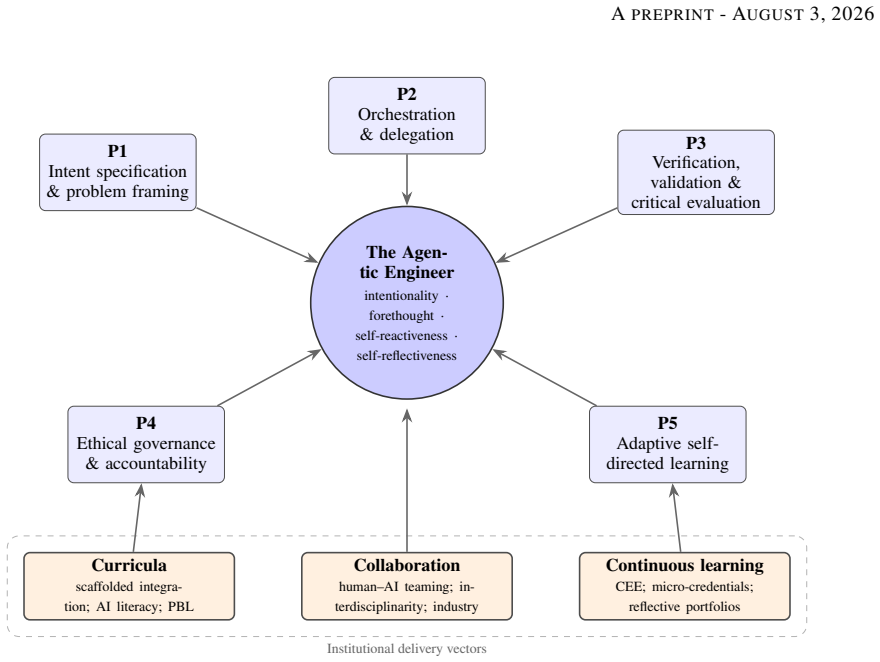
The paper's central claim is that educating the 'agentic engineer'—one who directs, verifies, and governs autonomous AI systems—requires systemic transformation, not incremental curricular change. It grounds this in agency theory, trust-in-automation research, and empirical findings that AI assistance benefits are uneven and often misperceived (experienced developers can be slower with AI while believing they are faster). The proposed ACCEL framework organizes five competency pillars—intent specification, orchestration and delegation, verification and critical evaluation, ethical governance, and adaptive self-directed learning—and maps them onto curricula, collaboration structures, and conti
What carries the argument
The load-bearing mechanism is the scaffolded curricular progression (Table 2) in which AI autonomy is expanded stage by stage, contingent on demonstrated verification competence. It is operationalized through a delegation–verification pedagogical loop: specify intent, delegate with guardrails, agent executes, verify against acceptance criteria, integrate or re-delegate, and reflect, with accountability gates on irreversible actions. This loop renders the supervisory cycle explicit, teachable, and assessable, and it anchors the paper's claim that assessment should target judgment rather than artifacts.
Load-bearing premise
The scaffolded progression assumes that withholding AI autonomy until students demonstrate verification competence will actually prevent dependency and deskilling; the paper itself notes this is a design hypothesis, not an empirically tested mechanism.
What would settle it
A randomized comparison of two otherwise identical courses—one using the ACCEL staged-autonomy progression, the other giving unstructured access—that measures students' unassisted problem-solving ability and reliance calibration at the end and after a delay. If unrestricted students match or exceed staged students on both, while staged students show no advantage in defect detection or calibration, the framework's central mitigation claim fails.
If this is right
- Degree programs should be re-architected around the five pillars, with AI literacy as a program-wide foundation rather than an elective.
- Assessment should shift from unassisted artifacts to portfolios, orchestration logs, defect-detection exercises, and reflective defenses, while retaining AI-restricted components to certify foundational understanding.
- Ethics must be integrated as governance engineering—bias audits, accountability matrices, red-team exercises—inside technical courses, not quarantined in standalone modules.
- Continuous learning becomes a designed outcome: micro-credentials, self-directed learning capacity, and personal learning infrastructure extend the degree into a career-length program.
- If staged autonomy works, it counters automation bias, deskilling, superficial engagement, and diffuse accountability—the four failure modes the framework is designed to mitigate.
Where Pith is reading between the lines
- The framework's logic suggests an analogous staging for other professions that will supervise autonomous systems, such as medicine, law, and operations.
- The emphasis on measured calibration implies that educational platforms should instrument acceptance decisions against ground truth, which could become a standard learning-analytics metric.
- The 'jagged frontier' evidence implies that curricula should teach students to diagnose which task regime they are in before choosing a reliance strategy, a meta-skill that transfers across tool generations.
- A testable extension: compare graduates of scaffolded-autonomy versus unrestricted-access programs on unassisted problem solving and reliance calibration in a longitudinal study.
Editorial analysis
A structured set of objections, weighed in public.
Referee Report
Summary. The paper argues that generative and agentic AI are shifting software/systems engineering from artifact production to direction, verification, and governance of autonomous systems, and that engineering education must therefore produce a new professional archetype, the 'agentic engineer.' It proposes the ACCEL framework (five competency pillars, three delivery vectors) with a scaffolded four-stage curricular progression, a delegation–verification pedagogical loop, redesigned assessment, and governance-literate ethics. The framework is presented as an integrative conceptual synthesis across engineering education, computing education, human–AI interaction, human factors, and learning sciences. The paper explicitly states in §11 that the framework has not been implemented and that its mitigation claims are design hypotheses; nevertheless, the abstract and conclusion claim that educating the agentic engineer 'requires systemic transformation rather than incremental curricular change.'
Significance. If the framework's underlying causal assumptions are ultimately supported, this would be a valuable synthesis that connects credible, mostly peer-reviewed evidence about AI-assisted programming, automation bias, and learning sciences into a coherent educational design. The paper's strengths are its explicit statement of limitations (§11), its cross-community convergence rule (§2), its concrete operationalization of competencies (Table 1), and a research agenda with falsifiable questions (§10.4). The scaffolded progression (Table 2) and the delegation–verification loop (Figure 2) are concrete design proposals that could seed empirical studies. However, the strongest prescriptive claim—that systemic curricular transformation is required—goes beyond what the cited evidence can support, because the central mechanism (staged autonomy preventing deskilling) is untested and the paper concedes this. The paper is best read as a design proposal with a validation agenda, not as an evidence-grounded conclusion that 'requires' systemic change.
major comments (3)
- [§5.2, Table 2, §12] The central claim—that educating the agentic engineer 'requires systemic transformation'—rests on the scaffolded-autonomy mechanism: granting AI autonomy only after verification competence is demonstrated prevents dependency and deskilling. The cited studies [23,24] document divergent outcomes under unstructured access, but none tests staged or contingent autonomy as a countermeasure. §11 concedes the framework is unimplemented and that mitigation claims are design hypotheses. A causal mechanism is asserted without direct evidence. To make the 'requires' claim defensible, the paper should either temper the conclusion to a design proposal, or present empirical support—even quasi-experimental—that staged restriction is necessary or sufficient. As written, the load-bearing assumption is unsupported.
- [§2, §11, abstract] The paper's evidence-grounding is weaker than stated. The abstract cites 'randomized and observational evidence' for uneven and misperceived AI benefits; the key randomized result [10] is an arXiv preprint, not peer-reviewed, and the characterization of AI-native practice draws substantially on the author's own preprints [1,12,13], as admitted in §11. The cross-community convergence rule (§2) is a reasonable expert heuristic, but convergence across two communities does not establish empirical validity. The claim in the abstract that the architecture is 'evidence-grounded' therefore needs qualification; a provenance table indicating which framework elements are supported by independent peer-reviewed evidence, self-cited preprints, or expert inference would make the grounding transparent.
- [§9, Table 3] The assessment redesign shifts the primary object from artifact to 'judgment,' assessed via orchestration logs, reflective portfolios, and reliance-calibration records. This is a coherent design principle, but its validity is assumed rather than demonstrated: the paper's own research agenda (question 3) asks whether such assessments predict professional performance. Moreover, process-based assessments are gameable—students may produce verbose logs that look reflective without being so. The conclusion that assessment 'measures judgment rather than artifacts' is thus premature. The paper should explicitly label this as a hypothesis requiring validation and specify minimal evidence (e.g., correlation with independent competence measures, inter-rater reliability) before it is presented as a settled principle.
minor comments (4)
- [§3.2, §8] Duplicated citation phrasing: '[14]’s [14] sense' and '[59]’s [59]' should be corrected to a single citation. Similarly, 'KeywordsAgentic' in the abstract lacks spacing.
- [Figures 1 and 2] The text explicitly references Figure 1 ('Figure 1 depicts...') and Figure 2, but no figures are present in the submitted manuscript. In a preprint this may be a rendering issue, but the figures (especially the delegation–verification loop) are integral to the argument and must be included.
- [Figure 1 caption] The abbreviation 'CEE' appears in the figure but is not defined (it presumably stands for 'continuing engineering education' from §7). Define all abbreviations in the caption.
- [Table 2] Stage 1 says 'generation restricted in assessed work' while the text (§5.2) says AI tutoring is used to support practice. Clarify whether AI generation is fully prohibited in all coursework or only in assessed components; the current phrasing may appear inconsistent.
Circularity Check
No significant circularity: ACCEL is an explicitly labeled conceptual framework and design agenda, not a fitted or self-referential derivation.
full rationale
The paper contains no mathematical predictions, fitted parameters, or equations whose outputs reduce to inputs by construction. Its central contribution, ACCEL, is presented as an 'integrative conceptual synthesis' (§2), and §11 explicitly concedes that 'the framework itself has not been implemented and evaluated as a whole; its mitigation claims are design hypotheses pending the studies outlined above.' The load-bearing empirical inputs are independent: uneven productivity effects [5,6], the perceived-vs-measured productivity gap [10,11], novice dependency patterns [24,30], and specification failure [53] are all peer-reviewed or archival external studies. Self-citations [1,12,13] are used primarily to label the 'agentic engineer' construct and to characterize 'AI-native practice,' but those characterizations are corroborated by independent sources cited in the same passages (e.g., [3,4,9,25,48]), and §11 states that every load-bearing claim is anchored to at least one independent peer-reviewed source. The scaffolded-autonomy proposal in Table 2 is an explicitly untested design hypothesis inferred from learning-science principles, not a prediction statistically forced by a fit. No uniqueness theorem from the authors' prior work is invoked, no ansatz is smuggled in via self-citation, and the acknowledged self-citation provenance is a stated limitation rather than a circular derivation chain. Therefore the derivation chain is self-contained in the sense required by the circularity analysis: the normative framework stands or falls on its explicitly declared empirical assumptions and future validation, not on circular reuse of its own outputs.
Axiom & Free-Parameter Ledger
axioms (7)
- domain assumption Bandura's four properties of human agency map one-to-one onto the five competency pillars of the agentic engineer.
- domain assumption Principal-agent theory applies to human–AI delegation and can be transposed to education as a structured decision problem.
- domain assumption Classic human-factors results on automation (levels of automation, misuse/disuse, irony of automation, trust calibration) transfer unchanged to generative and agentic AI.
- domain assumption The empirical findings on AI-assisted programming generalize to undergraduate engineering education and to the near-future agentic tools the framework targets.
- ad hoc to paper Granting AI autonomy only after demonstrated verification competence prevents dependency and deskilling.
- ad hoc to paper The cross-community convergence rule (a claim enters the framework if two research communities support it) is a valid method for deriving educational constructs.
- domain assumption Current curricular guidelines (CS2023, UNESCO AI competency frameworks) are insufficient because they omit orchestration, verification, and accountability outcomes.
invented entities (3)
-
The agentic engineer
no independent evidence
-
ACCEL framework (Agentic Competencies through Curricula, Collaboration, and Enduring Learning)
no independent evidence
-
Delegation–verification pedagogical loop
no independent evidence
read the original abstract
Generative and agentic artificial intelligence (AI) are reconfiguring software and systems engineering from a discipline centered on human authorship of artifacts to one focused on directing, verifying, and governing autonomous systems. This transition demands a new professional archetype, the \emph{agentic engineer}, whose enduring value lies in intent specification, orchestration of multi-agent workflows, critical evaluation of machine-generated outputs, and ethical judgment. This article presents an integrative conceptual synthesis across engineering education, computing education, human--AI interaction, human factors, and the learning sciences to derive an evidence-grounded educational architecture for this archetype. We introduce the ACCEL framework (Agentic Competencies through Curricula, Collaboration, and Enduring Learning), which organizes five competency pillars and maps them to three delivery vectors: curricula, collaboration, and continuous learning. Drawing on agency theory, trust-in-automation research, and empirical studies of AI-assisted programming, including evidence that AI benefits are unevenly realized and often misperceived, we propose a scaffolded curriculum, a delegation--verification pedagogical loop for human--AI teaming, redesigned assessment, governance-literate ethics integration, and alignment with current curricular guidelines and international AI competency frameworks. We identify key risks, including automation bias, deskilling, superficial engagement, and diffuse accountability, and conclude that educating the agentic engineer requires systemic transformation rather than incremental curricular change: instruction must shift from producing artifacts to exercising judgment over increasingly autonomous socio-technical systems.
Figures

Reference graph
Works this paper leans on
-
[1]
Mamdouh Alenezi. From determinism to delegation: AI-native software engineering and the evolution of the agentic engineer.arXiv preprint arXiv:2606.28791, 2026
Pith/arXiv arXiv 2026
-
[2]
Agentic AI in DevOps: Boosting software automation and collabo- ration
Mohammed Akour and Mamdouh Alenezi. Agentic AI in DevOps: Boosting software automation and collabo- ration. In2025 International Conference on Artificial Intelligence Security and Applications. IEEE, 2025
2025
-
[3]
Large language models for software engineering: A systematic literature review.ACM Transactions on Software Engineering and Methodology, 33(8):Article 220, 2024
Xinyi Hou, Yanjie Zhao, Yue Liu, Zhou Yang, Kailong Wang, Li Li, Xiapu Luo, David Lo, John Grundy, and Haoyu Wang. Large language models for software engineering: A systematic literature review.ACM Transactions on Software Engineering and Methodology, 33(8):Article 220, 2024
2024
-
[4]
Junwei Liu, Kaixin Wang, Yixuan Chen, Xin Peng, Zhenpeng Chen, Lingming Zhang, and Yiling Lou. Large language model-based agents for software engineering: A survey.ACM Transactions on Software Engineering and Methodology, 2026.https://doi.org/10.1145/3796507
doi:10.1145/3796507 2026
-
[5]
Sida Peng, Eirini Kalliamvakou, Peter Cihon, and Mert Demirer. The impact of AI on developer productivity: Evidence from GitHub Copilot.arXiv preprint arXiv:2302.06590, 2023
Pith/arXiv arXiv 2023
-
[6]
Generative AI at work.The Quarterly Journal of Eco- nomics, 140(2):889–942, 2025
Erik Brynjolfsson, Danielle Li, and Lindsey Raymond. Generative AI at work.The Quarterly Journal of Eco- nomics, 140(2):889–942, 2025
2025
-
[7]
Mollick, Hila Lifshitz-Assaf, Katherine Kellogg, Saran Rajendran, Lisa Krayer, Franc ¸ois Candelon, and Karim R
Fabrizio Dell’Acqua, Edward McFowland III, Ethan R. Mollick, Hila Lifshitz-Assaf, Katherine Kellogg, Saran Rajendran, Lisa Krayer, Franc ¸ois Candelon, and Karim R. Lakhani. Navigating the jagged technological frontier: Field experimental evidence of the effects of AI on knowledge worker productivity and quality. Technical Report Working Paper 24-013, Har...
2023
-
[8]
Glassman
Priyan Vaithilingam, Tianyi Zhang, and Elena L. Glassman. Expectation vs. experience: Evaluating the usability of code generation tools powered by large language models. InExtended Abstracts of the 2022 CHI Conference on Human Factors in Computing Systems, pages 1–7. ACM, 2022
2022
-
[9]
Gordon, Carina Negreanu, Christian Poelitz, Sruti Srinivasa Ragavan, and Ben Zorn
Advait Sarkar, Andrew D. Gordon, Carina Negreanu, Christian Poelitz, Sruti Srinivasa Ragavan, and Ben Zorn. What is it like to program with artificial intelligence? InProceedings of the 33rd Annual Conference of the Psychology of Programming Interest Group (PPIG 2022), 2022
2022
-
[10]
Joel Becker, Nate Rush, Beth Barnes, and David Rein. Measuring the impact of early-2025 AI on experienced open-source developer productivity.arXiv preprint arXiv:2507.09089, 2025
Pith/arXiv arXiv 2025
-
[11]
Alice Li, Andrew Rice, Devon Rifkin, Shawn Simister, Ganesh Sittam- palam, and Edward Aftandilian
Albert Ziegler, Eirini Kalliamvakou, X. Alice Li, Andrew Rice, Devon Rifkin, Shawn Simister, Ganesh Sittam- palam, and Edward Aftandilian. Measuring GitHub Copilot’s impact on productivity.Communications of the ACM, 67(3):54–61, 2024
2024
-
[12]
Mamdouh Alenezi. The rise of AI-native software engineering: Implications for practice, education, and the future workforce.arXiv preprint arXiv:2606.12986, 2026
Pith/arXiv arXiv 2026
-
[13]
Mamdouh Alenezi. Human–AI collaboration and the transformation of software engineering work.arXiv preprint arXiv:2606.03394, 2026
Pith/arXiv arXiv 2026
-
[14]
Toward a psychology of human agency.Perspectives on Psychological Science, 1(2):164–180, 2006
Albert Bandura. Toward a psychology of human agency.Perspectives on Psychological Science, 1(2):164–180, 2006
2006
-
[15]
Software engineering education in the era of conversational AI: Current trends and future directions.Frontiers in Artificial Intelligence, 7:1436350, 2024
Cigdem Sengul, Rumyana Neykova, and Giuseppe Destefanis. Software engineering education in the era of conversational AI: Current trends and future directions.Frontiers in Artificial Intelligence, 7:1436350, 2024
2024
-
[16]
Katz, Junaid Qadir, and Ashish Kohli
Aditya Johri, Andrew S. Katz, Junaid Qadir, and Ashish Kohli. Generative artificial intelligence and engineering education.Journal of Engineering Education, 112(3):572–577, 2023
2023
-
[17]
Emerging challenges in AI and the need for AI ethics education.AI and Ethics, 1:61–65, 2021
Jason Borenstein and Ayanna Howard. Emerging challenges in AI and the need for AI ethics education.AI and Ethics, 1:61–65, 2021
2021
-
[18]
Computer science curricula 2023 (CS2023): The final report
ACM/IEEE-CS/AAAI Joint Task Force on Computing Curricula. Computer science curricula 2023 (CS2023): The final report. Technical report, ACM, IEEE Computer Society, and AAAI, 2024
2023
-
[19]
UNESCO, Paris, 2024
Fengchun Miao and Kelly Shiohira.AI Competency Framework for Students. UNESCO, Paris, 2024
2024
-
[20]
UNESCO, Paris, 2024
Fengchun Miao and Mutlu Cukurova.AI Competency Framework for Teachers. UNESCO, Paris, 2024
2024
-
[21]
Becker, James Finnie-Ansley, Arto Hellas, Juho Leinonen, Andrew Luxton- Reilly, Brent N
Paul Denny, James Prather, Brett A. Becker, James Finnie-Ansley, Arto Hellas, Juho Leinonen, Andrew Luxton- Reilly, Brent N. Reeves, Eddie Antonio Santos, and Sami Sarsa. Computing education in the era of generative AI.Communications of the ACM, 67(2):56–67, 2024
2024
-
[22]
Becker, Ibrahim Albluwi, Michelle Craig, Hieke Keun- ing, Natalie Kiesler, Tobias Kohn, Andrew Luxton-Reilly, Stephen MacNeil, Andrew Petersen, Raymond Pettit, Brent N
James Prather, Paul Denny, Juho Leinonen, Brett A. Becker, Ibrahim Albluwi, Michelle Craig, Hieke Keun- ing, Natalie Kiesler, Tobias Kohn, Andrew Luxton-Reilly, Stephen MacNeil, Andrew Petersen, Raymond Pettit, Brent N. Reeves, and Jaromir Savelka. The robots are here: Navigating the generative AI revolution in comput- ing education. InProceedings of the ...
2023
-
[23]
Becker, Paul Denny, James Finnie-Ansley, Andrew Luxton-Reilly, James Prather, and Eddie Antonio Santos
Brett A. Becker, Paul Denny, James Finnie-Ansley, Andrew Luxton-Reilly, James Prather, and Eddie Antonio Santos. Programming is hard—or at least it used to be: Educational opportunities and challenges of AI code generation. InProceedings of the 54th ACM Technical Symposium on Computer Science Education (SIGCSE ’23), pages 500–506. ACM, 2023
2023
-
[24]
Ericson, David Weintrop, and Tovi Grossman
Majeed Kazemitabaar, Justin Chow, Carl Ka To Ma, Barbara J. Ericson, David Weintrop, and Tovi Grossman. Studying the effect of AI code generators on supporting novice learners in introductory programming. InPro- ceedings of the 2023 CHI Conference on Human Factors in Computing Systems, pages 1–23. ACM, 2023
2023
-
[25]
Taking flight with Copilot.Communications of the ACM, 66(6):56–62, 2023
Christian Bird, Denae Ford, Thomas Zimmermann, Nicole Forsgren, Eirini Kalliamvakou, Travis Lowdermilk, and Idan Gazit. Taking flight with Copilot.Communications of the ACM, 66(6):56–62, 2023
2023
-
[26]
Richard J. Torraco. Writing integrative literature reviews: Guidelines and examples.Human Resource Develop- ment Review, 4(3):356–367, 2005
2005
-
[27]
Literature review as a research methodology: An overview and guidelines.Journal of Business Research, 104:333–339, 2019
Hannah Snyder. Literature review as a research methodology: An overview and guidelines.Journal of Business Research, 104:333–339, 2019
2019
-
[28]
Froyd, Phillip C
Jeffrey E. Froyd, Phillip C. Wankat, and Karl A. Smith. Five major shifts in 100 years of engineering education. Proceedings of the IEEE, 100:1344–1360, 2012
2012
-
[29]
Lattuca, David B
Lisa R. Lattuca, David B. Knight, Hyun Kyoung Ro, and Brian J. Novoselich. Supporting the development of engineers’ interdisciplinary competence.Journal of Engineering Education, 106(1):71–97, 2017. 14 APREPRINT- AUGUST3, 2026
2017
-
[30]
Reeves, Juho Leinonen, Stephen MacNeil, Arisoa S
James Prather, Brent N. Reeves, Juho Leinonen, Stephen MacNeil, Arisoa S. Randrianasolo, Brett A. Becker, Bailey Kimmel, Jared Wright, and Ben Briggs. The widening gap: The benefits and harms of generative AI for novice programmers. InProceedings of the 2024 ACM Conference on International Computing Education Research (ICER ’24), pages 469–486. ACM, 2024
2024
-
[31]
Becker, Andrew Luxton-Reilly, and James Prather
James Finnie-Ansley, Paul Denny, Brett A. Becker, Andrew Luxton-Reilly, and James Prather. The robots are coming: Exploring the implications of OpenAI Codex on introductory programming. InProceedings of the 24th Australasian Computing Education Conference (ACE ’22), pages 10–19. ACM, 2022
2022
-
[32]
Said Elnaffar, Farzad Rashidi, and Abedallah Zaid Abualkishik. Teaching with AI: A systematic review of chatbots, generative tools, and tutoring systems in programming education.International Journal of Learning, Teaching and Educational Research, 25(1):1–28, 2026
2026
-
[33]
Bennett, Kori Inkpen, Jaime Teevan, Ruth Kikin-Gil, and Eric Horvitz
Saleema Amershi, Dan Weld, Mihaela V orvoreanu, Adam Fourney, Besmira Nushi, Penny Collisson, Jina Suh, Shamsi Iqbal, Paul N. Bennett, Kori Inkpen, Jaime Teevan, Ruth Kikin-Gil, and Eric Horvitz. Guidelines for human–AI interaction. InProceedings of the 2019 CHI Conference on Human Factors in Computing Systems, pages 1–13. ACM, 2019
2019
-
[34]
Lee and Katrina A
John D. Lee and Katrina A. See. Trust in automation: Designing for appropriate reliance.Human Factors, 46(1):50–80, 2004
2004
-
[35]
Humans and automation: Use, misuse, disuse, abuse.Human Factors, 39(2):230–253, 1997
Raja Parasuraman and Victor Riley. Humans and automation: Use, misuse, disuse, abuse.Human Factors, 39(2):230–253, 1997
1997
-
[36]
Sheridan, and Christopher D
Raja Parasuraman, Thomas B. Sheridan, and Christopher D. Wickens. A model for types and levels of human in- teraction with automation.IEEE Transactions on Systems, Man, and Cybernetics—Part A: Systems and Humans, 30(3):286–297, 2000
2000
-
[37]
Ironies of automation.Automatica, 19(6):775–779, 1983
Lisanne Bainbridge. Ironies of automation.Automatica, 19(6):775–779, 1983
1983
-
[38]
Human-centered artificial intelligence: Reliable, safe & trustworthy.International Journal of Human–Computer Interaction, 36(6):495–504, 2020
Ben Shneiderman. Human-centered artificial intelligence: Reliable, safe & trustworthy.International Journal of Human–Computer Interaction, 36(6):495–504, 2020
2020
-
[39]
Oxford University Press, Oxford, 2022
Ben Shneiderman.Human-Centered AI. Oxford University Press, Oxford, 2022
2022
-
[40]
Bernstein, and Ranjay Krishna
Helena Vasconcelos, Matthew J¨orke, Madeleine Grunde-McLaughlin, Tobias Gerstenberg, Michael S. Bernstein, and Ranjay Krishna. Explanations can reduce overreliance on AI systems during decision-making.Proceedings of the ACM on Human-Computer Interaction, 7(CSCW1):Article 129, 2023
2023
-
[41]
The National Academies Press, Washington, DC, 2018
National Academies of Sciences, Engineering, and Medicine.How People Learn II: Learners, Contexts, and Cultures. The National Academies Press, Washington, DC, 2018
2018
-
[42]
Barriers to student active learning in higher education.Teaching in Higher Education, 28(3):597–615, 2023
Kristin Børte, Katrine Nesje, and Sølvi Lillejord. Barriers to student active learning in higher education.Teaching in Higher Education, 28(3):597–615, 2023
2023
-
[43]
John Sweller, Jeroen J. G. van Merri ¨enboer, and Fred Paas. Cognitive architecture and instructional design: 20 years later.Educational Psychology Review, 31:261–292, 2019
2019
-
[44]
Zimmerman
Barry J. Zimmerman. Becoming a self-regulated learner: An overview.Theory Into Practice, 41(2):64–70, 2002
2002
-
[45]
Sch ¨on.The Reflective Practitioner: How Professionals Think in Action
Donald A. Sch ¨on.The Reflective Practitioner: How Professionals Think in Action. Basic Books, New York, 1983
1983
-
[46]
Designing educational technologies in the age of AI: A learning sciences- driven approach.British Journal of Educational Technology, 50(6):2824–2838, 2019
Rose Luckin and Mutlu Cukurova. Designing educational technologies in the age of AI: A learning sciences- driven approach.British Journal of Educational Technology, 50(6):2824–2838, 2019
2019
-
[47]
ChatGPT for good? on opportunities and challenges of large language models for education.Learning and Individual Differences, 103:102274, 2023
Enkelejda Kasneci, Kathrin Seßler, Stefan K ¨uchemann, Maria Bannert, Daryna Dementieva, Frank Fischer, Urs Gasser, Georg Groh, Stephan G ¨unnemann, Eyke H ¨ullermeier, Stephan Krusche, Gitta Kutyniok, Tilman Michaeli, Claudia Nerdel, J ¨urgen Pfeffer, Oleksandra Poquet, Michael Sailer, Albrecht Schmidt, Tina Seidel, Matthias Stadler, Jochen Weller, Joche...
2023
-
[48]
James, and Nadia Polikarpova
Shraddha Barke, Michael B. James, and Nadia Polikarpova. Grounded Copilot: How programmers interact with code-generating models.Proceedings of the ACM on Programming Languages, 7(OOPSLA1):85–111, 2023
2023
-
[49]
O’Brien, Carrie J
Joon Sung Park, Joseph C. O’Brien, Carrie J. Cai, Meredith Ringel Morris, Percy Liang, and Michael S. Bern- stein. Generative agents: Interactive simulacra of human behavior. InProceedings of the 36th Annual ACM Symposium on User Interface Software and Technology (UIST ’23), pages 1–22. ACM, 2023
2023
-
[50]
Jensen and William H
Michael C. Jensen and William H. Meckling. Theory of the firm: Managerial behavior, agency costs and owner- ship structure.Journal of Financial Economics, 3(4):305–360, 1976. 15 APREPRINT- AUGUST3, 2026
1976
-
[51]
Maruping
Aaron Baird and Likoebe M. Maruping. The next generation of research on IS use: A theoretical framework of delegation to and from agentic IS artifacts.MIS Quarterly, 45(1):315–341, 2021
2021
-
[52]
Mar´ın, Melissa Bond, and Franziska Gouverneur
Olaf Zawacki-Richter, Victoria I. Mar´ın, Melissa Bond, and Franziska Gouverneur. Systematic review of research on artificial intelligence applications in higher education—where are the educators?International Journal of Educational Technology in Higher Education, 16(1):39, 2019
2019
-
[53]
Feldman, and Carolyn Jane Anderson
Francesca Lucchetti, Zixuan Wu, Arjun Guha, Molly Q. Feldman, and Carolyn Jane Anderson. Substance beats style: Why beginning students fail to code with LLMs. InProceedings of the 2025 Conference of the Nations of the Americas Chapter of the Association for Computational Linguistics (NAACL-HLT 2025), Volume 1: Long Papers, pages 8541–8610. Association for...
2025
-
[54]
Software engineering 2014: Curriculum guidelines for undergraduate degree programs in software engineering
ACM/IEEE-CS Joint Task Force on Computing Curricula. Software engineering 2014: Curriculum guidelines for undergraduate degree programs in software engineering. Technical report, ACM and IEEE Computer Society, 2015
2014
-
[55]
Bahar Memarian and Tenzin Doleck. Fairness, accountability, transparency, and ethics (FATE) in artificial in- telligence (AI) and higher education: A systematic review.Computers and Education: Artificial Intelligence, 5:100152, 2023
2023
-
[56]
Artificial intelligence risk management framework (AI RMF 1.0)
National Institute of Standards and Technology. Artificial intelligence risk management framework (AI RMF 1.0). Technical Report NIST AI 100-1, U.S. Department of Commerce, 2023
2023
-
[57]
Regulation (EU) 2024/1689 laying down harmonised rules on artificial intelligence (artificial intelligence act)
European Parliament and Council of the European Union. Regulation (EU) 2024/1689 laying down harmonised rules on artificial intelligence (artificial intelligence act). Official Journal of the European Union, L series, 2024
2024
-
[58]
UNESCO, Paris, 2021
Fengchun Miao, Wayne Holmes, Ronghuai Huang, and Hui Zhang.AI and Education: Guidance for Policy- Makers. UNESCO, Paris, 2021
2021
-
[59]
Principles alone cannot guarantee ethical AI.Nature Machine Intelligence, 1(11):501–507, 2019
Brent Mittelstadt. Principles alone cannot guarantee ethical AI.Nature Machine Intelligence, 1(11):501–507, 2019
2019
-
[60]
Lifelong learning—more than training.Journal of Interactive Learning Research, 11(3):265– 294, 2000
Gerhard Fischer. Lifelong learning—more than training.Journal of Interactive Learning Research, 11(3):265– 294, 2000
2000
-
[61]
What is AI literacy? competencies and design considerations
Duri Long and Brian Magerko. What is AI literacy? competencies and design considerations. InProceedings of the 2020 CHI Conference on Human Factors in Computing Systems, pages 1–16. ACM, 2020
2020
-
[62]
Forms of implementation and challenges of PBL in engineering education: A review of literature.European Journal of Engineering Education, 46(1):90–115, 2021
Juebei Chen, Anette Kolmos, and Xiangyun Du. Forms of implementation and challenges of PBL in engineering education: A review of literature.European Journal of Engineering Education, 46(1):90–115, 2021
2021
-
[63]
The enduring impact of gamification on software engineering stu- dents’ engagement.International Journal of Technology Enhanced Learning, 2024
Mohammed Akour and Mamdouh Alenezi. The enduring impact of gamification on software engineering stu- dents’ engagement.International Journal of Technology Enhanced Learning, 2024
2024
-
[64]
Computing curricula 2020: Paradigms for global computing education
CC2020 Task Force. Computing curricula 2020: Paradigms for global computing education. Technical report, ACM and IEEE Computer Society, 2020. 16
2020
discussion (0)
Sign in with ORCID, Apple, or X to comment. Anyone can read and Pith papers without signing in.