REVIEW 3 major objections 5 minor 35 references
Bose-Einstein condensates' repulsion skews time-of-flight fits by tens of percent
Reviewed by Pith at T0; open to challenge. T0 means a machine referee read the full paper against a public rubric. the ladder, T0–T4 →
T0 review · deepseek-v4-flash
2026-08-03 10:17 UTC pith:O7RFQL2P
load-bearing objection A practical error map for standard Bose-enhanced fits, built on a simulation whose main simplification (ballistic expansion) is acknowledged but not quantified. the 3 major comments →
Cloud parameter estimation for interacting BEC after time-of-flight
The pith
A machine-rendered reading of the paper's core claim, the machinery that carries it, and where it could break.
Core claim
Below the critical temperature, the condensate acts as a repulsive mean-field barrier that pushes thermal atoms out of the trap centre. During time-of-flight this reshapes the thermal cloud: at short times the column density develops a central dip, and at long times it becomes more peaked than the non-interacting Bose-enhanced distribution. Because the standard analytical fit cannot represent either deformation, it over- or under-estimates the thermal atom number and temperature depending on geometry, temperature, and flight time, with errors that persist in the long-time limit. The simulation, when used as a fitting model, reproduces the semi-ideal model's condensed fraction on experimental
What carries the argument
The central object is the effective single-particle potential V_th = V + 2U0 n0 — the mean-field repulsion of a Thomas-Fermi condensate acting on thermal atoms — which the simulation retains for the in-trap cloud while treating the release as ballistic. The expansion profile is then an integral over initial positions of a Bose distribution inside this deformed potential; the integral has no closed form and is evaluated numerically on grids, exploiting cylindrical symmetry. These deformed profiles are what cause fitted parameters to shift.
Load-bearing premise
The load-bearing approximation is that all interactions switch off abruptly when the trap is released, so the expansion is purely ballistic; if mean-field forces during the dense early phase of expansion are non-negligible, the simulated profiles and the error estimates shift.
What would settle it
Take a single partially condensed cloud, image it after two different times of flight, extract temperature and thermal atom number with the Bose-enhanced fit, and check whether the difference between the two extractions matches the simulation's predicted sign reversal and magnitude; alternatively, compare time-of-flight-extracted temperatures with a simultaneous in-situ minimally destructive temperature measurement — a mismatch larger than the predicted errors would falsify the model.
If this is right
- Thermal atom numbers extracted with the standard Bose-enhanced fit can be wrong by tens of percent, and temperatures by up to about 10%, depending on trap shape and reduced temperature.
- The errors do not vanish at long flight times, so simply waiting longer before imaging does not make the standard fit accurate.
- For a given experiment, the simulation can provide a correction map — error versus atom number, temperature, and time of flight — to place systematic uncertainties on the usual analysis.
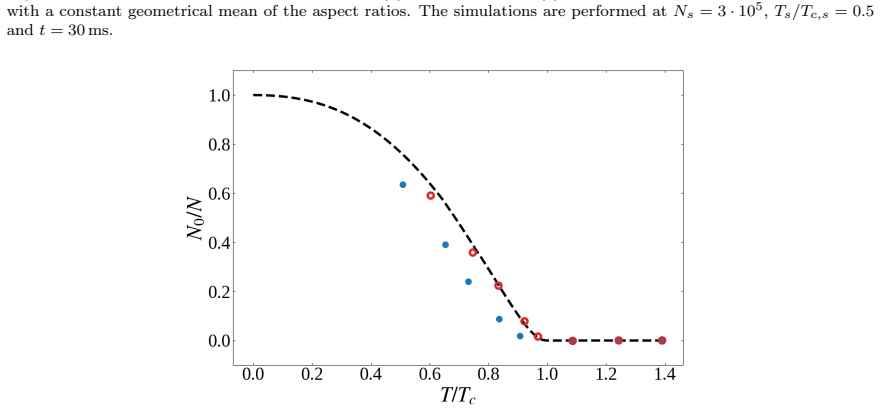
- Using the simulated profile as the fit function removes the largest part of the bias and brings extracted condensed fractions into line with the semi-ideal model.
- There is a trade-off: spherical traps give better temperature estimates but worse thermal-atom-number estimates when the standard fit is used.
Where Pith is reading between the lines
- If interactions during the early, dense part of time-of-flight were included, the error magnitudes and sign-reversal times would likely shift; the paper's conclusion that errors persist at long times is a lower bound for the realistic effect.
- The same numerical machinery could be extended to extract other quantities, such as the condensed fraction or chemical potential directly, and to non-axisymmetric traps by dropping the cylindrical-symmetry assumption.
- A direct experimental test would compare time-of-flight-extracted temperatures with an in-situ, minimally destructive measurement on the same cloud; agreement would validate the simulation as a correction tool.
Editorial analysis
A structured set of objections, weighed in public.
Referee Report
Summary. The paper addresses systematic errors in extracting temperature and thermal atom number from time-of-flight (TOF) absorption images of partially condensed Bose gases. The authors simulate the expansion of the thermal cloud by sampling the in-trap phase-space distribution in the combined harmonic trap plus the mean-field repulsion of a Thomas-Fermi condensate, then propagating the atoms ballistically to the image plane. Fitting these simulated profiles with the standard non-interacting Bose-enhanced distribution (Eq. (7)) yields error maps for N_th and T as functions of trap geometry, atom number, reduced temperature, and TOF (Figs. 5–9). The simulation is also used directly as a fitting function for experimental images, and the extracted BEC fractions are reported to agree better with the semi-ideal model than do results from the Bose-enhanced fit (Fig. 10). The central quantitative claims are that thermal-atom-number errors can reach tens of percent and temperature errors about 10%, and that these errors do not vanish at long TOF.
Significance. If the simulation is trustworthy, this is a practically useful study: TOF fitting with the Bose-enhanced distribution is ubiquitous, and quantified correction maps for common trap geometries and temperatures would be valuable. The paper has genuine strengths: the forward simulation is not circular in the fitting sense because the input parameters are known; grid convergence is explicitly checked in Figs. 2–3; the algorithm is described in sufficient detail to be reproduced; and the phenomenological explanations of the error patterns are plausible. However, the central results rest on the ballistic-expansion assumption, whose quantitative validity is not established, and the experimental validation is made against a model that shares the same conceptual structure as the simulation. These limitations must be addressed before the error maps can be relied upon as quantitative corrections.
major comments (3)
- [Sec. 3, Eq. (10)] The effective potential used in the simulation is written as V_eff = V + 2U_0 n_0 − μ = |μ − V|. The second equality is not correct: inside the Thomas-Fermi condensate V + 2U_0 n_0 = μ, so V_eff should be zero there, whereas |μ − V| is generally nonzero. If the numerical code implements the displayed equality literally, the in-trap distribution inside the condensate is wrong; if the code uses the correct piecewise expression, then Eq. (10) misstates the model and should be corrected. Because Eq. (10) is the foundation for all subsequent error maps, this inconsistency must be resolved and the implementation clarified.
- [Sec. 3 and Sec. 6] The load-bearing approximation is that interactions cease abruptly at release: the thermal cloud is propagated ballistically after the trap is switched off. The authors explicitly acknowledge that 'the simulations did not take interactions during the time-of-flight into account' and defer the issue to future work. This is not a minor caveat. At release the condensate density is maximal, and the mean-field force 2U_0|∇n_0| on nearby thermal atoms acts for a time ~1/ω. For typical parameters (μ/k_B ~ 100 nK, R ~ 10 μm), the resulting velocity change over a few ms is comparable to thermal velocities at T ~ 100 nK, so the early-time expansion can differ substantially from the ballistic trajectory. This would systematically shift the simulated profiles, the error maps in Figs. 5–9, and the experimental fits in Fig. 10. The manuscript should either quantify the validity of the ballistic approx
- [Sec. 5, Fig. 10] The experimental validation compares the simulation-based fit and the Bose-enhanced fit against the semi-ideal model [21]. This model, like the simulation, is built on Hartree-Fock mean-field repulsion from the condensate and neglects post-release interactions. The agreement in Fig. 10 therefore partly reflects internal consistency between the two models rather than an independent validation of the physical assumptions. The authors do note that the BEC and thermal components are fitted independently, which weakens the circularity, but the benchmark is still not independent. I recommend adding a discussion of this limitation or supplementing the comparison with measurements that do not rely on the same expansion model, such as in-situ probes or known thermodynamic relations.
minor comments (5)
- [Throughout] There are several typographical and LaTeX artifacts, including 'for for', 'uni00A0' in axis labels, and placeholder text 'LINK-LINK-LINK-LINK' in reference [13]. These should be cleaned before publication.
- [Sec. 2, Eq. (2) and Eq. (7)] The polylogarithm notation g_3/2 and g_2/g_3 is used without defining the subscript convention consistently. In particular, g_3(1) in Eq. (7) should be identified explicitly as ζ(3) or defined as the appropriate polylogarithm value.
- [Fig. 10] The text says the uncertainties of the mean values are too small to be visible. Please provide error bars in a table or an inset, since the claimed agreement with the semi-ideal model depends on the size of these uncertainties.
- [Sec. 4, Figs. 5–9] The color maps are not reproducible from the printed text alone. It would be helpful to state the exact numerical ranges and to mention whether the stripes visible in Fig. 6 are from the stated <1% numerical oscillation or from the plotting interpolation.
- [Sec. 3] The complexity statement O(ν^3 ξ^3) is useful, but the description of the parallel implementation on a GPU is very brief. A sentence on memory usage or typical runtime for the reported grids would aid reproducibility.
Circularity Check
No significant circularity: the error estimates are forward Monte Carlo comparisons with known simulation inputs, and the experimental validation is an external consistency check against the semi-ideal model.
full rationale
The central error analysis is a forward simulation: the paper chooses physical parameters (Ns, Ts, trap frequencies), generates a thermal-cloud expansion profile using an explicit model (Eq. (10)), and then fits that simulated profile with the Bose-enhanced distribution Eq. (7), comparing fitted Nth and T to the known simulation inputs. This is an open-loop numerical experiment, not a fit of a parameter that is then renamed as a prediction. The paper explicitly defines the errors as ΔNth = Nth - Nth,s and ΔT = T - Ts, so the 'predictions' are comparisons against known inputs. The experimental section is also not circular: the simulated distribution is used as a fitting function for independent experimental images, and the extracted condensed fraction is compared with the external semi-ideal model of Naraschewski and Stamper-Kurn (Ref. [21]). Although the simulation's in-trap effective potential is closely related to the semi-ideal model's potential, the simulation additionally assumes ballistic time-of-flight and is fitted to data independently; the paper itself notes this: 'Since the BEC and thermal components are fitted independently, the use of the semi-ideal model in the simulation of the cloud expansion does not guarantee that the BEC fraction follows the theoretically expected behavior as a function of temperature.' The stated limitation that 'The simulations did not take interactions during the time-of-flight into account' is an acknowledged approximation affecting the validity of the error estimates, not a circular step. Self-citations (e.g., Refs. [4] and [12]) support imaging calibration and apparatus details and are not load-bearing for the central derivation. No uniqueness theorem, ansatz, or fitted parameter is imported from the authors' prior work to force the result.
Axiom & Free-Parameter Ledger
free parameters (3)
- Grid sizes nu and xi =
nu=40, xi=60
- Fit exclusion radii =
1.2 R_i (inner), 3 w_i (outer)
- Initial condensate number N0,s in simulations =
Undisclosed
axioms (6)
- domain assumption At release, the thermal cloud is in equilibrium with the Bose-Einstein distribution under the condensate mean-field potential, and all interactions cease for the subsequent expansion.
- standard math The condensate is described by the Thomas-Fermi approximation and expands according to the scaling laws in Eq. (5).
- domain assumption The thermal mean-field term 2U0 n_th is negligible in both effective potentials.
- domain assumption The cloud and trap possess cylindrical symmetry, allowing a reduction of the numerical grid to two dimensions.
- standard math For the analytic Bose-enhanced fit, the fugacity is set to z=1 (chemical potential zero) for T<Tc.
- domain assumption The semi-ideal model of Ref. [21] is the correct benchmark for condensed fraction as a function of temperature.
read the original abstract
Experiments on Bose-Einstein condensates at finite temperature typically extract the system parameters, such as temperature, atom number, and condensed fraction from time-of-flight images taken after a free expansion time. This paper systematically examines the effect of repulsive interactions between the condensed and thermal atoms in partially condensed clouds on the expansion profile of the thermal cloud. An analytical expression for the expansion can be obtained only if the interactions between the Bose-Einstein condensate and thermal atoms are neglected, resulting in a Bose-enhanced distribution for the thermal component. Here, the deformation of the cloud due to interactions and the effects on estimated parameters are investigated by simulating the expansion using a ballistic approximation. By fitting the simulated expansion profiles with a Bose-enhanced distribution, the errors of using such a fit are estimated, and the results are explained phenomenologically. The simulation was also used as a fitting function for experimental data, showing better agreement of the extracted condensed fraction with the semi-ideal model than results from a Bose-enhanced fit.
Figures


Reference graph
Works this paper leans on
-
[1]
Ketterle W, Durfee D S and Stamper-Kurn D 1999 Making, probing and understanding Bose-Einstein condensates (IOS Press) pp 67–176
1999
-
[2]
Reinaudi G, Lahaye T, Wang Z and Guéry-Odelin D 2007Optics letters323143–3145
-
[3]
Veyron R, Mancois V, Gerent J B, Baclet G, Bouyer P and Bernon S 2022Physical Review Research4033033
-
[4]
Vibel T, Christensen M B, Kristensen M A, Thuesen J J, Stokholm L N, Weidner C A and Arlt J J 2024Journal of Physics B: Atomic, Molecular and Optical Physics
-
[5]
Hueck K, Luick N, Sobirey L, Siegl J, Lompe T, Moritz H, Clark L W and Chin C 2017Optics express258670–8679
-
[6]
Szczepkowski J, Gartman R, Witkowski M, Tracewski L, Zawada M and Gawlik W 2009 Review of Scientific Instruments80
2009
-
[7]
Muessel W, Strobel H, Joos M, Nicklas E, Stroescu I, Tomkovič J, Hume D B and Oberthaler M K 2013Applied Physics B11369–73
-
[8]
Genkina D, Aycock L, Stuhl B, Lu H I, Williams R and Spielman I 2015New Journal of Physics18013001
-
[9]
Putra A, Campbell D L, Price R M, De S and Spielman I 2014Review of Scientific Instruments85
-
[10]
Ramanathan A, Muniz S R, Wright K C, Anderson R P, Phillips W D, Helmerson K and Campbell G K 2012Rev. Sci. Instrum.83083119 URLhttps://pubs.aip.org/aip/rsi/ article/83/8/083119/358919/Partial-transfer-absorption-imaging-A-versatile
-
[11]
Arora P, Purnapatra S B, Acharya A, Kumar R and Sen Gupta A 2012MAPAN2731–39 ISSN 0974-9853 URLhttps://doi.org/10.1007/s12647-012-0003-3
-
[12]
Vibel T, Christensen M B, Andersen R M F, Stokholm L N, Pawłowski K, Rzążewski K, Kristensen M A and Arlt J J 2024Journal of Physics B: Atomic, Molecular and Optical Physics57195301 URLhttps://dx.doi.org/10.1088/1361-6455/ad7458
-
[13]
thesis Aarhus University URLLINK-LINK-LINK-LINK-LINK-LINK-LINK-LINK
Andersen M 2025Spectrally Probing Ultra-Cold Bosonic CloudsPh.D. thesis Aarhus University URLLINK-LINK-LINK-LINK-LINK-LINK-LINK-LINK
-
[14]
Schroeder D V 2014An Introduction to Thermal Physics1st ed (Pearson)
-
[15]
Pethick C J and Smith H 2008Bose-Einstein condensation in dilute gases2nd ed (Cambridge)
-
[16]
Gross E P 1961Il Nuovo Cimento20454–477
-
[17]
Pitaevskii L P 1961Soviet Physics JETP13451–454
-
[18]
Castin Y and Dum R 1996Phys. Rev. Lett.775315
-
[19]
Kagan Y, Surkov E L and Shlyapnikov G V 1996Phys. Rev. A54(3) R1753–R1756 URL https://link.aps.org/doi/10.1103/PhysRevA.54.R1753
-
[20]
Bagnato V, Pritchard D E and Kleppner D 1987Phys. Rev. A35(10) 4354–4358 URL https://link.aps.org/doi/10.1103/PhysRevA.35.4354 11
-
[21]
Naraschewski M and Stamper-Kurn D M 1998Phys. Rev. A582423
-
[22]
Giorgini S, Pitaevskii L P and Stringari S 1997Phys. Rev. Lett.783987
-
[23]
Griffin A 1996Phys. Rev. B539341
-
[24]
Görlitz A, Vogels J M, Leanhardt A E, Raman C, Gustavson T L, Abo-Shaeer J R, Chikkatur A P, Gupta S, Inouye S, Rosenband T and Ketterle W 2001Phys. Rev. Lett.87(13) 130402 URLhttps://link.aps.org/doi/10.1103/PhysRevLett.87.130402
-
[25]
Schweikhard V, Coddington I, Engels P, Mogendorff V P and Cornell E A 2004Phys. Rev. Lett.92(4) 040404 URLhttps://link.aps.org/doi/10.1103/PhysRevLett.92.040404
-
[26]
Burger S, Cataliotti F S, Fort C, Maddaloni P, Minardi F and Inguscio M 2002Europhysics Letters571 URLhttps://doi.org/10.1209/epl/i2002-00532-1
-
[27]
Hadzibabic Z, Stock S, Battelier B, Bretin V and Dalibard J 2004Phys. Rev. Lett.93(18) 180403 URLhttps://link.aps.org/doi/10.1103/PhysRevLett.93.180403
-
[28]
Andrews M R, Kurn D M, Miesner H J, Durfee D S, Townsend C G, Inouye S and Ketterle W 1997Phys. Rev. Lett.79(4) 553–556 URL https://link.aps.org/doi/10.1103/PhysRevLett.79.553
-
[29]
Ferioli G, Pancaldi S, Glicenstein A, Clément D, Browaeys A and Ferrier-Barbut I 2024Phys. Rev. Lett.132(13) 133601 URL https://link.aps.org/doi/10.1103/PhysRevLett.132.133601
-
[30]
Rychtarik D, Engeser B, Nägerl H C and Grimm R 2004Phys. Rev. Lett.92(17) 173003 URL https://link.aps.org/doi/10.1103/PhysRevLett.92.173003
-
[31]
Hammes M, Rychtarik D, Nägerl H C and Grimm R 2002Phys. Rev. A66(5) 051401 URL https://link.aps.org/doi/10.1103/PhysRevA.66.051401
-
[32]
Smith N L, Heathcote W H, Hechenblaikner G, Nugent E and Foot C J 2005Journal of Physics B: Atomic, Molecular and Optical Physics38223 URL https://doi.org/10.1088/0953-4075/38/3/007
-
[33]
thesis Aarhus University
Christensen M B 2020Microcanonical Fluctuations in Interacting Bose-Einstein Condensates Ph.D. thesis Aarhus University
-
[34]
Gajdacz M, Pedersen P L, Mørch T, Hilliard A J, Arlt J and Sherson J F 2013Review of Scientific Instruments84083105 ISSN 0034-6748 (Preprinthttps://pubs.aip.org/aip/ rsi/article-pdf/doi/10.1063/1.4818913/14781030/083105_1_online.pdf) URL https://doi.org/10.1063/1.4818913
work page doi:10.1063/1.4818913/14781030/083105_1_online.pdf
-
[35]
Kristensen M A, Gajdacz M, Pedersen P L, Klempt C, Sherson J F, Arlt J J and Hilliard A J 2017Journal of Physics B: Atomic, Molecular and Optical Physics50034004 URL https://dx.doi.org/10.1088/1361-6455/50/3/034004 12
discussion (0)
Sign in with ORCID, Apple, or X to comment. Anyone can read and Pith papers without signing in.