REVIEW 3 major objections 5 minor 130 references
Amplified capture rate of dark matter in compact binaries and constraints on bosonic dark matter from GW170817
T0 review · 3 major / 5 minor · reviewed 2026-08-15 · deepseek-v4-flash
Pith's one-line read The paper shows that neutron stars in binaries capture dark matter four to five times faster than isolated stars, tightening bosonic dark-matter bounds from GW170817.
desk verdict Plausible new amplification factor for DM capture in binaries, worth refereeing, but the central factor rests on an unsupported five-order-of-magnitude extrapolation that needs to be shown. read the letter →
The pith
A machine-rendered reading of the paper's core claim, the machinery that carries it, and where it could break.
The reading
What carries the argument
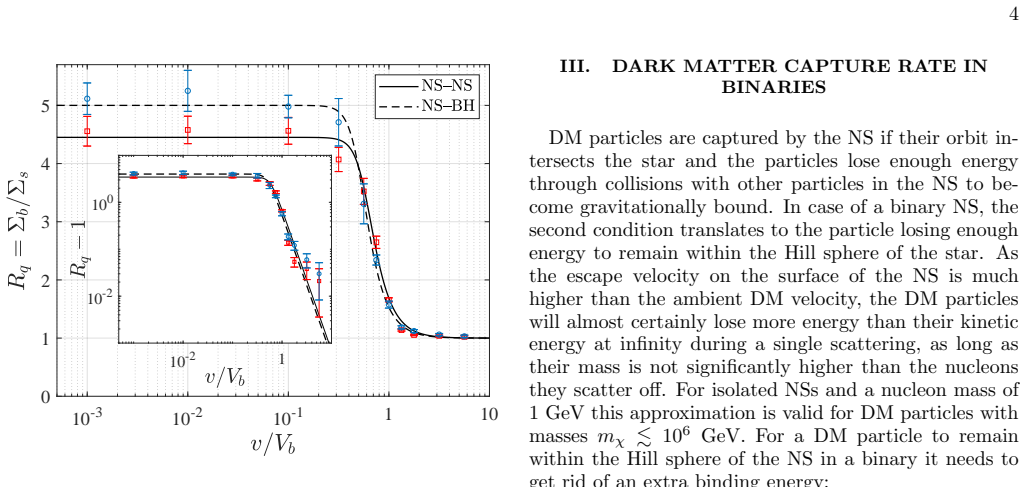
The load-bearing object is the restricted three-body scattering problem: test particles with a fixed velocity at infinity are injected toward a circular binary of masses $m_1,m_2$, and their orbits are integrated numerically, recording close encounters within the Hill sphere of each component. Because the test-particle orbits are non-integrable, a single particle can have multiple close encounters with the same star or with both stars, and the resulting flux ratio $R_q=\Sigma_b/\Sigma_s$ is the amplification factor. Gravitational dynamics is scale-free, so $R_q$ depends only on the dimensionless ratio $v/V_b$ of dark-matter velocity to binary orbital velocity, not on the individual values. The amplification is then folded into the standard capture-rate formula for neutron stars and integrated along the standard gravitational-wave inspiral for circular binaries, while the same scattering machinery supplies the dynamical-friction hardening rate that caps the total accreted mass.
What would settle it
Measure the eccentricity distribution of merging neutron-star binaries from gravitational-wave waveforms: if a substantial fraction merge with eccentricity larger than about 0.1 at frequencies where the orbital velocity is comparable to the dark-matter velocity dispersion, the circular-orbit integration fails as a description of the accretion history. Equivalently, a single old neutron-star merger in a high-dark-matter-density host whose delay time and dark-matter profile are well measured would let the bound be recomputed from event-specific parameters rather than the assumed 0.1 GeV/cm$^3$ and 220 km/s values, checking whether the factor-of-four tightening survives.
Extended reading notes
Core claim
On the paper's own terms, the central discovery is that the accretion flux of dark matter on neutron stars in a circular binary is not the sum of two isolated fluxes but a larger flux described by an amplification factor $R_q(v/V_b)$, which saturates near 4.5 when the dark-matter velocity is small compared with the binary orbital velocity and drops to unity when $v\gg V_b$. The factor is computed with few-body Monte Carlo scattering, fitted empirically as $R(x)=1+R_0[1+(x/w)^6]^{-1/2}$, and shown to be nearly constant over many orders of magnitude in encounter radius for $r\ll a$. Integrated over a gravitational-wave-driven inspiral, this gives about a fourfold increase in the number of captured particles for binaries that merge in roughly a Hubble time with a standard velocity dispersion of 220 km/s. From that increase, the paper derives a tighter upper bound on the bosonic dark-matter–nucleon scattering cross section from GW170817, and derives an upper bound of $\lesssim10^{-3}$ on the dark-matter mass fraction inside neutron stars at merger, enforced by the dynamical-friction drag of the ambient dark matter on the binary orbit.
Load-bearing premise
The calculation assumes the neutron stars spend essentially their whole lifetime as a circular binary whose separation shrinks only by gravitational waves and dark-matter dynamical friction; if real merger progenitors have significant eccentricity, form late from previously isolated neutron stars, or are hardened by other environmental processes, the integrated amplification and the derived constraints shift.
Editorial extensions
If this is right
- Dark-matter capture onto neutron stars in merging binaries is roughly four to five times the isolated-star rate over the inspiral, so earlier constraints built on isolated stars are conservative by about that factor.
- The upper bound on the bosonic dark-matter–nucleon scattering cross section derived from the observed binary neutron star merger GW170817 is correspondingly tighter than the isolated-star bound for the same host-galaxy assumptions.
- The accreted dark-matter mass fraction in binary neutron stars at merger is at most about $10^{-3}$, even in extreme dark-matter spikes, because dynamical friction drives the binary to merge before much mass can accumulate.
- The dynamical-friction cap applies to fermionic as well as bosonic dark matter, since it does not rely on collapse or annihilation inside the star.
- For the highest ambient dark-matter densities, the dynamical-friction dephasing of the gravitational-wave signal could become observable with upcoming space-based detectors.
Reading between the lines
- The authors apply the amplification to neutron stars, but the mechanism is purely gravitational and scale-free, so the same factor should multiply dark-matter capture in other compact or stellar binaries, such as white-dwarf binaries and black-hole–neutron-star binaries, whenever the binary spends a Hubble time at separations where $v_\chi\lesssim V_b$.
- They leave implicit that the amplification also raises the effective dark-matter exposure of old binaries in dense environments; a statistical sample of mergers with measured host-galaxy delay times could convert the single-event GW170817 bound into a population-level constraint.
- A testable extension is to check eccentric binaries: if a population of neutron-star mergers is found with non-negligible eccentricity, the circular-orbit integration used here would need to be repeated, and the resulting integrated amplification could be either larger or smaller depending on how much time the binary spends at wide separations.
- Because the amplification is geometric, it applies to any weakly interacting particle captured by neutron stars, not just bosonic ones; the authors note this for the mass-fraction cap, but the cross-section improvement would also propagate to other capture-based probes such as kinetic heating.
Signed reviews
Editorial analysis
A structured set of objections, weighed in public.
Referee Report
Summary. The paper argues that the flux of dark matter particles onto a stellar-mass compact object is amplified when the object is in a circular binary, because test-particle orbits in the restricted three-body problem are chaotic and can undergo repeated close encounters. The authors measure this amplification R_q(v/V_b) with a Monte Carlo simulation for two mass ratios (q=1 and q=0.28), fit the result to an empirical curve saturating at R_0 ~ 3.5-4.0, and then apply the factor to the DM capture rate of neutron stars in inspiraling binaries. Using this amplified capture rate, they derive updated upper bounds on the DM-nucleon scattering cross section from the non-collapse of the GW170817 binary, and they derive a cap on the accreted DM mass fraction enforced by dynamical friction from ambient DM. The main quantitative claim is that the amplification factor is approximately 4-5 for circular binaries with q ≳ 0.3 and small DM velocity dispersion, and that this tightens previous bosonic DM constraints by the same factor.
Significance. If the central amplification factor is correct, the paper adds a genuinely new physical ingredient to DM capture calculations: binary gravitational scattering can enhance the effective accretion flux beyond the isolated-star value. The simulation setup follows the established method of Quinlan (1993) and is described in enough detail that the procedure is credible. The amplification factor is computed independently of the DM-nucleon cross section, so there is no circularity in the resulting constraints. The GW170817-based bounds and the dynamical-friction mass-fraction cap are concrete, falsifiable predictions. The main risks are the unsupported small-radius extrapolation of R_q and the absence of statistical or systematic error estimates on the fitted amplification curve; both directly affect the claimed constraints. No code or data release is mentioned, which limits reproducibility of the central numerical result.
major comments (3)
- [Sec. II A, Eq. (7)] The constancy of R_q as a function of r/a is asserted but not demonstrated. The simulation records close encounters at r < 0.1 r_H, and for an equal-mass NS binary r_H = a (m_i/3M)^{1/3} ~ 0.55 a, so 0.1 r_H ~ 0.055 a, whereas the NS capture surface is at r_NS/a ~ 10^{-6}. The scale-free argument fixes only the dependence on v and V_b at fixed r/a; it does not exclude an additional r/a dependence at intermediate radii. Since Eqs. (17) and (20) and Figs. 4-5 all scale linearly with R_q, an unquantified 20% change in the extrapolation would directly shift the derived cross-section bounds and the DM-fraction cap. Please provide a figure or table showing R_q as a function of r/a for several v/V_b values down to the smallest resolved radius, together with statistical uncertainties, and state the range over which the plateau is actually verified.
- [Fig. 2, Table I] The empirical fit parameters R_0 and w are quoted without uncertainties, and the data points in Fig. 2 carry no error bars. Because the amplification factor enters as a linear prefactor in Eq. (17), the Monte Carlo statistical error in R_0 and the systematic uncertainty of the fitting form in Eq. (10) should be propagated into the cross-section bounds in Fig. 4. Additionally, the abstract's claim for q ≳ 0.3 rests on only two simulated mass ratios, q = 1 and q = 0.28; if that claim is retained, the authors should either simulate additional mass ratios or provide an explicit interpolation uncertainty for the q-dependence.
- [Discussion (final paragraph), Sec. IV] The final Discussion correctly acknowledges that the calculations assume negligible eccentricity and that eccentricity can significantly change the GW inspiral time. However, the GW170817 cross-section constraint and the DM-fraction limit in Figs. 4-5 are derived under the circular-orbit, GW-only inspiral assumption. Since the title highlights the GW170817 constraint, the authors should quantify how the integrated amplification changes for moderate initial eccentricities, for example by integrating Eq. (20) using Peters' eccentric-orbit inspiral rate, or explicitly restrict the title claim to binaries that circularize early.
minor comments (5)
- [Sec. IV A] In the sentence 'it is a topic of strong debate wether NS binaries', 'wether' should be 'whether'.
- [Fig. 2] The figure would benefit from explicit axis labels for x = v/V_b and y = R_q, and a legend identifying the error bars or noting their absence.
- [Table I] The table should report the uncertainties in R_0 and w obtained from the fit, and the text should state the reduced chi-squared or equivalent goodness-of-fit measure.
- [Sec. II A] The sentence 'All the orbits are unstable and thus eventually become expelled except for a set of initial condition with a volume of zero in the initial parameter space' is too strong given that integrations are truncated at 10^6 steps; please clarify how the truncation affects the recorded encounter statistics.
- [Sec. IV, abstract] The abstract refers to mass ratios q ≳ 0.3, but Section IV restricts the constraints to binary NSs with q = 1; aligning the wording would avoid overstating the coverage.
Circularity Check
No circularity: the amplification factor is a Monte Carlo output, and the GW170817 and collapse constraints use external inputs without author overlap.
full rationale
The derivation chain is self-contained. The central amplification factor R_q(v/V_b) is obtained in Sec. II A from Monte Carlo restricted-three-body scattering simulations, recorded as close-encounter fluxes and summarized by an empirical fit (Eq. 10, Table I); it is not fitted to any quantity derived from GW170817 or from the collapse thresholds. The subsequent capture-rate formula (Eq. 17) combines this simulated flux with the independently sourced single-scattering optical-depth threshold and collapse thresholds from Singh et al. [11], whose authors do not overlap with the present paper. The GW170817 bound (Sec. IV C 1) only inserts external astrophysical inputs (density, velocity dispersion, delay time) into the same formula. The maximum accreted fraction (Sec. IV D) uses the same simulated R_q and a dynamical-friction hardening rate from Quinlan [93], again external. The only author-overlapping citations (refs. 122-125) appear in a peripheral discussion of possible dephasing detectability and are not load-bearing for any derived constraint. A numerical-support gap exists in the assertion that R_q is constant from r < 0.1 r_H down to the NS radius without shown convergence data in the paper, but this is an extrapolation and reproducibility concern, not circularity: no equation defining R_q encodes the target observable, and no fitted parameter is renamed as a prediction.
Assumptions & free parameters
free parameters (5)
- R0 (amplification plateau) =
3.45 for q=1; 4.00 for q=0.28
- w (velocity falloff scale) =
0.59 for q=1; 0.51 for q=0.28
- H (dynamical friction factor) =
≈28
- Dark matter density at GW170817 location =
0.1 GeV/cm3
- Dark matter velocity dispersion =
220 km/s
assumptions (7)
- domain assumption Test particles in the restricted three-body problem are non-interacting and do not perturb the binary orbit.
- domain assumption The DM velocity distribution is Maxwell-Boltzmann with dispersion vχ.
- domain assumption The capture rate factorizes as F·min(σ/σth,1) with σth≈2e-45 cm2 and single-scattering energetics valid for mχ≲10^5-10^6 GeV.
- domain assumption The binary is circular and spends most of its lifetime in the GW-driven inspiral phase.
- domain assumption Accreted non-annihilating bosonic DM collapses the NS when N_capt reaches NBH from Eqs. (34)-(36), with thresholds taken from Ref. [11].
- domain assumption Rq depends only on v/Vb and is constant for r/a over many orders of magnitude, by the scale-free property of gravity.
- domain assumption The dynamical friction hardening rate follows Eq. (41) with H≈28 for vχ/Vb≲0.5.
Cite this review
Pith. "Pith review of Amplified capture rate of dark matter in compact binaries and constraints on bosonic dark matter from GW170817." pith.science (2026). https://pith.science/paper/OAGFQTSX
@misc{pith2026250903272,
  author       = {Pith},
  title        = {Pith review of: Amplified capture rate of dark matter in compact binaries and constraints on bosonic dark matter from GW170817},
  year         = {2026},
  howpublished = {\url{https://pith.science/paper/OAGFQTSX}},
  note         = {Machine review of arXiv:2509.03272}
}
abstract
The accretion of dark matter (DM) onto compact objects and the potential gravitational collapse of neutron stars due to this accretion has become a promising indirect probe of DM properties, complementing terrestrial experiments. We show that the accretion flux of DM on stellar objects is amplified in binary systems due to the complex gravitational interaction of said particles with the binary. We perform few-body Monte Carlo simulations to show that this amplification factor is $\sim4-5$ for circular binaries, small DM velocity dispersions and mass ratios $q\gtrsim0.3$. We use this factor to improve previous constraints on the scattering cross section of non-annihilating bosonic DM with baryonic matter, and derive upper bounds on this cross section from the observation of the binary NS merger associated with GW170817. We also show that the maximally accretable mass fraction of DM by binary NSs is $\lesssim10^{-3}$, even for extreme DM densities only possible in DM spikes, due to the dynamical friction exerted by the ambient DM.
Figures


Figures from the paper (2 more)


Reference graph
Works this paper leans on
-
[1]
Constraint from GW170817 The GW signal GW170817 was unambiguously asso- ciated with a binary NS merger [80]. Follow-up studies of the host galaxy NGC 4993 inferred that the star for- mation inside the galaxy peaked at ≳ 10 Gyr ago and subsequently showed the GW delay time of the progen- itor of GW170817 to be (6 .8− 13.6) Gyr [91]. Other works have also a...
-
[2]
W. H. Press and D. N. Spergel, Capture by the sun of a galactic population of weakly interacting, massive particles, Astrophys. J. 296, 679 (1985)
1985
-
[3]
Gould, Direct and Indirect Capture of Wimps by the Earth, Astrophys
A. Gould, Direct and Indirect Capture of Wimps by the Earth, Astrophys. J. 328, 919 (1988)
1988
-
[4]
Gould, Resonant Enhancements in WIMP Capture by the Earth, Astrophys
A. Gould, Resonant Enhancements in WIMP Capture by the Earth, Astrophys. J. 321, 571 (1987)
1987
-
[5]
G. Jungman, M. Kamionkowski, and K. Griest, Super- 11 symmetric dark matter, Phys. Rept. 267, 195 (1996), arXiv:hep-ph/9506380
arXiv 1996
- [6]
-
[7]
R. Kappl and M. W. Winkler, New Limits on Dark Mat- ter from Super-Kamiokande, Nucl. Phys. B 850, 505 (2011), arXiv:1104.0679 [hep-ph]
arXiv 2011
- [8]
Show all 130 references
-
[9]
Bramante, A
J. Bramante, A. Delgado, and A. Martin, Multiscatter stellar capture of dark matter, Phys. Rev. D 96, 063002 (2017), arXiv:1703.04043 [hep-ph]
2017 arXiv
-
[10]
R. K. Leane and J. Tong, Optimal celestial bodies for dark matter detection, JCAP 12, 031, arXiv:2405.05312 [hep-ph]
-
[11]
Bramante and N
J. Bramante and N. Raj, Dark matter in compact stars, Phys. Rept. 1052, 1 (2024), arXiv:2307.14435 [hep-ph]
2024 arXiv
-
[12]
Singh, A
D. Singh, A. Gupta, E. Berti, S. Reddy, and B. S. Sathyaprakash, Constraining properties of asymmet- ric dark matter candidates from gravitational-wave observations, Phys. Rev. D 107, 083037 (2023), arXiv:2210.15739 [gr-qc]
2023 arXiv
-
[13]
Khadkikar and D
S. Khadkikar and D. Singh, A case study of GW190425 for classifying binary neutron star versus binary black hole mergers and constraining asymmetric dark mat- ter with gravitational wave detectors, arXiv e-prints (2025), arXiv:2507.07895 [astro-ph.HE]
2025 arXiv
-
[14]
Robles, D
S. Robles, D. Vatsyayan, and G. Busoni, From Cap- ture to Collapse: Revisiting Black Hole formation by Fermionic Asymmetric Dark Matter in Neutron Stars, arXiv e-prints (2025), arXiv:2507.22881 [hep-ph]
2025
-
[15]
Aprile et al
E. Aprile et al. (XENON), First Dark Matter Search with Nuclear Recoils from the XENONnT Experiment, Phys. Rev. Lett. 131, 041003 (2023), arXiv:2303.14729 [hep-ex]
2023 arXiv
-
[16]
Aprile et al
E. Aprile et al. (XENON, (XENON Collaboration)**), Search for Light Dark Matter in Low-Energy Ionization Signals from XENONnT, Phys. Rev. Lett. 134, 161004 (2025), arXiv:2411.15289 [hep-ex]
2025 arXiv
-
[17]
Gu et al
L. Gu et al. (PandaX), First Search for the Absorp- tion of Fermionic Dark Matter with the PandaX-4T Experiment, Phys. Rev. Lett. 129, 161803 (2022), arXiv:2205.15771 [hep-ex]
2022 arXiv
-
[18]
Aalbers et al
J. Aalbers et al. (LZ), First Dark Matter Search Results from the LUX-ZEPLIN (LZ) Experiment, Phys. Rev. Lett. 131, 041002 (2023), arXiv:2207.03764 [hep-ex]
2023 arXiv
-
[19]
Aalbers et al
J. Aalbers et al. (LZ), Dark Matter Search Results from 4.2 Tonne-Years of Exposure of the LUX-ZEPLIN (LZ) Experiment, Phys. Rev. Lett. 135, 011802 (2025), arXiv:2410.17036 [hep-ex]
2025 arXiv
-
[20]
Tanaka et al
T. Tanaka et al. (Super-Kamiokande), An Indirect Search for WIMPs in the Sun using 3109.6 days of upward-going muons in Super-Kamiokande, Astrophys. J. 742, 78 (2011), arXiv:1108.3384 [astro-ph.HE]
2011 arXiv
-
[21]
Choi et al
K. Choi et al. (Super-Kamiokande), Search for neutri- nos from annihilation of captured low-mass dark matter particles in the Sun by Super-Kamiokande, Phys. Rev. Lett. 114, 141301 (2015), arXiv:1503.04858 [hep-ex]
2015 arXiv
-
[22]
Adri´ an-Mart´ ınezet al
S. Adri´ an-Mart´ ınezet al. (ANTARES), A search for Se- cluded Dark Matter in the Sun with the ANTARES neu- trino telescope, JCAP 05, 016, arXiv:1602.07000 [hep- ex]
-
[23]
Adrian-Martinez et al
S. Adrian-Martinez et al. (ANTARES), Limits on Dark Matter Annihilation in the Sun using the ANTARES Neutrino Telescope, Phys. Lett. B 759, 69 (2016), arXiv:1603.02228 [astro-ph.HE]
2016 arXiv
-
[24]
M. G. Aartsen et al. (IceCube), Search for annihilating dark matter in the Sun with 3 years of IceCube data, Eur. Phys. J. C 77, 146 (2017), [Erratum: Eur.Phys.J.C 79, 214 (2019)], arXiv:1612.05949 [astro-ph.HE]
2017 arXiv
-
[25]
Batell, M
B. Batell, M. Pospelov, A. Ritz, and Y. Shang, Solar Gamma Rays Powered by Secluded Dark Matter, Phys. Rev. D 81, 075004 (2010), arXiv:0910.1567 [hep-ph]
2010 arXiv
-
[26]
Schuster, N
P. Schuster, N. Toro, and I. Yavin, Terrestrial and Solar Limits on Long-Lived Particles in a Dark Sector, Phys. Rev. D 81, 016002 (2010), arXiv:0910.1602 [hep-ph]
2010 arXiv
-
[27]
N. F. Bell and K. Petraki, Enhanced neutrino signals from dark matter annihilation in the Sun via metastable mediators, JCAP 04, 003, arXiv:1102.2958 [hep-ph]
-
[28]
J. L. Feng, J. Smolinsky, and P. Tanedo, Detect- ing dark matter through dark photons from the Sun: Charged particle signatures, Phys. Rev. D 93, 115036 (2016), [Erratum: Phys.Rev.D 96, 099903 (2017)], arXiv:1602.01465 [hep-ph]
2016 arXiv
-
[29]
R. K. Leane, K. C. Y. Ng, and J. F. Beacom, Powerful Solar Signatures of Long-Lived Dark Mediators, Phys. Rev. D 95, 123016 (2017), arXiv:1703.04629 [astro- ph.HE]
2017 arXiv
-
[30]
Gould and G
A. Gould and G. Raffelt, Thermal Conduction by Mas- sive Particles, Astrophys. J. 352, 654 (1990)
1990
-
[31]
Gould and G
A. Gould and G. Raffelt, Cosmion Energy Transfer in Stars: The Knudsen Limit, Astrophys. J. 352, 669 (1990)
1990
-
[32]
A. C. Vincent and P. Scott, Thermal conduction by dark matter with velocity and momentum-dependent cross- sections, JCAP 04, 019, arXiv:1311.2074 [astro-ph.CO]
-
[33]
Geytenbeek, S
B. Geytenbeek, S. Rao, P. Scott, A. Serenelli, A. C. Vincent, M. White, and A. G. Williams, Effect of elec- tromagnetic dipole dark matter on energy transport in the solar interior, JCAP03, 029, arXiv:1610.06737 [hep- ph]
-
[34]
K. Eda, Y. Itoh, S. Kuroyanagi, and J. Silk, New Probe of Dark-Matter Properties: Gravitational Waves from an Intermediate-Mass Black Hole Embedded in a Dark- Matter Minispike, Phys. Rev. Lett. 110, 221101 (2013), arXiv:1301.5971 [gr-qc]
2013 arXiv
-
[35]
K. Eda, Y. Itoh, S. Kuroyanagi, and J. Silk, Gravita- tional waves as a probe of dark matter minispikes, Phys. Rev. D 91, 044045 (2015), arXiv:1408.3534 [gr-qc]
2015 arXiv
-
[36]
O. A. Hannuksela, K. W. K. Wong, R. Brito, E. Berti, and T. G. F. Li, Probing the existence of ultralight bosons with a single gravitational-wave measurement, Nature Astron. 3, 447 (2019), arXiv:1804.09659 [astro- ph.HE]
2019 arXiv
-
[37]
O. A. Hannuksela, K. C. Y. Ng, and T. G. F. Li, Extreme dark matter tests with extreme mass ratio inspirals, Phys. Rev. D 102, 103022 (2020), arXiv:1906.11845 [astro-ph.CO]
2020 arXiv
-
[38]
B. J. Kavanagh, D. A. Nichols, G. Bertone, and D. Gag- gero, Detecting dark matter around black holes with gravitational waves: Effects of dark-matter dynamics on the gravitational waveform, Phys. Rev. D 102, 083006 (2020), arXiv:2002.12811 [gr-qc]
2020 arXiv
-
[39]
Annulli, V
L. Annulli, V. Cardoso, and R. Vicente, Response of ultralight dark matter to supermassive black holes 12 and binaries, Phys. Rev. D 102, 063022 (2020), arXiv:2009.00012 [gr-qc]
2020 arXiv
-
[40]
Traykova, K
D. Traykova, K. Clough, T. Helfer, E. Berti, P. G. Fer- reira, and L. Hui, Dynamical friction from scalar dark matter in the relativistic regime, Phys. Rev. D 104, 103014 (2021), arXiv:2106.08280 [gr-qc]
2021 arXiv
-
[41]
Coogan, G
A. Coogan, G. Bertone, D. Gaggero, B. J. Kavanagh, and D. A. Nichols, Measuring the dark matter environ- ments of black hole binaries with gravitational waves, Phys. Rev. D 105, 043009 (2022), arXiv:2108.04154 [gr- qc]
2022 arXiv
-
[42]
Vicente and V
R. Vicente and V. Cardoso, Dynamical friction of black holes in ultralight dark matter, Phys. Rev. D 105, 083008 (2022), arXiv:2201.08854 [gr-qc]
2022 arXiv
-
[43]
P. S. Cole, A. Coogan, B. J. Kavanagh, and G. Bertone, Measuring dark matter spikes around primordial black holes with Einstein Telescope and Cosmic Explorer, Phys. Rev. D 107, 083006 (2023), arXiv:2207.07576 [astro-ph.CO]
2023 arXiv
-
[44]
Speeney, A
N. Speeney, A. Antonelli, V. Baibhav, and E. Berti, Impact of relativistic corrections on the detectability of dark-matter spikes with gravitational waves, Phys. Rev. D 106, 044027 (2022), arXiv:2204.12508 [gr-qc]
2022 arXiv
-
[45]
Shakeri and D
S. Shakeri and D. R. Karkevandi, Bosonic dark matter in light of the NICER precise mass-radius measurements, Phys. Rev. D 109, 043029 (2024), arXiv:2210.17308 [astro-ph.HE]
2024 arXiv
-
[46]
Rutherford, G
N. Rutherford, G. Raaijmakers, C. Prescod-Weinstein, and A. Watts, Constraining bosonic asymmetric dark matter with neutron star mass-radius measurements, Phys. Rev. D 107, 103051 (2023), arXiv:2208.03282 [astro-ph.HE]
2023 arXiv
-
[47]
Giangrandi, V
E. Giangrandi, V. Sagun, O. Ivanytskyi, C. Providˆ encia, and T. Dietrich, The Effects of Self-interacting Bosonic Dark Matter on Neutron Star Properties, Astrophys. J. 953, 115 (2023), arXiv:2209.10905 [astro-ph.HE]
2023 arXiv
-
[48]
Shirke, S
S. Shirke, S. Ghosh, D. Chatterjee, L. Sagunski, and J. Schaffner-Bielich, R-modes as a new probe of dark matter in neutron stars, JCAP 12, 008, arXiv:2305.05664 [astro-ph.HE]
-
[49]
Thakur, T
P. Thakur, T. Malik, A. Das, T. K. Jha, and C. Providˆ encia, Exploring robust correlations between fermionic dark matter model parameters and neutron star properties: A two-fluid perspective, Phys. Rev. D 109, 043030 (2024), arXiv:2308.00650 [hep-ph]
2024 arXiv
-
[50]
Ivanytskyi, V
O. Ivanytskyi, V. Sagun, and I. Lopes, Neutron stars: New constraints on asymmetric dark matter, Phys. Rev. D 102, 063028 (2020), arXiv:1910.09925 [astro-ph.HE]
2020 arXiv
-
[51]
Kouvaris, WIMP Annihilation and Cooling of Neutron Stars, Phys
C. Kouvaris, WIMP Annihilation and Cooling of Neutron Stars, Phys. Rev. D 77, 023006 (2008), arXiv:0708.2362 [astro-ph]
2008 arXiv
-
[52]
Busoni, Capture of Dark Matter in Neutron Stars, Moscow Univ
G. Busoni, Capture of Dark Matter in Neutron Stars, Moscow Univ. Phys. Bull. 77, 301 (2022), arXiv:2201.00048 [hep-ph]
2022 arXiv
-
[53]
N. Raj, P. Tanedo, and H.-B. Yu, Neutron stars at the dark matter direct detection frontier, Phys. Rev. D 97, 043006 (2018), arXiv:1707.09442 [hep-ph]
2018 arXiv
-
[54]
de Lavallaz and M
A. de Lavallaz and M. Fairbairn, Neutron Stars as Dark Matter Probes, Phys. Rev. D 81, 123521 (2010), arXiv:1004.0629 [astro-ph.GA]
2010 arXiv
-
[55]
Baryakhtar, J
M. Baryakhtar, J. Bramante, S. W. Li, T. Linden, and N. Raj, Dark Kinetic Heating of Neutron Stars and An Infrared Window On WIMPs, SIMPs, and Pure Higgsinos, Phys. Rev. Lett. 119, 131801 (2017), arXiv:1704.01577 [hep-ph]
2017 arXiv
-
[56]
N. F. Bell, G. Busoni, and S. Robles, Heating up Neu- tron Stars with Inelastic Dark Matter, JCAP 09, 018, arXiv:1807.02840 [hep-ph]
-
[57]
D. A. Camargo, F. S. Queiroz, and R. Sturani, Detecting Dark Matter with Neutron Star Spectroscopy, JCAP 09, 051, arXiv:1901.05474 [hep-ph]
1901 arXiv
-
[58]
Gonzalez and A
D. Gonzalez and A. Reisenegger, Internal heating of old neutron stars: contrasting different mechanisms, A&A 522, A16 (2010), arXiv:1005.5699 [astro-ph.HE]
2010 arXiv
-
[59]
D. R. Karkevandi, S. Shakeri, V. Sagun, and O. Ivanyt- skyi, Bosonic dark matter in neutron stars and its effect on gravitational wave signal, Phys. Rev. D 105, 023001 (2022), arXiv:2109.03801 [astro-ph.HE]
2022 arXiv
-
[60]
Koehn, E
H. Koehn, E. Giangrandi, N. Kunert, R. Somasun- daram, V. Sagun, and T. Dietrich, Impact of dark mat- ter on tidal signatures in neutron star mergers with the Einstein Telescope, Phys. Rev. D 110, 103033 (2024), arXiv:2408.14711 [astro-ph.HE]
2024 arXiv
-
[61]
H. C. Das, A. Kumar, and S. K. Patra, Effects of dark matter on the in-spiral properties of the binary neutron stars, Mon. Not. Roy. Astron. Soc. 507, 4053 (2021), arXiv:2104.01815 [astro-ph.HE]
2021 arXiv
-
[62]
Ellis, G
J. Ellis, G. H¨ utsi, K. Kannike, L. Marzola, M. Raidal, and V. Vaskonen, Dark Matter Effects On Neutron Star Properties, Phys. Rev. D 97, 123007 (2018), arXiv:1804.01418 [astro-ph.CO]
2018 arXiv
-
[63]
Nelson, S
A. Nelson, S. Reddy, and D. Zhou, Dark halos around neutron stars and gravitational waves, JCAP 07, 012, arXiv:1803.03266 [hep-ph]
-
[64]
Bauswein, G
A. Bauswein, G. Guo, J.-H. Lien, Y.-H. Lin, and M.- R. Wu, Compact dark objects in neutron star merg- ers, Phys. Rev. D 107, 083002 (2023), arXiv:2012.11908 [astro-ph.HE]
2023 arXiv
-
[65]
H. R. R¨ uter, V. Sagun, W. Tichy, and T. Dietrich, Quasiequilibrium configurations of binary systems of dark matter admixed neutron stars, Phys. Rev. D 108, 124080 (2023), arXiv:2301.03568 [gr-qc]
2023 arXiv
-
[66]
Giangrandi, H
E. Giangrandi, H. Rueter, N. Kunert, M. Emma, A. Abac, A. Adhikari, T. Dietrich, V. Sagun, W. Tichy, and C. Providencia, Numerical Relativity Simulations of Dark Matter Admixed Binary Neutron Stars, arXiv e-prints , arXiv:2504.20825 (2025), arXiv:2504.20825 [astro-ph.HE]
2025 arXiv
-
[67]
M. Emma, F. Schianchi, F. Pannarale, V. Sagun, and T. Dietrich, Numerical Simulations of Dark Matter Ad- mixed Neutron Star Binaries, Particles 5, 273 (2022), arXiv:2206.10887 [gr-qc]
2022 arXiv
-
[68]
Goldman and S
I. Goldman and S. Nussinov, Weakly Interacting Mas- sive Particles and Neutron Stars, Phys. Rev. D 40, 3221 (1989)
1989
-
[69]
Kouvaris and P
C. Kouvaris and P. Tinyakov, Constraining Asymmet- ric Dark Matter through observations of compact stars, Phys. Rev. D 83, 083512 (2011), arXiv:1012.2039 [astro- ph.HE]
2011 arXiv
-
[70]
Kouvaris and P
C. Kouvaris and P. Tinyakov, Excluding Light Asym- metric Bosonic Dark Matter, Phys. Rev. Lett. 107, 091301 (2011), arXiv:1104.0382 [astro-ph.CO]
2011 arXiv
-
[71]
S. D. McDermott, H.-B. Yu, and K. M. Zurek, Con- straints on Scalar Asymmetric Dark Matter from Black Hole Formation in Neutron Stars, Phys. Rev. D 85, 023519 (2012), arXiv:1103.5472 [hep-ph]
2012 arXiv
-
[72]
G¨ uver, A
T. G¨ uver, A. E. Erkoca, M. Hall Reno, and I. Sarcevic, On the capture of dark matter by neutron stars, JCAP 13 05, 013, arXiv:1201.2400 [hep-ph]
-
[73]
N. F. Bell, A. Melatos, and K. Petraki, Realistic neu- tron star constraints on bosonic asymmetric dark mat- ter, Phys. Rev. D 87, 123507 (2013), arXiv:1301.6811 [hep-ph]
2013 arXiv
-
[74]
Bramante, K
J. Bramante, K. Fukushima, J. Kumar, and E. Stop- nitzky, Bounds on self-interacting fermion dark matter from observations of old neutron stars, Phys. Rev. D 89, 015010 (2014), arXiv:1310.3509 [hep-ph]
2014 arXiv
-
[75]
Bertoni, A
B. Bertoni, A. E. Nelson, and S. Reddy, Dark Mat- ter Thermalization in Neutron Stars, Phys. Rev. D 88, 123505 (2013), arXiv:1309.1721 [hep-ph]
2013 arXiv
-
[76]
Garani, Y
R. Garani, Y. Genolini, and T. Hambye, New Analy- sis of Neutron Star Constraints on Asymmetric Dark Matter, JCAP 05, 035, arXiv:1812.08773 [hep-ph]
-
[77]
Liang and L
D. Liang and L. Shao, Improved bounds on the bosonic dark matter with pulsars in the Milky Way, JCAP 08, 016, arXiv:2303.05107 [astro-ph.HE]
-
[78]
Bramante, T
J. Bramante, T. Linden, and Y.-D. Tsai, Searching for dark matter with neutron star mergers and quiet kilono- vae, Phys. Rev. D 97, 055016 (2018), arXiv:1706.00001 [hep-ph]
2018 arXiv
-
[79]
P. S. Cowperthwaite et al. , The Electromagnetic Coun- terpart of the Binary Neutron Star Merger LIGO/Virgo GW170817. II. UV, Optical, and Near-infrared Light Curves and Comparison to Kilonova Models, Astro- phys. J. Lett. 848, L17 (2017), arXiv:1710.05840 [astro- ph.HE]
2017 arXiv
-
[80]
V. A. Villar et al. , The Combined Ultraviolet, Op- tical, and Near-Infrared Light Curves of the Kilo- nova Associated with the Binary Neutron Star Merger GW170817: Unified Data Set, Analytic Models, and Physical Implications, Astrophys. J. Lett. 851, L21 (2017), arXiv:1710.11...
2017 arXiv
-
[81]
B. P. Abbott et al. (LIGO Scientific, Virgo, Fermi GBM, INTEGRAL, IceCube, AstroSat Cadmium Zinc Telluride Imager Team, IPN, Insight-Hxmt, ANTARES, Swift, AGILE Team, 1M2H Team, Dark Energy Camera GW-EM, DES, DLT40, GRAWITA, Fermi-LAT, ATCA, ASKAP, Las Cumbres Observa- tory Gr...
2017 arXiv
-
[82]
Barbieri, O
C. Barbieri, O. S. Salafia, A. Perego, M. Colpi, and G. Ghirlanda, Electromagnetic counterparts of black hole-neutron star mergers: dependence on the neu- tron star properties, Eur. Phys. J. A 56, 8 (2020), arXiv:1908.08822 [astro-ph.HE]
2020 arXiv
-
[83]
N. F. Bell, G. Busoni, S. Robles, and M. Virgato, Im- proved Treatment of Dark Matter Capture in Neutron Stars, JCAP 09, 028, arXiv:2004.14888 [hep-ph]
2004 arXiv
-
[84]
N. F. Bell, G. Busoni, S. Robles, and M. Vir- gato, Improved Treatment of Dark Matter Capture in Neutron Stars II: Leptonic Targets, JCAP 03, 086, arXiv:2010.13257 [hep-ph]
2010 arXiv
-
[85]
N. F. Bell, G. Busoni, T. F. Motta, S. Robles, A. W. Thomas, and M. Virgato, Nucleon Structure and Strong Interactions in Dark Matter Capture in Neutron Stars, Phys. Rev. Lett. 127, 111803 (2021), arXiv:2012.08918 [hep-ph]
2021 arXiv
-
[86]
Anzuini et al
F. Anzuini et al. , Improved treatment of dark matter capture in neutron stars III: nucleon and exotic tar- gets, JCAP 11, 056, [Erratum: JCAP 04, E02 (2024)], arXiv:2108.02525 [hep-ph]
2024 arXiv
-
[87]
H. Sana, S. E. de Mink, A. de Koter, N. Langer, C. J. Evans, M. Gieles, E. Gosset, R. G. Izzard, J. B. Le Bouquin, and F. R. N. Schneider, Binary Interaction Dominates the Evolution of Massive Stars, Science 337, 444 (2012), arXiv:1207.6397 [astro-ph.SR]
2012 arXiv
-
[88]
K. A. Postnov and L. R. Yungelson, The Evolution of Compact Binary Star Systems, Living Rev. Rel. 17, 3 (2014), arXiv:1403.4754 [astro-ph.HE]
2014 arXiv
-
[89]
Cournoyer-Cloutier, A
C. Cournoyer-Cloutier, A. Sills, W. E. Harris, B. Po- lak, S. Rieder, E. P. Andersson, S. M. Appel, M.-M. Mac Low, S. McMillan, and S. Portegies Zwart, Mas- sive Star Cluster Formation with Binaries. I. Evolution of Binary Populations, Astrophys. J. 977, 203 (2024), arXiv:2410...
2024 arXiv
-
[90]
Y. C. Pan et al. , The Old Host-Galaxy Environment of SSS17a, the First Electromagnetic Counterpart to a Gravitational Wave Source, Astrophys. J. Lett. 848, L30 (2017), arXiv:1710.05439 [astro-ph.GA]
2017 arXiv
-
[91]
Margutti et al
R. Margutti et al. , The Electromagnetic Counterpart of the Binary Neutron Star Merger LIGO/VIRGO GW170817. V. Rising X-ray Emission from an Off- Axis Jet, Astrophys. J. Lett. 848, L20 (2017), arXiv:1710.05431 [astro-ph.HE]
2017 arXiv
-
[92]
P. K. Blanchard et al. , The Electromagnetic Counter- part of the Binary Neutron Star Merger LIGO/VIRGO GW170817. VII. Properties of the Host Galaxy and Constraints on the Merger Timescale, Astrophys. J. Lett. 848, L22 (2017), arXiv:1710.05458 [astro-ph.HE]
2017 arXiv
-
[93]
Belczynski et al
K. Belczynski et al. , The origin of the first neutron star – neutron star merger, Astron. Astrophys. 615, A91 (2018), arXiv:1712.00632 [astro-ph.HE]
2018 arXiv
-
[94]
G. D. Quinlan, The dynamical evolution of massive black hole binaries - I. hardening in a fixed stellar background, New Astron. 1, 35 (1996), arXiv:astro- ph/9601092
1996
-
[95]
E. R. Coughlin, P. J. Armitage, C. Nixon, and M. C. Begelman, Tidal disruption events from supermassive black hole binaries, Mon. Not. Roy. Astron. Soc. 465, 3840 (2017), arXiv:1608.05711 [astro-ph.GA]
2017 arXiv
-
[96]
Melchor, B
D. Melchor, B. Mockler, S. Naoz, S. C. Rose, and E. Ramirez-Ruiz, Tidal Disruption Events from the Combined Effects of Two-body Relaxation and the Ec- centric Kozai-Lidov Mechanism, Astrophys. J. 960, 39 (2024), arXiv:2306.05472 [astro-ph.GA]
2024 arXiv
-
[97]
Gondolo and J
P. Gondolo and J. Silk, Dark matter annihilation at the galactic center, Phys. Rev. Lett. 83, 1719 (1999), arXiv:astro-ph/9906391
1999 arXiv
-
[98]
Merritt, M
D. Merritt, M. Milosavljevic, L. Verde, and R. Jimenez, Dark matter spikes and annihilation radiation from the galactic center, Phys. Rev. Lett. 88, 191301 (2002), arXiv:astro-ph/0201376
2002 arXiv
-
[99]
Ullio, H
P. Ullio, H. Zhao, and M. Kamionkowski, A Dark matter 14 spike at the galactic center?, Phys. Rev. D 64, 043504 (2001), arXiv:astro-ph/0101481
2001 arXiv
-
[100]
O. Y. Gnedin and J. R. Primack, Dark Matter Profile in the Galactic Center, Phys. Rev. Lett.93, 061302 (2004), arXiv:astro-ph/0308385
2004 arXiv
-
[101]
Sadeghian, F
L. Sadeghian, F. Ferrer, and C. M. Will, Dark mat- ter distributions around massive black holes: A general relativistic analysis, Phys. Rev. D 88, 063522 (2013), arXiv:1305.2619 [astro-ph.GA]
2013 arXiv
-
[102]
S. F. Portegies Zwart and L. R. Yungelson, Formation and evolution of binary neutron stars, Astron. Astro- phys. 332, 173 (1998), arXiv:astro-ph/9710347
1998 arXiv
-
[103]
Belczynski, V
K. Belczynski, V. Kalogera, and T. Bulik, A Com- prehensive study of binary compact objects as grav- itational wave sources: Evolutionary channels, rates, and physical properties, Astrophys. J. 572, 407 (2001), arXiv:astro-ph/0111452
2001 arXiv
-
[104]
Belczynski, R
K. Belczynski, R. Perna, T. Bulik, V. Kalogera, N. Ivanova, and D. Q. Lamb, A study of compact object mergers as short gamma-ray burst progenitors, Astro- phys. J. 648, 1110 (2006), arXiv:astro-ph/0601458
2006 arXiv
-
[105]
C. J. Neijssel, A. Vigna-G´ omez, S. Stevenson, J. W. Barrett, S. M. Gaebel, F. S. Broekgaarden, S. E. de Mink, D. Sz´ ecsi, S. Vinciguerra, and I. Mandel, The effect of the metallicity-specific star formation history on double compact object mergers, MNRAS 490, 3740 (2019), a...
2019 arXiv
-
[106]
Ivanova, C
N. Ivanova, C. O. Heinke, F. A. Rasio, K. Belczynski, and J. M. Fregeau, Formation and evolution of compact binaries in globular clusters - II. Binaries with neutron stars, MNRAS 386, 553 (2008), arXiv:0706.4096 [astro- ph]
2008 arXiv
-
[107]
J. J. Andrews and I. Mandel, Double Neutron Star Pop- ulations and Formation Channels, ApJ 880, L8 (2019), arXiv:1904.12745 [astro-ph.HE]
2019 arXiv
-
[108]
P. C. Peters and J. Mathews, Gravitational Radiation from Point Masses in a Keplerian Orbit, Physical Re- view 131, 435 (1963)
1963
-
[109]
von Zeipel, Sur l’application des s´ eries de M
H. von Zeipel, Sur l’application des s´ eries de M. Lind- stedt ` a l’´ etude du mouvement des com` etes p´ eriodiques, Astronomische Nachrichten 183, 345 (1910)
1910
-
[110]
Kozai, Secular perturbations of asteroids with high inclination and eccentricity, AJ 67, 591 (1962)
Y. Kozai, Secular perturbations of asteroids with high inclination and eccentricity, AJ 67, 591 (1962)
1962
-
[111]
M. L. Lidov, The evolution of orbits of artificial satel- lites of planets under the action of gravitational per- turbations of external bodies, Planet. Space Sci. 9, 719 (1962)
1962
-
[112]
Seto, Highly Eccentric Kozai Mechanism and Gravitational-Wave Observation for Neutron-Star Binaries, Phys
N. Seto, Highly Eccentric Kozai Mechanism and Gravitational-Wave Observation for Neutron-Star Binaries, Phys. Rev. Lett. 111, 061106 (2013), arXiv:1304.5151 [astro-ph.CO]
2013 arXiv
-
[113]
B. Liu, D. Lai, and Y.-H. Wang, Black Hole and Neu- tron Star Binary Mergers in Triple Systems. II. Merger Eccentricity and Spin-Orbit Misalignment, Astrophys. J. 881, 41 (2019), arXiv:1905.00427 [astro-ph.HE]
2019 arXiv
-
[114]
T. K. Fritz, S. Chatzopoulos, O. Gerhard, S. Gillessen, R. Genzel, O. Pfuhl, S. Tacchella, F. Eisenhauer, and T. Ott, The Nuclear Cluster of the Milky Way: To- tal Mass and Luminosity, Astrophys. J. 821, 44 (2016), arXiv:1406.7568 [astro-ph.GA]
2016 arXiv
-
[115]
C. H. Hannah, A. C. Seth, N. C. Stone, and S. van Velzen, Counting the Unseen. I. Nuclear Density Scaling Relations for Nucleated Galaxies, AJ 168, 137 (2024), arXiv:2407.10911 [astro-ph.GA]
2024 arXiv
-
[116]
Rozner, A
M. Rozner, A. Generozov, and H. B. Perets, Binary for- mation through gas-assisted capture and the implica- tions for stellar, planetary, and compact object evolu- tion, MNRAS 521, 866 (2023), arXiv:2212.00807 [astro- ph.GA]
2023 arXiv
-
[117]
Tagawa, Z
H. Tagawa, Z. Haiman, and B. Kocsis, Formation and Evolution of Compact-object Binaries in AGN Disks, Astrophys. J. 898, 25 (2020), arXiv:1912.08218 [astro- ph.GA]
2020 arXiv
-
[118]
Bondi and F
H. Bondi and F. Hoyle, On the mechanism of accretion by stars, MNRAS 104, 273 (1944)
1944
-
[119]
Y. Lin, F. Wyrowski, H. B. Liu, A. F. Izquierdo, T. Csengeri, S. Leurini, and K. M. Menten, The evo- lution of temperature and density structures of OB cluster-forming molecular clumps, A&A 658, A128 (2022), arXiv:2112.01115 [astro-ph.GA]
2022 arXiv
-
[120]
T. W. Baumgarte and S. L. Shapiro, Neutron Stars Harboring a Primordial Black Hole: Maximum Sur- vival Time, Phys. Rev. D 103, L081303 (2021), arXiv:2101.12220 [astro-ph.HE]
2021 arXiv
-
[121]
Ebrov´ a, M
I. Ebrov´ a, M. B´ ılek, M. K. Yıldız, and J. Eli´ aˇ sek, NGC 4993, the shell galaxy host of GW170817: constraints on the recent galactic merger, Astron. Astrophys. 634, A73 (2020), arXiv:1801.01493 [astro-ph.GA]
2020 arXiv
-
[122]
Gaspari, H
N. Gaspari, H. F. Stevance, A. J. Levan, A. A. Chrimes, and J. D. Lyman, Binary neutron star merger offsets from their host galaxies - GW 170817 as a case study, Astron. Astrophys. 692, A21 (2024), arXiv:2410.19480 [astro-ph.HE]
2024 arXiv
-
[123]
Samsing, K
J. Samsing, K. Hendriks, L. Zwick, D. J. D’Orazio, and B. Liu, Gravitational Wave Phase Shifts in Eccentric Black Hole Mergers as a Probe of Dynamical Formation Environments, arXiv e-prints (2024), arXiv:2403.05625 [astro-ph.HE]
2024 arXiv
-
[124]
Hendriks, D
K. Hendriks, D. Atallah, M. Martinez, M. Zevin, L. Zwick, A. A. Trani, P. Saini, J. Tak´ atsy, and J. Sams- ing, Large Gravitational Wave Phase Shifts from Strong 3-body Interactions in Dense Stellar Clusters, arXiv e- prints (2024), arXiv:2411.08572 [astro-ph.HE]
2024 arXiv
-
[125]
Zwick, J
L. Zwick, J. Tak´ atsy, P. Saini, K. Hendriks, J. Sam- sing, C. Tiede, C. Rowan, and A. A. Trani, Environ- mental effects in stellar mass gravitational wave sources I: Expected fraction of signals with significant dephas- ing in the dynamical and AGN channels, arXiv e-prints (...
2025 arXiv
-
[126]
Tak´ atsy, L
J. Tak´ atsy, L. Zwick, K. Hendriks, P. Saini, G. Fabj, and J. Samsing, The construction and use of dephas- ing prescriptions for environmental effects in grav- itational wave astronomy, arXiv e-prints (2025), arXiv:2505.09513 [astro-ph.HE]
2025
-
[127]
Cardoso and A
V. Cardoso and A. Maselli, Constraints on the as- trophysical environment of binaries with gravitational- wave observations, Astron. Astrophys. 644, A147 (2020), arXiv:1909.05870 [astro-ph.HE]
2020 arXiv
-
[128]
Wilcox, D
E. Wilcox, D. A. Nichols, and K. Yagi, Probing dark-matter effects with gravitational waves using the parametrized post-Einsteinian framework, Phys. Rev. D 110, 124009 (2024), arXiv:2409.10846 [gr-qc]
2024 arXiv
-
[129]
Amaro-Seoane et al
P. Amaro-Seoane et al. , Laser Interferometer Space Antenna, arXiv e-prints , arXiv:1702.00786 (2017), arXiv:1702.00786 [astro-ph.IM]
2017 arXiv
-
[130]
Spitzer, Jr., Equipartition and the Formation of Com- pact Nuclei in Spherical Stellar Systems, ApJ 158, L139 (1969)
L. Spitzer, Jr., Equipartition and the Formation of Com- pact Nuclei in Spherical Stellar Systems, ApJ 158, L139 (1969)
1969
Reviewed August 15, 2026 · model on record in the stance chip above.
Discussion (0). Continue with ORCID to comment.