REVIEW 3 major objections 5 minor 18 references
Rethinking LLM Verification: Evidence Structure, Uncertainty, and Selective Refinement
T0 review · 3 major / 5 minor · reviewed 2026-08-12 · deepseek-v4-flash
Pith's one-line read The paper claims abstention is a genuine uncertainty signal and that triggering SNOMED CT grounding on abstained options lifts medical QA accuracy by 9.6 points, matching knowledge-graph performance without a curated knowledge base.
desk verdict Solid selective-grounding idea and useful ablation, but the headline numbers don't live in the table and the Stage 1 trace likely leaks the answer—so the ontology attribution is not yet established. read the letter →
The pith
A machine-rendered reading of the paper's core claim, the machinery that carries it, and where it could break.
The reading
What carries the argument
The load-bearing object is the abstention-triggered selective grounding loop: a two-stage verification function $V(Q, O_i, E)$ in which $E$ is first a self-generated reasoning trace and, for UNKNOWN options, is augmented with SNOMED CT definitions retrieved on demand. The key design property is that grounding is applied locally to uncertain options while re-evaluation is global, so the retrieved ontology context can correct the whole option set. The paper also uses the MedReason knowledge-graph-grounded traces as a gold-standard evidence condition, and McNemar's test with continuity correction to establish that stage-to-stage gains are statistically significant.
What would settle it
Mask the correct option when generating the Stage 1 reasoning trace and re-run the pipeline: if accuracy on the masked-trace condition drops toward the implicit baseline, or if an independent reader can recover the correct option from the trace text at above-chance rates, the central claim is not supported. A cheaper check is to compare Stage 1 accuracy with the correct option present versus removed from the prompt while keeping the rest of the question fixed.
Extended reading notes
Core claim
On the paper's own terms, the central discovery is that uncertainty, as expressed by an abstention option, is a reliable control signal: UNKNOWN predictions concentrate in low-confidence regions, and feeding SNOMED CT definitions only for those abstained options lets the model resolve most uncertainties and reach or exceed the accuracy of verification that uses pre-built knowledge-graph reasoning traces. The mechanism is a two-stage selective-refinement loop: a self-generated reasoning trace over all options, independent per-option verification with an UNKNOWN label, SNOMED retrieval only for uncertain options, and a global re-evaluation of all options with the retrieved ontology context. This yields question-level and hypothesis-level gains of 9.6 and 4.2 percentage points respectively, with coverage returning to near-complete levels, and matches or beats knowledge-graph-trace verification on MedReason without a curated knowledge base.
Load-bearing premise
The load-bearing premise is that the Stage 1 reasoning trace, generated with all options visible, does not encode or reveal the correct answer; the paper reports no check of trace neutrality, and if the trace leaks the answer, the reported gains would reflect leakage rather than structured reasoning and targeted ontology grounding.
Editorial extensions
If this is right
- Abstention rates and conditional accuracy change sharply with evidence structure: structured evidence produces selective abstention, while world-knowledge reasoning commits almost always, so abstention can be read as a genuine signal rather than an arbitrary refusal.
- Targeted SNOMED grounding closes most of the gap to curated-knowledge-graph performance, suggesting that expensive pre-built knowledge bases may be replaceable by on-demand ontology retrieval for verification.
- Independent hypothesis verification with a self-generated trace beats implicit world-knowledge verification by 4.2 to 7.3 percentage points depending on model and dataset.
- Re-evaluation alone is not the source of Stage 2 gains: the no-SNOMED ablation moves accuracy by only +0.2 points, whereas SNOMED grounding adds +4.2 points on the same 100-question subset.
- The remaining Stage 2 errors are concentrated in image-dependent questions and management questions whose treatment-guideline knowledge is not encoded in SNOMED CT.
Reading between the lines
- Editorial inference: the abstention-triggered refinement pattern is a general resource-allocation rule for LLM verification, spending retrieval or computation only where the model signals uncertainty; gains outside medicine would depend on the coverage and reliability of the available ontology.
- Editorial inference: a direct testable extension is to mask the correct option during Stage 1 trace generation; if accuracy on the masked-trace condition falls to the implicit baseline, trace leakage rather than structured reasoning is the driver.
- Editorial inference: the paper's residual-error taxonomy, image-dependent and guideline-dependent questions, points to a concrete next test: adding visual inputs or clinical-guideline text to the same selective-refinement loop should shrink the remaining error, a prediction the paper does not test.
Signed reviews
Editorial analysis
A structured set of objections, weighed in public.
Referee Report
Summary. The paper proposes a two-stage verification framework for medical multiple-choice questions: (1) the model first generates a free-form reasoning trace over all options; (2) each option is verified independently against that trace, with an UNKNOWN abstention label; (3) whenever any option is UNKNOWN, SNOMED CT definitions are retrieved for those options and all options are re-evaluated with the trace plus the retrieved definitions. The authors evaluate this on MedReason and MedQA with GPT-5.5 and DeepSeek-R1, reporting large gains in hypothesis-level accuracy (e.g., 92.0% to 96.2% on MedReason for GPT-5.5) and claiming that abstention can serve as a control signal for targeted ontology grounding, matching knowledge-graph-grounded accuracy without a curated KG. They also analyze confidence calibration and include an ablation of re-evaluation without SNOMED.
Significance. The central idea — using the model's own abstention as a trigger for selective, local ontology grounding — is practically appealing and, if validated, would reduce the cost of external knowledge injection while improving reliability. The paper also makes an effort to characterize the relationship between confidence and correctness under different evidence regimes. However, the main accuracy claim is currently not fully verifiable from the reported tables, and the answer-neutrality of the Stage 1 reasoning traces is not established, so the causal attribution of the gains to SNOMED grounding is not yet supported.
major comments (3)
- [Abstract / §4.3, Table 2] The Abstract's central claim that the framework 'improves question-level accuracy by 9.6 percentage points (82.9% to 92.5%)' cannot be verified from Table 2, the only full results table. Table 2 reports hypothesis-level Acc for each model–dataset pair (e.g., GPT-5.5 MedReason: 87.8→92.0→96.2), but no question-level accuracy is given, and the values 82.9% and 92.5% do not appear anywhere in the table or text. The authors should either report question-level accuracy (with a definition of how UNKNOWN hypotheses are counted) for each dataset and model, or explicitly state that the abstract numbers are averages over the four settings and provide the underlying question-level values.
- [§3.5, Appendix B.2, Appendix C] The Stage 1 reasoning trace is generated with all options visible (Section 3.5, Step 1; prompt in Appendix B.2) and only instructed 'Do NOT reveal which option is correct.' Step 2 then treats this trace as the sole evidence for per-option verification. Appendix C Example 1 shows the trace contains option-specific comparative content ('mycobacteria ... do not stain reliably with Gram stain') that effectively identifies the correct option. The paper reports no test of whether Stage 1 traces are answer-neutral. If traces leak the answer, the Stage 1 gains over the implicit baseline (Table 2: +4.2 pp and +6.7 pp on MedReason) and the Stage 2 gains built on them are inflated by answer leakage rather than by structured reasoning or targeted SNOMED grounding. The ablation in Section 4.4 controls only for re-evaluation without SNOMED, not for leaky traces. To support the causal attribution, the authors should test trace neutrality (e.g., generate traces with the answer options masked, or measure how often a blinded verifier can recover the correct option from the trace alone) and show the main results under a non-leaking condition.
- [§4.4] The ablation that attributes Stage 2 gains to SNOMED grounding is run on only 100 MedReason questions (400 hypotheses) with GPT-5.5, while the main results use 1000 questions (3996 hypotheses). The observed +0.2 pp difference has a 95% CI of [−0.2, +0.7] and p=1.00 (n.s.), i.e., a null result on a small subsample. This is too weak to establish that SNOMED, rather than re-evaluation, is the primary driver of the +4.2 pp Stage 2 improvement. Report the ablation on the full evaluation set, or provide a pre-specified power analysis justifying that the 100-question subsample can detect an effect of the claimed magnitude.
minor comments (5)
- [§3.2] The sentence 'SNOMED-CT has been used as an ontological grounding, and is accessed via BioPortal under its open API terms' appears twice in consecutive paragraphs; remove the duplicate.
- [Table 2 header] The label 'Cond (SNOMED)' is ambiguous; it should be 'Cond. Acc' (accuracy over non-UNKNOWN predictions) as in Table 1, with a note that the column refers to the condition being evaluated.
- [Appendix B.2] The instructions 'Consider all options' and 'Do not reveal which option is correct' are in tension; specify that the trace should discuss each option only to the extent needed to assess its viability, or constrain the trace format to list evidence per option without conclusions.
- [§4.5] With only 23.7% (14/59) explicit SNOMED citations for GPT-5.5, the causal role of SNOMED in the remaining cases is inferred rather than observed; consider adding a manual review or a counterfactual analysis of resolved cases where the SNOMED definition was absent.
- [References] The citation for 'Su and Wu (2025)' in the text points to 'MedOnto-RAG', but the reference list entry is titled 'Ontological reasoning mechanism for medical knowledge'; align the citation title with the entry.
Circularity Check
No significant circularity: external benchmarks, no fitted parameters, and no load-bearing self-citations.
full rationale
The paper's derivation chain is empirical rather than definitional. The central claims compare verification accuracy under different evidence conditions on public datasets (MedReason and MedQA), with no parameters fitted to the test data and no author-constructed benchmark. The two-stage framework is defined by prompts and explicit equations (Section 3.5), and the Stage 2 improvement is attributed to SNOMED grounding through a controlled ablation (Section 4.4) plus per-prediction retrieval-quality analysis (Section 4.5); these controls do not assume the conclusion being tested. The limitations and appendix passages are candid: Appendix C Example 2 states that whether SNOMED anchored the reasoning 'cannot be determined from the output text,' and Example 3 shows a correct resolution under failed retrieval, which the paper explicitly treats as a minor re-evaluation effect rather than hiding it. The concern that Stage 1 traces may leak the correct answer because all options are visible (Section 3.5 Step 1, prompt B.2) is a validity threat to the attribution of gains, but it is not circularity: it does not reduce any equation to its own input by construction, and no fitted parameter is renamed as a prediction. The confidence-abstention analysis is partly influenced by the prompt defining UNKNOWN as 'cannot be inferred confidently,' but the paper also supports the signal through coverage-accuracy tradeoffs, conditional accuracy, and ROC/calibration evidence, so the claim is not merely definitional. References to prior work are external and contextual; no load-bearing self-citation chain or imported uniqueness theorem appears. Accordingly, no circular step satisfies the required evidentiary standard, and the appropriate finding is no significant circularity.
Assumptions & free parameters
assumptions (4)
- domain assumption The UNKNOWN label is a faithful proxy for genuine model uncertainty about the hypothesis.
- domain assumption The Stage 1 generated reasoning trace is neutral with respect to the answer and does not leak the correct option.
- domain assumption SNOMED CT definitions retrieved via BioPortal are relevant and sufficient to resolve abstained hypotheses.
- standard math McNemar's test assumptions are met for the paired binary outcomes.
Cite this review
Pith. "Pith review of Rethinking LLM Verification: Evidence Structure, Uncertainty, and Selective Refinement." pith.science (2026). https://pith.science/paper/OB77MC6S
@misc{pith2026260810725,
  author       = {Pith},
  title        = {Pith review of: Rethinking LLM Verification: Evidence Structure, Uncertainty, and Selective Refinement},
  year         = {2026},
  howpublished = {\url{https://pith.science/paper/OB77MC6S}},
  note         = {Machine review of arXiv:2608.10725}
}
read the original abstract
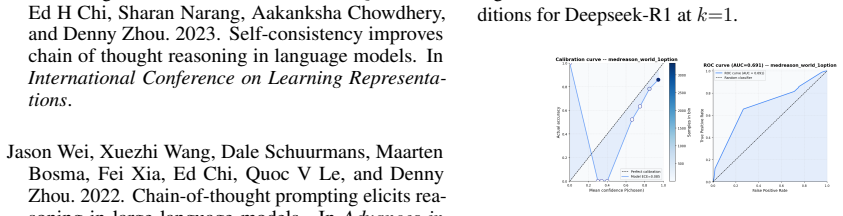
Large language models (LLMs) often rely on shortcuts rather than systematic reasoning, raising safety concerns in medical applications. Allowing models to abstain when uncertain improves reliability but introduces a coverage accuracy tradeoff. We propose a two-stage framework for medical hypothesis verification in multiple-choice settings that manages this tradeoff through targeted ontology grounding, applied only when the model abstains. We show that abstention is not random but reflects genuine uncertainty, with abstained predictions associated with lower confidence. Across two frontier models (GPT-5.5, accessed via the Azure OpenAI API, and DeepSeek-R1), the proposed framework improves question-level accuracy by 9.6 percentage points (82.9% to 92.5%) and hypothesis-level accuracy by 4.2 percentage points (92.0% to 96.2%). Our experiments conducted on MedReason and MedQA show that abstention can be repurposed as a control signal for selective reasoning refinement, achieving knowledge-graph-level performance without explicit knowledge graph construction.
Figures


Figures from the paper (4 more)



Reference graph
Works this paper leans on
-
[1]
Iv \'a n Arcuschin, Jett Janiak, Robert Krzyzanowski, Senthooran Rajamanoharan, Neel Nanda, and Arthur Conmy. 2025. https://openreview.net/forum?id=L8094Whth0 Chain-of-thought reasoning in the wild is not always faithful . In Workshop on Reasoning and Planning for Large Language Models
work page 2025
-
[2]
Yew Ken Chia, Guizhen Chen, Luu Anh Tuan, Soujanya Poria, and Lidong Bing. 2023. Contrastive chain-of-thought prompting. arXiv preprint arXiv:2311.09277
arXiv 2023
-
[3]
Ethan Goh, Robert Gallo, Jason Hom, Emily Strong, Yingjie Weng, Hannah Kerman, and 1 others. 2024. Large language model influence on diagnostic reasoning: a randomized clinical trial. JAMA Network Open, 7:e2440969
work page 2024
-
[4]
CLEAR: Revealing How Noise and Ambiguity Degrade Reliability in LLMs for Medicine
Kevin H. Guo and Chao Yan. 2026. https://arxiv.org/abs/2605.01011 Clear: Revealing how noise and ambiguity degrade reliability in llms for medicine . Preprint, arXiv:2605.01011
work page Pith review arXiv 2026
-
[5]
Di Jin, Eileen Pan, Nassim Oufattole, Wei-Hung Weng, Hanyi Fang, and Peter Szolovits. 2020. What disease does this patient have? a large-scale open domain question answering dataset from medical exams. arXiv preprint arXiv:2009.13081
arXiv 2020
-
[6]
Yubin Kim and 1 others. 2025. Medical hallucinations in foundation models and their impact on healthcare. arXiv preprint arXiv:2503.05777
arXiv 2025
-
[7]
Samuel Lewis-Lim, Xingwei Tan, Zhixue Zhao, and Nikolaos Aletras. 2025. https://doi.org/10.18653/v1/2025.emnlp-main.1516 Analysing chain of thought dynamics: Active guidance or unfaithful post-hoc rationalisation? In Proceedings of the 2025 Conference on Empirical Methods in Natural Language Processing, pages 29838--29853, Suzhou, China. Association for C...
-
[8]
Erping Long and 1 others. 2026. https://doi.org/10.1016/j.xcrm.2025.102547 Model confrontation and collaboration: A debate intelligence framework for enhancing medical reasoning in large language models . Cell Reports Medicine, 7(1):102547
arXiv 2026
Show all 18 references
-
[9]
Quinn McNemar. 1947. Note on the sampling error of the difference between correlated proportions or percentages. Psychometrika, 12(2):153--157
1947
-
[10]
Birger Mo \"e ll, Fredrik Sand Aronsson, and Sanian Akbar. 2025. https://doi.org/10.3389/frai.2025.1616145 Medical reasoning in LLMs : an in-depth analysis of DeepSeek R1 . Frontiers in Artificial Intelligence, 8:1616145
2025
-
[11]
Vinay Sharma and Manish Jain. 2026. Enhancing reasoning accuracy in large language models during inference time. arXiv preprint arXiv:2603.21301
2026
-
[12]
Ke Su and Shanshan Wu. 2025. https://doi.org/10.1145/3788112.3788136 Ontological reasoning mechanism for medical knowledge . In 2025 2nd International Conference on Smart Healthcare and Wearable Intelligent Devices (SHWID 2025), pages 155--160, Kuala Lumpur, Malaysia. ACM
2025
-
[13]
Xuezhi Wang, Jason Wei, Dale Schuurmans, Quoc V Le, Ed H Chi, Sharan Narang, Aakanksha Chowdhery, and Denny Zhou. 2023. Self-consistency improves chain of thought reasoning in language models. In International Conference on Learning Representations
2023
-
[14]
Jason Wei, Xuezhi Wang, Dale Schuurmans, Maarten Bosma, Fei Xia, Ed Chi, Quoc V Le, and Denny Zhou. 2022. Chain-of-thought prompting elicits reasoning in large language models. In Advances in Neural Information Processing Systems
2022
-
[15]
Bingbing Wen and 1 others. 2025. https://doi.org/10.1162/tacl_a_00754 Know your limits: A survey of abstention in large language models . Transactions of the Association for Computational Linguistics
2025 doi
-
[16]
Juncheng Wu, Wenlong Deng, Xingxuan Li, Sheng Liu, Taomian Mi, Yifan Peng, Ziyang Xu, Yi Liu, Hyunjin Cho, Chang-In Choi, Yihan Cao, Hui Ren, Xiang Li, Xiaoxiao Li, and Yuyin Zhou. 2025. https://arxiv.org/abs/2504.00993 Medreason: Eliciting factual medical reasoning steps in l...
2025 arXiv
-
[17]
Weidi Xie and 1 others. 2025. https://doi.org/10.1038/s41467-025-64769-1 Quantifying the reasoning abilities of LLMs on clinical cases . Nature Communications, 16:9799
2025 doi
-
[18]
Jaehoon Yun, Jiwoong Sohn, Jungwoo Park, Hyunjae Kim, Xiangru Tang, Yanjun Shao, Yonghoe Koo, Minhyeok Ko, Qingyu Chen, Mark Gerstein, Michael Moor, and Jaewoo Kang. 2025. https://api.semanticscholar.org/CorpusID:279392009 Med-PRM : Medical reasoning models with stepwise, guid...
2025
Reviewed August 12, 2026 · model on record in the stance chip above.
Discussion (0). Continue with ORCID to comment.