REVIEW 4 major objections 6 minor 1 cited by
A Framework for Critical Evaluation of Text-to-Image Models: Integrating Art Historical Analysis, Artistic Exploration, and Critical Prompt Engineering
T0 review · 4 major / 6 minor · reviewed 2026-08-11 · deepseek-v4-flash
Pith's one-line read This paper argues that auditing text-to-image models through art-historical reading, artistic experimentation, and critical prompt engineering reveals biases that technical metrics miss.
desk verdict A plausible qualitative evaluation framework, clearly written, but the supporting case studies are too thin to support the 'robust methodology' claim. read the letter →
The pith
A machine-rendered reading of the paper's core claim, the machinery that carries it, and where it could break.
The reading
What carries the argument
The central mechanism is a three-lens evaluative loop. Art historical analysis supplies formal and iconographic criteria for reading generated images; artistic exploration supplies iterative prompt variation and aesthetic judgment; critical prompt engineering supplies adversarial prompts grounded in feminist, critical-race, and postcolonial theory to provoke and expose stereotypes. The loop is codified as an eight-step benchmarking and auditing procedure that cycles between prompt design, generation, technical scoring, art-historical reading, artistic experimentation, critical analysis, feedback, and benchmark synthesis.
What would settle it
Run each case-study prompt with a large number of random seeds and identical settings; if elderly-people-of-color housekeeper images appear only in some seeds, or if modernized Arnolfini images without orientalist elements are just as common as those with them, the claim of consistent model bias collapses, whereas a controlled population count across seeds would settle the consistency claim.
Extended reading notes
Core claim
On the paper's own terms, the discovery is that a text-to-image model's output can be read the way an art historian reads a painting: formal analysis of line, color, composition, and iconographic analysis of symbols and cultural references expose what the training data assume about the world. Applied through iterative artistic experimentation and through prompts deliberately designed from critical theory, this reading reveals systematic associations, such as housekeeping with elderly people of color, non-Western culture with the exotic and historical, and female leadership with theatrical physical effort versus male leadership with upright composure. The paper claims these are model behaviors, not just single-image accidents, and that they would go undetected by FID- or CLIP-style scores and by category-counting bias studies.
Load-bearing premise
The argument leans on the assumption that a small set of subjectively interpreted generated images, produced without a documented sampling strategy or control prompts, is representative enough to show what a model consistently does.
Editorial extensions
If this is right
- Bias audits that rely only on technical metrics or category counts will miss stereotype intersections such as age and class in occupational imagery; the framework's qualitative readings catch them.
- The eight-step procedure gives an interdisciplinary team a reproducible template, where standardized prompts, fixed seeds, and documented interpretive criteria can turn sociocultural impact into a benchmark alongside technical scores.
- Because the housekeeper and construction-site case studies target current DALL-E, Midjourney, and Stable Diffusion outputs, the same prompts can be re-run as those models update to track whether bias mitigation changes behavior.
- Critical prompt engineering is portable: pronoun swapping and theory-informed wording can be applied to race, ethnicity, class, age, and disability, making the framework a general audit tool rather than a single-test method.
- Art historical and artistic readings can be incorporated into model development feedback loops, so qualitative findings inform prompt transformations and dataset curation before deployment.
Reading between the lines
- The framework's subjectivity could be tested by running the same case-study prompts with multiple independent annotators and measuring agreement; the paper acknowledges interpretive variability but does not provide such a test.
- The orientalist-elements finding invites a quantitative follow-up: generate many modernized Arnolfini variants across random seeds and count markers like turbans, arches, or exotic settings to check whether the pattern is statistically robust or an artifact of one image.
- The mirror effect suggests a bidirectional audit design: take art-historical verbal descriptions as prompts, generate images, then have blind annotators describe the images; the gap between original and re-described text would quantify semantic drift.
- Applying the same three lenses to non-Western artworks, for example asking for deities from various religions, would reveal whether models default to Western iconography and would extend the bias audit beyond the European canon.
Signed reviews
Editorial analysis
A structured set of objections, weighed in public.
Referee Report
Summary. The paper proposes an interdisciplinary framework for evaluating text-to-image models by integrating art historical analysis, artistic exploration, and critical prompt engineering alongside technical metrics. It presents three case studies: art-historical analysis of the Arnolfini Portrait (Section 4.1), artistic exploration with a Kehinde-Wiley-inspired housekeeper prompt (Section 4.2), and critical prompt engineering from the She Works, He Works project (Section 4.3). The paper claims these case studies reveal biases related to gender, race, age, and cultural representation that technical metrics and prior bias studies miss. Section 5 outlines an eight-step framework for benchmarking, evaluation, and auditing, with suggestions for sampling and standardization to be added in the future. The paper concludes that the framework contributes to the development of more equitable, responsible, and culturally aware text-to-image systems.
Significance. The paper addresses a genuine gap: technical metrics and automated bias benchmarks often fail to capture culturally situated meanings, historical iconography, and the nuanced ways in which gender, race, and power are encoded in AI-generated images. The synthesis of formal and iconographical art-historical analysis with feminist, critical race, and postcolonial theory is a useful conceptual contribution that could complement benchmarks such as HEIM and CUBE. The explicit step-by-step framework in Section 5 is a reasonable starting point for interdisciplinary auditing. However, the evidence presented is anecdotal and under-powered; the three case studies are the only demonstrations of the framework's utility, and they do not meet the reproducibility standards that the paper itself advocates. The claim in the abstract that the framework offers a 'robust methodology' is therefore not yet supported. The paper's main value lies in its proposal rather than its empirical demonstration.
major comments (4)
- [Section 4.2, Fig. 2] The claim that DALL-E, Midjourney, and Stable Diffusion 'consistently' depict housekeepers as elderly people of color rests on a single image per model (Fig. 2) with no disclosed sampling protocol, no seed values, and no report of the total number of generations. Moreover, the prompt contains the phrase 'a lifetime of domestic labor,' which semantically implies an older person, so the age finding may be a direct artifact of prompt wording rather than a model bias. To support the conclusion, the paper would need multiple samples per condition, prompt variants that remove age connotations, and inter-rater reliability for the demographic labels. As written, the 'consistent' generalization is not justified.
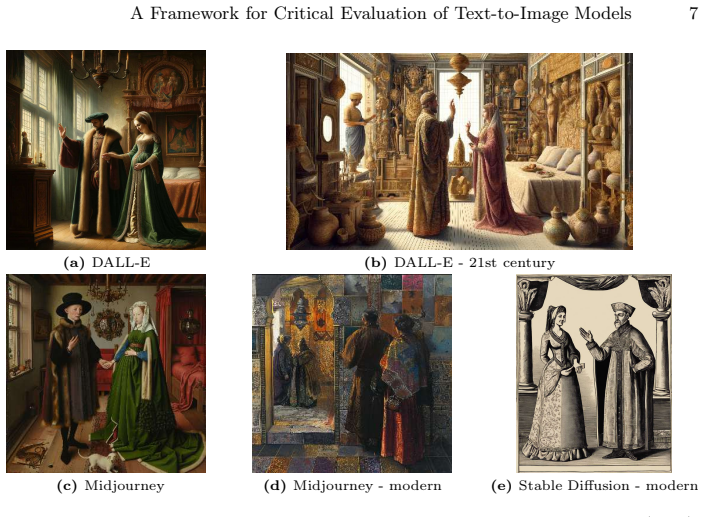
- [Section 4.1, Fig. 1] The attribution of 'orientalist elements' in the modernized versions of the Arnolfini Portrait to training-data bias is based on one output per model (Fig. 1b and 1d), with no baseline comparison such as the same prompt without the modernization instruction, no multiple seeds, and no inter-rater reliability for the 'orientalist' label. The section acknowledges subjectivity and prompt-induced bias, but it does not apply these cautions to its own conclusion that the outputs 'raised concerns about potential biases in their training data.' This is a load-bearing point for the paper's claim that art historical analysis uncovers biases that technical metrics miss.
- [Section 4.3, Fig. 3] The gender-bias observation in the She Works, He Works case study is based on two DALL-E outputs, one female and one male construction site manager, with no sampling across seeds, no comparison across models, and no quantitative measure of posture, attire, or composition. The conclusion that the model 'may be perpetuating the stereotype of women as less competent or less authoritative' is not supported by this evidence. The case study is better framed as an illustration of the critical prompt engineering methodology than as a validated finding about model bias.
- [Abstract and Section 5] The abstract describes the framework as a 'robust methodology,' but Section 5 presents only a checklist of steps and explicitly defers the implementation of sampling, standardization, and reproducibility to future work ('the framework could incorporate sampling methods... could leverage automated tools'). No inter-rater reliability protocol, no procedure for distinguishing prompt-induced effects from model biases, and no quantitative integration of the qualitative analyses are specified. The case studies do not implement these safeguards. The paper should either implement these elements in the demonstrations or be repositioned as a proposal for a methodology rather than a demonstrated and validated one.
minor comments (6)
- [Section 5] The phrase 'robust benchmarks' is used without operational definitions: no metrics or rubrics are given for art historical analysis, artistic exploration, or critical analysis, making the proposed benchmarks difficult to instantiate or compare across studies.
- [Section 4.1] The full prompt is provided in the text, but no model versions, sampling temperatures, or random seeds are listed. Adding this information would improve reproducibility, as the paper itself recommends in Section 5.
- [Section 4.2] The word 'consistently' is used twice to describe outcomes from a single image per model; avoid generalizing beyond the evidence shown.
- [Section 4.1 and 4.3] The case studies in these sections are drawn from the author's own previously published work (references [10] and [11]). The paper should state explicitly what new evidence or analysis is added here beyond those prior publications.
- [General] The figures are presented without supplementary data, code, or experiment logs, so the demonstrations are not independently reproducible even though the paper calls for reproducibility.
- [Title and references] There are minor typographical issues: the title contains 'T ext-to-Image' with a stray space, the abstract contains 'fo r' in the first sentence, and reference [5] contains 'F AccT' instead of 'FAccT'. These should be corrected in a revision.
Circularity Check
The §4.2 age-bias finding is written into the prompt, and the §4.1/§4.3 demonstrations are self-cited, so the evidential core is partly circular; the framework proposal itself remains independent.
-
self definitional
[Section 4.2, Artistic Exploration as a Form of Evaluation, around Fig. 2]
"The latter, inspired by Kehinde Wiley’s empowering aesthetic [32], ... 'A portrait of a person whose face reflects the resilience and dignity of a lifetime of domestic labor, with hands worn from years of toil yet holding a vibrant flower symbolizing hope and perseverance.' ... DALL-E, Midjourney, and Stable Diffusion generated images consistently depicting elderly people of color engaged in domestic labor (Fig. 2). ..."
The finding being offered as a model bias is that the models associate domestic labor with elderly people. But the prompt already contains 'a lifetime of domestic labor' and 'hands worn from years of toil', which semantically encode long service and advanced age, and it explicitly names 'domestic labor' as the occupation. The generated elderly portraits are therefore prompt compliance, not an independent model association. The paper even acknowledges the prompt likely influenced the result, yet still concludes there are 'age-related associations within the models ... in the absence of explicit age directives'; the age directive is present. No control prompt without 'lifetime' or 'years' is reported, so this particular observation reduces to the input by construction.
-
self citation load bearing
[Section 4.1, Applying Art Historical Methods to AI-Generated Images]
"Jan van Eyck’s The Arnolfini Portrait (1434) [33], taken from our previous study on art history and text-to-image models [11], was chosen for this case study as it exemplifies the framework’s potential. ... These findings underscore the value of art historical analysis in uncovering biases that technical metrics might miss."
The demonstration that the proposed art-historical case study reveals model biases is explicitly taken from the author's own prior publication [11], rather than from an independent benchmark or an external replication. The conclusion that the framework works is thus supported by re-presenting the same author's earlier interpretation, making the validation internal to the author's own line of work. This is load-bearing self-citation: if [11] is not independently verified, the case study does not independently establish the framework's utility.
1 more flagged steps
-
self citation load bearing
[Section 4.3, Critical Prompt Engineering]
"The art project She Works, He Works exemplifies this approach [10]. ... The resulting images from DALL-E (Fig. 3) reveal a stark contrast."
The evidence that critical prompt engineering 'reveals potential gender biases' is the author's own previously published art project [10]. The gendered outputs shown in Fig. 3 are drawn from that same project and are not independently reproduced or externally validated here. To the extent that the framework's practical applicability is demonstrated by these case studies, the demonstration depends on a self-citation rather than on a separate test, so the evidential chain is partly self-referential.
full rationale
This paper is a methodological proposal rather than a quantitative derivation: no parameters are fitted, no equations are derived, and the three framework components are presented as an integration of existing disciplinary methods. Most of the proposal is therefore not circular by construction. The circularity concerns are concentrated in the evidential case studies. In §4.2, the conclusion that models harbor age-related associations about domestic labor is built into the prompt itself ('a lifetime of domestic labor', 'hands worn from years of toil'), and the paper's own sentence admits the prompt likely influenced the result while still asserting the bias conclusion; the observation reduces to prompt compliance, not an independent model attribute. In §4.1 and §4.3, the two other demonstrations are explicitly drawn from the author's prior works [10,11], making the framework's practical validation depend on self-citation rather than external benchmarks or independent replication. The central claim — that an art-history-informed, artist-led, critical-prompting approach can supplement technical metrics — is still an independently meaningful proposal, so the circularity is partial rather than total.
Assumptions & free parameters
assumptions (4)
- domain assumption Art historical formal and iconographic analysis can be meaningfully applied to AI-generated images to expose biases.
- domain assumption The generated images discussed are representative of the model's typical output for the given prompt.
- domain assumption Qualitative interpretations by the author of visual details (pose, dress, symbols) are accurate and not confounded by prompt wording or random variation.
- domain assumption Critical theory frameworks (feminist, critical race, postcolonial) provide a valid lens for evaluating AI-generated imagery.
Cite this review
Pith. "Pith review of A Framework for Critical Evaluation of Text-to-Image Models: Integrating Art Historical Analysis, Artistic Exploration, and Critical Prompt Engineering." pith.science (2026). https://pith.science/paper/OB7NTIXN
@misc{pith2026241212774,
  author       = {Pith},
  title        = {Pith review of: A Framework for Critical Evaluation of Text-to-Image Models: Integrating Art Historical Analysis, Artistic Exploration, and Critical Prompt Engineering},
  year         = {2026},
  howpublished = {\url{https://pith.science/paper/OB7NTIXN}},
  note         = {Machine review of arXiv:2412.12774}
}
read the original abstract
This paper proposes a novel interdisciplinary framework for the critical evaluation of text-to-image models, addressing the limitations of current technical metrics and bias studies. By integrating art historical analysis, artistic exploration, and critical prompt engineering, the framework offers a more nuanced understanding of these models' capabilities and societal implications. Art historical analysis provides a structured approach to examine visual and symbolic elements, revealing potential biases and misrepresentations. Artistic exploration, through creative experimentation, uncovers hidden potentials and limitations, prompting critical reflection on the algorithms' assumptions. Critical prompt engineering actively challenges the model's assumptions, exposing embedded biases. Case studies demonstrate the framework's practical application, showcasing how it can reveal biases related to gender, race, and cultural representation. This comprehensive approach not only enhances the evaluation of text-to-image models but also contributes to the development of more equitable, responsible, and culturally aware AI systems.
Figures


Forward citations
Cited by 1 Pith paper
-
WP-CLIP: Leveraging CLIP to Predict W\"olfflin's Principles in Visual Art
WP-CLIP, a CLIP model fine-tuned on annotated artworks, predicts Wölfflin's five stylistic principles and is reported to generalize across art datasets.
Reference graph
Works this paper leans on
-
[1]
University of California Press (1974)
Arnheim, R.: Art and visual perception: A psychology of th e creative eye (New version). University of California Press (1974)
work page 1974
-
[2]
Bansal, H., Yin, D., Monajatipoor, M., Chang, K.W.: How we ll can Text-to-Image Generative Models understand Ethical Natur al Lan- guage Interventions? Proceedings of the 2022 Conference on Empiri- cal Methods in Natural Language Processing, EMNLP 2022 pp. 1 358– 1370 (oct 2022). https://doi.org/10.18653/v1/2022.emnlp-main.88, https://arxiv.org/abs/2210.15230v1
arXiv 2022
-
[3]
Benjamin, R.: Race after technology : abolitionist tools for the New Jim Code. Polity (2019)
work page 2019
-
[4]
(ed.): The Location of Culture
Bhabha, H.K. (ed.): The Location of Culture. Routledge (1 994)
-
[5]
In: Proceedings of the 2023 ACM Conference on Fairness, Account ability, and Transparency
Bianchi, F., Kalluri, P., Durmus, E., Ladhak, F., Cheng, M ., Nozza, D., Hashimoto, T., Jurafsky, D., Zou, J., Caliskan, A.: Easily a ccessible text- to-image generation amplifies demographic stereotypes at l arge scale. In: Proceedings of the 2023 ACM Conference on Fairness, Account ability, and Transparency. p. 1493–1504. F AccT ’23, Association for Com ...
arXiv 2023
-
[6]
ACM Journal on Responsi ble Computing 1(13), 13 (jun 2024)
Cheong, M., Robinson, P., Byrne, J., Ruppanner, L., Klein , C., Abe- din, E., Ferreira, M., Reimann, R., Chalson, S., Alfano, M., Cheong, M., Byrne, J., Ruppanner, L., Ferreira, .M., Reimann, R., Al fano, M., Chalson, S., Robinson, P., Klein, C.: Investigating Gen der and Racial Biases in DALL-E Mini Images. ACM Journal on Responsi ble Computing 1(13), 13...
doi:10.1145/3649883 2024
-
[7]
Cho, J., Zala, A., Bansal, M.: DALL-Eval: Probing the Reas oning Skills and Social Biases of Text-to-Image Generation Model s (2023), https://github.com/j-min/DallEval
work page 2023
-
[8]
AI & SOCIETY 36, 1105 – 1116 (2021), https://api.semanticscholar.org/CorpusID:253682611
Crawford, K., Paglen, T.: Excavating ai: the politics of i mages in ma- chine learning training sets. AI & SOCIETY 36, 1105 – 1116 (2021), https://api.semanticscholar.org/CorpusID:253682611
work page 2021
Show all 33 references
-
[9]
Doshi-Velez, F., Kim, B.: Towards a rigorous science of in terpretable machine learn- ing (2017), https://arxiv.org/abs/1702.08608
2017 arXiv
-
[10]
Foka, A.: She works, he works: A curious exploration of ge nder bias in ai-generated imagery (2024), https://arxiv.org/abs/2407.18524
2024 arXiv
-
[11]
In: Brown, K
Foka, A.: Experiments in the relationship between art hi story and text-to-image models. In: Brown, K. (ed.) Artificial Intelligence and Art H istory: Looking at Pictures in an Algorithmic Culture. Proceedings of the Brit ish Academy (to be published)
-
[12]
Pe arson (2019)
Frank, P., Preble, D., Preble, S.: Prebles’ Artforms. Pe arson (2019)
2019
-
[13]
A Study in the Psycholo gy of Pictorial Repre- sentation
Gombrich, E.H.: Art and Illusion. A Study in the Psycholo gy of Pictorial Repre- sentation. Princeton University Press (1969)
1969
-
[14]
Manchester University Press (2006)
Hatt, M., Klonk, C.: Art history: a critical introductio n to its methods. Manchester University Press (2006)
2006
-
[15]
Heusel, M., Ramsauer, H., Unterthiner, T., Nessler, B., Hochreiter, S.: Gans trained by a two time-scale update rule converge to a local nash equil ibrium (2018), https://arxiv.org/abs/1706.08500
2018 arXiv
-
[16]
(ed.): Black Looks: Race and Representation
Hooks, B. (ed.): Black Looks: Race and Representation. S outh End Press (1992) 16 A. Foka
1992
-
[17]
Kannen, N., Ahmad, A., Andreetto, M., Prabhakaran, V., P rabhu, U., Dieng, A.B., Bhattacharyya, P., Dave, S.: Beyond aesthetics: Cultural c ompetence in text-to- image models (2024), https://arxiv.org/abs/2407.06863
2024 arXiv
-
[18]
Kynkäänniemi, T., Karras, T., Laine, S., Lehtinen, J., A ila, T.: Im- proved precision and recall metric for assessing generativ e models (2019), https://arxiv.org/abs/1904.06991
2019 arXiv
-
[19]
Lee, T., Yasunaga, M., Meng, C., Mai, Y., Park, J.S., Gupt a, A., Zhang, Y., Narayanan, D., Teufel, H.B., Bellagente, M., Kang, M., Park , T., Leskovec, J., Zhu, J.Y., Fei-Fei, L., Wu, J., Ermon, S., Liang, P.: Holisti c evaluation of text-to- image models (2023), https://arxi...
2023 arXiv
-
[20]
Luccioni, A.S., Akiki, C., Mitchell, M., Jernite, Y.: St able bias: Analyzing societal representations in diffusion models (2023), https://arxiv.org/abs/2303.11408
2023 arXiv
-
[21]
Midjourney, I.: Midjourney (2023), https://www.midjourney.com/home
2023
-
[22]
Scree n 16(3), 6–18 (oct 1975)
Mulvey, L.: Visual Pleasure and Narrative Cinema. Scree n 16(3), 6–18 (oct 1975). https://doi.org/10.1093/SCREEN/16.3.6, https://dx.doi.org/10.1093/screen/16.3.6
1975 doi
-
[23]
OpenAI: DALL-E 3 (2023), https://openai.com/index/dall-e-3/
2023
-
[24]
OpenAI: DALL-E 3 system card (2023), https://openai.com/index/dall-e-3-system-card/
2023
-
[25]
Proceedings of the IEEE Computer So- ciety Conference on Computer Vision and Pattern Recognitio n 2023-June, 14277–14286 (apr 2023)
Otani, M., Togashi, R., Sawai, Y., Ishigami, R., Nakashi ma, Y., Rahtu, E., Heikkilä, J., Satoh, S.: Toward Verifiable and Reproducible Human Evalua- tion for Text-to-Image Generation. Proceedings of the IEEE Computer So- ciety Conference on Computer Vision and Pattern Recognit...
2023
-
[26]
The University of Chicago Press (1983)
Panofsky, E.: Meaning in the Visual Arts. The University of Chicago Press (1983)
1983
-
[27]
Routledge (2003)
Pollock, G.: Vision and difference : feminism, femininit y and the histories of art. Routledge (2003)
2003
-
[28]
In: Proce edings of Machine Learning Research
Radford, A., Kim, J.W., Hallacy, C., Ramesh, A., Goh, G., Agarwal, S., Sastry, G., Askell, A., Mishkin, P., Clark, J., Krueger, G., Sutskever, I.: Learning Transferable Visual Models From Natural Language Supervision. In: Proce edings of Machine Learning Research. vol. 139, pp...
2021
-
[29]
Ramesh, A., Dhariwal, P., Nichol, A., Chu, C., Chen, M.: H ier- archical text-conditional image generation with clip late nts (2022), https://arxiv.org/abs/2204.06125
2022 arXiv
-
[30]
Rombach, R., Blattmann, A., Lorenz, D., Esser, P., Ommer , B.: High-resolution image synthesis with latent diffusion mode ls (2022), https://arxiv.org/abs/2112.10752
2022 arXiv
-
[31]
Stability AI: Stability AI Image Models (2024), https://stability.ai/stable-image
2024
-
[32]
(ed.): Kehinde Wiley: A New Republic
Tsai, E. (ed.): Kehinde Wiley: A New Republic. Brooklyn M useum (2015)
2015
-
[33]
The Art Bulletin 75(1), 174 (1993)
Wood, C.S., Harbison, C., Upton, J.M., Bedaux, J.B.: Jan van Eyck: The Play of Realism. The Art Bulletin 75(1), 174 (1993). https://doi.org/10.2307/3045938
1993 doi
Reviewed August 11, 2026 · model on record in the stance chip above.
Discussion (0). Continue with ORCID to comment.