REVIEW 3 major objections 6 minor 24 references
EDATracer: An Agentic Framework for Large-Scale EDA Artifact Analysis
T0 review · 3 major / 6 minor · reviewed 2026-08-06 · deepseek-v4-flash
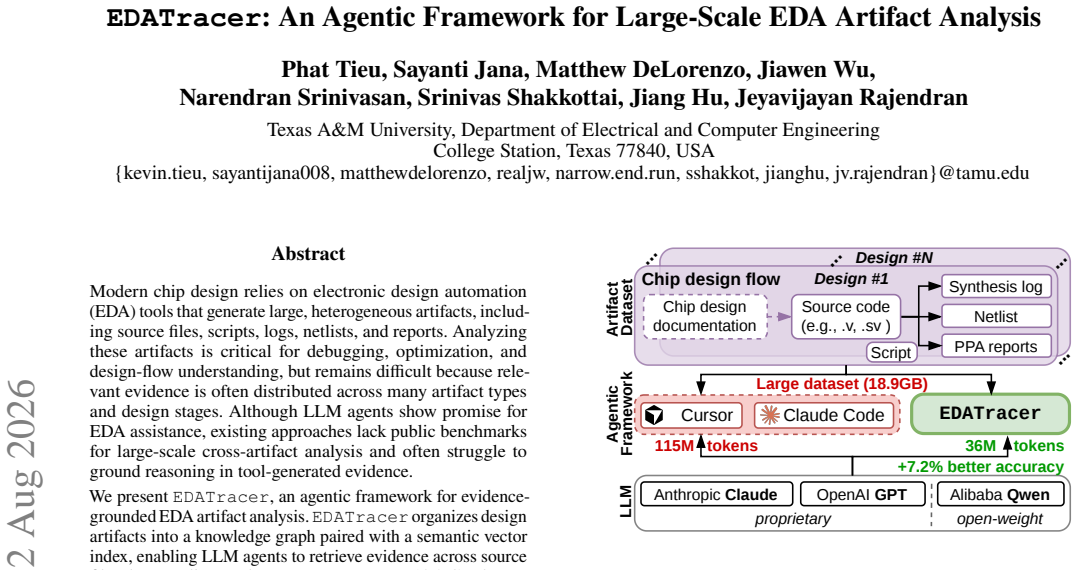
Pith's one-line read Structuring chip-design artifacts as a knowledge graph lets an LLM agent answer EDA artifact questions more accurately than Cursor or Claude Code while using 2.0-3.2x fewer tokens.
desk verdict Don't take the headline numbers at face value: the dataset and graph-retrieval design are the real contributions, but the accuracy and token claims need independent evaluation before they are established. read the letter →
The pith
A machine-rendered reading of the paper's core claim, the machinery that carries it, and where it could break.
The reading
What carries the argument
The load-bearing object is the knowledge graph $G=(V,E)$ paired with a graph-associated semantic vector index $Z$. Each node $v$ carries metadata $\phi(v)$ such as artifact type, file path, line span, extracted metrics, and warning labels, and each typed edge $(u,\rho,v)$ records artifact hierarchy, provenance, or structural relation, so every retrieved chunk resolves back to its design and synthesis run. Retrieval runs in two modes: semantic search over $Z$ by cosine similarity, and structured Cypher queries (a graph query language) over $G$; a reasoning agent inspects the accumulated evidence $E_q^{(i)}$, requests more when it is insufficient, and returns an answer only when the graph context suffices. The offline ingestion pipeline of artifact parsing, provenance linking, and semantic indexing is what turns raw heterogeneous files into this resolvable structure.
What would settle it
Have external chip-design engineers, blind to which framework produced each answer, score the same 90 questions with the same rubric: if EDATracer's pass@1 margin over Cursor and Claude Code does not reproduce under blinded scoring, the claimed accuracy advantage fails. A complementary check is to generate a second question set from an independent pool of repositories using the same pipeline and see whether EDATracer's lead survives questions the authors did not write.
Extended reading notes
Core claim
The paper's central claim is that organizing EDA artifacts into a knowledge graph with provenance makes LLM agents answer cross-artifact questions both more accurately and more cheaply than general-purpose coding agents. EDATracer parses each design's ingestion set into an attributed, typed graph $G=(V,E)$ whose nodes are designs, artifact files, text chunks, RTL modules, and netlist elements, with edges encoding hierarchy, provenance, and dependencies, plus a semantic vector index $Z$ over text-bearing nodes. An online loop alternates a reasoning agent, which issues information requests until evidence is sufficient, and a retrieval agent, which answers requests through cosine-similarity search over $Z$ or structured Cypher queries over $G$. In the paper's evaluation, EDATracer achieves the best pass@1 accuracy, outperforming Cursor and Claude Code by 6.4 and 7.2 percentage points on average while using 2.0-3.2x fewer tokens, and an ablation against flat retrieval-augmented generation reports 3.36x and 5.03x improvements in average human-expert score on the two LLM backbones tested.
Load-bearing premise
The accuracy comparison rests on the assumption that the authors' 90-question benchmark and their human-expert scoring are unbiased measures of EDA artifact analysis ability, since the authors wrote and grounded every question themselves and manually re-extracted the gold answers from the artifacts.
Editorial extensions
If this is right
- If the knowledge-graph representation is the cause of the gains, flat retrieval-augmented generation is insufficient for cross-artifact EDA question answering: the paper's ablation reports 3.36x and 5.03x improvements in average human-expert score over RAG on the same LLMs.
- Token consumption drops from 54M-115M across the two commercial baselines to 20M-36M for EDATracer on the five LLM settings tested, so per-question cost falls by roughly the same factor.
- Local open-weight models become viable for many artifact questions: Qwen 3.5-9B with EDATracer approaches GPT-5.4-mini on factual and statistical questions, though it still lags on reasoning-heavy questions.
- The 18.9 GB dataset of 2,787 synthesizable designs with generated synthesis logs, netlists, and PPA reports becomes a reusable public resource for future EDA agent research.
- The largest category-level gains are on statistical questions, up to +1.86 points with Claude Haiku 4.5, indicating that multi-artifact aggregation is where grounding matters most.
Reading between the lines
- My inference: the graph-plus-vector recipe should transfer to other tool-generated artifact domains, such as software build and test logs, infrastructure telemetry, or simulation output, wherever evidence is scattered across heterogeneous file types tied to a single run; the paper demonstrates the mechanism only on synthesis-stage artifacts.
- A natural test of generalizability: the appendix's alternative LLM-council scoring has EDATracer leading pass@1 in only 2 of 5 model settings, so an independently authored benchmark with blind expert scoring would show whether the 6.4- and 7.2-point margins persist.
- The paper notes that weaker models benefit less on reasoning questions, which suggests the knowledge graph compensates for retrieval and aggregation failures but not for composing a final explanation; adding an explicit answer-drafting step to the reasoning agent is a concrete next lever.
- The future-work sketch of floorplanning, placement, routing, timing-closure, and sign-off artifacts would let the same schema trace timing violations to their sources across the full design flow, since the provenance edges already model design-to-artifact lineage.
Editorial analysis
A structured set of objections, weighed in public.
Referee Report
Summary. The paper presents EDATracer, an agentic framework that converts EDA artifacts (RTL source, synthesis scripts, logs, netlists, PPA reports) into a knowledge graph plus a semantic vector index, and then uses retrieval and reasoning agents to answer questions that require evidence distributed across multiple artifact types. The authors curate an 18.9 GB dataset of 2,787 open-source chip designs, generate synthesis artifacts for them, and introduce a 90-question benchmark spanning factual, statistical, and reasoning questions. They evaluate EDATracer against Cursor and Claude Code across several LLMs, reporting that EDATracer achieves the best pass@1 accuracy (outperforming Cursor and Claude Code by 6.4 and 7.2 percentage points on average) while using 2.0–3.2x fewer tokens. The paper also includes a RAG-vs-KG ablation, an LLM-council evaluation, and a local open-weight-model experiment with Qwen 3.5-9B.
Significance. If the accuracy and efficiency claims were robustly established, this paper would be a solid contribution to EDA-oriented LLM agents: it provides a large-scale cross-artifact EDA artifact dataset with synthesis logs, netlists, and PPA reports; a graph-and-vector retrieval framework that grounds answers in artifact provenance; and evidence that a small open-weight model can perform reasonably on factual and statistical questions. The paper's strengths include a detailed, largely reproducible dataset curation pipeline, an explicit iterative repair algorithm, a controlled RAG-vs-KG ablation, and candid reporting of the LLM-council divergence. These features are valuable regardless of the exact rank ordering, and the benchmark could become a useful community resource. The main weakness is that the headline numerical claims rest on a small, author-controlled evaluation with no uncertainty quantification and with internal inconsistencies in the token-usage reporting.
major comments (3)
- [Appendix 'Creation of EDA Evaluation Benchmark'; §Evaluation metrics] The central pass@1 claim is not yet supported by the reported evaluation. The benchmark is only 90 questions (30 per category), all final content and golden answers were determined and verified by the authors (Appendix 'Creation of EDA Evaluation Benchmark'), and no confidence intervals or inter-annotator agreement are reported. For a single 90-question setting the standard error of a difference in pass@1 between two agents with pass rates near 80% is roughly 6 percentage points, so the headline average margin of 6.4 pp over Cursor is about one standard error; several individual comparisons in Table 1 are within sampling noise. The authors should report bootstrap confidence intervals, per-question variance, and ideally independent human scoring or a second annotator with agreement statistics.
- [§LLM Benchmark Evaluation Process; Tables 10-11] The paper's own alternative evaluation method flips the central ranking. Under LLM-council scoring (Tables 10-11), EDATracer leads pass@1 in only 2 of 5 settings, and for Claude Haiku 4.5 and GPT-5.4-mini, Cursor or Claude Code have higher or comparable council averages. The manuscript attributes the discrepancy to the council being more lenient about missing or wrong units, but it does not provide inter-rater reliability for the human scoring nor evidence that the human rubric is insensitive to the same ambiguity. Because human-expert scoring is selected as primary after observing these divergences, the scoring-protocol choice itself needs a principled defense (e.g., pre-registration, blind dual scoring, or unit-error-specific validation).
- [§RQ2: Efficiency of Token Usage; Figure 5; Table 10; footnote 3] The token-efficiency claims are internally inconsistent and not measured on the same benchmark. RQ2 states that EDATracer 'consistently uses fewer tokens across all evaluated LLMs, using only 20M–36M tokens', but Table 10 reports 64.1M tokens for EDATracer with Qwen 3.5-9B. Even if that row is excluded, the comparison against Cursor is not apples-to-apples: footnote 3 says Cursor token counts come from aggregate statistics on the Cursor website, not from measurements on the same 90-question benchmark. Report measured token usage for every configuration on the same benchmark, and clarify whether the counts are per run or across five repeated runs.
minor comments (6)
- [§Ablation Studies / Database Formulation] The RAG baseline scores are extremely low (2.58 and 1.47 overall, Table 9), which could indicate an underpowered baseline rather than a genuine advantage of the KG; consider strengthening the RAG baseline (e.g., multi-hop retrieval or re-ranking) and reporting retrieval-recall-oriented metrics.
- [Figure 4] The artifact tree in Figure 4 contains the typo 'READMNE.md'; it should be 'README.md'.
- [Paragraph above Table 10] The text 'Opus 4,7' should read 'Opus 4.7'.
- [§Human Expert Benchmark Evaluation Process] This section does not specify the number of human evaluators, their expertise criteria, or whether any evaluator is an author; please report these details.
- [§Evaluation metrics] The definition of pass@k says a question passes if at least one score is 8 or higher, but it does not explain how the five repeated runs are used to compute pass@1 (e.g., best-of-run or majority) or whether pass@5 is computed from the five runs; please clarify.
- [Appendix and Conclusion] The paper would be easier to reproduce if the benchmark, dataset manifest, and code were released under a persistent identifier; as written, the appendix describes protocols but no public artifact link is given.
Circularity Check
No derivational circularity: EDATracer's accuracy and efficiency claims are empirical evaluations, not results derived from fitted parameters or self-referential definitions.
full rationale
EDATracer is an empirical systems paper whose central claim is an evaluated accuracy comparison, not a derivation from fitted parameters or prior theorems. No equation in the paper derives the reported 6.4 and 7.2 percentage point pass@1 advantages from EDATracer's construction; the knowledge-graph pipeline, Cypher/vector retrieval, and reasoning-agent loop contain no parameters fitted to the 90-question benchmark, and no prediction is constructed from a subset of the same benchmark and then presented as an independent result. The benchmark is author-created and the gold answers are author-verified, and the paper itself reports that the alternative LLM-council scoring changes the ranking (EDATracer leads pass@1 in only 2 of 5 settings), but this is an evaluation-robustness and protocol-selection concern, not definitional circularity: the human-expert rubric and golden answers are inputs to the evaluation, not outputs of the system's derivation. Similarly, the Cursor token counts are taken from aggregate website statistics rather than measured on the same 90-question benchmark, which is a measurement-validity limitation, not a reduction of the token-efficiency claim to its own input. The only overlapping-author citation (Bush et al. 2025) is used to characterize existing code-generation LLM work in the background and is not load-bearing for any central claim. No self-citation chain, uniqueness theorem, or ansatz-by-citation is used to make the design choice forced. Therefore, no circular step can be exhibited with a specific equation or constructed identity, and the paper is best assessed as containing no significant circularity.
Assumptions & free parameters
free parameters (6)
- Repository heuristic thresholds =
stars >= 2 (fork >= 5), size >= 10 KB, last push <= 10 years
- LLM evaluator confidence threshold =
0.6
- Synthesis repair attempt limit =
15
- Semantic chunk size and overlap
- Semantic retrieval top-K
- Pass threshold for pass@k =
score >= 8
assumptions (5)
- domain assumption Regex-based Verilog parsing and top-module and clock heuristics identify the intended top module and clock for each repository.
- ad hoc to paper Artifacts produced by automated repair with alternative top modules and virtual clocks are valid evidence for the original repository.
- domain assumption The 90 author-verified questions form an unbiased benchmark of EDA artifact analysis ability.
- ad hoc to paper Human expert scoring is more representative than LLM-council scoring for the primary claims.
- domain assumption Synthesis logs and PPA reports used as gold evidence are internally consistent and correctly linked to the design.
Cite this review
Pith. "Pith review of EDATracer: An Agentic Framework for Large-Scale EDA Artifact Analysis." pith.science (2026). https://pith.science/paper/OBEGZMCW
@misc{pith2026260804032,
  author       = {Pith},
  title        = {Pith review of: EDATracer: An Agentic Framework for Large-Scale EDA Artifact Analysis},
  year         = {2026},
  howpublished = {\url{https://pith.science/paper/OBEGZMCW}},
  note         = {Machine review of arXiv:2608.04032}
}
read the original abstract
Modern chip design relies on electronic design automation (EDA) tools that generate large, heterogeneous artifacts, including source files, scripts, logs, netlists, and reports. Analyzing these artifacts is critical for debugging, optimization, and design-flow understanding, but remains difficult because relevant evidence is often distributed across many artifact types and design stages. Although LLM agents show promise for EDA assistance, existing approaches lack public benchmarks for large-scale cross-artifact analysis and often struggle to ground reasoning in tool-generated evidence. We present EDATracer, an agentic framework for evidence-grounded EDA artifact analysis. EDATracer organizes design artifacts into a knowledge graph paired with a semantic vector index, enabling LLM agents to retrieve evidence across source files, logs, netlists, and reports. We curate an 18.9 GB dataset of 2,787 synthesizable open-source chip designs and introduce a 90-question benchmark spanning factual, statistical, and reasoning tasks. Across evaluated agents, EDATracer achieves the best pass@1 accuracy, outperforming Cursor and Claude Code by 6.4 and 7.2 percentage points on average, while using 2.0-3.2x fewer tokens.
Figures


Figures from the paper (4 more)


Reference graph
Works this paper leans on
-
[2]
Blocklove, J.; Thakur, S.; Tan, B.; Pearce, H.; Garg, S.; and Karri,R.2025
AI Agents Transform EDA with Cadence. Blocklove, J.; Thakur, S.; Tan, B.; Pearce, H.; Garg, S.; and Karri,R.2025. AutomaticallyImprovingLLM-basedVerilog Generation using EDA Tool Feedback.ACM Transactions on Design Automation of Electronic Systems, 30(6). Bush, S.; DeLorenzo, M.; Tieu, P.; and Rajendran, J
work page 2025
-
[3]
Genus Synthesis Solution Datasheet. Accessed: 2026-05-05. Chen, D.; Ganesh, V.; Li, W.; Lin, Y. C.; Liu, Y.; Mitra, S.; Pan, D. Z.; Puri, R.; Cong, J.; and Sun, Y. 2026a. Report for NSF Workshop on AI for Electronic Design Automation. arXiv:2601.14541. Chen, M.; Tworek, J.; Jun, H.; Yuan, Q.; Pinto, H. P. d. O.; Kaplan, J.; Edwards, H.; Burda, Y.; Joseph,...
arXiv 2026
-
[5]
OntoLogX: Ontology-Guided Knowledge Graph Extraction From Cybersecurity Logs With Large Language Models.Advanced Intelligent Systems, 8(6): e202501381. Cursor.2026. CursorDocumentation. Accessed:2026-05-23. DeLong, L. N.; Mir, R. F.; and Fleuriot, J. D
work page 2026
-
[8]
SkyWater SKY130 Open-Source PDK and Standard Cell Resources. Accessed: 2026-05-05. Groeneveld, P
work page 2026
-
[9]
Kanagal,R.2025.LLM-PoweredEDALogAnalysisforEffec- tive Design Debugging
Machine Learning for Electronic Design Automation: A Survey.ACM Transactions on Design Automation of Electronic Systems (TODAES), 26(5). Kanagal,R.2025.LLM-PoweredEDALogAnalysisforEffec- tive Design Debugging. Master’s thesis, EECS Department, University of California, Berkeley. Lewis, P.; Perez, E.; Piktus, A.; Petroni, F.; Karpukhin, V.; Goyal, N.; Kütt...
work page 2025
-
[11]
AutoEDA: EnablingEDAFlowAutomationthroughMicroservice-Based LLM Agents. arXiv:2508.01012. Ma, Y.; He, Z.; Li, W.; Zhang, L.; and Yu, B
-
[12]
In Proceedings of the 2020 International Symposium on Physi- cal Design, ISPD ’20, 119–126
Under- standingGraphsinEDA:FromShallowtoDeepLearning. In Proceedings of the 2020 International Symposium on Physi- cal Design, ISPD ’20, 119–126. Association for Computing Machinery. ISBN 9781450370912. Memgraph. 2026a. Memgraph Documentation. Accessed: 2026-05-23. Memgraph. 2026b. Vector Search in Memgraph. Accessed: 2026-05-23. Nandal, D.; Revalor, R.; ...
work page 2020
-
[13]
LAUDE: LLM-Assisted Unit Test Generation and Debugging of Hard- ware DEsigns. arXiv:2601.08856. Neo4J
Show all 24 references
-
[15]
arXiv:2407.15353
Customized RetrievalAugmentedGenerationandBenchmarkingforEDA Tool Documentation QA. arXiv:2407.15353. PwC
-
[16]
Qi, J.; Huang, S.; Luan, Z.; Yang, S.; Fung, C.; Yang, H.; Qian, D.; Shang, J.; Xiao, Z.; and Wu, Z
Accessed: 2026-05-21. Qi, J.; Huang, S.; Luan, Z.; Yang, S.; Fung, C.; Yang, H.; Qian, D.; Shang, J.; Xiao, Z.; and Wu, Z
2026
-
[18]
Accessed: 2026-05-20
https://www.semiconduc tors.org/global-annual-semiconductor-sales-increase-25-6- to-791-7-billion-in-2025/. Accessed: 2026-05-20. Siemens
2025
-
[19]
https: //www.siemens.com/en-us/technology/electronic-design- automation-eda/
Electronic Design Automation (EDA). https: //www.siemens.com/en-us/technology/electronic-design- automation-eda/. Accessed: 2026-05-20. Siemens EDA
2026
-
[20]
https://resources.sw.siemens.com/en-US/white-paper-a- new-era-of-eda-powered-by-ai/
A New Era of EDA Powered by AI. https://resources.sw.siemens.com/en-US/white-paper-a- new-era-of-eda-powered-by-ai/. Accessed: 2026-05-20. Strands Agents
2026
-
[21]
Accessed: 2026-05-23
Strands Agents SDK Documentation. Accessed: 2026-05-23. Synopsys.2026. DesignCompiler:Timing,Area,Power,and Test Optimization. Accessed: 2026-05-05. Tang,Y.;andYang,Y.2024. MultiHop-RAG:Benchmarking Retrieval-Augmented Generation for Multi-Hop Queries. In Proceedings of the Co...
2026
-
[22]
The OpenROAD Project
VeriGen: A Large Language Model for Verilog Code Generation.ACM Transactions on Design Automation of Electronic Systems, 29(3). The OpenROAD Project. 2026a. ASAP7 Library / Design Kit Resources. Accessed: 2026-05-05. TheOpenROADProject.2026b. NanGate45LibrarySupport in OpenROA...
2026
-
[23]
https://www.commerce.gov/news/blog /2024/08/two-years-later-funding-chips-and-science-act- creating-quality-jobs-growing-local
Two Years Later: Funding from CHIPS and Science Act Creating Quality Jobs, Growing Local Economies, and Bringing Semiconductor Manufacturing Back to America. https://www.commerce.gov/news/blog /2024/08/two-years-later-funding-chips-and-science-act- creating-quality-jobs-growin...
2024
-
[24]
Wang,Y.;Ye,W.;Guo,P.;etal.2025
Deep Learning-Based ChipPowerPredictionandOptimization:AnIntelligentEDA Approach.International Journal of Innovative Research in Computer Science and Technology, 12(4): 77–87. Wang,Y.;Ye,W.;Guo,P.;etal.2025. SymRTLO:Enhancing RTL Code Optimization with LLMs and Neuron-Inspired...
2025
-
[2020]
InProceedings of the 34th International Conference on Neural Information Processing Systems, NIPS ’20
Retrieval-augmented gen- eration for knowledge-intensive NLP tasks. InProceedings of the 34th International Conference on Neural Information Processing Systems, NIPS ’20. Red Hook, NY, USA: Curran Associates Inc. ISBN 9781713829546. Li,J.;Wong,S.-Z.;Wan,G.-W.;Wang,X.;andYang,J...
2025
-
[2021]
Chen, Z.; Pu, Y.; Han, H.; Nie, Y.; Qin, J.; Qin, Y.; Qiu, T.; He, Z.; Zhai, J.; Yu, B.; and Zhao, K
Evaluating Large Language Models Trained on Code.arXiv preprint arXiv:2107.03374. Chen, Z.; Pu, Y.; Han, H.; Nie, Y.; Qin, J.; Qin, Y.; Qiu, T.; He, Z.; Zhai, J.; Yu, B.; and Zhao, K. 2026b. MAEDA: An LLM-Powered Multi-Agent Evaluation Framework for EDA ToolDocumentationQA. In...
2026 arXiv
-
[2022]
https://blogs.sw.siemens.com/verificatio nhorizons/2022/10/10/prologue-the-2022-wilson-research- group-functional-verification-study/
The 2022 Wilson research group functional verification study. https://blogs.sw.siemens.com/verificatio nhorizons/2022/10/10/prologue-the-2022-wilson-research- group-functional-verification-study/. Accessed: 2026-05-20. Gautam, A.; Patton, R.; Potok, T.; Kannan, R.; Aimone, J.;...
2022
-
[2023]
LogGPT: Exploring ChatGPT for Log-Based Anomaly Detection. In 2023 IEEE International Conference on High Performance Computing & Communications, Data Science & Systems, Smart City & Dependability in Sensor, Cloud & Big Data Systems & Application, 273–280. Qiu, S.; Wang, M.; Af...
2023
-
[2024]
InProceedings of the 2024 8th International Conference on Deep Learning Technologies, ICDLT ’24, 42–48
Log File Anomaly Detection Using Knowledge Graph Completion. InProceedings of the 2024 8th International Conference on Deep Learning Technologies, ICDLT ’24, 42–48. New York, NY, USA: As- sociation for Computing Machinery. ISBN 9798400716867. Pu, Y.; He,Z.; Qiu, T.;Wu,H.; and Yu,B
2024
-
[2025]
InProceed- ings of the Great Lakes Symposium on VLSI 2025, GLSVLSI ’25, 996–1001
AI-Powered Knowledge Graphs for Neuromorphic and Energy-Efficient Computing. InProceed- ings of the Great Lakes Symposium on VLSI 2025, GLSVLSI ’25, 996–1001. Association for Computing Machinery. ISBN 9798400714962. Google and SkyWater Technology Foundry
2025
-
[2026]
Accessed: 2026- 05-23
Claude Code Overview. Accessed: 2026- 05-23. Arneberg, T
2026
Reviewed August 6, 2026 · model on record in the stance chip above.
Discussion (0). Continue with ORCID to comment.