Continuation of Force-Free Electrodynamics upon the loss of magnetic dominance
Pith reviewed 2026-06-29 02:22 UTC · model grok-4.3
The pith
Force-free electrodynamics can be continued after loss of magnetic dominance by a null-field theory whose principal null direction follows a geodesic congruence.
A machine-rendered reading of the paper's core claim, the machinery that carries it, and where it could break.
Core claim
After the loss of magnetic dominance, FFE may be replaced by a theory of null fields, F^{ab}F_{ab}=0=F^{ab} ilde{F}_{ab}, characterized by the condition that its principal null direction is tangent to a geodesic congruence. In flat spacetime, this theory may be equivalently stated as the condition that the field satisfies B^{2}−E^{2}=0=E·B and the integral curves of the drift velocity E imes B/B^{2} are straight lines.
What carries the argument
Null-field theory defined by vanishing invariants together with the principal null direction being tangent to a geodesic congruence, which supplies the evolution rule once FFE ceases to be hyperbolic.
If this is right
- The birth and evolution of the null region (F^{ab}F_{ab}=0) is captured by the combined scheme.
- Current-sheet formation occurs at the location and on the timescale seen in the PIC runs.
- The same continuation reproduces the macroscopic evolution of Adhikari’s exact type-changing FFE solution.
- The drift-velocity curves remain straight lines throughout the null phase in flat spacetime.
Where Pith is reading between the lines
- The geodesic-congruence condition may supply a coordinate-independent way to continue the equations in curved spacetime around compact objects.
- Numerical codes could switch from FFE to the null continuation at the surface F^{ab}F_{ab}=0 without introducing additional dissipation.
- Higher-dimensional or non-planar wave collisions could test whether the straight-line drift condition survives once transverse structure appears.
Load-bearing premise
The null-field theory is defined by the condition that its principal null direction is tangent to a geodesic congruence.
What would settle it
A 1D PIC simulation of colliding planar symmetric Alfvén waves in which the location or growth rate of the null region (F^{ab}F_{ab}=0) or the current-sheet thickness deviates measurably from the prediction of the FFE-plus-null continuation.
Figures
read the original abstract
Force-Free Electrodynamics (FFE) describes the evolution of the electromagnetic field in magnetically dominated plasmas, but ceases to be hyperbolic once the magnetic dominance condition $F^{ab}F_{ab}>0$ is lost. We demonstrate that, after the loss of magnetic dominance, FFE may be replaced by a theory of null fields, $F^{ab}F_{ab}=0=F^{ab}\tilde{F}_{ab}$, characterized by the condition that its principal null direction is tangent to a geodesic congruence. In flat spacetime, this theory may be equivalently stated as the condition that the field satisfies $\vec{B}^2-\vec{E}^2=0=\vec{E}\cdot\vec{B}$ and the integral curves of the drift velocity $\vec{E}\times\vec{B}/\vec{B}^{2}$ are straight lines. We develop the general structure and the properties of this theory and test it against 1D PIC simulations using the collision of planar symmetric Alfv\'en waves. We find that the force-free combined with the null continuation shows remarkable macroscopic agreement with PIC simulations, including the birth and evolution of the null region ($F^{ab}F_{ab}=0$) and the formation of a current sheet. As an independent test, we apply the null continuation to Adhikari's type-changing solution, an exact FFE solution exhibiting finite-time loss of magnetic dominance, and also find macroscopic agreement with 1D PIC simulations.
Editorial analysis
A structured set of objections, weighed in public.
Referee Report
Summary. The manuscript proposes a continuation of Force-Free Electrodynamics (FFE) after loss of magnetic dominance (F^{ab}F_{ab} > 0) by switching to a null-field theory satisfying F^{ab}F_{ab}=0 = F^{ab} ilde{F}_{ab} with the additional requirement that the principal null direction is tangent to a geodesic congruence. In flat spacetime this is equivalent to ilde{B}^2 - ilde{E}^2 = 0 = ilde{E}· ilde{B} together with straight integral curves of the drift velocity ilde{E}× ilde{B}/ ilde{B}^2. The combined FFE-plus-null theory is tested against two 1D PIC simulations (planar Alfvén-wave collision and Adhikari's type-changing solution), with the claim of macroscopic agreement in the birth and evolution of the null region and current-sheet formation.
Significance. If the geodesic continuation is the correct extension, the work supplies a parameter-free, hyperbolic theory for the null regime that can be used in astrophysical modeling of current sheets and pair-production zones. The explicit comparison against two independent external PIC runs and the absence of free parameters are positive features that strengthen the result if the central assumption holds.
major comments (2)
- [Abstract] Abstract: the claim of 'remarkable macroscopic agreement' with the two PIC tests is presented without quantitative metrics (e.g., L2 norms, pointwise residuals, or convergence checks), rendering it difficult to judge how accurately the null continuation reproduces the simulated fields and currents beyond qualitative similarity.
- [Abstract, paragraph describing the theory of null fields] Abstract, paragraph describing the theory of null fields: the geodesic condition on the principal null direction is adopted as the defining continuation rule, yet the PIC data are not post-processed to extract the worldlines of the principal null directions and test whether they remain geodesic after dominance loss. Consequently the reported agreement could arise from the shared null invariants (E·B=0, |E|=|B|) rather than from the geodesic constraint itself.
Simulated Author's Rebuttal
We thank the referee for their constructive comments on our manuscript. We respond to each major comment below, indicating where revisions will be made to strengthen the presentation.
read point-by-point responses
-
Referee: Abstract: the claim of 'remarkable macroscopic agreement' with the two PIC tests is presented without quantitative metrics (e.g., L2 norms, pointwise residuals, or convergence checks), rendering it difficult to judge how accurately the null continuation reproduces the simulated fields and currents beyond qualitative similarity.
Authors: We agree that quantitative metrics would allow a more rigorous evaluation of the agreement. In the revised manuscript we will add L2-norm comparisons and pointwise residual plots for the electromagnetic fields and current density between the combined FFE-plus-null theory and the PIC data, focused on the null regions for both the Alfvén-wave collision and the type-changing solution. revision: yes
-
Referee: Abstract, paragraph describing the theory of null fields: the geodesic condition on the principal null direction is adopted as the defining continuation rule, yet the PIC data are not post-processed to extract the worldlines of the principal null directions and test whether they remain geodesic after dominance loss. Consequently the reported agreement could arise from the shared null invariants (E·B=0, |E|=|B|) rather than from the geodesic constraint itself.
Authors: The null invariants E·B=0 and |E|=|B| are necessary but insufficient to close the system and determine its evolution. The geodesic condition on the principal null directions supplies the additional dynamical constraint that renders the theory hyperbolic and consistent with the force-free limit. In flat spacetime this is equivalent to the requirement that the integral curves of the drift velocity are straight lines. Because the PIC simulations evolve the full set of Maxwell equations coupled to particles, the macroscopic agreement we report already incorporates the consequences of that geodesic constraint. An explicit extraction of principal-null-direction worldlines from the PIC output would constitute an independent verification; while we did not perform this post-processing, the agreement with the complete theory supports the necessity of the geodesic rule rather than the invariants alone. revision: no
Circularity Check
Null continuation defined by independent geodesic condition and tested externally
full rationale
The paper defines the null-field theory by the explicit additional condition that the principal null direction is tangent to a geodesic congruence (abstract and theory description). This premise is introduced as a characterizing assumption of the continuation, not extracted from or fitted to the PIC data. The subsequent development of the theory's structure and its comparison to independent 1D PIC simulations (Alfvén-wave collision and Adhikari solution) is presented as an external test rather than a tautological reproduction. No quoted equation or step reduces the reported agreement to a self-definition, a fitted input renamed as prediction, or a load-bearing self-citation chain. The derivation chain therefore remains self-contained against the external benchmarks.
Axiom & Free-Parameter Ledger
axioms (1)
- domain assumption The principal null direction of the null field is tangent to a geodesic congruence
Reference graph
Works this paper leans on
-
[1]
Solving FFE and NFE regions We now solve the FFE and NFE regions within this 1 + 1D sector satisfying Eq. (119). In this case, the fields take the form ⃗E= (E x(t, z),0,0), ⃗B= (0, B y(t, z), B0),(120) whereB 0 is the constant guide field. In terms of the field tensorF, this is F=E xdx∧dt+B ydz∧dx+B 0dx∧dy.(121) For this ansatz ⃗E· ⃗B= 0 is satisfied auto...
-
[2]
The solution for thez <0 region is obtained from thez >0 solution by applying Eq
Triangular wave collision and birth of NFE region Due to the reflection symmetry, it is sufficient to work in thez >0 region. The solution for thez <0 region is obtained from thez >0 solution by applying Eq. (122). Letf(s) denote the incoming wave packet before the col- lision and chooset= 0 to be the time when the two waves start to collide. In thez >0 r...
-
[3]
(29) and (30)
Plasma energy in the NFE region Here, we derive the stress tensor of the plasma in the NFE region using the expressions forφ NFE andφ m de- fined in Eqs. (29) and (30). With our choice of affine parameter,ℓtakes the form given in Eq. (134) so that ℓa(∂t)a =−1 is satisfied. Then,φ NFE can be interpreted as the energy densityϵin the NFE region measured by a...
-
[4]
outer interface
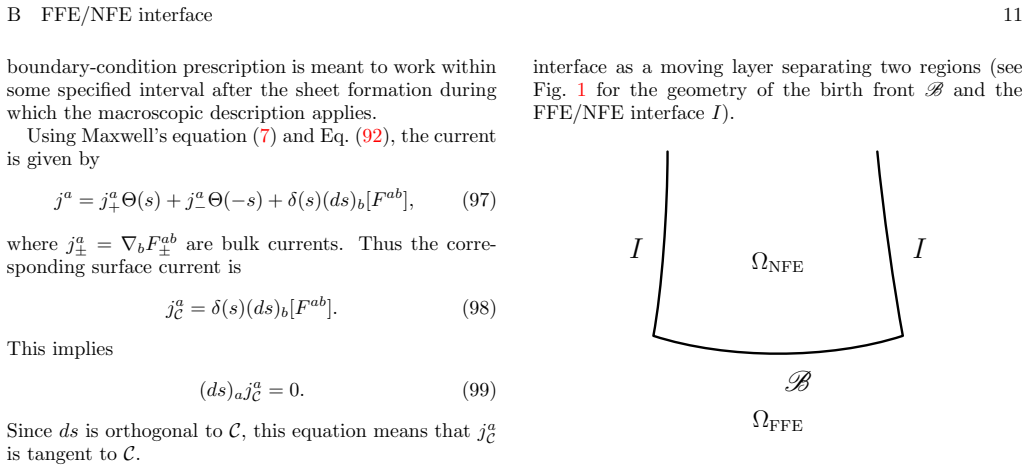
Interface law and outer interface Once the NFE region is born fromB, the FFE/NFE interface evolves subject to the pullback continuity (102) and the interface kinetic law (113)–(114). Since the birth frontBends atσ=W/2, the first such interface emerges from this location. We refer to the interface emerging fromσ=W/2 as the “outer interface” (since the “inn...
-
[5]
Current sheet formation The NFE description is valid only before the congru- ence (150)–(152) develops conjugate points, after which the newly formed current sheet replaces the NFE de- scription at the location of the conjugate point. In this reflection-symmetric collision, the rays launched fromB move towards thez= 0 plane sinceUis negative; thus, the co...
-
[6]
inner interface
After sheet formation: inner FFE region Once the sheet is formed atz= 0, we impose the cur- rent sheet boundary condition (96). By reflection sym- metry, the current sheet stays atz= 0 and the pullback continuity (95) is automatically satisfied. The null cur- rent sheet condition (96) then imposes Ex(t, z= 0) =B 0 = 1. t > t sheet (201) This condition sup...
-
[7]
Following the same argument used to derive Eq
Inner interface evolution The inner interface satisfies the same interface condi- tions as the outer interface. Following the same argument used to derive Eq. (179), the right-moving waveR(u −) is written in terms ofL(v −) as R(u−) = E(1−V −U)−L(v −)(1 +V −) 1−V − (209) However, in contrast to the outer interface where the form of the left-moving waveL(v+...
-
[8]
In this collision problem, they eventually meet
Merging of the inner and outer interfaces and subsequent evolution The outer interface evolves fromσ=W/2 atBwhile the inner interface starts fromt=t sheet atz= 0. In this collision problem, they eventually meet. The inner and outer interfaces merge atσ=σ m that satisfies the following equations simultaneously: u−(σm) =u +(σm), v −(σm) =v +(σm).(226) After...
-
[9]
Thus, it is worth summa- rizing the full process of FFE+NFE construction
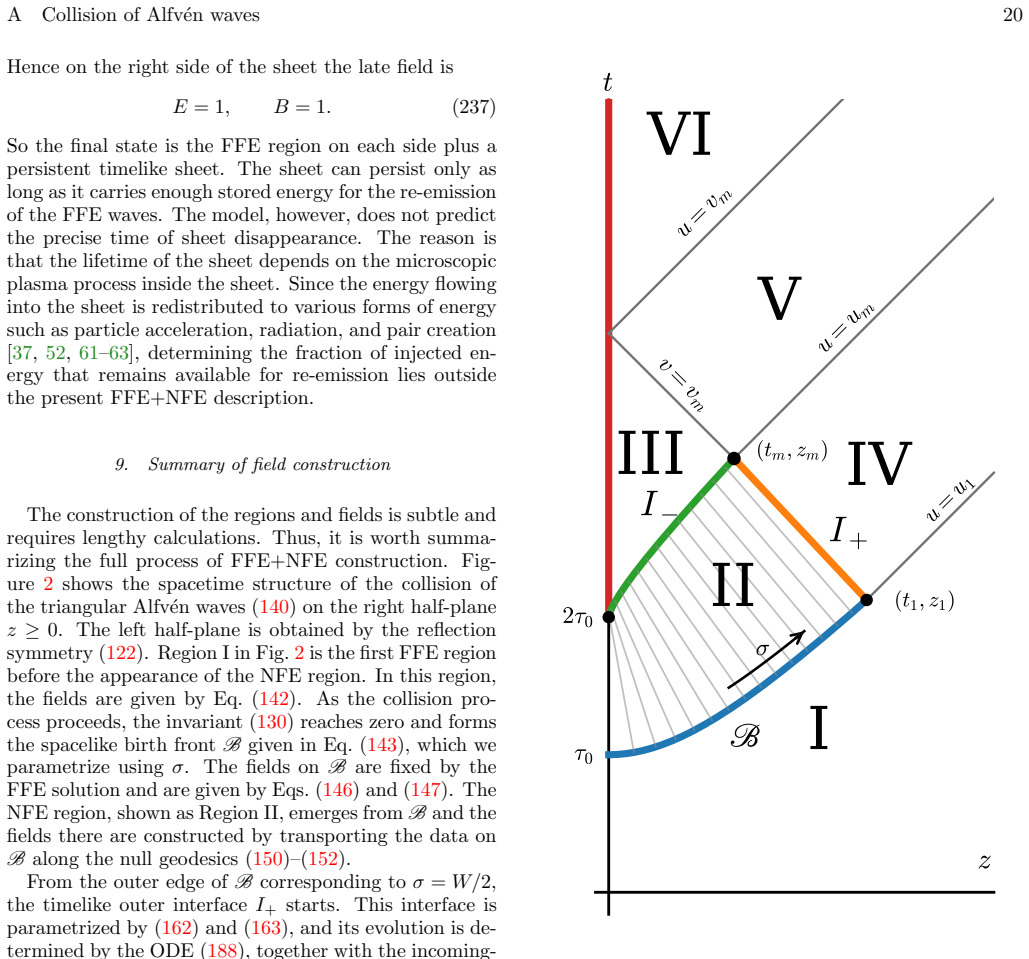
Summary of field construction The construction of the regions and fields is subtle and requires lengthy calculations. Thus, it is worth summa- rizing the full process of FFE+NFE construction. Fig- ure 2 shows the spacetime structure of the collision of the triangular Alfv´ en waves (140) on the right half-plane z≥0. The left half-plane is obtained by the ...
-
[10]
The initial setup is two counter-propagating triangular wave packets (140) on a uniform guide field
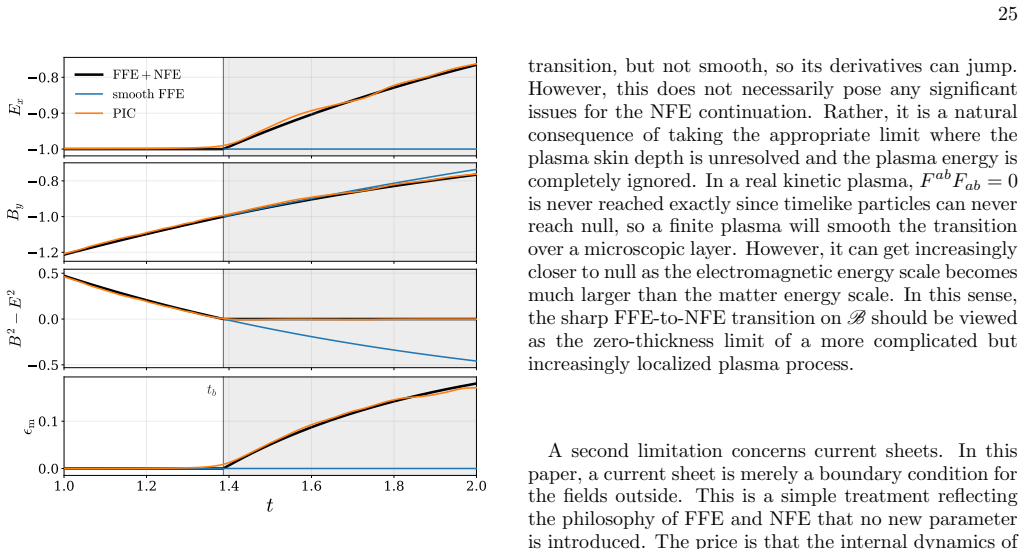
Comparison with the PIC simulation In order to test the validity of the FFE+NFE de- scription we developed above, we conducted a one- dimensional PIC simulation using Tristan-v2 [40]. The initial setup is two counter-propagating triangular wave packets (140) on a uniform guide field. The simulation box hasN z = 20000 cells for the wave propagation di- rec...
-
[11]
We can see that NFE-predicted energy (161) agree well with the PIC results, confirming that NFE can indeed capture the macroscopic plasma energy
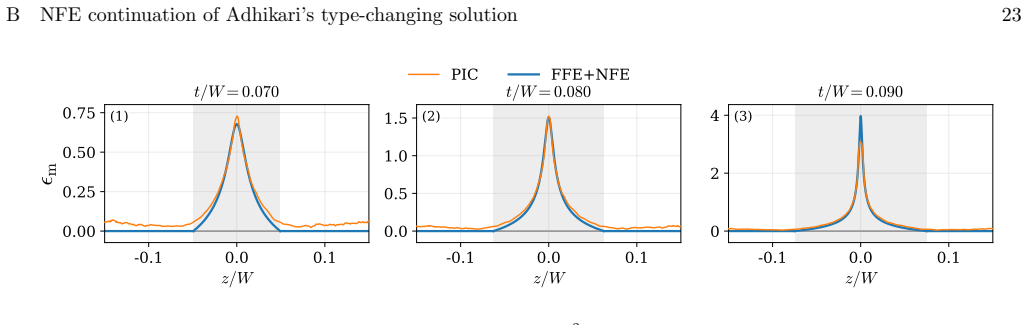
Outside the NFE region, FFE predictsϵ m = 0 while PIC shows a finite energy density of the plasma. We can see that NFE-predicted energy (161) agree well with the PIC results, confirming that NFE can indeed capture the macroscopic plasma energy. Before concluding this analysis, we should mention one important caveat. In this 1+1D calculation, we do not con...
-
[12]
sinh2 X dt∧dX +c1 sinhX dt∧dZ+ coshX dX∧dZ].(243) Then, the PND on the birth front is ℓ=∂ t −c 1 tanhX ∂ x +β(X)∂ z,(244) where β(X) = q 1−c 2 1 tanh2 X.(245) Usingλ=t−t b as an affine parameter, the geodesic congruence is given by t=t b +λ,(246) x=X−c 1λtanhX,(247) y=Y(248) z=Z+β(X)λ.(249) B NFE continuation of Adhikari’s type-changing solution 23 -0.1 0...
-
[13]
(254) with a one-dimensional Tristan- v2 PIC simulation of Adhikari’s type-changing solution
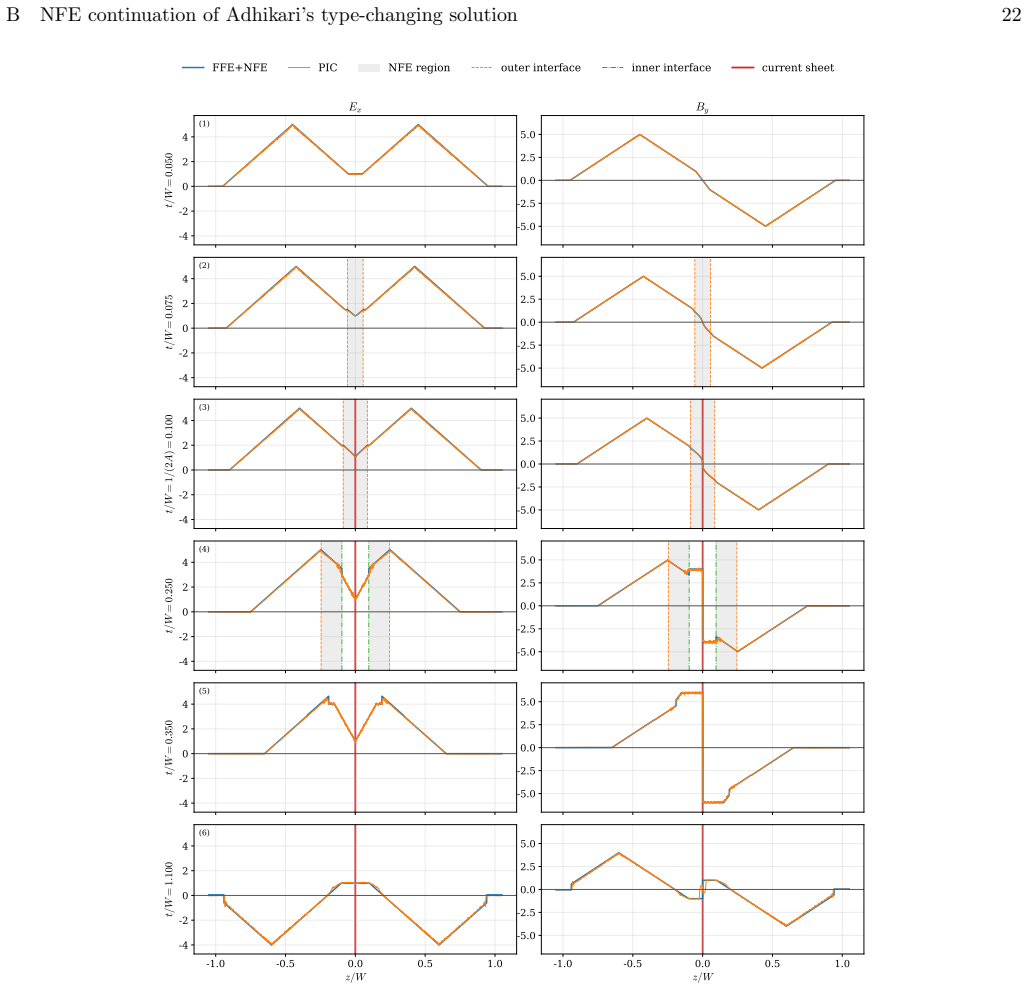
Comparison to PIC We compare the FFE and its NFE continuation con- structed in Eq. (254) with a one-dimensional Tristan- v2 PIC simulation of Adhikari’s type-changing solution. The 1+1D reduction was possible since Adhikari’s solu- tion (238) depends only ontandxand can be treated in 1+1 dimensions. For the simulation, we chosec 1 =−0.5 andc 2 = 1, for wh...
-
[14]
Theory of force-free electromagnetic fields. i. general theory,
T. Uchida, “Theory of force-free electromagnetic fields. i. general theory,”Phys. Rev. E56(Aug, 1997) 2181–2197.https: //link.aps.org/doi/10.1103/PhysRevE.56.2181
-
[15]
Linear perturbations in force-free black hole magnetospheres -II. Wave propagation,
T. Uchida, “Linear perturbations in force-free black hole magnetospheres -II. Wave propagation,”MNRAS 291no. 1, (Oct., 1997) 125–144
1997
-
[16]
The force-free magnetosphere around an oblique rotator,
T. Uchida, “The force-free magnetosphere around an oblique rotator,”MNRAS297no. 1, (June, 1998) 315–322
1998
-
[17]
Time-dependent, force-free, degenerate electrodynamics,
S. S. Komissarov, “Time-dependent, force-free, degenerate electrodynamics,”MNRAS336no. 3, (Nov.,
-
[18]
759–766,arXiv:astro-ph/0202447 [astro-ph]
-
[19]
Spacetime approach to force-free magnetospheres,
S. E. Gralla and T. Jacobson, “Spacetime approach to force-free magnetospheres,”Monthly Notices of the Royal Astronomical Society445no. 3, (2014) 2500–2534
2014
-
[20]
Effective Field Theory of Force-Free Electrodynamics,
S. E. Gralla and N. Iqbal, “Effective Field Theory of Force-Free Electrodynamics,”Phys. Rev. D99no. 10, (2019) 105004,arXiv:1811.07438 [hep-th]
Pith/arXiv arXiv 2019
-
[21]
Rotating Neutron Stars as the Origin of the Pulsating Radio Sources,
T. Gold, “Rotating Neutron Stars as the Origin of the Pulsating Radio Sources,”Nature (London)218 no. 5143, (May, 1968) 731–732
1968
-
[22]
Pulsar Electrodynamics,
P. Goldreich and W. H. Julian, “Pulsar Electrodynamics,”Astrophys. J.157(Aug., 1969) 869
1969
-
[23]
Electromagnetic extraction of energy from Kerr black holes.,
R. D. Blandford and R. L. Znajek, “Electromagnetic extraction of energy from Kerr black holes.,”MNRAS 179(May, 1977) 433–456
1977
-
[24]
Robustness of the Blandford-Znajek mechanism,
C. Palenzuela, C. Bona, L. Lehner, and O. Reula, “Robustness of the Blandford-Znajek mechanism,” Class. Quant. Grav.28(2011) 134007, arXiv:1102.3663 [astro-ph.HE]
Pith/arXiv arXiv 2011
-
[25]
Hyperbolicity of Force-Free Electrodynamics,
H. P. Pfeiffer and A. I. MacFadyen, “Hyperbolicity of Force-Free Electrodynamics,”arXiv:1307.7782 [gr-qc]
-
[26]
Covariant hyperbolization of force-free electrodynamics,
F. Carrasco and O. Reula, “Covariant hyperbolization of force-free electrodynamics,”Physical Review D93 no. 8, (Apr., 2016) . http://dx.doi.org/10.1103/PhysRevD.93.085013
-
[27]
Breakdown of force-free electrodynamics in electric zones,
A. Levinson, “Breakdown of force-free electrodynamics in electric zones,”Mon. Not. Roy. Astron. Soc.517 no. 1, (2022) 569–575,arXiv:2207.07535 [astro-ph.HE]
arXiv 2022
-
[28]
Time-dependent force-free pulsar magnetospheres: Axisymmetric and oblique rotators,
A. Spitkovsky, “Time-dependent force-free pulsar magnetospheres: Axisymmetric and oblique rotators,” The Astrophysical Journal648no. 1, (Aug., 2006) L51–L54.http://dx.doi.org/10.1086/507518
-
[29]
Simulations of axisymmetric magnetospheres of neutron stars,
S. S. Komissarov, “Simulations of axisymmetric magnetospheres of neutron stars,”Mon. Not. Roy. Astron. Soc.367(2006) 19–31, arXiv:astro-ph/0510310
Pith/arXiv arXiv 2006
-
[30]
J. C. McKinney, “General relativistic force-free electrodynamics: a new code and applications to black hole magnetospheres,”Mon. Not. Roy. Astron. Soc. 367(2006) 1797–1807,arXiv:astro-ph/0601410
Pith/arXiv arXiv 2006
-
[31]
Three-dimensional numerical simulations of the pulsar magentoshere: Preliminary results,
C. Kalapotharakos and I. Contopoulos, “Three-dimensional numerical simulations of the pulsar magentoshere: Preliminary results,”Astron. Astrophys. 496(2009) 495–502,arXiv:0811.2863 [astro-ph]
Pith/arXiv arXiv 2009
-
[32]
Toward a Realistic Pulsar Magnetosphere,
C. Kalapotharakos, D. Kazanas, A. Harding, and I. Contopoulos, “Toward a Realistic Pulsar Magnetosphere,”Astrophys. J.749no. 1, (Apr., 2012) 2,arXiv:1108.2138 [astro-ph.SR]
Pith/arXiv arXiv 2012
-
[33]
Resistive solutions for pulsar magnetospheres,
J. Li, A. Spitkovsky, and A. Tchekhovskoy, “Resistive solutions for pulsar magnetospheres,”The Astrophysical Journal746no. 1, (Jan., 2012) 60. http://dx.doi.org/10.1088/0004-637X/746/1/60
-
[34]
K. Parfrey, A. M. Beloborodov, and L. Hui, “Introducing phaedra: a new spectral code for simulations of relativistic magnetospheres: phaedra: a new spectral code,”Monthly Notices of the Royal Astronomical Society423no. 2, (Apr., 2012) 1416–1436.http: //dx.doi.org/10.1111/j.1365-2966.2012.20969.x
-
[35]
Accurate Simulations of Binary Black-Hole Mergers in Force-Free Electrodynamics,
D. Alic, P. Mosta, L. Rezzolla, O. Zanotti, and J. L. Jaramillo, “Accurate Simulations of Binary Black-Hole Mergers in Force-Free Electrodynamics,”Astrophys. J. 754(2012) 36,arXiv:1204.2226 [gr-qc]. 30
Pith/arXiv arXiv 2012
-
[36]
Force-free electromagnetic configurations in arbitrary geometries,
R. Adhikari, “Force-free electromagnetic configurations in arbitrary geometries,”Phys. Rev. D112no. 10, (2025) 104063,arXiv:2511.06693 [gr-qc]
arXiv 2025
-
[37]
A semilinear wave sector in force-free electrodynamics,
Y. E. S. Sanchez, “A semilinear wave sector in force-free electrodynamics,” 2026. https://arxiv.org/abs/2604.15630
Pith/arXiv arXiv 2026
-
[38]
A new scheme for matching general relativistic ideal magnetohydrodynamics to its force-free limit,
V. Paschalidis and S. L. Shapiro, “A new scheme for matching general relativistic ideal magnetohydrodynamics to its force-free limit,”Physical Review D88no. 10, (Nov., 2013) . http://dx.doi.org/10.1103/PhysRevD.88.104031
-
[39]
Ab initio pulsar magnetosphere: Three-dimensional particle-in-cell simulations of oblique pulsars,
A. A. Philippov, A. Spitkovsky, and B. Cerutti, “Ab initio pulsar magnetosphere: Three-dimensional particle-in-cell simulations of oblique pulsars,”The Astrophysical Journal801no. 1, (Mar., 2015) L19. http://dx.doi.org/10.1088/2041-8205/801/1/L19
-
[40]
Particle acceleration in axisymmetric pulsar current sheets,
B. Cerutti, A. Philippov, K. Parfrey, and A. Spitkovsky, “Particle acceleration in axisymmetric pulsar current sheets,”Monthly Notices of the Royal Astronomical Society448no. 1, (Feb., 2015) 606–619. http://dx.doi.org/10.1093/mnras/stv042
-
[41]
Weak alfv´ enic turbulence in relativistic plasmas. part 2. current sheets and dissipation,
B. Ripperda, J. Mahlmann, A. Chernoglazov, J. TenBarge, E. Most, J. Juno, Y. Yuan, A. Philippov, and A. Bhattacharjee, “Weak alfv´ enic turbulence in relativistic plasmas. part 2. current sheets and dissipation,”Journal of Plasma Physics87no. 5, (Oct.,
-
[42]
http://dx.doi.org/10.1017/S0022377821000957
-
[43]
Heating of magnetically dominated plasma by alfv´ en-wave turbulence,
J. N¨ attil¨ a and A. M. Beloborodov, “Heating of magnetically dominated plasma by alfv´ en-wave turbulence,”Physical Review Letters128no. 7, (Feb.,
-
[44]
http: //dx.doi.org/10.1103/PhysRevLett.128.075101
-
[45]
Aristotelian Electrodynamics solves the Pulsar: Lower Efficiency of Strong Pulsars,
A. Gruzinov, “Aristotelian Electrodynamics solves the Pulsar: Lower Efficiency of Strong Pulsars,” arXiv:1303.4094 [astro-ph.HE]
-
[46]
Structure of Aristotelian Electrodynamics,
T. Jacobson, “Structure of Aristotelian Electrodynamics,”Phys. Rev. D92no. 2, (2015) 025029,arXiv:1504.07311 [astro-ph.HE]
Pith/arXiv arXiv 2015
-
[47]
Bosonization of Strong-Field Pair Plasma,
S. E. Gralla, “Bosonization of Strong-Field Pair Plasma,”JCAP05(2019) 002,arXiv:1811.08422 [hep-th]
Pith/arXiv arXiv 2019
-
[48]
On the Robinson theorem and shearfree geodesic null congruences,
J. Tafel, “On the Robinson theorem and shearfree geodesic null congruences,”Letters in Mathematical Physics10no. 1, (July, 1985) 33–39
1985
-
[49]
The null and force-free electromagnetic field,
G. Menon, “The null and force-free electromagnetic field,”Classical and Quantum Gravity38no. 4, (2021) 045011
2021
-
[50]
Further Results on Null and Force-free Electromagnetic Fields,
G. Menon and R. Adhikari, “Further Results on Null and Force-free Electromagnetic Fields,” arXiv:2603.14046 [gr-qc]
-
[51]
Exact Solutions to Force-Free Electrodynamics in Black Hole Backgrounds,
T. D. Brennan, S. E. Gralla, and T. Jacobson, “Exact Solutions to Force-Free Electrodynamics in Black Hole Backgrounds,”Class. Quant. Grav.30(2013) 195012, arXiv:1305.6890 [gr-qc]
Pith/arXiv arXiv 2013
-
[52]
L. C. Evans,Partial differential equations. American Mathematical Society, Providence, R.I., 2010
2010
-
[53]
Relativistic reconnection: An efficient source of non-thermal particles,
L. Sironi and A. Spitkovsky, “Relativistic reconnection: An efficient source of non-thermal particles,”The Astrophysical Journal783no. 1, (Feb., 2014) L21. http://dx.doi.org/10.1088/2041-8205/783/1/L21
-
[54]
L. Sironi, D. A. Uzdensky, and D. Giannios, “Relativistic Magnetic Reconnection in Astrophysical Plasmas: A Powerful Mechanism of Nonthermal Emission,”Ann. Rev. Astron. Astrophys.63no. 1, (2025) 127–178,arXiv:2506.02101 [astro-ph.HE]
arXiv 2025
-
[55]
Fast dissipation of colliding alfv´ en waves in a magnetically dominated plasma,
X. Li, A. M. Beloborodov, and L. Sironi, “Fast dissipation of colliding alfv´ en waves in a magnetically dominated plasma,”The Astrophysical Journal915 no. 2, (July, 2021) 101. http://dx.doi.org/10.3847/1538-4357/abfe5f
-
[56]
Princetonuniversity/tristan-mp-v2: v2.9,
H. Hakobyan, A. Spitkovsky, A. Chernoglazov, A. Philippov, D. Groselj, J. Mahlmann, F. Bacchini, and A. Vanthieghem, “Princetonuniversity/tristan-mp-v2: v2.9,” Dec., 2024. https://doi.org/10.5281/zenodo.14564000
-
[57]
R. M. Wald,General Relativity. Chicago Univ. Pr., Chicago, USA, 1984
1984
-
[58]
The gyration of a charged particle,
M. Kruskal, “The gyration of a charged particle,” tech. rep., Princeton Univ., N.J. Project Matterhorn, 03, 1958.https://www.osti.gov/biblio/4332926
arXiv 1958
-
[59]
The guiding center approximation to charged particle motion,
T. G. Northrop, “The guiding center approximation to charged particle motion,”Annals of Physics (New York) (U.S.)Vol: 15(07, 1961) . https://www.osti.gov/biblio/4017538
arXiv 1961
-
[60]
The relativistic motion of a charged particle in an inhomogeneous electromagnetic field,
P. O. Vandervoort, “The relativistic motion of a charged particle in an inhomogeneous electromagnetic field,”Annals of Physics10no. 3, (July, 1960) 401–453
1960
-
[61]
Stability in force-free electrodynamics,
A. Gruzinov, “Stability in force-free electrodynamics,” 1999.https://arxiv.org/abs/astro-ph/9902288
Pith/arXiv arXiv 1999
-
[62]
Null electromagnetic fields,
I. Robinson, “Null electromagnetic fields,”Journal of Mathematical Physics2no. 3, (May, 1961) 290–291
1961
-
[63]
K. L. Duggal and A. Bejancu,Lightlike Submanifolds of Semi-Riemannian Manifolds and Applications, vol. 364 ofMathematics and Its Applications. Kluwer Academic Publishers, Dordrecht, 1996
1996
-
[64]
S. M. Carroll,Spacetime and Geometry: An Introduction to General Relativity. 2019
2019
-
[65]
S. W. Hawking and G. F. R. Ellis,The Large Scale Structure of Space-Time. Cambridge Monographs on Mathematical Physics. Cambridge University Press, 2, 2023
2023
-
[66]
Poisson,A Relativist’s Toolkit: The Mathematics of Black-Hole Mechanics
E. Poisson,A Relativist’s Toolkit: The Mathematics of Black-Hole Mechanics. Cambridge University Press, 12, 2009
2009
-
[67]
P. D. Lax,1. Hyperbolic Systems of Conservation Laws and the Mathematical Theory of Shock Waves, pp. 1–48. https://epubs.siam.org/doi/abs/10.1137/1. 9781611970562.ch1
-
[68]
Physical conditions in the reconnection layer in pulsar magnetospheres,
D. A. Uzdensky and A. Spitkovsky, “Physical conditions in the reconnection layer in pulsar magnetospheres,” The Astrophysical Journal780no. 1, (Dec., 2013) 3. http://dx.doi.org/10.1088/0004-637X/780/1/3
-
[69]
Global solutions of the relativistic Euler equations,
J. Smoller and B. Temple, “Global solutions of the relativistic Euler equations,”Communications in Mathematical Physics156no. 1, (Sept., 1993) 67–99
1993
-
[70]
Singular hypersurfaces and thin shells in general relativity,
W. Israel, “Singular hypersurfaces and thin shells in general relativity,”Nuovo Cimento B Serie44no. 1, (July, 1966) 1–14
1966
-
[71]
P. Mart´ ın-Moruno and M. Visser, “Generalized Rainich conditions, generalized stress-energy conditions, and the Hawking-Ellis classification,”Class. Quant. Grav.34 no. 22, (2017) 225014,arXiv:1707.04172 [gr-qc]
Pith/arXiv arXiv 2017
-
[72]
Thin shells in general relativity and cosmology: The lightlike limit,
C. Barrab` es and W. Israel, “Thin shells in general relativity and cosmology: The lightlike limit,”Phys. Rev. D43(Feb, 1991) 1129–1142.https: //link.aps.org/doi/10.1103/PhysRevD.43.1129
-
[73]
Dissipation of 31 Alfv´ en Waves in Relativistic Magnetospheres of Magnetars,
X. Li, J. Zrake, and A. M. Beloborodov, “Dissipation of 31 Alfv´ en Waves in Relativistic Magnetospheres of Magnetars,”arXiv:1810.10493 [astro-ph.HE]
-
[74]
Functional differential equations with state-dependent delays: Theory and applications,
F. Hartung, T. Krisztin, H.-O. Walther, and J. Wu, “Functional differential equations with state-dependent delays: Theory and applications,” inHandbook of Differential Equations: Ordinary Differential Equations, vol. 3, pp. 435–545. Elsevier, 2006
2006
-
[75]
A two-body problem of classical electrodynamics: The one-dimensional case,
R. D. Driver, “A two-body problem of classical electrodynamics: The one-dimensional case,”Ann. Phys.Vol: 21(01, 1963) . https://www.osti.gov/biblio/4715929
arXiv 1963
-
[76]
A one-dimensional two-body problem of classical electrodynamics,
S. P. Travis, “A one-dimensional two-body problem of classical electrodynamics,”SIAM Journal on Applied Mathematics28no. 3, (1975) 611–632. https://doi.org/10.1137/0128051
-
[77]
Effects of synchrotron cooling and pair production on collisionless relativistic reconnection,
H. Hakobyan, A. Philippov, and A. Spitkovsky, “Effects of synchrotron cooling and pair production on collisionless relativistic reconnection,”The Astrophysical Journal877no. 1, (May, 2019) 53. http://dx.doi.org/10.3847/1538-4357/ab191b
-
[78]
Three-dimensional relativistic pair plasma reconnection with radiative feedback in the crab nebula,
B. Cerutti, G. R. Werner, D. A. Uzdensky, and M. C. Begelman, “Three-dimensional relativistic pair plasma reconnection with radiative feedback in the crab nebula,”The Astrophysical Journal782no. 2, (Feb.,
-
[79]
http://dx.doi.org/10.1088/0004-637X/782/2/104
104. http://dx.doi.org/10.1088/0004-637X/782/2/104
-
[80]
Magnetic Reconnection and Associated Particle Acceleration in High-Energy Astrophysics,
F. Guo, Y.-H. Liu, S. Zenitani, and M. Hoshino, “Magnetic Reconnection and Associated Particle Acceleration in High-Energy Astrophysics,”Space Sci. Rev.220no. 4, (2024) 43,arXiv:2309.13382 [astro-ph.HE]
arXiv 2024
discussion (0)
Sign in with ORCID, Apple, or X to comment. Anyone can read and Pith papers without signing in.