REVIEW 4 major objections 5 minor 42 references
Chatter Detection in Turning Using Machine Learning and Similarity Measures of Time Series via Dynamic Time Warping
T0 review · 4 major / 5 minor · reviewed 2026-08-14 · deepseek-v4-flash
Pith's one-line read The paper claims that a kNN classifier using Dynamic Time Warping distances on raw acceleration signals detects chatter with the highest accuracy in three of four tool stickout configurations, reaching up to 99.5%, and transfers across…
desk verdict Useful application of a standard DTW+kNN recipe to chatter detection, but the headline accuracies are unreliable until the train/test split unit and K selection are fixed. read the letter →
The pith
A machine-rendered reading of the paper's core claim, the machinery that carries it, and where it could break.
The reading
What carries the argument
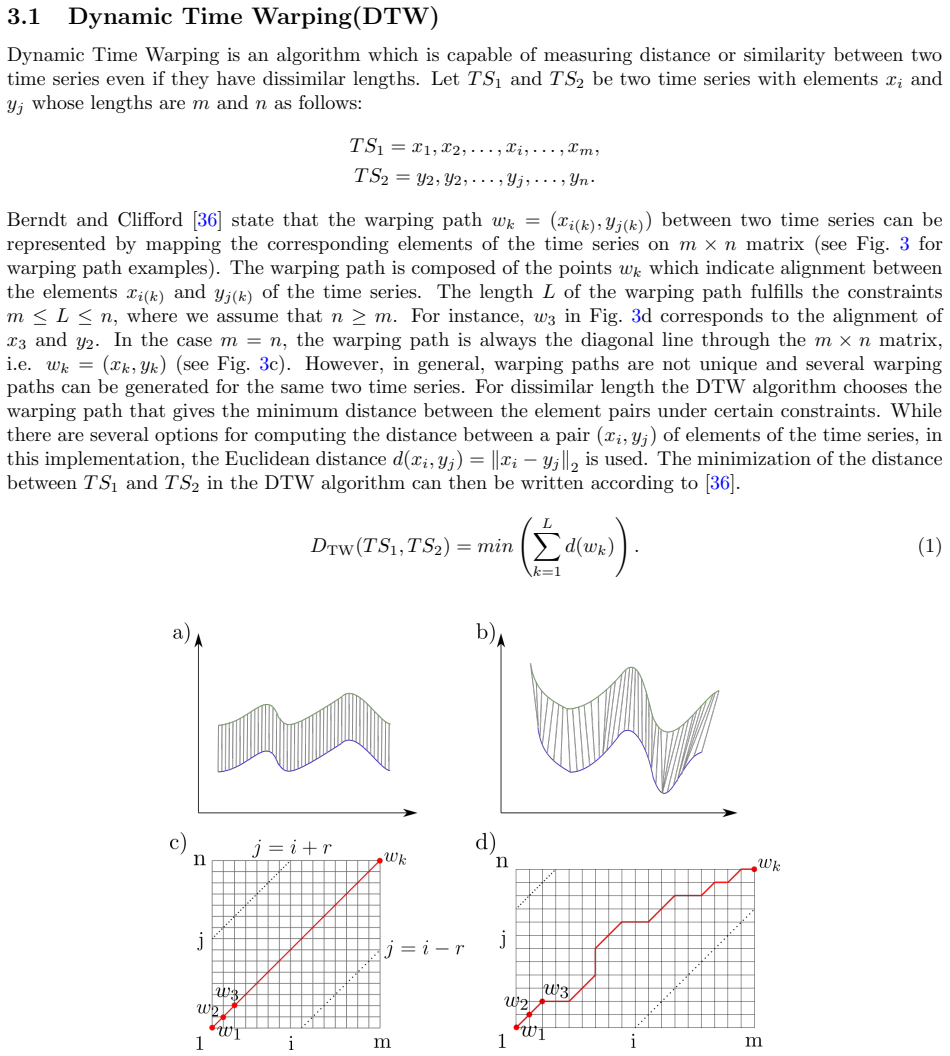
The mechanism is the DTW distance matrix: each pair of time series is aligned by a warping path that minimizes the accumulated Euclidean distance between elements under monotonicity, continuity, boundary, window, and slope constraints; the resulting pairwise distances are fed to a kNN classifier. Because the warping path adapts to local time shifts and handles unequal signal lengths, the distance is computed on the raw waveforms rather than on reconstructed packets or IMFs, which is why no informative-band selection or manual preprocessing is needed.
What would settle it
Run the same DTW-kNN pipeline on a turning dataset whose chatter labels are fixed by an independent objective criterion, such as surface-roughness measurements or a force-dynamometer threshold, instead of manual peak inspection, and check whether the top accuracies (99.5%, 94.6%, 81.5%) reproduce; if accuracy drops sharply, the manual labels were doing much of the work.
Extended reading notes
Core claim
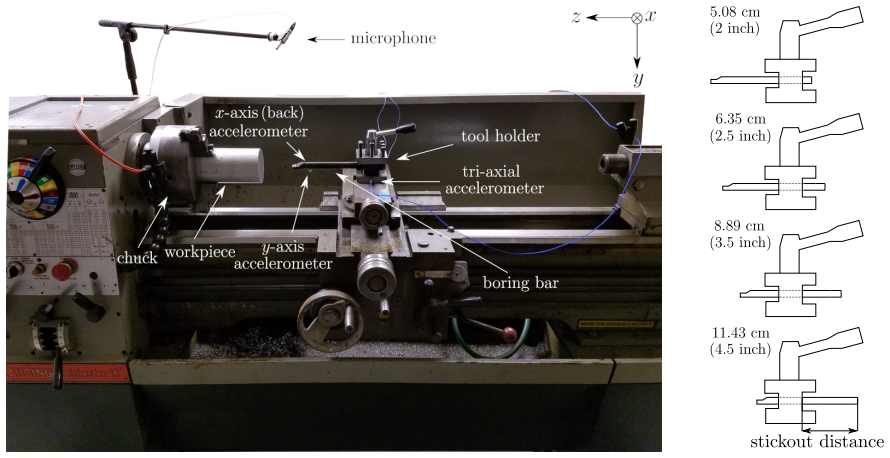
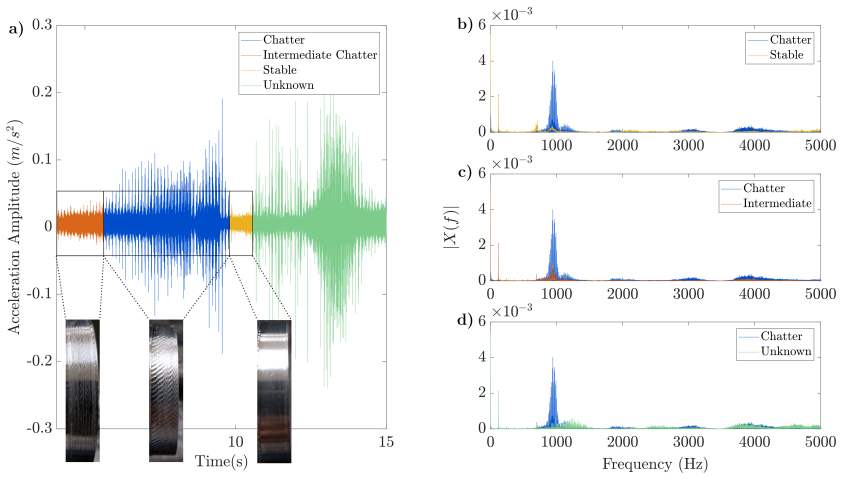
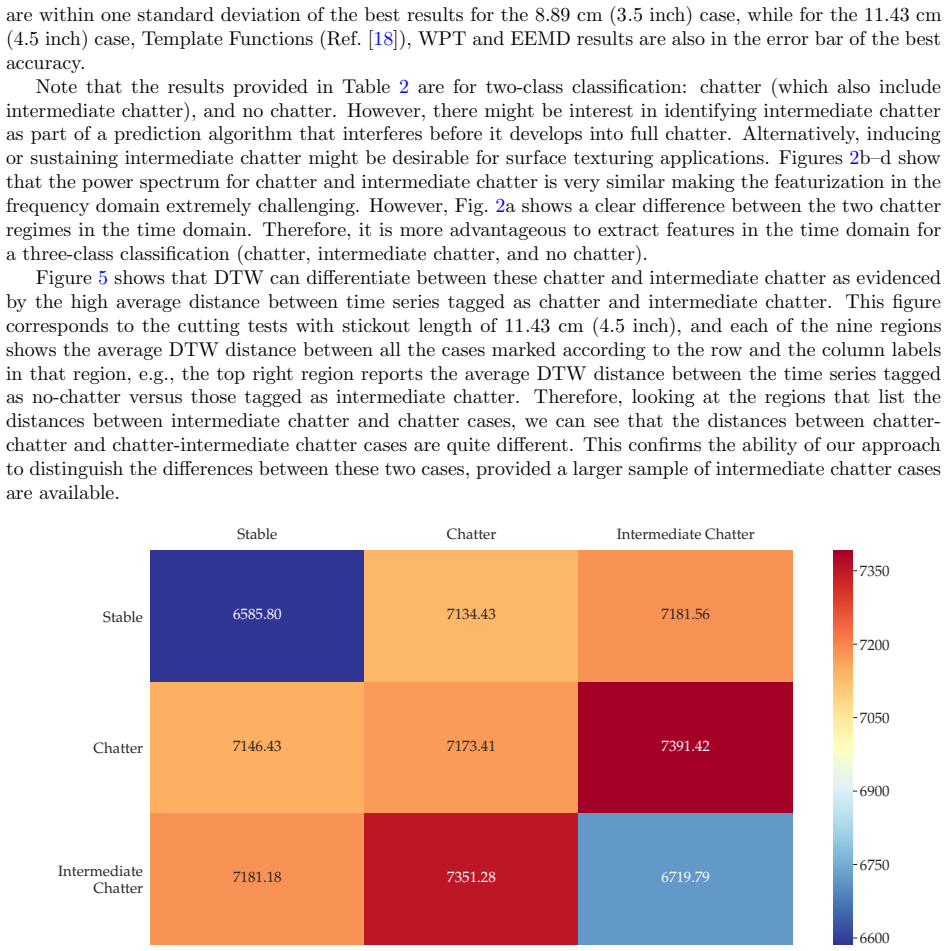
The central discovery is that DTW distances between raw, z-score-normalized acceleration time series carry enough information about the machining state that a kNN classifier on those distances detects chatter without any hand-built features: 99.5% (5.08 cm), 94.6% (8.89 cm), and 81.5% (11.43 cm) average two-class test accuracy, versus lower or overlapping scores for WPT, EEMD, and TDA feature methods. When trained on one extreme stickout and tested on the other, DTW retained 78.2% and 87.7% test accuracy, beating WPT and EEMD transfer performance. The method also distinguishes chatter from intermediate chatter in three-class tests, which the authors note is difficult or impossible with frequency-based features because the spectra are too similar.
Load-bearing premise
The labels that define chatter, intermediate chatter, and stable are assigned by manual inspection of time-domain peak heights and frequency-domain peaks below 5 kHz, with ambiguous stretches discarded, so every reported accuracy inherits whatever noise those labels contain.
Editorial extensions
If this is right
- A chatter classifier can be built directly from raw accelerometer readings with no feature extraction, no manual selection of frequency bands, and no reconstruction of informative signal components.
- In three of the four stickout configurations the DTW-kNN pipeline gives the highest average two-class accuracy among the methods compared: 99.5%, 94.6%, and 81.5%.
- The same classifier can be reused across very different tool stiffnesses: transfer between 5.08 cm and 11.43 cm stickouts yields 78.2% and 87.7% test accuracy, exceeding the WPT and EEMD transfer results.
- Three-class results (chatter, intermediate chatter, no chatter) show that time-domain shape carries information that separates intermediate from full chatter even when their spectra are nearly identical.
- After the offline training phase, classifying a new chunk requires only one row of the training-test DTW distance matrix, so the online per-sample cost is much smaller than the training-time cost.
Reading between the lines
- Because DTW aligns time series of unequal lengths without fixed resampling, the same pipeline could naturally extend to variable-duration cutting passes or changes in spindle speed without re-engineering the features.
- An online implementation could train once offline and then classify each new acceleration chunk by computing a single DTW row; the fast DTW variants the paper cites suggest this could fit on a machine controller or small embedded device, though the paper does not demonstrate this itself.
- The authors' three-class heat map suggests that amplitude-normalized waveform shape, not absolute amplitude, may be doing much of the separation; a direct test would be to scale all signals to the same peak amplitude and see whether the accuracy survives.
- The transfer-learning result hints that DTW distances are less tied to the specific chatter eigenfrequency than WPT or EEMD features are, which would make the method more robust to machine stiffness drift, but this conclusion goes beyond the two stickout pairs tested.
Signed reviews
Editorial analysis
A structured set of objections, weighed in public.
Referee Report
Summary. The paper proposes a chatter detection method for turning processes that combines k-nearest-neighbor (kNN) classification with dynamic time warping (DTW) distances computed directly on raw acceleration time series, thereby avoiding the manual feature-engineering steps used by WPT, EEMD, and TDA-based baselines. Using data from four tool stickout configurations, the authors report that DTW achieves the highest average two-class accuracy in three of four configurations (99.5%, 94.6%, and 81.5% for the 5.08, 8.89, and 11.43 cm cases, respectively), outperforms WPT and EEMD in transfer-learning experiments between the two extreme stickout lengths, and can also distinguish an intermediate-chatter class in a three-class setting. The paper includes comparisons to previously published WPT/EEMD and TDA results, runtime comparisons, and a discussion of optimized DTW implementations for in-process use.
Significance. If the reported accuracies are trustworthy, the contribution is practically significant: a chatter detector that operates on raw signals without feature extraction and that transfers across cutting configurations would simplify deployment and reduce the need for expert preprocessing. The paper also makes a useful comparison of DTW against established signal-processing and topological methods on a shared experimental dataset, and the dataset is publicly available in Mendeley. The transfer-learning analysis is a valuable addition to the chatter-detection literature. However, the strength of these conclusions depends critically on the experimental protocol being well-defined and free of data leakage, which is currently not established.
major comments (4)
- [Section 3.2] The benchmark is potentially invalidated by an unspecified split unit. Section 3.2 states that, before computing similarity matrices, the time series are 'subdivided while maintaining the corresponding tagging' into parts of length nearly 10,000, and the text does not state whether the random train/test splits are performed on these subsequences or on the parent labeled time series listed in Table 1. If subsequences from one parent recording are split independently, the same parent signal appears in both training and test sets, and a kNN classifier can match near-duplicate waveform chunks from the same recording. This would make the reported accuracies and very small standard deviations (e.g., 99.5% +/- 0.5% in Table 6 for the 5.08 cm case) reflect memorization rather than generalization, and the same ambiguity affects the transfer results in Table 4. The authors must specify the split unit, and if subsequences are used, they should either keep all subsequences of a parent signal in one fold or explicitly justify why within-signal leakage is negligible.
- [Section 5.2 and Tables 2, 3, 4, and 6] The reported 'best' results are obtained by selecting the number of nearest neighbors K from {1,...,5} based on test-set accuracy. This is stated explicitly for the transfer-learning experiments in Section 5.2 ('a KNN classifier was trained for K in {1,2,...,5}, and the highest resulting accuracy was listed') and is implied for Tables 2 and 3, which report the best entries from the full tables in the appendix. Model selection on the test set over five choices inflates the expected accuracy and can explain part of the gap between DTW and the comparison methods. The authors should select K using an internal validation split or nested cross-validation, and report the corresponding accuracy, or report all K values without claiming that the best one is the expected performance.
- [Table 1 and Section 2.3] The ground-truth labels are based on manual inspection of time-domain peaks, frequency-domain peaks below 5 kHz, and workpiece surface finish, with no inter-rater reliability assessment. Since every accuracy and every comparison inherits these labels, label noise or inconsistency is a direct threat to the central claim. The fragility is compounded by the per-class counts: for the 8.89 cm stickout case there are only 2 intermediate and 2 full chatter time series (11 total), and for the 6.35 cm case there are 3 chatter series (14 total). With such small samples, a few mislabeled or accidentally similar series can dominate the reported average accuracy and make the standard deviations in Tables 6-8 unreliable. The authors should provide evidence of label reliability (e.g., multiple annotators or a documented annotation protocol with examples) and should report results with confidence intervals or leave-one-parent-out cross-validation that respects the parent signal structure.
- [Section 5.1 and Table 2] The comparison with WPT, EEMD, and TDA relies on numbers taken from the authors' own prior papers (Refs. [10] and [16]) rather than on re-running those methods under the same train/test protocol used for DTW. The paper should clarify whether the WPT/EEMD and TDA results used the same subdivision, the same split unit, and the same K-selection procedure. Without this, the 'highest accuracy' comparisons in Table 2 may reflect differences in experimental protocol rather than genuine differences in method quality. This is particularly relevant for the 8.89 cm and 11.43 cm rows, where the best DTW result is within one standard deviation of several comparison methods.
minor comments (5)
- [Section 3.2] The claim that 'DTW is not commutative' and hence that the similarity matrix requires N^2 computations is incorrect for the standard DTW formulation used here: with a symmetric pointwise distance and symmetric step constraints, DTW(T S1, T S2) = DTW(T S2, T S1). The matrix is symmetric and only N(N-1)/2 computations are needed. If a non-symmetric variant is intended, this should be stated explicitly.
- [Abstract and Section 1] The claim that the approach 'does not require feature extraction' should be qualified: the method still requires normalization, downsampling, subdivision, and a choice of DTW slope constraint and window, which are preprocessing and hyperparameter choices even if they are not manual feature engineering.
- [Section 5.2] The sentence '67% of the training set was used to train the classifier, and testing was performed using 67% of the testing set' is confusing and likely contains a typo. The authors should clarify exactly how the source and target sets were split for the transfer-learning experiments, including whether the 67% selection was random and whether the test portion was disjoint from the training portion of the same source configuration.
- [Table 5] The runtime comparison mixes different implementations (optimized WPT/EEMD versus an unoptimized FastDTW package) and excludes the manual preprocessing time for WPT/EEMD. The conclusion that DTW is viable for in-process detection would be strengthened by reporting the time per test sample after training, rather than only the total training-plus-test runtime.
- [Section 2.3] The tag 'unknown' is used for regions that do not fit the three main categories, and these regions are excluded from classification. The number of excluded 'unknown' time series per configuration is not reported, so it is unclear how much data was discarded and whether the exclusion could bias the class balance.
Circularity Check
No circularity: DTW-kNN accuracies are measured on held-out data, and the cited comparison methods are separate benchmarks rather than inputs to the DTW result.
full rationale
The derivation chain is not circular. The DTW-kNN accuracies in Tables 2, 3, and 4 are obtained by computing pairwise DTW distances from the raw acceleration time series and then evaluating kNN on held-out test splits; no parameter of the DTW distance is fitted to the labels, and the labels are assigned by the independent manual criteria of Sec. 2.3. The comparison numbers for WPT, EEMD, and TDA are imported from the authors' prior papers [10] and [16], but those are separate benchmark experiments on the same public dataset; they are externally falsifiable and do not contain the DTW result, so the self-citations are not load-bearing. The mild concerns raised by the skeptic--selecting K from 1..5 on the test set and not specifying whether the random split is performed before or after subsequencing--can affect the validity or interpretability of the reported accuracies, but they are not cases where a prediction reduces to its inputs by construction. Therefore no circular step is identified.
Assumptions & free parameters
free parameters (3)
- K (number of neighbors in kNN) =
Selected per configuration from {1,...,5}; e.g., 2-NN for 5.08 cm two-class, 1-NN for 6.35 cm three-class, 4-NN for…
- DTW slope constraint P =
1
- Time series subdivision length =
approximately 10000 samples per segment
assumptions (5)
- domain assumption DTW with Euclidean local cost and the stated warping constraints is an appropriate similarity measure for chatter versus no-chatter separation.
- domain assumption Manual peak-based tagging in time and frequency domains (Section 2.3), verified by surface finish photos, provides correct ground-truth labels.
- domain assumption The x-axis acceleration signal from the tri-axial accelerometer is sufficient; other sensor channels are redundant (Section 2.3).
- domain assumption FastDTW's approximation is close enough to exact DTW for these signals.
- standard math DTW path constraints (monotonicity, continuity, boundary, adjustment window, slope) follow the standard definitions in [36,37].
Cite this review
Pith. "Pith review of Chatter Detection in Turning Using Machine Learning and Similarity Measures of Time Series via Dynamic Time Warping." pith.science (2026). https://pith.science/paper/OCXCRSWI
@misc{pith2026190801678,
  author       = {Pith},
  title        = {Pith review of: Chatter Detection in Turning Using Machine Learning and Similarity Measures of Time Series via Dynamic Time Warping},
  year         = {2026},
  howpublished = {\url{https://pith.science/paper/OCXCRSWI}},
  note         = {Machine review of arXiv:1908.01678}
}
read the original abstract
Chatter detection from sensor signals has been an active field of research. While some success has been reported using several featurization tools and machine learning algorithms, existing methods have several drawbacks such as manual preprocessing and requiring a large data set. In this paper, we present an alternative approach for chatter detection based on K-Nearest Neighbor (kNN) algorithm for classification and the Dynamic Time Warping (DTW) as a time series similarity measure. The used time series are the acceleration signals acquired from the tool holder in a series of turning experiments. Our results, show that this approach achieves detection accuracies that in most cases outperform existing methods. We compare our results to the traditional methods based on Wavelet Packet Transform (WPT) and the Ensemble Empirical Mode Decomposition (EEMD), as well as to the more recent Topological Data Analysis (TDA) based approach. We show that in three out of four cutting configurations our DTW-based approach attains the highest average classification rate reaching in one case as high as 99% accuracy. Our approach does not require feature extraction, is capable of reusing a classifier across different cutting configurations, and it uses reasonably sized training sets. Although the resulting high accuracy in our approach is associated with high computational cost, this is specific to the DTW implementation that we used. Specifically, we highlight available, very fast DTW implementations that can even be implemented on small consumer electronics. Therefore, further code optimization and the significantly reduced computational effort during the implementation phase make our approach a viable option for in-process chatter detection.
Figures
Figures from the paper (3 more)


Reference graph
Works this paper leans on
-
[10]
M. C. Yesilli, F. A. Khasawneh, and A. Otto, “On transfer learning for chatter detection in turning using wavelet packet transform and empirical mode decomposition,” arXiv preprint: 1905.01982 , 2019
work page Pith review arXiv 1905
-
[16]
Topological Feature Vectors for Chatter Detection in Turning Processes
M. C. Yesilli, F. A. Khasawneh, and A. Otto, “Topological feature vectors for chatter detection in turning processes,” arXiv preprint: 1905.08671 , 2019
work page Pith review arXiv 1905
-
[1]
Chatter suppression techniques in metal cutting,
J. Munoa, X. Beudaert, Z. Dombovari, Y. Altintas, E. Budak, C. Brecher, and G. Stepan, “Chatter suppression techniques in metal cutting,” CIRP Annals, vol. 65, no. 2, pp. 785–808, 2016
work page 2016
-
[2]
Chatter detection in milling machines by neural network classification and feature selection,
M. Lamraoui, M. Barakat, M. Thomas, and M. E. Badaoui, “Chatter detection in milling machines by neural network classification and feature selection,” Journal of Vibration and Control , vol. 21, pp. 1251– 1266, aug 2013
work page 2013
-
[3]
Early chatter detection based on logistic regression with time and fre- quency domain features,
L. Ding, Y. Sun, and Z. Xiong, “Early chatter detection based on logistic regression with time and fre- quency domain features,” in 2017 IEEE International Conference on Advanced Intelligent Mechatronics (AIM), IEEE, jul 2017
work page 2017
-
[4]
Chatter detection in band sawing based on discriminant analysis of sound features,
T. Thaler, P. Potoˇ cnik, I. Bric, and E. Govekar, “Chatter detection in band sawing based on discriminant analysis of sound features,” Applied Acoustics, vol. 77, pp. 114–121, mar 2014. 12
work page 2014
-
[5]
Z. Han, H. Jin, D. Han, and H. Fu, “ESPRIT- and HMM-based real-time monitoring and suppression of machining chatter in smart CNC milling system,”The International Journal of Advanced Manufacturing Technology, vol. 89, pp. 2731–2746, dec 2016
work page 2016
-
[6]
G. S. Chen and Q. Z. Zheng, “Online chatter detection of the end milling based on wavelet packet transform and support vector machine recursive feature elimination,” The International Journal of Advanced Manufacturing Technology, vol. 95, pp. 775–784, nov 2017
work page 2017
Show all 42 references
-
[7]
Early milling chatter identification by improved empirical mode decomposition and multi-indicator synthetic evaluation,
Y. Ji, X. Wang, Z. Liu, H. Wang, L. Jiao, D. Wang, and S. Leng, “Early milling chatter identification by improved empirical mode decomposition and multi-indicator synthetic evaluation,” Journal of Sound and Vibration, vol. 433, pp. 138–159, oct 2018
2018
-
[8]
The chatter identification in end milling based on combining EMD and WPD,
C. Liu, L. Zhu, and C. Ni, “The chatter identification in end milling based on combining EMD and WPD,” The International Journal of Advanced Manufacturing Technology , vol. 91, pp. 3339–3348, jan 2017
2017
-
[9]
An intelligent chatter detection method based on EEMD and feature selection with multi-channel vibration signals,
Y. Chen, H. Li, L. Hou, J. Wang, and X. Bu, “An intelligent chatter detection method based on EEMD and feature selection with multi-channel vibration signals,” Measurement, vol. 127, pp. 356–365, oct 2018
2018
-
[11]
Mirror milling chatter identification using q-factor and SVM,
Y. Wang, Q. Bo, H. Liu, L. Hu, and H. Zhang, “Mirror milling chatter identification using q-factor and SVM,” The International Journal of Advanced Manufacturing Technology , vol. 98, pp. 1163–1177, jun 2018
2018
-
[12]
Machining chatter prediction using a data learning model,
Cherukuri, Perez-Bernabeu, Selles, and Schmitz, “Machining chatter prediction using a data learning model,” Journal of Manufacturing and Materials Processing , vol. 3, p. 45, jun 2019
2019
-
[13]
Stability determination in turning using persistent homology and time series analysis,
F. A. Khasawneh and E. Munch, “Stability determination in turning using persistent homology and time series analysis,” in Volume 4B: Dynamics, Vibration, and Control , ASME, nov 2014
2014
-
[14]
Chatter detection in turning using persistent homology,
F. A. Khasawneh and E. Munch, “Chatter detection in turning using persistent homology,” Mechanical Systems and Signal Processing , vol. 70-71, pp. 527–541, mar 2016
2016
-
[15]
Chatter classification in turning using machine learning and topological data analysis,
F. A. Khasawneh, E. Munch, and J. A. Perea, “Chatter classification in turning using machine learning and topological data analysis,” IF AC-PapersOnLine, vol. 51, no. 14, pp. 195–200, 2018
2018
-
[17]
The ring of algebraic functions on persistence bar codes,
A. Adcock, E. Carlsson, and G. Carlsson, “The ring of algebraic functions on persistence bar codes,” Homology, Homotopy and Applications , vol. 18, no. 1, pp. 381–402, 2016
2016
-
[18]
Approximating continuous functions on persistence diagrams using template functions,
J. A. Perea, E. Munch, and F. A. Khasawneh, “Approximating continuous functions on persistence diagrams using template functions,” arXiv preprint: 1902.07190 , 2019
1902 arXiv
-
[19]
A stable multi-scale kernel for topological machine learning,
J. Reininghaus, S. Huber, U. Bauer, and R. Kwitt, “A stable multi-scale kernel for topological machine learning,”
-
[20]
Persistence paths and signature features in topological data analysis,
I. Chevyrev, V. Nanda, and H. Oberhauser, “Persistence paths and signature features in topological data analysis,” IEEE Transactions on Pattern Analysis and Machine Intelligence , pp. 1–1, 2018
2018
-
[21]
Persistence in sampled dynamical systems faster,
U. Bauer, H. Edelsbrunner, G. Jablonski, and M. Mrozek, “Persistence in sampled dynamical systems faster,”
-
[22]
Performance tradeoffs in dynamic time warping algorithms for isolated word recognition,
C. Myers, L. Rabiner, and A. Rosenberg, “Performance tradeoffs in dynamic time warping algorithms for isolated word recognition,” IEEE Transactions on Acoustics, Speech, and Signal Processing , vol. 28, pp. 623–635, dec 1980. 13
1980
-
[23]
A comparative study of several dynamic time-warping algorithms for connected-word recognition,
C. S. Myers and L. R. Rabiner, “A comparative study of several dynamic time-warping algorithms for connected-word recognition,” Bell System Technical Journal , vol. 60, pp. 1389–1409, sep 1981
1981
-
[24]
Dynamic programming algorithm optimization for spoken word recognition,
H. Sakoe, S. Chiba, A. Waibel, and K. Lee, “Dynamic programming algorithm optimization for spoken word recognition,” Readings in speech recognition, vol. 159, p. 224, 1990
1990
-
[25]
On the hidden markov model and dynamic time warping for speech recognition-a unified view,
B.-H. Juang, “On the hidden markov model and dynamic time warping for speech recognition-a unified view,” AT&T Bell Laboratories Technical Journal , vol. 63, pp. 1213–1243, sep 1984
1984
-
[26]
Minimum prediction residual principle applied to speech recognition,
F. Itakura, “Minimum prediction residual principle applied to speech recognition,” IEEE Transactions on Acoustics, Speech, and Signal Processing , vol. 23, pp. 67–72, feb 1975
1975
-
[27]
On clustering multimedia time series data using k- means and dynamic time warping,
V. Niennattrakul and C. A. Ratanamahatana, “On clustering multimedia time series data using k- means and dynamic time warping,” in 2007 International Conference on Multimedia and Ubiquitous Engineering (MUE '07), IEEE, 2007
2007
-
[28]
Clustering time series with granular dynamic time warping method,
F. Yu, K. Dong, F. Chen, Y. Jiang, and W. Zeng, “Clustering time series with granular dynamic time warping method,” in 2007 IEEE International Conference on Granular Computing (GRC 2007) , IEEE, nov 2007
2007
-
[29]
Dynamic time warping averaging of time series allows faster and more accurate classification,
F. Petitjean, G. Forestier, G. I. Webb, A. E. Nicholson, Y. Chen, and E. Keogh, “Dynamic time warping averaging of time series allows faster and more accurate classification,” in 2014 IEEE International Conference on Data Mining , IEEE, dec 2014
2014
-
[30]
Off-line signature verification using DTW,
A. P. Shanker and A. Rajagopalan, “Off-line signature verification using DTW,” Pattern Recognition Letters, vol. 28, pp. 1407–1414, sep 2007
2007
-
[31]
Continuous dynamic time warping for translation-invariant curve alignment with applications to signature verification,
M. Munich and P. Perona, “Continuous dynamic time warping for translation-invariant curve alignment with applications to signature verification,” inProceedings of the Seventh IEEE International Conference on Computer Vision , IEEE, 1999
1999
-
[32]
A comparative analysis of regional correlation, dynamic time warping, and skeletal tree matching for signature verification,
M. Parizeau and R. Plamondon, “A comparative analysis of regional correlation, dynamic time warping, and skeletal tree matching for signature verification,” IEEE Transactions on Pattern Analysis and Machine Intelligence , vol. 12, pp. 710–717, jul 1990
1990
-
[33]
On-line signature verification by dynamic time-warping,
R. Martens and L. Claesen, “On-line signature verification by dynamic time-warping,” in Proceedings of 13th International Conference on Pattern Recognition , IEEE, 1996
1996
-
[34]
Turning dataset for chatter diagnosis using machine learning
F. Khasawneh, A. Otto, and M. Yesilli, “Turning dataset for chatter diagnosis using machine learning.” Mendeley Data, v1. http://dx.doi.org/10.17632/hvm4wh3jzx.1, 2019
2019 doi
-
[35]
On the chatter frequencies of milling processes with runout,
T. Insperger, B. P. Mann, T. Surmann, and G. St´ ep´ an, “On the chatter frequencies of milling processes with runout,” International Journal of Machine Tools and Manufacture , vol. 48, pp. 1081–1089, aug 2008
2008
-
[36]
Using dynamic time warping to find patterns in time series.,
D. J. Berndt and J. Clifford, “Using dynamic time warping to find patterns in time series.,” in KDD workshop, vol. 10, pp. 359–370, Seattle, WA, 1994
1994
-
[37]
Dynamic programming algorithm optimization for spoken word recognition,
H. Sakoe and S. Chiba, “Dynamic programming algorithm optimization for spoken word recognition,” IEEE Transactions on Acoustics, Speech, and Signal Processing , vol. 26, pp. 43–49, feb 1978
1978
-
[38]
Toward accurate dynamic time warping in linear time and space,
S. Salvador and P. Chan, “Toward accurate dynamic time warping in linear time and space,” Intelligent Data Analysis, vol. 11, no. 5, pp. 561–580, 2007
2007
-
[39]
Feature selection,
S. Theodoridis and K. Koutroumbas, “Feature selection,” in Pattern Recognition, pp. 261–322, Elsevier, 2009
2009
-
[40]
The distance-weighted k-nearest-neighbor rule,
S. A. Dudani, “The distance-weighted k-nearest-neighbor rule,” IEEE Transactions on Systems, Man, and Cybernetics, no. 4, pp. 325–327, 1976. 14
1976
-
[41]
Relational instance-based learning with lists and terms,
T. Horv´ ath, S. Wrobel, and U. Bohnebeck, “Relational instance-based learning with lists and terms,” Machine Learning, vol. 43, pp. 53–80, Apr 2001
2001
-
[42]
Searching and mining trillions of time series subsequences under dynamic time warping,
T. Rakthanmanon, B. Campana, A. Mueen, G. Batista, B. Westover, Q. Zhu, J. Zakaria, and E. Keogh, “Searching and mining trillions of time series subsequences under dynamic time warping,” inProceedings of the 18th ACM SIGKDD international conference on Knowledge discovery and d...
2012
Reviewed August 14, 2026 · model on record in the stance chip above.
Discussion (0). Continue with ORCID to comment.