The Rising Unsustainability of AI Graphics Cards Production
Pith reviewed 2026-07-04 00:09 UTC · model grok-4.3
The pith
Production of NVIDIA graphics cards for AI shows steadily rising environmental impacts from 2013 to 2025.
A machine-rendered reading of the paper's core claim, the machinery that carries it, and where it could break.
Core claim
Compiling and analyzing a dataset on NVIDIA workstation graphics cards production since 2013 reveals a steady increase in production-related impacts, including energy consumption, carbon emissions, and resource depletion over the 2013-2025 period, demonstrating that these manufacturing costs are escalating even as operational efficiencies improve.
What carries the argument
The compiled dataset documenting the environmental damages of NVIDIA workstation graphics cards production since 2013, used to track trends in energy, emissions, and resource use.
If this is right
- Production impacts are escalating and cannot be overlooked in AI environmental assessments.
- Greater transparency in life-cycle data from manufacturers is required.
- The AI community must confront the necessity of sufficiency beyond incremental optimizations.
- Structural changes such as policy interventions and hardware design for longevity may be needed.
Where Pith is reading between the lines
- If production impacts keep rising, AI infrastructure scaling could face physical resource limits earlier than operational energy costs alone would indicate.
- Designs that extend graphics card usable life could reduce the frequency of new production and its associated damages.
- Mandating standardized public reporting of full life-cycle impacts would allow more accurate tracking of these trends.
Load-bearing premise
The compiled dataset on NVIDIA graphics cards production accurately reflects environmental damages despite acknowledged challenges in obtaining transparent life-cycle data.
What would settle it
Independent verification using complete manufacturer-supplied life-cycle data that shows flat or declining production impacts over the same period.
Figures
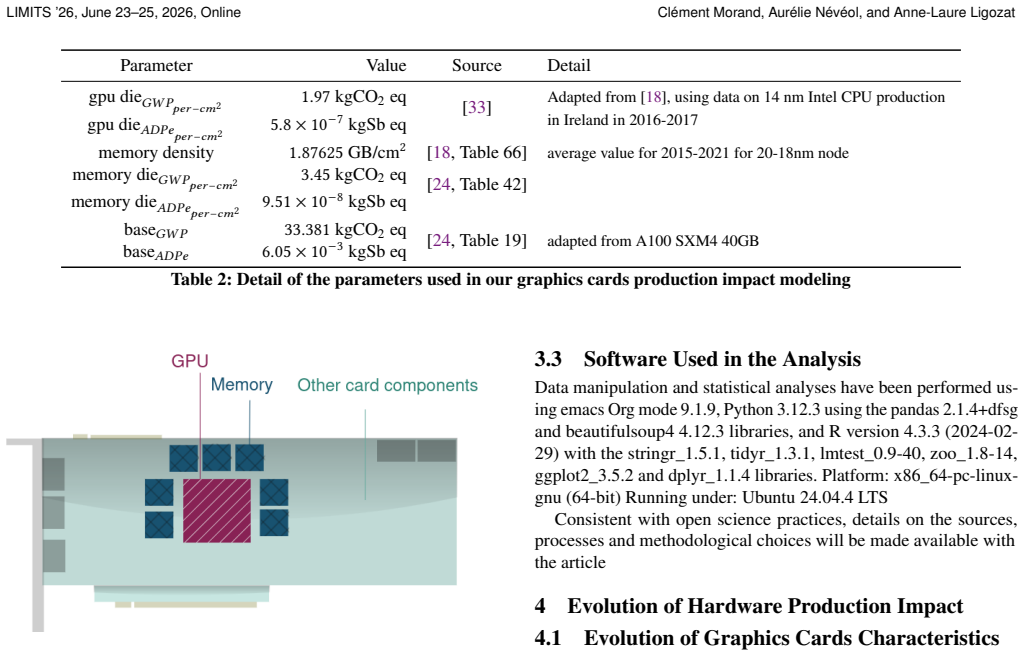
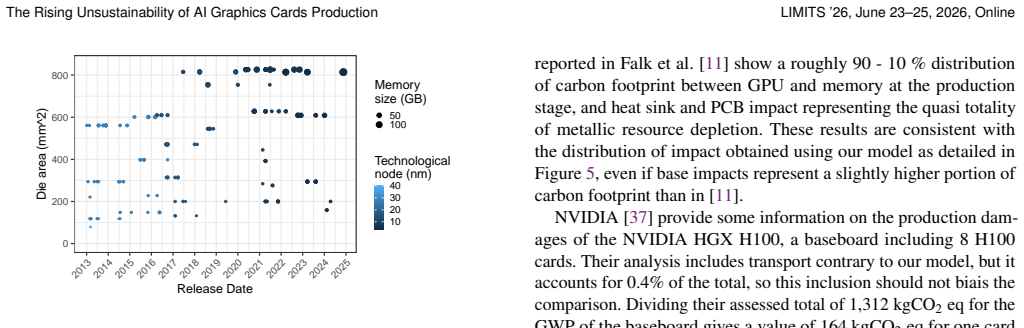
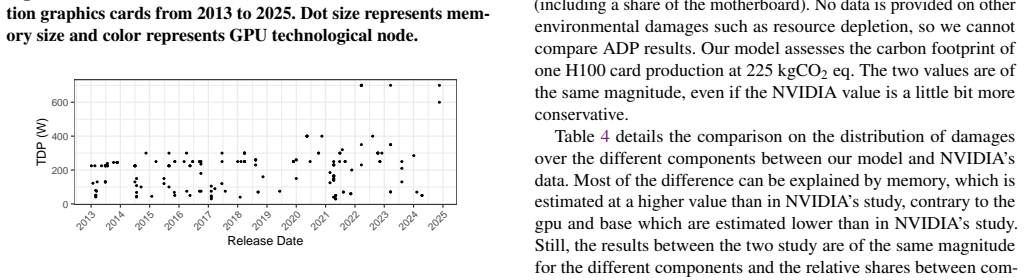
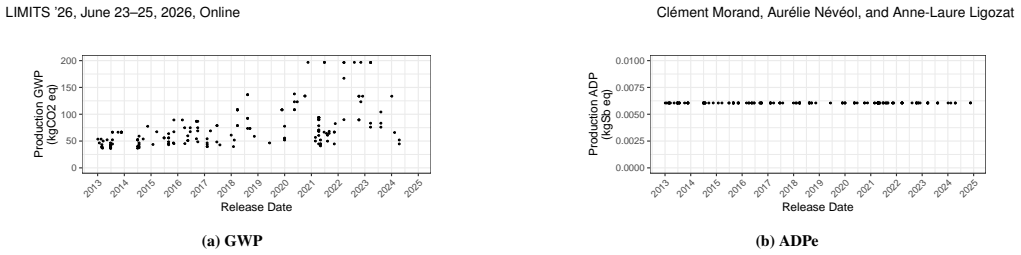
read the original abstract
The rapid advancement of Artificial Intelligence (AI) has been accompanied by significant increases in computational and environmental costs, driven by large-scale investments in AI infrastructure, hardware, and software. In particular, graphics cards have become central to AI training, with frequent hardware updates required to meet escalating computational demands. However, the environmental damages of graphics cards production remain understudied. This study addresses this gap by estimating the environmental damages associated with graphics cards production over the past decade (2013-2025). We analyze trends in energy consumption, carbon emissions and resource depletion. We compile and provide a dataset documenting the environmental damages of NVIDIA workstation graphics cards production since 2013. Our analysis of this dataset reveals a steady increase in production-related impacts over the period. Our finding highlights the need for greater transparency in life-cycle data, a persistent challenge in AI environmental assessments. While operational efficiency improvements (e.g., energy-efficient training, carbon-aware computing) are often prioritized, our results underscore that production-related impacts are also escalating and cannot be overlooked. The AI community must move beyond incremental optimizations and confront the necessity of sufficiency. This shift may demand structural changes such as policy interventions, hardware design for longevity, and cultural shifts away from perpetual growth and increased performance.
Editorial analysis
A structured set of objections, weighed in public.
Referee Report
Summary. The paper compiles a dataset of environmental impacts (energy use, CO2e emissions, resource depletion) for NVIDIA workstation graphics cards from 2013–2025 and reports a steady increase in production-related damages. It argues that this trend, combined with non-transparent life-cycle data, necessitates greater transparency, hardware longevity, policy interventions, and a cultural shift toward sufficiency rather than perpetual performance growth.
Significance. If the compiled dataset and trend are shown to be robust, the result would usefully complement the dominant focus on operational AI energy use by quantifying rising embodied impacts. The public dataset itself would be a concrete contribution for follow-on work. However, the absence of methodological detail currently limits the finding’s ability to shift consensus or inform policy.
major comments (3)
- [Dataset section] The central claim of a steady increase rests on the authors’ internally compiled per-card impact estimates, yet the manuscript supplies no description of primary data sources, proxy values, allocation rules, extrapolation functions, or manufacturing-location assumptions used for each year (see Dataset section and any accompanying table of per-model values).
- [Results section] No validation, cross-check against independent LCA studies, uncertainty ranges, or sensitivity tests are reported for the impact estimates; without these, it is impossible to determine whether the upward trend is robust or an artifact of changing modeling choices across the 2013–2025 period (Results section).
- [Abstract] The abstract states the finding of a steady increase but provides zero information on data sources, estimation methods, error handling, or validation steps, rendering the claim impossible to evaluate from the provided summary alone.
minor comments (2)
- [Dataset section] Clarify whether 2025 values are projections or observed data and state the cutoff date of the compilation.
- Ensure the promised dataset is deposited in a persistent repository with a DOI and that all proxy sources are cited at the level of individual card models.
Simulated Author's Rebuttal
We thank the referee for these constructive comments on methodological transparency. We agree that the current manuscript lacks sufficient detail on data sources and validation procedures, which limits the interpretability of the results. We will prepare a major revision that expands the Dataset and Results sections with the requested information and updates the abstract accordingly.
read point-by-point responses
-
Referee: [Dataset section] The central claim of a steady increase rests on the authors’ internally compiled per-card impact estimates, yet the manuscript supplies no description of primary data sources, proxy values, allocation rules, extrapolation functions, or manufacturing-location assumptions used for each year (see Dataset section and any accompanying table of per-model values).
Authors: We agree that the Dataset section is currently insufficient. In the revised manuscript we will add a detailed subsection describing all primary data sources (manufacturer environmental reports, Ecoinvent and similar LCA databases, and industry benchmarks), the proxy values and scaling factors applied where direct measurements were unavailable, the allocation rules used for shared manufacturing processes, the extrapolation methods for years without published data, and the manufacturing-location assumptions (including regional electricity mixes). A supplementary table will list the specific values and sources for each model-year combination. revision: yes
-
Referee: [Results section] No validation, cross-check against independent LCA studies, uncertainty ranges, or sensitivity tests are reported for the impact estimates; without these, it is impossible to determine whether the upward trend is robust or an artifact of changing modeling choices across the 2013–2025 period (Results section).
Authors: We acknowledge the absence of validation and robustness checks. The revised Results section will incorporate (1) direct comparisons with any available independent LCA studies for overlapping NVIDIA models, (2) uncertainty ranges derived from Monte Carlo sampling of key parameters, and (3) sensitivity analyses on critical assumptions such as electricity grid carbon intensity, material substitution rates, and yield improvements. These additions will allow readers to assess whether the observed upward trend persists under alternative modeling choices. revision: yes
-
Referee: [Abstract] The abstract states the finding of a steady increase but provides zero information on data sources, estimation methods, error handling, or validation steps, rendering the claim impossible to evaluate from the provided summary alone.
Authors: We will revise the abstract to include a concise statement on the data compilation approach and the public release of the dataset, while noting that full methodological details and validation appear in the main text. This will give readers the minimal context needed to evaluate the central claim without exceeding abstract length limits. revision: yes
Circularity Check
No circularity: empirical dataset compilation and trend analysis
full rationale
The paper compiles a dataset of environmental impacts for NVIDIA workstation graphics cards (2013-2025) from external sources and reports an observed upward trend in production-related impacts. No derivation chain, equations, predictions, or first-principles results are present that reduce to the paper's own inputs by construction. No self-citations are invoked as load-bearing uniqueness theorems or ansatzes. The analysis is a direct empirical observation from the compiled data, with acknowledged data limitations treated as external challenges rather than internal fitting loops. This matches the default expectation of no significant circularity (score 0-2).
Axiom & Free-Parameter Ledger
axioms (1)
- domain assumption Life-cycle assessment data for graphics cards production can be reliably compiled despite transparency challenges in the industry.
Reference graph
Works this paper leans on
-
[1]
Bender, E.M., Gebru, T., McMillan-Major, A., Shmitchell, S., 2021. On the dangers of stochastic parrots: Can language models be too big?, in: Proceedings of the 2021 ACM Conference on Fairness, Accountability, and Transparency, Association for Computing Machinery, New York, NY , USA. p. 610–623. URL: https://doi.org/10.1145/3442188.3445922, doi:10.1145/34...
-
[2]
Estimating the environmental impact of Generative-AI services using an LCA-based methodology, in: Procedia CIRP, Turin, Italy
Berthelot, A., Caron, E., Jay, M., Lefèvre, L., 2024. Estimating the environmental impact of Generative-AI services using an LCA-based methodology, in: Procedia CIRP, Turin, Italy. pp. 1–10. URL: https://inria.hal.science/hal-04346102
2024
-
[3]
Boavizta, 2021. Numérique et environnement : Comment évaluer l’empreinte de la fabrication d’un serveur, au-delà des émissions de gaz à effet de serre˜? URL: https://www.boavizta.org/blog/empreinte-de-la-fabrication-d-un-serveur. https://www.boavizta.org/blog/empreinte-de-la-fabrication-d-un-serveur, Accessed on May 15, 2023
2021
-
[4]
Sources of variation in life cycle assessments of smartphones and tablet computers
Clément, L.P.P.V ., Jacquemotte, Q.E., Hilty, L.M., 2020. Sources of variation in life cycle assessments of smartphones and tablet computers. Environmental Impact Assessment Review 84, 106416
2020
-
[5]
Computing as Ecocide, in: Ninth Computing within Limits 2023, LIMITS
Comber, R., Eriksson, E., 2023. Computing as Ecocide, in: Ninth Computing within Limits 2023, LIMITS. Https://limits.pubpub.org/pub/a8h46wqy
2023
-
[6]
The globalization of artificial intelligence: con- sequences for the politics of environmentalism
Dauvergne, P., 2021. The globalization of artificial intelligence: con- sequences for the politics of environmentalism. Globalizations 18, 285–299. URL: h t t p s : / / d o i . o r g / 1 0 . 1 0 8 0 / 1 4 7 4 7 7 3 1 . 2 0 2 0 . 1 7 8 5 6 7 0, doi: 1 0 . 1 0 8 0 / 1 4 7 4 7 7 3 1 . 2 0 2 0 . 1 7 8 5 6 7 0 , arXiv:https://doi.org/10.1080/14747731.2020.1785670
-
[7]
Handbook on Life Cycle Assessment: Operational Guide to the ISO Standards
de Bruijn, J., Guinée, ., Gorrée, M., Heijungs, R., Huppes, G., Kleijn, E., Wegener Sleeswijk, A., Udo de Haes, H., van Duin, J., Huijbregts, M., 2002. Handbook on Life Cycle Assessment: Operational Guide to the ISO Standards. Kluwer Academic Publishers
2002
-
[8]
The growing energy footprint of artificial intelligence
de Vries, A., 2023. The growing energy footprint of artificial intelligence. Joule 7, 2191–2194. URL: https://www.sciencedirect.com/science/article/pii/S254243512 3003653, doi:https://doi.org/10.1016/j.joule.2023.09.004. The Rising Unsustainability of AI Graphics Cards Production LIMITS ’26, June 23–25, 2026, Online
-
[9]
Data on machine learning hardware
Epoch AI, 2024. Data on machine learning hardware. URL: https://epoch.ai/data/ machine-learning-hardware. accessed: 2025-03-05
2024
-
[10]
Data on ai chip sales
Epoch AI, 2026. Data on ai chip sales. URL: https://epoch.ai/data/ai-chip-sales. accessed: 2 Apr 2026
2026
-
[11]
More than carbon: Cradle-to-grave environmental impacts of genai training on the nvidia a100 gpu
Falk, S., Ekchajzer, D., Pirson, T., Lees-Perasso, E., Wattiez, A., Biber- Freudenberger, L., Luccioni, S., van Wynsberghe, A., 2025. More than carbon: Cradle-to-grave environmental impacts of genai training on the nvidia a100 gpu. URL: https://arxiv.org/abs/2509.00093,arXiv:2509.00093
-
[12]
The attribution problem of a seemingly intangible industry
Falk, S., van Wynsberghe, A., Biber-Freudenberger, L., 2024. The attribution problem of a seemingly intangible industry. Environmental Challenges 16, 101003. URL: https://www.sciencedirect.com/science/article/pii/S2667010024001690, doi:https://doi.org/10.1016/j.envc.2024.101003
-
[13]
Challenging ai for sustainability: what ought it mean? AI and Ethics 4, 1345–1355
Falk, S., van Wynsberghe, A., 2024. Challenging ai for sustainability: what ought it mean? AI and Ethics 4, 1345–1355. URL: https://link.springer.com/article/10.1 007/s43681-023-00323-3, doi:10.1007/s43681-023-00323-3
-
[14]
A comprehensive review of the end- of-life modeling in LCAs of digital equipment
Ficher, M., Bauer, T., Ligozat, A.L., 2025. A comprehensive review of the end- of-life modeling in LCAs of digital equipment. The International Journal of Life Cycle Assessment 30, 20 – 42. URL: https://doi.org/10.1007/s11367-024-02367- x, doi:10.1007/s11367-024-02367-x
-
[15]
Forster, P., Storelvmo, T., Armour, K., Collins, W., Dufresne, J.L., Frame, D., Lunt, D., Mauritsen, T., Palmer, M., Watanabe, M., Wild, M., Zhang, H., 2023. The earth’s energy budget, climate feedbacks and climate sensitivity, in: Masson- Delmotte, V ., Zhai, P., Pirani, A., Connors, S., Péan, C., Berger, S., Caud, N., Chen, Y ., Goldfarb, L., Gomis, M.,...
-
[16]
Freitag, C., Berners-Lee, M., Widdicks, K., Knowles, B., Blair, G.S., Friday, A.,
-
[17]
The real climate and transformative impact of ict: A critique of estimates, trends, and regulations. Patterns 2, 100340. URL: https://www.sciencedirect.com/ science/article/pii/S2666389921001884, doi:https://doi.org/10.1016/ j.patter.2021.100340
-
[18]
environmental report 2024
Google, 2024. environmental report 2024. URL: https://www.gstatic.com/gumdro p/sustainability/google-2024-environmental-report.pdf. accessed March 18 2025
2024
-
[19]
Green Cloud Computing: lebenszyklusbasierte Datenerhebung zu Umweltwirkungen des Cloud Computing: Abschlussbericht
Gröger, J., Liu, R., Stobbe, L., Druschke, J., Richter, N., 2021. Green Cloud Computing: lebenszyklusbasierte Datenerhebung zu Umweltwirkungen des Cloud Computing: Abschlussbericht. Umweltbundesamt. URL: https://www.umweltbu ndesamt.de/sites/default/files/medien/5750/publikationen/2021-06-17_texte_94- 2021_green-cloud-computing.pdf
2021
-
[20]
Chasing carbon: The elusive environmental footprint of computing
Gupta, U., Kim, Y .G., Lee, S., Tse, J., Lee, H.H.S., Wei, G.Y ., Brooks, D., Wu, C.J., 2022. Chasing carbon: The elusive environmental footprint of computing. IEEE Micro 42, 37–47. doi:10.1109/MM.2022.3163226
-
[21]
(Eds.), 2017
Hauschild, M.Z., Rosenbaum, R.K., Olsen, S.I. (Eds.), 2017. Life Cycle Assess- ment, Theory and Practice. Springer Cham. doi: https://doi-org/10.1 007/978-3-319-56475-3
2017
-
[22]
Electricity 2024
International Energy Agency (IEA), 2024. Electricity 2024. URL: https://www.ie a.org/reports/electricity-2024. licence: CC BY 4.0
2024
-
[23]
Jiang, H.H., Brown, L., Cheng, J., Khan, M., Gupta, A., Workman, D., Hanna, A., Flowers, J., Gebru, T., 2023. AI art and its impact on artists, in: Proceedings of the 2023 AAAI/ACM Conference on AI, Ethics, and Society, Association for Computing Machinery, New York, NY , USA. p. 363–374. URL: https://doi.org/ 10.1145/3600211.3604681, doi:10.1145/3600211.3604681
-
[24]
Aligning artificial intelligence with climate change mitigation
Kaack, L.H., Donti, P.L., Strubell, E., Kamiya, G., Creutzig, F., Rolnick, D., 2022. Aligning artificial intelligence with climate change mitigation. Nature Climate Change 12, 518–527. URL: https://doi.org/10.1038/s41558-022-01377-7, doi:doi.org/10.1038/s41558-022-01377-7
-
[25]
Analyse de cycle de vie de GPU (cartes graphiques) pour l’intelligence artificielle
Lees-Perasso, E., Ekchajzer, D., Roussilhe, G., Latour, T.D., 2026. Analyse de cycle de vie de GPU (cartes graphiques) pour l’intelligence artificielle. Technical Report. ADEME. URL: https://librairie.ademe.fr/economie-circulaire-et- dechets/9103-analyse-de-cycle-de-vie-de-gpu-cartes-graphiques-pour-l- intelligence-artificielle.html
2026
-
[26]
Climate and technology-specific PUE and WUE estimations for u.s
Lei, N., Masanet, E., 2022. Climate and technology-specific PUE and WUE estimations for u.s. data centers using a hybrid statistical and thermodynamics- based approach. Resources, Conservation and Recycling 182, 106323. URL: https://www.sciencedirect.com/science/article/pii/S0921344922001719, doi:https://doi.org/10.1016/j.resconrec.2022.106323
-
[27]
Making AI less "thirsty": Uncovering and addressing the secret water footprint of AI models
Li, P., Yang, J., Islam, M.A., Ren, S., 2025. Making AI less "thirsty": Uncovering and addressing the secret water footprint of AI models. URL: https://arxiv.org/ab s/2304.03271,arXiv:2304.03271
-
[28]
Ligozat, A.L., Lefevre, J., Bugeau, A., Combaz, J., 2022. Unraveling the hidden environmental impacts of AI solutions for environment life cycle assessment of AI solutions. Sustainability 14. URL: https://www.mdpi.com/2071-1050/14/9/5172, doi:10.3390/su14095172
-
[29]
Loubet, P., Vincent, A., Collin, A., Dejous, C., Ghiotto, A., Jego, C., 2023. Life cycle assessment of ict in higher education: a comparison between desktop and single-board computers. The International Journal of Life Cycle Assessment , 1–19doi:https://doi.org/10.1007/s11367-022-02131-z
-
[30]
Estimating the carbon footprint of BLOOM, a 176b parameter language model
Luccioni, A.S., Viguier, S., Ligozat, A.L., 2023. Estimating the carbon footprint of BLOOM, a 176b parameter language model. Journal of Machine Learning Research 24, 1–15. URL: http://jmlr.org/papers/v24/23-0069.html
2023
-
[31]
ICT sector elec- tricity consumption and greenhouse gas emissions – 2020 outcome
Malmodin, J., Lövehagen, N., Bergmark, P., Lundén, D., 2024. ICT sector elec- tricity consumption and greenhouse gas emissions – 2020 outcome. Telecommu- nications Policy , 102701URL: https://www.sciencedirect.com/science/article/pii/ S0308596123002124, doi:https://doi.org/10.1016/j.telpol.202 3.102701
-
[32]
Re- calibrating global data center energy-use estimates
Masanet, E., Shehabi, A., Lei, N., Smith, S., Koomey, J., 2020. Re- calibrating global data center energy-use estimates. Science 367, 984–986. URL: h t t p s : / / w w w . s c i e n c e . o r g / d o i / a b s / 1 0 . 1 1 2 6 / s c i e n c e . a b a 3 7 5 8, doi:1 0 . 1 1 2 6 / s c i e n c e . a b a 3 7 5 8 , arXiv:https://www.science.org/doi/pdf/10.1126/...
-
[33]
2024 sustainability report
Meta, 2024. 2024 sustainability report. URL: https://sustainability.atmeta.com/wp- content/uploads/2024/08/Meta-2024-Sustainability-Report.pdf. accessed March 18 2025
2024
-
[34]
Morand, C., Ligozat, A.L., Névéol, A., 2024. MLCA: a tool for Machine Learn- ing Life Cycle Assessment, in: 2024 10th International Conference on ICT for Sustainability (ICT4S), IEEE, Stockholm, Sweden. pp. 227–238. URL: https: //hal.science/hal-04643414, doi:10.1109/ICT4S64576.2024.00031
-
[35]
Mytton, D., 2021. Data center water consumption. npj Clean Water 4. URL: https://doi.org/10.1038/s41545-021-00101-w, doi: 10.1038/s41545-021- 00101-w
-
[36]
Nardi, B., Tomlinson, B., Patterson, D.J., Chen, J., Pargman, D., Raghavan, B., Penzenstadler, B., 2018. Computing within limits. Commun. ACM 61, 86–93. URL: https://doi.org/10.1145/3183582, doi:10.1145/3183582
-
[37]
Pcf summary for nvidia hgx b200
NVIDIA, 2025a. Pcf summary for nvidia hgx b200. URL: https://images.nvidia. com/aem-dam/Solutions/documents/HGX-B200-PCF-Summary.pdf
-
[38]
Pcf summary for nvidia hgx h100
NVIDIA, 2025b. Pcf summary for nvidia hgx h100. URL: https://images.nvidia. com/aem-dam/Solutions/documents/HGX-H100-PCF-Summary.pdf
-
[39]
Pirson, T., Delhaye, T., Pip, A., Le Brun, G., Raskin, J.P., Bol, D., 2022. The environmental footprint of IC production: Meta-analysis and historical trends, in: ESSDERC 2022 - IEEE 52nd European Solid-State Device Research Conference (ESSDERC), pp. 352–355. doi: 10.1109/ESSDERC55479.2022.994719 8
-
[40]
The environmental footprint of IC production: Review, analysis, and lessons from historical trends
Pirson, T., Delhaye, T.P., Pip, A.G., Le Brun, G., Raskin, J.P., Bol, D., 2023a. The environmental footprint of IC production: Review, analysis, and lessons from historical trends. IEEE Transactions on Semiconductor Manufacturing 36, 56–67. doi:10.1109/TSM.2022.3228311
-
[41]
Pirson, T., Golard, L., Bol, D., 2023b. Evaluating the (ir)relevance of IoT solutions with respect to environmental limits based on LCA and backcasting studies, in: Ninth Computing within Limits 2023, LIMITS. doi: doi:10.21428/bf6fb 269.6af396ff. https://limits.pubpub.org/pub/8ld7lmdf
-
[42]
Roussilhe, G., Pirson, T., Xhonneux, M., Bol, D., 2024. From silicon shield to carbon lock-in? the environmental footprint of electronic com- ponents manufacturing in taiwan (2015–2020). Journal of Industrial Ecology n/a, 15. URL: https://onlinelibrary.wiley.com/doi/abs/10 .1111/jiec.13487, doi: https://doi.org/10.1111/jiec.13487 , arXiv:https://onlinelib...
-
[43]
Sala, S., Crenna, E., Secchi, M., Sanyé-Mengual, E., 2020. Environmental sustainability of european production and consumption assessed against plan- etary boundaries. Journal of Environmental Management 269, 110686. URL: https://www.sciencedirect.com/science/article/pii/S0301479720306186, doi:https://doi.org/10.1016/j.jenvman.2020.110686
-
[44]
An Introduction to Life-Cycle Emissions of Artificial Intelli- gence Hardware
Schneider, I., Xu, H., Benecke, S., Patterson, D., Huang, K., Ranganathan, P., Elsworth, C., 2025. An Introduction to Life-Cycle Emissions of Artificial Intelli- gence Hardware . IEEE Micro 45, 9–19. URL: https://doi.ieeecomputersociety.or g/10.1109/MM.2025.3592568, doi:10.1109/MM.2025.3592568
-
[45]
2024 United States Data Center Energy Usage Report
Shehabi, A., Smith, S., Hubbard, A., Newkirk, A., Lei, N., S., M.A.B., Holecek, B., Koomey, J., Masanet, E., Sartor, D., 2024. 2024 United States Data Center Energy Usage Report. Technical Report. Lawrence Berkeley National Laboratory, Berkeley, California. LBNL-2001637
2024
-
[46]
BoaviztAPI: a bottom-up model to assess the environmental impacts of cloud services, in: HotCarbon’24 - 3rd Workshop on Sustainable Computer Systems, Santa Cruz, United States
Simon, T., Ekchajzer, D., Berthelot, A., Fourboul, E., Rince, S., Rouvoy, R., 2024. BoaviztAPI: a bottom-up model to assess the environmental impacts of cloud services, in: HotCarbon’24 - 3rd Workshop on Sustainable Computer Systems, Santa Cruz, United States. URL: https://hal.science/hal-04621947
2024
-
[47]
Life Cycle Assessment Dell Servers R6515, R7515, R6525, R7525
Sphera, 2021. Life Cycle Assessment Dell Servers R6515, R7515, R6525, R7525. URL: https://www.delltechnologies.com/asset/fr-fr/products/servers/technical- support/lca-poweredge-r6515-r7515-r6525-r7525.pdf
2021
-
[48]
Planetary boundaries: Guiding human develop- ment on a changing planet
Steffen, W., Richardson, K., Rockström, J., Cornell, S.E., Fetzer, I., Ben- nett, E.M., Biggs, R., Carpenter, S.R., de Vries, W., de Wit, C.A., Folke, C., Gerten, D., Heinke, J., Mace, G.M., Persson, L.M., Ramanathan, V ., Reyers, B., Sörlin, S., 2015. Planetary boundaries: Guiding human develop- ment on a changing planet. Science 347, 1259855. URL: https...
-
[49]
Intelligence artificielle, données, calculs : quelles infrastructures dans un monde décarboné ? Technical Report
The Shift Project, 2025. Intelligence artificielle, données, calculs : quelles infrastructures dans un monde décarboné ? Technical Report. URL: https: LIMITS ’26, June 23–25, 2026, Online Clément Morand, Aurélie Névéol, and Anne-Laure Ligozat //theshiftproject.org/app/uploads/2025/09/RF- PIA- 1.pdf. last accessed 16/10/2025
2025
-
[50]
Life Cycle Assessment of Dell R740
Thinkstep, 2019. Life Cycle Assessment of Dell R740. URL: https://www.dellte chnologies.com/asset/fr-fr/products/servers/technical-support/lca_poweredge_ r740.pdf
2019
-
[51]
The dual footprint of artificial intelligence: environmental and social impacts across the globe
Tubaro, P., 2025. The dual footprint of artificial intelligence: environmental and social impacts across the globe. Globalizations , 1–18URL: https://hal.science/hal- 05384319, doi:10.1080/14747731.2025.2589571
-
[52]
Valdivia, A., 2025. The supply chain capitalism of ai: a call to (re)think algo- rithmic harms and resistance through environmental lens. Information, Com- munication & Society 28, 2118–2134. URL: https://doi.org/10.1080/13 69118X.2024.2420021, doi: 10.1080/1369118X.2024.2420021 , arXiv:https://doi.org/10.1080/1369118X.2024.2420021
work page doi:10.1080/13 2025
-
[53]
Valdivia, A., 2026. Follow the Thing: AI. Springer Nature Switzerland, Cham. pp. 31–49. URL: https://doi.org/10.1007/978-3-032-09748-4_2, doi: 10.1007/97 8-3-032-09748-4_2
-
[54]
Varoquaux, G., Luccioni, S., Whittaker, M., 2025. Hype, sustainability, and the price of the bigger-is-better paradigm in ai, in: Proceedings of the 2025 ACM Conference on Fairness, Accountability, and Transparency, Association for Computing Machinery, New York, NY , USA. p. 61–75. URL: https://doi.org/10.1 145/3715275.3732006, doi:10.1145/3715275.3732006
-
[55]
Data centres as impermanent infrastructures
Velkova, J., 2019. Data centres as impermanent infrastructures. Culture Machine
2019
-
[56]
URL: http://culturemachine.net/vol-18-the-nature-of-data-centers/data- centers-as-impermanent/
-
[57]
E-waste challenges of generative artificial intelligence
Wang, P., Zhang, L.Y ., Tzachor, A., Chen, W.Q., 2024. E-waste challenges of generative artificial intelligence. Nature Computational Science 4, 818–823
2024
-
[58]
Wattiez, A., Le Goff, K., Bol, D., 2024. Exploring the influence of database selection on the life cycle assessment of digital services, in: 2024 10th International Conference on ICT for Sustainability (ICT4S), poster session, Stockholm, Sweden
2024
-
[59]
Copenhagen — Wikipedia, the free encyclopedia
Wikipedia contributors, 2026. Copenhagen — Wikipedia, the free encyclopedia. https://en.wikipedia.org/w/index.php?title=Copenhagen&oldid=1354926906. [Online; accessed 20-May-2026]
2026
discussion (0)
Sign in with ORCID, Apple, or X to comment. Anyone can read and Pith papers without signing in.